

Surveyor Council Housing: Complete Guide to Property Inspections and Party Wall Matters in 2026
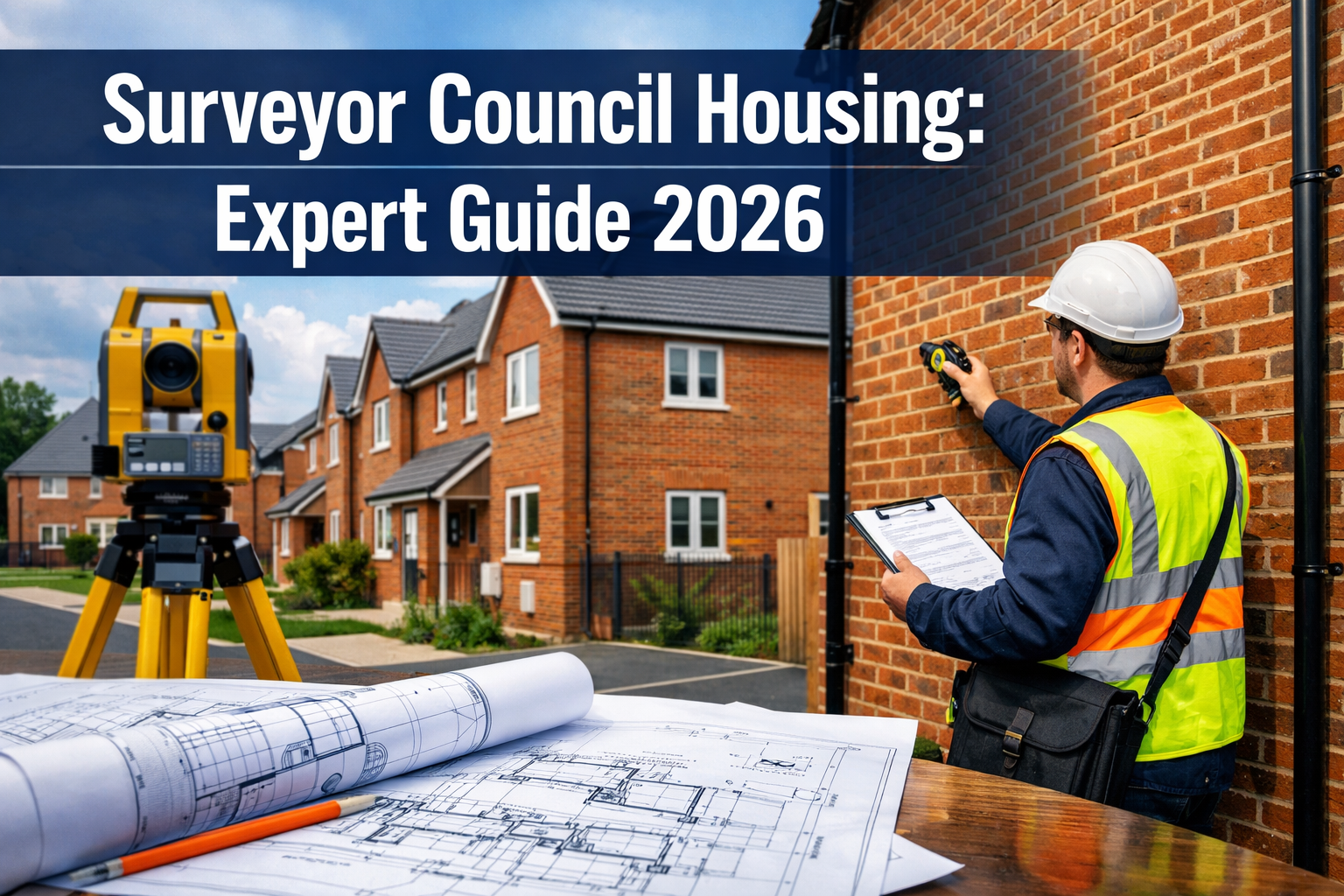
When council housing tenants or leaseholders face building work—whether their own renovations or a neighbour’s construction project—navigating the surveying process can feel overwhelming. Understanding how surveyor council housing arrangements work is essential for protecting your rights, ensuring structural safety, and maintaining positive relationships with neighbours and local authorities.
Council housing properties present unique challenges when it comes to surveying and party wall matters. Unlike privately owned homes, these properties involve additional stakeholders, specific approval processes, and distinct legal considerations that require specialized knowledge and careful navigation.
Key Takeaways
- Council housing surveying involves unique considerations including local authority permissions, leaseholder rights, and tenant obligations that differ from private property arrangements
- Party wall matters in council housing require coordination between tenants, leaseholders, the local authority, and neighbouring property owners under the Party Wall etc. Act 1996
- Professional surveyors experienced in council housing can navigate complex approval processes, ensuring compliance with both party wall legislation and council-specific requirements
- Costs and responsibilities for surveying work vary depending on whether you’re a secure tenant, leaseholder, or facing works initiated by neighbours or the council itself
- Early engagement with qualified surveyors and proper notice procedures can prevent disputes, delays, and unexpected expenses in council housing scenarios
Understanding Surveyor Council Housing Relationships
What Makes Council Housing Different?
Council housing properties operate within a unique framework that distinguishes them from privately owned homes. Whether you’re a secure tenant or a leaseholder who purchased your council flat under Right to Buy, your relationship with the property involves the local authority as a key stakeholder.
When building work affects council housing, several parties may be involved:
- The local housing authority (property owner for tenanted properties)
- Secure tenants (residents with tenancy agreements)
- Leaseholders (those who purchased under Right to Buy schemes)
- Neighbouring property owners (who may be private owners, tenants, or leaseholders)
- Professional surveyors appointed to manage party wall procedures
This multi-layered ownership and occupancy structure means that surveying work requires careful coordination. A professional party wall surveyor experienced in council housing can navigate these complexities effectively.
The Role of Surveyors in Council Housing Projects
Surveyors serving council housing properties perform several critical functions:
🏗️ Pre-construction assessments – Evaluating structural conditions before work begins
📋 Compliance verification – Ensuring projects meet Party Wall Act requirements and council regulations
🔍 Condition surveys – Creating detailed schedules of condition to protect all parties
⚖️ Dispute resolution – Acting as impartial professionals when disagreements arise
📄 Award preparation – Drafting legally binding party wall awards that protect everyone’s interests
The surveyor’s role becomes particularly important when works involve shared structures common in council housing estates—party walls between flats, shared foundations in terraced properties, or boundary walls between council and private properties.
Party Wall Matters in Council Housing Developments
When Does the Party Wall Act Apply?
The Party Wall etc. Act 1996 applies to council housing just as it does to private properties across England and Wales. Understanding what triggers party wall procedures is essential for both tenants and leaseholders.
Common scenarios requiring party wall notices in council housing:
| Type of Work | Party Wall Notice Required | Typical Council Housing Example |
|---|---|---|
| Building on boundary line | Yes – Line of Junction Notice | Constructing extension between semi-detached council houses |
| Work to existing party wall | Yes – Party Structure Notice | Removing chimney breast in terraced council flat |
| Excavation near neighbour | Yes – Notice of Adjacent Excavation | Basement conversion in council property |
| Repairs to shared wall | Possibly – depends on extent | Repointing shared wall between flats |
| Internal alterations only | No | Redecorating or replacing kitchen units |
Even seemingly straightforward projects can trigger party wall requirements. For instance, if you’re a leaseholder planning to convert your council flat’s loft, you’ll likely need to serve party wall notices to neighbours in adjacent properties.
Serving Notices as a Council Tenant or Leaseholder
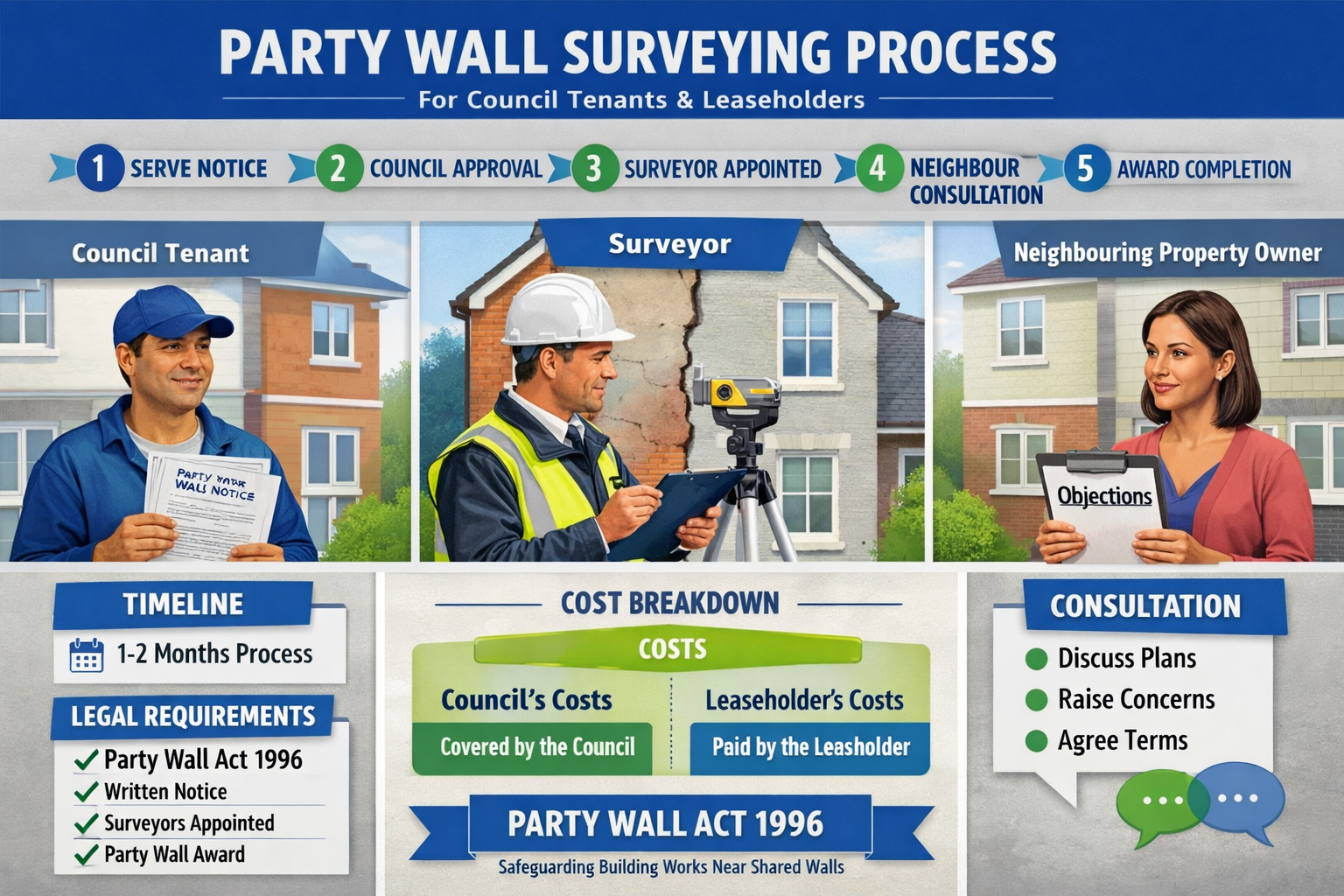
The process of serving party wall notices when living in council housing involves additional steps compared to private homeownership:
Step 1: Obtain Council Permission 🏛️
Before serving any party wall notices, tenants must secure written permission from the local authority for proposed works. Leaseholders should review their lease terms, as major alterations typically require council consent.
Step 2: Identify All Affected Parties 👥
Determine who needs to receive notices—this may include neighbouring tenants, leaseholders, and the council itself if it owns adjacent properties.
Step 3: Serve Formal Notices 📬
Proper party wall notice procedures must be followed, typically giving neighbours 1-2 months’ notice depending on the work type.
Step 4: Appoint Surveyors if Needed 🎯
If neighbours dissent or don’t respond within 14 days, surveyor appointments become necessary. You can learn more about building owners’ responsibilities in this process.
“Council housing party wall matters require an extra layer of coordination. Surveyors must understand not only the Party Wall Act but also local authority procedures, lease restrictions, and the unique dynamics of social housing environments.” – Expert Party Wall Surveyor
Responding to Notices When Your Neighbour Is Carrying Out Works
Council housing residents frequently receive party wall notices from neighbours undertaking renovations. Understanding how to respond when your neighbour is carrying out works protects your interests.
Your response options:
✅ Consent – Agreeing to the works (though you may still want a condition survey for protection)
❌ Dissent – Disagreeing, which triggers the surveyor appointment process
⏰ No response – Silence for 14 days counts as dissent under the Act
Important considerations for council housing residents:
- Tenants should inform the council when receiving party wall notices, as the local authority technically owns the property
- Leaseholders can respond directly but should keep the council informed, especially if works might affect common areas
- Free surveyor appointments – If you dissent, the building owner must pay for surveyor appointments, including yours if you choose to appoint an adjoining owner’s surveyor
Many council housing residents worry about costs when neighbours serve notices. The good news: if you’re the adjoining owner (the person receiving the notice), the building owner typically covers all reasonable surveying fees.
Surveyor Council Housing Inspections and Assessments
Types of Surveys Conducted in Council Properties
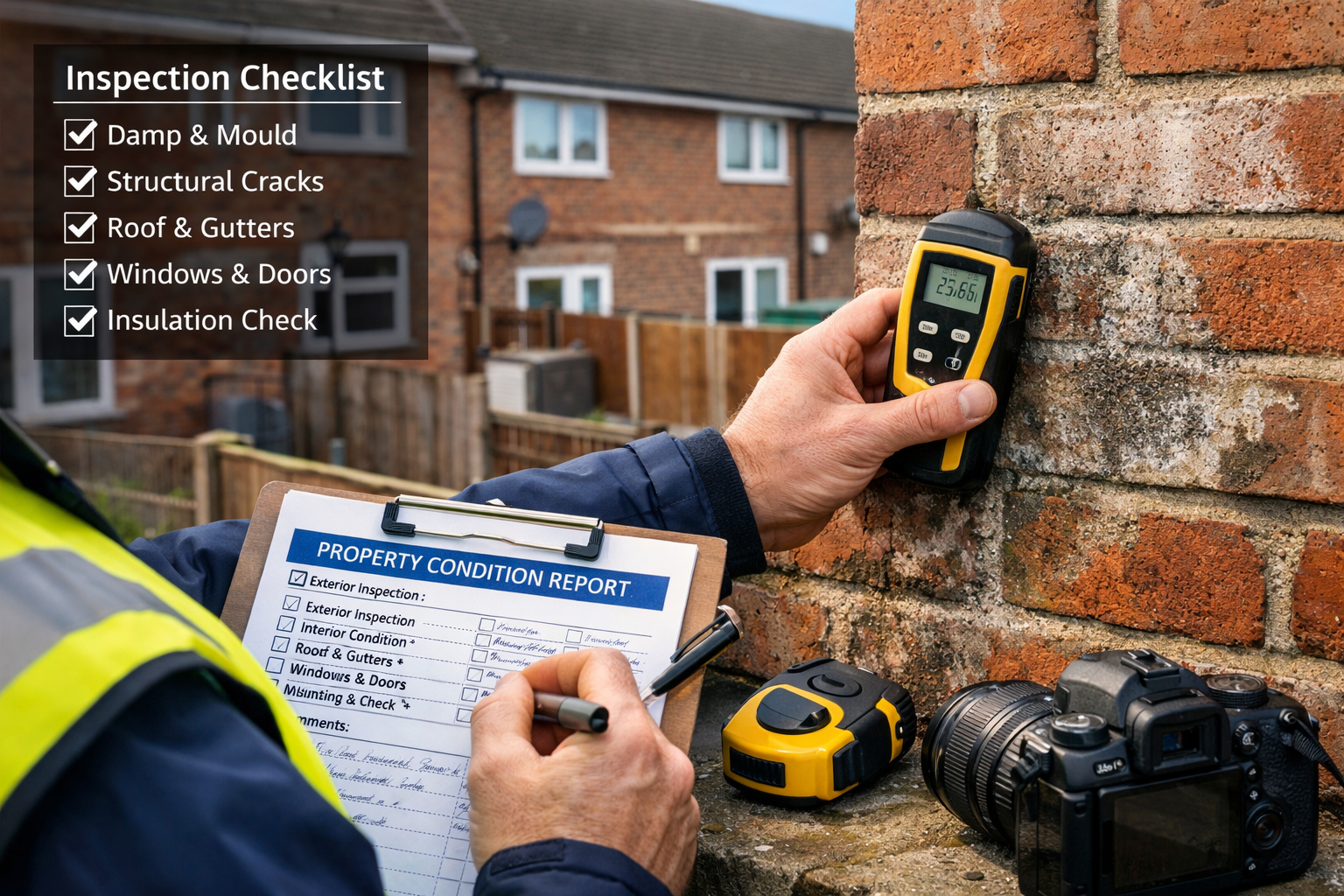
Professional surveyors conduct various types of inspections in council housing contexts, each serving specific purposes:
1. Pre-Works Condition Surveys 📸
These comprehensive assessments document the existing state of properties before construction begins. Surveyors photograph and describe every relevant detail—cracks, dampness, structural conditions—creating a baseline record.
Benefits for council housing residents:
- Proves pre-existing conditions if damage claims arise later
- Protects tenants and leaseholders from false damage accusations
- Provides evidence for insurance or council maintenance requests
2. Structural Assessments 🏗️
When significant works are planned—such as loft conversions, extensions, or removing load-bearing walls—structural surveys determine whether existing structures can safely support proposed changes.
3. Party Wall Awards ⚖️
The formal document that sets out the rights and responsibilities of all parties. Party wall awards in council housing must address unique considerations like council ownership, shared facilities, and access arrangements.
4. Dispute Resolution Surveys 🤝
When disagreements arise about proposed works, damage claims, or access rights, surveyors conduct impartial assessments to resolve conflicts fairly.
The Condition Survey Process
Understanding what happens during a condition survey helps council housing residents prepare effectively:
Before the Survey:
- The surveyor contacts you to arrange a convenient appointment
- You should ensure access to all relevant areas (gardens, shared spaces, internal rooms)
- Gather any existing documentation about property conditions or previous repairs
During the Survey:
- The surveyor systematically examines all areas potentially affected by proposed works
- Detailed photographs document existing conditions
- Measurements and notes capture structural details
- You can point out existing issues or concerns
After the Survey:
- A comprehensive written report describes findings with photographic evidence
- The schedule of condition becomes part of the party wall award
- This document protects you if damage occurs during construction
For council housing, these surveys often extend beyond the immediate neighbouring property to include shared areas, common structures, and council-maintained elements.
Navigating Council Approvals and Permissions
Understanding Your Rights as a Tenant or Leaseholder
The rights and obligations regarding building work differ significantly between council tenants and leaseholders:
Secure Council Tenants:
- Must obtain written permission from the local authority for ANY alterations
- Cannot undertake structural changes without explicit council approval
- Typically have more limited rights to modify properties
- Should request permission well in advance of any planned work
Council Property Leaseholders:
- Generally have more freedom to alter their properties
- Must still comply with lease terms and seek consent for major works
- Often required to use approved contractors
- May need to pay ground rent or service charges related to works
Shared responsibilities:
Both tenants and leaseholders must:
- Comply with the Party Wall etc. Act 1996 when works affect neighbours
- Obtain necessary planning permissions and building regulations approval
- Ensure works don’t compromise structural integrity or safety
- Maintain insurance coverage during construction
Working with Local Housing Authorities
Successful surveyor council housing projects require effective collaboration with local authorities. Here’s how to navigate this relationship:
Communication strategies:
📧 Submit formal written requests – Always document permission requests in writing, keeping copies of all correspondence
📞 Identify the right department – Contact the council’s property services, estate management, or leasehold services department
⏱️ Allow adequate time – Council approval processes can take 4-8 weeks or longer; plan accordingly
📋 Provide complete information – Include detailed plans, surveyor reports, and contractor details with permission requests
Many councils have specific forms and procedures for requesting permission to undertake building works. Your surveyor can often assist with preparing these applications, ensuring all necessary information is included.
Pro Tip: Engaging a surveyor experienced in council housing early in the planning process can streamline approvals, as they understand what documentation local authorities require and can prepare comprehensive submissions.
Cost Considerations for Surveyor Council Housing Services
Who Pays for What?
Understanding cost responsibilities prevents unwelcome financial surprises in council housing party wall matters:
When YOU are undertaking works (Building Owner):
💰 Your costs include:
- Your own surveyor’s fees (if you appoint one)
- The adjoining owner’s surveyor’s fees (if they appoint one)
- The agreed surveyor’s fees (if both parties use the same surveyor)
- Preparation of party wall awards and schedules of condition
- Any necessary monitoring or follow-up inspections
When YOUR NEIGHBOUR is undertaking works (Adjoining Owner):
✅ You typically pay nothing:
- The building owner covers all reasonable surveying costs
- You have the right to appoint your own surveyor at their expense
- Condition surveys protecting your property are paid for by the building owner
Council-initiated works:
When the local authority undertakes building projects affecting your property, cost arrangements depend on your status:
- Tenants – The council typically covers all surveying costs
- Leaseholders – May be recharged costs through service charges (check your lease)
For guidance on managing expenses effectively, explore strategies for keeping party wall costs down.
Typical Fee Ranges for Council Housing Surveys
While costs vary based on project complexity, location, and property type, here are typical ranges for 2026:
Basic party wall services:
- Single surveyor (agreed surveyor) for straightforward works: £700-£1,200
- Separate surveyors for each party: £800-£1,500 per surveyor
- Complex projects (multiple properties, extensive works): £1,500-£3,000+
Additional services:
- Detailed condition surveys: £300-£600 per property
- Structural assessments: £500-£1,500
- Dispute resolution services: £150-£300 per hour
- Post-works inspections: £200-£400
Factors affecting costs in council housing:
- Number of adjoining properties affected
- Estate layout complexity (terraced blocks, high-rise buildings)
- Accessibility challenges
- Council-specific documentation requirements
- Need for coordination with multiple stakeholders
Many surveyors offer fixed-fee arrangements for standard council housing party wall matters, providing cost certainty from the outset. When obtaining quotes, ensure the surveyor has specific experience with council housing projects and understands the additional complexities involved.
Common Challenges in Council Housing Party Wall Matters
Dealing with Multiple Stakeholders
Council housing estates often involve numerous affected parties, creating coordination challenges:
Scenario: Terraced council houses
A leaseholder planning a rear extension may need to serve notices to:
- Neighbours on both sides (who might be tenants, leaseholders, or private owners)
- The council (if it owns adjacent properties)
- Residents in properties backing onto the work area
Solution approaches:
- Appoint an experienced surveyor early to identify all affected parties
- Coordinate notice serving to ensure all parties receive proper notification simultaneously
- Consider using an agreed surveyor to reduce complexity and costs
- Maintain clear communication channels with all stakeholders
Addressing Access and Shared Facilities
Council housing estates frequently feature shared access routes, communal gardens, and common facilities that complicate building projects:
Access challenges:
- Scaffolding requirements in shared courtyards
- Construction vehicles using communal driveways
- Need to access neighbouring properties for works
Practical solutions:
✓ Discuss access arrangements with neighbours and the council before works begin
✓ Include detailed access provisions in party wall awards
✓ Schedule works to minimize disruption to shared facilities
✓ Provide advance notice to all affected residents, even those not directly adjoining
Understanding boundary rules and neighbour building proximity helps prevent access disputes before they arise.
Managing Communication in High-Density Housing
Council estates often feature high-density housing where works in one property can affect many neighbours:
Effective communication strategies:
📢 Broader notification – Inform residents beyond those legally requiring notices
📅 Clear timelines – Provide realistic schedules and update neighbours about delays
🤝 Designated contact person – Ensure someone is available to address concerns
📋 Written updates – Regular progress reports help maintain positive relationships
Many disputes in council housing arise from poor communication rather than the works themselves. Proactive, transparent communication prevents misunderstandings and maintains community harmony.
Special Considerations for Different Council Housing Types
High-Rise and Multi-Story Buildings
Tower blocks and multi-story council buildings present unique surveying challenges:
Structural considerations:
- Works may affect multiple floors above and below
- Shared structural elements require careful assessment
- Fire safety regulations are particularly stringent
- Access for surveys may require coordination with multiple residents
Party wall implications:
Alterations in high-rise council housing often trigger notices to:
- Residents directly above and below
- Neighbours on the same floor sharing walls
- Sometimes residents on multiple floors if structural work is involved
Surveyors working on high-rise council housing must understand complex structural systems, shared services (plumbing, electrical, heating), and building-specific regulations.
Converted Council Properties and Mixed Developments
Many former council properties now exist in mixed-ownership developments where some units remain council-owned while others have been sold:
Complexity factors:
- Different owners with varying interests and priorities
- Mix of tenants, leaseholders, and private owners
- Varying levels of understanding about party wall procedures
- Potential for freeholder involvement (housing associations, private companies)
Best practices:
- Identify the current ownership status of all affected properties early
- Tailor communication approaches to different stakeholder types
- Ensure all parties understand their rights and obligations
- Consider whether having a party wall agreement without a surveyor is feasible (usually not recommended in complex situations)
Maisonettes and Split-Level Properties
Council maisonettes—properties occupying multiple floors—create particular surveying challenges:
Unique considerations:
- Party floors (ceilings/floors shared between properties)
- Staircases that may be structural elements
- Sound insulation requirements between levels
- Potential impact on properties on multiple floors
Works affecting party floors require particularly careful surveying, as damage can manifest in ways different from traditional party walls. Experienced surveyors understand these nuances and can protect all parties effectively.
Selecting the Right Surveyor for Council Housing Projects
Essential Qualifications and Experience
Not all surveyors have experience with council housing party wall matters. Look for professionals with:
Qualifications:
- Membership in RICS (Royal Institution of Chartered Surveyors) or FPWS (Faculty of Party Wall Surveyors)
- Specific training in the Party Wall etc. Act 1996
- Professional indemnity insurance
- Continuing professional development in party wall matters
Experience indicators:
✓ Demonstrated track record with council housing projects
✓ Understanding of local authority procedures and requirements
✓ Familiarity with different council housing types (high-rise, terraced, maisonettes)
✓ Experience working with diverse stakeholders (tenants, leaseholders, councils)
✓ Knowledge of social housing lease structures and restrictions
When researching potential surveyors, review their credentials and learn more about their experience working specifically with council housing situations.
Questions to Ask Potential Surveyors
Before appointing a surveyor for council housing party wall matters, ask:
About their experience:
- How many council housing party wall cases have you handled?
- Have you worked with [specific council name] before?
- What types of council housing projects have you surveyed (extensions, loft conversions, etc.)?
About their approach:
4. How do you handle coordination with local authorities?
5. What’s your typical timeline for council housing party wall matters?
6. How do you communicate with tenants versus leaseholders?
About costs and process:
7. What are your fees, and what do they include?
8. Will you provide a fixed-fee quote?
9. What happens if disputes arise or the project becomes more complex?
About outcomes:
10. Can you provide references from previous council housing clients?
11. What’s your success rate in resolving disputes without formal proceedings?
Reputable surveyors will answer these questions transparently and provide clear information about their experience and approach.
The Party Wall Award Process in Council Housing
What a Party Wall Award Includes
A party wall award is the legally binding document that sets out the rights and responsibilities of all parties involved in building works. For council housing, awards must address:
Standard elements:
- Description of the proposed works
- Rights granted to the building owner
- Protections for adjoining owners
- Schedule of condition documenting existing property states
- Access arrangements and timing
- Dispute resolution procedures
Council housing-specific provisions:
- Council approval requirements and conditions
- Shared facility access and protection
- Service charge implications (for leaseholders)
- Tenant notification requirements
- Council property maintenance responsibilities
Understanding party wall awards and contract templates helps you know what to expect from the process.
Timeline Expectations
The party wall process in council housing typically follows this timeline:
Week 1-2: Planning and Permission
- Obtain council permission for proposed works
- Engage surveyor to advise on party wall requirements
- Prepare detailed plans and specifications
Week 3-4: Notice Serving
- Serve party wall notices to all affected parties
- Notices must be served at least 1-2 months before work commences (depending on work type)
Week 5-6: Response Period
- Adjoining owners have 14 days to respond
- If they consent, works can proceed (though condition surveys are still advisable)
- If they dissent or don’t respond, surveyor appointments are required
Week 7-10: Surveyor Process
- Surveyors conduct condition surveys
- Surveyors negotiate terms and prepare the award
- Award is served on all parties
Week 11+: Works Commence
- Building work can begin once the award is in place
- Surveyors may conduct monitoring visits during works
- Post-completion inspections verify no damage occurred
Total timeline: 3-4 months from initial planning to work commencement is typical for straightforward council housing party wall matters. Complex projects involving multiple properties or disputes may take longer.
Preventing and Resolving Disputes
Proactive Dispute Prevention Strategies
Most party wall disputes in council housing can be prevented through:
Early engagement 🗓️
Begin conversations with neighbours and the council well before serving formal notices. Informal discussions help identify concerns early.
Clear communication 💬
Explain what you’re planning, why, and how you’ll minimize disruption. Provide contact information for questions or concerns.
Professional guidance 👨💼
Engage experienced surveyors who can anticipate potential issues and address them proactively in party wall awards.
Reasonable scheduling ⏰
Consider neighbours’ circumstances when planning work schedules. Avoid unnecessarily disruptive timing.
Comprehensive condition surveys 📋
Thorough pre-works documentation protects everyone and reduces disputes about damage responsibility.
When Disputes Arise
Despite best efforts, disagreements sometimes occur in council housing party wall matters:
Common dispute types:
- Disagreement about whether works are permissible
- Concerns about proposed work methods or timing
- Damage claims during or after construction
- Access disputes
- Cost disagreements
Resolution approaches:
Step 1: Direct negotiation
Many disputes resolve through calm, respectful conversation between parties or their surveyors.
Step 2: Surveyor mediation
Impartial surveyors can propose solutions that address all parties’ concerns while allowing works to proceed.
Step 3: Third surveyor
If appointed surveyors cannot agree, they may select a third surveyor to resolve specific disagreements.
Step 4: Formal dispute resolution
As a last resort, parties can appeal to the County Court, though this is rare and expensive.
For additional guidance, explore resources about understanding party fence walls and boundary wall rules that often feature in disputes.
Regional Considerations Across London
Geographic Variations in Council Housing
London’s diverse boroughs feature different council housing types, each with unique surveying considerations:
Central London council housing:
- Often older estates with historical significance
- High property values affecting damage claim amounts
- Mixed-ownership developments common
- Find party wall surveyors in Central London familiar with these properties
East London developments:
- Mix of traditional estates and newer regeneration projects
- Diverse ownership structures
- Growing number of leaseholder-initiated projects
- East London party wall surveyors understand local dynamics
North London properties:
- Varied housing types from tower blocks to terraced estates
- Established communities with long-term residents
- North London specialists navigate these relationships effectively
South London estates:
- Large council estates with complex layouts
- Significant regeneration activity
- South London party wall experts handle regeneration projects
West London housing:
- Mix of affluent areas and traditional council estates
- High-value properties affecting surveying considerations
- West London surveyors understand local contexts
Working with Different London Councils
Each London borough has distinct procedures for approving building works in council housing:
Variation factors:
- Application forms and submission requirements
- Processing timelines (ranging from 3-12 weeks)
- Fee structures for permissions
- Specific technical requirements or restrictions
- Preferred contractor lists or approval processes
Experienced local surveyors understand these borough-specific requirements and can streamline the approval process. When selecting a surveyor, consider choosing one with specific experience in your borough.
Practical Tips for Council Housing Residents
For Tenants Planning Building Work
If you’re a council tenant considering alterations:
Before you start:
- ✅ Review your tenancy agreement for alteration clauses
- ✅ Contact your housing officer to discuss your plans informally
- ✅ Obtain formal written permission before proceeding
- ✅ Engage a qualified surveyor if party wall matters are involved
- ✅ Ensure contractors are properly insured and qualified
During the process:
- Keep the council informed of progress
- Maintain good communication with neighbours
- Document everything in writing
- Follow all conditions attached to council permission
After completion:
- Provide the council with completion certificates
- Retain all documentation for future reference
- Update tenancy records if required
For Leaseholders Undertaking Projects
Council property leaseholders have more freedom but additional responsibilities:
Key steps:
- 📖 Review your lease thoroughly—it governs what you can and cannot do
- 🏛️ Submit formal applications to the council’s leasehold services
- 💰 Budget for potential service charge implications
- 📋 Ensure full compliance with building regulations and planning requirements
- 🤝 Serve proper party wall notices to all affected parties
Common pitfalls to avoid:
- ❌ Assuming you have the same rights as private freeholders
- ❌ Starting work before obtaining all necessary permissions
- ❌ Failing to serve party wall notices to the council when required
- ❌ Underestimating the time required for approvals
For Residents Receiving Party Wall Notices
When you receive a party wall notice as a council housing resident:
Immediate actions:
- Read the notice carefully and note the response deadline
- Inform the council if you’re a tenant (they may need to respond formally)
- Review your rights and obligations
- Consider whether to consent or appoint a surveyor
Decision factors:
Consider consenting if:
- Works are minor and unlikely to cause damage
- You trust the neighbour and their contractors
- The proposed schedule is reasonable
Consider appointing a surveyor if:
- Works are extensive or structural
- You have concerns about potential damage
- You want professional protection and documentation
- The building owner will pay for your surveyor anyway
Remember: appointing a surveyor doesn’t mean you’re being difficult or opposing the works. It simply ensures professional oversight and protection for your property.
Future Trends in Council Housing Surveying
Regeneration and Estate Renewal
Many London councils are undertaking significant estate regeneration programs, creating new surveying challenges:
Implications for residents:
- Phased demolition and rebuilding affecting multiple properties
- Temporary relocations during construction
- Complex party wall matters involving numerous properties
- Need for specialized surveyors understanding regeneration projects
Surveyor roles in regeneration:
- Coordinating notices across large-scale projects
- Managing multiple stakeholder interests
- Ensuring resident rights are protected
- Documenting pre-existing conditions across entire estates
Sustainability and Energy Efficiency Upgrades
The push toward net-zero carbon housing is driving new types of council housing projects:
Common sustainability works:
- External wall insulation installations
- Solar panel installations on roofs
- Heat pump installations
- Window and door replacements
Party wall implications:
Many sustainability upgrades affect party walls, shared roofs, or require excavation for ground-source heat pumps, triggering party wall procedures even when residents might not expect them.
Digital Innovation in Surveying
Technology is transforming how surveyors work in council housing:
Emerging tools:
- 📱 Digital condition surveys with tablet-based documentation
- 🎥 Video recording of existing conditions
- 📊 3D scanning for precise structural measurements
- 💻 Online portals for document sharing and communication
- 🤖 AI-assisted damage detection and assessment
These innovations can make the surveying process more efficient, accurate, and transparent for council housing residents.
Conclusion
Navigating surveyor council housing matters requires understanding the unique intersection of party wall legislation, local authority procedures, and social housing dynamics. Whether you’re a tenant planning modest alterations, a leaseholder undertaking significant renovations, or a resident responding to a neighbour’s building project, professional surveying expertise protects your interests and ensures compliance with legal requirements.
The complexity of council housing—with its multiple stakeholders, varied ownership structures, and specific approval processes—makes professional surveyor involvement particularly valuable. Experienced surveyors navigate these challenges efficiently, preventing disputes, ensuring proper documentation, and facilitating smooth project completion.
Your Next Steps
If you’re planning building work in council housing:
- Research requirements – Understand your tenancy or lease obligations and council approval processes
- Engage professionals early – Contact experienced party wall surveyors before finalizing plans
- Obtain permissions – Secure council approval before serving party wall notices
- Communicate proactively – Discuss plans with neighbours and maintain transparency throughout
- Document everything – Keep written records of all permissions, notices, and communications
If you’ve received a party wall notice:
- Don’t ignore it – Respond within the 14-day deadline
- Understand your rights – Review adjoining owner information to understand your position
- Consider professional advice – Appointing a surveyor costs you nothing and provides protection
- Inform the council – If you’re a tenant, notify your housing officer
- Stay engaged – Maintain communication throughout the process
For additional guidance:
- Explore comprehensive party wall resources covering various scenarios
- Review frequently asked questions about party wall procedures
- Understand the types of party wall works that might affect your property
- Learn about party wall costs and the process to budget appropriately
Council housing party wall matters don’t need to be stressful or contentious. With proper planning, professional guidance, and clear communication, building projects can proceed smoothly while protecting everyone’s interests and maintaining positive community relationships. The investment in qualified surveyor services pays dividends through dispute prevention, proper documentation, and peace of mind throughout the construction process.
By understanding your rights, obligations, and the resources available to you, you can confidently navigate party wall matters in council housing, ensuring that building projects enhance rather than disrupt your community.