


The student housing market in 2026 faces unprecedented challenges. After experiencing robust growth throughout 2024 and 2025, the sector now confronts demographic headwinds and significant visa processing delays that have left many purpose-built student accommodation (PBSA) properties struggling with vacancies. For surveyors and property developers working on student housing retrofits, understanding Party Wall Agreements for Student Housing Retrofits: Navigating Complexity in a Volatile Sector has never been more critical. As landlords rush to convert, renovate, and repurpose existing student properties to remain competitive, the legal and technical complexities of party wall procedures become paramount.
This comprehensive guide explores the unique challenges surveyors face when managing party wall agreements in the volatile student housing sector, providing practical strategies for navigating uncertainty while protecting all parties' interests.
Key Takeaways
- 📉 Market volatility in 2026 requires flexible party wall agreements that account for project delays and budget constraints in student housing retrofits
- 🏗️ Student housing conversions often involve complex structural work affecting party walls, requiring thorough documentation and experienced surveyors
- 📋 Proactive communication with adjoining owners and comprehensive schedules of condition are essential risk management tools
- ⚖️ Legal compliance with the Party Wall etc. Act 1996 remains mandatory regardless of market conditions or project urgency
- 💰 Cost management strategies can help developers control party wall expenses during uncertain economic periods
Understanding the 2026 Student Housing Market Context

The Shift from Growth to Uncertainty
The student housing sector experienced remarkable expansion during 2024 and 2025, driven by increased international student enrollment and strong domestic demand. However, 2026 has brought significant challenges that directly impact retrofit and renovation projects:
Demographic headwinds have emerged as birth rates from the early 2000s translate into smaller cohorts entering higher education. This reduction in the traditional student-age population creates immediate pressure on occupancy rates.
Visa processing delays have severely affected international student intake, particularly from key markets. Extended waiting periods and increased scrutiny have led many institutions to miss enrollment targets, leaving student accommodation providers with unexpected vacancies.
Financial pressure on property owners has intensified, with many seeking to retrofit existing buildings rather than develop new properties. These renovation projects frequently trigger party wall procedures that must be carefully managed.
Why Retrofits Are Increasing
Student housing operators are responding to market volatility through several strategies:
- 🔄 Converting older properties to modern specifications with en-suite facilities
- 🏢 Repurposing commercial buildings into student accommodation
- ⚡ Upgrading existing stock to meet energy efficiency standards
- 🎯 Reconfiguring layouts to create different room types and price points
Each of these approaches typically involves structural alterations that affect party walls, making proper legal procedures essential.
Party Wall Agreements for Student Housing Retrofits: Navigating Complexity in a Volatile Sector – The Legal Framework
The Party Wall etc. Act 1996 in Student Housing Context
The Party Wall etc. Act 1996 applies to all building work affecting party walls, regardless of the property's use or market conditions. Student housing retrofits commonly trigger the Act through:
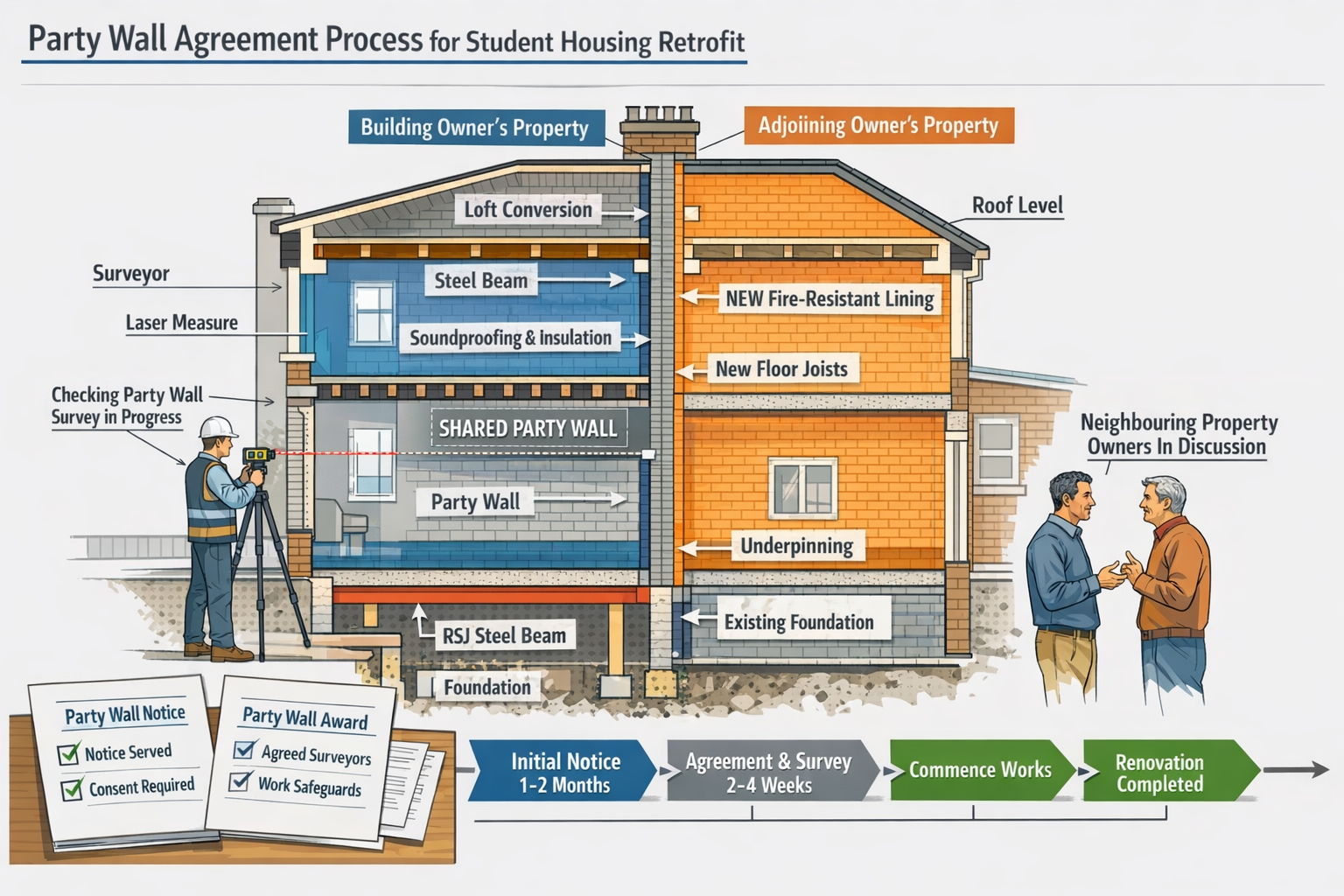
Structural alterations including removing or inserting beams, cutting into party walls for new openings, or underpinning foundations. These works require serving a Party Structure Notice to adjoining owners.
Building on the line of junction when constructing new structures that sit astride or immediately adjacent to boundary lines, necessitating a Line of Junction Notice.
Excavation works within three or six meters of neighboring structures, depending on depth, which require notice under Section 6 of the Act.
For student housing projects, adjoining properties may include:
- Other student accommodation blocks
- Residential properties occupied by homeowners
- Commercial premises
- Mixed-use developments
- Properties owned by educational institutions
Each type of adjoining owner presents different considerations for the party wall process.
Notice Requirements and Timelines
Proper notice is the foundation of lawful party wall procedures. Building owners must serve appropriate party wall notices at least two months before commencing work for Party Structure Notices, or one month for Line of Junction Notices.
In the volatile 2026 market, these timelines create challenges:
| Challenge | Impact | Solution |
|---|---|---|
| Project delays | Notices may expire before work begins | Serve notices strategically when funding confirmed |
| Budget uncertainty | Cannot commit to surveyor fees early | Include contingency in financial planning |
| Changing scope | Original notices may not cover revised work | Re-serve notices if significant changes occur |
| Vacant adjoining properties | Difficulty locating owners | Conduct thorough ownership searches early |
Understanding these timing considerations helps surveyors guide clients through the process efficiently. For detailed guidance on the notice process, review our comprehensive resource on party wall act notices and how to respond.
Technical Challenges in Student Housing Party Wall Projects
Common Structural Works Affecting Party Walls
Student housing retrofits typically involve specific types of structural interventions that trigger party wall procedures:
1. Creating En-Suite Facilities
Modern students expect en-suite bathrooms, requiring landlords to reconfigure existing layouts. This work often involves:
- Cutting into party walls for new plumbing runs
- Installing drainage systems that penetrate party structures
- Adding ventilation that may affect party walls
- Strengthening floors to support additional bathroom weight
2. Open-Plan Living Conversions
Converting traditional room layouts into studio apartments or open-plan spaces may require:
- Removing internal walls that provide lateral support to party walls
- Installing steel beams that bear on party walls
- Altering floor structures that connect to party walls
- Modifying roof structures shared between properties
3. Basement Conversions and Extensions
Maximizing space through basement development involves:
- Underpinning party walls to achieve additional ceiling height
- Excavating near party wall foundations
- Installing damp-proofing that affects party structures
- Creating new openings for access
4. Facade and Roof Improvements
Energy efficiency upgrades and aesthetic improvements include:
- External wall insulation affecting party wall junctions
- Roof replacements on party wall structures
- Installation of solar panels requiring roof penetrations
- Window replacements in party walls
Surveyor Considerations for Student Housing
Surveyors working on student housing party wall agreements face unique technical challenges:
Building age and condition: Many student properties occupy Victorian or Edwardian terraces with aging party walls that may have existing defects, making it difficult to distinguish pre-existing damage from new construction impact.
Multiple adjoining owners: Student housing often sits within terraces where work may affect several neighboring properties simultaneously, requiring coordination of multiple party wall agreements.
Mixed construction types: Retrofit projects may encounter unexpected construction methods, particularly in older conversions, complicating structural assessments.
Access limitations: During term time, accessing student properties for schedules of condition can be challenging, requiring careful planning around academic calendars.
"The key to successful party wall management in student housing is anticipating complexity. Never assume a straightforward Victorian terrace will be simple—these buildings have often undergone multiple conversions, creating hidden structural interdependencies that only emerge during detailed surveys."
Party Wall Agreements for Student Housing Retrofits: Managing Costs and Risks in Uncertain Markets
Cost Management Strategies
The volatile market conditions of 2026 place enormous pressure on project budgets. Party wall costs can escalate quickly if not properly managed. Developers should consider:
Early engagement: Appointing surveyors early in the project planning phase allows for accurate cost estimation and budget allocation. Understanding the full scope of costs of party wall procedures prevents nasty surprises.
Agreed surveyor approach: When adjoining owners consent, appointing a single agreed surveyor to act for both parties significantly reduces professional fees compared to appointing separate surveyors.
Scope clarity: Clearly defining the scope of work before serving notices prevents the need to re-serve or amend awards, which generates additional costs.
Proactive communication: Maintaining open dialogue with adjoining owners often prevents disputes that escalate costs. Many disagreements arise from poor communication rather than genuine conflicts of interest.
For practical tips on controlling expenses, explore our guide on how to keep party wall costs down.
Risk Mitigation in Volatile Markets
The uncertainty characterizing the 2026 student housing market requires robust risk management:
Comprehensive schedules of condition documenting the pre-existing state of adjoining properties protect building owners from spurious damage claims. In student housing areas, where properties may already show wear and tear, photographic and written records are invaluable.
Insurance considerations should include adequate cover for party wall work, ensuring protection against claims arising from construction activity.
Contingency planning for project delays must account for the possibility that party wall procedures may extend timelines, particularly if disputes arise requiring resolution.
Financial reserves should cover potential party wall awards that may require building owners to fund protective works or make good damage to adjoining properties.
Dispute resolution protocols established at the outset provide clear pathways if disagreements emerge, preventing costly litigation.
Managing Adjoining Owner Relations
Student housing retrofits often affect various types of adjoining owners, each requiring different approaches:
Institutional owners (universities, large PBSA operators) typically have established procedures for party wall matters and may require compliance with specific protocols.
Individual landlords of neighboring student properties may be more concerned about minimizing disruption during term time and protecting rental income.
Residential homeowners adjacent to student housing may have concerns about noise, disruption, and long-term property values that extend beyond pure party wall considerations.
Commercial property owners focus primarily on business continuity and ensuring work doesn't interfere with operations.
Effective communication tailored to each adjoining owner's priorities helps maintain positive relationships throughout the project.
Navigating Party Wall Agreements for Student Housing Retrofits: Practical Workflows
Step-by-Step Process for Surveyors
Successfully managing party wall agreements for student housing retrofits requires systematic approach:
Phase 1: Pre-Notice Assessment (4-6 weeks before notice)
- 🔍 Conduct thorough site survey identifying all party walls and structures
- 📋 Review proposed works against Party Wall Act triggers
- 🏘️ Identify all adjoining owners through Land Registry searches
- 💰 Estimate party wall costs for client budgeting
- 📅 Establish project timeline accounting for statutory notice periods
Phase 2: Notice Service (2-3 months before work)
- ✍️ Prepare accurate notices describing proposed works
- 📮 Serve notices on all adjoining owners with appropriate lead time
- 📞 Follow up to confirm receipt and offer explanatory discussions
- ⏰ Monitor response deadlines (14 days for consent/dissent)
- 📝 Document all communications meticulously
Phase 3: Award Preparation (4-8 weeks)
- 🏗️ Appoint surveyors (agreed surveyor or separate appointments)
- 📸 Conduct comprehensive schedules of condition on adjoining properties
- 📊 Assess proposed works and determine necessary protective measures
- 💬 Negotiate award terms with adjoining owners' surveyors
- ⚖️ Prepare and serve party wall awards on all parties
Phase 4: Construction Monitoring
- 👷 Ensure building owner complies with award conditions
- 🔎 Conduct periodic inspections of adjoining properties
- 📢 Maintain communication with adjoining owners regarding progress
- 🚨 Address any emerging issues or damage promptly
- 📋 Document all site activities affecting party walls
Phase 5: Post-Construction
- ✅ Conduct final inspections of adjoining properties
- 🔧 Arrange making good of any damage identified
- 📄 Close out party wall files with final documentation
- 💵 Settle all outstanding surveyor fees
- 🤝 Obtain sign-off from adjoining owners where appropriate
Documentation Best Practices
Thorough documentation protects all parties and provides evidence if disputes arise:
Photographic records should include date-stamped images of:
- All party walls before work commences
- Adjoining properties' condition (interior and exterior)
- Construction progress at key milestones
- Any damage or issues that emerge
- Completed works
Written records must capture:
- All correspondence with adjoining owners
- Site meeting notes and decisions
- Variations to the original scope
- Incidents or concerns raised
- Remedial works undertaken
Technical documentation includes:
- Structural calculations affecting party walls
- Method statements for sensitive operations
- Monitoring data (vibration, movement, etc.)
- As-built drawings showing party wall interfaces
- Test certificates for materials and installations
Using cloud-based project management systems ensures all stakeholders can access current documentation while maintaining version control.
Special Considerations for Student Housing Party Wall Projects
Term-Time vs. Vacation Scheduling
The academic calendar significantly impacts student housing retrofit projects:
Vacation periods (Christmas, Easter, summer) offer advantages:
- ✅ Easier property access for surveys
- ✅ Reduced disruption to students
- ✅ Greater flexibility for noisy or intrusive works
- ✅ Adjoining student properties may also be vacant
However, vacation scheduling creates challenges:
- ❌ Compressed timelines requiring efficient execution
- ❌ Premium labor costs during peak construction periods
- ❌ Difficulty accessing adjoining properties if students have left
- ❌ Pressure to complete before next term starts
Term-time work requires:
- Strict working hours to minimize student disruption
- Enhanced communication about noise and access
- Careful coordination with academic schedules (exams, etc.)
- Robust complaints handling procedures
Surveyors should advise clients on optimal timing considering both party wall procedures and operational constraints.
Fire Safety and Building Regulations Compliance
Student housing retrofits in 2026 face heightened scrutiny regarding fire safety, particularly following regulatory changes. Party wall work must not compromise fire separation:
Fire-stopping at party wall junctions requires specialist materials and installation techniques that comply with current Building Regulations.
Compartmentation must be maintained when creating new openings or penetrations through party walls.
Structural fire protection may need upgrading when party walls are exposed during construction.
Coordination between party wall surveyors and Building Control ensures all works meet both statutory requirements simultaneously.
HMO Licensing Implications
Many student properties operate as Houses in Multiple Occupation (HMOs) with specific licensing requirements. Retrofit works affecting party walls may trigger:
License variations if room layouts or occupancy numbers change
Additional standards for fire safety, amenity provision, and management
Inspection requirements that may coincide with party wall schedules of condition
Surveyors should be aware of HMO regulations in their jurisdiction and how party wall works intersect with licensing compliance.
Energy Performance Considerations
With increasing focus on energy efficiency, student housing retrofits often include:
- External wall insulation systems
- Replacement windows and doors
- Roof insulation upgrades
- Renewable energy installations
These improvements frequently affect party walls and require careful design to:
- Maintain structural integrity
- Preserve fire separation
- Avoid creating thermal bridges
- Comply with party wall awards
Coordinating energy consultants, structural engineers, and party wall surveyors ensures holistic project delivery.
Regional Variations and Location-Specific Factors

University Town Dynamics
Different university locations present unique party wall challenges:
Traditional university cities (Oxford, Cambridge, Durham) feature historic buildings with complex party wall arrangements, often involving listed building considerations alongside party wall procedures.
Modern campus developments may have purpose-built student villages with clearer ownership structures but potentially more restrictive covenants affecting alterations.
Urban universities (London, Manchester, Birmingham) involve working in dense terraced housing where multiple adjoining owners are common. For London-specific guidance, surveyors can consult resources for party wall surveyors in Central London, North London, South London, East London, and West London.
Coastal and regional universities may have different property values and owner expectations affecting party wall negotiations.
Mixed-Use Environments
Student housing increasingly occupies mixed-use areas where adjoining properties include:
- Ground-floor retail with residential above
- Professional offices
- Traditional family homes
- Other commercial uses
Each use type brings different sensitivities regarding:
- Noise tolerance (offices vs. residential)
- Access requirements (business hours vs. flexible)
- Risk perception (commercial vs. personal property)
- Decision-making speed (corporate vs. individual owners)
Surveyors must adapt their approach to suit the specific context of each project.
Future-Proofing Party Wall Agreements in Uncertain Times
Building Flexibility Into Awards
Given the market volatility characterizing 2026, party wall awards for student housing projects should incorporate flexibility:
Phasing provisions allow work to proceed in stages if funding constraints emerge, without requiring new awards for each phase.
Time extensions acknowledge that market conditions may delay projects beyond original schedules.
Scope variations permit minor changes without triggering complete award revisions.
Review mechanisms enable surveyors to reassess conditions if significant delays occur.
Contingency Planning
Robust contingency planning addresses potential scenarios:
Project abandonment: If market conditions force project cancellation, awards should clarify obligations regarding partial works and making good.
Ownership changes: Both building owner and adjoining owner properties may change hands during projects. Awards should clearly state that obligations run with the land.
Dispute escalation: Clear procedures for resolving disagreements prevent minor issues becoming major obstacles.
Financial failure: Protection mechanisms ensure adjoining owners aren't left with unresolved damage if building owners face financial difficulties.
Technology and Innovation
Modern technology enhances party wall management:
Digital surveys using laser scanning create precise records of existing conditions.
Structural monitoring systems provide real-time data on movement and vibration, offering objective evidence of construction impact.
Project management platforms facilitate communication and document sharing among all parties.
BIM (Building Information Modeling) helps visualize complex party wall interfaces and plan works more accurately.
Surveyors embracing these technologies deliver better outcomes while managing risk more effectively.
Conclusion
Party Wall Agreements for Student Housing Retrofits: Navigating Complexity in a Volatile Sector requires surveyors to balance legal compliance, technical expertise, and commercial awareness. The challenging market conditions of 2026—characterized by demographic headwinds and visa delays—make proper party wall management more critical than ever.
Successful navigation of this complex landscape depends on:
✅ Early engagement with party wall procedures during project planning
✅ Comprehensive documentation protecting all parties' interests
✅ Proactive communication with adjoining owners and stakeholders
✅ Cost management strategies that control expenses without compromising quality
✅ Flexibility in awards and agreements to accommodate market uncertainty
✅ Technical excellence in surveys, assessments, and monitoring
Actionable Next Steps
For surveyors and developers working on student housing retrofit projects:
- Assess your project against Party Wall Act triggers early in the planning process
- Engage experienced surveyors familiar with both party wall procedures and student housing sector dynamics
- Budget appropriately for party wall costs, including contingencies for potential disputes
- Plan timelines accounting for statutory notice periods and potential delays
- Establish communication protocols with adjoining owners before serving notices
- Document everything from initial surveys through project completion
- Stay informed about market conditions affecting the student housing sector
- Consider timing carefully, balancing construction efficiency with academic calendars
The volatile student housing market of 2026 presents challenges, but proper management of party wall agreements transforms potential obstacles into manageable processes. By combining legal compliance, technical competence, and commercial sensitivity, surveyors can deliver successful retrofit projects that protect all parties' interests while navigating sector uncertainty.
Whether you're carrying out works or representing adjoining owners, understanding the unique complexities of student housing party wall agreements positions you for success in this demanding but rewarding sector.