


A party wall award that took months to negotiate can be struck down in minutes if a court finds the surveyors acted outside their jurisdiction. That single fact drives more neighbour disputes, project delays, and professional negligence claims than almost any other issue under the Party Wall etc. Act 1996. In 2026, with RICS consulting on a landmark 8th edition of its party wall practice guidance, understanding how and why awards fail — and what surveyors must do to prevent failure — has never been more important. This article examines the 2026 party wall act enforcement landscape, the grounds on which courts challenge invalid awards, and the surveyor best practices now being codified through updated RICS guidance.
Key Takeaways
- Courts can void party wall awards that are ultra vires — meaning surveyors acted beyond their statutory jurisdiction — regardless of how technically sound the award appears.
- Either party has 14 days from service of an award to appeal to the County Court; missing this window does not always prevent a later ultra vires challenge.
- The RICS draft 8th edition guidance (consultation closed June 2026) strengthens standards on impartiality, notice validity, fee practices, and the role of the Third Surveyor. [1]
- A robust, jurisdiction-proof award depends on a valid notice served correctly before any works begin — a step that remains the most common point of failure.
- Surveyors who follow the updated RICS checklist approach significantly reduce the risk of their awards being challenged or set aside by a court.
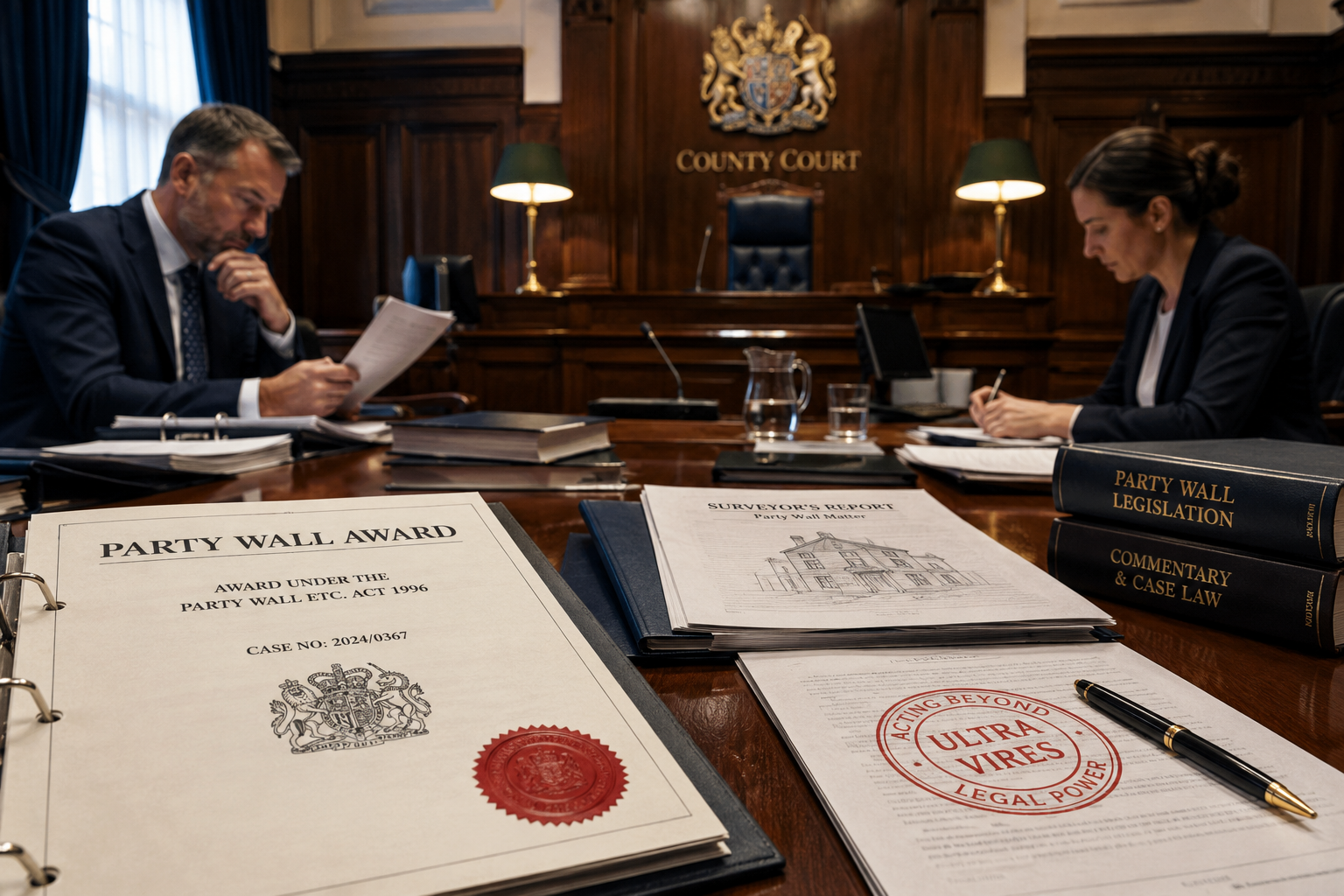
Why Awards Fail: The Ultra Vires Problem in 2026 Party Wall Act Enforcement
The phrase ultra vires — Latin for "beyond the powers" — is the most dangerous concept in party wall law. When a court finds that surveyors issued an award without proper jurisdiction, that award is void from the outset. It cannot be corrected on appeal; it simply never had legal effect.
The Jurisdiction Chain: Where It Breaks
Jurisdiction under the Party Wall etc. Act 1996 flows through a strict sequence:
- A valid notice is served on the adjoining owner.
- A dispute arises (or is deemed to have arisen).
- Surveyors are properly appointed.
- The appointed surveyors act within the scope of the dispute.
If any link in that chain is broken, every step that follows is potentially void. Courts have repeatedly confirmed this principle. The most common points of failure are:
- Defective notices: A notice that omits required information, is served too early or too late, or is addressed to the wrong party cannot trigger the statutory process.
- Premature appointment: Appointing a surveyor before a dispute has arisen or been deemed to have arisen removes the jurisdictional foundation.
- Awards exceeding scope: An award that addresses matters outside the notified works strays beyond the surveyors' authority.
- Appointment by an unqualified party: If the building owner does not have the legal right to carry out the notified works, the entire process is compromised.
The RICS draft 8th edition guidance directly addresses this problem, clarifying that awards can be challenged as ultra vires in subsequent proceedings even after the 14-day appeal window has passed. [2] This is a critical point: an adjoining owner who misses the appeal deadline is not necessarily without remedy if the award was made without jurisdiction.
The 14-Day Appeal Window and Its Limits
Section 10(17) of the Act gives either party the right to appeal an award to the County Court within 14 days of service. The court may rescind or modify the award as it sees fit. However, this statutory appeal is distinct from a jurisdictional challenge. As the draft RICS guidance confirms, ultra vires challenges can be raised in subsequent proceedings — for example, when a building owner seeks to enforce an award or recover costs. [2]
This distinction matters enormously in practice. A surveyor who believes an award is simply unfair must advise their client to appeal within 14 days. But a surveyor who suspects the entire process lacked jurisdiction faces a different, more fundamental problem that no appeal timetable can cure.
To understand the full scope of what a properly constituted award should contain, reviewing a detailed guide on party wall awards is an essential starting point for both surveyors and property owners.
Surveyor Best Practices: What the RICS 8th Edition Guidance Requires
In April and May 2026, RICS launched a public consultation on the draft 8th edition of "Party Wall Legislation and Procedure," with the consultation closing on 5 June 2026. [1] The revised guidance represents the most significant update to party wall professional standards in years, with a clear focus on reducing the risk of awards being challenged or invalidated.
Impartiality as a Statutory Duty
One of the most emphatic themes in the draft 8th edition is surveyor impartiality. The guidance stresses that appointments under the Act are personal and statutory — they are not an extension of the client relationship. A surveyor appointed by the building owner does not act as the building owner's advocate; they act as a statutory officer whose duty is to resolve the dispute fairly. [1]
This matters for enforcement because courts have shown willingness to scrutinise the conduct of surveyors where there is evidence of partiality. An award produced by a surveyor who demonstrably favoured their appointing owner is vulnerable to challenge on grounds of procedural impropriety, even if the substantive content appears reasonable.
Key impartiality requirements from the draft guidance:
| Requirement | Practical Implication |
|---|---|
| Appointments are personal, not delegable | A surveyor cannot transfer their appointment to a colleague without fresh consent |
| Independent of client instruction | Surveyors must not take direction from clients on the content of awards |
| Duty to act expeditiously | Delay caused by one party's surveyor can itself be challenged |
| Fee arrangements must not create conflicts | Contingency or success-based fees are incompatible with the statutory role |
Notice Validity: The Foundation of Every Award
The draft guidance reinforces that a valid notice is the bedrock of jurisdiction. [3] Surveyors must verify notice validity before accepting appointment and certainly before drafting any award. The following checklist reflects the standards now being codified in the 8th edition.
Surveyor's Notice Validity Checklist (2026)
- Confirm the notice is in writing and identifies the building owner correctly.
- Verify the correct notice type has been served (Party Structure Notice, Line of Junction Notice, or Three Metre/Six Metre Notice as appropriate).
- Check the notice period: two months for party structure works, one month for line of junction and excavation notices.
- Confirm the notice has not expired before works commenced.
- Verify the adjoining owner's identity — including all owners and mortgagees where relevant.
- Ensure the description of works is sufficiently detailed to define the scope of any future award.
- Check that the notice was served correctly (personal service, recorded delivery, or leaving at the premises).
For a detailed breakdown of how notices work and how to respond to them, the guide on party wall act notices provides clear, practical information.
Property owners who are unsure whether they need a surveyor at all should also consider reading about having a party wall agreement without a surveyor — though for complex or high-value works, professional appointment is strongly advisable.
Drafting the Primary Award: Scope and Precision
The draft 8th edition dedicates significant attention to the surveyor's responsibilities when drafting the primary award. [3] An award that is vague, internally inconsistent, or that purports to cover matters outside the notified works is at immediate risk of challenge.
Best practice principles for award drafting:
- Define the works precisely: The award must describe the notified works with enough specificity that any competent person can identify what is and is not authorised.
- Address access rights explicitly: If the award grants the building owner access to the adjoining owner's land, the conditions and duration of that access must be stated.
- Include a schedule of condition: A pre-works schedule of condition, properly appended to the award, is essential for any subsequent damage claim. Details on this can be found in guidance on schedule of condition requirements.
- State the dispute resolution mechanism: The award should identify the Third Surveyor and confirm the process for resolving any disagreement between the two appointed surveyors.
- Avoid prospective awards: Surveyors should not make awards in anticipation of disputes that have not yet arisen.
"An award that exceeds the surveyors' jurisdiction is not merely voidable — it is void. No amount of technical excellence in the drafting can cure a jurisdictional defect."
The Role of the Third Surveyor
The draft guidance strengthens the provisions relating to the Third Surveyor — the independent professional selected at the outset to resolve disagreements between the two appointed surveyors. [1] In practice, the Third Surveyor is often underused, with parties instead resorting to court proceedings that are slower and more expensive.
Key points from the updated guidance:
- The Third Surveyor must be selected at the time of appointment, not after a dispute arises between the surveyors.
- Either surveyor (not just the parties) can refer a matter to the Third Surveyor.
- The Third Surveyor's award has the same legal force as an award made by the two appointed surveyors.
- Attempts to exclude or circumvent the Third Surveyor mechanism may themselves render an award invalid.
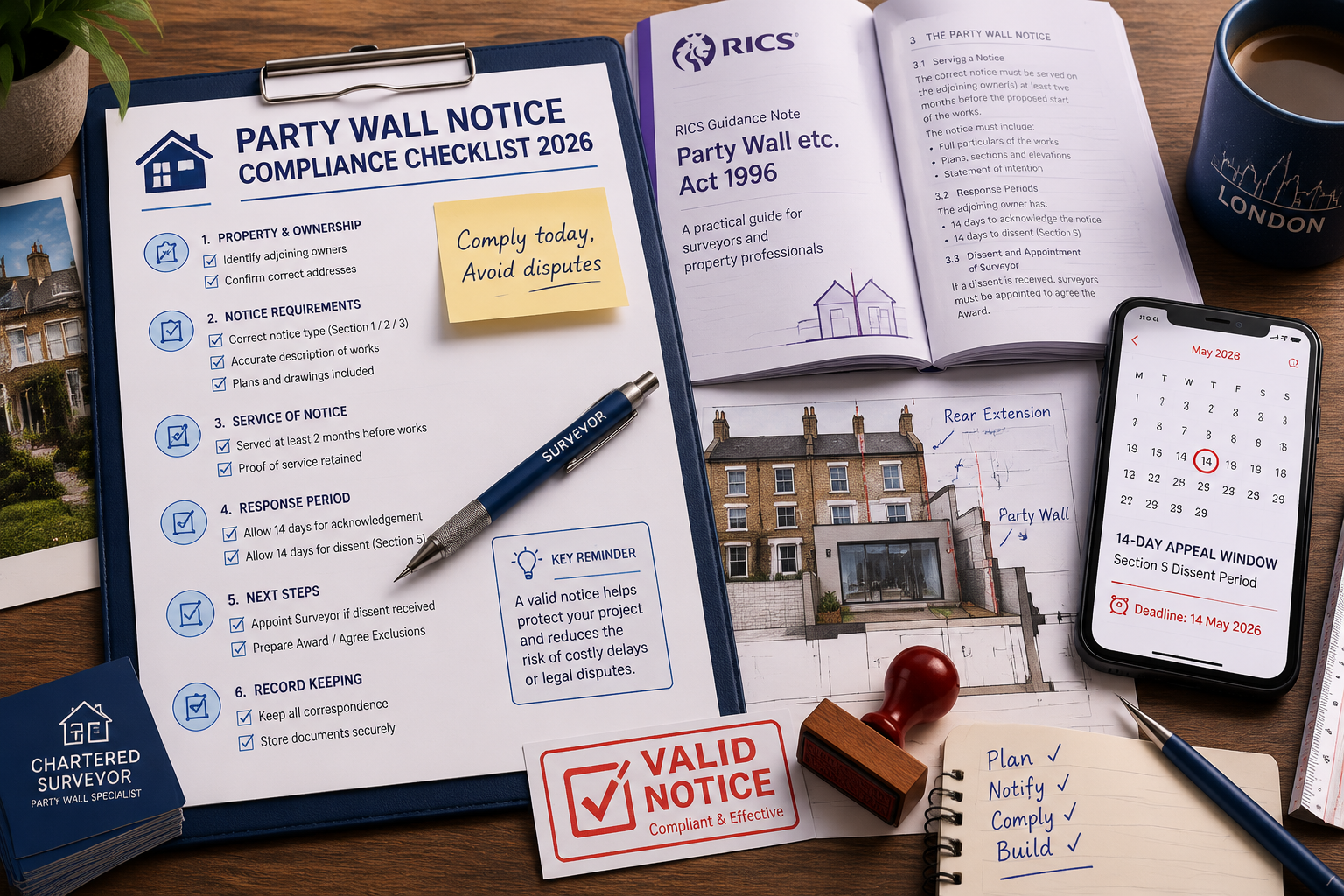
Court Challenges in Practice: Lessons for 2026 Party Wall Act Enforcement
Understanding the theoretical grounds for challenge is one thing; understanding how courts approach these cases in practice is another. The following patterns emerge consistently from reported decisions and from the RICS guidance materials.
Pattern 1: The Defective Notice That Invalidated Everything
The most frequently litigated scenario involves a building owner who served a notice that was technically deficient — wrong address, incorrect description of works, or served outside the required time window. When the adjoining owner later challenged the award, the court found that no valid statutory process had ever been triggered. The surveyors' appointments, the award, and any access rights purportedly granted by the award were all void.
Lesson: Surveyors must conduct their own independent verification of notice validity. Relying on the building owner's assurance that notice was properly served is not sufficient.
Pattern 2: The Award That Went Too Far
A second common pattern involves surveyors who, with the best intentions, included provisions in their award that went beyond the scope of the notified works. For example, an award that purported to regulate the building owner's future maintenance obligations on a wall that was not the subject of the notice, or that imposed conditions on works that had already been completed before the notice was served.
Courts have consistently held that surveyors' jurisdiction is limited to the dispute arising from the notified works. Anything beyond that scope is ultra vires.
Lesson: The award must track the notice. If the building owner wishes to carry out additional works, a fresh notice must be served.
Pattern 3: The Conflicted Surveyor
A third pattern involves surveyors whose fee arrangements, prior relationships, or conduct during the process gave rise to a finding of apparent bias. While the Act does not expressly require surveyors to be independent in the same way as arbitrators, courts have applied public law principles to find that an award made by a demonstrably partial surveyor was procedurally flawed.
The RICS draft 8th edition guidance addresses this directly, reinforcing that fee practices must not create conflicts of interest. [1] Surveyors who are paid on a contingency basis — or whose fees are conditional on the award containing particular provisions — face a serious professional and legal risk.
For building owners and adjoining owners in London who need properly appointed surveyors, resources are available for both building owners and adjoining owners to understand their rights and obligations before any appointment is made.
Practical Risk Reduction: A Surveyor's Pre-Award Checklist
The following checklist consolidates the RICS guidance into actionable steps before any award is signed and served.
Pre-Award Checklist for Surveyors (2026)
- Valid notice confirmed in writing, with correct notice period observed.
- Appointing parties correctly identified (all legal owners, not just occupiers).
- Surveyor's own appointment confirmed in writing and accepted.
- Third Surveyor selected and agreed by both appointed surveyors.
- Schedule of condition completed and agreed before works commence.
- Award drafted to cover only the works described in the notice.
- Award reviewed for internal consistency — no contradictory provisions.
- Fee arrangements reviewed for conflicts of interest.
- Award served on both parties simultaneously.
- 14-day appeal period noted and communicated to both parties.
RICS also offers a structured CPD course, "Party Walls: The Fundamentals," providing 15 hours of learning that covers notice procedures, award preparation, and the process for challenging awards. [4] For surveyors seeking to align their practice with the updated 8th edition standards, this course provides a solid foundation.
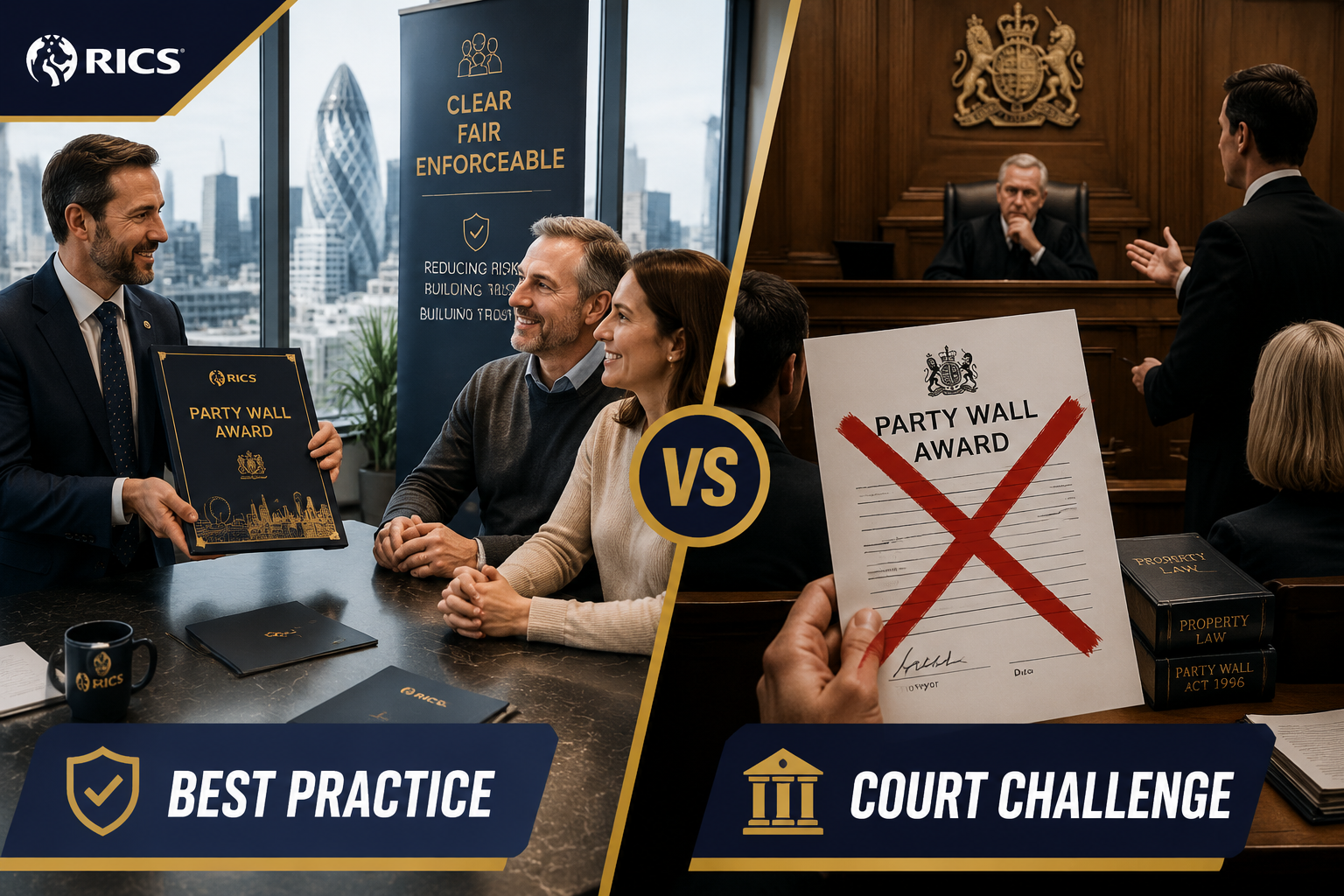
Consumer Awareness and the Broader Enforcement Picture
The 2026 party wall act enforcement environment is not only a professional issue for surveyors. Property owners — both building owners and adjoining owners — need to understand the enforcement framework to protect their interests effectively.
RICS has published a consumer guide to party walls that explains rights and responsibilities under the Act in accessible language. [5] Key points for property owners include:
- Building owners who proceed without a valid notice, or who begin works before an award is made, lose the protection the Act provides and expose themselves to injunction proceedings.
- Adjoining owners who receive a defective notice are not obliged to treat it as valid, but should take professional advice rather than simply ignoring it.
- Both parties should understand that an award, once made, is binding on successors in title — meaning a buyer of either property inherits both the rights and obligations it creates.
For property owners in London seeking local expertise, specialist surveyors are available across the city, including in South London, North London, and West London.
Conclusion
The 2026 party wall act enforcement landscape demands a higher standard of professional rigour than many practitioners have historically applied. Courts will not rescue a defective process; they will void it. The RICS draft 8th edition guidance, with its emphasis on impartiality, notice validity, award scope, and the proper use of the Third Surveyor mechanism, provides a clear roadmap for surveyors who want their awards to withstand scrutiny. [1][2][3]
Actionable next steps for surveyors:
- Adopt the pre-award checklist above as a standard part of every appointment.
- Review fee arrangements immediately to ensure no conflict of interest exists.
- Complete or update CPD on party wall fundamentals, using the RICS structured course as a benchmark. [4]
- Treat notice verification as a personal professional duty — not a task to delegate to the client.
- Familiarise yourself with the RICS 8th edition guidance once published, and update internal procedures accordingly.
Actionable next steps for property owners:
- Before serving any notice, confirm the correct notice type and period using authoritative resources on the Party Wall etc. Act 1996.
- If you receive a notice, do not ignore it — seek professional advice promptly.
- If an award has been served and you have concerns about its validity, consult a specialist surveyor or solicitor immediately, bearing in mind the 14-day appeal window.
- Keep all correspondence, notices, and award documents safely stored, as they may be needed by future buyers or in subsequent legal proceedings.
The cost of getting party wall procedure wrong — in time, money, and neighbourly relations — far exceeds the cost of getting it right from the start.
References
[1] RICS Launches Consultation on Updated Party Wall Practice Guidance – https://www.rics.org/news-insights/rics-launches-consultation-on-updated-party-wall-practice-guidance?utm_source=openai
[2] RICS 8th Edition Guidance – Challenging Awards and Appeals – https://consultations.rics.org/party_walls_8th_edition_guidance/viewCompoundDoc?docid=16799988&partid=16804308&pfv=y&utm_source=openai
[3] RICS 8th Edition Guidance – Surveyor Responsibilities and Award Drafting – https://consultations.rics.org/party_walls_8th_edition_guidance/viewCompoundDoc?docid=16799988&partid=16800244&pfv=y&utm_source=openai
[4] Party Walls: The Fundamentals – RICS Academy – https://academy.rics.org/distance-learning/building-surveying/party-walls-the-fundamentals?utm_source=openai
[5] RICS Consumer Guide: Party Walls – https://www.ricsfirms.com/residential/legal-issues/party-walls/rics-consumer-guide-party-walls/?utm_source=openai