


Fewer than 40% of building owners in England and Wales fully understand their obligations under the Party Wall etc. Act 1996 before construction begins — yet non-compliance can halt projects, trigger costly disputes, and expose surveyors to professional liability. For practitioners working in this specialist field, staying current with professional development, emerging case law, and evolving guidance is not optional. It is the foundation of credible practice. This article explores FPWS Events and Training for Party Wall Surveyors: 2026 Insights on Awards and Act Compliance, examining the key events, certification pathways, regulatory changes, and award-drafting best practices that define professional standards in 2026.
Key Takeaways
- The RICS 8th Edition Party Wall Guidance, consulted in May 2026, introduces stronger rules on surveyor independence, fee transparency, and notice service.
- RICS mandatory AI standards effective March 2026 require surveyors to maintain professional judgment over automated outputs and conduct quarterly risk assessments.
- The Faculty of Party Wall Surveyors (FPWS) and allied bodies offer structured training in notice validation, award drafting, and Act compliance.
- Homebuying reforms in 2026 are pushing party wall notices and condition reports into pre-sale disclosure packs, reshaping when surveyors are engaged.
- Comprehensive Schedules of Condition and precisely drafted Party Wall Awards remain the primary tools for dispute prevention across London and the South East.
Understanding FPWS and the Professional Landscape for Party Wall Surveyors in 2026
First for Party Wall Surveyors (FPWS) is a specialist practice covering Essex, Kent, and London, with a team that includes members of the Faculty of Party Wall Surveyors and the Pyramus & Thisbe Society — the two most recognised professional bodies in this niche [9]. The Faculty of Party Wall Surveyors exists specifically to raise standards through education, peer review, and structured events. In a field where the legislation is deceptively complex and the consequences of errors are significant, membership of such bodies signals a commitment to rigorous practice.
The Party Wall etc. Act 1996 governs works to shared walls, boundary structures, and excavations near neighbouring properties. Understanding the full scope of the Party Wall etc. Act 1996 is essential for any surveyor operating in this space. The Act requires building owners to serve formal notices before certain works begin, and where neighbours dissent or fail to respond, appointed surveyors must produce a Party Wall Award — a legally binding document that sets out the permitted works, working methods, and dispute resolution mechanisms [6].
The Role of Specialist Bodies in Shaping Practice
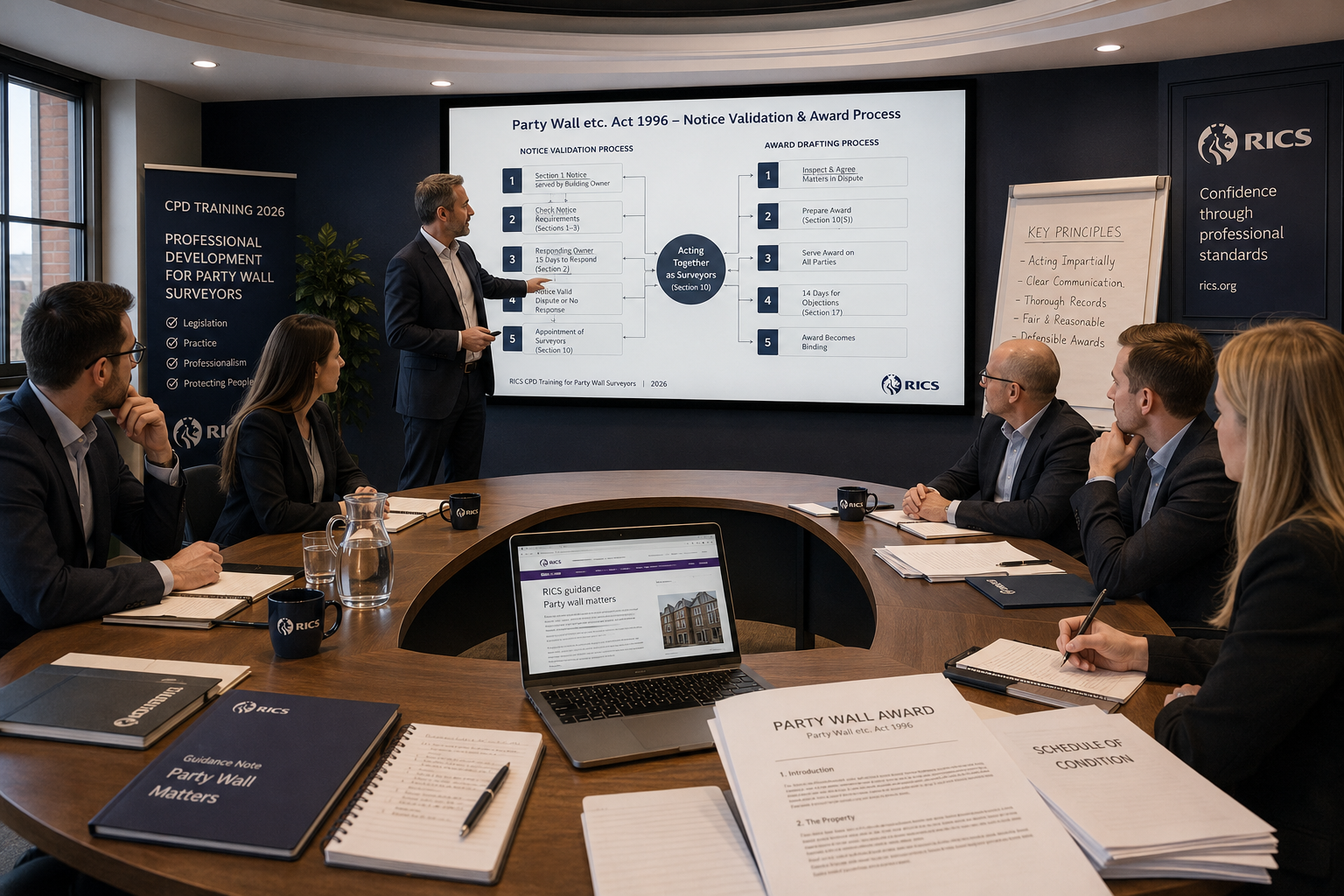
The Pyramus & Thisbe Society and the Faculty of Party Wall Surveyors both run events, seminars, and training programmes that keep practitioners current. FPWS events in 2026 focus on three core areas:
- Notice validation — ensuring notices are correctly served under the Act's strict procedural requirements
- Award drafting — producing legally sound, comprehensive awards that withstand challenge
- Emerging case law — understanding how courts are interpreting the Act in recent judgments
These themes reflect the pressures facing the profession in 2026: a revised RICS guidance edition, new AI use standards, and homebuying reforms that are changing when and how party wall surveyors are instructed.
2026 Regulatory Changes Shaping FPWS Events and Training for Party Wall Surveyors
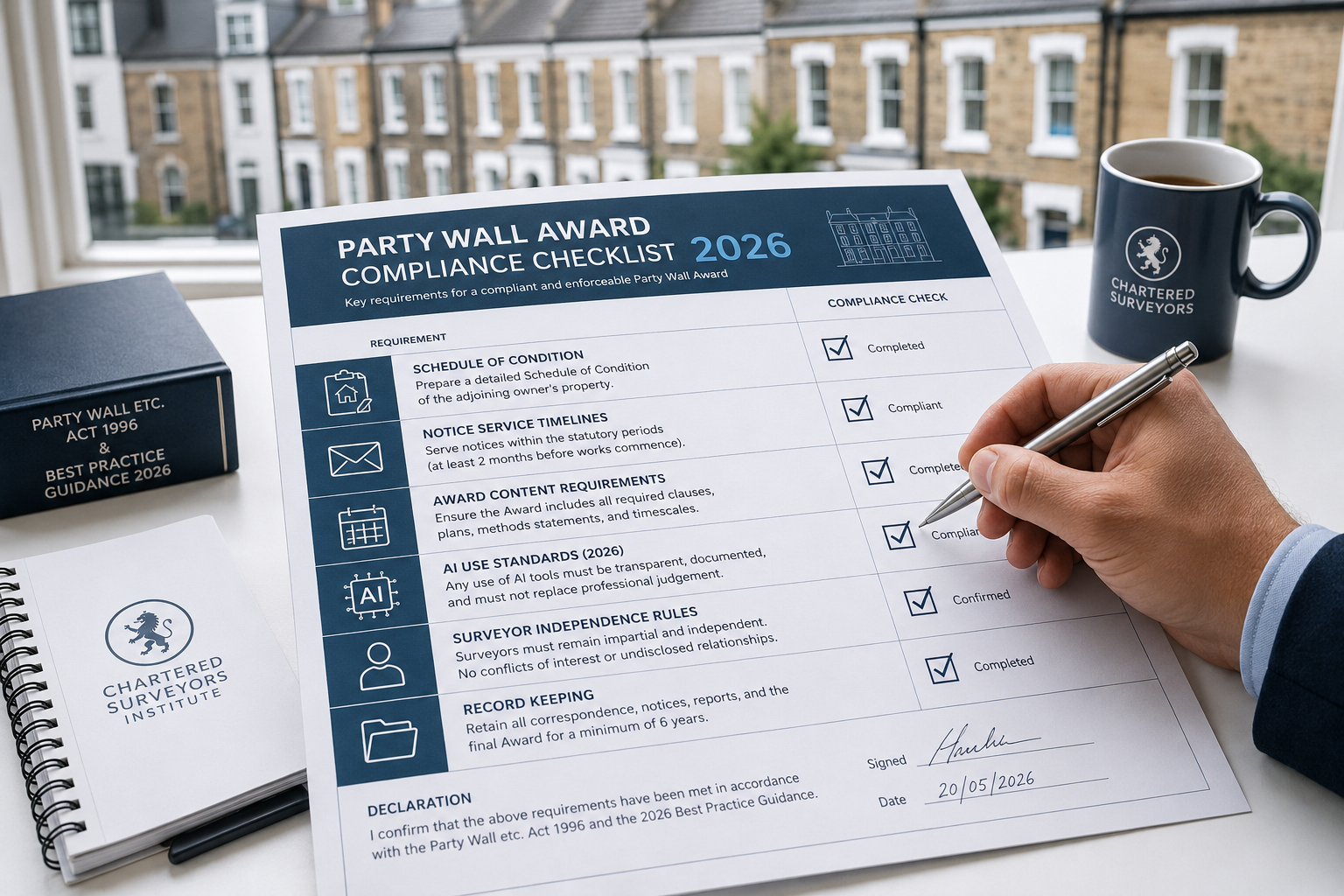
The regulatory environment for party wall surveyors has shifted considerably in 2026. Three developments in particular are driving the content of professional training events and certification programmes.
RICS 8th Edition Party Wall Guidance
RICS concluded a formal consultation on the 8th Edition of Party Wall Legislation and Procedure in May 2026 [1]. This updated guidance — the most significant revision in over a decade — addresses several persistent ambiguities in practice:
| Area of Change | Key Provision |
|---|---|
| Surveyor independence | Strengthened rules preventing conflicts of interest |
| Fee transparency | Clearer obligations to disclose fee structures upfront |
| Notice service | Clarified methods for valid service, including electronic notice |
| Jurisdiction | Refined guidance on what falls within the Act's scope |
For surveyors, the 8th Edition is not merely advisory. RICS members are expected to align their practice with the updated guidance, and failure to do so can constitute a breach of professional standards. FPWS events in 2026 are already incorporating 8th Edition content into workshops, particularly around notice validation and the boundaries of surveyor jurisdiction [1].
Mandatory AI Standards from March 2026
Effective 9 March 2026, RICS implemented mandatory standards governing the use of artificial intelligence in surveying practice [2]. These standards have direct implications for party wall surveyors who use AI tools for condition monitoring, report drafting, or document management.
The key obligations are:
- Professional judgment must override AI outputs — surveyors cannot defer to automated conclusions without independent verification
- Quarterly risk assessments — practices must formally review their AI tools and associated risks every three months
- Written consent — clients must give explicit written consent before any confidential data is uploaded to AI platforms [2]
These requirements are being incorporated into FPWS training programmes, with workshops covering how to document AI use appropriately and how to frame consent clauses in engagement letters. For surveyors drafting Party Wall Awards, the practical implication is clear: AI can assist with drafting, but the surveyor's professional judgment — and professional liability — remains paramount.
Homebuying Reforms and Pre-Sale Disclosure
June 2026 saw the publication of reform proposals aimed at reducing property transaction failures [3]. A central recommendation is that Party Wall Act notices and Schedules of Condition should be included in pre-sale disclosure packs, making them available to buyers before exchange. This mirrors the approach already used for searches and title documents.
For party wall surveyors, this reform has significant implications:
- Surveyors may be instructed earlier in the transaction timeline
- Schedules of Condition will need to meet a higher standard of completeness to serve as pre-sale documents
- Disputes that previously emerged post-completion may be identified and resolved before sale
FPWS events in 2026 are addressing this shift directly, with sessions on how to prepare condition reports that are fit for purpose in a pre-sale context and how to advise building owners who are selling rather than developing [3].
Key Events, Training Pathways, and Certification for Party Wall Surveyors in 2026

Professional development in the party wall field operates through a combination of formal training courses, CPD events, and specialist seminars. In 2026, the calendar is particularly rich, reflecting the volume of regulatory change that practitioners must absorb.
RICS Seminar: Early Doors and Party Walls
On 26 June 2026, RICS is hosting a seminar titled "Early Doors and Party Walls: Managing Risk from the Outset" at the Black Country Living Museum [4]. The session covers core Party Wall Act principles with a particular focus on early engagement — the argument that surveyors and building owners who address party wall obligations before works begin avoid the majority of disputes and delays.
Key themes from this event include:
- Identifying notifiable works at the planning stage
- Serving valid party wall notices before statutory deadlines
- Structuring initial client conversations to set realistic expectations
- Managing risk when neighbours are unresponsive or hostile
This event is directly relevant to FPWS practitioners, as early engagement is a core principle of the Faculty's approach to practice.
Institute of Party Wall Surveyors Training Courses
The Institute of Party Wall Surveyors (IPWS) offers two structured training programmes [5]:
Two-Day Foundation Course
Designed for those new to the Party Wall Act, this course covers the legislation in full, from the scope of notifiable works through to award drafting and dispute resolution. Successful completion can support an application for full membership of the Institute.
One-Day Practitioner Course
Aimed at practising surveyors who need to update their knowledge or formalise their CPD record, this course focuses on current practice issues including the 8th Edition RICS guidance, AI standards, and recent case law.
Both courses are recognised as qualifying CPD activity and are valued by FPWS members seeking to demonstrate ongoing competence.
What Certification Means for Career Development
Membership of the Faculty of Party Wall Surveyors, the Pyramus & Thisbe Society, or the IPWS signals to clients and employers that a surveyor has committed to specialist education and peer accountability. In a field where there is no statutory licensing requirement, these credentials serve as the primary quality markers.
For surveyors working as either a building owner's surveyor or an adjoining owner's surveyor, membership of a specialist body also provides access to guidance, precedent documents, and peer networks that are invaluable when handling complex or contested awards.
"Specialist certification is not a formality — it is the professional infrastructure that allows surveyors to navigate contested awards, novel case law, and regulatory change with confidence."
Award Drafting, Notice Validation, and Act Compliance: Practical Workshop Themes in 2026
The practical content of FPWS events and training for party wall surveyors in 2026 reflects the specific challenges practitioners face in the field. Three workshop themes dominate the 2026 calendar.
Notice Validation
Serving a valid notice is the foundation of the entire Party Wall Act process. A defective notice can invalidate subsequent awards, expose building owners to injunctions, and create professional liability for the surveyor who advised on service. FPWS workshops in 2026 focus on:
- The correct form and content of each notice type under the Act
- Valid methods of service, including the updated guidance on electronic service in the 8th Edition [1]
- Timeframes — particularly the distinction between the two-month notice period for party structure works and the one-month period for line of junction works
- What constitutes a valid response and how to handle silence or ambiguity
For a detailed overview of notice types and service requirements, the guide on party wall notices and how to respond provides a useful reference for both surveyors and their clients.
Award Drafting
A Party Wall Award is a legally binding document, and its drafting must be precise [6]. Poorly drafted awards are vulnerable to appeal under Section 10(17) of the Act and can leave both parties without adequate protection. FPWS training in 2026 addresses:
- The essential components of a valid award
- How to describe proposed works with sufficient specificity
- Incorporating Schedules of Condition as protective annexures
- Setting out hours of working, dust and noise controls, and access rights
- Drafting provisions for damage assessment and remediation
A practical resource for practitioners and clients alike is the party wall contract template and guide on party wall awards, which illustrates the structure of a compliant award document.
Real-world practice reinforces the importance of this precision. In February 2026, SHW's Building Consultancy Team represented an adjoining owner in a party wall matter at Norfolk Square, Brighton, maintaining strict impartiality and ensuring full compliance with the Act throughout the award process [7]. Cases like this demonstrate that even straightforward residential matters require rigorous procedural adherence.
Schedule of Condition Best Practice
The Schedule of Condition — a detailed photographic and written record of a property's condition before works begin — is the primary tool for resolving post-works damage claims. Recent guidance from London and South East practitioners emphasises that comprehensive Schedules are essential for both dispute prevention and Act compliance [8].
FPWS workshops in 2026 cover:
- What areas must be documented and to what level of detail
- Photographic standards and metadata requirements
- How Schedules interact with award provisions on damage and reinstatement
- Preparing Schedules for pre-sale disclosure under the 2026 homebuying reform proposals [3]
Compliance Challenges and Emerging Case Law in 2026
Beyond formal training events, FPWS practitioners are tracking a number of live compliance challenges that are shaping practice in 2026.
Surveyor Independence Under Scrutiny
The 8th Edition RICS guidance places renewed emphasis on surveyor independence [1]. The agreed surveyor model — where a single surveyor acts for both building owner and adjoining owner — is under particular scrutiny. FPWS events are addressing how surveyors can demonstrate genuine independence when acting in this capacity, including documentation practices and conflict-of-interest checks.
AI Use in Condition Monitoring
The March 2026 RICS AI standards [2] are generating significant discussion at FPWS events. Surveyors are exploring how AI-assisted condition monitoring tools can be used compliantly, what documentation is required, and how to communicate AI involvement to clients without undermining confidence in the professional service.
The Expanding Scope of Notifiable Works
Case law and planning practice in 2026 are testing the boundaries of what constitutes notifiable works under the Act. FPWS seminars are examining recent decisions on basement excavations, roof works affecting party structures, and the treatment of modern construction methods that do not fit neatly into the Act's 1996 framework.
Surveyors working across London — whether in Central London, South London, or North London — encounter a wide variety of construction types and property configurations, making familiarity with emerging case law particularly important.
Conclusion
The party wall surveying profession is navigating a period of concentrated regulatory change in 2026. The RICS 8th Edition guidance, mandatory AI standards, homebuying reform proposals, and an active programme of professional events are collectively raising the bar for what competent practice looks like. FPWS Events and Training for Party Wall Surveyors: 2026 Insights on Awards and Act Compliance is not simply a calendar of seminars — it represents the professional infrastructure that allows practitioners to serve clients well, draft defensible awards, and maintain compliance with a demanding legislative framework.
Actionable next steps for party wall surveyors in 2026:
- Review your practice against the RICS 8th Edition guidance and identify any gaps in notice service procedures or fee disclosure
- Complete or update your AI use documentation in line with the March 2026 RICS mandatory standards, including client consent clauses
- Attend the RICS "Early Doors and Party Walls" seminar or an IPWS training course to formalise your CPD record
- Audit your Schedule of Condition template against the 2026 pre-sale disclosure requirements
- Consider membership of the Faculty of Party Wall Surveyors or the Pyramus & Thisbe Society to access peer networks and precedent resources
- Ensure your award drafting practice reflects current case law, particularly on surveyor independence and the scope of notifiable works
For building owners and adjoining owners seeking specialist guidance, working with a surveyor who is actively engaged in professional development through FPWS and allied bodies is the most reliable indicator of quality in this specialist field.
References
[1] Rics 8th Edition Party Wall Guidance 2026 Implementation Challenges And Surveyor Compliance Strategies – https://wimbledonsurveyors.com/rics-8th-edition-party-wall-guidance-2026-implementation-challenges-and-surveyor-compliance-strategies/?utm_source=openai
[2] Responsible Ai Use In Party Wall Awards Rics March 2026 Standards For Automated Condition Monitoring – https://wimbledonsurveyors.com/responsible-ai-use-in-party-wall-awards-rics-march-2026-standards-for-automated-condition-monitoring/?utm_source=openai
[3] Party Wall Awards Under Homebuying Reforms Integrating Surveys Into 2026 Upfront Processes – https://kingstonsurveyors.com/party-wall-awards-under-homebuying-reforms-integrating-surveys-into-2026-upfront-processes/?utm_source=openai
[4] Rics In The Black Country Early Doors And Party Walls Managing Risk From The Outset – https://www.rics.org/training-events/networking-events/rics-in-the-black-country-early-doors-and-party-walls-managing-risk-from-the-outset?utm_source=openai
[5] Training Course – https://www.ipws.co.uk/training-course/?utm_source=openai
[6] Party Wall Awards Explained – https://www.partywallagreementlondon.co.uk/blog/party-wall-awards-explained.html?utm_source=openai
[7] Shw Party Wall Award Norfolk Square Brighton – https://www.shw.co.uk/articles/2026/shw—party-wall-award–norfolk-square-brighton.html?utm_source=openai
[8] Party Wall Act Compliance In London South East Price Stabilization Surveyor Checklists For 2026 – https://wimbledonsurveyors.com/party-wall-act-compliance-in-london-south-east-price-stabilization-surveyor-checklists-for-2026/?utm_source=openai
[9] fpws.co.uk – https://fpws.co.uk/?utm_source=openai