
Nearly 70% of party wall disputes that escalate to formal tribunal proceedings could have been resolved earlier — not because the legal framework was unclear, but because communication broke down between neighbours and their surveyors. Emotional intelligence for party wall surveyors mastering neighbour disputes in high-stakes awards is no longer a soft skill reserved for therapists or HR professionals. In 2026, it is a core professional competency that separates surveyors who consistently deliver enforceable, respected awards from those who find themselves mired in appeals, complaints, and damaged client relationships.
This article examines how surveyors can deploy emotional intelligence (EI) at every stage of the party wall process — from the first notice refusal to the final signing of an award — drawing on the latest RICS standards, AI integration challenges, and practical de-escalation techniques.
Key Takeaways
- Emotional intelligence is a measurable professional skill that directly affects dispute outcomes under the Party Wall etc. Act 1996.
- Notice refusals are often emotional events, not purely legal ones; surveyors who recognise this de-escalate faster and at lower cost.
- RICS now mandates impartiality standards that align closely with EI principles, including self-regulation and empathy in decision-making.
- As AI handles more routine drafting and risk assessment tasks, human EI becomes the primary differentiator in high-stakes award negotiations.
- Structured EI frameworks — applied consistently across building owner and adjoining owner interactions — produce more durable, less-challenged awards.
Why Emotional Intelligence Matters in Party Wall Surveying
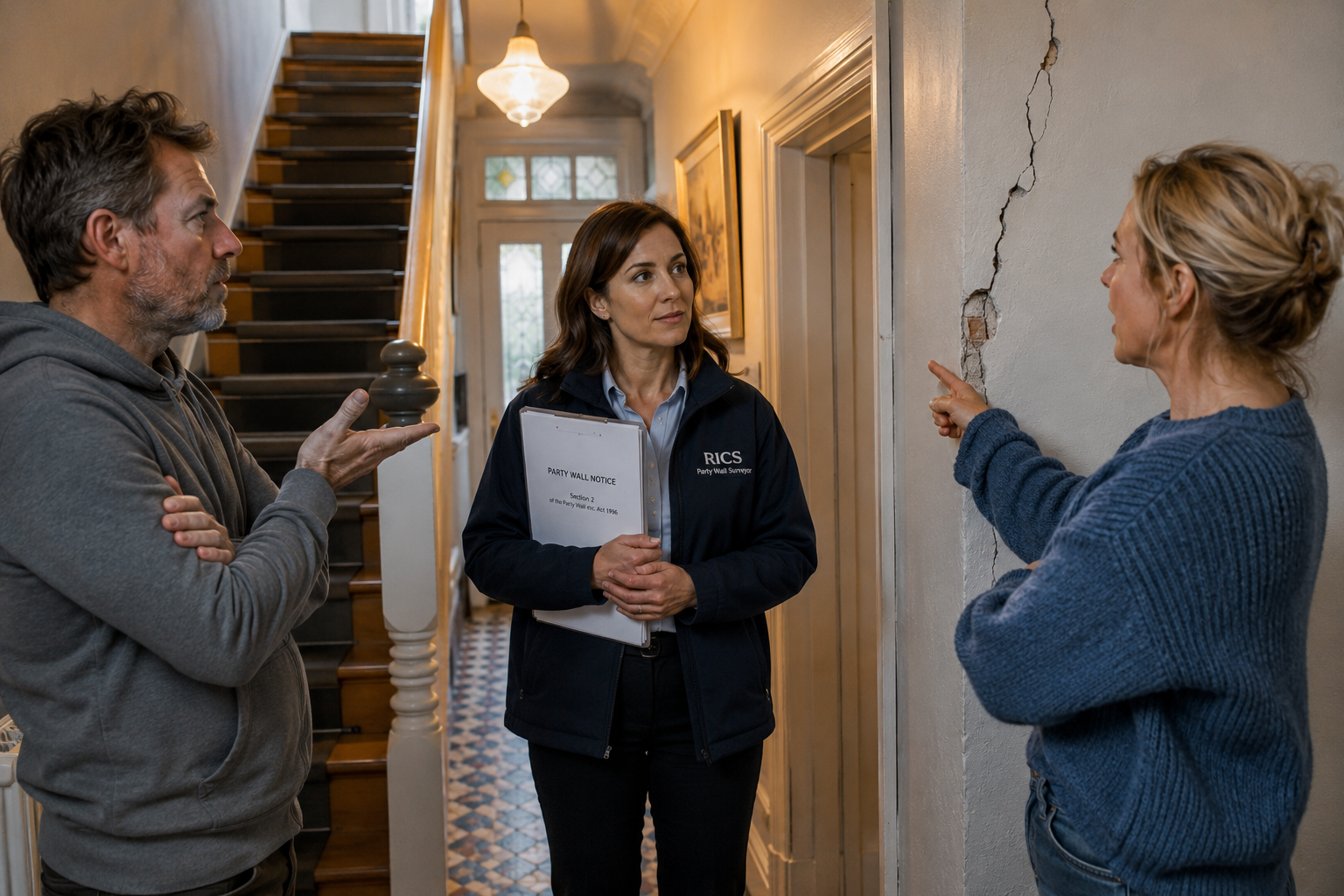
The party wall process is, at its core, a statutory mechanism designed to protect neighbours from each other. Yet the moment a building owner serves notice on an adjoining owner, the interaction becomes deeply personal. A homeowner receiving a party wall notice is not reading a neutral legal document — they are processing a signal that their home, their sanctuary, is about to be affected by someone else's ambitions.
Understanding this emotional reality is the foundation of emotional intelligence for party wall surveyors mastering neighbour disputes in high-stakes awards.
The Five Components of EI Applied to Surveying Practice
Psychologist Daniel Goleman's widely cited EI framework maps directly onto the surveyor's professional role:
| EI Component | Surveyor Application |
|---|---|
| Self-awareness | Recognising personal bias toward the appointing party |
| Self-regulation | Maintaining composure when adjoining owners become hostile |
| Motivation | Sustaining commitment to fair outcomes under pressure |
| Empathy | Understanding why a neighbour fears structural damage |
| Social skills | Facilitating productive dialogue between opposing parties |
RICS has long emphasised that surveyors must act impartially, avoiding bias and potential conflicts of interest to ensure fair and effective dispute resolution [3]. This impartiality standard is not merely a legal obligation — it is an EI discipline. A surveyor who cannot regulate their own emotional responses to a difficult client cannot credibly claim to be impartial.
Notice Refusals as Emotional Flashpoints
When an adjoining owner dissents from a party wall notice, the legal machinery of the Party Wall etc. Act 1996 activates automatically. But the human machinery — fear, resentment, distrust — activates first.
Common emotional drivers behind notice refusals include:
- Fear of structural damage to a property that represents a family's largest financial asset
- Distrust of the building owner, particularly in pre-existing neighbour conflicts
- Lack of understanding of what the notice actually requires or permits
- Perceived power imbalance, especially when the building owner has professional advisers and the adjoining owner does not
A surveyor with high EI recognises these drivers immediately. Rather than treating a dissent as a purely procedural event, they treat it as an opportunity to address the underlying concern. A brief, empathetic phone call explaining what the party wall notice means in plain language can, in many cases, convert a hostile dissent into a cooperative one — reducing costs and timelines for all parties.
"The surveyor who listens first and drafts second will always produce a more durable award than one who treats the process as purely technical."
De-Escalation Techniques During Award Negotiations
Award negotiations represent the highest-stakes phase of the party wall process. By this point, both parties have appointed surveyors, positions have hardened, and the financial and emotional investment in the dispute is significant. This is precisely where emotional intelligence for party wall surveyors mastering neighbour disputes in high-stakes awards delivers its greatest return.
Active Listening as a Professional Tool
Active listening is not passive silence. It is a deliberate technique involving:
- Reflecting back what a party has said before responding
- Naming emotions without amplifying them ("It sounds like you're concerned about the timeline")
- Separating positions from interests — a neighbour who demands the works stop may actually want assurance that their garden wall will be protected
- Asking open questions that invite elaboration rather than yes/no answers
When surveyors apply these techniques during site visits and joint meetings, they frequently uncover resolvable concerns that were obscured by combative language. For adjoining owners who feel their concerns are being heard, cooperation with the award process increases markedly.
Surveyors acting for adjoining owners carry a particular EI responsibility. As an adjoining owner's surveyor, the role demands genuine advocacy without becoming a proxy for the client's grievances. The distinction between representing an owner's legitimate interests and amplifying their emotional state is one that requires constant self-regulation.
Managing the Three-Surveyor Dynamic
When a third surveyor is appointed under Section 10 of the Party Wall etc. Act 1996, the dynamic shifts. The two party-appointed surveyors must now present their positions to a neutral adjudicator. This is a moment where EI failures are most costly.
Surveyors who have allowed their client's emotional state to infect their own professional judgment often present poorly in three-surveyor proceedings. They overstate technical arguments, dismiss the opposing party's concerns, and lose credibility with the third surveyor.
Surveyors with strong EI, by contrast, present clearly, acknowledge legitimate points made by the opposing surveyor, and demonstrate that their award position is grounded in the Act and in objective assessment — not in client pressure.
RICS ethics guidance reminds surveyors to adhere to professional practices that protect the reputation of the entire discipline [4]. In three-surveyor proceedings, this means the ability to disagree professionally, without personal animosity, and to accept a third surveyor's determination gracefully even when it goes against one's position.
Practical De-Escalation Strategies
The following strategies have proven effective in high-stakes award negotiations:
- Pre-meeting briefings: Brief each party separately before joint meetings to manage expectations and reduce the chance of ambush reactions
- Neutral venue selection: Conducting meetings on neutral ground rather than at either property reduces territorial defensiveness
- Written summaries after verbal discussions: Confirming what was agreed in writing immediately after a meeting prevents misremembering and reduces conflict at the next meeting
- Staged award disclosure: Where possible, share draft award provisions with both parties before finalising, allowing concerns to be raised without triggering a formal challenge
- Acknowledging uncertainty: When technical questions are genuinely uncertain, saying so builds more trust than false confidence
For building owners navigating this process, understanding the role of a building owner's surveyor and what to expect from award negotiations is essential context before tensions escalate.
EI, AI, and the Future of Party Wall Awards in 2026
The professional landscape for party wall surveyors has shifted considerably in 2026. On 9 March 2026, RICS mandated the "Responsible AI Use in Party Wall Awards" standard, requiring surveyors to maintain professional judgment over AI outputs and ensuring decisions are not solely automated [1]. This development has a direct and underappreciated connection to emotional intelligence.

Where AI Ends and EI Begins
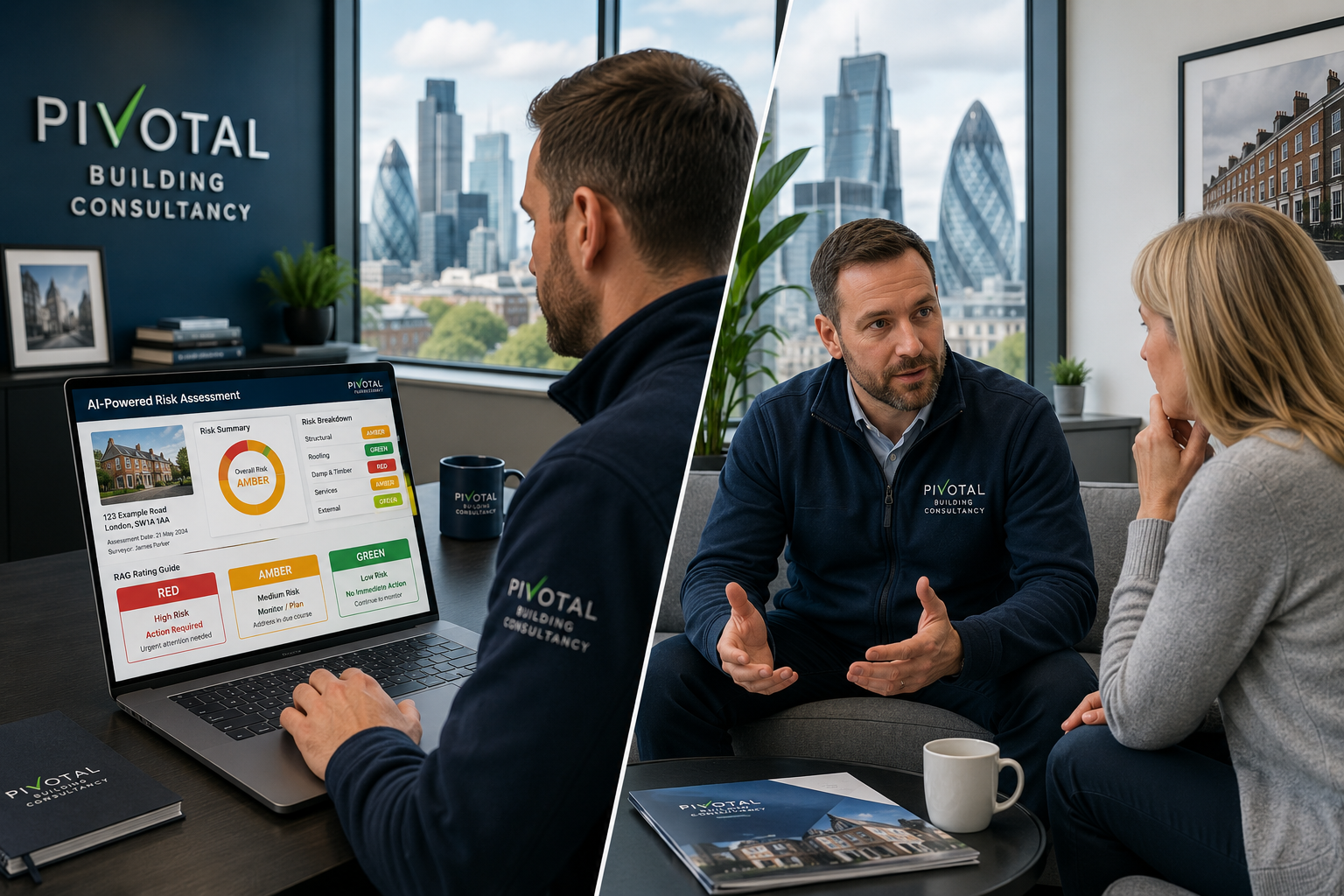
AI tools are now capable of drafting notice templates, predicting dispute risk factors based on property ownership patterns, and integrating with Building Information Modelling data to assess structural impacts [2]. Firms are required to maintain quarterly-reviewed risk registers using red/amber/green (RAG) ratings for each AI tool employed [1].
This standardisation is valuable. It reduces disputes arising from ambiguous documentation and improves the technical baseline of party wall practice. However, AI cannot:
- Sense that an adjoining owner is on the verge of withdrawing cooperation
- Recognise that a building owner's aggressive tone masks genuine anxiety about project costs
- Adapt communication style in real time based on a party's emotional state
- Build the trust that makes an award feel legitimate to both parties, not just legally enforceable
The effectiveness of AI in party wall risk assessment is also limited by data quality issues, including incomplete historical records and inconsistent data formats [5]. Where AI predictions are uncertain, the surveyor's EI — their ability to navigate ambiguity with clients — becomes the decisive factor.
Surveyors who combine technical expertise with emotional intelligence, including effective client communication and ethical decision-making, are positioned to gain a significant competitive advantage as AI handles routine tasks [2]. This is not a distant prediction. It is already the reality in 2026 for firms operating in competitive urban markets.
Data Consent and the Trust Dimension
RICS now requires surveyors to obtain express written consent before uploading any confidential party wall data to AI platforms [1]. This requirement has an EI dimension that is easy to overlook. Explaining to a nervous adjoining owner why their property data is being processed by an AI system, and securing their informed consent, requires exactly the kind of transparent, empathetic communication that EI training develops.
Surveyors who handle this conversation poorly — treating consent as a box-ticking exercise — risk undermining the trust they have built throughout the process. Those who handle it well demonstrate that their commitment to the client's interests extends beyond the technical scope of the award.
Integrating EI into Surveying Practice: A Framework
The following framework offers a structured approach to applying EI across the party wall process:
Stage 1 — Notice Service
- Anticipate the adjoining owner's emotional response before serving notice
- Prepare a plain-language summary to accompany formal documentation
- Make early contact to answer questions before positions harden
Stage 2 — Dissent and Appointment
- Treat dissent as information, not obstruction
- Conduct an empathy-led initial meeting to identify the adjoining owner's core concerns
- Document emotional as well as technical concerns in case notes
Stage 3 — Award Drafting
- Review draft award provisions through the lens of both parties' stated and unstated concerns
- Use the party wall award as an opportunity to address practical anxieties, not just legal obligations
- Consult the party wall contract template guide to ensure provisions are clear and unambiguous
Stage 4 — Award Finalisation and Works
- Brief both parties on what the award means in practical terms
- Establish a clear communication channel for concerns during works
- Conduct a post-works review to close the emotional as well as technical loop
For adjoining owners who find themselves on the receiving end of a building project, understanding their rights and the process through resources like what to do when my neighbour is carrying out works can reduce anxiety significantly before a surveyor is even appointed.
Building Long-Term Professional Reputation Through EI
The party wall surveying market in London and across the UK is competitive. Referrals — from solicitors, estate agents, architects, and satisfied clients — remain the primary source of new instructions for most practices. Those referrals are built on reputation, and reputation in this field is built on outcomes.
Outcomes are not purely technical. A party wall award that is technically correct but leaves both neighbours feeling unheard and resentful is a poorer professional outcome than one that achieves the same legal result while preserving the neighbourly relationship. The latter generates referrals. The former generates complaints.
Surveyors who invest in EI development — through training, supervision, and reflective practice — consistently report:
- Fewer formal challenges to awards
- Shorter dispute resolution timelines
- Higher client satisfaction scores
- Stronger referral networks
- Greater personal job satisfaction and reduced professional stress
For surveyors working across London's diverse neighbourhoods, from West London to South London and North London, the cultural and interpersonal diversity of clients makes EI not just valuable but essential. Different communities have different norms around conflict, authority, and negotiation. A surveyor with strong cross-cultural empathy navigates these differences with ease; one without it creates unnecessary friction.
Conclusion
Emotional intelligence for party wall surveyors mastering neighbour disputes in high-stakes awards is the professional capability that will define the next generation of practice leaders. The technical foundations of party wall surveying — statutory compliance, structural assessment, award drafting — remain essential. But they are increasingly supported by AI tools, standardised templates, and predictive analytics. What AI cannot replicate is the human capacity to sense fear, build trust, de-escalate conflict, and guide two neighbours toward an outcome they can both accept.
Actionable next steps for surveyors in 2026:
- Complete a structured EI assessment to identify personal development areas, particularly around self-regulation and empathy under pressure.
- Review current client communication practices at each stage of the party wall process and identify where emotional concerns are being missed or mishandled.
- Develop plain-language materials to accompany formal notice documentation, reducing the fear and confusion that drives unnecessary dissents.
- Engage with RICS guidance on impartiality and ethics as EI frameworks, not just compliance obligations.
- When integrating AI tools into practice, apply the same transparent, consent-led communication approach to clients that EI principles demand in all professional interactions.
The surveyors who thrive in this environment will be those who treat every notice, every dissent, and every award negotiation as both a technical and a human challenge — and who have the skills to meet both with equal competence.
References
[1] Responsible Ai Use In Party Wall Awards Rics March 2026 Standards For Automated Condition Monitoring – https://wimbledonsurveyors.com/responsible-ai-use-in-party-wall-awards-rics-march-2026-standards-for-automated-condition-monitoring/?utm_source=openai
[2] Responsible Ai Use In Party Wall Surveys Rics 2026 Standards For Dispute Prediction And Award Drafting – https://wimbledonsurveyors.com/responsible-ai-use-in-party-wall-surveys-rics-2026-standards-for-dispute-prediction-and-award-drafting/?utm_source=openai
[3] Party Wall Surveyors Impartiality – https://ww3.rics.org/uk/en/journals/built-environment-journal/party-wall-surveyors-impartiality.html?utm_source=openai
[4] Ethics And Party Wall Practice – https://ww3.rics.org/uk/en/journals/property-journal/ethics-and-party-wall-practice.html?utm_source=openai
[5] Ai Assisted Party Wall Risk Assessment Predictive Analytics For Identifying High Dispute Scenarios In 2026 – https://partywallsurveyorlondon.uk/blogs/ai-assisted-party-wall-risk-assessment-predictive-analytics-for-identifying-high-dispute-scenarios-in-2026/?utm_source=openai