

Fewer than one in five homeowners planning a new boundary wall realise that a single missed deadline — just 14 days of silence from a neighbour — is enough to make a surveyor appointment legally mandatory under English and Welsh law. The Party Wall Act for New Boundary Walls: When Notices Trigger Surveyors and How to Expedite Agreements is a topic that catches even experienced developers off guard, yet the rules are precise, the timelines are short, and the consequences of getting them wrong can delay construction by months and add thousands of pounds to project costs.
Understanding exactly when the Party Wall etc. Act 1996 applies to a new boundary wall — and knowing how to move efficiently through the notice and agreement process — is the single most effective way to protect a project's timeline and budget in 2026.
Key Takeaways
- A new wall on or astride the boundary line requires a formal Line of Junction Notice served at least 1 month before work begins.
- If a neighbour does not respond within 14 days, a dispute is automatically deemed to have arisen, making surveyor appointments legally required.
- Written consent from the adjoining owner within 14 days allows work to proceed without a surveyor or a formal Party Wall Award.
- Excavations within 3 m or 6 m of a neighbour's structure can trigger the Act independently of any wall on the boundary.
- Using an Agreed Surveyor — a single professional appointed by both parties — is the fastest and most cost-effective route to a binding Party Wall Award.
What the Party Wall Act Actually Covers for New Boundary Walls
The Party Wall etc. Act 1996 applies across England and Wales and governs three categories of work: works to existing party walls or party structures, new walls built at or astride the boundary line, and excavations near neighbouring buildings [10]. For homeowners and developers building a new boundary wall, the relevant provisions sit primarily under Section 1 of the Act, which deals with the "line of junction" — the legal term for the boundary between two properties.
It is important to understand the distinction between different types of boundary structures before serving any notice. A party fence wall is a wall that straddles the boundary and belongs jointly to both owners. A boundary wall built entirely within one owner's land is a different matter and does not automatically engage the Act. The guide on boundary wall rules and the difference between party fence walls and boundary walls provides a detailed breakdown of these distinctions, which directly affect whether a notice is required at all.
The Three Scenarios That Trigger a Notice
| Scenario | Notice Required | Minimum Notice Period |
|---|---|---|
| New wall built entirely within your land | No notice required | N/A |
| New wall built on the boundary line (line of junction) | Line of Junction Notice | 1 month |
| New wall built astride the boundary (partly on neighbour's land) | Line of Junction Notice + written consent | 1 month |
| Works to an existing party wall or party structure | Party Structure Notice | 2 months |
| Excavation within 3 m or 6 m of neighbour's structure | Adjacent Excavation Notice (Section 6) | 1 month |
Building a wall entirely within your own land, with no part crossing the boundary and no excavation near the neighbour's foundations, falls outside the Act's scope [1]. However, the moment any part of the proposed wall sits on or over the boundary, or when foundations are dug within the statutory proximity distances, the Act applies and formal notice becomes mandatory.
When Notices Trigger Surveyors: The 14-Day Rule Explained
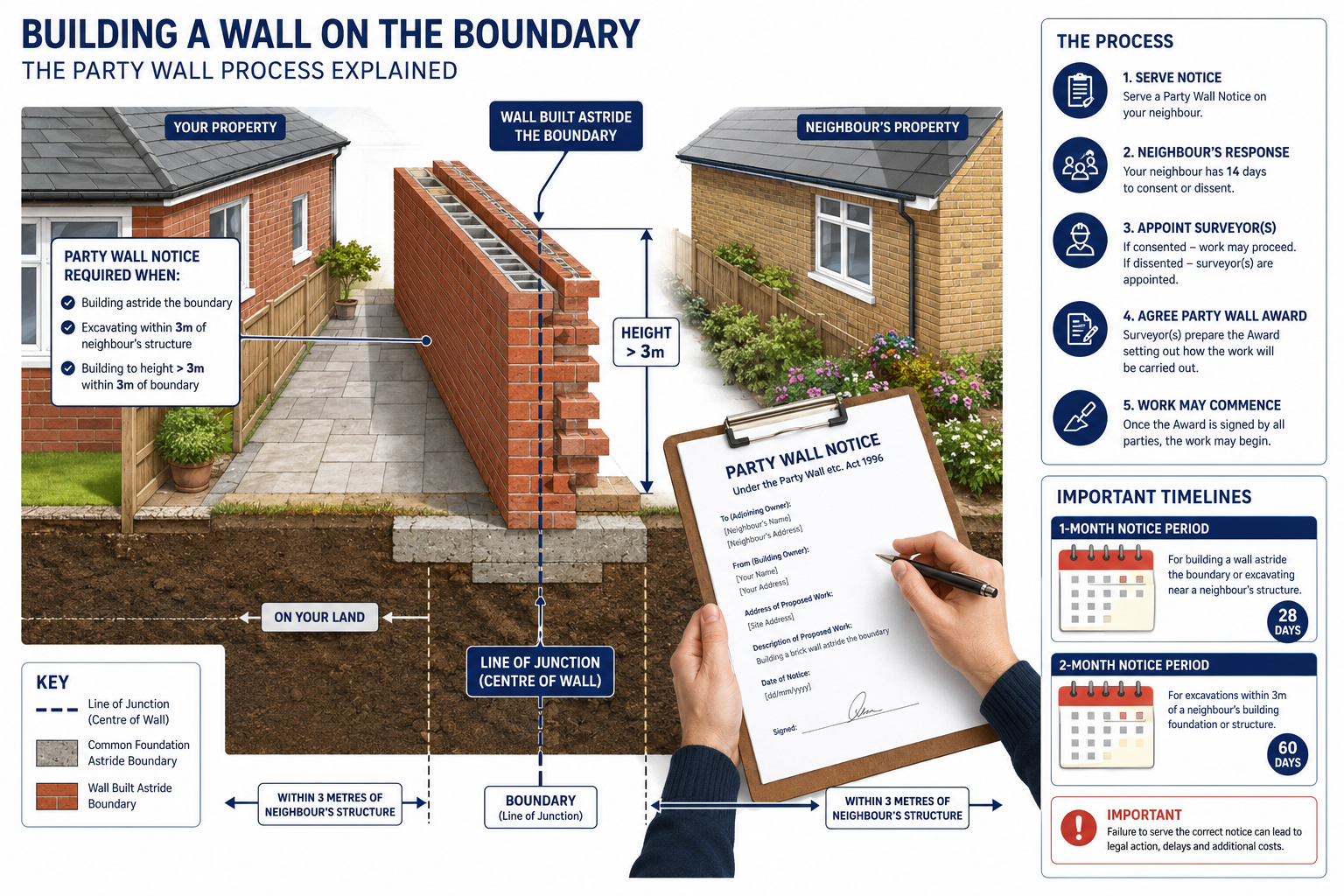
The most misunderstood element of the Party Wall Act for New Boundary Walls: When Notices Trigger Surveyors and How to Expedite Agreements is the 14-day response window. Once a valid Line of Junction Notice has been served, the adjoining owner has exactly 14 days to respond in writing [6]. The outcome of that 14-day period determines everything that follows.
Three Possible Outcomes After Serving Notice
1. Neighbour consents in writing within 14 days
Work can proceed without surveyors, without a Party Wall Award, and without any further statutory formality. This is the best-case outcome and the one every building owner should actively work towards.
2. Neighbour dissents in writing within 14 days
A dispute is formally triggered. Both parties must appoint surveyors — either a single Agreed Surveyor acting for both, or one surveyor each — and a Party Wall Award must be produced before work can start [8].
3. Neighbour does not respond within 14 days
Silence is treated as dissent under the Act. A dispute is automatically deemed to have arisen, and the surveyor appointment process begins regardless of whether the neighbour intended to consent or simply forgot to reply [6].
"No response within 14 days is legally equivalent to a formal objection. The building owner cannot simply proceed — the Act requires the dispute-resolution mechanism to run its course."
This 14-day rule is the primary reason projects stall. A neighbour who is travelling, unwell, or simply disorganised can inadvertently trigger a surveyor process that adds weeks or months to a project's start date. Understanding this risk in advance allows building owners to take practical steps to encourage a timely written response.
Section 6 Excavations: When the Wall Is Inside Your Land but the Foundations Are Not
Many boundary wall projects involve strip or piled foundations that extend deeper than the neighbour's existing foundations and fall within 3 m of the neighbour's structure. Even where the wall itself sits entirely within the building owner's land, this excavation proximity triggers a separate notice obligation under Section 6 of the Act [6][3].
The two excavation thresholds are:
- 3 m rule: Excavation within 3 m of a neighbouring building or structure, where the new excavation goes deeper than the neighbour's foundations.
- 6 m rule: Excavation within 6 m of a neighbouring building or structure, where a 45-degree line drawn downward from the bottom of the neighbour's foundations intersects the proposed excavation [6].
In practice, many boundary wall projects — particularly those involving extensions with new strip foundations — trigger Section 6 notices, which carry the same 14-day response window and the same risk of automatic dispute if the neighbour does not reply [2][7].
For a thorough overview of all notice types and how to respond to them correctly, the detailed resource on party wall notices — what they are and how to respond is an essential reference.
How to Expedite Agreements: Practical Strategies for Fast, Low-Cost Resolutions


The Party Wall Act for New Boundary Walls: When Notices Trigger Surveyors and How to Expedite Agreements does not have to be a slow or expensive process. The statute itself provides mechanisms for swift resolution, and experienced building owners use several well-established strategies to keep timelines short and costs manageable.
Strategy 1: Serve Notice Early and Communicate Proactively
The single most effective way to avoid a surveyor appointment is to speak with the neighbour before serving any formal notice. An informal conversation that explains the proposed works, their likely duration, and the neighbour's rights under the Act dramatically increases the likelihood of written consent within the 14-day window.
When the formal notice is served, it should be accompanied by:
- A clear, plain-English cover letter explaining what the notice means
- A copy of the proposed plans or drawings
- A pre-addressed reply envelope or email address for the written response
- A polite request for a response within 10 days (giving a small buffer before the 14-day statutory deadline)
For those who want to understand what a compliant notice looks like before drafting one, a free downloadable sample party wall agreement template is available and provides a reliable starting point.
Strategy 2: Use an Agreed Surveyor
If a dispute is triggered — whether by dissent or by silence — the fastest route to a Party Wall Award is appointing a single Agreed Surveyor who acts for both the building owner and the adjoining owner [4]. This avoids the delays inherent in two separately appointed surveyors negotiating through correspondence.
An Agreed Surveyor can typically produce a Party Wall Award significantly faster than a two-surveyor process, and the cost is shared between the parties rather than duplicated. The building owner's surveyor page provides more detail on how a building owner's surveyor operates and what to expect from the appointment process.
Strategy 3: Consent Without a Surveyor Where Possible
Where the neighbour is willing to consent but wants some form of written protection, it is sometimes possible to reach a party wall agreement without a surveyor — provided both parties are fully informed and the works are straightforward. This route is only appropriate for lower-risk projects and requires careful consideration of what protections each party genuinely needs.
Strategy 4: Instruct a Surveyor Promptly if Dispute Is Triggered
Delay after a dispute is deemed to have arisen does not pause the project — it simply extends the period during which no work can legally start. Once it is clear that surveyors are required, instructing a qualified party wall surveyor immediately is the fastest path to a completed Award and a legal start date.
Notice Template: Line of Junction Notice — Key Elements
A valid Line of Junction Notice must include:
| Element | Detail Required |
|---|---|
| Building owner's name and address | Full legal name and property address |
| Description of proposed works | Clear description of the new wall, its position, and dimensions |
| Statement of intention | Whether the wall is to be built on the boundary or astride it |
| Proposed start date | Must be at least 1 month after the notice date |
| Signature and date | Signed by or on behalf of the building owner |
Serving a defective notice — one that omits required information or gives insufficient notice — restarts the clock and can cause significant delays. Checking the notice against the statutory requirements in the Party Wall etc. Act 1996 explanatory booklet before service is strongly recommended [1].
Managing Costs Throughout the Process
Party wall costs are often higher than building owners anticipate, particularly when two surveyors are appointed and the Award process is protracted. Several practical steps can keep costs down:
- Serve notices for all relevant works at the same time rather than in stages
- Provide surveyors with complete drawings and information at the outset to avoid multiple site visits
- Respond promptly to all surveyor correspondence to avoid unnecessary delays
- Consider whether a schedule of condition can be agreed informally before a formal Award is needed
For a detailed breakdown of what drives costs and how to reduce them, the guide on how to keep party wall costs down covers the most common cost drivers and practical mitigation strategies.
Common Mistakes That Delay Boundary Wall Projects
Even well-prepared building owners make errors that trigger unnecessary delays. The most common include:
- Starting work before the notice period expires. The 1-month notice period is a minimum, not a guideline. Starting early exposes the building owner to injunctions and potential demolition orders [1].
- Serving notice on the wrong person. Notice must be served on the legal owner of the adjoining property, not a tenant or occupier. Land Registry checks before service are essential.
- Assuming verbal agreement is sufficient. The Act requires written consent. A neighbour who verbally agrees but does not put it in writing provides no statutory protection [8].
- Ignoring the excavation thresholds. Building owners who focus only on the wall and overlook the Section 6 excavation rules often find themselves in a dispute they did not anticipate [3].
- Failing to keep proof of service. If a dispute later arises about whether notice was properly served, documented proof — recorded delivery, process server certificate, or signed acknowledgement — is essential.
Conclusion
The Party Wall Act for New Boundary Walls: When Notices Trigger Surveyors and How to Expedite Agreements operates on tight statutory timelines that leave little room for error. The 14-day response window is the critical threshold: written consent within that period keeps the project on track without surveyors; silence or dissent triggers a formal dispute process that requires surveyor appointments and a Party Wall Award before any work can begin.
Actionable next steps for building owners in 2026:
- Confirm whether the proposed wall sits on, astride, or within the boundary — and whether any excavation falls within the 3 m or 6 m thresholds — before any other step is taken.
- Speak with the adjoining owner informally before serving formal notice to maximise the chance of written consent within 14 days.
- Serve a compliant Line of Junction Notice at least 1 month before the planned start date, with clear supporting information to help the neighbour make an informed decision.
- If a dispute is triggered, instruct a party wall surveyor immediately and propose an Agreed Surveyor to both parties to minimise time and cost.
- Keep documented proof of every step — notice service, responses, and all correspondence — throughout the process.
For property owners across the capital, specialist support is available from qualified surveyors covering North London, South London, East London, and West London, ensuring that every boundary wall project is handled correctly from the first notice to the final Award.
References
[1] The Party Wall Etc Act 1996 Explanatory Booklet – https://www.gov.uk/government/publications/preventing-and-resolving-disputes-in-relation-to-party-walls/the-party-wall-etc-act-1996-explanatory-booklet
[2] Watch – https://www.youtube.com/watch?v=LSTVHcPimTc
[3] Dont Let Your Extension Go To The Party Wall – https://www.cwj.co.uk/site/library/legalnews/dont_let_your_extension_go_to_the_party_wall.html
[4] Party Wall Agreement – https://hoa.org.uk/advice/guides-for-homeowners/i-am-improving/party-wall-agreement/
[6] In Plain English Party Wall Act – https://www.savills.ie/blog/article/274838/commercial-property/in-plain-english–party-wall-act.aspx
[7] Richardlenevefoster Partywallact Constructionlaw Surveying Activity – https://www.linkedin.com/posts/richardlenevefoster_partywallact-constructionlaw-surveying-activity-7284671718604824580-3Dsg
[8] Party Wall Agreements What You Need To Know – https://www.fmb.org.uk/find-a-builder/ultimate-guides-to-home-renovation/party-wall-agreements-what-you-need-to-know.html
[10] Party Walls Building Works – https://www.gov.uk/party-walls-building-works