


Nearly one in three construction-related neighbour disputes in London escalates beyond a simple exchange of letters before any formal process begins. In 2026, with the capital experiencing one of its most active building periods in over a decade, that statistic carries real financial weight. Resolving 2026 party wall disputes with RICS mediation — as illustrated by case studies from construction recovery projects — has become one of the most practical tools available to property owners who want to protect their assets without the cost and delay of court proceedings.
This article examines how RICS mediation frameworks, updated guidance, and real-world case patterns are reshaping the way surveyors and property owners handle shared-wall conflicts during active builds.
Key Takeaways
- The RICS 8th Edition Party Wall Guidance (May 2026) introduced clearer frameworks for surveyors, reducing procedural errors that trigger disputes.
- The new ACRE Mediation Service offers a structured, relationship-preserving alternative to litigation for property and construction conflicts.
- Most party wall disputes in 2026 stem from improperly served notices, unclear awards, or damage claims during excavation and loft works.
- RICS-mediated outcomes in construction recovery projects typically resolve faster and at lower cost than county court proceedings.
- Early engagement with a qualified surveyor and a properly drafted party wall award remains the single most effective dispute-prevention strategy.
Why Party Wall Disputes Are Surging in 2026
London's post-pandemic construction recovery accelerated sharply through 2024 and 2025, and 2026 has brought no slowdown. Basement conversions, loft extensions, and side-return additions are being carried out at record rates across inner and outer boroughs. Each project that touches a shared wall, shared structure, or boundary line triggers obligations under the Party Wall etc. Act 1996.
When those obligations are ignored or mishandled, disputes follow quickly. The most common flashpoints in 2026 include:
- Improperly served or missing party wall notices before works begin
- Disputed damage claims arising from excavation near foundations
- Ambiguous party wall awards that fail to specify working hours, access rights, or reinstatement obligations
- Failure to commission a schedule of condition before works start, leaving both parties arguing about pre-existing versus new damage
"The volume of active sites in London means surveyors are under pressure, and procedural shortcuts are creating disputes that a properly drafted award would have prevented entirely."
The release of the RICS 8th Edition Party Wall Guidance in May 2026 directly addressed many of these failure points [1]. However, implementation has not been seamless. Surveyors across London are still adapting their practice to the updated framework, and compliance gaps are contributing to a backlog of contested awards [1].
The RICS Mediation Framework in 2026
What Changed with the 8th Edition Guidance
RICS published the 8th edition of its Party Wall Legislation and Procedure guidance in May 2026, following a formal consultation process that gathered input from practising surveyors, solicitors, and property owners [6]. The revised guidance places greater emphasis on:
- Correct service of party wall notices and the consequences of defective service
- The surveyor's duty to act impartially, regardless of who appointed them
- Clearer standards for drafting party wall awards that reduce ambiguity
- Protocols for dealing with emergency situations during live construction projects
The guidance does not create new law, but it sets the professional standard against which surveyors are measured. A surveyor who departs from the 8th edition framework without good reason faces professional risk [5].
The ACRE Mediation Service
In March 2026, RICS launched the Analytical, Commercial, Restorative, and Expert (ACRE) Mediation Service, specifically designed for disputes in the property and construction sectors [2]. ACRE differs from traditional mediation in several important ways:
| Feature | Traditional Mediation | ACRE Mediation |
|---|---|---|
| Mediator expertise | General dispute resolution | Property and construction specialist |
| Focus | Settlement of current dispute | Preserving ongoing business relationships |
| Process flexibility | Moderate | High — tailored to project stage |
| Outcome type | Negotiated settlement | Can include expert determination elements |
| Typical timeline | 4-8 weeks | 2-6 weeks |
For construction recovery projects — where a dispute has already caused delay and both parties need to resume works — ACRE's emphasis on speed and relationship preservation is particularly valuable [2].
The Boundary Disputes Mediation Service
Running alongside ACRE, RICS continues to operate the Boundary Disputes Mediation Service, a joint initiative with the Property Litigation Association [3]. While boundary disputes and party wall disputes are legally distinct, they frequently overlap in practice. A loft extension that encroaches on a boundary line, or an excavation that undermines a boundary wall, can trigger both sets of rules simultaneously.
The boundary mediation service provides a cost-effective route for neighbours who need a neutral expert to interpret title deeds, plans, and physical evidence without going to court [3].
Case Studies: Resolving 2026 Party Wall Disputes with RICS Mediation in Construction Recovery Projects
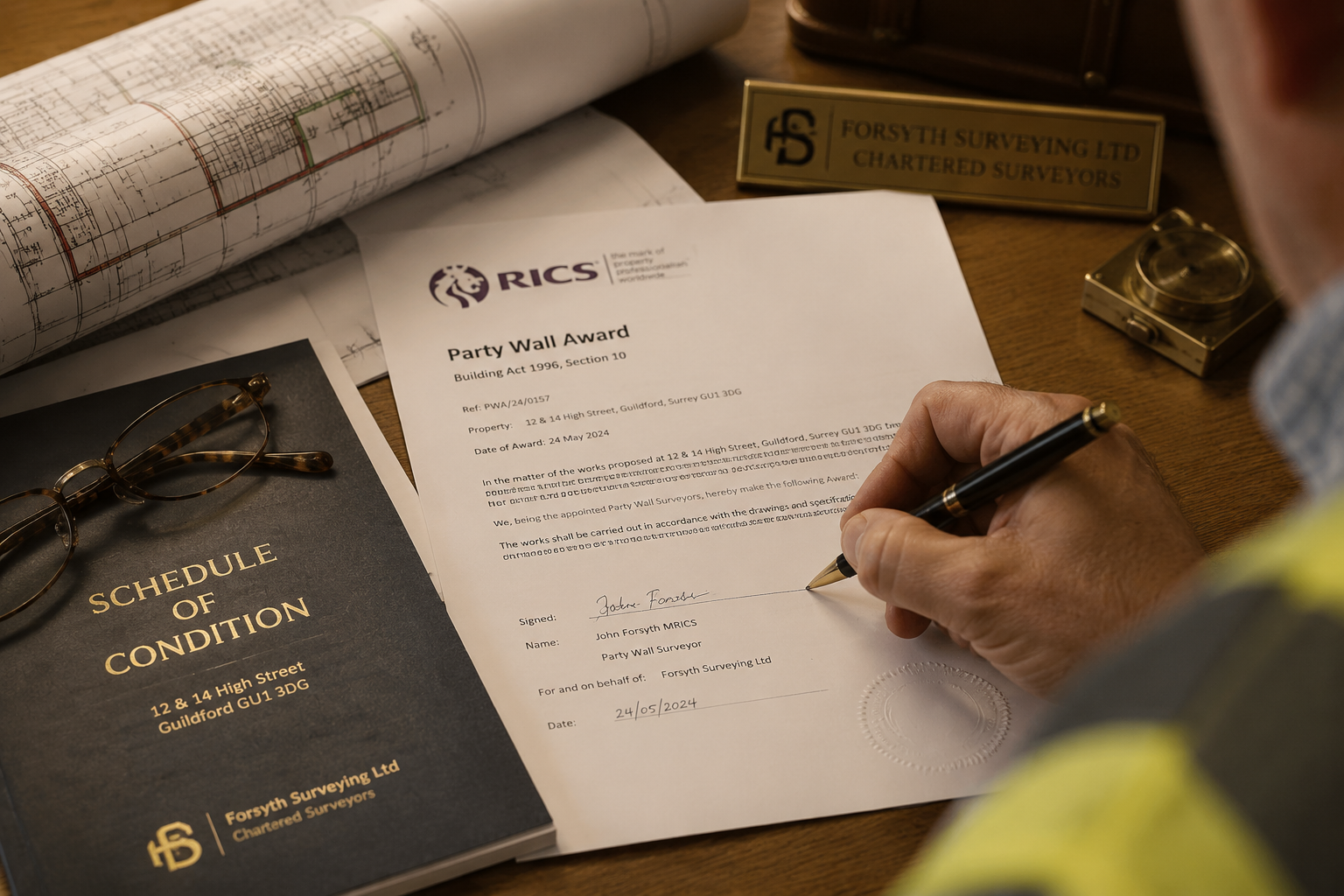

The following case studies are drawn from patterns typical of 2026 construction recovery disputes. They illustrate how RICS mediation frameworks have been applied in practice.
Case Study 1: Basement Excavation Dispute in South London
Background: A building owner in a Victorian terrace began a basement conversion without serving the required party structure notice on the adjoining owner. Excavation proceeded to a depth that triggered the three-metre rule under the Act. Within six weeks, the adjoining owner reported cracks in their kitchen wall and a sticking door frame.
The dispute: The adjoining owner alleged the excavation had undermined their foundations. The building owner's contractor disputed causation, arguing the cracks were pre-existing. No schedule of condition had been commissioned before works began.
RICS mediation outcome: An RICS-appointed mediator facilitated a joint inspection with a structural engineer. The absence of a pre-works schedule of condition meant the building owner could not disprove causation. The mediated settlement required the building owner to fund remedial works to the cracked wall and door frame, pay the adjoining owner's surveyor fees, and commission a retrospective party wall award before works resumed.
Key lesson: A schedule of condition, commissioned before any notifiable works begin, is one of the cheapest forms of insurance available to a building owner. Its absence in this case cost the building owner significantly more than the original surveyor fee would have.
Case Study 2: Loft Extension Dispute in North London
Background: A building owner in a semi-detached property served a party structure notice for a loft extension. The adjoining owner dissented and appointed their own surveyor. The two surveyors failed to agree on the award, and a third surveyor was appointed under the Act.
The dispute: The third surveyor issued an award, but the building owner challenged it on the grounds that it imposed unreasonable working hour restrictions and required access to the adjoining property for works that the building owner argued could be completed from their own side.
RICS mediation outcome: Rather than proceeding to a county court appeal — which carries a 14-day time limit and significant legal costs — the parties agreed to RICS mediation. The mediator, a specialist building surveyor, reviewed the technical drawings and confirmed that three of the five disputed conditions in the award were more restrictive than necessary. A revised award was agreed within three weeks, and works resumed without court involvement.
Key lesson: Appealing a party wall award to the county court is an adversarial, time-limited process. RICS mediation offers a faster, less expensive route to a revised outcome, particularly where the dispute is technical rather than relational.
Case Study 3: Construction Recovery Project — Disputed Damage After Contractor Insolvency
Background: A contractor carrying out party wall works in East London became insolvent mid-project. The building owner engaged a replacement contractor, but the adjoining owner disputed whether the new contractor was bound by the original party wall award. Damage to the shared wall had occurred before the insolvency, and the adjoining owner sought compensation.
The dispute: The building owner argued the award obligations transferred with the project. The adjoining owner argued the award needed to be reissued to cover the new contractor's works. Both parties faced significant delay costs.
RICS mediation outcome: The ACRE Mediation Service was engaged given the commercial complexity. The mediator confirmed that the original award remained valid but recommended a supplementary award to address the specific methods the new contractor would use. Compensation for the pre-insolvency damage was agreed as a lump sum, avoiding the need to trace the insolvent contractor through legal proceedings. Works resumed within five weeks of mediation commencing [2].
Key lesson: Contractor insolvency during party wall works creates legal uncertainty. RICS mediation, particularly through the ACRE framework, can resolve multi-party commercial disputes faster than litigation, especially when the primary goal is resuming construction.
Practical Strategies for Preventing Escalation
Resolving 2026 party wall disputes with RICS mediation is most effective when parties understand the prevention strategies that reduce the likelihood of reaching that stage.
Serve Notices Correctly and on Time
The Party Wall Act notice process requires specific notice periods depending on the type of work. Line of junction notices require one month. Party structure notices require two months. Notices served too late, or served on the wrong person, are a leading cause of disputes in 2026.
Building owners who are uncertain about their obligations can review the types of party wall works that trigger the Act before engaging a surveyor.
Draft a Robust Party Wall Award
A well-drafted award anticipates problems rather than simply recording agreement. It should specify:
- Working hours and permitted noise levels
- Access rights and notice periods for access
- Materials and methods to be used
- Reinstatement obligations if damage occurs
- Dispute resolution steps if the award is breached
Reviewing a party wall contract template and award guide before instructing a surveyor helps building owners understand what a thorough award looks like.
Commission a Schedule of Condition
As the South London case study demonstrates, the absence of a pre-works schedule of condition leaves building owners exposed to unverifiable damage claims. A schedule documents the existing state of the adjoining property — cracks, settlement, damp patches — before any vibration or excavation begins.
Understand the Costs Before Committing
Party wall disputes are expensive. Mediation is significantly cheaper than litigation, but prevention is cheaper still. Understanding how to keep party wall costs down from the outset — including the option of an agreed surveyor where both parties consent — can reduce the financial exposure of all parties.
The Role of the RICS Mediation Scheme in Construction Recovery
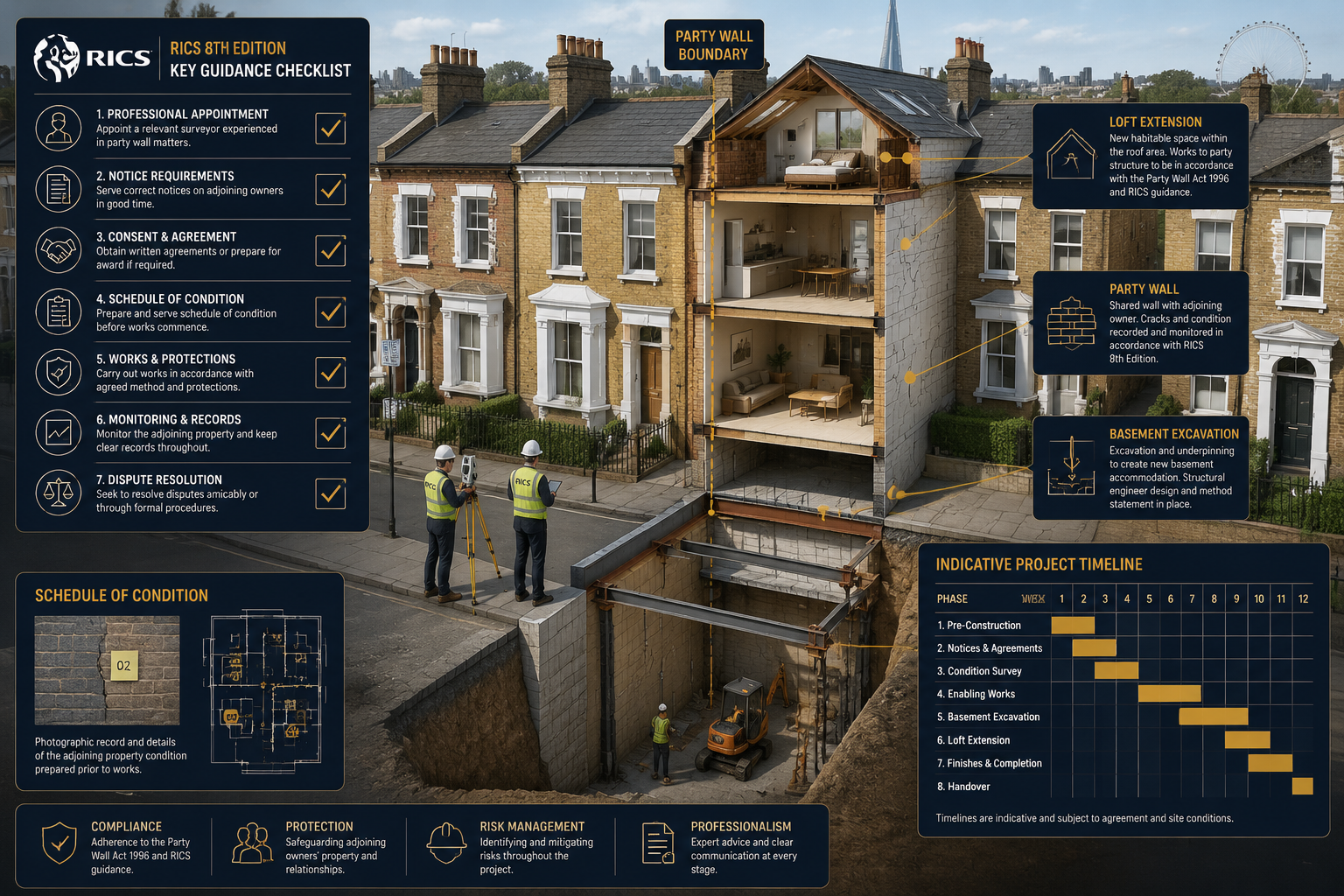
The RICS Mediation Scheme for land, property, and construction disputes provides a structured process that sits between informal negotiation and formal litigation [4]. For construction recovery projects specifically — where a dispute has already caused delay, cost overruns, or structural damage — the scheme offers several advantages:
Speed: Most RICS-mediated party wall disputes resolve within two to six weeks, compared to six to eighteen months for county court proceedings.
Cost: Mediation fees are a fraction of litigation costs. For disputes involving sums under £50,000 — which covers the majority of party wall damage claims — the cost differential is substantial.
Confidentiality: Mediation outcomes are not public record. This matters for neighbours who will continue to live adjacent to each other after the dispute resolves.
Flexibility: A mediator can propose solutions that a court cannot order — such as a phased construction schedule, a shared access arrangement, or a joint monitoring protocol for structural movement.
Preservation of relationships: The ACRE framework specifically focuses on restoring working relationships, which is essential when construction works need to continue after the dispute is resolved [2].
The 8th edition guidance reinforces the expectation that surveyors will consider mediation before advising clients to pursue court appeals [1][5]. Surveyors who fail to explore mediation options may face professional scrutiny if a dispute escalates unnecessarily.
When Mediation Is Not Enough
RICS mediation resolves the vast majority of party wall disputes that enter the process. However, there are circumstances where it is not the appropriate route:
- Where one party refuses to engage in good faith
- Where the dispute involves a point of law that requires judicial determination
- Where injunctive relief is needed urgently to stop ongoing damage
- Where the building owner has committed a criminal act under the Act (rare but possible)
In these cases, county court proceedings remain the correct route. The 14-day appeal window for party wall awards is strict, and building owners or adjoining owners who believe an award is unlawful should seek legal advice immediately rather than waiting for mediation to fail.
For adjoining owners who are concerned about works being carried out next door, the adjoining owners section of this site provides a clear overview of rights and options.
Conclusion
The surge in construction activity across London in 2026 has made party wall disputes more common, more complex, and more expensive to resolve through traditional channels. Resolving 2026 party wall disputes with RICS mediation — as demonstrated by the case studies from construction recovery projects reviewed here — offers a faster, cheaper, and more relationship-preserving alternative to court proceedings in the majority of cases.
The RICS 8th Edition Party Wall Guidance and the new ACRE Mediation Service represent a significant upgrade in the tools available to surveyors and property owners. But the most effective strategy remains prevention: serve notices correctly, commission a schedule of condition, draft a thorough award, and engage a qualified surveyor before works begin rather than after a dispute has already taken hold.
Actionable next steps for property owners in 2026:
- Before starting any notifiable works, confirm which notices are required and serve them within the correct timeframes.
- Instruct a qualified party wall surveyor to draft a robust award that addresses access, damage, and reinstatement in detail.
- Commission a schedule of condition of the adjoining property before any excavation or structural works begin.
- If a dispute arises, contact RICS Dispute Resolution Services to explore mediation before considering a court appeal.
- If works are already underway and a dispute has escalated, seek specialist advice immediately — the 14-day appeal window for party wall awards is unforgiving.
For property owners and surveyors across London, understanding both the legal framework and the mediation options available in 2026 is not optional. It is essential.
References
[1] Rics 8th Edition Party Wall Guidance 2026 Implementation Challenges And Surveyor Compliance Strategies – https://wimbledonsurveyors.com/rics-8th-edition-party-wall-guidance-2026-implementation-challenges-and-surveyor-compliance-strategies/?utm_source=openai
[2] Acre Mediation – https://www.rics.org/dispute-resolution-service/drs-services/mediation-services/acre-mediation?utm_source=openai
[3] Boundary Disputes Mediation Service – https://www.rics.org/dispute-resolution-service/drs-services/consumer-disputes/boundary-disputes-mediation-service?utm_source=openai
[4] Rics Mediation Scheme For Property And Building Maintenance Disputes Jan 2024 – https://www.rics.org/content/dam/ricsglobal/documents/dispute-resolution-service/RICS-Mediation-Scheme-for-property-and-building-maintenance-disputes-Jan-2024.pdf?utm_source=openai
[5] Party Wall Legislation And Procedure – https://www.rics.org/profession-standards/rics-standards-and-guidance/sector-standards/building-surveying-standards/party-wall-legislation-and-procedure?utm_source=openai
[6] Viewcompounddoc – https://consultations.rics.org/party_walls_8th_edition_guidance/viewCompoundDoc?docid=16799988&partid=16800244&pfv=y&utm_source=openai