


{"cover":"Professional landscape format (1536×1024) hero image with bold text overlay: 'Surveyor Decision-Making in Party Wall Awards: Inclusion Protocols for Building Owners' in extra large 70pt white sans-serif font with dark semi-transparent background panel, centered upper third. Background shows two professional surveyors in hard hats reviewing architectural drawings beside a brick party wall in an urban London setting, with legal documents and a gavel subtly visible. Color scheme: deep navy blue, white, gold accents. Magazine cover quality, editorial style, high contrast, 2026 case law theme.","content":["Wide-angle landscape format (1536×1024) showing a formal surveyor tribunal setting: two party wall surveyors seated across a conference table with architectural plans, a party wall award document prominently displayed between them, and a third surveyor figure in the background. Legal textbooks and RICS guidance notes visible on shelves. Lighting is professional and neutral. Color palette: charcoal grey, white, steel blue. Editorial quality, clean composition, impartiality and decision-making theme.","Overhead bird's-eye landscape format (1536×1024) depicting a split-view diagram: on the left, a building owner reviewing a party wall notice checklist with a surveyor pointing to inclusion protocol steps; on the right, a flowchart showing the award-making process with boxes labeled Notice, Schedule of Condition, Award, and Appeal. Documents, measuring tools, and a London townhouse cross-section blueprint spread across a large table. Color scheme: warm amber, white, dark grey. Infographic-style, process-focused, professional.","Close-up landscape format (1536×1024) of a legal professional's hands holding a party wall award document with a County Court stamp visible, a calendar showing a 14-day appeal window marked in red, and a gavel resting beside a stack of case law reports. Background shows blurred courtroom or legal office setting with bookshelves. Color palette: deep burgundy, cream, black. Dramatic lighting, accountability and appeal process theme, editorial quality."]

Fewer than one in five building owners fully understand what a party wall surveyor is legally permitted to include in a formal award — and that gap in knowledge is costing property developers, homeowners, and contractors thousands of pounds in disputed works, delayed projects, and avoidable litigation. Surveyor Decision-Making in Party Wall Awards: Inclusion Protocols for Building Owners Under Evolving 2026 Case Law has become one of the most pressing areas of property law in England and Wales, driven by tightening judicial scrutiny, a major RICS consultation underway in 2026, and a growing body of case law that is reshaping how surveyors document, justify, and defend their decisions.
Understanding how surveyors balance transparency with procedural control — and how building owners can remain informed without undermining the impartiality that makes awards legally valid — is no longer optional knowledge. It is a practical necessity.
Key Takeaways
- Party wall surveyors act as a quasi-judicial tribunal and must remain impartial regardless of who appointed them, a principle reinforced by RICS 8th Edition draft guidance published in 2026.
- Courts are increasingly invalidating awards where surveyors have exceeded their jurisdiction or failed to provide reasoned, balanced decisions — making procedural compliance more critical than ever.
- Building owners have defined rights to inclusion in the award process, but those rights must be exercised through proper channels to avoid compromising surveyor impartiality.
- Retrospective party wall awards issued after works have begun without notice are not legally binding under the Party Wall etc. Act 1996.
- Appeals against awards must be lodged with the County Court within 14 days of service, and grounds must go beyond simple dissatisfaction with the outcome.
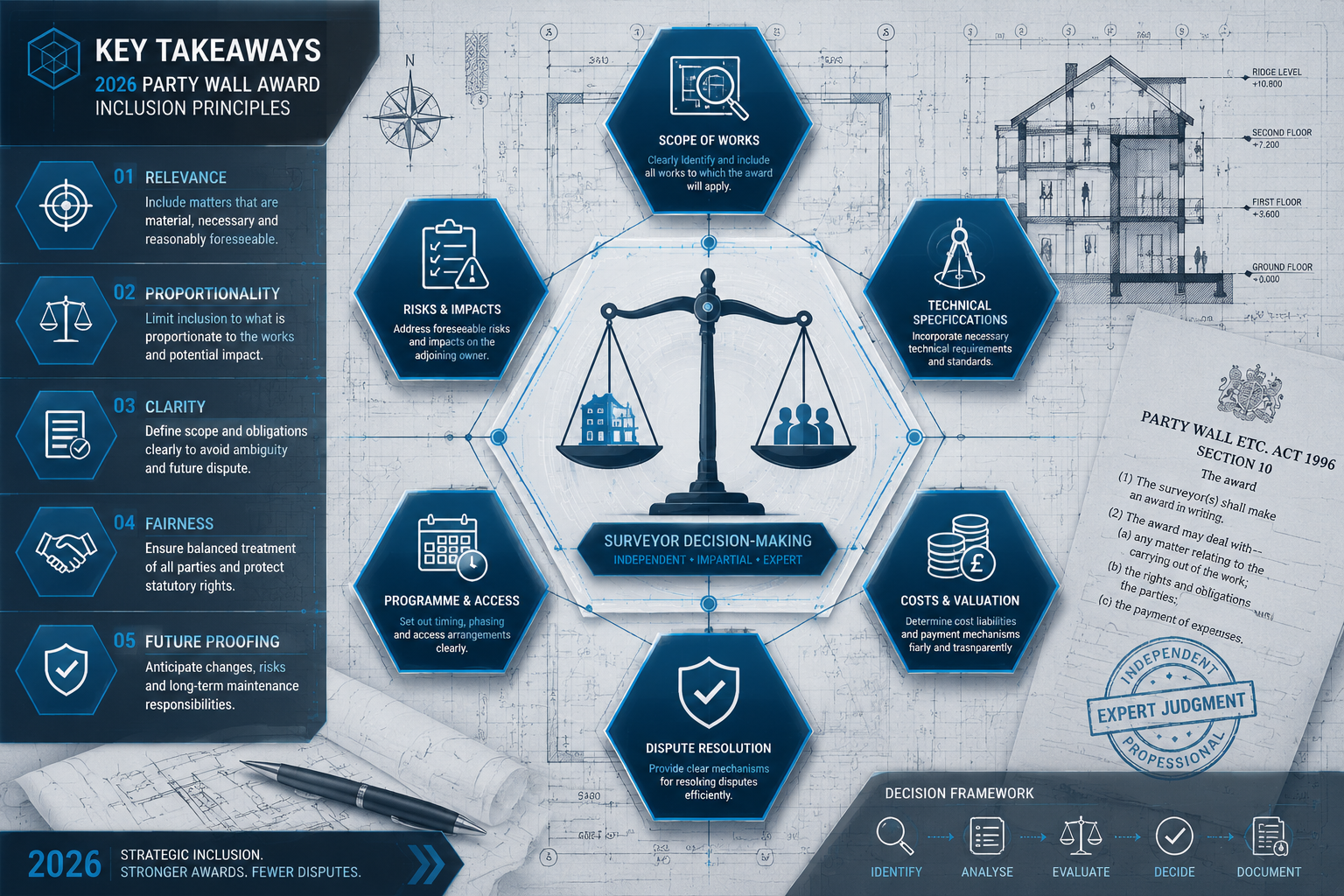
The Surveyor's Role: A Quasi-Judicial Function With Real Accountability
The starting point for understanding inclusion protocols is grasping what a party wall surveyor actually is in legal terms. Under the Party Wall etc. Act 1996, appointed surveyors do not act as advocates for the party who appointed them. Instead, they form what the RICS 8th Edition draft guidance describes as a "practical tribunal" — a body tasked with resolving disputes between building and adjoining owners through the mechanism of a formal award [1].
This distinction matters enormously for building owners. Many assume that their appointed surveyor will push for the most permissive award possible on their behalf. In practice, the law requires the opposite. A surveyor who acts purely in the interests of the appointing party risks producing an award that is challengeable, unenforceable, or subject to successful appeal.
What surveyors can include in an award:
- Permission to carry out specified notifiable works
- Conditions under which those works may proceed
- Protective measures for the adjoining owner's property
- A schedule of condition documenting pre-existing property states
- Provisions for access, working hours, and noise controls
- Allocation of costs between the parties
What surveyors cannot include:
- Provisions that fall outside the scope of the notified works
- Conditions that amount to an abuse of the award mechanism
- Retrospective authorisation for works already completed without notice [3]
- Terms that are punitive rather than protective in nature
The RICS draft guidance also makes clear that surveyors, despite their quasi-judicial function, do not enjoy judicial immunity. They remain subject to professional regulation, and their awards can be appealed to the County Court within 14 days of service under section 10(17) of the Act [1]. This accountability framework is what gives the award process its credibility — and it is precisely why building owners need to understand the boundaries of surveyor authority before works begin.
For building owners who want to understand their position in detail, the building owner's guide to the party wall process provides a useful foundation.
Inclusion Protocols for Building Owners: Rights, Limits, and Evolving 2026 Case Law

The phrase "inclusion protocols" refers to the formal and informal mechanisms through which building owners participate in the award-making process. Surveyor Decision-Making in Party Wall Awards: Inclusion Protocols for Building Owners Under Evolving 2026 Case Law is not simply about what goes into an award — it is about how building owners can legitimately influence that content without crossing the line into improper interference.
Serving Proper Notice: The Non-Negotiable First Step
No inclusion protocol is available to a building owner who has not served a valid party wall notice. This is not a procedural technicality — it is a jurisdictional requirement. Without a valid notice, no award can lawfully be made, and any works carried out are potentially actionable as a trespass or nuisance at common law [3].
The Party Wall etc. Act 1996 framework sets out the specific notice requirements depending on the type of work proposed. Building owners should serve notice at least two months before proposed works begin for party structure works, or one month for line of junction works.
Submitting Representations to the Surveyor
Once the surveyor appointment process is underway, building owners have a legitimate right to submit representations — written statements of their position, proposed working methods, and any specific conditions they believe are appropriate. These representations form part of the record that surveyors must consider when drafting the award.
The case of Walsh v PSB Management, referenced in 2026 commentary, illustrates why this matters. Courts have held that awards must demonstrate balanced consideration of both parties' submissions and provide reasoned explanations for the decisions reached [4]. An award that ignores substantive representations from either party is vulnerable to appeal.
"A party wall award that cannot show it weighed both parties' positions is not merely unfair — it is legally fragile."
This principle creates a practical obligation on building owners: submit clear, documented representations early in the process. Vague verbal instructions to a surveyor are far less useful than a written statement of the proposed works, the methods to be used, and the protections the building owner is prepared to accept.
The Third Surveyor Mechanism
Where the two appointed surveyors cannot agree on the content of an award, either surveyor may refer the matter to a third surveyor, selected at the outset of the dispute process. The RICS 8th Edition draft guidance details this mechanism as a critical safeguard against deadlock [1].
Building owners should understand that the third surveyor does not act as an arbitrator appointed by either party. The third surveyor's role is to resolve the specific disagreement between the two appointed surveyors, and their determination is binding. This mechanism is designed to keep construction projects moving — but it also means that a building owner cannot simply replace a surveyor they disagree with mid-process.
Costs and Their Allocation
The draft RICS guidance specifies that reasonable costs — including surveyor fees and the fees of other appropriate advisers — are to be determined by the surveyors, provided they have been properly incurred [5]. In most cases, the building owner bears the costs of the party wall process, since they are the party proposing the works.
However, costs can be allocated differently where the adjoining owner's conduct has unreasonably increased the expense of the process. Building owners who believe costs have been inflated unfairly should raise this through their appointed surveyor rather than by withholding payment, which can create separate legal complications.
For practical guidance on managing the financial side of the process, the guide to keeping party wall costs down offers actionable strategies.
Transparency, Impartiality, and the 2026 Case Law Landscape
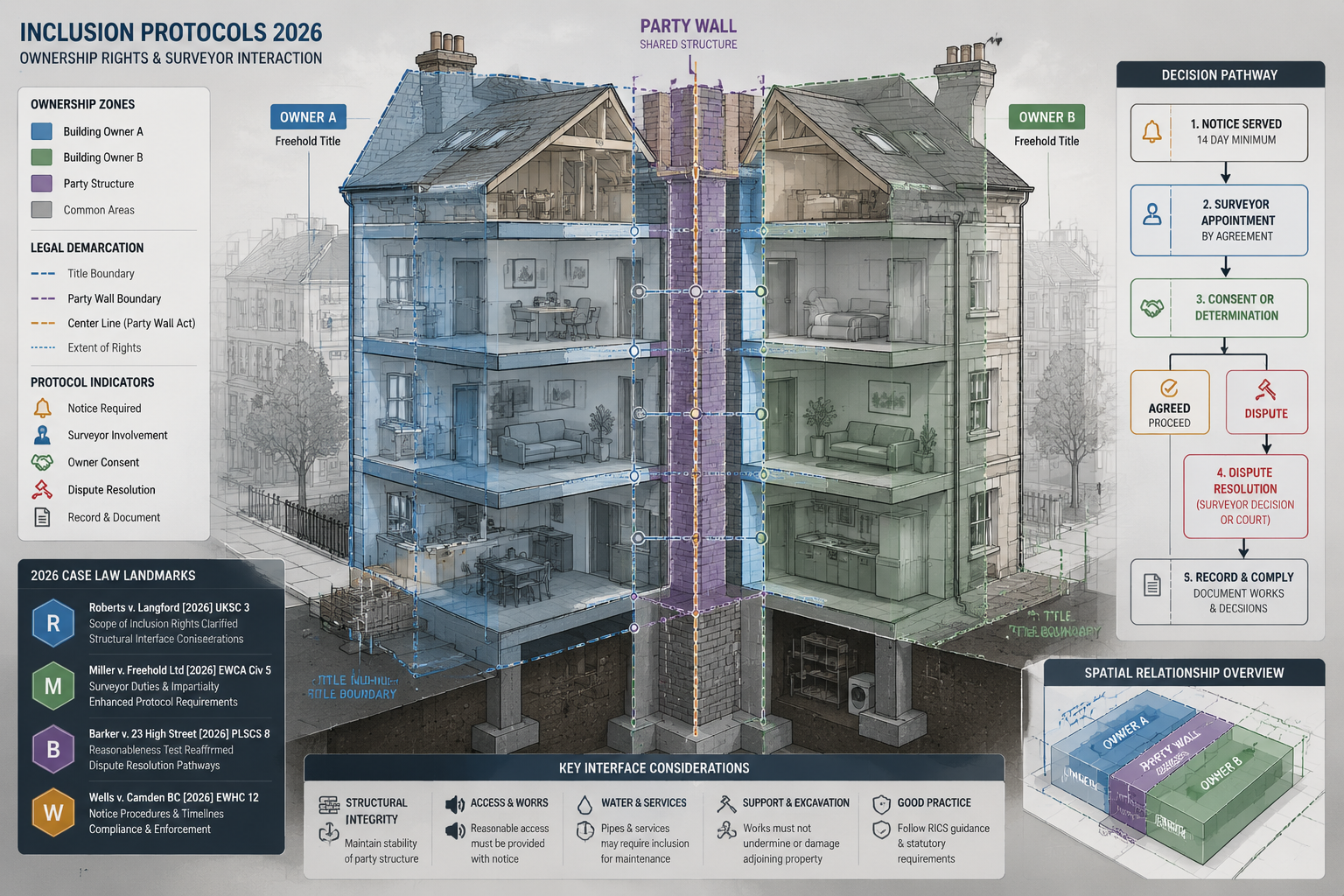
The central tension in Surveyor Decision-Making in Party Wall Awards: Inclusion Protocols for Building Owners Under Evolving 2026 Case Law is the relationship between transparency and impartiality. Building owners want to know what is in their award, why specific conditions have been imposed, and how the surveyor reached their conclusions. Surveyors, meanwhile, must protect the integrity of their quasi-judicial function.
How Courts Are Responding in 2026
Recent case law trends show a clear pattern: courts are more willing than at any previous point to scrutinise the reasoning behind party wall awards and to invalidate those that fall short [2]. The grounds for successful challenges in 2026 have included:
| Ground for Challenge | Outcome |
|---|---|
| Surveyor exceeded statutory jurisdiction | Award set aside |
| No reasoned explanation for key conditions | Award remitted for reconsideration |
| Failure to consult both parties on material changes | Award partially invalidated |
| Retrospective award for works already completed | Award held non-binding |
| Evidence of partiality toward appointing party | Award set aside; costs awarded against surveyor |
This table reflects a broader shift in judicial attitude. The courts are treating the party wall award process not as a rubber-stamp exercise but as a genuine dispute resolution mechanism that must meet minimum standards of procedural fairness [4].
What Building Owners Can Legitimately Expect
Transparency in the award process does not mean that building owners have the right to dictate terms. It means they have the right to:
- Receive a copy of the completed award promptly after it is made
- Understand the basis for any conditions imposed on their works
- Challenge any condition they believe exceeds the surveyor's jurisdiction
- Appeal the award to the County Court within 14 days if grounds exist [6]
What building owners cannot do is pressure their appointed surveyor to produce an award that ignores the legitimate interests of the adjoining owner. Surveyors who yield to such pressure risk producing an award that is challenged successfully — which ultimately harms the building owner's project timeline far more than a balanced award would have done.
The Retrospective Award Problem
One of the clearest examples of how case law is protecting the integrity of the process is the treatment of retrospective awards. Legal interpretation in 2026 confirms that an award cannot retrospectively authorise works that have already been carried out without proper notice [3]. Building owners who begin notifiable works before completing the party wall process do not simply face a procedural irregularity — they face potential injunctions, damages claims, and the loss of the statutory protections the Act was designed to provide.
The party wall notices overview sets out the specific notice types and timelines that must be followed to maintain the protection of the Act.
Surveyor Impartiality: The Cornerstone of Award Validity
The RICS 8th Edition draft guidance reiterates that impartiality is not optional — it is the foundation upon which the entire party wall award system rests [1]. A surveyor who is seen to be acting as an advocate for the appointing party rather than as an impartial decision-maker exposes their award to challenge and exposes themselves to professional regulatory action.
For building owners, this means that the most effective strategy is not to seek a surveyor who will "fight their corner" but to seek a surveyor who will produce a well-reasoned, properly documented award that will withstand scrutiny. A robust award protects the building owner's right to proceed with their works — which is, ultimately, the outcome they need.
Building owners in different parts of London can access specialist advice through regional surveyor services, including party wall surveyors in West London, South London, and North London.
Practical Steps for Building Owners in 2026
Given the evolving legal landscape, building owners should take the following steps to protect their position:
-
Serve notice correctly and on time. No inclusion protocol is available without a valid notice. Use the correct notice type for the proposed works and allow the statutory notice periods to run.
-
Appoint a qualified, impartial surveyor. The surveyor's impartiality protects the building owner's award as much as it protects the adjoining owner. A biased award is a fragile award.
-
Submit written representations early. Document the proposed works, methods, and any conditions the building owner considers reasonable. This creates a record that the surveyor must consider.
-
Understand the schedule of condition. A properly prepared schedule of condition protects the building owner against unfounded claims of damage after works are complete.
-
Review the award carefully on receipt. Check that the award accurately reflects the notified works and that conditions are proportionate. If grounds for appeal exist, act within the 14-day window [6].
-
Do not begin works before the award is made. The retrospective award problem is entirely avoidable. Starting works without an award in place is one of the most costly mistakes a building owner can make.
-
Seek legal advice on enforcement if needed. A valid award creates legal obligations on both sides. If the adjoining owner obstructs access or compliance, court enforcement is available — but legal advice should be obtained before taking that step [1].
For a detailed walkthrough of the full award-making process, the party wall awards guide covers the key stages from notice to completion.
Conclusion
The 2026 case law environment has made one thing clear: the party wall award process is not a formality to be managed around — it is a legal mechanism that demands genuine engagement from building owners, surveyors, and adjoining owners alike. Surveyor Decision-Making in Party Wall Awards: Inclusion Protocols for Building Owners Under Evolving 2026 Case Law reflects a system that is becoming more rigorous, not less.
Building owners who understand their rights within this system — and who respect its boundaries — are in the strongest possible position. They can serve proper notices, submit meaningful representations, receive well-reasoned awards, and proceed with their projects on a legally sound footing. Those who attempt to shortcut the process, pressure their surveyors, or begin works without authorisation face an increasingly hostile legal environment that offers them little protection.
Actionable next steps for building owners in 2026:
- Review the type of works proposed and confirm which party wall notices apply before any site preparation begins.
- Appoint a surveyor with a demonstrable track record of producing awards that have withstood challenge.
- Request a pre-award meeting with your surveyor to submit written representations and understand the likely content of the award.
- Diarise the 14-day appeal window from the date the award is served.
- Consult a specialist if the adjoining owner disputes the award or obstructs the works after the award is made.
The party wall process exists to enable construction while protecting neighbours. Used correctly, it is one of the most effective dispute-prevention tools in English property law.
References
[1] Viewcompounddoc – https://consultations.rics.org/party_walls_8th_edition_guidance/viewCompoundDoc?docid=16799988&partid=16802324&pfv=y&utm_source=openai
[2] Evolving Duties Of Party Wall Surveyors Case Law Trends Favoring Adjoining Owners In 2026 Awards – https://partywallsurveyorlondon.uk/blogs/evolving-duties-of-party-wall-surveyors-case-law-trends-favoring-adjoining-owners-in-2026-awards/?utm_source=openai
[3] What Is A Retrospective Party Wall Award – https://iconsurveyors.co.uk/faqs/what-is-a-retrospective-party-wall-award/?utm_source=openai
[4] Party Wall Surveyor Impartiality In 2026 Balancing Client Duties With Adjoining Owner Protections – https://partywallsurveyorlondon.uk/blogs/party-wall-surveyor-impartiality-in-2026-balancing-client-duties-with-adjoining-owner-protections/?utm_source=openai
[5] Viewcompounddoc – https://consultations.rics.org/party_walls_8th_edition_guidance/viewCompoundDoc?docid=16799988&partid=16802804&pfv=y&utm_source=openai
[6] Party Wall Award – https://www.aylingassociates.com/knowledge/party-wall-award?utm_source=openai