

Fewer than 40% of party wall matters actually require formal surveyor appointment — yet thousands of homeowners in 2026 are spending hundreds or thousands of pounds on statutory procedures that were never legally necessary in the first place. The result? Inflated costs, strained neighbour relationships, and in the worst cases, party wall awards that courts can overturn because the appointment process was fundamentally flawed.
Understanding When a Genuine Dispute Doesn't Exist: Party Wall Surveyor Appointment Pitfalls and Award Enforceability in 2026 is not just a legal technicality — it is the difference between a smooth renovation project and a costly, drawn-out legal quagmire. This guide cuts through the confusion, explaining exactly when statutory procedures are triggered, what appointment mistakes invalidate awards, and how to protect your project from the ground up.
Key Takeaways 📌
- Not every neighbourly disagreement triggers the Party Wall etc. Act 1996 — only specific works and genuine dissent create a statutory duty to appoint surveyors.
- Agreed surveyor appointments carry structural risks — the arrangement frequently creates conflicting expectations that undermine impartiality and award credibility.
- Procedural errors in appointment letters, notices, and legal names can invalidate an entire award, rendering it unenforceable.
- The third surveyor must be selected at the time of appointment, not when a dispute arises — non-compliance is a statutory breach.
- Informal consent from neighbours eliminates the need for formal proceedings entirely, saving time and significant cost.

What Counts as a "Genuine Dispute" Under the Party Wall Act?
The Party Wall etc. Act 1996 does not spring into action simply because two neighbours disagree about something. The statute has a precise trigger mechanism, and misunderstanding it is one of the most expensive mistakes a building owner can make in 2026.
The Three Statutory Triggers
The Act applies when a building owner intends to carry out one or more of the following:
| Trigger | Relevant Section | Example Works |
|---|---|---|
| Works to an existing party wall or structure | Section 2 | Cutting into a shared wall, raising a party wall |
| New building at or astride the boundary line | Section 1 | Building a new wall on the boundary |
| Excavation near an adjoining owner's foundations | Section 6 | Basement digs, deep footings within 3–6 metres |
A genuine dispute arises only when the adjoining owner either explicitly dissents to a valid notice or fails to respond within 14 days, triggering deemed dissent. If the adjoining owner consents in writing within that window, no dispute exists — and no surveyor appointment is required. [3]
💡 Pull Quote: "Consent removes the need for any formal procedure entirely. Rushing to appoint surveyors before the consent window closes wastes money and goodwill."
When Informal Agreement Suffices
Many neighbours are perfectly willing to agree to proposed works without formal statutory involvement. A written consent letter, signed by all legal owners of the adjoining property, is legally sufficient to proceed under the Act. This approach:
- Eliminates surveyor fees entirely
- Preserves the neighbourly relationship
- Keeps the project timeline on track
For straightforward projects, exploring a party wall agreement without a surveyor is a legitimate and often underused option. However, it is only appropriate where the works are genuinely low-risk and both parties fully understand what they are consenting to.
The critical point: appointing surveyors when no genuine dispute exists does not make an award more valid — it may actually create problems where none existed.
Appointment Pitfalls That Undermine Award Enforceability
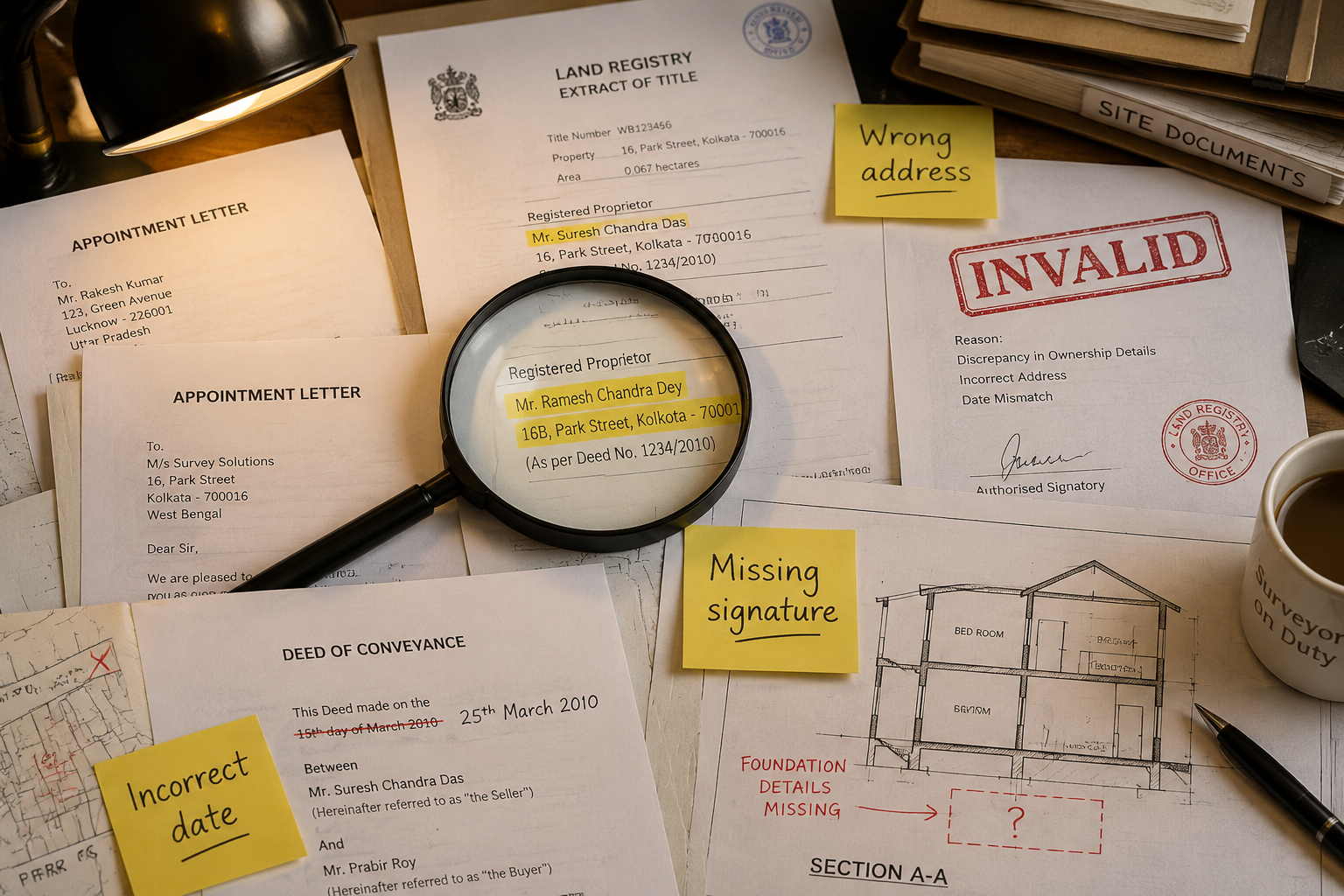
Once a genuine dispute is confirmed, the appointment process must be executed with precision. In 2026, procedural errors remain the leading cause of award challenges. Understanding When a Genuine Dispute Doesn't Exist: Party Wall Surveyor Appointment Pitfalls and Award Enforceability in 2026 means recognising that even valid disputes can produce unenforceable awards if the paperwork is wrong.
1. Incorrect Legal Names and Land Registry Mismatches
Every appointment letter must be signed by all legal owners of the respective properties. Full names must be obtained directly from the Land Registry and must match exactly what appears on the register. [2]
A common scenario: a husband serves notice in his name alone, but the property is jointly owned with his spouse. The appointment letter is therefore defective, and any award produced under it is vulnerable to challenge.
Checklist for correct appointment letters:
- ✅ Full legal names from Land Registry title register
- ✅ Signatures from all registered proprietors
- ✅ Correct property description matching the title
- ✅ Accurate notice service dates
2. Wrong Dates in the Award
Party wall awards containing incorrect dates — whether the notice service date, the Schedule of Condition date, or the award execution date — create enforceability problems. [2] Courts and county court judges examining disputed awards will scrutinise these details. An award dated before a valid notice was served, for example, is procedurally impossible and immediately suspect.
3. Serving Notice to the Wrong Address
Party wall notices must be served to the adjoining owner's actual contact address, not simply the address of the property adjacent to the works. [2] If an adjoining owner lives elsewhere — common with rental properties — a notice sent only to the affected property may not reach them. The consequences:
- Deemed dissent may be triggered without the owner's knowledge
- The appointment timeline is delayed by two to three additional weeks [3]
- The entire notice process may need to be restarted
4. Incomplete Response Options on Notices
Surveyors sometimes issue notices that fail to provide adjoining owners with the full range of statutory response options. [2] A valid notice must offer the recipient the opportunity to:
- Consent to the works
- Dissent and appoint their own surveyor
- Dissent and agree to an agreed surveyor
- Do nothing (resulting in deemed dissent after 14 days)
Omitting any of these options — particularly the right to appoint an agreed surveyor — can render the notice defective. For a detailed breakdown of how notices should be structured, see this guide on party wall act notices and how to respond.
5. Missing Section Drawings for Section 6 Notices
When serving notice under Section 6(1) for excavation works, surveyors must include section drawings that clearly show the proposed foundation depth and its relationship to the adjoining owner's foundations. [2] Omitting these drawings renders the Section 6 notice invalid — meaning the entire excavation programme may be proceeding without lawful notice.
This is a particularly costly error on basement projects, where party wall awards are complex and the potential for damage to adjoining properties is significant.
The Agreed Surveyor Problem: A Structural Flaw
The agreed surveyor arrangement — where both parties appoint a single surveyor — appears efficient on paper. In practice, it creates a structural tension that frequently leads to award challenges. [1]
Building owners who fund the survey often expect decisions that favour their project. Adjoining owners expect robust protection. When the surveyor makes genuinely impartial decisions, both parties may feel let down — and one or both may challenge the award. [1]
The neutrality requirement is non-negotiable: the agreed surveyor must not be the same professional the building owner is already using for their project design or management. [4] If the adjoining owner perceives any connection between the surveyor and the building owner's team, the appointment's credibility collapses before the award is even drafted.
⚠️ Key Risk: Awards drafted by agreed surveyors are disproportionately challenged because either party can claim the surveyor was biased — even when the surveyor acted with complete integrity. [1]
The Third Surveyor Requirement and Award Enforceability
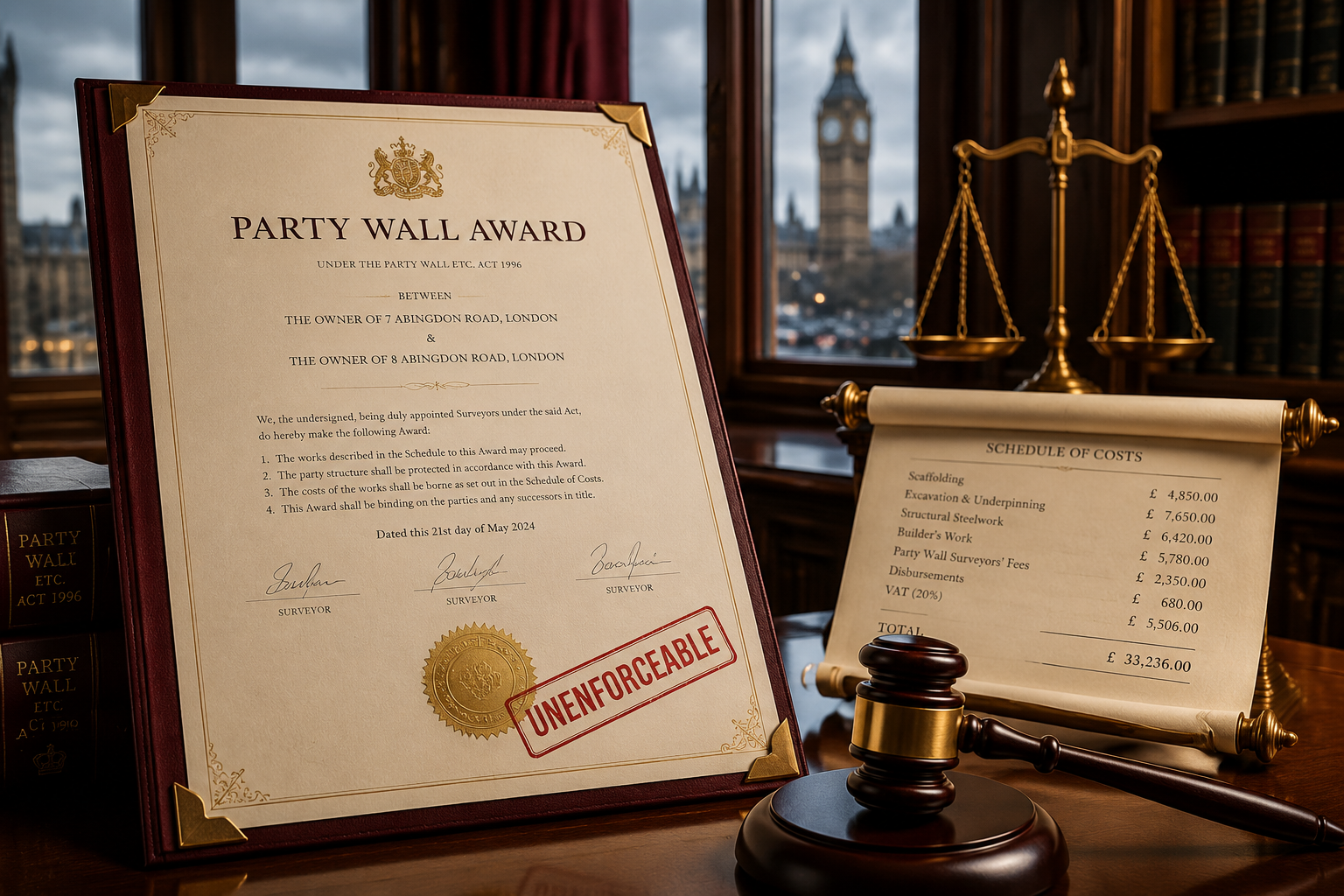
One of the most frequently overlooked statutory requirements — and one of the most damaging when ignored — is the obligation to select a third surveyor at the point of appointment.
When Must the Third Surveyor Be Selected?
Under Section 10 of the Party Wall etc. Act 1996, the third surveyor must be jointly selected by both appointed surveyors at the time of their own appointments — not when a dispute between them arises. [3] This is a mandatory statutory step, not an optional precaution.
Failing to select a third surveyor at appointment stage means that if the two appointed surveyors later reach deadlock, there is no agreed mechanism to break it. The entire award process stalls, causing project delays and potential legal costs that dwarf the original surveyor fees.
When Does the Third Surveyor Become Active?
The third surveyor is called upon when: [3]
- The two appointed surveyors cannot agree on award terms
- A fee dispute arises between surveyors
- One surveyor refuses to engage or respond
- There is disagreement about the scope of notifiable works
The third surveyor does not automatically become involved — one of the parties or surveyors must formally refer the matter. But without a pre-selected third surveyor, that referral mechanism does not exist.
What This Means for Award Enforceability
An award produced without proper third surveyor selection in place is procedurally deficient. While courts have sometimes taken a pragmatic approach to minor procedural irregularities, a fundamental failure to comply with Section 10 creates real enforceability risk — particularly if the award is later challenged in the county court.
For building owners and adjoining owners in London navigating complex projects, working with experienced professionals is essential. Whether the project is in North London, South London, or Central London, the procedural requirements are identical — and the consequences of getting them wrong are equally serious.
Cost Implications of Getting It Wrong in 2026
Procedural errors are not just legal problems — they are financial ones. When an award is challenged or invalidated, the costs multiply rapidly.
Surveyor Fee Benchmarks (2026)
Based on 2024 baseline data, adjusted for 2026 market conditions: [3]
| Service | Regional Rate | London Rate |
|---|---|---|
| Serving notices | £75–£200 | £150–£350 |
| Simple Party Wall Award | £700–£2,000 | £1,200–£3,000 |
| Schedule of Condition | £300–£1,000 | £500–£1,500 |
| Complex award (basement) | £1,500–£4,000+ | £2,500–£6,000+ |
| Hourly rate | £80–£200 | £200–£400 |
When an award is challenged and must be redone — or when a county court appeal is pursued — these costs can double or triple. The costs of the party wall process are significant enough without the added burden of procedural errors that could have been avoided.
For practical strategies to manage costs without cutting corners on compliance, the guide on how to keep party wall costs down offers actionable advice.
Protecting Your Position: A Practical Framework for 2026
Whether acting as a building owner or an adjoining owner, the following framework reduces the risk of appointment pitfalls and unenforceable awards.
For Building Owners 🏗️
- Serve valid notices first — confirm all legal owners of adjoining properties via Land Registry before serving. Explore the building owner's surveyor process to understand your obligations.
- Wait out the consent window — do not appoint surveyors before the 14-day response period expires.
- Do not appoint your project surveyor as the agreed surveyor — the appearance of neutrality is as important as actual neutrality. [4]
- Ensure Section 6 notices include section drawings — missing drawings invalidate the notice entirely. [2]
- Confirm third surveyor selection at appointment — do not leave this until a dispute arises. [3]
For Adjoining Owners 🏠
- Read the notice carefully — check that all response options are included and that the notice is addressed correctly. [2]
- Respond within 14 days — silence triggers deemed dissent and adds weeks to the timeline. [3]
- Consider appointing your own surveyor — the adjoining owner's surveyor acts solely in your interests, unlike an agreed surveyor.
- Request a Schedule of Condition — this protects your position if damage claims arise later. See the schedule of condition service for details.
Conclusion: Clarity Before Cost
When a Genuine Dispute Doesn't Exist: Party Wall Surveyor Appointment Pitfalls and Award Enforceability in 2026 is ultimately a question of proportionality. The Party Wall etc. Act 1996 is a powerful statutory framework — but it was designed to resolve genuine disputes, not to generate procedural complexity where neighbours are willing to cooperate.
The actionable takeaways are clear:
- ✅ Confirm whether a genuine dispute actually exists before appointing any surveyor
- ✅ Use informal written consent where neighbours agree — it is legally sufficient and far cheaper
- ✅ Verify all legal names against the Land Registry before signing any appointment letter
- ✅ Serve notices to the correct address with all required documentation and response options
- ✅ Select the third surveyor at the point of appointment, not after deadlock occurs
- ✅ Avoid the agreed surveyor arrangement where impartiality may be questioned
The cost of getting the process right is modest. The cost of getting it wrong — through invalid notices, defective appointments, or unenforceable awards — can be substantial. In 2026's active construction environment, where neighbour disputes are rising alongside renovation activity, procedural precision is not optional. It is the foundation of every enforceable party wall award.
References
[1] The Failure Of The Agreed Surveyor Appointment – https://akt-surveyors.com/the-failure-of-the-agreed-surveyor-appointment/
[2] Party Wall Surveyor Mistakes – https://stokemont.com/advice/party-wall-surveyor-mistakes/
[3] Party Wall Dispute – https://onlinearchitecturalservices.com/party-wall-dispute/
[4] Party Wall Agreement – https://hoa.org.uk/advice/guides-for-homeowners/i-am-improving/party-wall-agreement/
[5] Avoiding Party Wall Disputes In 2026 Construction Boom Surveyor Best Practices For Notice Procedures And Early Neighbour Engagement – https://nottinghillsurveyors.com/blog/avoiding-party-wall-disputes-in-2026-construction-boom-surveyor-best-practices-for-notice-procedures-and-early-neighbour-engagement
[6] Party Wall Surveys And Neighbour Disputes During 2026s Construction Uptick Rics Compliance Framework – https://nottinghillsurveyors.com/blog/party-wall-surveys-and-neighbour-disputes-during-2026s-construction-uptick-rics-compliance-framework