


Nearly one in three neighbour disputes in England and Wales involves some form of construction or property alteration — and the majority of those conflicts stem not from major building projects, but from small-scale works that homeowners assumed were too minor to matter legally. Understanding why party wall surveys are essential even for seemingly minor works: preventing future disputes under the Party Wall Act is not just a legal technicality — it is the difference between a smooth renovation and a costly, relationship-damaging legal battle.
The Party Wall etc. Act 1996 governs construction activities that affect shared walls, boundaries, and nearby excavations across England and Wales [6]. While most homeowners are aware of the Act in broad terms, many underestimate its reach — particularly when it comes to projects that feel routine or low-impact. A small kitchen extension, a loft conversion, or even installing a new beam can trigger statutory obligations that, if ignored, expose the building owner to serious legal liability [1].
This article draws on expert insights and real-world examples to explain how proactive party wall surveys — including formal Party Wall Awards — protect both building owners and their neighbours, even when the works in question seem entirely minor.
Key Takeaways 📋
- "Minor" does not mean exempt: Many small works, including extensions and structural alterations, still fall under the Party Wall Act and require formal notice.
- A Schedule of Condition is critical: Documenting the pre-work state of neighbouring properties protects both parties from unfounded damage claims.
- Notice periods are strict: Building owners must serve written notice at least two months before most party wall works begin, or one month for excavation and new boundary walls [6].
- A Party Wall Award provides legal protection: This binding document outlines how works must proceed and can prevent disputes from escalating to court [1].
- 2026 brings new compliance demands: The RICS 8th Edition guidance and updated case law are reshaping how surveyors approach even routine party wall matters [3][4].
What Counts as a "Minor" Work — and Why the Distinction Is Misleading
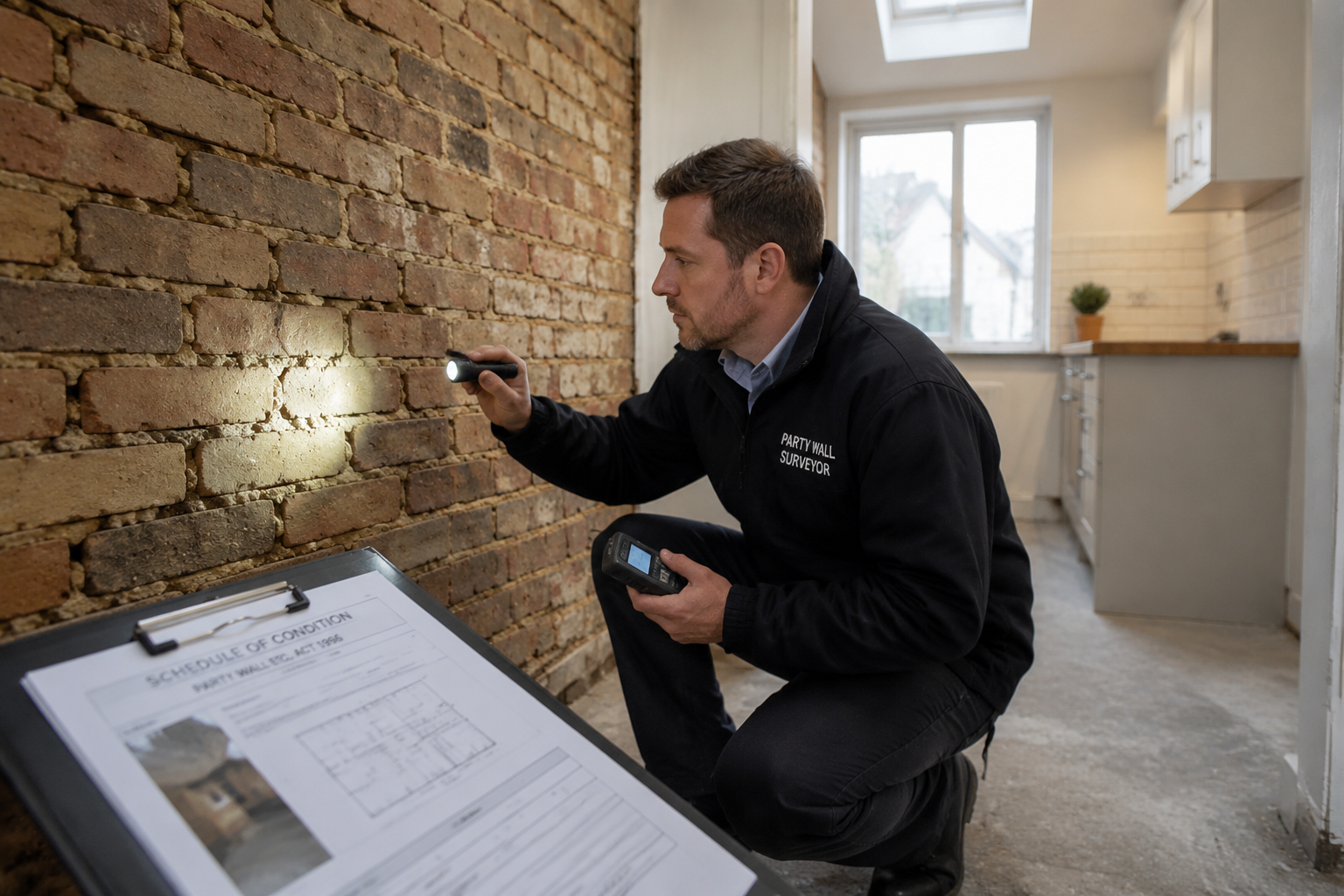
The term "minor works" is deceptively reassuring. Homeowners frequently assume that small projects — fitting kitchen units, drilling into a shared wall, or adding a single-storey rear extension — sit comfortably outside the scope of the Party Wall Act. In some cases, they are right. Truly minor works such as plastering, internal electrical work, or drilling to fit shelving do not require a party wall agreement [6]. However, the line between exempt and notifiable work is far thinner than most people realise.
Consider the following works that do require compliance under the Act:
| Type of Work | Notice Required | Notice Period |
|---|---|---|
| Cutting into a party wall | Yes | 2 months |
| Building a rear extension touching a party wall | Yes | 2 months |
| Loft conversion involving party wall | Yes | 2 months |
| New wall at the boundary line | Yes | 1 month |
| Excavation within 3–6 metres of a neighbour's foundations | Yes | 1 month |
| Installing a damp-proof course | Yes | 2 months |
💡 Pull Quote: "The most dangerous assumption a homeowner can make is that because a project feels small, it must be legally straightforward."
A single-storey kitchen extension, for example, may require cutting into a shared wall to insert a steel beam — a notifiable act under Section 2 of the Act. Without proper notice and a surveyor's involvement, the building owner has no legal protection if the neighbour later claims damage, even if the works were carried out perfectly. For a full breakdown of works that fall under the Act, see this guide to types of party wall works.
The Risk of Assuming Consent
Many homeowners speak informally with their neighbours before starting work and assume a friendly conversation constitutes agreement. It does not. Under the Party Wall Act, consent must be given in writing, and the process must follow statutory procedures [6]. Verbal agreements offer no legal protection whatsoever.
If a neighbour later disputes damage — even damage that predated the works — the building owner without a formal survey and Schedule of Condition has no documentary evidence to defend themselves. This is where the value of a party wall survey becomes undeniable, regardless of the project's scale.
Why Party Wall Surveys Are Essential Even for Seemingly Minor Works: The Schedule of Condition Explained
One of the most powerful — and most overlooked — tools in party wall practice is the Schedule of Condition. This is a detailed photographic and written record of the state of the adjoining property before any works begin [6]. It forms a core part of any properly executed party wall agreement and is referenced directly in the Party Wall Award when disputes arise.
Why the Schedule of Condition Matters for Small Projects
Here is a real-world scenario that illustrates the point:
A homeowner in West London undertakes a modest rear extension — just one storey, with minimal structural impact anticipated. No party wall surveyor is appointed. Six months after completion, the neighbour notices a crack in their kitchen wall and attributes it to the extension works. Without a Schedule of Condition, there is no baseline record to confirm whether that crack existed before construction began.
The result? A dispute that costs both parties thousands of pounds in legal fees, surveyor appointments, and stress — all of which could have been avoided with a pre-work survey costing a fraction of that amount.
A properly prepared Schedule of Condition:
- ✅ Documents existing cracks, settlement, and structural issues
- ✅ Provides photographic evidence of pre-existing damage
- ✅ Protects the building owner from unfounded claims
- ✅ Reassures the adjoining owner that their property is being safeguarded
- ✅ Forms part of the legally binding Party Wall Award
For those carrying out works, understanding the schedule of condition process is an essential first step. Similarly, adjoining owners who are worried about a neighbour's project should explore their rights through the adjoining owners' surveyor service.
The 2026 Compliance Landscape
In 2026, compliance expectations have tightened considerably. The Royal Institution of Chartered Surveyors (RICS) closed its consultation on the draft 8th Edition of Party Wall Legislation and Procedure in May 2026, introducing updated guidance that affects how surveyors document and manage even routine party wall matters [3][4]. Surveyors are now expected to apply more rigorous standards around evidence-gathering, conflict of interest management, and communication — raising the bar for what constitutes a professionally adequate party wall survey [4].
Additionally, the 2026 Renters' Rights Act has introduced new requirements around tenant notification in party wall matters for buy-to-let properties, adding another layer of compliance for landlords undertaking renovation works [2]. These regulatory shifts make professional surveyor involvement more important than ever, even for projects that might once have been handled informally.
Why Party Wall Surveys Are Essential Even for Seemingly Minor Works: Navigating Notices, Awards, and Dispute Prevention
Understanding the procedural framework of the Party Wall Act is essential for any homeowner planning works — regardless of scale. The process is more structured than many expect, and the consequences of getting it wrong can be severe.
Serving the Right Notice at the Right Time
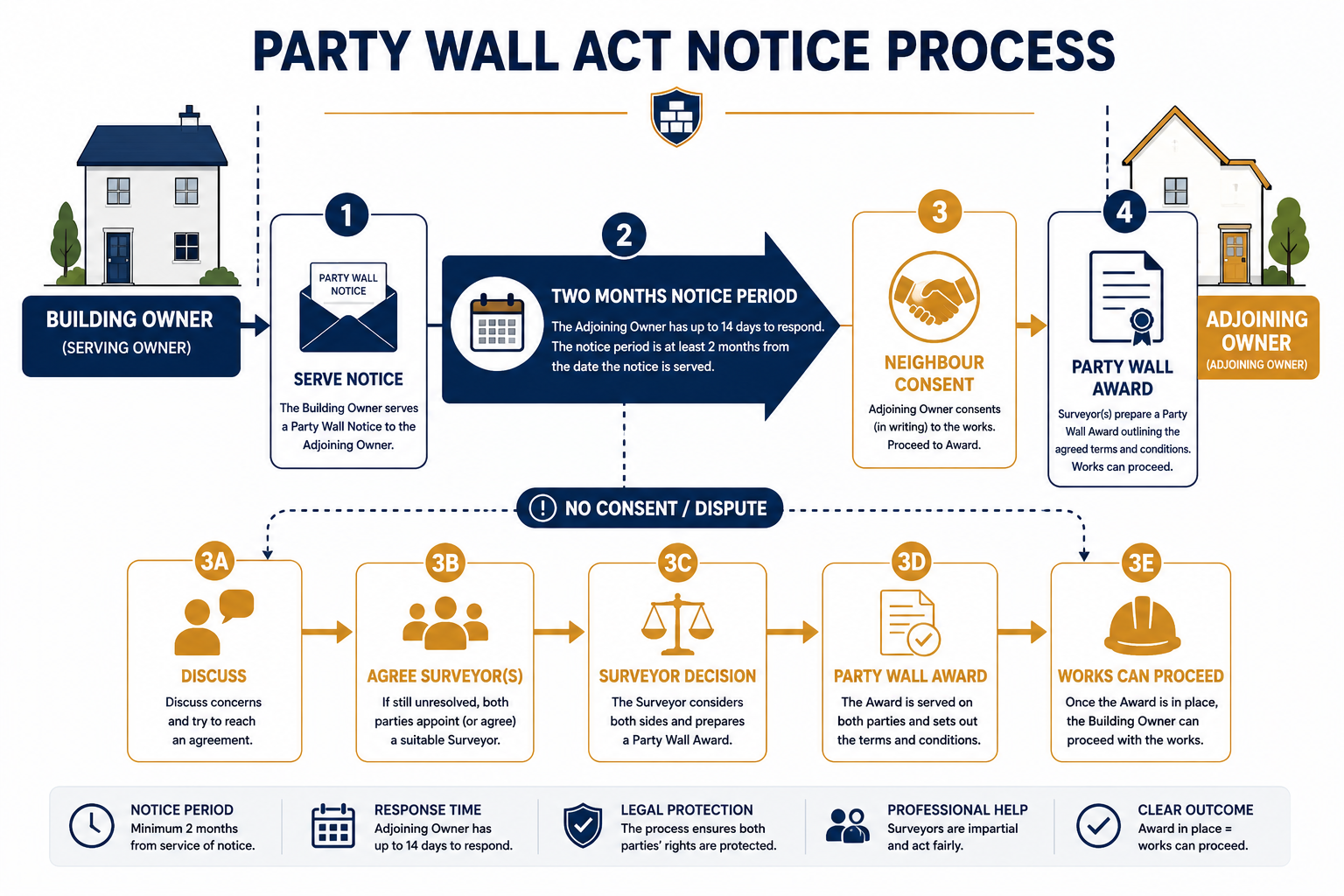
The Act requires building owners to serve written notice on all adjoining owners before commencing notifiable works [6]. The key timeframes are:
- 2 months' notice for works directly on or affecting a party wall or party structure
- 1 month's notice for excavation works or building a new wall at the boundary line [6]
These are minimum periods. Serving notice late — or not at all — means the building owner cannot legally start work, and any works carried out without proper notice may be subject to an injunction from the County Court [1].
For guidance on how to serve notice correctly, the party wall notices resource provides a clear overview of the process. It is also worth reviewing what a Party Structure Notice is and how to serve it for works directly affecting a shared wall.
What Happens When a Neighbour Doesn't Consent?
If an adjoining owner does not consent to the works within 14 days of receiving notice, a dispute is deemed to have arisen under the Act — even if no explicit objection has been made [6]. At this point, both parties must appoint surveyors (either a single agreed surveyor or one each) to draw up a Party Wall Award.
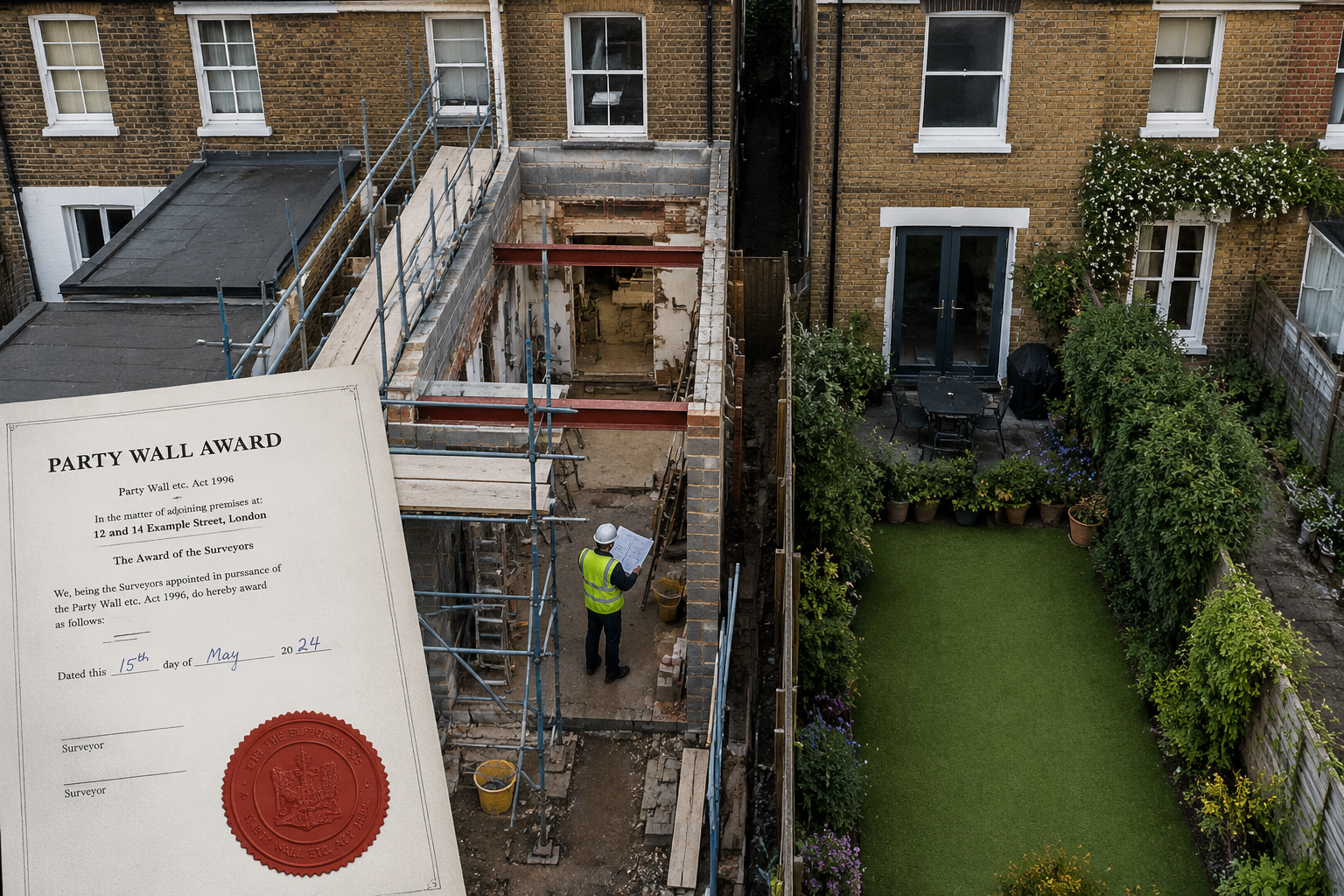
The Party Wall Award is a legally binding document that:
- Specifies exactly how and when works may be carried out
- Sets out any protective measures for the adjoining property
- Includes the Schedule of Condition as a reference document
- Outlines rights of access for the surveyor during works [1]
Both the building owner and adjoining owner retain the right to appeal the Award to the County Court within 14 days of receiving it [6]. This built-in appeal mechanism ensures fairness, but it also underlines why getting the Award right the first time — through a qualified surveyor — is so important.
For a deeper understanding of what a Party Wall Award contains, see this guide on Party Wall Awards and contract templates.
Dispute Resolution Takes Time — Plan Ahead
One of the most underestimated risks of skipping a party wall survey is the time cost of disputes. The dispute resolution process under the Act can take several weeks or more, particularly if neighbours are uncooperative or if the appointed surveyors disagree [1]. For a homeowner with a contractor booked and materials ordered, this delay can be financially ruinous.
Proactive engagement — serving notice early, appointing a surveyor promptly, and securing a Party Wall Award before work begins — eliminates this risk entirely. The costs of the party wall process are almost always far lower than the cost of resolving a dispute after the fact.
Updated Case Law and Construction Trends in 2026
The construction uptick of 2026 has brought increased scrutiny to party wall matters across London and beyond. Updated interpretations of the Act — reflecting new construction methods, materials, and building techniques — mean that surveyors must stay current with evolving case law [5]. Projects involving modern insulation systems, steel frame extensions, or innovative foundation techniques may raise new questions about the Act's application that only an experienced surveyor can navigate confidently [5].
This is particularly relevant in dense urban areas where properties share walls, party fence walls, and boundary structures in complex configurations. Understanding the difference between a party fence wall and a boundary wall is a foundational step that many homeowners skip — often to their detriment.
Common Misconceptions That Lead to Disputes
Even well-intentioned homeowners fall into predictable traps. Here are the most common misconceptions — and the reality behind each one:
❌ Misconception 1: "We get on well with our neighbours, so we don't need a formal agreement."
✅ Reality: Friendly relationships change. A new owner may move in next door and dispute damage with no knowledge of any informal arrangement. Only a written, legally compliant agreement provides lasting protection.
❌ Misconception 2: "The works are so small, the Act can't possibly apply."
✅ Reality: The Act applies to the type of work, not its scale. A small notch cut into a party wall to run a pipe is still a notifiable act under Section 2 [6].
❌ Misconception 3: "My builder said I don't need a party wall agreement."
✅ Reality: Builders are not qualified to give legal advice on party wall matters. Only a qualified party wall surveyor can confirm whether the Act applies to specific works.
❌ Misconception 4: "If something goes wrong, I'll deal with it then."
✅ Reality: Without a pre-work Schedule of Condition, proving what damage existed before the works is nearly impossible. The building owner bears the burden of proof [6].
Conclusion: Take Action Before the First Brick Moves
The evidence is clear: party wall surveys are not a bureaucratic formality reserved for large-scale developments. They are a practical, cost-effective safeguard that protects homeowners, preserves neighbourly relationships, and ensures compliance with a law that applies across England and Wales to a remarkably wide range of works.
In 2026, with updated RICS guidance, new tenant protection requirements, and a busy construction market generating more disputes than ever, the case for professional party wall surveying has never been stronger [3][4][5].
Actionable Next Steps ✅
- Identify whether your works are notifiable — use the types of party wall works guide as a starting point.
- Serve notice on time — at least two months before party wall works, or one month for excavation and new boundary walls.
- Appoint a qualified party wall surveyor — whether as a building owner or an adjoining owner, professional representation is essential.
- Insist on a Schedule of Condition — this single document can save thousands in disputed damage claims.
- Secure a Party Wall Award before works begin — do not rely on verbal agreements or informal arrangements.
The cost of a party wall survey is modest. The cost of ignoring the need for one can be enormous. Act early, act properly, and protect your project — and your relationships — from the outset.
References
[1] Understanding Party Wall Act What Homeowners Need Know Before Renovating – https://www.partywallslimited.com/blog/understanding-party-wall-act-what-homeowners-need-know-before-renovating
[2] Party Wall Surveys For Institutional Buy To Let Expansions Compliance Strategies For 2026s Landlord Investment Surge – https://wimbledonsurveyors.com/party-wall-surveys-for-institutional-buy-to-let-expansions-compliance-strategies-for-2026s-landlord-investment-surge/
[3] Rics Launches Consultation On Party Wall Guidance – https://thenegotiator.co.uk/news/regulation-law-news/rics-launches-consultation-on-party-wall-guidance/
[4] Rics 8th Edition Party Wall Guidance 2026 Implementation Challenges And Surveyor Compliance Strategies – https://wimbledonsurveyors.com/rics-8th-edition-party-wall-guidance-2026-implementation-challenges-and-surveyor-compliance-strategies/
[5] Party Wall Surveys And Neighbour Disputes During 2026s Construction Uptick Rics Compliance Framework – https://nottinghillsurveyors.com/blog/party-wall-surveys-and-neighbour-disputes-during-2026s-construction-uptick-rics-compliance-framework
[6] Party Wall Agreement – https://hoa.org.uk/advice/guides-for-homeowners/i-am-improving/party-wall-agreement/