


Nearly one in three residential construction disputes in England and Wales involves a party wall issue that could have been avoided with early professional involvement [4]. Despite the Party Wall etc. Act 1996 being over two decades old, homeowners continue to misunderstand when a surveyor is legally required — and the consequences range from costly delays to court injunctions.
Understanding the 7 Key Scenarios Triggering Party Wall Surveyor Appointments: From Shared Walls to Excavations in 2026 is not just useful — it is essential for anyone planning building work near a shared boundary. This guide breaks down each scenario with precision, provides checklists, and uses real-world case examples to show how early surveyor involvement protects both time and money.
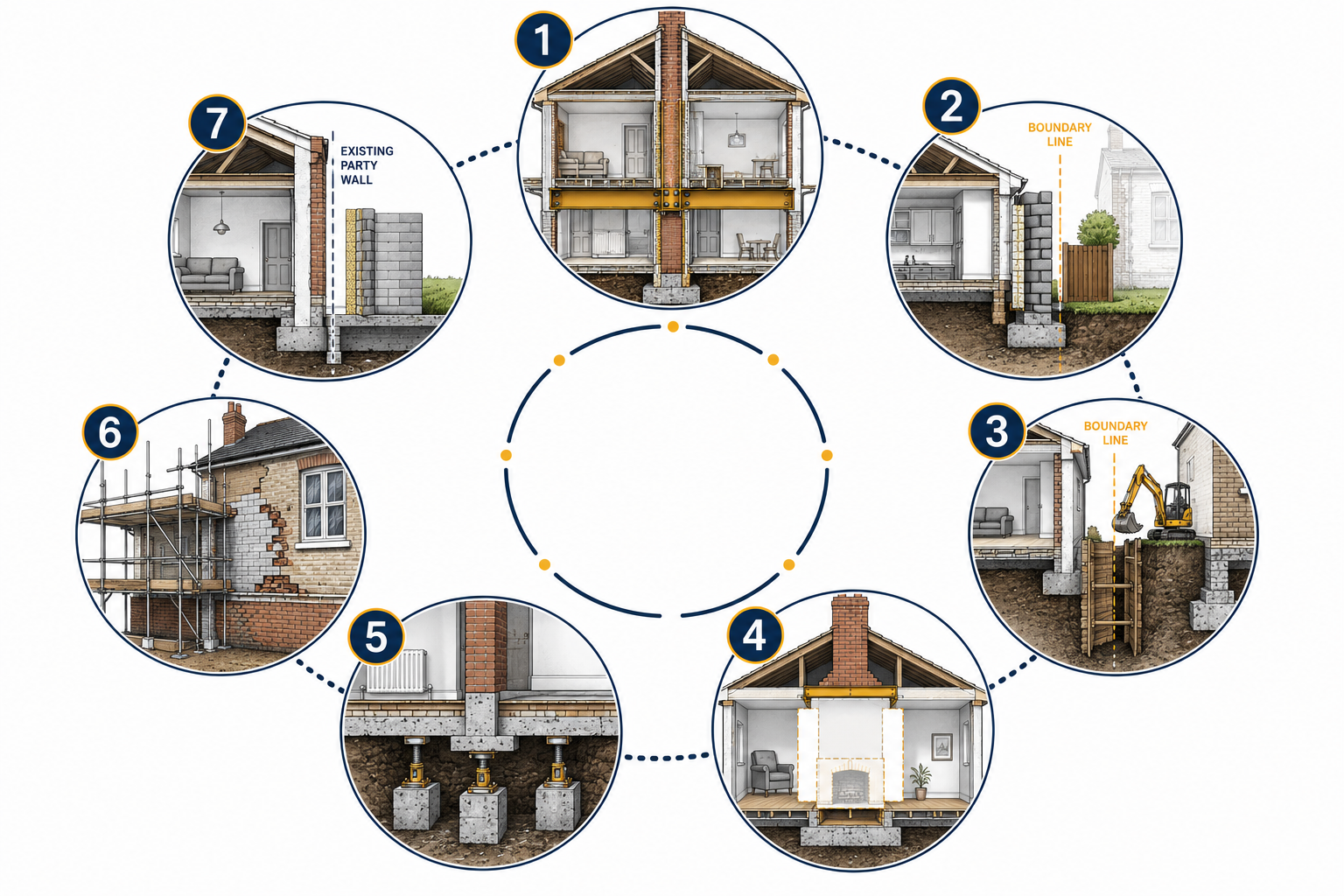
Key Takeaways 📋
- The Party Wall etc. Act 1996 mandates surveyor involvement across seven distinct construction scenarios — from shared wall alterations to deep excavations.
- Neighbour dissent or non-response within 14 days automatically triggers a legal requirement to appoint surveyors.
- Excavation within 3–6 metres of a neighbouring structure requires a formal notice and surveyor assessment, depending on depth.
- Written consent from all adjoining owners can avoid surveyor appointments in simple cases — but only if no dispute arises.
- Early surveyor appointment can prevent 4–8 week project delays and protect against costly legal disputes.
What Is a Party Wall Surveyor and Why Does It Matter in 2026?
A party wall surveyor is a specialist professional appointed under the Party Wall etc. Act 1996 to assess, document, and regulate building work that affects shared structures or boundaries. Their role is to protect both the building owner carrying out works and the adjoining owner whose property may be affected.
In 2026, with urban densification driving more loft conversions, basement extensions, and infill developments, the frequency of party wall disputes is rising [5]. Understanding exactly when a surveyor must be appointed is the first line of defence against legal and financial risk.
💡 Pull Quote: "Appointing a party wall surveyor proactively is not a cost — it is insurance against delays, disputes, and structural damage claims."
The 7 Key Scenarios Triggering Party Wall Surveyor Appointments: From Shared Walls to Excavations in 2026
Scenario 1 — Work to Existing Shared Walls 🧱
The most common trigger under the Act is undertaking work directly to an existing party wall or shared structure. This includes:
- Inserting steel beams through a party wall (common in loft conversions and rear extensions)
- Raising, thickening, or rebuilding a shared wall
- Removing chimney breasts attached to a party wall
- Cutting into a party wall to insert a damp-proof course
A Party Wall Notice must be served at least two months before work begins for party structure works. If the neighbour consents in writing within 14 days, no surveyor is required. If they dissent — or fail to respond — surveyor appointment becomes mandatory [6].
✅ Checklist for Scenario 1:
- Identify all adjoining owners
- Serve a Party Structure Notice at least 2 months before start date
- Await written consent within 14 days
- If no response or dissent received, appoint a surveyor immediately
- Arrange a Schedule of Condition before works begin
Scenario 2 — Building New Walls at or Astride the Boundary Line
Constructing a new wall along or astride the boundary line between two properties falls squarely within the Act. Building astride the boundary — meaning the wall straddles the legal line — normally requires the explicit agreement of the neighbouring owner [6][7].
This scenario is frequently encountered in:
- Side return extensions
- Garden wall replacements
- New outbuildings positioned at the boundary
If the neighbour does not consent to a wall being built astride the boundary, the building owner must construct entirely on their own land. A surveyor helps navigate this distinction and ensures the correct notice type is served. For more on understanding boundary distinctions, see this guide on party fence walls and boundary walls.
Scenario 3 — Excavation Near Neighbouring Buildings ⛏️
One of the most technically complex triggers involves excavation work close to a neighbour's structure. The Act applies when:
| Excavation Depth | Distance from Neighbour's Structure | Notice Required? |
|---|---|---|
| Deeper than the neighbour's foundations | Within 3 metres | ✅ Yes |
| Deeper than the neighbour's foundations | Within 6 metres (line of 45° angle) | ✅ Yes |
| Shallower than neighbour's foundations | Any distance | ❌ No |
This scenario is critical for basement conversions, new extensions with deep foundations, and drainage works [6][9]. A surveyor assesses the risk of settlement, vibration damage, and undermining of existing foundations.
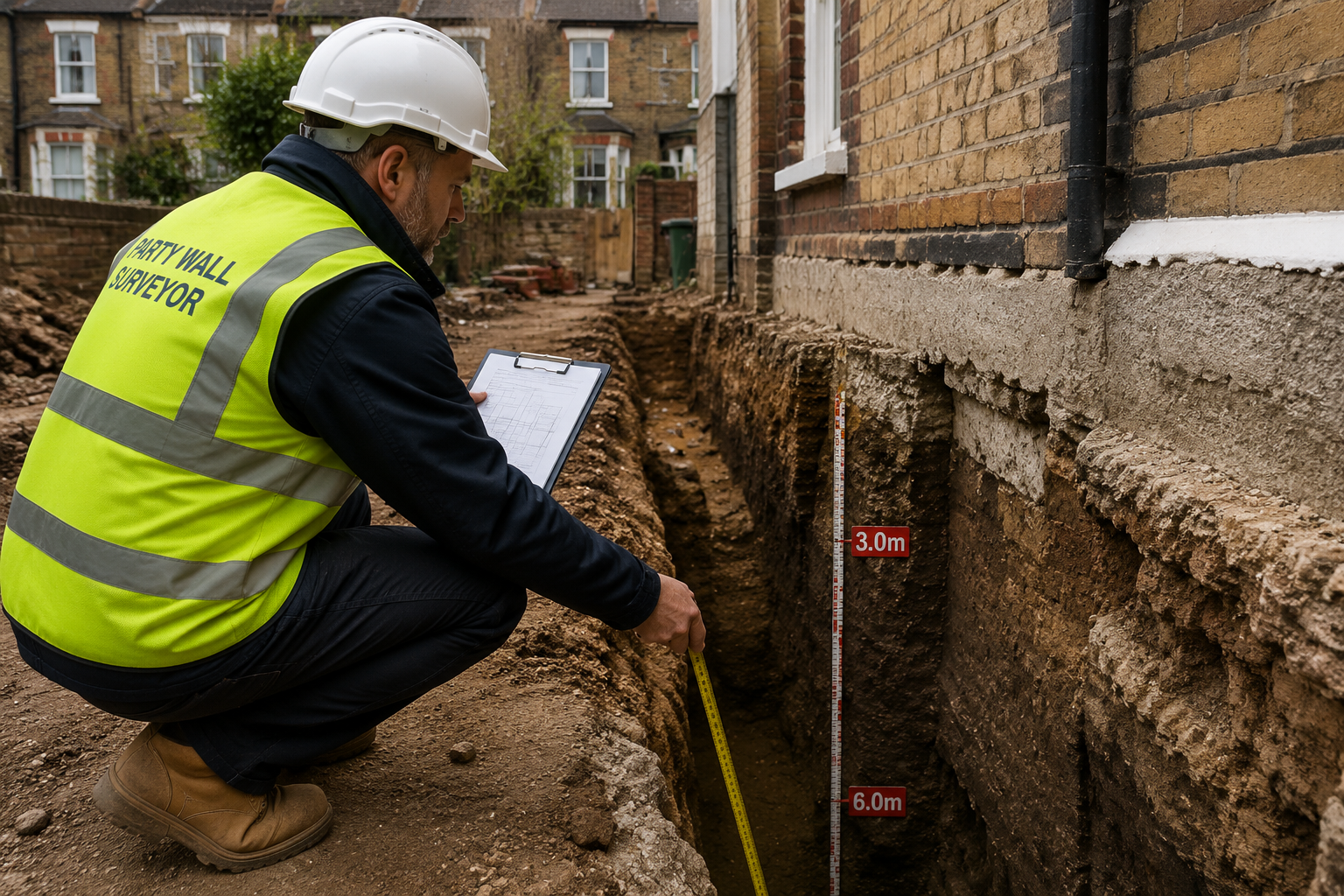
Case Study — Basement Extension in North London:
A homeowner in Islington commenced a basement conversion without serving an Excavation Notice. The neighbouring property, a Victorian terrace, developed visible cracking within three weeks. Without a pre-works Schedule of Condition, the building owner faced a damages claim with no documented baseline. A party wall surveyor in North London was appointed retrospectively — at significantly greater cost and with a six-week construction halt.
Scenario 4 — Structural Alterations Including Steel Beam Installation
Structural alterations to party walls — particularly the installation of steel beams (RSJs) — require mandatory surveyor involvement [7]. This is because the insertion of a beam changes the load distribution within the shared wall, potentially affecting the structural integrity of the adjoining property.
Common examples include:
- Loft conversions requiring padstone installation in party walls
- Rear kitchen extensions with steel lintels bearing on shared walls
- Removal of internal chimney breasts that are structurally connected to the party wall
The surveyor's role here is to assess the proposed method of work, specify protective measures, and produce a Party Wall Award that binds both parties legally.
Scenario 5 — Underpinning Party Walls
Underpinning — the process of strengthening or deepening existing foundations — is one of the highest-risk party wall activities. When underpinning affects a shared wall or is carried out near a neighbouring structure, surveyor appointment is not optional [7][8].
Key risks that surveyors assess include:
- Differential settlement between properties
- Vibration damage during breaking-out works
- Temporary instability of the shared structure
- Water ingress during excavation phases
⚠️ Important: Underpinning without a Party Wall Award in place exposes the building owner to unlimited liability for any resulting damage.
The surveyor will specify the sequence of underpinning bays, temporary propping requirements, and monitoring protocols to protect both properties throughout the works.
Scenario 6 — Repairs to Party Walls
Not all party wall work involves new construction. Significant repairs to an existing party wall — such as repointing, rebuilding sections, or addressing structural defects — can also trigger the Act [7].
The key question is whether the repair materially affects the shared structure or the adjoining owner's property. Minor cosmetic repairs on the building owner's side of the wall typically do not require notice. However, any repair that involves:
- Cutting into or through the wall
- Temporary removal of sections of the wall
- Insertion of new materials that alter the wall's structure
…will require a Party Wall Notice and, if the neighbour dissents, a formal surveyor appointment.
For homeowners unsure about whether their planned repairs require formal action, this resource on party wall notices and how to respond provides clear practical guidance.
Scenario 7 — Building New Walls in Close Proximity to Existing Party Walls
The final scenario involves constructing a new wall that, while not on the boundary, sits in close proximity to an existing party wall [7][8]. This is particularly relevant for:
- New garden structures or annexes built near shared walls
- Internal walls constructed close to a party wall that may affect its load-bearing function
- Retaining walls near shared boundaries
The concern here is that new construction can exert lateral pressure on existing shared walls, alter drainage patterns, or affect the thermal and moisture performance of the party wall. A surveyor assesses these risks and specifies any protective or monitoring measures required.
When Does a Surveyor Become Legally Mandatory?
Understanding the 7 Key Scenarios Triggering Party Wall Surveyor Appointments: From Shared Walls to Excavations in 2026 is only part of the picture. The legal obligation to appoint a surveyor is triggered by specific responses (or non-responses) from adjoining owners.
The 14-Day Rule ⏱️
When a Party Wall Notice is served, the adjoining owner has 14 days to respond. Three outcomes are possible:
- Written Consent → No surveyor required (works may proceed)
- Written Dissent → Surveyor appointment mandatory
- No Response → Deemed dissent — surveyor appointment mandatory [6]
This 14-day "deemed dissent" rule catches many building owners off guard. Silence is not consent under the Act.
Agreed Surveyor vs. Two Surveyors
When a dispute arises, the parties may either:
- Appoint a single agreed surveyor jointly (cost-effective)
- Each appoint their own surveyor, who then select a Third Surveyor if needed
For guidance on costs and the full process, see this detailed breakdown of party wall costs and the process.
Special Circumstances That Demand Surveyor Involvement
Multi-Neighbour Properties
Terraced houses, purpose-built flats, and corner plots may have multiple adjoining owners, each of whom must receive a separate notice [6]. Even if some neighbours consent, dissent from a single owner triggers the full surveyor appointment process. The complexity of coordinating multiple awards makes professional surveyor involvement strongly advisable from the outset.
Time-Sensitive Projects
Projects with fixed contractor start dates, mortgage offer expiry deadlines, or planning permission time limits face particular risk. A dispute that arises mid-process can cause 4–8 week delays while the Award is prepared [6]. Proactive surveyor appointment — before serving notices — allows the Award to be prepared in parallel, dramatically reducing this risk.

Case Study — Loft Conversion in West London:
A homeowner in Ealing had a builder booked and a fixed-price contract in place. After serving Party Wall Notices, both neighbours failed to respond within 14 days — triggering deemed dissent. Without a surveyor already engaged, the process took seven weeks, causing the builder to move to another project. A party wall surveyor in West London was eventually appointed, but the delay cost the homeowner an additional £4,200 in rescheduling fees. Early appointment would have prevented this entirely.
Can Works Proceed Without a Surveyor?
Yes — but only under specific conditions [6]:
- All adjoining owners provide written consent within 14 days
- The works are straightforward with no dispute about method, timing, or protective measures
- There are no complex structural implications
Even with consent, it is strongly recommended to obtain a Schedule of Condition documenting the state of the neighbouring property before works begin. This protects the building owner against exaggerated or false damage claims after works are complete.
💡 Pro Tip: Written consent only covers the works as described in the notice. Any changes to scope during construction may require a new notice — and potentially a surveyor.
For those exploring whether a party wall agreement can be handled without a surveyor, this resource provides important context: having a party wall agreement without a surveyor.
Quick Reference: The 7 Scenarios at a Glance
| # | Scenario | Notice Type | Minimum Notice Period |
|---|---|---|---|
| 1 | Work to existing shared walls | Party Structure Notice | 2 months |
| 2 | New walls at/astride boundary | Line of Junction Notice | 1 month |
| 3 | Excavation near neighbouring buildings | Three/Six Metre Notice | 1 month |
| 4 | Structural alterations (beams, etc.) | Party Structure Notice | 2 months |
| 5 | Underpinning party walls | Party Structure Notice | 2 months |
| 6 | Repairs to party walls | Party Structure Notice | 2 months |
| 7 | New walls near existing party walls | Line of Junction Notice | 1 month |
Conclusion: Act Early, Save More
The 7 Key Scenarios Triggering Party Wall Surveyor Appointments: From Shared Walls to Excavations in 2026 cover a broad range of construction activities — from the most common (inserting beams into shared walls) to the most technically demanding (underpinning and deep excavation). In every case, the cost of early professional involvement is a fraction of the cost of retrospective dispute resolution.
Actionable Next Steps ✅
- Identify your scenario — use the table above to determine which notice type applies to your project.
- Serve notices early — allow sufficient time before your planned start date.
- Engage a surveyor proactively — especially for complex works, multiple neighbours, or tight timelines.
- Document everything — obtain a Schedule of Condition before any works begin.
- Seek specialist advice — whether you are a building owner or an adjoining owner, professional guidance protects your interests.
The Party Wall etc. Act 1996 exists to protect both sides of a shared boundary. Used correctly, it is not a barrier to building — it is a framework that makes construction safer, fairer, and more predictable for everyone involved.
References
[1] Watch – https://www.youtube.com/watch?v=ndVaTVqQunE
[2] Jan 22 Party Wall Legislation And Procedure 7th Edition – https://www.rics.org/content/dam/ricsglobal/documents/standards/jan_22_party_wall_legislation_and_procedure_7th_edition.pdf
[3] Party Wall Agreement – https://hoa.org.uk/advice/guides-for-homeowners/i-am-improving/party-wall-agreement/
[4] Seven Commonly Asked Questions About Party Wall Issues – https://www.squarepointsurveyors.co.uk/blog/seven-commonly-asked-questions-about-party-wall-issues/
[5] Simple Surveys Party Wall Predictions For 2026 – https://www.simplesurvey.co.uk/article/simple-surveys-party-wall-predictions-for-2026/
[6] Do I Really Need A Party Wall Surveyor In 2026 – https://www.simplesurvey.co.uk/article/do-i-really-need-a-party-wall-surveyor-in-2026/
[7] Scenarios That Require A Party Wall Surveyor – https://iconsurveyors.co.uk/blog/scenarios-that-require-a-party-wall-surveyor/
[8] Scenarios That Require A Party Wall Surveyor – https://iconsurveyors.co.uk/scenarios-that-require-a-party-wall-surveyor/
[9] When Party Wall Surveyor Appointments Determine Project Success – https://www.angelsmedia.co.uk/backlinks/when-party-wall-surveyor-appointments-determine-project-success.html