


Nearly one in three residential building projects in London experiences a delay linked to party wall disputes — and the vast majority of those delays were entirely preventable [2]. If you are planning a build, extension, or renovation in 2026, understanding how to stop party wall conflicts early through preemptive surveyor strategies and notice best practices is not just good advice — it is essential project management.
This guide draws on the latest 2026 surveyor insights, viral short-form content from industry professionals, and the foundational rules of the Party Wall etc. Act 1996 to give building owners and adjoining owners a clear, practical roadmap for conflict-free construction.
Key Takeaways 📌
- Start party wall planning 2–3 months before your intended build date, not when construction is about to begin.
- Notice periods are legally fixed: 1 month for excavation/boundary works, 2 months for party structure works.
- A neighbour's dissent does not stop your project — it simply triggers the formal award process.
- Invalid notices are a leading cause of 2026 project delays — use specialist surveyors and correct templates.
- Early communication, condition schedules, and 2026 tech tools can de-escalate disputes before they ever arise.
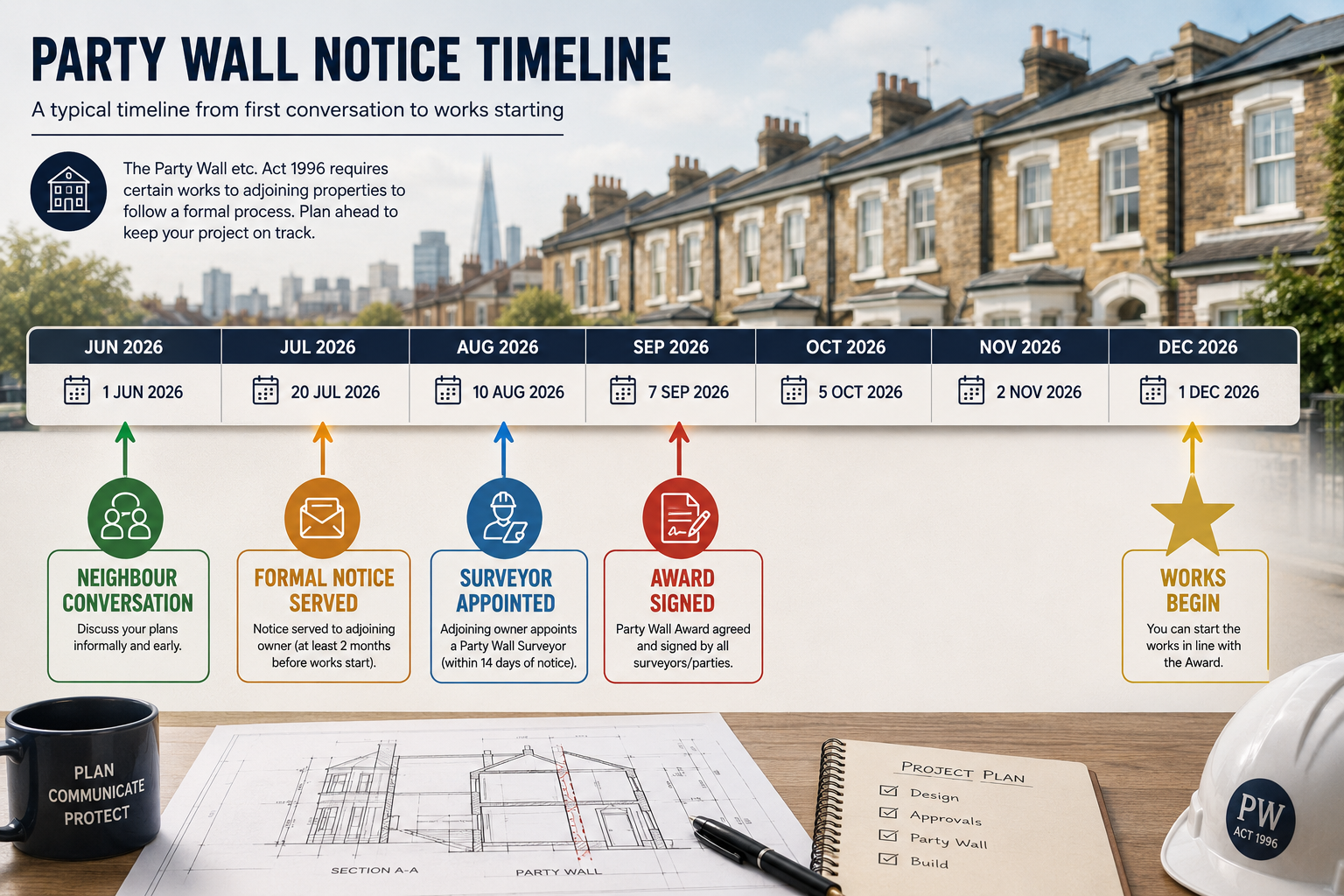
Why 2026 Builds Demand Earlier Party Wall Planning Than Ever
The construction landscape in 2026 is busier, more regulated, and more neighbour-aware than at any previous point under the Party Wall etc. Act 1996. Surveyors are reporting higher appointment volumes, longer award preparation windows, and neighbours who are better informed — and more likely to dissent — than a decade ago [4].
The Timeline Problem Most Builders Get Wrong
One of the most common mistakes seen in 2026 projects is treating party wall compliance as a last-minute administrative task. Builders wait until groundworks are about to begin, then scramble to serve notices — only to discover that legal timelines mean work cannot lawfully start for weeks or months.
Here is the correct timeline framework:
| Work Type | Minimum Notice Period | Recommended Lead Time |
|---|---|---|
| Excavation within 3m of neighbour | 1 month | 2–3 months |
| Excavation within 6m (45° line rule) | 1 month | 2–3 months |
| Party structure works (e.g., steel beams, chimney breasts) | 2 months | 3–4 months |
| New boundary wall construction | 1 month | 2 months |
💡 Pull Quote: "Serving a notice the week before your groundworks begin is not planning — it is gambling with your project timeline." — 2026 Party Wall Surveyor Insight [4]
The excavation rules catch many builders off guard. Notice is required if excavating within 3 metres of a neighbouring structure where the excavation is deeper than the neighbour's foundations, or within 6 metres where the excavation intersects a 45-degree line drawn from the base of neighbouring foundations [4][8]. This applies even to modest single-storey extensions.
Allow Buffer Time for the Award Process
After a surveyor is appointed and begins preparing the party wall award, allow an additional 2–4 weeks for the award to be drafted, reviewed, amended, and signed by both surveyors before it is formally served [6]. Building in this buffer at the planning stage prevents the award from sitting on the critical path of your project.
Preemptive Surveyor Strategies to Stop Party Wall Conflicts Early
Stopping party wall conflicts early is not about legal technicality — it is about human communication, professional expertise, and smart sequencing. The strategies below are drawn from the most effective approaches seen across 2026 builds [4][5].
Strategy 1: Talk to Your Neighbour Before Serving Notice
The law does not require a pre-notice conversation. But best practice in 2026 absolutely does [4].
A brief, friendly discussion before any formal paperwork lands on a neighbour's doorstep can transform the entire dynamic. Key elements of an effective pre-notice conversation:
- ✅ Explain the works clearly — what you are doing, why, and how long it will take
- ✅ Share drawings or plans where appropriate to reduce uncertainty
- ✅ Reassure about disruption — noise, dust, access, and working hours
- ✅ Listen actively to concerns and acknowledge them
- ✅ Put any informal agreements in writing — even a simple email confirmation
Most disputes stem not from genuine legal conflict but from misunderstanding and lack of information [2]. A neighbour who feels informed and respected is far less likely to dissent — or to appoint an obstructive surveyor if they do.
For a deeper understanding of what neighbours receive and how they should respond, the guide on Party Wall Act notices — what they are and how to respond is an excellent resource for both parties.
Strategy 2: Serve Legally Valid Notices — Every Time
Invalid notices are one of the leading causes of project delays in 2026 [4]. A notice that omits required information, uses the wrong format, or is served too late is legally void — and the clock does not start running until a valid notice is served.
A valid Party Wall Notice must contain:
- 📋 Correct ownership details for both building owner and adjoining owner
- 📋 Clear description of the proposed works
- 📋 The correct property address
- 📋 The proposed start date
- 📋 The correct statutory notice period for the work type
- 📋 Reference to the Party Wall etc. Act 1996
Generic online templates frequently fail on points 1, 2, or 5. Using a specialist surveyor to prepare and serve notices — rather than a generalist or a DIY template — significantly reduces this risk. For full guidance on the party wall notice process, specialist resources are available to ensure compliance from the outset.
Strategy 3: Understand the Response Window and What Happens Next
Neighbours have 14 days to respond to a party wall notice [6][8]. If there is no response within that window, a reminder notice must be served giving an additional 10 days. If there is still no response, the building owner must appoint a surveyor to act on the neighbour's behalf — adding further delay.
What each response means:
| Neighbour Response | What Happens Next |
|---|---|
| Consent in writing | Works can proceed (no award needed) |
| Consent with early start authorisation | Works can begin before notice period expires |
| Dissent | Surveyors appointed; Party Wall Award prepared |
| No response | Deemed dissent; surveyor appointed on neighbour's behalf |
🔑 Key Point: A neighbour's dissent does not prevent work from proceeding. It simply means the formal process applies and a legally binding award must be prepared first [4]. Many building owners in 2026 still believe dissent means "no" — it does not.

Strategy 4: Commission a Schedule of Condition Early
One of the most underused preemptive tools in the party wall process is the schedule of condition — a detailed photographic and written record of the adjoining property's existing state before works begin.
Commissioning a schedule of condition early serves two critical functions:
- Protects the building owner from exaggerated or fraudulent damage claims after works
- Protects the adjoining owner by creating a clear baseline for any legitimate claims
In 2026, surveyors increasingly recommend commissioning this schedule even when a neighbour has consented, not just when dissent occurs. It is a low-cost, high-value de-escalation tool.
Strategy 5: Choose a Specialist Party Wall Surveyor, Not a Generalist
In 2026, using a surveyor without regular, dedicated experience under the Party Wall etc. Act 1996 is a false economy [4]. Generalist surveyors can inadvertently:
- Issue invalid or incomplete awards
- Misinterpret excavation notice requirements
- Fail to act with the required impartiality as agreed surveyor
- Create delays through unfamiliarity with the process
When selecting a surveyor, look for:
- ✔️ Regular, dedicated party wall practice
- ✔️ Clear explanation of options and costs upfront
- ✔️ Transparent fee structures
- ✔️ Impartiality where acting as agreed surveyor
- ✔️ Local knowledge of the area
Whether the project is in South London, North London, East London, or West London, local specialist surveyors bring familiarity with area-specific property types, common structural configurations, and local neighbour dynamics that generalists simply cannot replicate.
2026 Tech Tools and Communication Tactics That De-Escalate Disputes
The most forward-thinking surveyors and builders in 2026 are not just following the letter of the Party Wall etc. Act — they are leveraging technology and structured communication to prevent disputes from arising in the first place [5].

Virtual Inspections and Digital Condition Surveys
Remote inspection technology has matured significantly. In 2026, surveyors can now conduct preliminary virtual inspections using:
- 📱 Video call walkthroughs — building owners or neighbours film areas of concern via smartphone
- 🖥️ 3D scanning and photogrammetry — for detailed structural documentation without physical access
- 📂 Cloud-shared condition report platforms — both parties access the same timestamped, photo-rich document in real time
These tools are particularly valuable where access to the adjoining property is difficult or where initial trust between parties is low. A virtual inspection can often resolve concerns that would otherwise escalate into formal disputes.
Structured Communication Frameworks
Beyond technology, structured communication protocols are proving highly effective in 2026 [2][5]:
- Pre-notice information pack — share a simple, jargon-free summary of the works, expected timeline, and contact details for the project surveyor
- Regular project updates — brief, friendly notifications when key milestones are reached (e.g., "groundworks begin Monday, expected to complete by Friday")
- Dedicated point of contact — one named person for the neighbour to call with concerns, rather than navigating a contractor chain
- Written confirmation of verbal agreements — even informal agreements should be confirmed by email to prevent later misunderstanding
Early Award Strategy
Rather than waiting for dissent before beginning the award process, proactive building owners in 2026 are initiating the award process simultaneously with notice service — particularly for complex projects [5]. This approach:
- Reduces the total time between notice and works commencement
- Gives the adjoining owner confidence that protections are in place
- Allows the award to be ready for signing the moment the notice period expires
For building owners who want to understand the full scope of what an award covers, the detailed guide on party wall awards explains the process, content, and legal effect of a properly prepared award.
Keeping Costs Transparent and Reasonable
One underappreciated source of neighbour friction is cost anxiety. Adjoining owners who receive a notice sometimes fear they will be left with unexpected legal or surveyor fees. Proactively addressing this concern — explaining that party wall costs are typically borne by the building owner, and that the adjoining owner's reasonable surveyor fees are covered — removes a significant source of resistance.
For building owners looking to manage expenditure without cutting corners, practical guidance on how to keep party wall costs down can help balance compliance with budget management.
Common 2026 Mistakes That Escalate Disputes — and How to Avoid Them
| ❌ Common Mistake | ✅ Preemptive Fix |
|---|---|
| Serving notice too late | Begin planning 2–3 months before intended start [4] |
| Using a generic notice template | Use a specialist surveyor to prepare notices |
| Assuming dissent means "no" | Educate the team: dissent triggers process, not prohibition [4] |
| Skipping the pre-notice conversation | Always speak to neighbours before serving formal notice [4] |
| Ignoring excavation notice rules | Check 3m and 6m thresholds for all groundworks [4][8] |
| No schedule of condition | Commission one proactively, even with consent |
| Appointing a generalist surveyor | Choose a dedicated party wall specialist [4] |
| Failing to follow up non-responses | Serve reminder notice after 14 days; appoint on their behalf if needed [6] |
Conclusion: Act Early, Communicate Clearly, Build Confidently in 2026
The single most powerful thing any building owner can do to stop party wall conflicts early in 2026 is to start the process earlier than feels necessary. Two to three months of lead time, a friendly pre-notice conversation, legally valid notices, a specialist surveyor, and a proactive schedule of condition will resolve the vast majority of potential disputes before they ever become formal disagreements.
The Party Wall etc. Act 1996 is not an obstacle — it is a framework designed to protect all parties and enable construction to proceed lawfully and safely. Used correctly, with the preemptive surveyor strategies and notice best practices outlined above, it becomes a tool for building trust with neighbours rather than conflict.
Actionable Next Steps ✅
- Check your project timeline today — count back 2–3 months from your intended start date and identify when notices must be served
- Book a specialist party wall surveyor for an initial consultation before any notices are issued
- Have an informal conversation with your neighbour — share your plans, listen to their concerns
- Commission a schedule of condition as early as possible in the process
- Verify your notice requirements — especially excavation thresholds — using the Party Wall etc. Act 1996 guidance
- Explore the full range of party wall services available through a dedicated party wall surveyor to ensure your 2026 build proceeds without unnecessary delay
References
[1] Party Wall Dispute – https://onlinearchitecturalservices.com/party-wall-dispute/
[2] Effective Strategies For Resolving Party Wall Disputes – https://www.completebuilds.com/post/effective-strategies-for-resolving-party-wall-disputes
[3] Understanding Party Wall Act What Homeowners Need Know Before Renovating – https://www.partywallslimited.com/blog/understanding-party-wall-act-what-homeowners-need-know-before-renovating
[4] 2026 Party Wall Surveyor Tips – https://www.simplesurvey.co.uk/uncategorised/2026-party-wall-surveyor-tips/
[5] Simple Surveys Party Wall Predictions For 2026 – https://www.simplesurvey.co.uk/article/simple-surveys-party-wall-predictions-for-2026/
[6] Watch – https://www.youtube.com/watch?v=DBLxtfZWJG0
[7] Watch – https://www.youtube.com/watch?v=FxtEZp14vJE
[8] The Party Wall Etc Act 1996 Explanatory Booklet – https://www.gov.uk/government/publications/preventing-and-resolving-disputes-in-relation-to-party-walls/the-party-wall-etc-act-1996-explanatory-booklet