


Nearly one in three party wall notices served in London receives no response from the adjoining owner within the statutory timeframe — leaving building owners stuck, confused, and at risk of costly project delays. The good news? The law already has a solution built in.
Section 10(4) Surveyors Under the Party Wall Act: Building Owner Rights When Neighbors Ignore Notices in 2026 is the legal mechanism that allows a building owner to move forward even when a neighbour stays completely silent. Understanding how this provision works — and how to use it correctly — can be the difference between a smooth renovation and months of expensive standstill. [1]
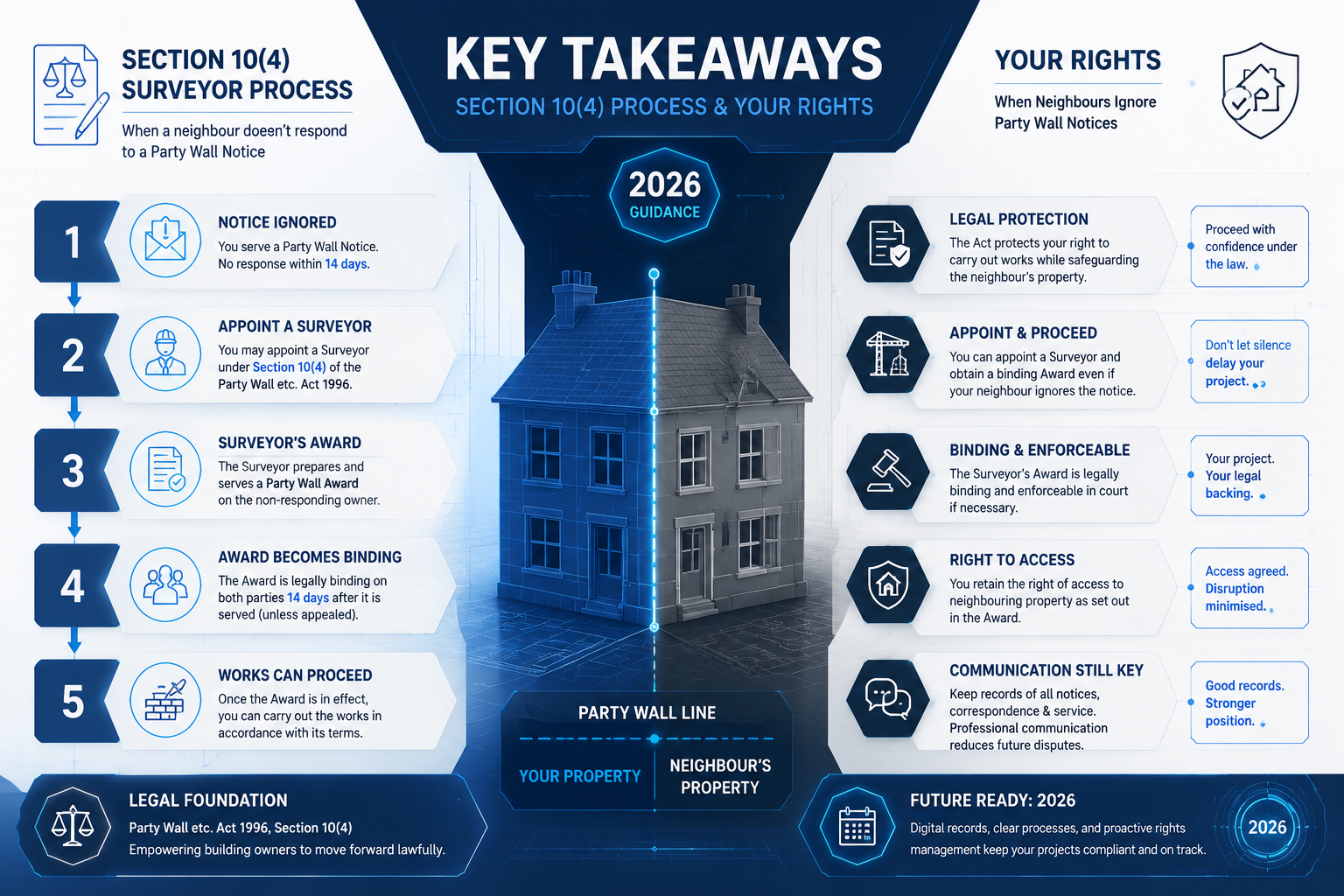
Key Takeaways 📌
- Adjoining owners have 14 days to respond to a party wall notice, followed by a further 10-day window after a second notice.
- If silence continues after both periods, a dispute is automatically deemed to exist under Section 10 of the Party Wall Act 1996.
- The building owner gains the legal right to appoint a surveyor on the neighbour's behalf under Section 10(4).
- Two separate surveyors must be appointed — one for each party — when the neighbour is non-responsive.
- The building owner bears all costs, but the process protects the project and keeps construction legally compliant.
What Is Section 10 of the Party Wall Act 1996?
The Party Wall etc. Act 1996 establishes a clear framework for resolving disputes between building owners and their neighbours when construction works affect shared or boundary structures. Section 10 is the dispute resolution engine at the heart of this framework. [1]
Under Section 10, a dispute is triggered when an adjoining owner either:
- Dissents to the proposed works after receiving a party wall notice, or
- Fails to respond within the statutory time periods
Both scenarios activate the same dispute resolution procedure — and both give the building owner defined rights and responsibilities. [3]
When Must a Building Owner Serve Notice?
Before reaching Section 10(4), a building owner must first have correctly served a party wall notice. The Act requires notice when:
| Type of Work | Notice Required |
|---|---|
| Building a new wall on or astride a boundary | Yes — Line of Junction Notice |
| Works directly to a party wall or structure | Yes — Party Structure Notice |
| Excavating within 3 metres of an adjoining property | Yes — Three Metre Notice |
Failing to serve notice correctly can invalidate the entire process, so it is essential to understand what a party structure notice is and how to serve it before proceeding. [6]
The Step-by-Step Timeline: From Notice to Section 10(4) Appointment
Understanding the exact sequence of events is critical for any building owner navigating a non-responsive neighbour situation in 2026.
Step 1: Serve the Initial Party Wall Notice
The building owner serves the appropriate party wall notice. The adjoining owner then has 14 days to respond with one of three options:
- ✅ Consent — Works can proceed without surveyors
- 🔄 Dissent and agree to a single agreed surveyor — One surveyor acts for both parties
- ❌ Dissent and appoint their own independent surveyor — Two surveyors proceed
If no response arrives within 14 days, the building owner cannot simply proceed. [6]
Step 2: Serve a Second Notice (10-Day Window)
After the initial 14-day period expires with no response, the building owner must serve a further notice giving the adjoining owner an additional 10 days to respond. This secondary notice is a legal requirement — skipping it can undermine the validity of any subsequent appointment. [6]
💬 Pull Quote: "Silence from a neighbour is not a green light — it is a legal trigger that activates a specific set of rights and obligations under the Act."
Step 3: Dispute Is Automatically Deemed to Exist
If the adjoining owner still does not respond after the 10-day secondary notice period, a dispute is automatically deemed to have arisen under Section 10 of the Party Wall Act 1996. No further action from the neighbour is required to create this legal status — the clock simply runs out. [6]
Step 4: Section 10(4) — The Building Owner Appoints a Surveyor on the Neighbour's Behalf
This is the critical provision. Under Section 10(4), when an adjoining owner neglects or refuses to appoint a surveyor, the building owner is legally entitled to appoint a surveyor on that person's behalf. [3]
This appointed surveyor does not represent the building owner — they are appointed to represent and protect the interests of the non-responsive adjoining owner. The building owner must simultaneously appoint their own separate surveyor. [6]
For expert guidance on the building owner's surveyor role, see Building Owner's Surveyor services.
Section 10(4) Surveyors Under Party Wall Act: Practical Steps for Building Owners in 2026
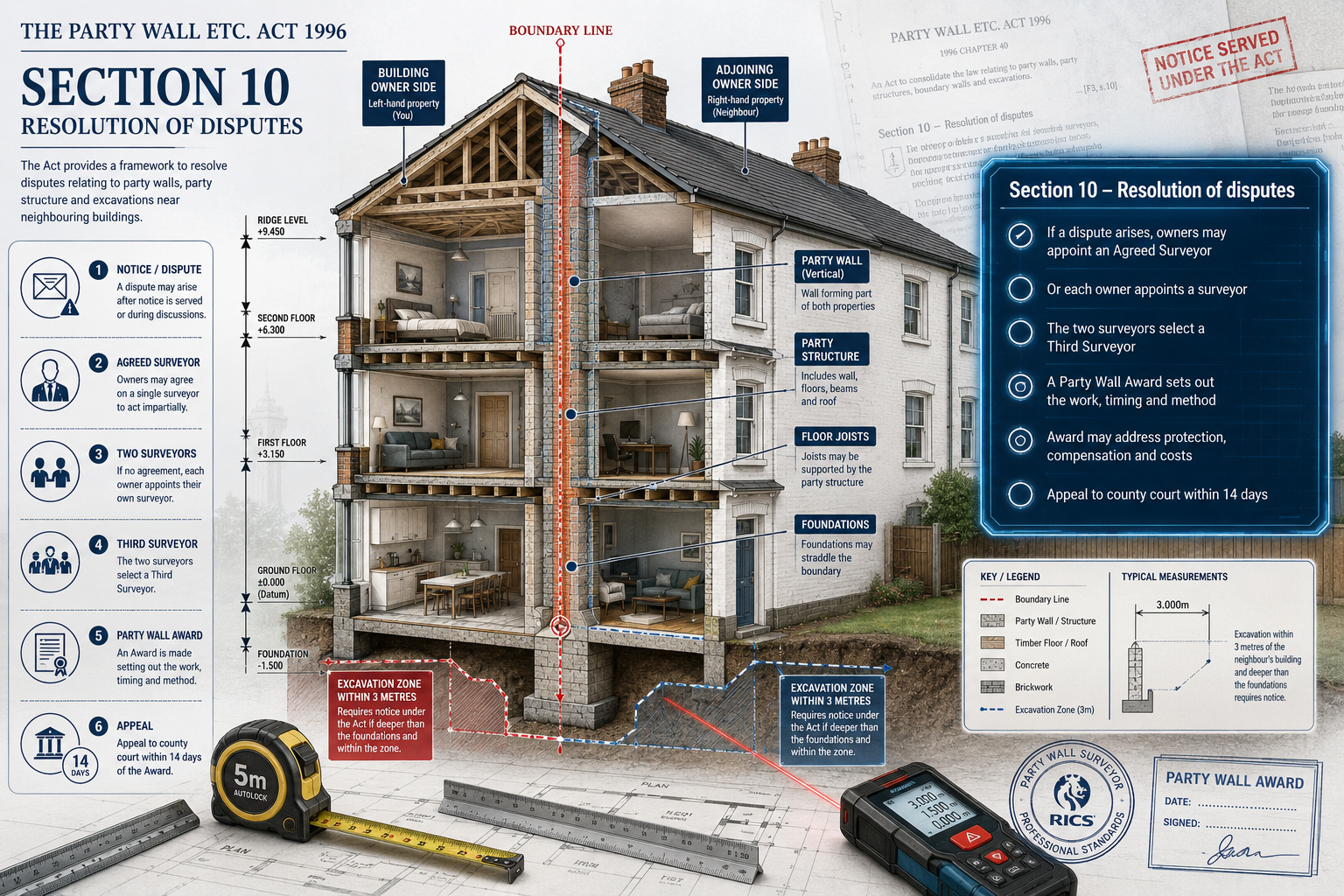
Once the Section 10(4) appointment is made, the two surveyors work together to produce a Party Wall Award — the legally binding document that governs how the works are carried out. Here is what happens in practice.
Choosing the Right Section 10(4) Surveyor
The surveyor appointed on behalf of the non-responsive adjoining owner must be:
- Genuinely independent from the building owner's surveyor
- Qualified and experienced in party wall matters
- Willing to act impartially in the absent owner's interests
⚠️ Important: An agreed surveyor — a single surveyor acting for both parties — cannot be used when the adjoining owner has not consented. Two separate surveyors are mandatory in this scenario. [6]
The Schedule of Condition
Before any works begin, the appointed surveyors carry out a Schedule of Condition — a detailed photographic and written record of the current state of the adjoining property. This document is vital because it:
- Establishes a baseline for the property's condition before works
- Protects the adjoining owner from unfair damage claims
- Protects the building owner from exaggerated post-works complaints
Even when a neighbour is non-responsive, the Schedule of Condition must still be completed thoroughly. The surveyor appointed under Section 10(4) will typically arrange access — or document the exterior if access is refused.
Drafting the Party Wall Award
The two surveyors then jointly draft a Party Wall Award. This document sets out:
- 📋 The nature and scope of the permitted works
- 🕐 Working hours and access arrangements
- 🛡️ Protection measures for the adjoining property
- 💰 Liability for costs and compensation provisions
- 📸 The completed Schedule of Condition as an appendix
Once both surveyors sign and serve the Award, the building owner can legally proceed with the works — even without any participation from the neighbour. [6]
For a practical overview of what a Party Wall Award contains, the guide on party wall contract templates and awards is a helpful reference.
Who Pays? Understanding Cost Liability Under Section 10(4)
One of the most common questions building owners ask in 2026 is: "If my neighbour ignores me, do I still have to pay their surveyor?"
The answer, under the Act, is yes — in most cases.
Cost Allocation Rules
| Cost Item | Who Pays? |
|---|---|
| Building owner's own surveyor | Building owner |
| Section 10(4) appointed surveyor (neighbour's) | Building owner |
| Third surveyor (if required) | Typically building owner |
| Damage repairs caused by works | Building owner |
The rationale is straightforward: the building owner is the one proposing works that affect the neighbouring property. The costs of the statutory process are treated as a reasonable overhead of undertaking those works. [6]
💡 Tip: To keep costs manageable, choose a Section 10(4) surveyor with a clear, fixed-fee structure and experience in efficient award drafting. For practical advice on managing expenses, see how to keep party wall costs down.
What If the Neighbour's Appointed Surveyor Also Fails to Act?
The Act anticipates even this scenario. If the surveyor appointed under Section 10(4) on the adjoining owner's behalf fails to act effectively within 10 days of receiving a written request from the building owner's surveyor, the building owner's surveyor may proceed to make and serve the Party Wall Award ex parte — meaning without the other surveyor's participation. [5][6]
This ex parte provision ensures the building owner is never permanently blocked by a combination of a non-responsive neighbour and an inactive appointed surveyor.
Section 10(4) Surveyors Under Party Wall Act: Rights, Risks, and Real-World Applications in 2026
The Risk of Ongoing Notice Validity
A critical but often overlooked point: party wall notices remain open and valid until either a response is received or a surveyor is appointed. This means a neighbour who initially ignores a notice could, in theory, appoint their own surveyor at any point during the construction process — potentially halting works until the full procedure is followed. [6]
This risk underscores why completing the Section 10(4) process promptly and correctly is so important. Once a valid Award is in place, the building owner has a secure legal foundation for the works.
Appeal Rights: What Happens If the Neighbour Reappears?
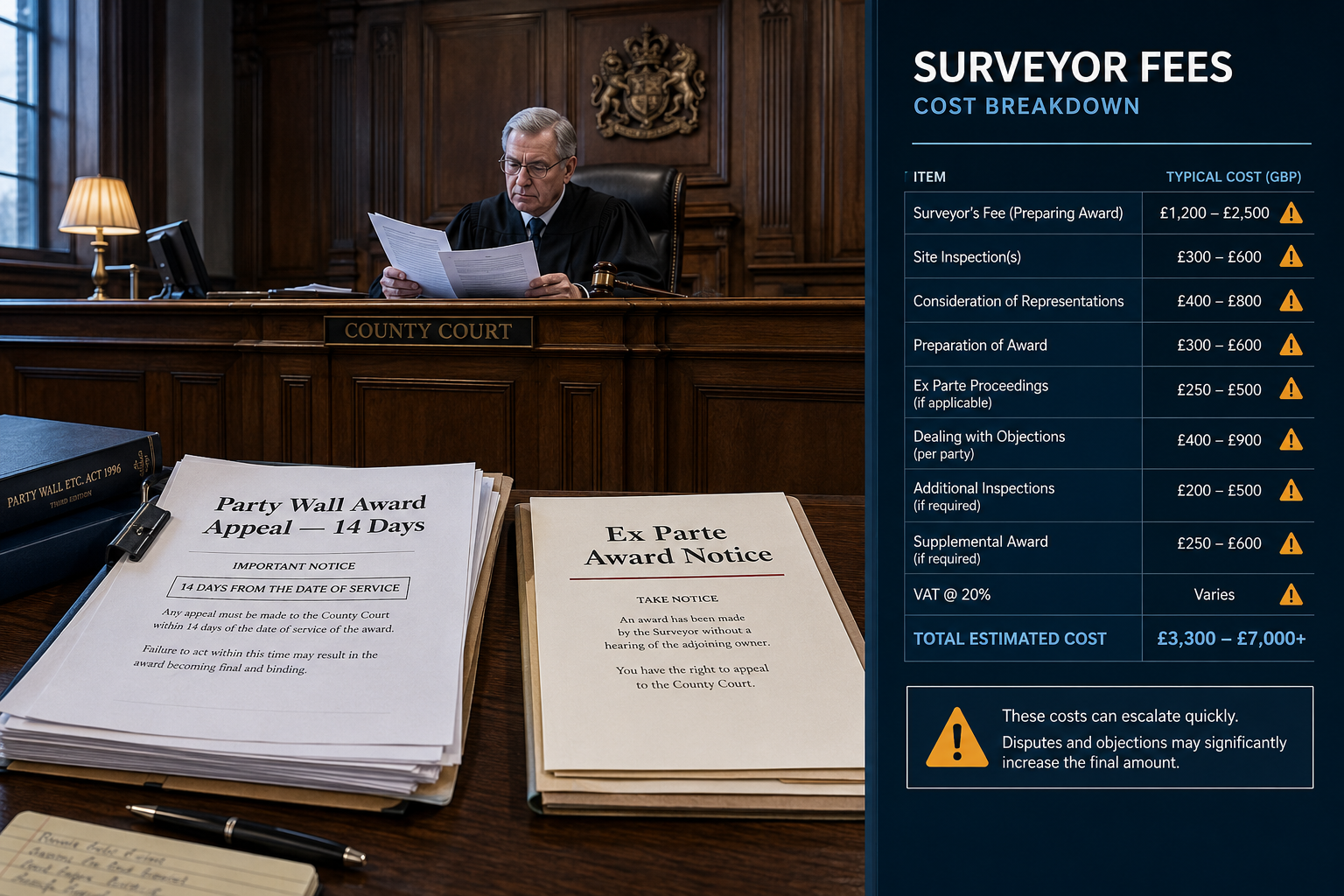
Either party — including the previously silent adjoining owner — has the right to appeal a Party Wall Award to the county court within 14 days of the Award being served. The court may rescind, modify, or confirm the Award as it sees fit. [3][5]
This is not a reason to delay the process. An Award made correctly by two properly appointed surveyors is robust and difficult to overturn without strong grounds.
Real-World Applications: Common Scenarios in 2026
Scenario A — Loft Conversion in North London
A building owner in Islington serves notice for a loft conversion involving works to a party wall. The neighbour, who is overseas, does not respond within 14 days or the subsequent 10-day period. The building owner appoints their own surveyor and a Section 10(4) surveyor for the neighbour. An Award is made, a Schedule of Condition completed, and works proceed on schedule. For local support, party wall surveyors in North London can assist with exactly this type of case.
Scenario B — Basement Extension in South London
A building owner in Lambeth proposes excavation within 3 metres of the adjoining property. The neighbour dissents but then fails to appoint a surveyor within the required period. Under Section 10(4), the building owner appoints a surveyor on the neighbour's behalf. The two surveyors produce a detailed Award covering structural monitoring requirements. Party wall surveyors in South London regularly handle these basement excavation cases.
Scenario C — Rear Extension in East London
A building owner in Hackney serves notice for a single-storey rear extension. The neighbour ignores both notices. The building owner's surveyor serves a 10-day notice on the Section 10(4) appointed surveyor, who also fails to respond. An ex parte Award is made and served, allowing works to commence lawfully.
Common Mistakes Building Owners Make — And How to Avoid Them
Navigating Section 10(4) without professional guidance leads to predictable errors. Here are the most frequent pitfalls in 2026:
❌ Skipping the secondary 10-day notice — This invalidates the subsequent appointment.
❌ Appointing an agreed surveyor without consent — Only two separate surveyors are permissible when the neighbour has not agreed.
❌ Proceeding with works before the Award is served — This exposes the building owner to injunctions and legal liability.
❌ Choosing a Section 10(4) surveyor who is not genuinely independent — This can lead to challenges to the Award's validity.
❌ Ignoring the ongoing validity of the notice — A neighbour can still engage at any point before an Award is made.
For building owners who want to understand their full position before starting any project, the building owners' guide to party wall works provides a comprehensive overview of rights and responsibilities.
Conclusion: Taking Control When Neighbours Go Silent
A non-responsive neighbour does not have to mean a stalled project. The Section 10(4) Surveyors Under Party Wall Act mechanism exists precisely to protect building owners from being held hostage by a neighbour's inaction — while simultaneously ensuring the adjoining owner's interests are professionally represented.
The process is clear, legally robust, and well-established. When followed correctly in 2026, it allows construction to proceed on a firm legal footing, protects both parties from future disputes, and produces a Party Wall Award that documents everything from working hours to the pre-works condition of the affected property.
Actionable Next Steps for Building Owners in 2026
- ✅ Serve the correct notice for the type of works planned — and keep proof of service.
- ✅ Wait the full 14 days before serving the secondary 10-day notice.
- ✅ Appoint a qualified building owner's surveyor immediately after the dispute is deemed to exist.
- ✅ Select an independent Section 10(4) surveyor to represent the non-responsive neighbour.
- ✅ Ensure a Schedule of Condition is completed before any works begin.
- ✅ Wait for the Party Wall Award to be formally served before commencing works.
- ✅ Keep records of all notices, appointments, and correspondence throughout.
For professional support at every stage of this process, contact a qualified party wall surveyor who specialises in Section 10(4) appointments and dispute resolution.
References
[1] Understanding Section 10 Of The Party Wall Act – https://www.stephensons.co.uk/site/blog/consumer-law-blog/understanding-section-10-of-the-party-wall-act
[2] Disputes Resolution – Section 10 of the Party Wall Act – https://www.designingbuildings.co.uk/wiki/Disputes%20Resolution%20-%20Section%2010%20of%20the%20Party%20Wall%20Act
[3] Party Wall etc. Act 1996, Section 10 – https://www.legislation.gov.uk/ukpga/1996/40/section/10
[4] Party Wall Legislation and Procedure, 7th Edition – https://www.rics.org/content/dam/ricsglobal/documents/standards/jan_22_party_wall_legislation_and_procedure_7th_edition.pdf
[5] Party Wall etc. Act 1996, Section 10 (Data View) – https://www.legislation.gov.uk/ukpga/1996/40/section/10/data.xht?view=snippet&wrap=true
[6] Section 10(4) Party Wall Surveyors – https://stokemont.com/blog/section-104-party-wall-surveyors/
[7] Section 10(4) Party Wall Surveyors (Advice) – https://stokemont.com/advice/section-104-party-wall-surveyors/
