


A defective party wall notice does not just cause minor inconvenience — it can halt an entire construction project, trigger legal injunctions, and add months to a programme that was already tight. In 2026, surveyors across England and Wales continue to encounter the same recurring errors that undermine notices before work even begins. Understanding what makes a party wall notice invalid — and the most common jurisdiction errors surveyors still see in 2026 — is essential for any building owner, developer, or professional involved in construction near a shared boundary.
The Party Wall etc. Act 1996 sets out precise requirements for how notices must be drafted, served, and timed. Miss any one of them, and the entire statutory process may need to restart from scratch.
Key Takeaways 📋
- Wrong notice type is one of the most damaging errors — using the incorrect statutory route can invalidate the whole process from the outset.
- Vague work descriptions and missing plans prevent adjoining owners from making informed decisions and increase the risk of dissent.
- Timing failures — particularly serving notice too late — create unrealistic start dates and render the proposed commencement invalid.
- Improper service and poor record-keeping can mean the statutory clock never legally started.
- A defective notice typically requires complete re-service, adding one to two months to project timelines [1].
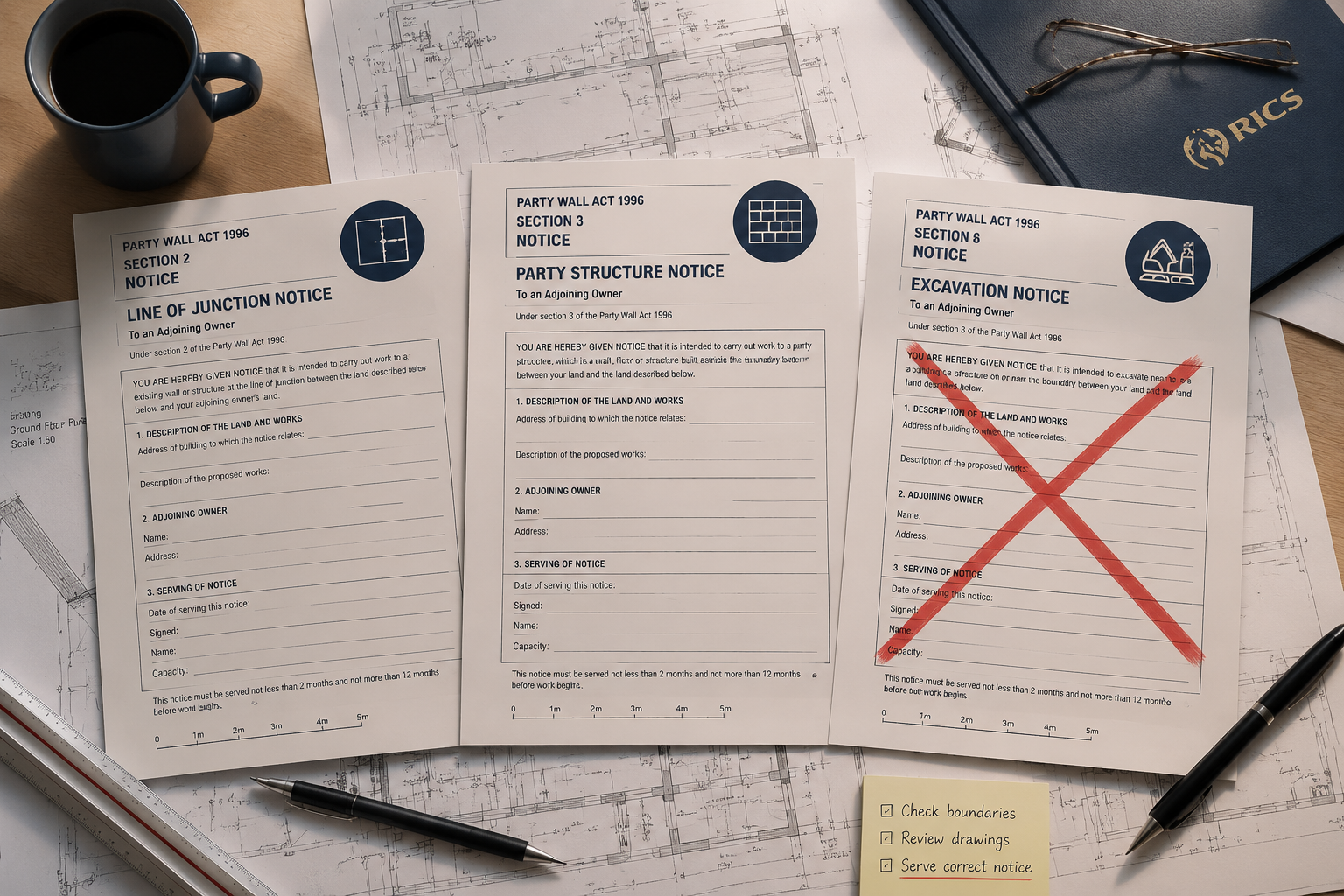
The Three Notice Types — and Why Choosing the Wrong One Is a Critical Error
One of the most fundamental questions in the party wall process is deceptively simple: which notice do you actually need? The Party Wall etc. Act 1996 provides three distinct statutory routes:
| Notice Type | When It Applies | Minimum Notice Period |
|---|---|---|
| Line of Junction Notice | Building a new wall on or at the boundary | 1 month |
| Party Structure Notice | Works to an existing party wall or structure | 2 months |
| Three Metre / Six Metre Excavation Notice | Excavations near a neighbour's foundations | 1 month |
Selecting the wrong notice type is not a technicality — it is a jurisdictional defect [1]. For example, serving a Line of Junction Notice when the works actually involve cutting into an existing shared wall means the correct statutory process for that work has never been triggered. The notice must be re-served using the correct form, and the full notice period must run again.
💬 Pull Quote: "Using the wrong notice type is like filing a planning application under the wrong category — the process simply does not apply to the work being done."
For a detailed breakdown of how a Party Structure Notice works and when it is required, it is worth reviewing the specific statutory criteria before drafting any documentation.
Template Misuse: A Growing Problem in 2026
Generic online templates continue to be a source of defective notices. Downloading a standard form and filling in the blanks without reviewing whether it matches the specific works, the correct notice type, and the applicable statutory requirements is a common shortcut that routinely backfires [1]. Templates are a starting point — not a substitute for project-specific legal and professional review.
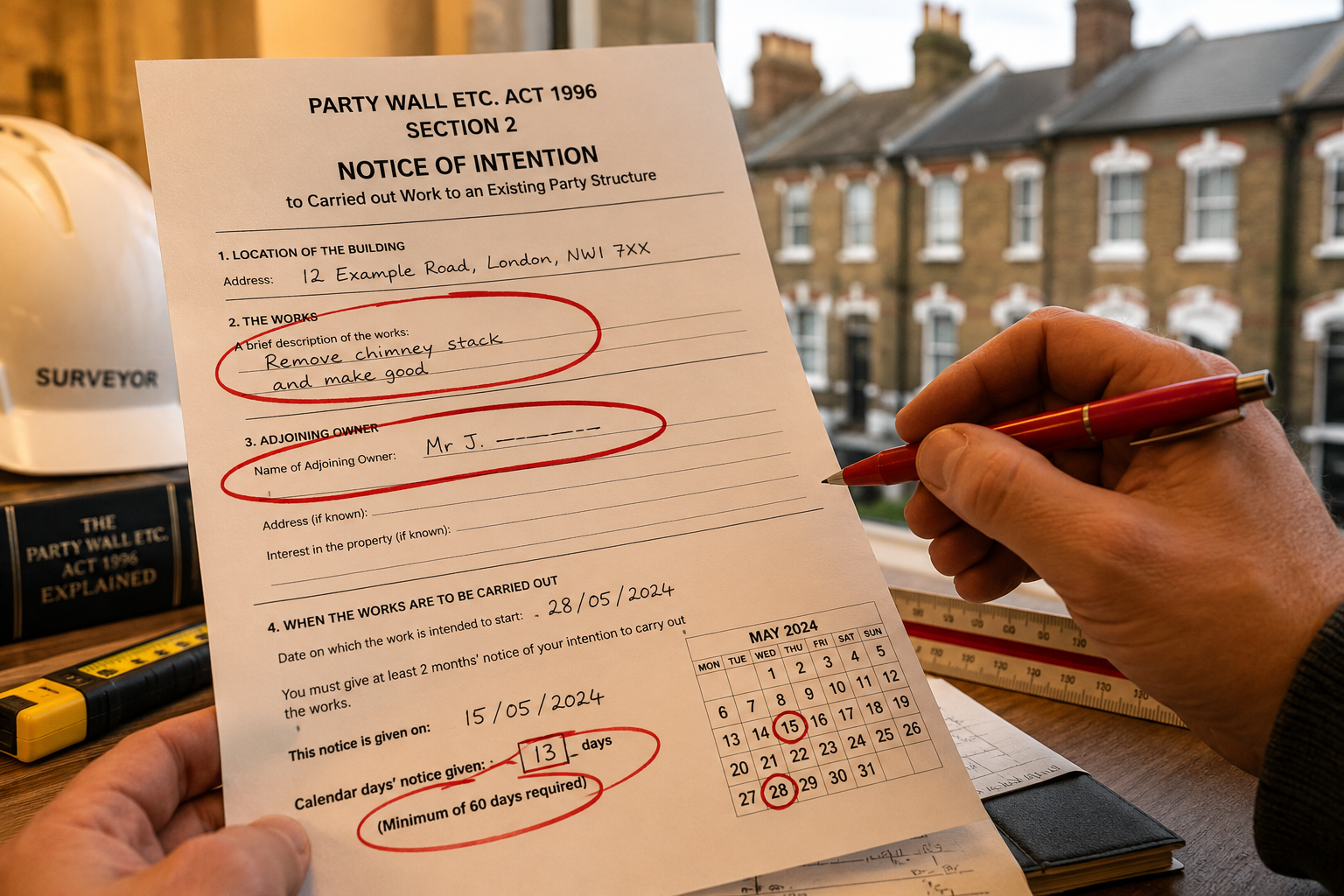
Formal Defects That Make a Party Wall Notice Invalid: The Most Common Jurisdiction Errors Surveyors Still See in 2026
Beyond selecting the wrong notice type, there is a cluster of formal defects that surveyors encounter repeatedly. Each one has the potential to render a notice ineffective.
1. 🔴 Vague or Incomplete Work Descriptions
The notice must clearly describe the proposed works. Vague language such as "general building works" or "loft conversion" without further detail fails to give the adjoining owner enough information to make an informed decision about whether to consent or dissent [1].
A proper description should include:
- The nature of the works (e.g., removing and rebuilding a chimney breast, inserting a steel beam)
- The location on the party wall or boundary
- The approximate start date
- Reference to any drawings or plans attached
When descriptions are inadequate, the adjoining owner cannot properly assess the risk to their property — which significantly increases the likelihood of dissent and subsequent disputes [1].
2. 🔴 Missing Plans and Supporting Documentation
For excavation, boundary, and structural works, plans and sections are not optional extras — they are a statutory requirement. Without drawings showing the depth, position, and proximity of proposed works to the adjoining owner's foundations, neither the neighbour nor their surveyor can properly assess the impact [1].
This is particularly critical for basement excavations and underpinning, where the risk to adjacent structures is highest.
3. 🔴 Incorrect Identification of Adjoining Owners
The notice must be served on all relevant adjoining owners — not just the person the building owner happens to know. Common errors include:
- Serving only one owner of a jointly owned property
- Failing to identify all properties affected (e.g., serving the immediate neighbour but not the property behind)
- Serving a tenant rather than the freeholder (or vice versa, depending on the circumstances)
Failing to identify and serve the correct parties renders the notice ineffective for those parties and may require complete re-service [1]. Understanding what constitutes a party fence wall and which structures trigger the Act is essential to identifying who needs to be served.
4. 🔴 Incomplete Response Pathway Information
The notice must clearly set out the options available to the adjoining owner — specifically, that they may consent to the works or dissent and trigger the surveyor appointment process [3]. Notices that omit this information, or that obscure it in confusing language, can be challenged as defective.
Building owners should also be aware that failing to include clear response instructions can complicate the entire subsequent procedure if the adjoining owner later claims they did not understand their rights.
5. 🔴 Improper Service and Poor Record-Keeping
How a notice is served matters as much as what it says. The Act permits service by:
- Hand delivery to the property
- Recorded post to the last known address
- Leaving it at the property if the owner is absent
Many disputes turn on when and how the notice was actually served [1]. Without proper documentation — proof of postage, delivery confirmation, or a witness to hand delivery — the building owner may find themselves unable to prove that the statutory clock ever started running. This creates serious arguments about whether the notice period has elapsed and whether work can legally begin.
Timing Failures: When the Clock Works Against You
Timing errors are among the most straightforward defects to avoid — yet they remain a persistent problem.
Insufficient Notice Periods
The Act is clear:
- 2 months written notice is required before building work starts for party structure works [3]
- 1 month notice is required for line of junction and excavation works
Serving notice too late — even by a few days — creates an unrealistic proposed start date and invalidates the commencement date stated in the notice [3]. This is not a minor administrative issue; it means the building owner cannot legally start work on the date they planned.
A real-world example of this problem appeared in an online housing forum in 2026, where a homeowner received a party wall notice just 17 days before the proposed start date — well short of the statutory minimum [9]. The notice was defective on its face, and work could not lawfully proceed on the stated date.
💬 Pull Quote: "Serving a notice 17 days before the proposed start date is not a minor oversight — it is a statutory failure that resets the entire timeline."
The Re-Service Penalty
When a notice contains defects that require correction and re-service, the entire relevant notice period must typically run again [1]. For a project already under time pressure, this can mean:
- +1 month delay for line of junction or excavation works
- +2 months delay for party structure works
In a construction market where programme delays translate directly into cost overruns, this is a significant commercial consequence.
For building owners planning works, understanding how to respond to party wall notices from both sides of the process helps clarify what a valid notice must contain and what the timelines actually mean in practice.
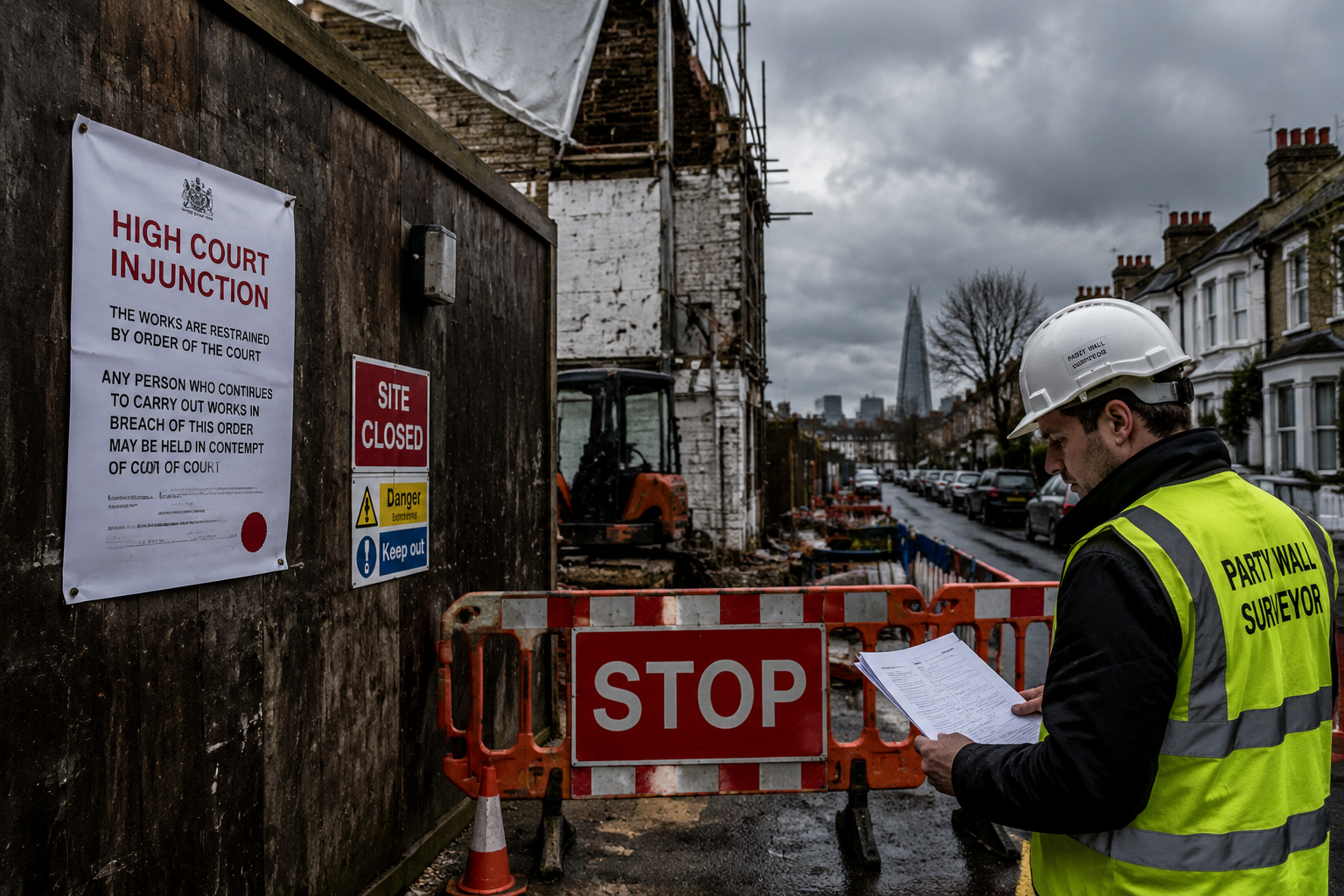
The Legal Consequences of an Invalid or Absent Notice
The consequences of serving a defective notice — or no notice at all — extend well beyond programme delays.
Injunctions and Work Stoppages
If a building owner commences work without serving proper notice, the adjoining owner has the right to apply to court for an injunction to stop work entirely [3]. Courts have shown willingness to grant such injunctions, particularly where there is a risk of damage to the adjoining property.
Ignoring the Party Wall Act altogether — not just serving defective notices — can result in legal action, injunctions, and financial penalties [5]. The cost of defending injunction proceedings, combined with the cost of a construction programme halted mid-build, can dwarf the cost of getting the notice right in the first place.
Disputes Over Pre-Existing Damage
Without a properly prepared Schedule of Condition completed before work starts, it becomes extremely difficult to establish which damage was caused by the building works and which was pre-existing [3]. This is a jurisdictional weakness that creates costly disputes — and it is entirely avoidable.
The Surveyor Appointment Process
When a valid notice is served and the adjoining owner dissents, the surveyor appointment process begins. Understanding the roles of the building owner's surveyor and the adjoining owner's surveyor is important for navigating this process efficiently. A defective notice delays the point at which this process can even begin.
A Practical Checklist: What a Valid Party Wall Notice Must Include ✅
Before serving any notice, verify the following:
- Correct notice type selected for the specific works proposed
- Full name and address of the building owner
- Full name and address of ALL relevant adjoining owners
- Clear, specific description of the proposed works
- Proposed start date that respects the minimum notice period
- Plans and sections attached where required
- Response options clearly explained (consent or dissent)
- Proof of service method documented and retained
- Notice reviewed by a qualified party wall surveyor before service
For those considering handling the process without professional assistance, it is worth understanding the risks involved in having a party wall agreement without a surveyor before proceeding.
Why These Errors Persist in 2026
Despite the Party Wall etc. Act 1996 being nearly three decades old, jurisdiction errors remain common. Several factors contribute:
🔹 Increased construction activity — The 2026 construction uptick across urban areas has brought more homeowners and developers into the party wall process, many of whom are unfamiliar with the statutory requirements [7].
🔹 Overreliance on online resources — Free templates and generic guides give a false sense of security. They rarely account for the specific nature of the works, the property type, or the correct notice route [1].
🔹 Time pressure — Building owners under programme pressure are tempted to serve notices quickly rather than correctly, creating the very delays they were trying to avoid.
🔹 Misunderstanding of the Act's scope — Many building owners do not realise that the Act applies not just to shared walls but also to excavations within specified distances of a neighbour's foundations. Understanding what types of work trigger the Act is the essential first step.
Conclusion: Get the Notice Right Before the Programme Starts
An invalid party wall notice is not a minor paperwork problem — it is a jurisdictional failure that can stop a project in its tracks, expose a building owner to legal action, and damage relationships with neighbours that may need to remain workable for years.
The errors outlined above — wrong notice type, vague work descriptions, incorrect owner identification, missing documentation, timing failures, and poor service records — are entirely preventable. They persist in 2026 not because the law is unclear, but because the notice process is underestimated.
Actionable Next Steps 🎯
- Identify the correct notice type for the specific works before drafting anything.
- Commission a qualified party wall surveyor to review or prepare the notice — the cost is minimal compared to the cost of re-service delays.
- Serve notice well in advance of the programme start date, accounting for the full statutory period plus any time needed for the surveyor appointment process.
- Document service carefully — keep proof of postage, delivery records, or witness statements.
- Arrange a Schedule of Condition before work begins to protect all parties.
Getting the notice right from the start is the single most effective way to protect a project timeline, avoid disputes, and ensure the party wall process works as the Act intended.
References
[1] What Makes A Party Wall Notice Valid – https://www.houricanassociates.com/party-wall-news/what-makes-a-party-wall-notice-valid/
[2] All Well Property Services What Is A Party Wall Notice Your 2026 Renovation Activity – https://www.linkedin.com/posts/all-well-property-services_what-is-a-party-wall-notice-your-2026-renovation-activity-7447956272936726528-uRgL
[3] Party Wall Agreement – https://hoa.org.uk/advice/guides-for-homeowners/i-am-improving/party-wall-agreement/
[4] Invalid Party Wall Notices – https://stokemont.com/advice/invalid-party-wall-notices/
[5] What Happens If You Ignore The Party Wall Act – https://fpws.uk/what-happens-if-you-ignore-the-party-wall-act/
[7] Party Wall Surveys And Neighbour Disputes During 2026s Construction Uptick RICS Compliance Framework – https://nottinghillsurveyors.com/blog/party-wall-surveys-and-neighbour-disputes-during-2026s-construction-uptick-rics-compliance-framework
[9] Neighbour Sent A Party Wall Notice 17 Days Before – https://www.reddit.com/r/HousingUK/comments/1r7yno3/neighbour_sent_a_party_wall_notice_17_days_before/