


Nearly 60% of party wall notices served in London result in a dissent or no response — yet most building owners have no clear idea what happens next. Understanding Party Wall Awards After a Dissent: What Surveyors Decide, What They Can't Decide, and How the Process Really Works is not just useful — it is essential for anyone planning construction work on or near a shared boundary. The award process is widely misunderstood: adjoining owners often believe a dissent gives them the power to stop a project, while building owners assume the process is a rubber stamp. Neither is correct.
This article cuts through the confusion, explaining exactly what a Party Wall Award controls, where surveyors' powers end, and how the formal process unfolds from the moment a dissent lands on the doorstep.
Key Takeaways 📋
- A dissent does not stop works — it triggers a legal requirement for a formal Party Wall Award before construction begins.
- A Party Wall Award is a binding legal document made by surveyors acting as a tribunal, not a contract between neighbours.
- Surveyors decide what works may be carried out, how, and under what conditions — they cannot adjudicate on property ownership, compensation for inconvenience, or planning matters.
- The full award process typically takes 2–3 months, with the award itself taking 4–6 weeks to finalise after dissent.
- Either party can appeal to the County Court within 14 days of the award being served — but this is genuinely a last resort.
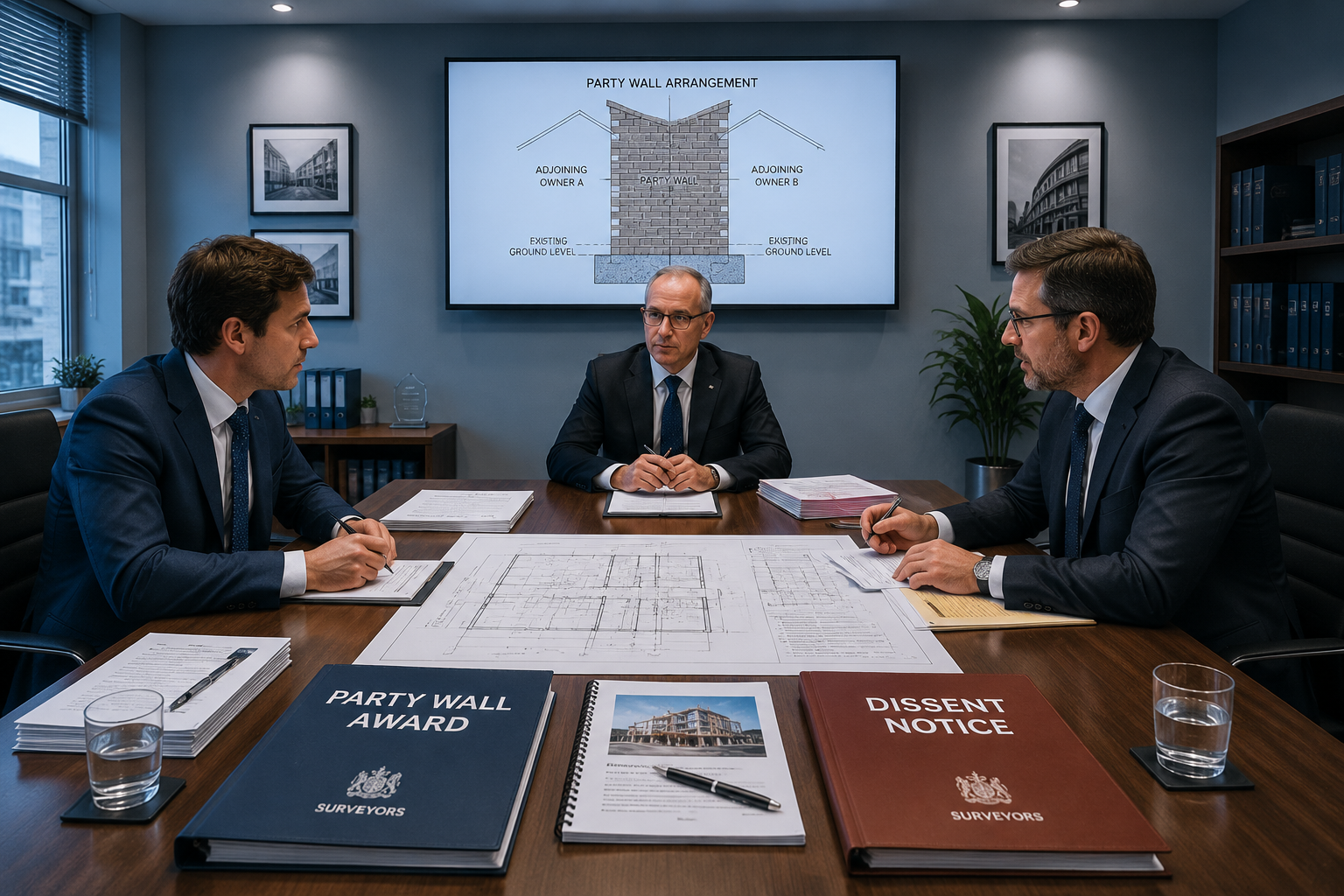
What Actually Happens When an Adjoining Owner Dissents
The Dissent Trigger: From Notice to Dispute
When a building owner serves a party wall notice, the adjoining owner has 14 days to respond. Three outcomes are possible:
| Response | Legal Effect |
|---|---|
| Written consent | Works may proceed without a formal award |
| No response within 14 days | A "dispute" is deemed to have arisen |
| Written dissent | A "dispute" is formally triggered |
Both silence and active dissent produce the same legal result: a dispute under the Party Wall etc. Act 1996 is deemed to exist, and a formal Party Wall Award must be put in place before any notifiable works can begin [2].
💡 Key insight: The word "dissent" is misleading. An adjoining owner who dissents is not vetoing the project — they are triggering a process of formal oversight and documentation.
This is one of the most important things to understand: the adjoining owner cannot actually prevent the works from proceeding [2]. Their dissent's effect is procedural, not prohibitive. It requires formal review, not authorisation to refuse. For building owners feeling anxious about a dissent notice, this distinction matters enormously. For adjoining owners who believe they have blocked a neighbour's extension — they have not.
To understand what types of work trigger this process in the first place, it helps to review the types of party wall works covered under the Act.
Surveyor Appointments: Getting It Right From the Start
Once a dispute is triggered, each party must appoint a surveyor. There are two models:
- Agreed surveyor: Both parties appoint a single, impartial surveyor jointly.
- Two surveyors: Each party appoints their own surveyor, who then jointly select a third surveyor to act as umpire if they cannot agree [2].
⚠️ Critical procedural point: All surveyor appointments must be made in writing. If appointments are not properly documented, a court could declare the resulting Party Wall Award invalid [2]. This is not a technicality to overlook — it has real legal consequences.
The building owner typically bears the cost of the process, including the adjoining owner's surveyor's reasonable fees. For a full breakdown of what to expect financially, see the guide on party wall costs and the process.
Party Wall Awards After a Dissent: What Surveyors Decide, What They Can't Decide, and How the Process Really Works in Practice
What Surveyors Are Empowered to Decide
The Party Wall Award is not an agreement between two neighbours. It is a formal legal decision made by appointed surveyors acting as a quasi-judicial tribunal [2]. Their role is to draw up a document that:
- Sets out what the building owner may do — the specific notifiable works authorised
- Specifies how and when those works must be carried out
- Establishes a framework for preventing and resolving disputes that may arise during the works [2]
Before finalising the award, the surveyor(s) conduct a detailed technical review of architectural drawings, structural engineer's calculations, and contractor proposals [5]. This is not a cursory check — it is a substantive assessment of whether the proposed works are being carried out safely and with proper regard for the adjoining property.
Typical contents of a Party Wall Award include:
- ✅ Description of the authorised works
- ✅ Working hours and days permitted
- ✅ Method of construction and materials
- ✅ Access rights to the adjoining property
- ✅ Requirement for a Schedule of Condition (a record of the adjoining property's pre-works condition)
- ✅ Security for expenses (in some cases)
- ✅ Dispute resolution procedure during works
- ✅ Commencement deadline — usually 12 months from the date the award is served [7]
The 12-month commencement rule is significant. If works do not begin within this window, a new award may be required, as conditions and ownership of adjoining properties could have changed [7].
What Surveyors Cannot Decide ❌
This is where many people — and even some professionals — get confused. The surveyors' jurisdiction under the Act is strictly limited to matters arising from the notifiable works. They cannot:
| Outside Surveyor Jurisdiction | Correct Forum |
|---|---|
| Ownership of the party wall or boundary | Land Registry / County Court |
| Planning permission disputes | Local Planning Authority |
| Compensation for general inconvenience | Civil courts |
| Trespass claims | Civil courts |
| Disputes about works not covered by the notice | Separate legal action |
| Neighbour nuisance unrelated to the works | Environmental Health / courts |
🔑 Pull quote: "A Party Wall Award is a powerful document — but its power is precisely defined. Surveyors are not arbiters of neighbourly relations. They are technical decision-makers with a specific statutory remit."
This distinction matters practically. An adjoining owner who wants compensation because the building work has been noisy and disruptive cannot obtain that through the award process. An adjoining owner who believes the building owner has encroached on their land cannot resolve that through the surveyors. These are separate legal matters requiring separate action.
For adjoining owners navigating this process, understanding the role of an adjoining owner's surveyor is essential to knowing what protections are genuinely available.
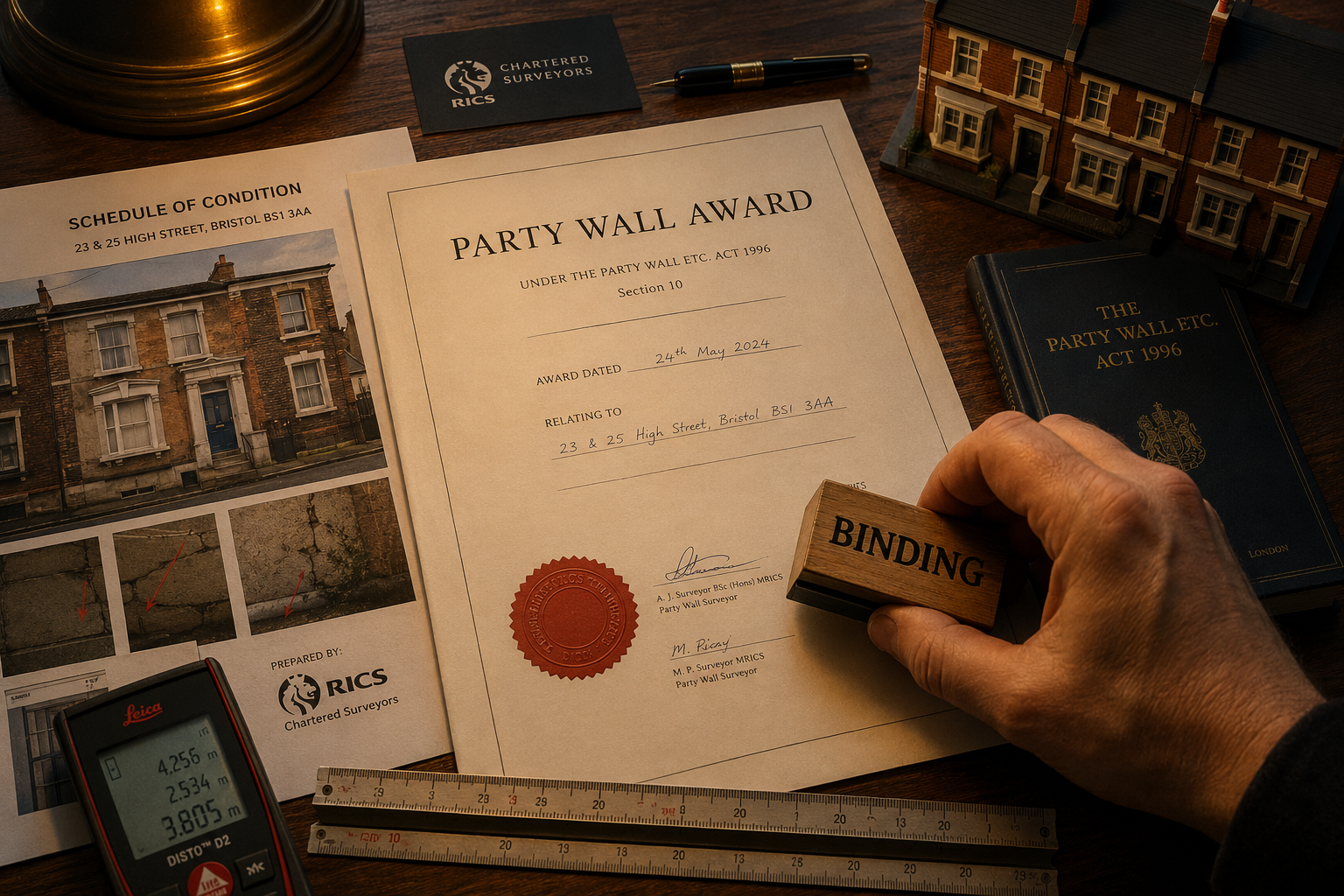
How the Award Process Really Works: A Step-by-Step Timeline
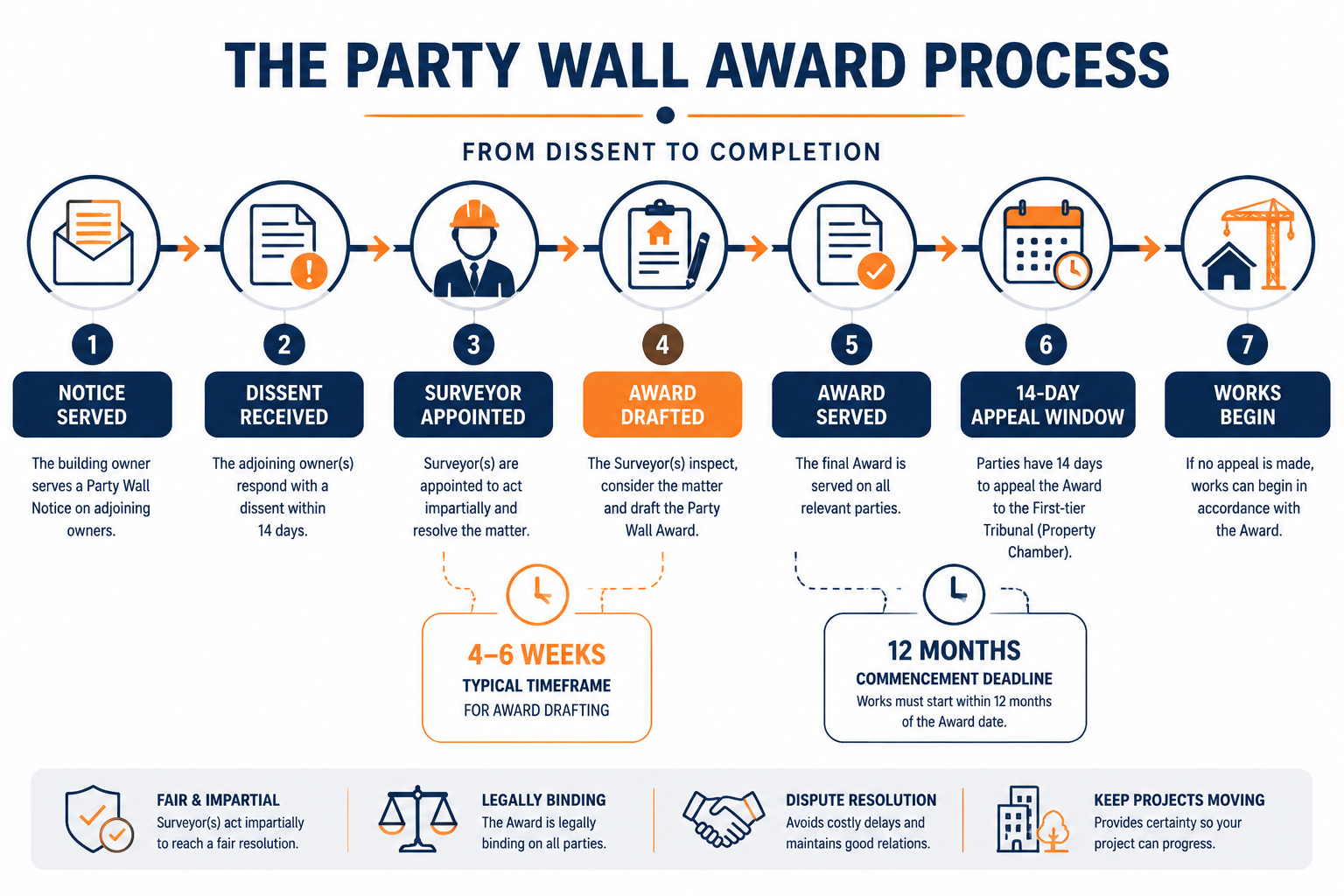
Understanding Party Wall Awards After a Dissent: What Surveyors Decide, What They Can't Decide, and How the Process Really Works is easier with a clear picture of the timeline. Industry guidance recommends allowing a minimum of 2 months, ideally 3 months, for the full process [5]. Here is how it typically unfolds:
Stage 1: Notice Served (Week 0)
The building owner serves the appropriate notice — a Party Structure Notice for works to the wall itself, or a Line of Junction Notice for new walls at the boundary. The 14-day response window begins.
Stage 2: Dissent Received (Week 2–3)
The adjoining owner dissents (or fails to respond). The dispute is triggered. Surveyor appointments are made in writing by both parties.
Stage 3: Technical Review (Weeks 3–6)
The appointed surveyor(s) review architectural drawings, structural reports, and contractor proposals [5]. A Schedule of Condition survey of the adjoining property is typically carried out at this stage — this protects both parties by establishing a clear baseline.
Stage 4: Award Drafted and Agreed (Weeks 4–8)
The award is drafted. If two surveyors are appointed, they negotiate its terms. If they cannot agree, the third surveyor (umpire) is called in to make the final determination. The award itself usually takes 4–6 weeks to agree after dissent is received [5].
Stage 5: Award Served (Week 8–10)
The finalised award is formally served on both parties. It is legally binding on both the building owner and adjoining owner from this point [2].
Stage 6: 14-Day Appeal Window
Either party has 14 days from the conclusion of the award to appeal to the County Court [2][7]. After this window closes, the award is final and cannot be challenged through this route.
Stage 7: Works Commence
Works begin — within the 12-month commencement deadline stipulated in the award.
The Three-Surveyor Model in Practice
The three-surveyor structure deserves special attention. When each side appoints their own surveyor, those two surveyors must agree on a third surveyor before the award process begins [2]. This third surveyor does not get involved unless the two appointed surveyors reach an impasse.
Why does this matter?
- It prevents deadlock — the process cannot be stalled indefinitely
- It provides an independent check on the two appointed surveyors
- Either party (not just the surveyors) can call on the third surveyor if needed
The third surveyor's decision, if called upon, carries the same legal weight as an award agreed by the two appointed surveyors.
Appealing a Party Wall Award: The Option of Last Resort
When and How Appeals Work
The Act provides a right of appeal to the County Court for either party [2][7]. The strict rules are:
- Appeal must be made within 14 days of the award being concluded and served
- The court can rescind or modify the award
- After 14 days, the award is final and binding — no further challenge is possible through this route
Why Appeals Are Rarely the Right Move
Court proceedings for appealing party wall awards are inevitably risky and potentially expensive [2][8]. An unsuccessful appellant may face a costs order against them — meaning they pay not only their own legal fees but potentially the other party's as well.
⚠️ Practical warning: Before considering an appeal, both parties should take independent legal advice. The 14-day window is short, costs can be significant, and courts do not lightly overturn awards made by properly appointed surveyors acting within their jurisdiction.
For most disputes, the better approach is to raise concerns with the appointed surveyor before the award is finalised — not after. The party wall awards process is specifically designed to allow both parties to make representations before the document is concluded.
Common Misconceptions About the Award Process
"The Award Protects Only the Adjoining Owner"
False. The award protects both parties. It gives the building owner a clear legal right to carry out the specified works. Without it, a building owner who proceeds after a dissent is acting without legal authority and could face an injunction.
"Surveyors Can Award Compensation for Disruption"
Partly true, but limited. Surveyors can require security for expenses and can address direct physical damage caused by the works. They cannot award compensation for general inconvenience, loss of enjoyment, or business losses.
"A Dissent Means the Neighbour Hates the Project"
Not necessarily. Many solicitors and surveyors advise adjoining owners to dissent as a matter of routine, simply to ensure formal documentation is in place. A dissent is often a protective measure, not a declaration of hostility.
"The Award Covers Everything That Might Go Wrong"
No. The award covers the specific notifiable works described in the notice. Any works outside that scope — or damage that occurs in ways not covered by the award — may require separate legal action.
Conclusion: Turning a Dissent Into a Manageable Process
A dissent is not a disaster. Understood correctly, it is a prompt to put proper legal and technical protections in place — for both sides. Party Wall Awards After a Dissent: What Surveyors Decide, What They Can't Decide, and How the Process Really Works comes down to one central principle: surveyors have real but bounded power. They authorise and regulate specific works; they do not resolve every dispute a shared wall might generate.
Actionable Next Steps 🚀
For building owners:
- Serve notices early — allow at least 3 months before planned works begin
- Appoint a surveyor in writing immediately after a dissent is received
- Prepare full architectural and structural drawings for the technical review
- Ensure works commence within 12 months of the award being served
For adjoining owners:
- Respond to notices within 14 days — silence triggers a dispute just as dissent does
- Appoint your own surveyor promptly to protect your interests
- Raise all concerns with your surveyor before the award is finalised
- Understand that the appeal window is only 14 days — act quickly if needed
For both parties: The party wall process works best when both sides engage constructively and early. Delays, non-responses, and last-minute objections make the process slower and more expensive for everyone.
Whether carrying out works or responding to a neighbour's notice, professional guidance from the outset makes a material difference. Explore the Party Wall etc. Act 1996 explained for the full legislative framework underpinning every award.
References
[1] Party Walls Awards Appeals And A Case Law Update – https://hstalks.com/article/1862/party-walls-awards-appeals-and-a-case-law-update/
[2] Party Wall Awards – https://www.ladbrokeassociation.org/party-wall-awards/
[3] Party Wall Notices And Awards – https://www.simplesurvey.co.uk/article/party-wall-notices-and-awards/
[4] Party Wall Awards A Simple Guide – https://www.delvearchitects.com/stories/party-wall-awards-a-simple-guide
[5] Party Wall Awards – https://runprojects.co.uk/party-wall-awards/
[6] Party Wall Awards – https://homz.uk/party-wall-awards/
[7] Party Wall Awards – https://www.partywallslimited.com/services/party-wall-awards
[8] Party Wall Awards – https://hudsonpartywallsurveyors.co.uk/party-wall-awards/
[9] Party Wall Disputes PLA Autumn Training Day 17.11.2021 – http://www.falcon-chambers.com/images/uploads/articles/Party_Wall_Disputes_-_PLA_Autumn_Training_Day_-_17.11_.2021_.docx_.pdf
[10] Consent Or Dissent What Happens After A Party Wall Notice – https://harrisonclarke.co.uk/consent-or-dissent-what-happens-after-a-party-wall-notice/