


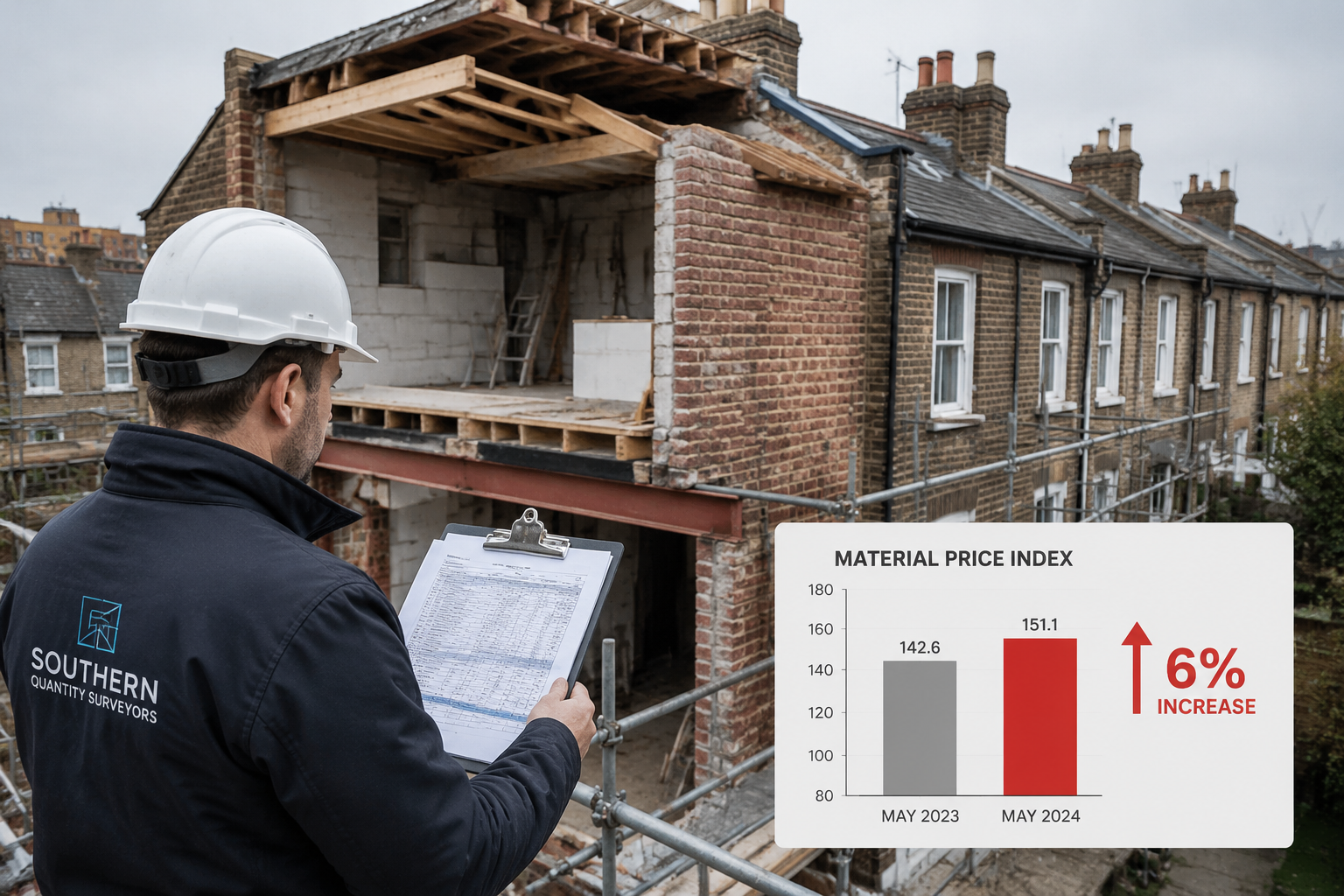
Construction material costs in the United Kingdom rose by an estimated 6.0% above 2024 baseline figures in early 2026 — not because of demand spikes or supply chain disruptions alone, but because of deliberate trade policy decisions made thousands of miles away. [3] For anyone involved in party wall matters — whether as a building owner, an adjoining owner, or a surveyor — that number is not abstract. It translates directly into the reliability of cost assumptions embedded in party wall awards, schedules of condition, and agreed compensation figures. Understanding tariff impacts on party wall surveying costs: updating awards and agreements for 2026 material price volatility is now a practical necessity, not an optional exercise in macroeconomics.
Key Takeaways
- Global tariffs introduced in 2026 are adding approximately 6.0% to construction material costs and 3.0% to total project costs, directly affecting the financial assumptions inside party wall awards.
- Layered tariff measures — covering steel, aluminium, copper, timber, and kitchen fittings — create compounding cost pressures on the most common party wall works.
- Party wall awards drafted before mid-2025 may contain cost estimates that are materially out of date and should be reviewed for escalation provisions.
- Surveyors should include time-stamped, escalation-linked cost schedules in all new awards to protect both building owners and adjoining owners.
- Short-term tariff volatility in 2026 means cost assumptions can shift within weeks, making regular review clauses essential.
How 2026 Tariffs Are Reshaping Construction Material Prices
To understand the pressure on party wall surveying costs, it helps to map exactly which tariff measures are currently in force. As of spring 2026, three overlapping regimes are simultaneously affecting the cost of construction materials commonly used in party wall works:
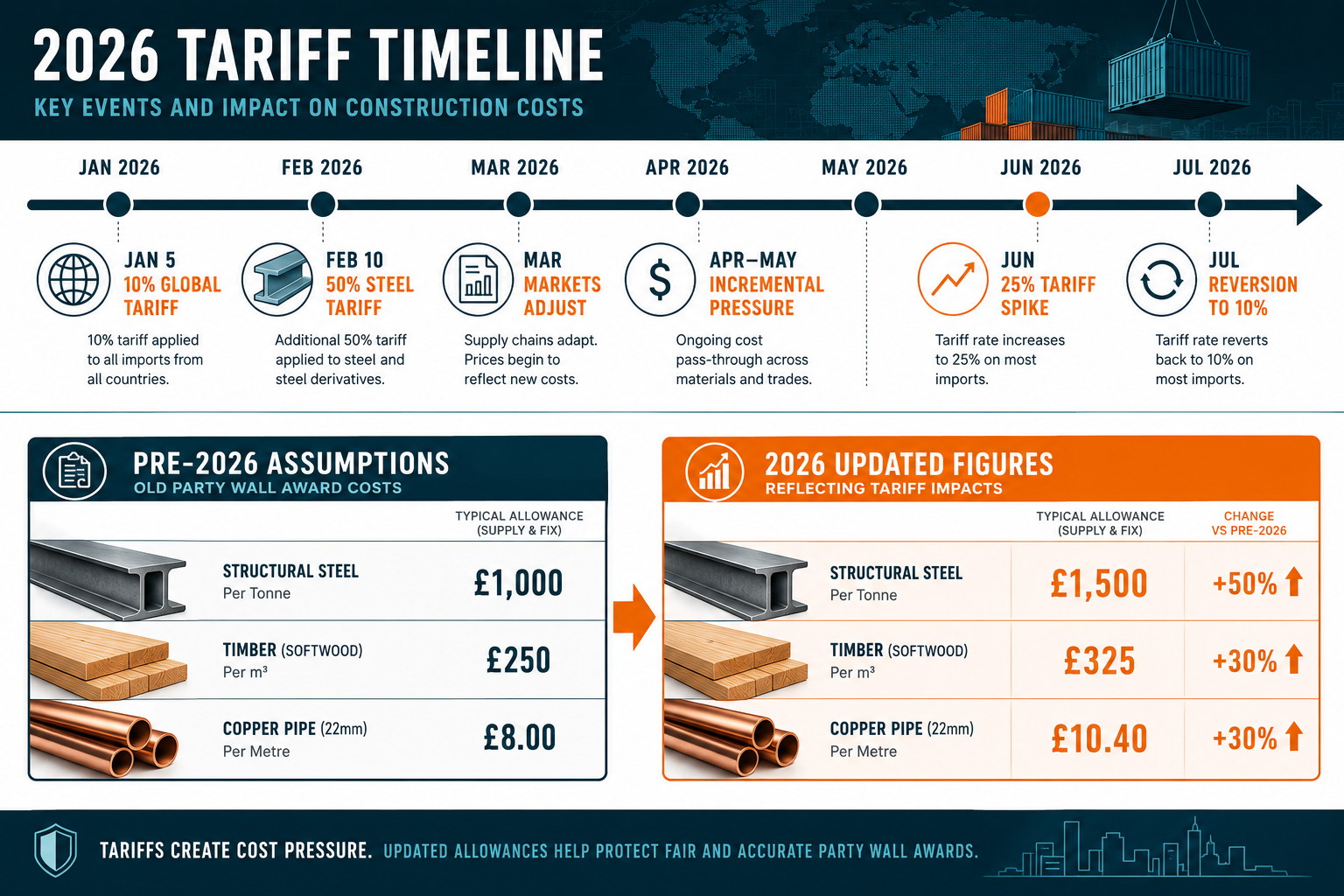
The 10% global Section 122 tariff applies to a broad basket of imports and is scheduled to remain in force until 24 July 2026. [2] This baseline measure affects a wide range of manufactured goods, including fixings, insulation products, and prefabricated components.
The 50% Section 232 tariff applies specifically to raw steel, aluminium, and copper products. [2] For party wall works, this is particularly significant. Lintels, rolled steel joists (RSJs), copper DPC flashings, and aluminium cavity trays are all standard components in loft conversions, basement excavations, and structural beam insertions — the exact types of works that most frequently trigger the Party Wall etc. Act 1996.
Timber and softwood lumber face approximately 10% tariffs, [2] affecting floor joists, studwork partitions, and temporary support structures used during notifiable works.
Kitchen cabinets and vanities — relevant where party wall works involve rear extensions with kitchen refits — face tariffs ranging from 10% to 50% depending on source country and timing. [5]
These are not independent measures. They stack. A structural steel beam used in a loft conversion may attract the 50% Section 232 tariff on the raw steel, plus additional duties on the fabrication process. A timber-framed party wall may face the 10% lumber tariff on the structural members and the 10% global tariff on the insulation batts. The compounding effect is what makes 2026 different from previous periods of material price inflation.
| Material Category | Applicable Tariff (2026) | Typical Party Wall Use |
|---|---|---|
| Raw steel and aluminium | 50% (Section 232) | RSJs, lintels, padstones |
| Softwood timber/lumber | ~10% | Joists, studwork, formwork |
| Copper products | 50% (Section 232) | DPC flashings, pipework |
| Kitchen cabinetry | 10-50% (varies) | Rear extension fit-outs |
| General manufactured imports | 10% (Section 122, until 24 July 2026) | Fixings, insulation, membranes |
Sources: [2][5]
Beyond the headline figures, the volatility pattern is equally important for surveyors to understand. A January 2026 tariff risk update documented an extreme example: tariffs on Great Britain and certain trading partners moved from 0% to 10%, with a scheduled rise to 25% on 1 June 2026, before reverting to 0% — all within a matter of weeks. [4] That kind of policy oscillation makes any static cost estimate embedded in a party wall award potentially unreliable within its own validity period.
Turner & Townsend's 2026 market intelligence reports that bid price escalation has risen from 4.0% to approximately 4.25% in 2026, driven by trade realignment and tight labour markets. [8] This means that even where surveyors use current tender prices as their baseline, those prices are themselves moving targets.
Why Party Wall Awards Are Particularly Exposed to Material Price Volatility
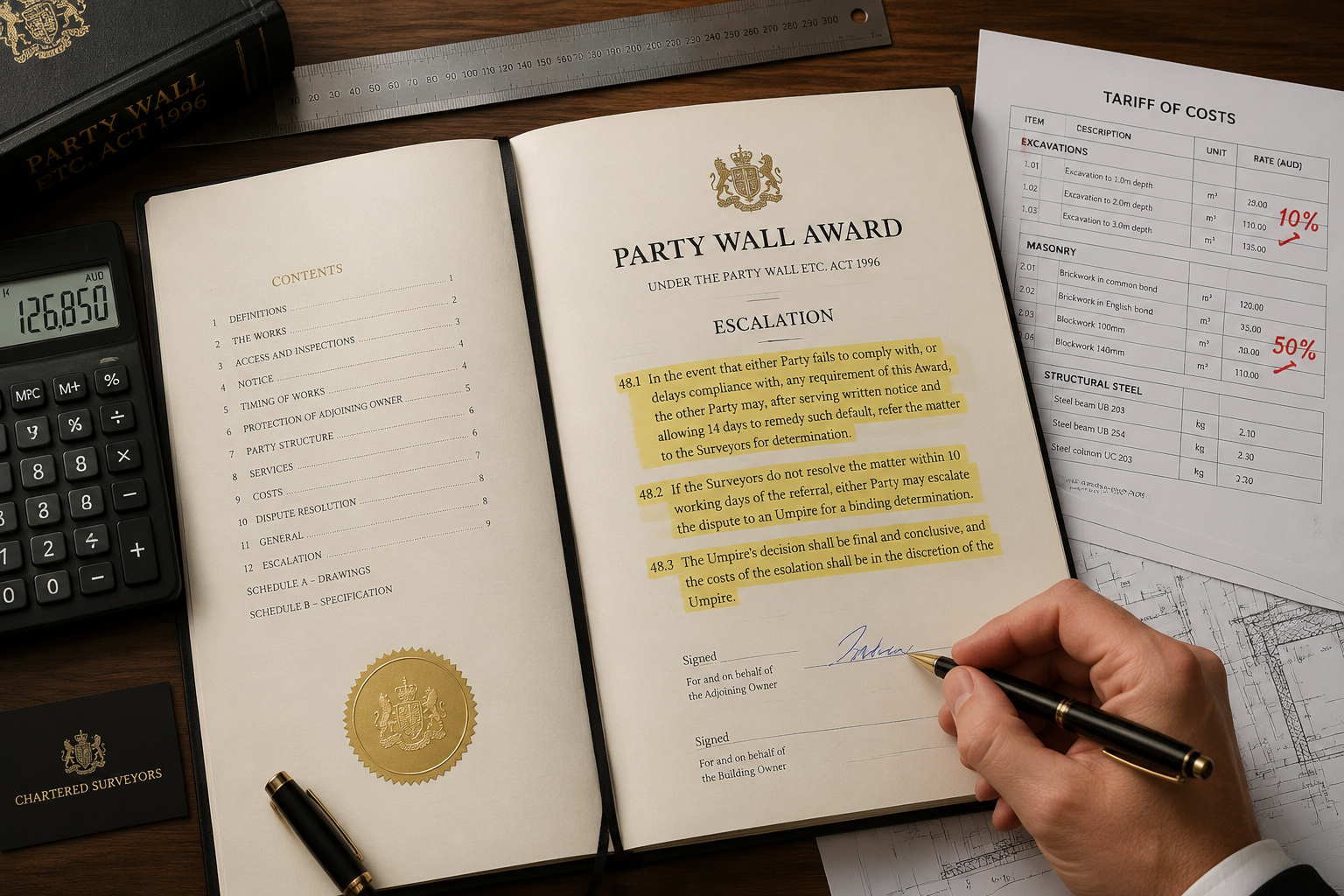
A party wall award is a legally binding document. Once sealed, it governs the rights and obligations of both the building owner and the adjoining owner throughout the works. Learn more about how party wall awards work and what they typically contain. The problem with a volatile cost environment is that awards drafted even six months ago may contain cost assumptions — for make-good works, for compensation schedules, or for specified materials — that no longer reflect market reality.
Consider a common scenario: a building owner in South London serves notice for a loft conversion involving the insertion of a steel beam through a party wall. The party wall surveyor drafts an award specifying that any make-good works to the adjoining owner's property will use materials "of equivalent quality and specification." That clause sounds reasonable. But if the cost of equivalent steel components has risen by 50% due to Section 232 tariffs, [2] the building owner's contingency budget — if one was embedded in the award — is almost certainly insufficient.
Three categories of party wall awards face the greatest exposure:
- Awards with fixed compensation figures — where a specific sum is agreed for potential damage, without any escalation mechanism.
- Awards specifying particular materials by product type — where the named product may now be subject to import tariffs that did not exist when the award was drafted.
- Long-duration works — basement excavations and structural alterations that may span 12-18 months, during which tariff regimes could change multiple times.
For adjoining owners, the risk is that compensation or make-good provisions prove inadequate. For building owners, the risk is that contractors submit variation claims mid-project because the award's assumed cost basis no longer holds. Both scenarios create disputes — exactly what the party wall process is designed to prevent.
Understanding the costs of the party wall process in 2026 requires factoring in not just surveyor fees but the downstream cost implications of awards that fail to account for tariff-driven escalation.
Practical Guidance: Updating Awards and Agreements for 2026 Material Price Volatility
This is where tariff impacts on party wall surveying costs — and the process of updating awards and agreements for 2026 material price volatility — move from analysis into action. Surveyors, building owners, and adjoining owners all have roles to play.
Escalation Clauses: The Core Protective Mechanism
The most direct response to tariff-driven volatility is the inclusion of escalation clauses within party wall awards. An escalation clause links cost assumptions to an external index or trigger event, allowing the award to remain valid even as market prices move.
Effective escalation clauses in 2026 should include:
- A base date — the date on which cost estimates were prepared, explicitly stated.
- An index reference — such as the BCIS All-in Tender Price Index or the ONS Construction Output Price Index, against which future costs are measured.
- A review trigger — specifying that if material costs rise by more than a defined threshold (e.g., 5%) between the award date and the commencement of works, the compensation schedule is reviewed.
- A tariff-specific carve-out — acknowledging that government trade policy changes (including Section 232 and Section 122 measures) constitute a force majeure-adjacent event warranting cost review.
"A party wall award that treats today's steel price as tomorrow's certainty is not protecting either party — it is creating a dispute waiting to happen."
Reviewing and Amending Existing Awards
Where works have not yet commenced and an existing award was drafted before the current tariff regime took effect, surveyors should consider whether a supplemental award or agreed amendment is appropriate. The Party Wall etc. Act 1996 does not prohibit parties from agreeing modifications to an existing award, provided both surveyors (or the agreed surveyor) consent and the amendment is properly documented.
Steps for reviewing an existing award:
- Identify all cost-sensitive provisions — compensation figures, material specifications, make-good schedules.
- Obtain current market pricing for the specified materials, noting any tariff surcharges.
- Calculate the variance against the award's original assumptions.
- If the variance exceeds 5-10%, prepare a supplemental award or agreed schedule of revised costs.
- Ensure the supplemental document is dated and references the specific tariff measures driving the revision.
For building owners who want to understand their options before works begin, reviewing the types of party wall works that commonly involve tariff-sensitive materials is a useful starting point.
Material Specification Flexibility
Rather than specifying a named product or a fixed material standard, awards drafted in 2026 should use performance-based specifications where possible. Instead of "100mm Kingspan K103 insulation board," an award might specify "insulation achieving a minimum U-value of 0.18 W/m²K using materials sourced in compliance with current building regulations." This gives contractors flexibility to substitute equivalent products if a tariffed product becomes disproportionately expensive, without triggering a variation dispute.
Contractor Procurement Advice
Surveyors are not procurement specialists, but they can advise building owners to seek fixed-price contracts with clearly defined material allowances rather than provisional sums. A provisional sum for structural steelwork, for example, leaves the building owner exposed to the full impact of Section 232 tariffs if steel prices rise between tender and procurement. [2] Fixed-price contracts with a named steel specification transfer that risk to the contractor — who is better placed to hedge it through early procurement.
Research from ABC Carolinas confirms that contractors who lock in material prices early and use escalation clauses in their own contracts are significantly better positioned to protect margins in a tariff-volatile environment. [1] The same logic applies to party wall works in the UK context.
Tariff Impacts on Party Wall Surveying Costs: What Building Owners and Adjoining Owners Should Do Now
The practical implications of tariff impacts on party wall surveying costs — and the need for updating awards and agreements for 2026 material price volatility — differ depending on which side of the wall a party stands on.
For Building Owners
Building owners initiating works in 2026 should take the following steps before serving notice:
- Commission an updated cost plan from a quantity surveyor or contractor that explicitly accounts for current tariff levels on steel, timber, and copper. A 6.0% uplift on material costs and 3.0% on total project costs [3] should be treated as a minimum planning assumption, not a worst case.
- Budget for contingency above standard levels. In a stable market, a 10% contingency is often sufficient. In 2026, given the documented volatility of tariff policy, [4] a 15-20% contingency on material-intensive scopes is more appropriate.
- Engage a surveyor early. The earlier a surveyor is involved, the more time there is to draft an award with robust escalation provisions before works commence. For guidance on how to keep party wall costs down, early engagement is consistently the most effective strategy.
- Serve notice promptly. The statutory notice periods under the Party Wall etc. Act 1996 mean that delays in serving notice push commencement dates back. In a rising-cost environment, delay is itself a financial risk.
For those planning works in specific areas, local surveyors with knowledge of regional contractor markets can provide more precise cost intelligence. Whether the project is in South London, North London, or East London, the tariff pressures are consistent but local labour market conditions vary.
For Adjoining Owners
Adjoining owners should not assume that an existing award adequately protects them if it was drafted before 2026 tariff measures took effect. Key actions include:
- Request sight of the cost schedule underlying any compensation or make-good provisions in the award.
- Ask the surveyor to confirm that the figures reflect current (2026) material prices, not pre-tariff baselines.
- Consider appointing a separate surveyor if the existing award appears to contain outdated assumptions. The right to appoint an adjoining owner's surveyor exists precisely to provide independent scrutiny of these provisions.
For Surveyors
Surveyors drafting awards in 2026 carry a professional responsibility to ensure that cost assumptions are current and that awards contain mechanisms to remain valid as prices move. The Brookings Institution has noted that tariff-driven cost increases pose a particular threat to residential construction projects where budgets are fixed and contingencies are thin. [10] Party wall awards sit at the intersection of legal obligation and construction economics — surveyors who ignore the tariff environment are not serving their clients well.
Best practice for 2026 award drafting includes:
- Dating all cost schedules explicitly and referencing the tariff environment at the time of drafting.
- Including a review clause triggered by material cost movements exceeding a defined threshold.
- Using performance specifications rather than product-specific material references where possible.
- Advising building owners in writing of the tariff risks affecting their project budget.
For a detailed reference on what a well-structured party wall award should contain, the party wall contract template guide provides a useful framework that can be adapted to include 2026-specific escalation provisions.
The Broader Context: Why This Matters Beyond Individual Projects
The cumulative effect of tariff-driven cost pressure across the construction sector has implications that extend beyond individual party wall disputes. Cushman & Wakefield's analysis estimates that the current tariff regime adds approximately 3.0% to total project costs across the commercial real estate sector. [3] For residential projects — which typically have tighter margins and less sophisticated risk management — the impact may be proportionally greater.
Brookings research highlights that recent tariff measures pose a direct threat to residential construction activity, particularly in segments where affordability is already constrained. [10] In London, where party wall works are disproportionately common due to the density of terraced and semi-detached housing stock, this translates into a significant volume of projects where cost assumptions in existing awards may be materially incorrect.
The construction industry is also facing compounding pressures from labour market tightness alongside tariff-driven material cost increases. [8] This means that even where material costs stabilise — for example, if the Section 122 global tariff lapses on 24 July 2026 as currently scheduled [2] — labour cost escalation may continue to push total project costs upward. Party wall awards that address material costs but ignore labour escalation will remain partially exposed.
Conclusion
The intersection of trade policy and property law is not a comfortable place for most practitioners, but in 2026 it is unavoidable. Tariff impacts on party wall surveying costs — and the challenge of updating awards and agreements for 2026 material price volatility — demand a proactive, structured response from everyone involved in the party wall process.
Actionable next steps:
- If works have not yet commenced and an award was drafted before 2026 tariff measures took effect, commission a cost review immediately and consider a supplemental award if variances exceed 5-10%.
- Ensure all new awards include explicitly dated cost schedules, index-linked escalation clauses, and a tariff-specific review trigger.
- Building owners should increase contingency budgets to reflect a minimum 6.0% uplift on material costs and consider fixed-price procurement for tariff-sensitive materials.
- Adjoining owners should request confirmation that compensation and make-good provisions reflect current 2026 pricing before consenting to any award.
- Surveyors should treat tariff documentation — including current Section 232 and Section 122 rates — as standard background research for every award drafted in 2026.
The party wall process exists to protect both parties. In a period of material price volatility driven by layered tariff measures, that protection is only as strong as the cost assumptions underpinning the award. Getting those assumptions right — and building in mechanisms to keep them right — is the most important thing surveyors can do for their clients in 2026.
References
[1] Construction Material Tariff Costs 2026 How Carolinas Contractors Can Protect Their Margins – https://abccarolinas.org/construction-material-tariff-costs-2026-how-carolinas-contractors-can-protect-their-margins/
[2] How Tariffs Impact Home Building – https://www.nahb.org/advocacy/top-priorities/building-materials-trade-policy/how-tariffs-impact-home-building
[3] The Impact Of Tariffs On Cre Construction Costs – https://www.cushmanwakefield.com/en/united-states/insights/the-impact-of-tariffs-on-cre-construction-costs
[4] Tariff Risk Update January 26 2026 – https://www.kowbc.com/post/tariff-risk-update-january-26-2026
[5] Back To The Drawing Board Tariff Considerations For Architects – https://www.forvismazars.us/forsights/2026/05/back-to-the-drawing-board-tariff-considerations-for-architects
[8] Us Market Intelligence The Tariff Divide – https://www.turnerandtownsend.com/insights/us-market-intelligence-the-tariff-divide/
[10] Recent Tariffs Threaten Residential Construction – https://www.brookings.edu/articles/recent-tariffs-threaten-residential-construction/
