

Nearly half of all disputes between neighbours during building work stem not from the work itself, but from confusion about costs and professional fees. When a building owner receives three quotes for party wall surveying services — all described as "fixed fee" — and the figures range from £800 to £2,500 for what appears to be the same job, something is clearly wrong with how those quotes are being presented. Understanding fixed-fee party wall surveying, what's included, what's not, and how to compare quotes fairly is the only way to cut through that confusion and make a genuinely informed decision.
This article breaks down exactly how party wall surveyors price their services, which tasks are typically bundled into a fixed fee, which ones quietly sit outside it, and what questions to ask before signing any agreement.
Key Takeaways
- Fixed-fee party wall surveying packages vary significantly in what they cover — the headline price rarely tells the full story.
- Core inclusions typically cover the party wall notice, schedule of condition, and the party wall award; additional visits and dispute resolution often cost extra.
- The building owner is generally responsible for paying all reasonable surveyor fees, including those of the adjoining owner's surveyor.
- Choosing an agreed surveyor (one surveyor acting for both parties) is usually faster and cheaper than appointing two separate surveyors.
- Comparing quotes fairly means examining the scope of each service line, not just the total figure.
What a Fixed-Fee Party Wall Surveying Package Typically Covers
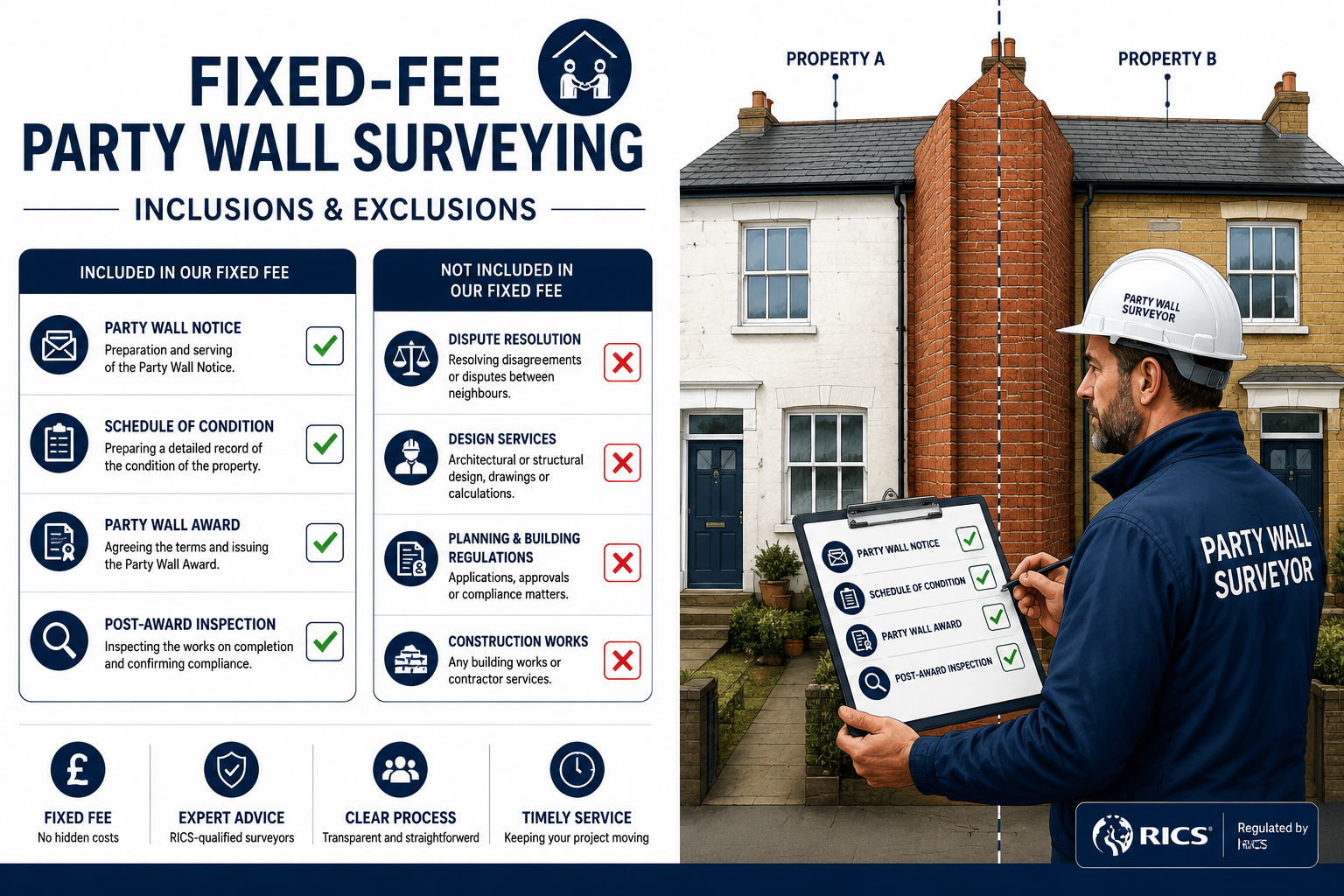
The term "fixed fee" in party wall surveying is meant to provide cost certainty. In practice, however, the scope of what that fee covers differs considerably between firms. A well-structured fixed-fee package should include the following core components.
Party Wall Notices
The process begins with serving the correct statutory notice on the adjoining owner. Depending on the type of work being carried out, this could be a Party Structure Notice, a Line of Junction Notice, or a Three Metre Notice. Most fixed-fee packages include the preparation and service of the relevant notice as a baseline task. For a detailed overview of the different notice types and how to respond to them, the guide on party wall act notices is a useful starting point.
Schedule of Condition
A schedule of condition is a photographic and written record of the adjoining property's existing state before any work begins. This document is critical — it protects both parties by establishing a clear baseline for any damage claims. Reputable fixed-fee packages include this as standard. Schedules of condition are not optional extras; they are a fundamental part of proper party wall practice.
The Party Wall Award
The party wall award (sometimes called a party wall agreement) is the legally binding document that sets out the rights and obligations of both parties during the works. It specifies working hours, methods of construction, access rights, and the process for dealing with damage. Comprehensive fixed-fee packages cover the preparation and service of this award. Party wall awards are the cornerstone of the entire process, and their preparation should always be included in any quoted fee.
Post-Award Support and Final Inspection
Some — though not all — fixed-fee packages include post-award support during construction and a final inspection once work is complete. According to research into agreed surveyor services, comprehensive packages typically cover initial consultations, review of notices, property inspections, photographic schedules of condition, preparation of the award, post-award support, and final inspections [1]. When comparing quotes, it is worth confirming explicitly whether these elements are included or priced separately.
Typical fixed-fee ranges by project type [1] [2]:
| Project Type | Typical Fixed-Fee Range |
|---|---|
| Simple extension | £800 – £1,200 |
| Loft conversion | £1,000 – £1,500 |
| Basement excavation | £1,500 – £2,500 |
What Is Not Included: The Hidden Extras That Inflate Final Bills
This is where fixed-fee party wall surveying comparisons become genuinely difficult. The services listed below are frequently excluded from headline quotes, yet they represent real costs that many building owners only discover mid-project.
Additional Inspections During Construction
If problems arise during the works — cracking, unexpected ground conditions, or disputes about method — the surveyor may need to attend the site more than once. Most fixed-fee agreements cover a defined number of visits. Additional inspections beyond that number are typically charged at an hourly or daily rate, which can range from £150 to £350 per visit depending on location and firm.
Award Amendments
If the scope of works changes significantly after the award has been issued, the award may need to be formally amended. This is a separate piece of work and is almost never included in the original fixed fee [1].
Dispute Resolution
If the adjoining owner challenges the award or a dispute arises that cannot be resolved between the appointed surveyors, a third surveyor may be called in. The costs associated with this process — including the third surveyor's fees — fall outside the standard fixed-fee scope [1].
Structural Engineering Advice
For complex projects involving basement excavations, underpinning, or significant structural alterations, the surveyor may need to liaise with or instruct a structural engineer. Fees for advising engineers on structurally complex works are typically charged as an additional cost [5].
Making Use Payments
If the building owner intends to use a wall that was built entirely at the adjoining owner's expense, a "making use" payment may be required under the Party Wall etc. Act 1996. This is a statutory payment, not a surveyor's fee, but it can catch building owners off guard.
Damage Reinstatement Costs
If damage occurs to the adjoining property during the works, the cost of reinstatement is the building owner's responsibility. While the schedule of condition establishes what damage existed before the works, the costs of repairing new damage are entirely separate from any surveying fee [5].
Important note: A lower headline fee that excludes the schedule of condition, post-award visits, and dispute resolution can easily cost more in total than a higher headline fee that bundles all of these elements. Always request an itemised breakdown.
Agreed Surveyor vs. Two Surveyors: The Cost Structure Explained
One of the most significant decisions affecting the total cost of party wall surveying is whether the parties appoint a single agreed surveyor or each appoint their own.
The Agreed Surveyor Route
Under the Party Wall etc. Act 1996, both parties may agree to appoint a single surveyor to act impartially for both the building owner and the adjoining owner. This is known as the agreed surveyor route. It is generally faster, simpler, and considerably cheaper. Agreed surveyor fees typically range from £1,000 to £1,500 for standard residential projects [2].
The Two-Surveyor Route
If the adjoining owner dissents and appoints their own surveyor, costs increase substantially. The building owner is responsible for paying both surveyors' fees — their own and the adjoining owner's — unless the award determines otherwise [3]. Total costs for the two-surveyor route commonly range from £1,400 to £3,000 or more for standard projects [2].
Who pays for what:
- Building owner's surveyor fee: Paid by the building owner
- Adjoining owner's surveyor fee: Paid by the building owner (in most cases) [3]
- Third surveyor's fee (if required): Paid by the party who loses the dispute, or as directed
For building owners looking to understand the full cost picture before starting, the detailed breakdown of party wall costs and the process provides a useful reference. There are also practical strategies for keeping party wall costs down without cutting corners on compliance.
Factors That Affect Fixed-Fee Party Wall Surveying Prices
Several variables influence where a fixed-fee quote lands within the typical ranges. Understanding these factors helps explain why two quotes for apparently similar projects can differ by hundreds of pounds.
Key cost drivers [2]:
- Number of adjoining owners: A mid-terrace property with neighbours on both sides requires notices and potentially awards for each adjoining owner, doubling the workload.
- Project complexity: Basement excavations, underpinning, and works near foundations are more technically demanding and attract higher fees.
- Number of surveyors involved: As outlined above, the agreed surveyor route is significantly cheaper.
- Property location: Central London projects typically attract higher fees than those in outer boroughs or other cities. Firms operating across south London, north London, and east London may price differently based on local demand and travel time.
- Property type: Flats in multi-unit buildings involve more complex ownership structures and may require multiple notices and awards.
How to Compare Party Wall Surveying Quotes Fairly
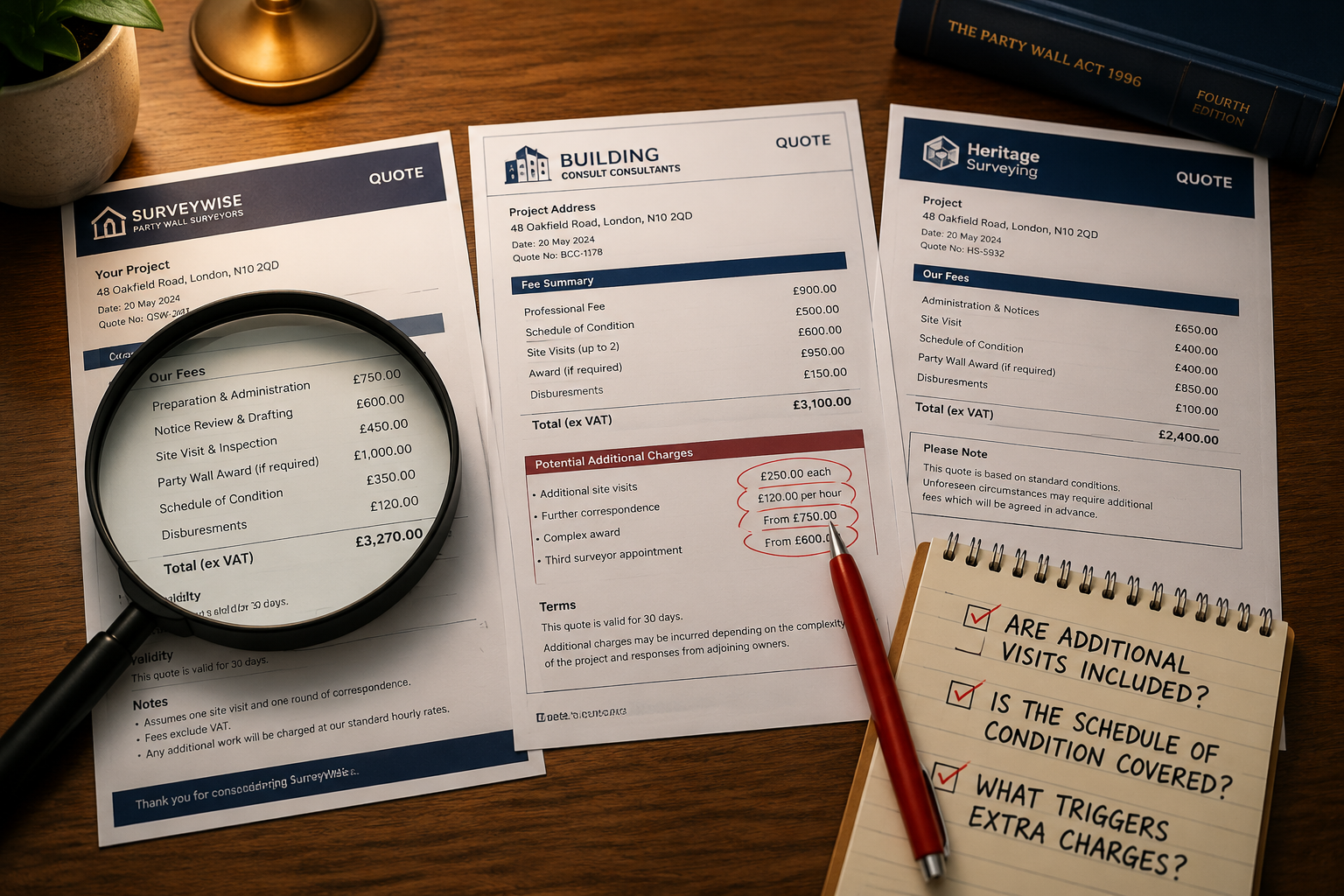
Comparing quotes for fixed-fee party wall surveying fairly requires looking beyond the headline number. The following framework provides a structured approach.
Step 1: Request an Itemised Scope
Ask every firm to break down their quote into individual service lines. A transparent quote should list:
- Party wall notice preparation and service
- Schedule of condition (number of properties covered)
- Party wall award preparation and service
- Number of site visits included
- Post-award support
- Final inspection
If a firm refuses to itemise or provides only a single total figure, that is a warning sign.
Step 2: Identify What Triggers Additional Charges
Ask directly: "What would cause my final bill to exceed this quoted figure?" The answer should cover additional visits, award amendments, dispute resolution, and any scenario where a third surveyor might be required. Some surveyors offer menu pricing — a flat rate for each individual task — which makes this comparison much easier [4].
Step 3: Verify Qualifications and Insurance
The title "party wall surveyor" is not legally protected in the UK. Anyone can use it, regardless of training or experience [6]. Before appointing any surveyor, verify:
- Membership of a recognised professional body (RICS, CIOB, or the Faculty of Party Wall Surveyors)
- Professional indemnity insurance
- Specific experience with party wall matters, not just general surveying
Asking for references from past clients on similar projects is entirely reasonable and professionally expected [7].
Step 4: Assess Value, Not Just Price
A surveyor charging £1,200 with a comprehensive scope that includes the schedule of condition, all standard visits, and post-award support represents better value than one charging £900 for a stripped-back service that bills separately for every additional task. The goal of fixed-fee party wall surveying — comparing what's included, what's not, and how to compare quotes fairly — is to arrive at a true total cost comparison, not a headline price comparison.
Step 5: Clarify the Timeline
Ask how long the process is expected to take from notice to award. A surveyor who is overcommitted may cause delays that affect the building owner's construction programme, which has its own cost implications.
Questions to ask every surveyor before appointing them [7]:
- How many party wall awards have you prepared in the last 12 months?
- Are you a member of RICS, CIOB, or the Faculty of Party Wall Surveyors?
- What professional indemnity insurance do you carry?
- Is the schedule of condition included in your quoted fee?
- How many site visits are covered, and what is the charge for additional visits?
- What happens if the adjoining owner disputes the award?
Common Mistakes When Choosing a Fixed-Fee Party Wall Surveyor
Even well-informed building owners make avoidable errors when selecting a surveyor. The most common include:
Choosing on price alone. The lowest quote rarely represents the best value once the full scope is understood.
Failing to check qualifications. Given that the title is unprotected, appointing an unqualified practitioner is a genuine risk [6].
Not reading the engagement letter carefully. The engagement letter (or terms of appointment) is the document that defines what is and is not included. Reading it before signing is essential.
Assuming the adjoining owner's surveyor is independent. When the adjoining owner appoints their own surveyor, that surveyor acts in the adjoining owner's interests. The building owner still pays their fees, but has no say in who is appointed.
Overlooking the schedule of condition. Skipping or skimping on the schedule of condition to reduce costs is a false economy. Without it, any damage claim during or after the works becomes a dispute about what existed before the works started.
For building owners who are new to the process, the guide on what is covered for building owners provides a clear overview of rights and responsibilities before any appointment is made.
Conclusion
Fixed-fee party wall surveying offers genuine cost certainty — but only when the scope is clearly defined and honestly presented. The headline figure on a quote is a starting point, not a final answer. By understanding which services are typically included (notices, schedule of condition, the party wall award, and standard site visits), which are commonly excluded (additional inspections, award amendments, dispute resolution, and structural engineering advice), and how to compare quotes on a like-for-like basis, building owners can make decisions based on value rather than price alone.
Actionable next steps:
- Before requesting quotes, identify the type of works being carried out and the number of adjoining owners affected — this determines the baseline complexity.
- Request itemised quotes from at least three firms, using the checklist of questions above.
- Verify the qualifications and insurance of every surveyor being considered.
- Read the engagement letter carefully before signing, paying particular attention to what triggers additional charges.
- If the adjoining owner has already dissented and appointed their own surveyor, seek independent advice on whether the agreed surveyor route is still available.
Taking the time to compare fixed-fee party wall surveying quotes fairly — examining what's included, what's not, and how the total cost might evolve — is the most effective way to protect both the project budget and the relationship with neighbouring owners.
References
[1] Agreed Surveyor Party Wall – https://wimbledonsurveyors.com/agreed-surveyor-party-wall/?utm_source=openai
[2] How Much Does Party Wall Surveyor Cost – https://www.metsurveyors.co.uk/post/how-much-does-party-wall-surveyor-cost?utm_source=openai
[3] Who Pays For A Party Wall Surveyor – https://partywalldiy.com/guides/who-pays-for-a-party-wall-surveyor?utm_source=openai
[4] Party Wall Surveyor Fees A Simple Guide – https://www.coburnspartywall.co.uk/knowledge-base/party-wall-surveyor-fees-a-simple-guide?utm_source=openai
[5] Party Wall Surveying Costs – https://stokemont.com/party-wall-surveyors/party-wall-surveying-costs/?utm_source=openai
[6] Party Wall Surveyor Qualifications – https://www.simplesurvey.co.uk/uncategorised/party-wall-surveyor-qualifications/?utm_source=openai
[7] Party Wall Surveyors Cost – https://www.mybuilder.com/architectural-services/price-guides/party-wall-surveyors-cost?utm_source=openai