


Over 500,000 listed buildings exist across England alone, yet a significant number of owners undertaking works adjacent to these structures fail to recognise that the standard party wall process is only part of the legal picture. Understanding party wall awards for historic and listed buildings requires navigating an intersection of heritage law, planning consent, and the Party Wall etc. Act 1996 — a combination that catches even experienced property owners off guard.
When a building carries listed status or sits within a conservation area, the obligations layered on top of a conventional party wall award become considerably more demanding. Vibration thresholds, specialist repair methods, access protocols, and heritage-specific consent requirements all need to be addressed within the award itself. Failing to do so creates legal exposure that standard residential projects rarely face.
Key Takeaways
- A Party Wall Award for a listed or historic building must go beyond standard provisions and specifically address heritage-sensitive concerns such as vibration limits, specialist materials, and conservation-compliant repair methods.
- Listed Building Consent is a separate legal requirement from a Party Wall Award; both must be obtained before notifiable works begin, and neither substitutes for the other.
- A thorough Schedule of Condition is especially critical for heritage structures, providing photographic and written evidence of pre-existing conditions before any work commences.
- Ambiguous award drafting — such as vague descriptions of permitted works or undefined compensation triggers — is one of the most common causes of disputes and project delays [1].
- Engaging a surveyor with demonstrable heritage experience is not optional on listed building projects; it is a practical necessity that protects all parties.
What Makes Historic and Listed Buildings Different Under the Party Wall Act
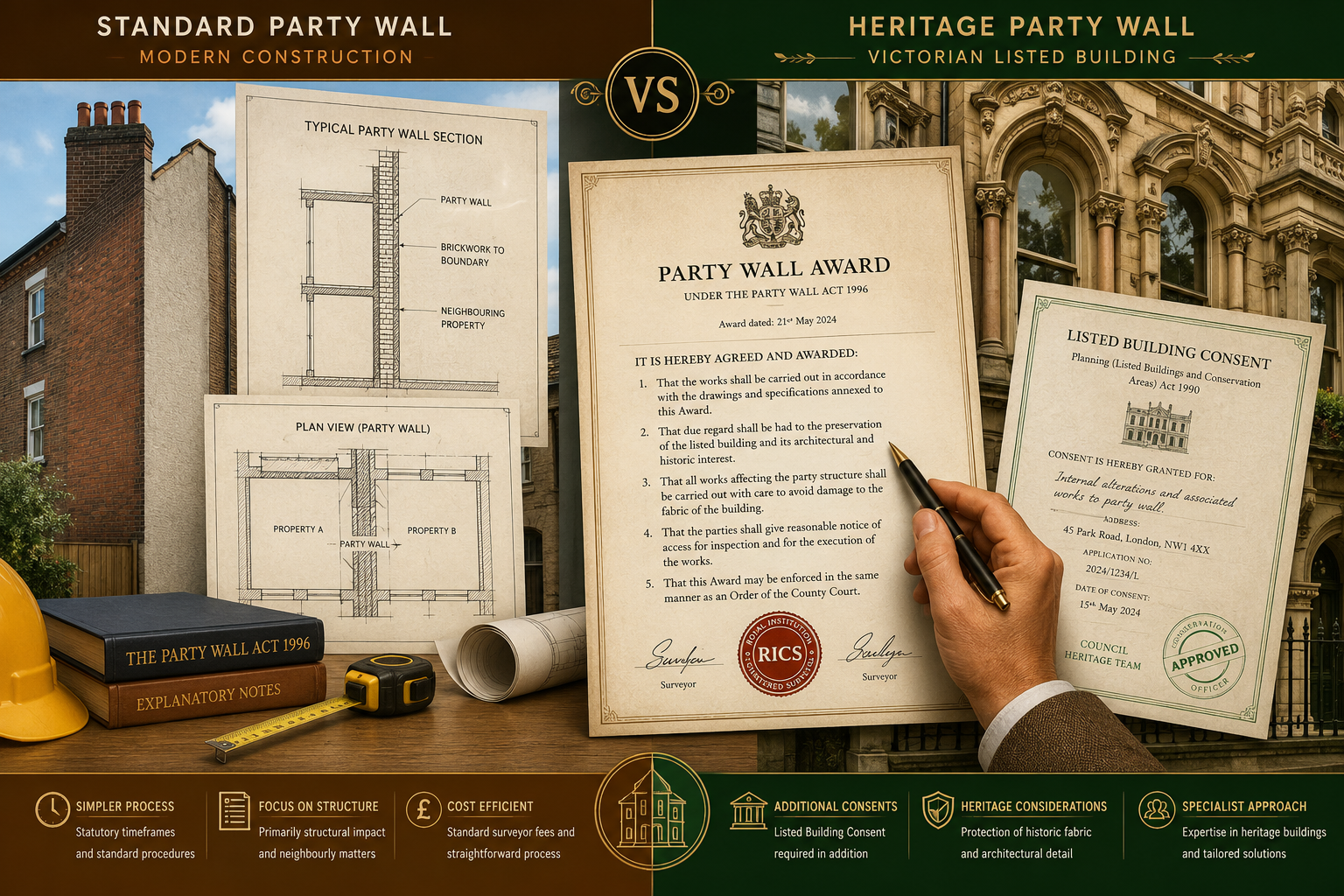
The Party Wall etc. Act 1996 applies equally to listed and unlisted buildings. There is no heritage exemption. However, the Act's framework — which governs works to shared walls, excavations near neighbouring foundations, and new walls on boundary lines — intersects with a separate body of heritage law that imposes additional restrictions.
Listed Building Consent (LBC) is required under the Planning (Listed Buildings and Conservation Areas) Act 1990 for any works that would affect the character of a listed building. This includes internal alterations, repairs using non-original materials, and any structural intervention to a party wall that forms part of the listed structure. LBC is granted by the local planning authority (LPA) and is entirely separate from a Party Wall Award.
Conservation Area Consent applies to unlisted buildings within designated conservation areas. Demolition of any part of a structure, including sections of a party wall, may require consent even if the building itself is not individually listed.
The critical point is this: a valid Party Wall Award does not grant permission to carry out works that require LBC. Both consents must be in place before work begins. Treating one as a substitute for the other is a fundamental error that can result in enforcement action, mandatory reinstatement of altered fabric, and significant financial penalties.
How the Two Regimes Interact
When drafting a party wall award for a listed building, surveyors must ensure the award explicitly acknowledges the existence of LBC requirements. The award should:
- Confirm that LBC has been obtained (or is a condition precedent to commencing works)
- Reference the specific consent number and any conditions attached to it
- Ensure that the described works in the award do not exceed the scope of the LBC
- Include provisions for using heritage-appropriate materials and methods
If the LBC contains conditions — for example, requiring lime mortar rather than cement, or mandating the retention of original stonework — those conditions must be reflected in the award's working method clauses. An award that permits works inconsistent with the LBC creates a direct conflict that courts have little sympathy for.
Drafting Party Wall Awards for Heritage Structures: Specific Provisions Required
Standard party wall awards typically address access rights, working hours, a schedule of condition, and compensation provisions. For historic and listed buildings, these provisions need significant expansion. Understanding party wall awards for historic and listed buildings at this level of detail is what separates a robust, dispute-resistant award from one that creates problems mid-project.
Vibration Monitoring and Thresholds
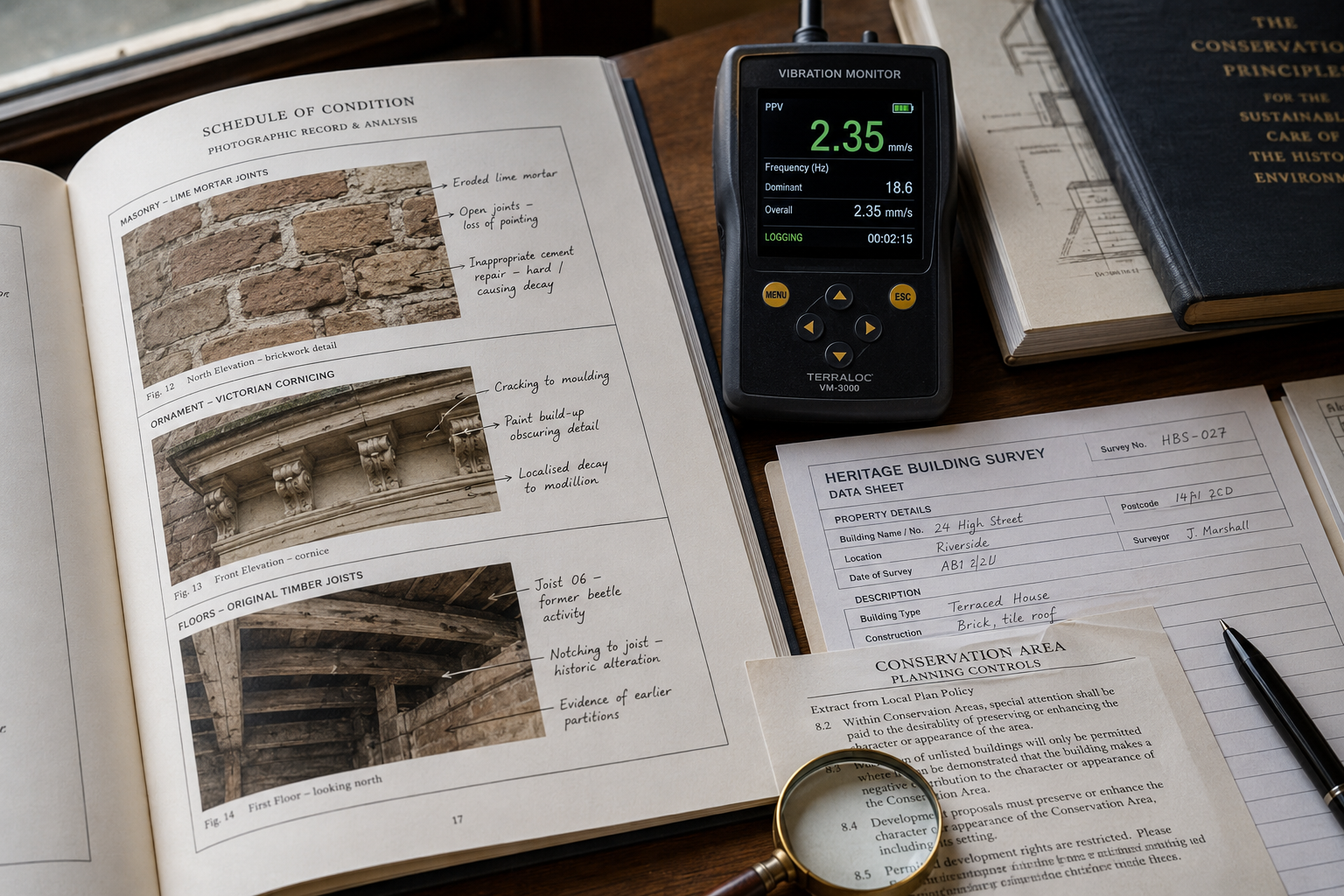
Construction vibration is one of the most significant risks to historic structures. Older buildings frequently feature:
- Lime mortar joints with reduced binding strength compared to modern cement
- Decorative plasterwork and cornicing susceptible to cracking
- Timber structural elements that may already be stressed
- Fragile ceramic tiles, stained glass, or other irreplaceable decorative features
A party wall award for a listed building should specify vibration limits expressed in peak particle velocity (PPV), typically referenced against British Standard BS 7385-2:1993 or BS 5228-2:2009. The award should require continuous vibration monitoring during high-impact operations such as piling, demolition, or heavy excavation, with automatic work-stoppage triggers if thresholds are exceeded.
Without these provisions, a building owner whose contractor causes vibration damage to a listed neighbour's ornamental plasterwork faces a damages claim with no contractual framework to limit liability.
Access Rights and Heritage-Sensitive Protocols
The Party Wall etc. Act grants the building owner a right of access to the adjoining owner's property for the purpose of carrying out notifiable works. For listed buildings, this right must be exercised with considerably more care than on a standard project.
The award should specify:
| Provision | Standard Award | Heritage Award |
|---|---|---|
| Access notice period | Typically 14 days | 14 days minimum; longer for complex works |
| Supervision requirements | None specified | Specialist heritage contractor or clerk of works present |
| Protection of features | General care clause | Named features with specific protection methods |
| Reinstatement standard | "Make good" | Match original materials, methods, and finish |
| Photographic record | Recommended | Mandatory, pre- and post-access |
The "make good" obligation in a standard award is insufficient for heritage work. An award covering a listed building should require reinstatement to a standard that matches the original in material, method, and visual appearance, with the adjoining owner's surveyor having approval rights over proposed reinstatement works before they are carried out.
Schedule of Condition: Non-Negotiable for Heritage Properties
A Schedule of Condition is a detailed record of the existing state of the adjoining property before works begin. For listed buildings, this document takes on heightened legal and practical importance.
The schedule should include:
- High-resolution photographs of all elevations, party wall faces, and vulnerable decorative elements
- Written descriptions of existing cracks, defects, and areas of previous repair
- Specific notes on fragile features: cornicing, ceiling roses, chimney breasts, original windows
- Condition of lime mortar joints, pointing, and render
- Structural survey notes where relevant
A thorough schedule protects both parties. It protects the adjoining owner by establishing baseline conditions before any damage occurs. It protects the building owner by preventing inflated or fraudulent damage claims [4]. Disputes about whether a crack existed before works began are among the most common and costly post-construction arguments. A comprehensive schedule eliminates ambiguity.
Repair Obligations and Material Specifications
Standard awards often include a generic obligation to "repair any damage caused." For listed buildings, this is wholly inadequate. The award must specify:
- Approved materials: lime mortar mixes, matching brick or stone sources, heritage paint specifications
- Approved contractors: works to a listed building may require contractors with specific heritage accreditation
- Approval process: the adjoining owner's surveyor should approve repair specifications before work begins
- LPA notification: some LPAs require notification when emergency repairs to a listed building are carried out
Failure to specify materials can result in a situation where a contractor repairs cracked lime pointing with modern cement — technically repairing the damage but causing long-term harm to the historic fabric and potentially triggering an LBC enforcement notice.
Common Pitfalls in Party Wall Processes for Listed Buildings
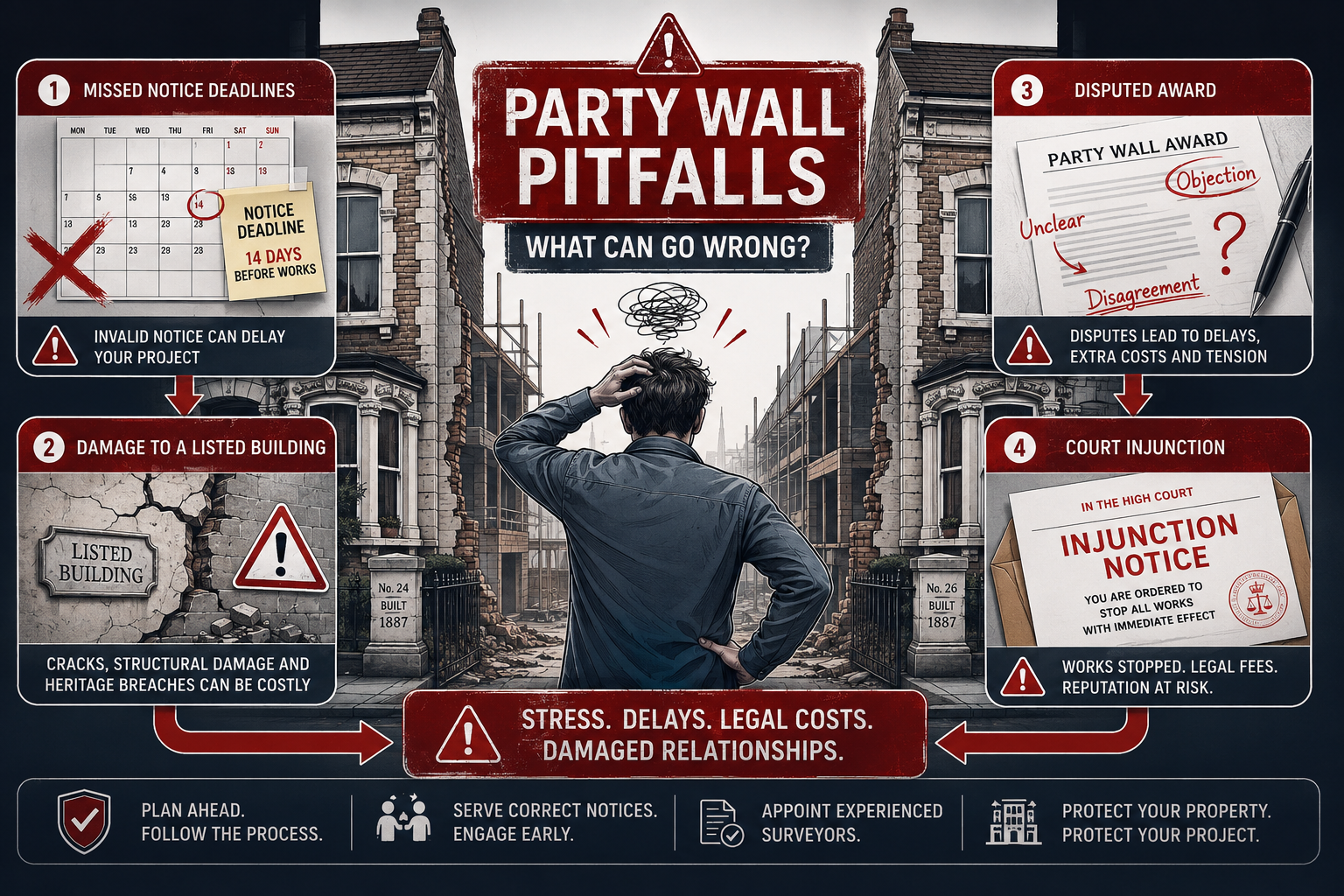
Understanding party wall awards for historic and listed buildings also means understanding where things most commonly go wrong. The pitfalls below account for a disproportionate share of disputes, injunctions, and project failures on heritage sites.
Pitfall 1: Confusing Notice with Award
A Party Wall Notice is the formal notification served on adjoining owners before works begin. A Party Wall Award is the legally binding document that governs how those works proceed. These are not interchangeable [3].
Serving a notice and receiving no response (which triggers a deemed dissent after 14 days) does not mean work can begin. An award must be prepared and agreed before notifiable works commence. On listed building projects, where the award requires extensive heritage-specific provisions, the preparation process takes longer. Building owners who assume that serving notice is sufficient and begin work prematurely expose themselves to injunctions and project stoppages [2].
Pitfall 2: Vague Award Drafting
Ambiguous descriptions of permitted works, undefined access rights, and unclear compensation triggers are leading causes of award challenges and project delays [1]. On heritage projects, vagueness is even more dangerous because the potential consequences — damage to irreplaceable historic fabric — are more severe.
Best practice requires that every party wall award for a listed building:
- References specific, dated architectural drawings and specifications
- Names the contractor and any specialist subcontractors
- Defines compensation triggers with precision (e.g., PPV thresholds, specific crack widths)
- States clearly which party bears the cost of each obligation
For guidance on what a well-structured award should contain, reviewing a party wall contract template guide provides a useful baseline — though heritage projects will require significant additions beyond the standard framework.
Pitfall 3: Treating the Award as Advisory
A Party Wall Award is a legally binding document. Treating it as a set of guidelines rather than enforceable obligations is a serious error [5]. On listed building projects, where the award incorporates LBC conditions and heritage-specific requirements, non-compliance can trigger enforcement action from both the adjoining owner (under the Act) and the local planning authority (under heritage legislation).
Building owners must ensure their contractors have read and understood the award before works begin. The award should be referenced in the building contract as a compliance document.
Pitfall 4: Ignoring Conservation Area Status
Not all heritage-sensitive properties are individually listed. A building within a conservation area may not carry Grade I, II*, or II listing, but it may still be subject to Article 4 Directions that remove permitted development rights, or conservation area policies that restrict the scope of works. A party wall surveyor working in a conservation area should flag these constraints in the award even when the building is not listed.
Pitfall 5: Underestimating Costs and Timelines
The financial implications of party wall procedures are always borne primarily by the building owner [4]. For listed building projects, those costs are higher. Heritage-specific schedules of condition take longer to prepare. Specialist surveyors command higher fees. Award drafting is more complex. Vibration monitoring equipment adds to project costs.
Understanding the costs of the party wall process from the outset allows for realistic budgeting. Underestimating these costs leads to pressure to cut corners — which on a listed building project can have consequences far exceeding the savings.
Pitfall 6: Consent vs. Dissent Decisions Made Without Advice
When an adjoining owner receives a party wall notice, they can consent or dissent. Consenting allows work to proceed without a formal award. For listed buildings, this is rarely advisable [6]. Without an award, there is no binding document specifying heritage-appropriate working methods, vibration limits, or reinstatement standards. Adjoining owners of listed buildings should almost always dissent and appoint a surveyor to ensure an award is prepared that adequately protects their property.
The Role of Specialist Surveyors on Heritage Projects
The complexity of party wall procedures for listed buildings makes the choice of surveyor critically important. A surveyor without heritage experience may produce a technically valid award that nonetheless fails to address the specific vulnerabilities of the historic structure [7].
A specialist surveyor brings:
- Knowledge of heritage construction methods and materials
- Familiarity with LBC conditions and conservation area policies
- Experience drafting vibration monitoring provisions
- Relationships with heritage contractors and conservation officers
- The ability to identify risks that a generalist surveyor might overlook
For adjoining owners who are unsure of their rights and obligations, the adjoining owners' surveyor role is particularly important on heritage projects. Their surveyor acts solely in their interest, ensuring the award protects the historic fabric of their property.
It is also worth noting that attempting to navigate a listed building party wall situation without professional input — as some owners consider for cost reasons — carries substantially elevated risk. The guidance on having a party wall agreement without a surveyor makes clear that even on straightforward projects this approach has significant limitations. On a heritage project, it is not a viable option.
Conclusion
Party wall procedures for listed and historic buildings operate at the intersection of two demanding legal frameworks. The Party Wall etc. Act 1996 provides the procedural structure; heritage legislation provides additional constraints that must be woven into every aspect of the award. Getting this right requires early engagement, specialist expertise, and meticulous award drafting.
Actionable next steps for building owners and adjoining owners in 2026:
- Confirm heritage status early: Before serving any notice, establish whether the property or its neighbour is listed, within a conservation area, or subject to Article 4 Directions.
- Obtain LBC before or alongside the party wall process: Do not wait until the award is agreed to apply for Listed Building Consent. The two processes should run in parallel.
- Appoint a surveyor with heritage experience: Ask directly about their experience with listed buildings and conservation area projects.
- Insist on a comprehensive Schedule of Condition: For a listed building, this is not optional. It should cover all vulnerable features in detail.
- Review the award before works begin: Ensure contractors understand and are contractually bound by the award's provisions.
- Budget realistically: Heritage party wall procedures cost more and take longer. Build both into the project programme from day one.
The consequences of getting this wrong — enforcement notices, injunctions, mandatory reinstatement of historic fabric, and reputational damage — are far more costly than the investment in doing it properly.
References
[1] The Most Common Reasons Party Wall Awards Get Delayed Challenged Or Ignored – https://manchestersurveyors.com/the-most-common-reasons-party-wall-awards-get-delayed-challenged-or-ignored/?utm_source=openai
[2] Last Minute Party Wall Awards Risks Delays And How Surveyors Can Rescue A Project – https://partywallsurveyorlondon.uk/blogs/last-minute-party-wall-awards-risks-delays-and-how-surveyors-can-rescue-a-project/?utm_source=openai
[3] Difference Between Party Wall Notices And Awards – https://www.partywallslimited.com/blog/difference-between-party-wall-notices-and-awards?utm_source=openai
[4] Party Wall Act 1996 Step By Step Guide To Notices Awards And Surveyor Models For 2026 Projects – https://wimbledonsurveyors.com/party-wall-act-1996-step-by-step-guide-to-notices-awards-and-surveyor-models-for-2026-projects/?utm_source=openai
[5] Party Wall Award – https://www.aylingassociates.com/knowledge/party-wall-award?utm_source=openai
[6] Party Wall Notice Consent Vs Dissent – https://www.simplesurvey.co.uk/article/party-wall-notice-consent-vs-dissent/?utm_source=openai
[7] Do Your Own Party Wall Agreement – https://www.fandt.com/insights/do-your-own-party-wall-agreement/?utm_source=openai