
Only 14% of UK construction disputes involving shared walls are resolved without a formal surveyor-led process — yet the documentation methods underpinning those processes have barely changed since the Party Wall etc. Act 1996 came into force. That gap between legislative intent and practical execution is exactly what the Digital Transformation of Party Wall Notices: BIM and AI Integration Under RICS 2026 is designed to close.
In 2026, two converging forces are reshaping how party wall notices are prepared, served, and managed: the RICS draft 8th edition of its "Party Wall Legislation and Procedure" guidance (launched for consultation in April 2026) [1], and mandatory RICS standards for responsible AI use in surveying practice (effective March 9, 2026) [2]. Together, they create both the framework and the obligation for surveyors to adopt Building Information Modelling (BIM) and artificial intelligence tools — not as optional upgrades, but as professional standards.
This article provides a practical, step-by-step guide for surveyors and building owners on how to harness BIM and AI within the boundaries of current RICS requirements, while ensuring every party wall notice remains legally sound.
Key Takeaways
- RICS mandatory AI standards (March 2026) require quarterly-reviewed risk registers for every AI tool used in party wall practice, with professional judgment always overriding AI outputs.
- The draft RICS 8th edition guidance introduces updated award templates, revised letters of appointment, and strengthened conduct requirements relevant to digital workflows.
- BIM integration allows surveyors to produce spatially precise party wall notices, reducing ambiguity in boundary definitions and scope of works.
- AI can automate notice drafting, condition monitoring, and risk flagging — but express written consent is required before uploading confidential data to any AI platform.
- Digital-first party wall services are now commercially available in the UK, demonstrating that end-to-end digital workflows are both viable and compliant.
Understanding the RICS 2026 Framework for Digital Party Wall Practice
The Draft 8th Edition Guidance and What It Changes
In April 2026, RICS launched an eight-week consultation on the draft 8th edition of "Party Wall Legislation and Procedure." [1] For surveyors already exploring digital tools, the timing is significant. The revised guidance introduces:
- Updated draft letters of appointment that reflect modern service delivery models, including digital-first practices
- Revised award templates designed to accommodate more detailed technical schedules, which BIM outputs can directly populate
- Strengthened conduct guidance on fee practices and public engagement, relevant when automated pricing tools are used
- Clarification on jurisdiction — the guidance reaffirms that a party wall surveyor's appointment is personal and statutory, independent of client instruction [1]
That last point carries direct implications for AI use. No automated system can hold a statutory appointment. The surveyor remains the legally responsible party, regardless of how much of the process is digitally assisted.
For a full overview of how party wall notices work and what they must contain, the Party Wall Act Notices guide provides a clear foundation before layering in digital tools.
Mandatory AI Standards: The March 2026 Rules Every Surveyor Must Know
The RICS mandatory standards for responsible AI use, effective March 9, 2026, establish four core obligations for party wall surveyors [2]:
| Obligation | Requirement |
|---|---|
| Human override | Professional judgment must always override AI outputs |
| Risk registers | Quarterly-reviewed registers for every AI tool in use |
| Data consent | Express written consent before uploading confidential party wall data to AI platforms |
| Delegation limits | Final decision-making cannot be delegated to automated systems |
These rules are not advisory. Firms that fail to maintain compliant risk registers or that upload client data without consent face potential RICS disciplinary action. The practical effect is that AI becomes a powerful assistant — not a replacement — for the qualified surveyor.
"A party wall surveyor's appointment is personal and statutory, independent of client instruction." — RICS Draft 8th Edition Guidance, 2026 [1]
How BIM Transforms the Preparation of Party Wall Notices
What BIM Adds to Traditional Notice Preparation
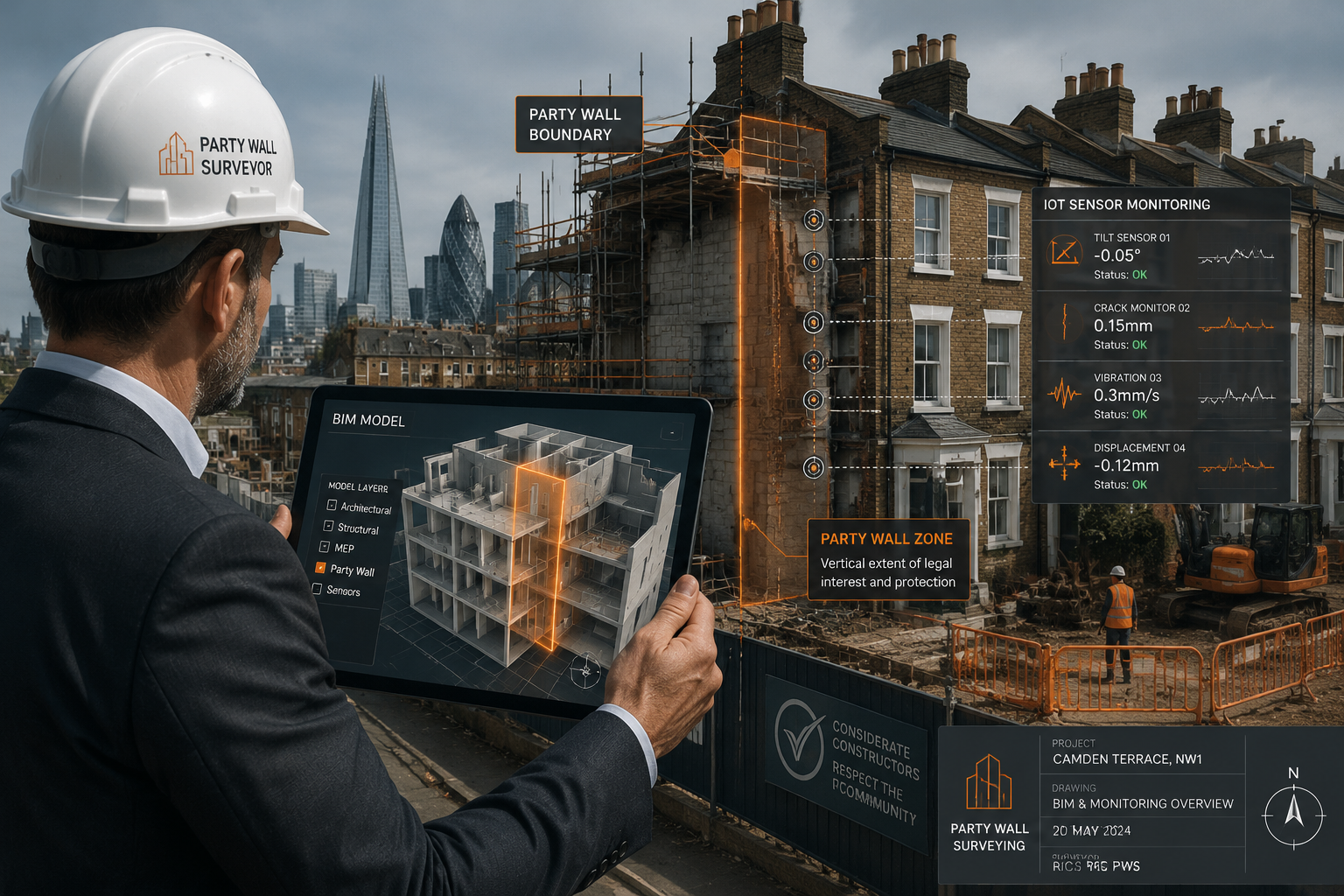
Building Information Modelling is a process for creating and managing digital representations of a building's physical and functional characteristics. [5] When applied to party wall practice, BIM shifts notice preparation from a largely text-and-sketch exercise to a data-rich, spatially verified workflow.
Traditional party wall notices often rely on hand-drawn plans or basic CAD files that lack depth information, material specifications, or structural load data. BIM models, by contrast, can contain:
- Precise boundary coordinates for the party wall or party fence wall
- Structural element data including wall thickness, material composition, and load-bearing status
- Proposed works overlays showing exactly which elements will be affected
- Existing condition records linked to photographic and sensor data
This level of detail directly supports the requirements of a party structure notice, where the scope of works must be described with sufficient precision to allow the adjoining owner to understand the impact on their property.
Step-by-Step: Using BIM to Prepare a Compliant Party Wall Notice
Step 1 — Establish the BIM Model Scope
Before any notice is drafted, the building owner's surveyor should confirm whether an existing BIM model is available from the architect or structural engineer. If not, a measured survey should be commissioned to create a base model. The model must include the shared wall, its boundaries, and the proposed works in sufficient detail to support the notice.
For guidance on what qualifies as a party fence wall versus a party wall, the party fence wall definition guide helps clarify which structures fall under the Act.
Step 2 — Extract Notice-Relevant Data from the Model
From the BIM model, extract:
- Floor plans and sections showing the party wall and proposed works
- Structural specifications for any notifiable works (e.g., underpinning, beam insertions, excavations near the boundary)
- Clearance distances from the boundary for any excavation works
These outputs replace or supplement traditional drawings attached to the notice, providing a higher standard of disclosure to the adjoining owner.
Step 3 — Populate the Notice Template
The RICS draft 8th edition provides revised notice templates. [1] BIM data can be used to auto-populate key fields — property descriptions, works descriptions, affected elements — reducing transcription errors. Some digital platforms now offer direct integration between BIM software and notice generation tools.
Step 4 — Attach a BIM-Derived Schedule of Condition
A schedule of condition is one of the most important documents in any party wall process. BIM-linked IoT sensors and photographic records can create a timestamped, spatially referenced baseline of the adjoining property's condition before works begin. [4] This provides far stronger protection for both parties than a traditional paper-based schedule.
Step 5 — Serve the Notice and Manage the Response Digitally
Digital-first party wall services, such as the UK's first fully online party wall platform, now offer notice serving within 72 hours with direct management of neighbour communications. [3] These platforms are managed by MRICS-qualified surveyors and provide fixed-price models, making the process more accessible to building owners.
AI Integration in Party Wall Notices: Practical Applications and Compliance
Where AI Adds Genuine Value
AI tools are now being applied across several stages of the party wall process. The key is understanding which applications are compliant under the March 2026 RICS standards and which carry risk.
Compliant and high-value AI applications:
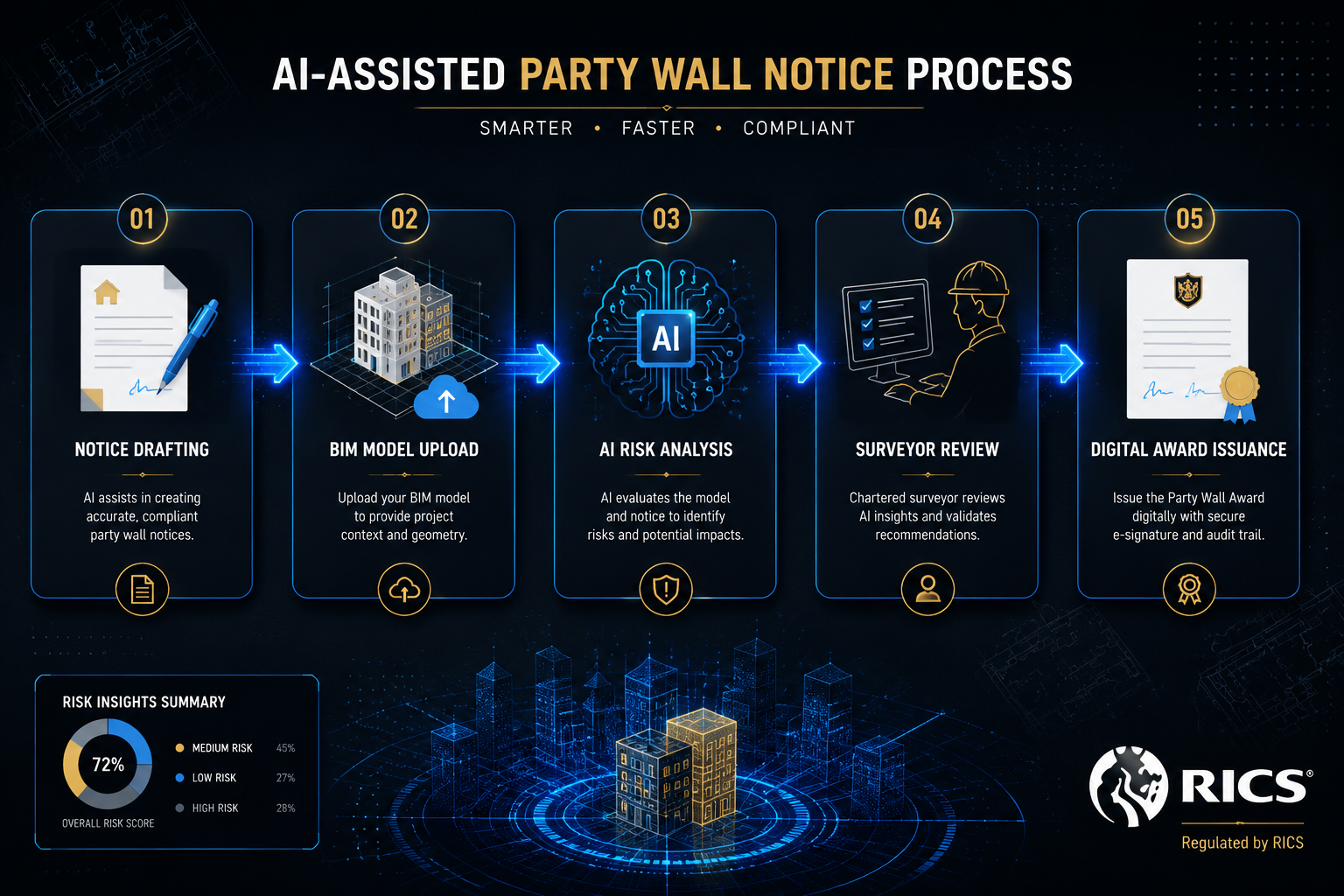
- Automated notice drafting: AI can generate first-draft notices from structured BIM data inputs, reducing preparation time significantly. The surveyor reviews and approves the output before service.
- Risk flagging: AI models trained on historical party wall disputes can flag notices that are likely to be contested, allowing surveyors to address ambiguities proactively.
- Condition monitoring: IoT sensors integrated with BIM models can use AI to detect movement, vibration, or moisture changes in party walls during construction, triggering alerts for the surveyor. [4]
- Document classification: AI can organise and cross-reference notice responses, consent letters, and award drafts, reducing administrative burden.
Applications requiring caution:
- AI-generated awards: Any award drafted with AI assistance must be fully reviewed and signed off by the appointed surveyor. The award cannot be attributed to an automated system. [2]
- Boundary determination: AI-assisted boundary analysis should be treated as a preliminary tool only. Final boundary determinations require professional judgment and, where necessary, a formal boundary survey.
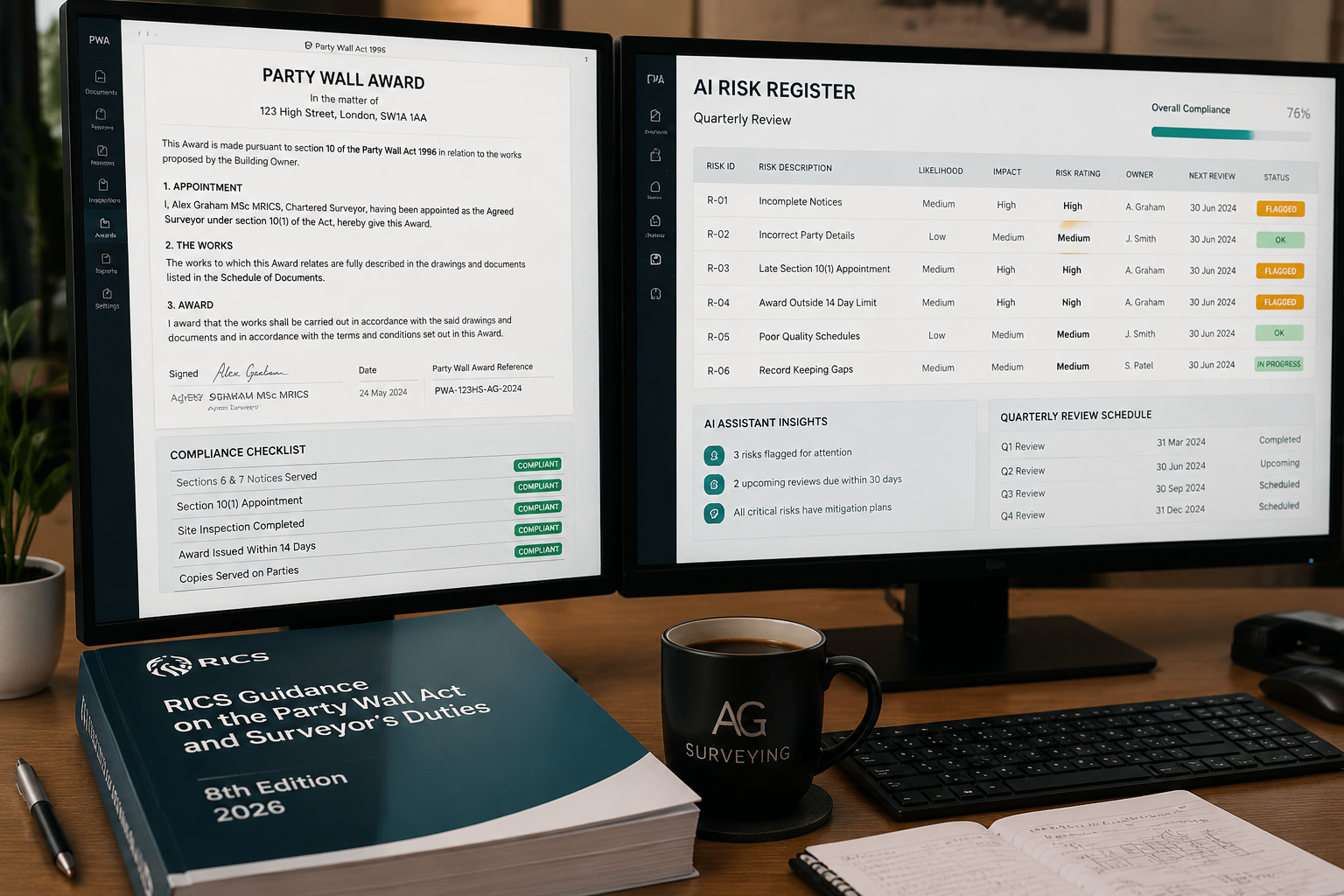
Building the Compliant AI Risk Register
Under the March 2026 RICS standards, every AI tool used in party wall practice must appear on a quarterly-reviewed risk register. [2] A compliant register entry should include:
| Field | Example Entry |
|---|---|
| Tool name and version | AI Notice Drafter v2.1 |
| Purpose | First-draft notice generation from BIM data |
| Data inputs | Property address, BIM model export, works description |
| Data consent obtained | Yes — written consent dated [date] |
| Known limitations | Cannot verify legal boundary positions independently |
| Review date | Quarterly |
| Responsible surveyor | [Name, MRICS] |
This register is not merely a compliance document — it is a risk management tool that protects the surveyor if an AI-assisted notice is later challenged.
Data Privacy and Confidentiality
The requirement for express written consent before uploading confidential party wall data to AI platforms [2] has practical implications for how surveyors structure their client engagement letters. The RICS draft 8th edition's revised letters of appointment [1] should be updated to include explicit consent clauses covering:
- Which AI platforms may process the client's data
- What categories of data will be uploaded (e.g., property plans, correspondence, condition records)
- How data will be stored and deleted after the matter concludes
This aligns with existing UK GDPR obligations and reinforces the surveyor's professional duty of confidentiality.
Practical Considerations for Surveyors and Building Owners in 2026
Costs, Efficiency, and the Digital Dividend
One of the most tangible benefits of BIM and AI integration is cost efficiency. Digital workflows reduce the time spent on manual document preparation, chasing responses, and correcting errors in notices. For building owners looking to manage expenditure, understanding how to keep party wall costs down is directly connected to the efficiency of the notice process.
BIM-derived notices with clear, unambiguous scope descriptions reduce the likelihood of disputes — which are the primary driver of cost escalation in party wall matters. When an adjoining owner can see a precise 3D model of the proposed works rather than a vague written description, the rate of unnecessary dissent notices is likely to fall.
The Role of the Adjoining Owner
Digital transformation does not diminish the rights of the adjoining owner — it should enhance them. A BIM-based notice provides more information, not less, allowing adjoining owners and their surveyors to make better-informed decisions. Adjoining owners who receive a digitally prepared notice with attached BIM extracts and a condition monitoring plan are in a stronger position to assess the risk to their property.
For adjoining owners who are uncertain about their rights when a neighbour begins works, the guide for neighbours carrying out works explains the process clearly.
Regional Considerations Across London
Digital party wall services are particularly relevant in high-density urban areas where party wall disputes are most common. Surveyors operating across North London, South London, and other areas of the capital are dealing with high volumes of terraced and semi-detached properties where shared walls are the norm. BIM and AI tools that reduce turnaround time and improve notice accuracy have a direct impact on project timelines in these markets.
Party Wall Awards in a Digital Context
The party wall award remains the central legal instrument in any contested party wall matter. Digital tools can assist in drafting and managing awards, but the RICS 2026 standards are clear: the award is the surveyor's document, not the algorithm's. [2] The revised award templates in the draft 8th edition [1] are designed to accommodate more detailed technical schedules — exactly the kind of output that BIM models can generate.
For a detailed look at what a party wall award contains and how it is structured, the party wall contract and award guide provides a useful reference.
Conclusion
The Digital Transformation of Party Wall Notices: BIM and AI Integration Under RICS 2026 is not a future aspiration — it is a present-tense professional obligation. The RICS mandatory AI standards and the draft 8th edition guidance together define a clear direction: digital tools are expected, but professional accountability is non-negotiable.
For surveyors, the actionable steps are straightforward:
- Audit current workflows against the March 2026 AI standards — establish or update risk registers for every AI tool in use.
- Integrate BIM outputs into notice preparation, starting with the schedule of condition and works description.
- Update letters of appointment to include express data consent clauses before uploading any client information to AI platforms.
- Engage with the RICS draft 8th edition consultation outputs and adopt the revised templates as they are finalised.
- Explore digital-first service platforms as a complement to traditional practice, particularly for high-volume or time-sensitive instructions.
For building owners, the message is equally clear: a surveyor who uses BIM and AI responsibly — within the RICS framework — is likely to deliver a faster, more accurate, and more defensible party wall process. Ask your surveyor what digital tools they use and how they comply with the 2026 standards.
The party wall process has always been about protecting both parties. Digital transformation, done correctly, makes that protection more precise, more transparent, and more efficient.
References
[1] Rics Launches Consultation On Updated Party Wall Practice Guidance – https://www.rics.org/news-insights/rics-launches-consultation-on-updated-party-wall-practice-guidance?utm_source=openai
[2] Responsible Ai Use In Party Wall Awards Rics March 2026 Standards For Automated Condition Monitoring – https://wimbledonsurveyors.com/responsible-ai-use-in-party-wall-awards-rics-march-2026-standards-for-automated-condition-monitoring/?utm_source=openai
[3] partywallonline.co.uk – https://partywallonline.co.uk/?utm_source=openai
[4] Bim Power Data Construction – https://www.rics.org/news-insights/bim-power-data-construction?utm_source=openai
[5] Revolutionising Construction Introducing Building Information Modelling – https://www.rics.org/news-insights/revolutionising-construction-introducing-building-information-modelling?utm_source=openai