


Fewer than one in five party wall disputes that escalate to formal legal proceedings are resolved without some form of expert surveyor testimony — yet the quality and format of that testimony increasingly determines the outcome. Understanding Expert Witness Roles in Party Wall Disputes: Leveraging 2026 Survey Tech for Courtroom Success is no longer optional for surveyors who want to remain competitive and credible in an era when judges are themselves adopting digital tools at a rapid pace [3].
The landscape has shifted. Courts now expect structured, data-rich evidence. RICS is consulting on updated guidance for its 8th edition of "Party Wall Legislation and Procedure." Mobile 3D mapping, AI-assisted analysis, and rigorous CPR Part 35 compliance have become the new baseline for surveyors stepping into the expert witness role. This article equips party wall surveyors with a practical framework for meeting those demands.
Key Takeaways
- Expert witnesses in party wall disputes must comply with CPR Part 35 and maintain strict independence from the parties they serve.
- Mobile 3D scanning and LiDAR technology now produce court-admissible, high-precision evidence that significantly strengthens party wall awards.
- RICS maintains an accreditation register for expert witness surveyors, requiring demonstrated court experience and proficiency in legal procedures.
- A well-prepared schedule of condition, supported by digital documentation, is the foundation of defensible courtroom testimony.
- Over 60% of federal judges now use at least one AI tool in their judicial work, signalling that courts are increasingly receptive to technology-driven evidence [3].
What the Expert Witness Role Actually Demands in Party Wall Cases
The term "expert witness" carries specific legal weight. In England and Wales, an expert witness in a party wall dispute is not an advocate for either the building owner or the adjoining owner. The duty runs to the court, not the client. This distinction is codified in Civil Procedure Rules Part 35 (CPR Part 35), which governs all expert evidence in civil proceedings.
RICS-accredited expert witnesses must satisfy demanding criteria before they can be placed on the register [1][2]:
- Specialist experience in boundary identification, structural assessment, and dispute resolution under the Party Wall etc. Act 1996
- Mandatory training covering legal procedure, report writing, and courtroom testimony
- Proficiency in interpreting historical title documents, Ordnance Survey mapping, and photographic evidence
- Demonstrated court experience, including the ability to withstand rigorous cross-examination
"The expert's overriding duty is to the court, not to the party instructing them. Any perceived bias can destroy the credibility of an otherwise technically sound report."
For surveyors working under the Party Wall etc. Act 1996, the transition from appointed surveyor to expert witness requires a clear mental shift. As an appointed surveyor, the role is quasi-judicial. As an expert witness in subsequent litigation, the role is purely advisory to the court, based on technical expertise.
Core Duties Under CPR Part 35
| Duty | Practical Requirement |
|---|---|
| Overriding duty to the court | Written declaration in every report |
| Objectivity | No financial stake in the outcome |
| Completeness | Address all material facts, including those unfavourable to the instructing party |
| Clarity | Use plain language accessible to a non-specialist judge |
| Timeliness | Meet court-ordered deadlines for reports and joint statements |
Failure on any of these points can result in the expert's evidence being excluded or given little weight. In high-value party wall disputes — particularly those involving basement excavations or structural modifications in dense urban areas — this can be decisive [9].
How 2026 Survey Technology Transforms Evidence Quality
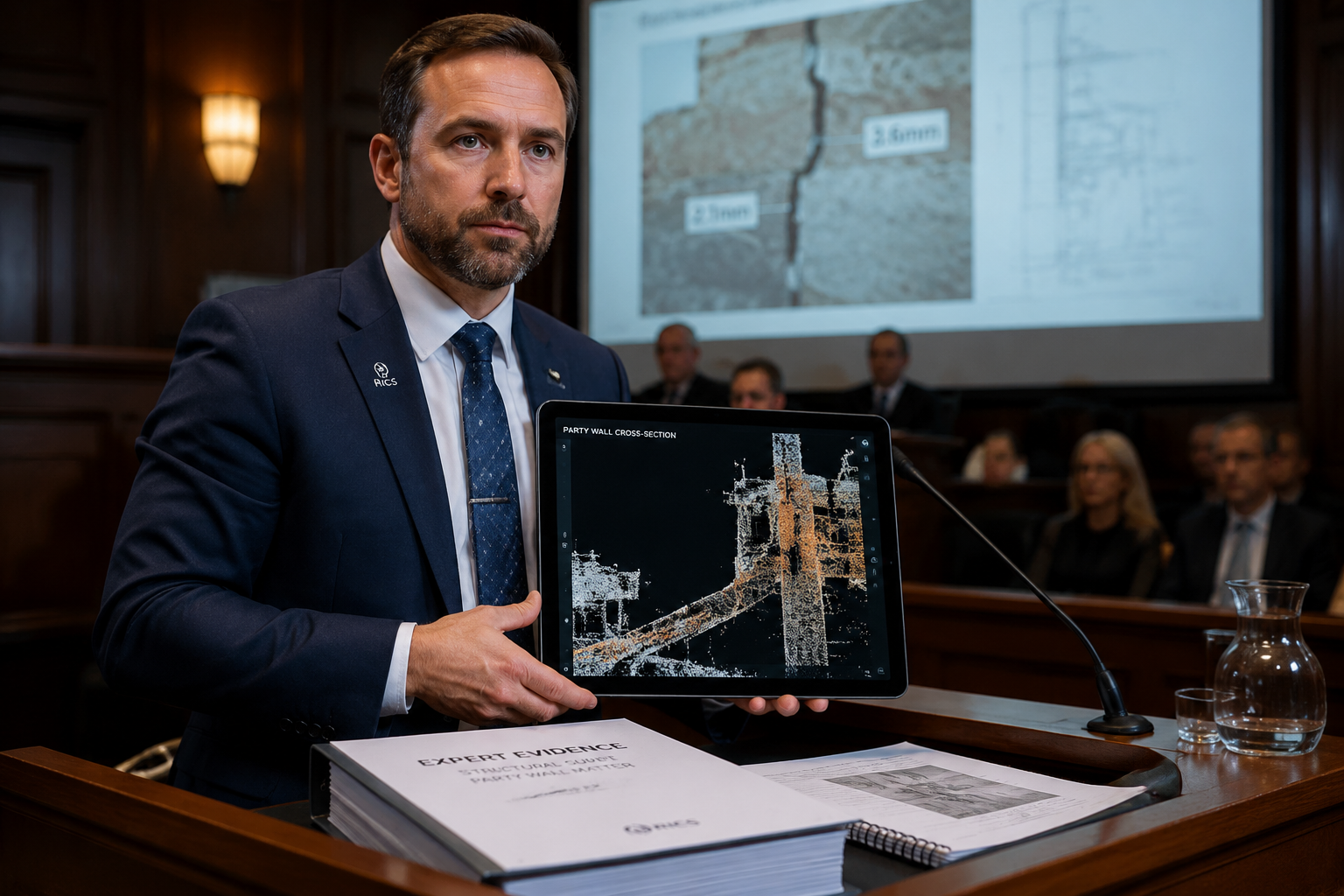
The phrase Expert Witness Roles in Party Wall Disputes: Leveraging 2026 Survey Tech for Courtroom Success captures a genuine transformation in how physical evidence is gathered, stored, and presented. Three technology categories are reshaping practice in 2026.
Mobile 3D LiDAR Scanning
Handheld and pole-mounted LiDAR scanners can now capture a full party wall elevation at sub-millimetre accuracy within minutes. The resulting point cloud data can be:
- Exported as dimensionally accurate 2D cross-sections for inclusion in court reports
- Rendered as interactive 3D models for presentation on courtroom screens
- Time-stamped and geotagged to establish an unbroken chain of evidence
- Compared against a second scan taken after construction to quantify any movement or damage
This is directly relevant to the schedule of condition process. A schedule of condition prepared with LiDAR data is far more defensible than one relying solely on photographs and written descriptions, because it provides objective, measurable baselines that are difficult to dispute.
AI-Assisted Crack Detection and Structural Analysis
AI tools trained on large datasets of structural defects can now flag and classify cracks, spalling, and settlement patterns from photographic or point cloud inputs. A March 2026 study by Northwestern University found that over 60% of federal judges have used at least one AI tool in their judicial work [3]. While judicial AI adoption is still cautious — only 22.4% use such tools weekly or daily — the trend confirms that courts are becoming more comfortable with technology-assisted analysis.
For expert witnesses, this means AI-generated structural assessments can be introduced as supporting evidence, provided the methodology is transparent and the expert can explain and defend the tool's outputs under cross-examination. The expert must never present AI output as a substitute for professional judgment.
Digital Documentation and Remote Inspection Protocols
The forthcoming 8th edition of the RICS "Party Wall Legislation and Procedure" guidance is expected to address digital documentation standards and remote inspection protocols explicitly. Key anticipated requirements include:
- Metadata integrity: All digital files must retain original creation timestamps
- Version control: Reports must log all amendments with reasons
- Remote inspection records: Video walkthroughs must be of sufficient resolution to support the same evidential standard as physical inspections
Surveyors handling party wall awards should begin adopting these standards now, ahead of formal publication, to ensure their documentation practices are already compliant when the guidance takes effect.
Courtroom Presentation Technology
Courts across England and Wales are investing in digital display infrastructure. A January 2026 report on courtroom modernisation noted that IT leaders are standardising large-format displays, wireless presentation systems, and secure digital evidence portals as priority upgrades [4]. For expert witnesses, this means:
- 3D models and annotated point clouds can be displayed directly in court
- Comparative before-and-after visualisations are now technically feasible in most venues
- Digital reports can be navigated interactively rather than printed and paginated
Surveyors who arrive at court with well-structured digital evidence packages — rather than ring-binder bundles — project competence and modernity that reinforces their credibility.
Building a Court-Ready Expert Witness Report for Party Wall Disputes
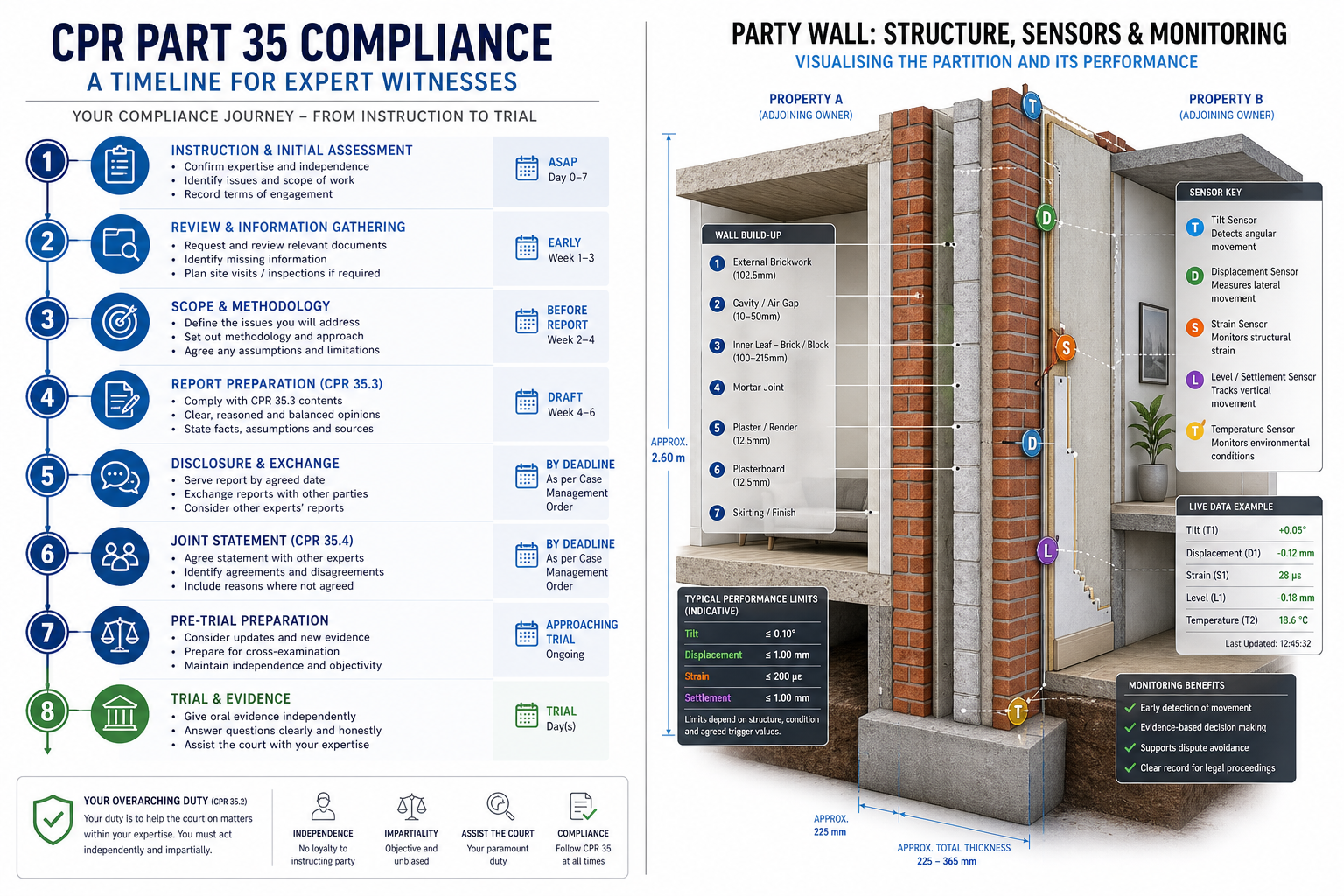
The technical quality of survey data is only as valuable as the report that presents it. Courts assess expert witness reports against a strict set of criteria, and a technically brilliant survey can be undermined by a poorly structured report [9].
Essential Report Structure
A CPR Part 35-compliant expert witness report for a party wall dispute should include:
- Instructions received — who instructed the expert and on what basis
- Statement of independence — the CPR Part 35 declaration
- Scope of inspection — dates, access granted, areas examined
- Methodology — equipment used, scanning parameters, software applied
- Findings — presented objectively, with supporting data
- Opinion — the expert's professional conclusions, clearly distinguished from findings
- Limitations — any constraints on the inspection or data quality
- Appendices — annotated photographs, point cloud exports, scan data, historical documents
For disputes involving types of party wall works such as basement construction, underpinning, or chimney breast removal, the methodology section deserves particular attention. Judges increasingly scrutinise whether the survey method was proportionate to the complexity of the alleged damage [8].
The Joint Statement Process
Where both parties instruct expert witnesses, the court will typically order a joint meeting and a joint statement identifying areas of agreement and disagreement. This process rewards surveyors who have used standardised data formats. When both experts have used LiDAR scanning, for example, their datasets can be directly compared, making it far easier to isolate genuine disputes from measurement artefacts.
"Surveyors who enter the joint statement process with robust, reproducible data are in a much stronger negotiating position than those relying on subjective written descriptions alone."
Avoiding Common Pitfalls
Expert witnesses in party wall cases most frequently lose credibility through:
- Advocacy creep: Allowing the instructing party's interests to colour the report's tone
- Selective evidence: Omitting findings that do not support the instructing party's case
- Overstating certainty: Expressing opinions as facts without acknowledging uncertainty
- Technical jargon: Using surveying terminology without explanation, alienating the judge
The RICS accreditation process specifically tests for these weaknesses through mock cross-examination exercises [2]. Surveyors preparing for expert witness roles should seek similar preparation independently if they are not yet on the RICS register.
Practical Steps for Surveyors: From Appointment to Courtroom
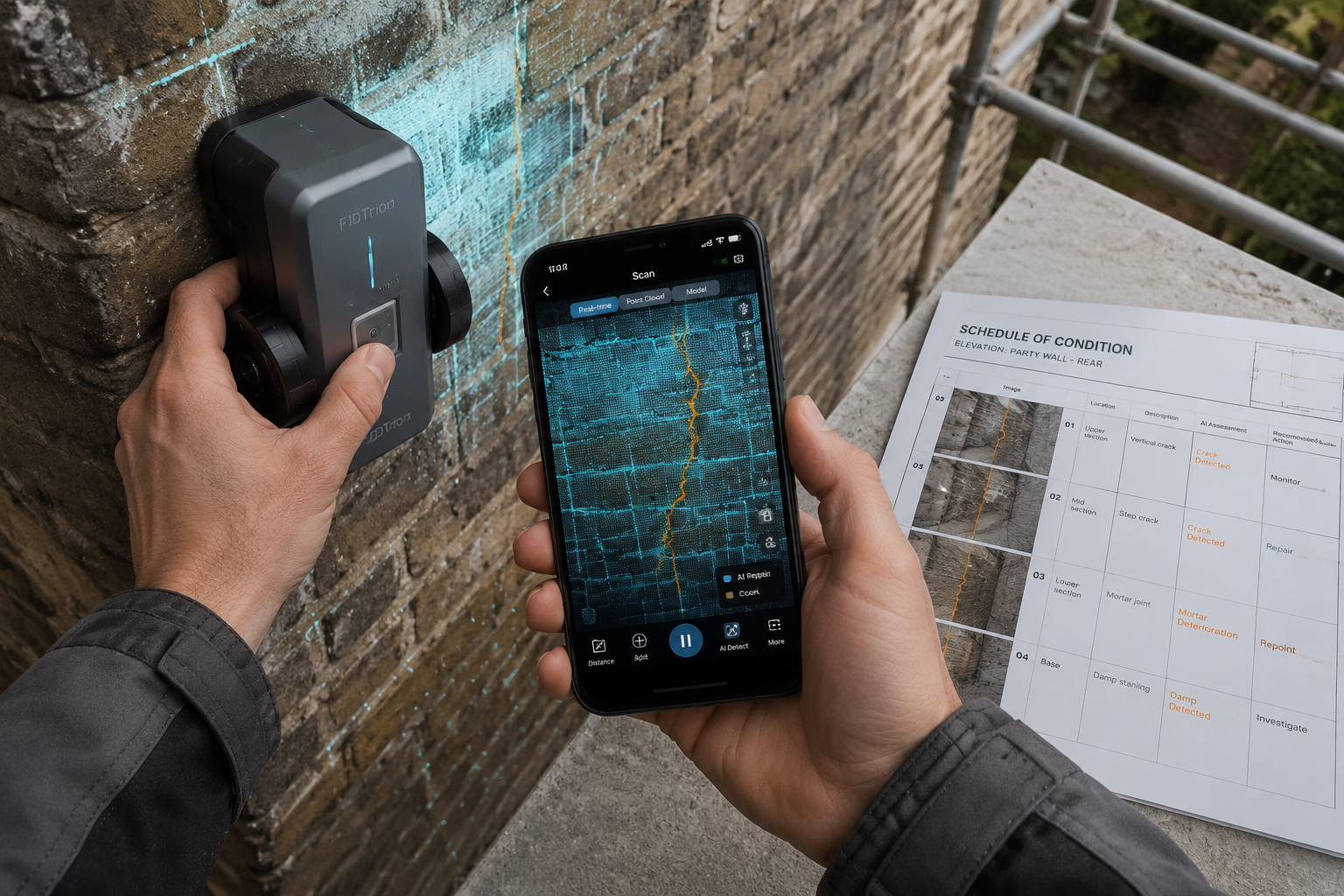
Applying Expert Witness Roles in Party Wall Disputes: Leveraging 2026 Survey Tech for Courtroom Success principles to day-to-day practice requires a structured workflow. The following framework integrates 2026 technology standards with legal compliance requirements.
Step 1: Establish the Evidential Foundation Early
The strongest expert witness cases are built from the moment of initial appointment, not retrospectively. For surveyors acting as building owner's surveyor or adjoining owner's surveyor, this means:
- Conducting a thorough pre-works LiDAR scan and photographic schedule of condition
- Serving party wall notices correctly and retaining all correspondence with timestamps
- Documenting all communications in a format that can be disclosed in proceedings
Step 2: Maintain a Contemporaneous Evidence Log
Every site visit, telephone call, and email exchange relevant to the dispute should be logged with date, time, and a brief summary. This log becomes a powerful tool in court, demonstrating that the expert's conclusions are grounded in a continuous, documented process rather than a retrospective reconstruction.
Step 3: Apply Standardised Digital Formats
The legal technology sector is rapidly converging on standardised digital evidence formats. The KPMG eDiscovery Industry Survey highlighted that standardisation of digital evidence handling is a top priority for legal teams in 2026 [6]. For party wall surveyors, this means:
- Saving point cloud data in universally readable formats (e.g., .LAS, .E57)
- Using PDF/A for archival-quality report storage
- Ensuring all embedded metadata is accurate and unaltered
Step 4: Prepare for Cross-Examination
Cross-examination in party wall litigation typically focuses on three areas: the reliability of the survey methodology, the completeness of the inspection, and the independence of the expert. Preparation should include:
- A thorough re-read of the report from an adversarial perspective
- Anticipating challenges to the scanning equipment's calibration and accuracy
- Preparing clear, non-technical explanations of AI-assisted analysis tools used
The Wolters Kluwer Future Ready Lawyer Survey for 2026 noted that legal professionals who integrate technology fluency with strong communication skills significantly outperform those who rely on either alone [5]. The same principle applies to expert witnesses: technical excellence must be matched by the ability to explain complex findings simply and confidently.
Step 5: Understand the Costs and Process Context
Parties involved in party wall disputes benefit from understanding the full costs of the party wall process before committing to litigation. Expert witness fees represent a significant additional cost layer beyond the surveyor's standard fees. Clear communication about these costs, and about the realistic prospects of success, is part of the expert's broader professional responsibility.
Conclusion
The role of the expert witness in party wall disputes has never been more technically demanding — or more consequential. Courts are modernising. Judges are adopting digital tools. RICS is updating its guidance to reflect new standards for digital documentation and remote inspection. In this environment, surveyors who master Expert Witness Roles in Party Wall Disputes: Leveraging 2026 Survey Tech for Courtroom Success principles will be far better positioned to deliver credible, defensible testimony that withstands scrutiny.
Actionable next steps for surveyors in 2026:
- Invest in mobile LiDAR scanning equipment and ensure all operators are trained to produce court-admissible datasets.
- Review current schedule of condition practices against the anticipated RICS 8th edition standards and update templates accordingly.
- Seek RICS expert witness accreditation or undertake equivalent CPR Part 35 training if not already completed.
- Standardise digital file formats and metadata practices across all party wall instructions, not just those that appear likely to proceed to litigation.
- Engage with the RICS consultation on the 8th edition of "Party Wall Legislation and Procedure" to stay ahead of incoming practice changes.
For property owners and developers navigating a live dispute, the quality of the surveyor appointed matters enormously. Whether you are in South London, North London, or Central London, engaging a surveyor with demonstrable expert witness experience and up-to-date technology capability is the single most effective step toward a successful outcome.
References
[1] Party Wall Expert Witness Roles In Matrimonial Property Disputes Valuation Strategies And Rics Standards – https://www.canterburysurveyors.com/blog/party-wall-expert-witness-roles-in-matrimonial-property-disputes-valuation-strategies-and-rics-standards/
[2] Expert Witness Surveyors In Neighbour Boundary Disputes Rics Standards Vs Land Registry Evidence – https://www.canterburysurveyors.com/blog/expert-witness-surveyors-in-neighbour-boundary-disputes-rics-standards-vs-land-registry-evidence/
[3] Federal Judges Report Broad Adoption Of Ai Tools – https://www.mccormick.northwestern.edu/news/articles/2026/03/federal-judges-report-broad-adoption-of-ai-tools/
[4] Courtroom Modernization In 2026 What It Leaders Are Standardizing First And Why – https://www.avnation.tv/2026/01/28/courtroom-modernization-in-2026-what-it-leaders-are-standardizing-first-and-why/
[5] Wolters Kluwer Releases 2026 Future Ready Lawyer Survey Report – https://www.wolterskluwer.com/en/news/wolters-kluwer-releases-2026-future-ready-lawyer-survey-report
[6] Kpmg Ediscovery Industry Survey 2025 – https://kpmg.com/us/en/articles/2026/kpmg-ediscovery-industry-survey-2025.html
[8] Expert Witness Roles In Structural Collapse Disputes Under Awaabs Law 2026 Evidence Standards For Party Wall Awards – https://wimbledonsurveyors.com/expert-witness-roles-in-structural-collapse-disputes-under-awaabs-law-2026-evidence-standards-for-party-wall-awards/
[9] Expert Witness Surveyors In Party Wall Disputes Cpr Compliance And Case Studies From Recent Uk Litigation – https://wimbledonsurveyors.com/expert-witness-surveyors-in-party-wall-disputes-cpr-compliance-and-case-studies-from-recent-uk-litigation/