

{"cover":"Professional landscape format (1536×1024) hero image with bold text overlay: 'Party Wall Act Compliance for Basement Developments: 2026 Surveyor Best Practices', extra large 72pt white bold sans-serif font with dark drop shadow, centered upper-third composition. Background shows a dramatic cross-section architectural illustration of a London terraced house basement excavation with underpinning supports, party wall boundary markers, and a surveyor in hard hat reviewing technical drawings on-site. Color palette: deep navy blue, white text, amber accent lines. Magazine cover aesthetic, high contrast, editorial quality, professional construction photography style.","content":["Detailed landscape format (1536×1024) illustration showing a professional party wall surveyor in hard hat and hi-vis vest standing at the edge of a deep basement excavation in London, reviewing a Section 6 Adjacent Excavation Notice document. Visible underpinning supports along brick party wall, vibration monitoring equipment attached to wall, measuring tape showing 3-meter proximity rule. Technical drawings spread on portable site table. Warm construction lighting, urban terrace row houses visible above ground level. Focus on compliance documentation and structural safety equipment. Editorial quality, professional photography style.","Detailed landscape format (1536×1024) showing a split-scene infographic-style image: left side depicts a timeline flowchart of Party Wall Act notice stages for basement works with labeled steps from Section 6 notice through Party Wall Award, right side shows a surveyor's schedule of condition report with annotated photographs of neighboring property walls, crack gauges, and waterproofing membrane details. Clean white and navy blue color scheme, bold sans-serif labels, professional technical document aesthetic. Vibration monitoring graph visible in background. Editorial quality, crisp and informative visual style.","Detailed landscape format (1536×1024) showing a top-down aerial perspective of a London residential street with a basement development in progress, highlighting the 3-meter and 6-meter excavation zones marked with colored overlays on the ground plan. A party wall award document is shown in the foreground with highlighted security for expenses clause. Adjacent property owners represented by silhouettes on either side of a clearly marked party wall boundary. Color palette: muted terracotta, slate grey, white annotation lines. Professional urban planning and legal compliance aesthetic, editorial quality."]
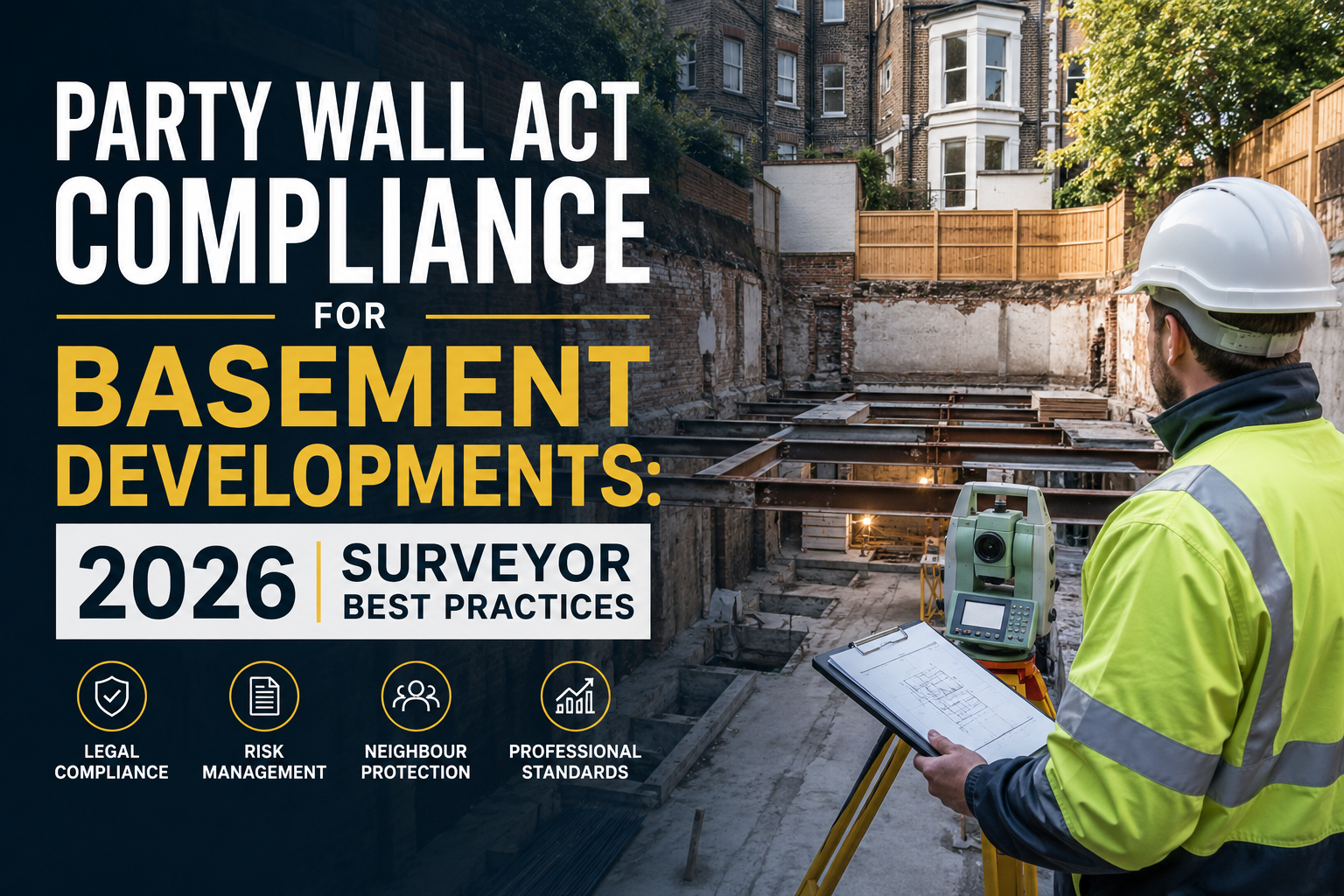
Basement extensions account for nearly 40% of all party wall disputes in urban areas — a figure that reflects not just the complexity of underground works, but the persistent gap between what homeowners assume is required and what the law actually demands [1]. For surveyors and building owners navigating this landscape in 2026, Party Wall Act Compliance for Basement Developments: 2026 Surveyor Best Practices has never been more critical to understand in full, from the first notice served to the final monitoring report filed.
Basement projects introduce challenges that above-ground extensions simply do not. Vibration from excavation equipment can travel through soil and masonry in unpredictable ways. Waterproofing failures can migrate laterally to affect neighboring foundations. And the legal exposure from non-compliance — injunctions, damages claims, and costly delays — falls heavily on building owners who assumed a general contractor would handle the paperwork.
This guide sets out a clear, step-by-step compliance framework for 2026, covering notice obligations, schedule of condition requirements, vibration monitoring protocols, and the surveyor's role in protecting all parties throughout the build.
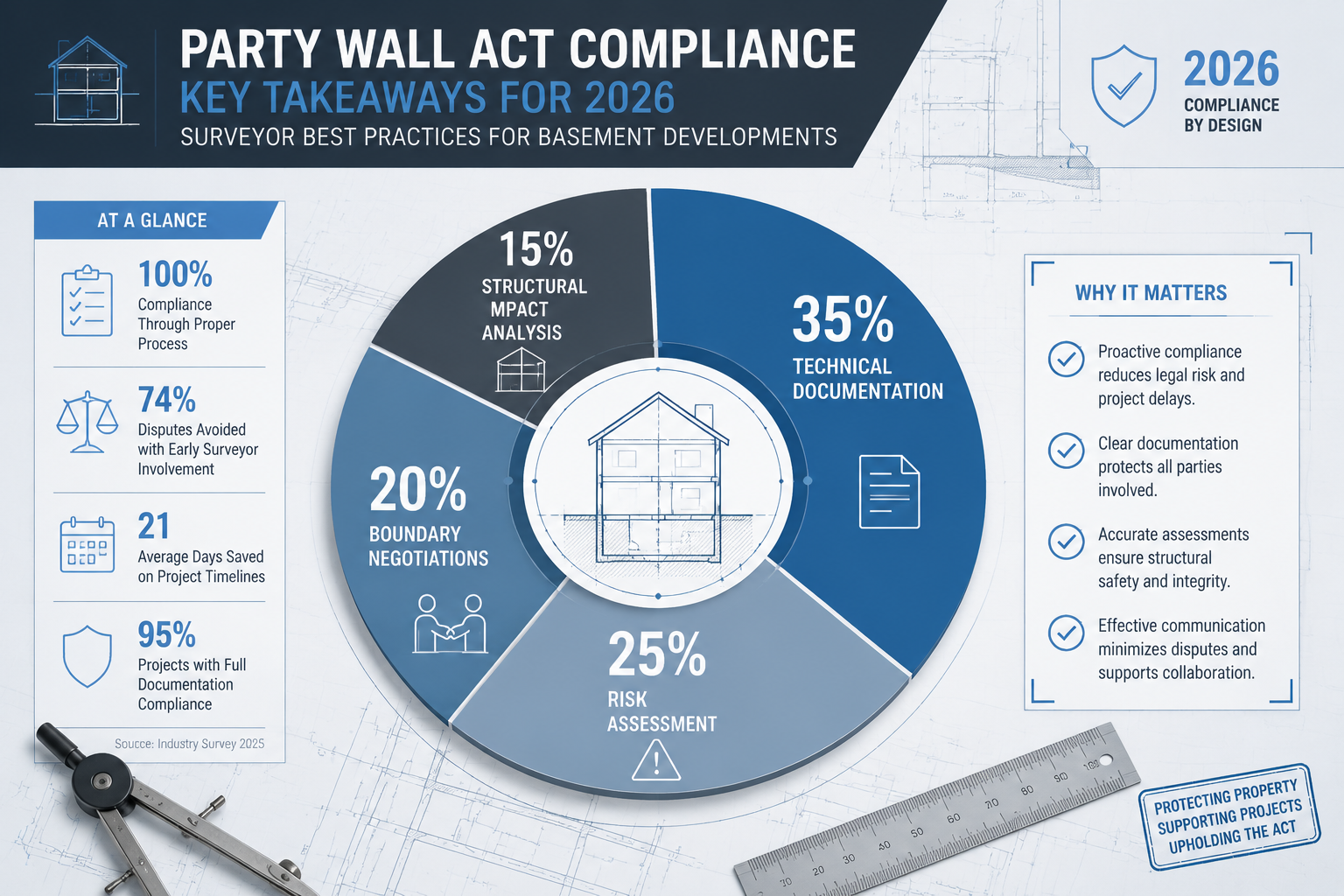
Key Takeaways
- Basement works almost always trigger multiple Party Wall Act notice types, including the often-overlooked Section 6 Adjacent Excavation Notice.
- A schedule of condition documenting the neighboring property's pre-works state is essential protection for both building and adjoining owners.
- Vibration monitoring and waterproofing oversight must be built into the Party Wall Award as enforceable conditions, not afterthoughts.
- Adjoining owners have a statutory right under Section 12 to request a security deposit before works begin.
- Selecting a surveyor with verified basement-specific experience is not optional — it is the single most important decision in the compliance process.
Why Basement Developments Demand Specialist Party Wall Act Compliance
Basement conversions are among the most technically complex and highest-risk projects covered by the Party Wall etc. Act 1996 [10]. Unlike a loft conversion or rear extension, a basement involves deep excavation immediately adjacent to neighboring foundations, underpinning of shared walls, and the introduction of waterproofing systems that must perform for decades without failure.
The risks are not theoretical. Subsidence, cracking, and water ingress affecting neighboring properties are documented outcomes of poorly managed basement works. The legal framework under the Party Wall etc. Act 1996 exists precisely to manage these risks — but only when applied correctly.
The Vibration Problem
Excavation equipment generates ground vibration that can cause micro-cracking in masonry, loosen mortar joints, and disturb the bearing capacity of neighboring foundations. In dense urban terraces — the most common setting for London basement projects — these effects can travel 10 to 15 meters from the source. Without baseline vibration data captured before works begin, attributing post-works damage becomes a contested and expensive exercise.
Best practice in 2026 requires continuous vibration monitoring at the party wall face throughout the excavation phase, with data logged and available to the adjoining owner's surveyor on request. The Party Wall Award should specify peak particle velocity (PPV) thresholds — typically 5mm/s for residential masonry — and require immediate work stoppage if those thresholds are exceeded.
The Waterproofing Risk
Tanked basement systems and cavity drain membranes can redirect groundwater laterally if they are not designed and installed with neighboring drainage patterns in mind. A basement that performs perfectly for the building owner may, over time, increase hydrostatic pressure against the neighboring foundation wall. This risk must be addressed in the structural engineer's design and referenced explicitly in the Party Wall Award.
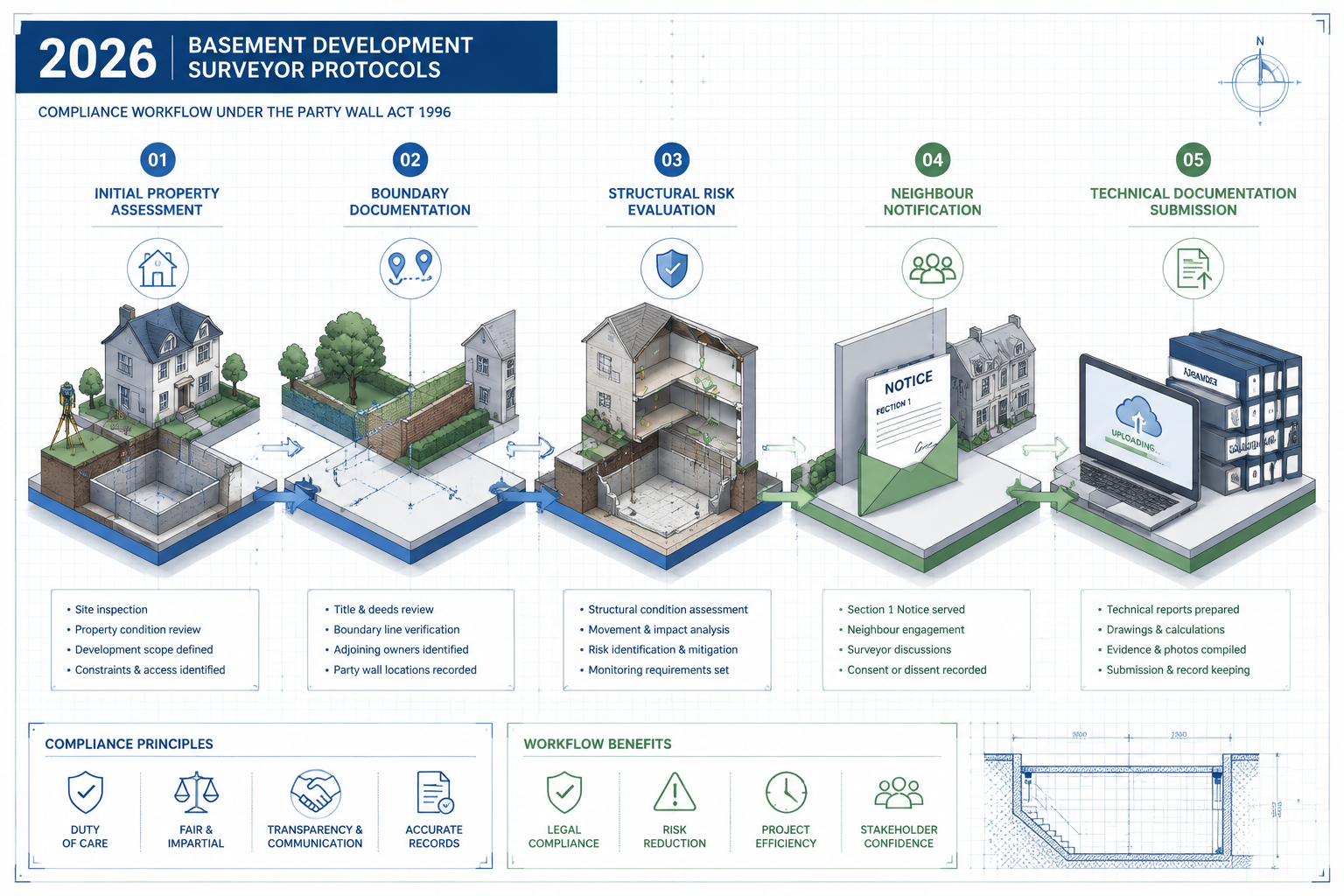
Step-by-Step Party Wall Act Compliance for Basement Developments: 2026 Surveyor Best Practices
Step 1: Identify Which Notices Apply
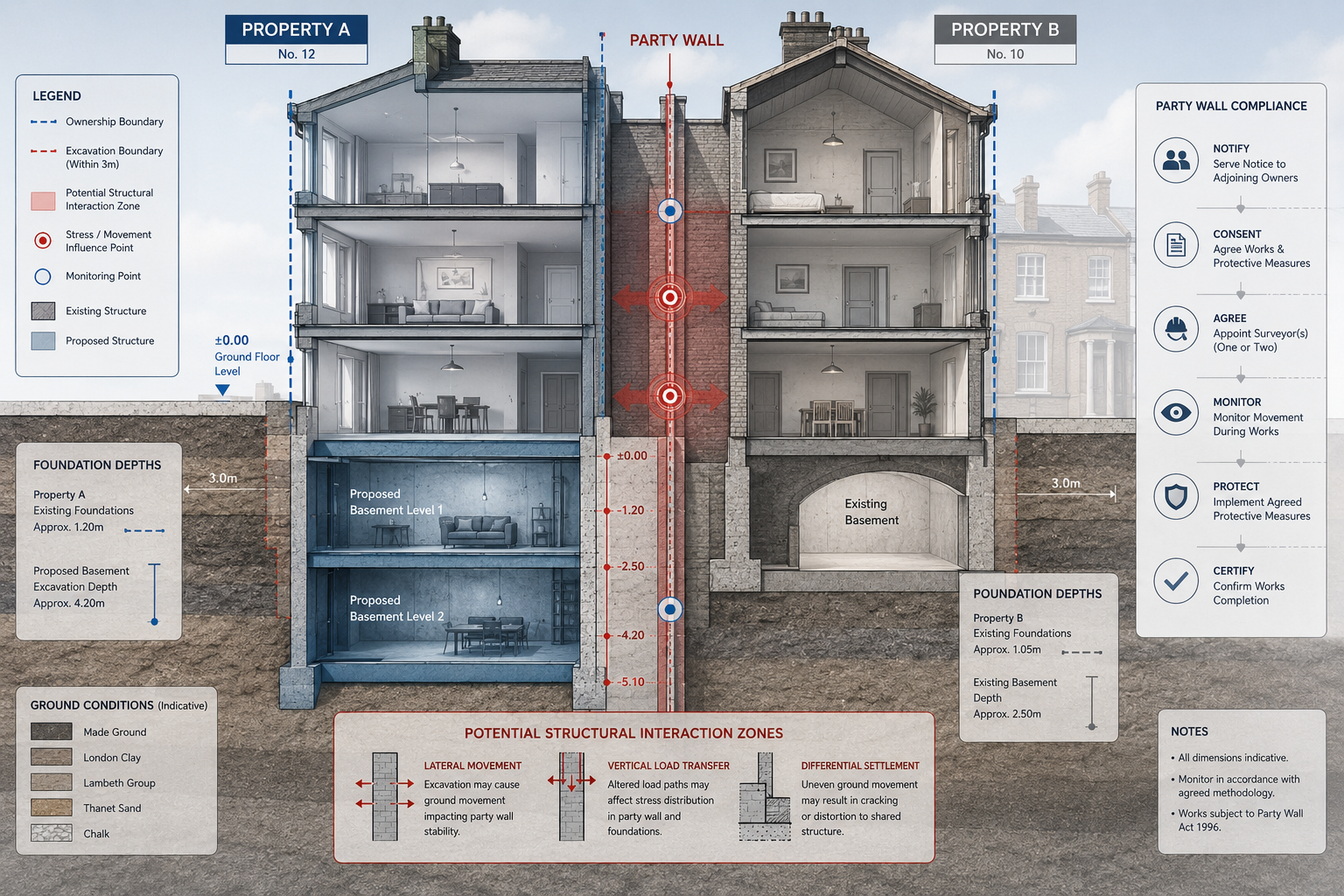
Basement works typically trigger more than one type of notice under the Act. Surveyors must assess the full scope of works before serving any notices to ensure nothing is missed. The types of party wall works covered by the Act include:
| Notice Type | Triggering Condition | Minimum Notice Period |
|---|---|---|
| Section 3 Party Structure Notice | Works to a shared wall, including underpinning | 2 months |
| Section 6 Adjacent Excavation Notice | Excavation within 3m of neighbor's building, deeper than their foundations | 1 month |
| Section 6 (6-meter rule) | Excavation within 6m where a 45-degree line from the base of works intersects neighboring foundations | 1 month |
Failing to serve a Section 6 Adjacent Excavation Notice is the single most common and costly mistake in basement projects — even when no shared wall is directly affected [6]. The 3-meter rule requires a formal notice whenever proposed excavation is within three meters of the neighbor's building and deeper than the bottom of their existing foundations [9]. Many building owners incorrectly assume that because they are not touching a party wall, no notice is needed.
For a detailed explanation of how to serve these notices correctly, see the guidance on Party Wall Act notices.
Step 2: Serve Notices Correctly and on Time
Notices must be served in writing to every adjoining owner — not just the immediate neighbor, but any owner whose property falls within the statutory distances. In a typical London terrace, this can mean serving notices on properties to the side, rear, and occasionally diagonally adjacent.
The 2024 CPD sessions for party wall surveyors introduced stricter standards for notice timelines, reinforcing that late or defective notices cannot be retrospectively validated [3]. A notice served after works have begun offers no legal protection and can result in an injunction requiring the building owner to stop work immediately.
Key elements of a valid notice include:
- Full name and address of the building owner
- Description of the proposed works with reference to plans
- The anticipated start date
- A statement of the owner's rights under the Act
Adjoining owners have 14 days to respond. If they consent in writing, works can proceed without a formal award. If they dissent — or fail to respond — the dispute resolution mechanism under the Act is triggered, and surveyors must be appointed. For adjoining owners who have received a notice and are unsure how to respond, the adjoining owners' surveyor service provides specialist representation.
Step 3: Prepare a Thorough Schedule of Condition
Before any excavation begins, a detailed schedule of condition must be prepared for the adjoining property. This document records the existing state of the neighboring building — every crack, settlement mark, damp patch, and structural feature — with dated photographs and written descriptions.
The schedule of condition serves two purposes. First, it protects the building owner by establishing a clear baseline: any damage that predates the works cannot be attributed to them. Second, it protects the adjoining owner by providing an evidential record if new damage does occur.
In 2026, best practice requires:
- High-resolution photography of all internal and external walls adjacent to the works
- Crack gauge installation on any existing cracks, with initial readings recorded
- A written structural condition assessment by the surveyor
- The document to be signed by both parties or their appointed surveyors before works commence
Step 4: Draft a Comprehensive Party Wall Award
The Party Wall Award is the legally binding document that governs how the works are carried out. For basement projects, a standard award template is rarely sufficient. The award must address the specific risks of deep excavation and must include enforceable conditions that protect the adjoining property throughout the build.
A robust basement Party Wall Award should include:
- Approved drawings and structural calculations referenced by document number and revision
- Temporary Works Design and Method Statement prepared by a qualified structural engineer [4]
- Vibration monitoring protocol specifying equipment type, PPV thresholds, monitoring frequency, and reporting obligations
- Waterproofing specification with reference to BS 8102 (Protection of Below Ground Structures Against Water from the Ground)
- Working hours restrictions to limit vibration impact during sensitive periods
- Notification obligations requiring the building owner to inform the adjoining owner's surveyor before each phase of excavation
- Security for expenses provisions under Section 12 of the Act
"A Party Wall Award that does not address vibration monitoring and waterproofing for a basement project is not fit for purpose in 2026. These are not optional extras — they are the core of the document."
Step 5: Address Security for Expenses
Under Section 12 of the Party Wall Act, adjoining owners have a statutory right to request a security deposit from the building owner before works begin [4]. This deposit covers the cost of making good any damage caused by the works, and it can be a significant sum for a deep basement project.
Surveyors acting for adjoining owners should routinely advise their clients of this right. The amount of security is determined by the appointed surveyors and should reflect the realistic cost of remediation if the worst-case damage scenario occurs. For a full basement with underpinning to a party wall, this figure can range from several thousand to tens of thousands of pounds depending on the proximity and condition of the adjoining structure.
Step 6: Implement and Oversee the Monitoring Programme
Compliance does not end when the award is signed. The monitoring programme must be actively managed throughout the construction period. This means:
- Weekly vibration data reviews during active excavation
- Monthly crack gauge readings until the structure is watertight and backfilled
- Immediate site inspections if any threshold exceedance is recorded
- A post-works inspection to update the schedule of condition and confirm no new damage has occurred
The building owner's surveyor and the adjoining owner's surveyor should agree a communication protocol at the outset, specifying how monitoring data will be shared and what escalation steps will be taken if concerns arise.
Selecting the Right Surveyor for Basement Party Wall Work
Choosing a surveyor with verified experience in basement conversions is critical [7]. General party wall knowledge is not sufficient for these projects. A surveyor who has handled loft conversions and rear extensions but has never managed a deep excavation project will not have the technical vocabulary to interrogate a structural engineer's method statement or to specify an appropriate vibration monitoring regime.
When selecting a surveyor for basement works, building owners and adjoining owners should ask:
- How many basement underpinning projects have you managed under the Act?
- Can you provide references from comparable projects?
- Are you familiar with BS 8102 and current guidance on temporary works design?
- Do you have a working relationship with structural engineers who specialize in basement work?
For those in London, specialist surveyors are available across all areas of the city. Whether the project is in East London, North London, South London, or West London, the surveyor appointed should have direct experience with the ground conditions and property types common to that area.
The Consequences of Non-Compliance
Non-compliance with the Party Wall Act in a basement context carries serious legal and financial consequences [8]. These include:
- Injunctions requiring immediate cessation of works, which can leave an excavation open and unstable
- Damages claims for negligence or trespass if neighboring property is affected
- Retrospective awards that may impose conditions more restrictive than those that would have applied had the process been followed correctly
- Increased insurance premiums and potential voidance of contractor liability cover
The cost of compliance — notices, surveyor fees, monitoring equipment — is a small fraction of the cost of a single injunction application or a structural damage claim. For a detailed breakdown of what to expect financially, the costs of the party wall process provides a useful reference point.
Common Compliance Failures and How to Avoid Them
The following table summarizes the most frequent compliance failures in basement projects and the corrective action required:
| Failure | Consequence | Prevention |
|---|---|---|
| No Section 6 notice served | Injunction risk; no legal protection | Always assess excavation depth and proximity before starting |
| Late notice service | Notice invalid; works cannot proceed lawfully | Serve notices at least 1-2 months before planned start |
| Inadequate schedule of condition | Disputed damage liability | Commission full photographic and written survey before works |
| No vibration monitoring | Cannot defend damage claims | Specify monitoring in the award; install equipment before excavation |
| Security for expenses ignored | Adjoining owner unprotected | Surveyors must advise clients of Section 12 rights |
| Generic Party Wall Award | Key risks unaddressed | Use a basement-specific award template with engineering inputs |
Conclusion
Party Wall Act Compliance for Basement Developments: 2026 Surveyor Best Practices is not a bureaucratic exercise — it is a structured risk management framework that protects everyone involved in one of the most technically demanding types of residential construction. The combination of deep excavation, underpinning, vibration risk, and waterproofing complexity means that a casual approach to compliance will, sooner or later, produce a serious and expensive outcome.
Actionable next steps for building owners:
- Appoint a surveyor with verified basement experience before engaging a contractor.
- Identify all adjoining owners within 3 and 6 meters of the proposed excavation.
- Serve all required notices — Section 3 and Section 6 as applicable — with the correct notice periods.
- Commission a full schedule of condition before any ground is broken.
- Ensure the Party Wall Award includes vibration monitoring thresholds, a method statement, and waterproofing specifications.
- Budget for security for expenses and factor it into project financing.
For adjoining owners:
- Respond to notices within the 14-day window to preserve your rights.
- Appoint your own surveyor — the building owner typically bears the cost.
- Request a copy of the vibration monitoring data throughout the works.
- Exercise your Section 12 right to security for expenses on any significant basement project.
The legal framework is clear. The technical standards are well-established. The only variable is whether the parties involved choose to apply them properly. In 2026, there is no credible excuse for getting this wrong.
References
[1] Avoiding Party Wall Disputes In Basement Extensions 2026 Notice Timelines And Protective Measures – https://partywallsurveyorlondon.uk/blogs/avoiding-party-wall-disputes-in-basement-extensions-2026-notice-timelines-and-protective-measures/?utm_source=openai
[2] Party Wall Survey For Basement Works London – https://www.houricanassociates.com/party-wall-surveyor-services/party-wall-survey-for-basement-works-london/?utm_source=openai
[3] How Recent Changes To The Party Wall Act Impact Current Home Extensions And Basement Projects – https://partywallsurveyorlondon.uk/blogs/how-recent-changes-to-the-party-wall-act-impact-current-home-extensions-and-basement-projects/?utm_source=openai
[4] Basements – https://www.partywall.info/basements.html?utm_source=openai
[5] Party Wall Surveyor For Basement Works What London Homeowners Should Know – https://www.expresspartywall.com/party-wall-surveyor-for-basement-works-what-london-homeowners-should-know/?utm_source=openai
[6] Party Wall Notice Mistakes Basement Extensions London 2026 The Complete Guide To Avoiding Costly Disputes – https://partywallsurveyorlondon.uk/blogs/party-wall-notice-mistakes-basement-extensions-london-2026-the-complete-guide-to-avoiding-costly-disputes/?utm_source=openai
[7] Party Wall Surveying For Basement Conversions Navigating Deeper Excavations In Stabilising Southern Markets – https://www.canterburysurveyors.com/blog/party-wall-surveying-for-basement-conversions-navigating-deeper-excavations-in-stabilising-southern-markets/?utm_source=openai
[8] Basement Underpinning – https://www.partywall-expert.com/basement-underpinning/?utm_source=openai
[9] Party Wall Act 3 Metre Rule – https://www.aylingassociates.com/knowledge/party-wall-act-3-metre-rule?utm_source=openai
[10] partywallspecialists – https://partywallspecialists.com/?p=32125&utm_source=openai