


{"cover":"Professional landscape format (1536×1024) hero image with bold text overlay: 'Evergreen Guide to Party Wall Awards: RICS Requirements, Pitfalls & 2026 Updates' in extra large 72pt white bold sans-serif font with dark semi-transparent background panel, centered upper third composition. Background shows two semi-detached British townhouses sharing a party wall, construction scaffolding on one side, a surveyor in high-vis vest holding architectural drawings, warm afternoon light, urban London streetscape. Color palette: deep navy blue, white text, amber accent lines. Magazine cover aesthetic, editorial quality, high contrast.","content":["Landscape format (1536×1024) editorial infographic illustration showing a split-scene comparison: left side depicts a homeowner receiving a formal Party Wall Notice document at their front door, right side shows a RICS-accredited surveyor at a desk reviewing a Party Wall Award document with legal stamps and 2026 date visible. Central dividing line labeled 'Agreement vs Award'. Clean professional style, navy and white color scheme, realistic architectural office setting, warm indoor lighting, document details clearly visible.","Landscape format (1536×1024) detailed close-up editorial image of a professional surveyor's desk with a Party Wall Award document prominently displayed, annotated with red warning flags on common pitfall sections such as vague scope wording and missing schedule of condition. Surrounding items include a RICS 8th Edition guidance booklet, a fee disclosure form, a checklist clipboard, and a magnifying glass. Overhead flat-lay perspective, crisp natural daylight, navy and amber color accents, clean professional aesthetic.","Landscape format (1536×1024) editorial scene showing a modern construction site beside a Victorian terrace row in London, with a project timeline Gantt chart overlaid as a semi-transparent graphic panel. The chart highlights early engagement milestones, notice periods, and award sign-off dates in 2026. A surveyor and building owner shake hands in the foreground. Background shows brick party wall with scaffolding. Color scheme: slate grey, white, green progress bars, amber warning markers. Professional, editorial quality."]

Fewer than one in three homeowners planning structural work near a shared boundary correctly distinguishes between a party wall agreement and a legally binding party wall award — a gap that costs the UK construction sector millions in delays, injunctions, and remedial disputes every year. This evergreen guide to party wall awards: RICS requirements, pitfalls, and 2026 updates for all property owners cuts through that confusion with precise, actionable information for both building owners and their neighbours.
Key Takeaways
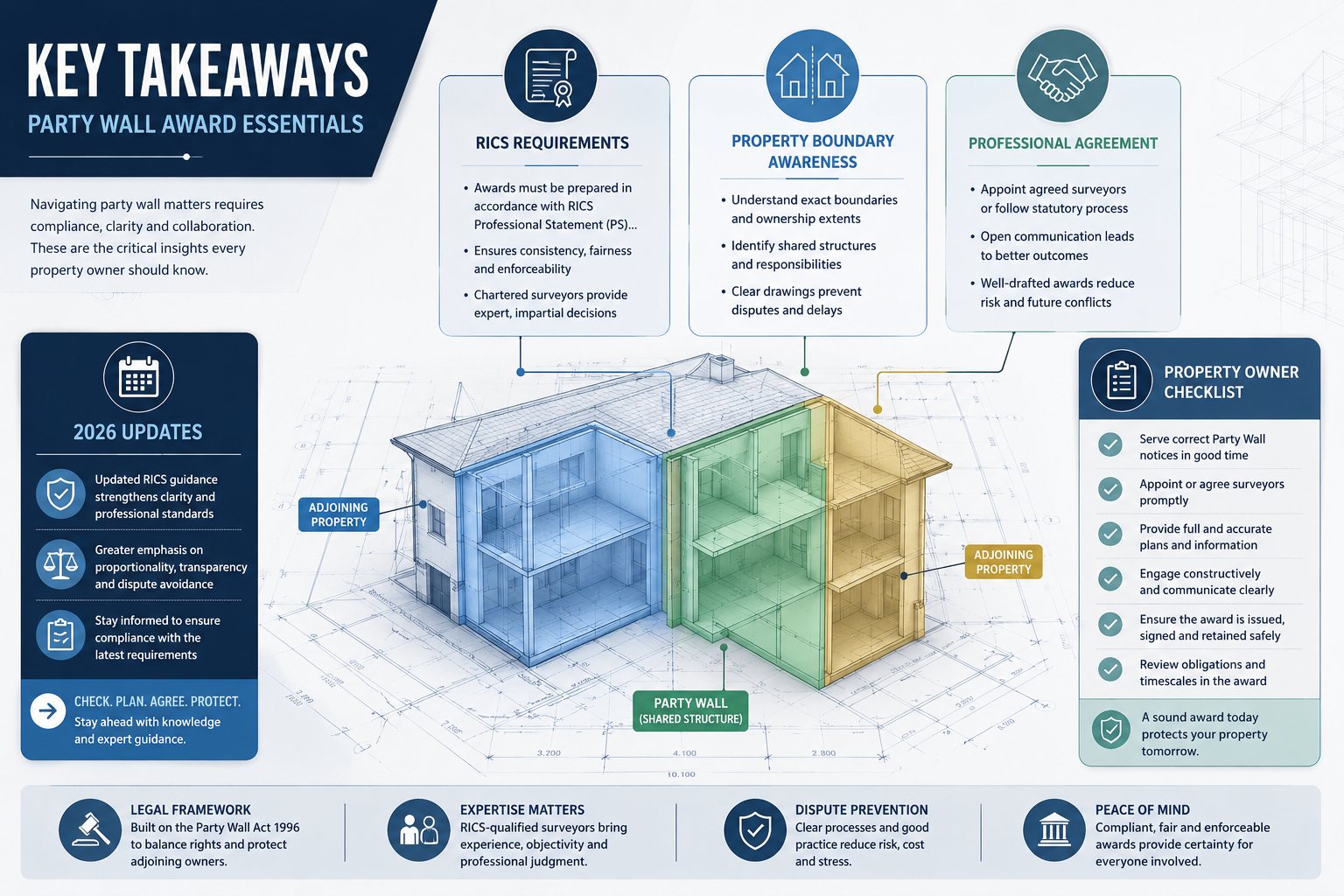
- A party wall award is a formal legal document issued by appointed surveyors; it is mandatory for certain notifiable works under the Party Wall etc. Act 1996, not optional.
- In April 2026, RICS launched a consultation on its draft 8th edition party wall guidance, introducing revised templates, stronger surveyor independence rules, and updated fee disclosure requirements. [1]
- Vague award wording and late engagement are the two leading causes of project delays, legal challenges, and financial loss for both building owners and adjoining owners. [8]
- The award process has defined costs, timelines, and appeal rights that every property owner should understand before serving or receiving a party wall notice.
- Early instruction of a qualified surveyor — ideally before planning permission is granted — dramatically reduces risk and cost throughout the project lifecycle. [9]
What Is a Party Wall Award and When Is It Mandatory
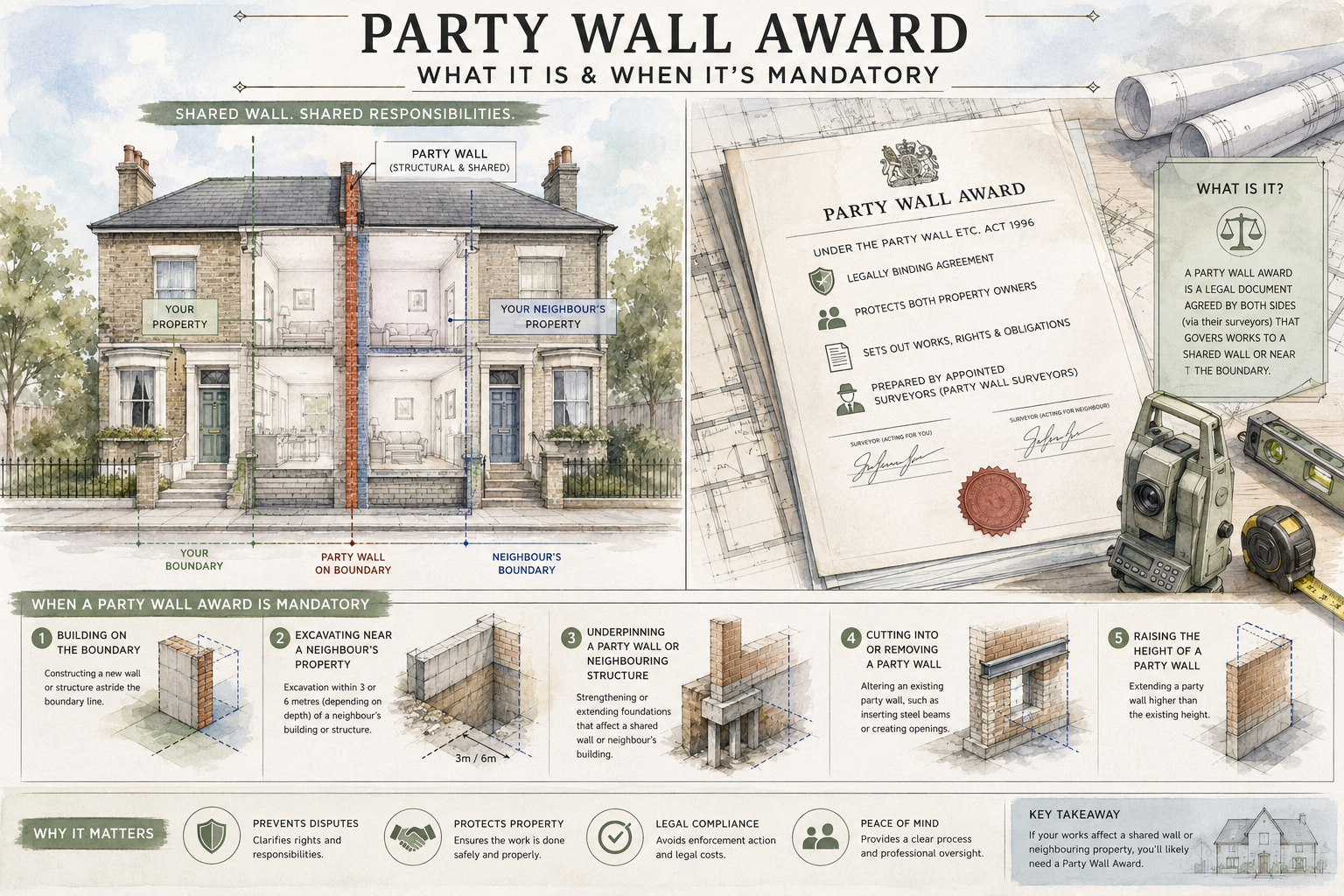
A party wall award (also called a party wall agreement in common usage, though the two are legally distinct) is a binding determination made by one or more appointed surveyors under the Party Wall etc. Act 1996. It sets out the rights and obligations of both the building owner and the adjoining owner before, during, and after notifiable construction work.
The critical distinction: A written consent from a neighbour after receiving a party wall notice is sometimes loosely called an "agreement," but it carries no surveyor-drafted protections. A formal party wall award, by contrast, is a legal instrument that can be enforced in the county court.
Works That Require a Formal Award
An award is required when the adjoining owner dissents to a party wall notice, or when the Act mandates one regardless of consent. Notifiable works include:
| Work Type | Relevant Notice | Typical Notice Period |
|---|---|---|
| Building on or at the line of junction | Line of Junction Notice | 1 month |
| Works to an existing party wall or structure | Party Structure Notice | 2 months |
| Excavation within 3 or 6 metres of a neighbour's foundations | Three/Six Metre Notice | 1 month |
For a full breakdown of which works trigger which notice, see the detailed overview of types of party wall works.
Agreement vs. Award: A Practical Comparison
| Feature | Neighbour Consent (Agreement) | Formal Party Wall Award |
|---|---|---|
| Legal enforceability | Limited | High — county court enforceable |
| Surveyor involvement | Not required | Required upon dissent |
| Schedule of condition | Optional | Standard best practice |
| Appeal rights | None | 14-day appeal to county court |
| Protection for adjoining owner | Minimal | Comprehensive |
"A party wall award is not a bureaucratic hurdle — it is the document that protects both sides of the wall."
RICS Requirements and the 2026 8th Edition Update
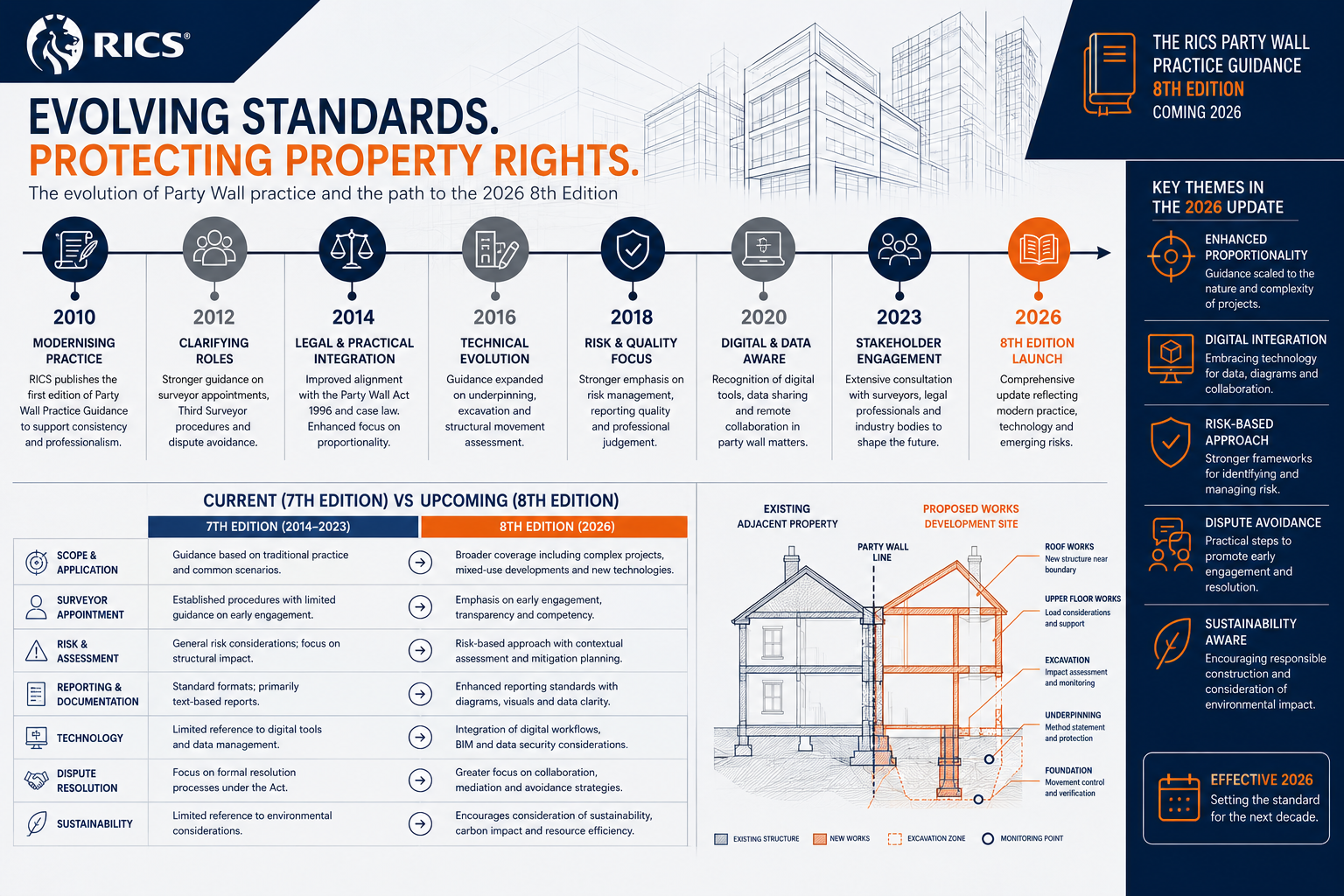
The Royal Institution of Chartered Surveyors (RICS) sets the professional standards that govern how party wall surveyors operate. In April 2026, RICS launched an eight-week consultation on the draft 8th edition of its Party Wall Legislation and Procedure guidance — the most significant update to the framework in over a decade. [1]
What the Draft 8th Edition Changes
The proposed revisions address several areas that practitioners and property owners have long identified as sources of confusion and dispute. [1] [6]
1. Revised Templates for Letters of Appointment and Award Drafts
The 8th edition introduces updated templates for letters of appointment, terms of engagement, and award drafts. These templates aim to reduce ambiguity in scope descriptions — one of the most common triggers for award challenges. [7]
2. Strengthened Surveyor Independence Rules
The draft guidance explicitly clarifies that a party wall surveyor's appointment is personal and statutory. Surveyors must act independently of client instructions, even when appointed solely by the building owner. [2] This matters because a surveyor who defers to their appointing client risks producing an award that can be challenged or set aside.
3. Updated Fee Disclosure Practices
The new guidance strengthens directives on fee transparency. Surveyors will be expected to provide clear, written fee estimates at the point of appointment, reducing the scope for disputes over costs after the award is made. [6]
4. Enhanced Notice Service Protocols
The 8th edition places greater emphasis on precise notice service procedures. Errors in how notices are served — wrong addresses, incorrect descriptions of works, or missed adjoining owners — can render subsequent awards procedurally void, exposing building owners to injunctions. [3]
5. Clearer Role of the Third Surveyor
When two party-appointed surveyors cannot agree, a third surveyor (selected in advance) makes the determination. The draft guidance strengthens the procedural framework around this role to prevent tactical delays. [1]
What Surveyors Must Do to Comply
Surveyors adapting to the 8th edition face practical implementation challenges, including updating their notice templates, revising standard award drafts, and introducing formal fee disclosure documentation. [6] Property owners should ask any surveyor they instruct whether their documentation reflects the 2026 consultation drafts.
For those in specific areas of London, qualified local expertise is available through party wall surveyors in North London, South London, East London, and West London.
Common Pitfalls in the Party Wall Award Process
Understanding what goes wrong in party wall matters is as important as knowing the correct procedure. The following pitfalls affect both homeowners and professional builders.
Pitfall 1: Vague Award Wording
Imprecise descriptions of permitted works are the single most common reason awards are challenged or ignored. [8] When an award states "general structural works to the party wall" without specifying depths, materials, working hours, or access arrangements, disputes are almost inevitable.
Best practice: Award drafts should reference specific drawings by revision number, define working hours explicitly, and include a clear schedule of permitted access.
Pitfall 2: Missing or Inadequate Schedule of Condition
A schedule of condition records the pre-works state of the adjoining owner's property with photographs and written descriptions. Without it, attributing post-works damage becomes a contested exercise that frequently ends in litigation.
Pitfall 3: Late Engagement and Last-Minute Awards
Delaying the party wall process until contractors are already mobilised creates serious risk. Legal injunctions can halt works entirely, financial penalties accumulate, and structural risks increase when work begins without an agreed award in place. [5] RICS is addressing this directly: its June 2026 seminar, "Early Doors and Party Walls: Managing Risk from the Outset," is specifically focused on the consequences of late engagement. [9]
Pitfall 4: Confusion Between Notices and Awards for Listed and Historic Buildings
For listed buildings and properties in conservation areas, the party wall process intersects with listed building consent requirements. A party wall award does not substitute for listed building consent, and surveyors must navigate both frameworks simultaneously. Confusing the two, or failing to identify which additional consents are needed, is a documented source of project delays and regulatory penalties. [4]
Pitfall 5: Serving Notices on the Wrong Parties
The Act requires notices to be served on all adjoining owners — including freeholders, leaseholders with leases of more than one year, and mortgagees in possession. Missing any one of these parties can invalidate the entire process. [3]
Pitfall 6: Attempting to Proceed Without a Surveyor
Some building owners attempt to manage the party wall process without professional help. While the Act does not prohibit this in all circumstances, the risks are substantial. For guidance on the limitations of this approach, see the detailed analysis of having a party wall agreement without a surveyor.
Costs, Timelines, and the Award Process Step by Step
Typical Costs in 2026
Party wall costs vary by project complexity, location, and the number of adjoining owners involved. The table below provides general guidance.
| Service | Typical Cost Range (2026) |
|---|---|
| Building owner's surveyor fee | GBP 700 – GBP 1,500 per award |
| Adjoining owner's surveyor fee (paid by building owner) | GBP 700 – GBP 1,500 per award |
| Third surveyor determination | GBP 1,000 – GBP 3,000+ |
| Schedule of condition | GBP 300 – GBP 800 |
For a detailed breakdown of what drives these figures, see the guide to party wall costs and the process, and practical tips on how to keep party wall costs down.
Step-by-Step Award Process
Step 1: Serve the correct notice
The building owner serves the appropriate notice on all adjoining owners. Notice periods are one or two months depending on work type. For guidance on what notices cover, see the overview of party wall notices.
Step 2: Await response
The adjoining owner has 14 days to respond. Options are: consent in writing, dissent and appoint a surveyor, or fail to respond (which triggers a deemed dissent after a further 10-day period).
Step 3: Appoint surveyors
Upon dissent, both parties appoint surveyors. They may agree to use a single "agreed surveyor," or each appoints their own. Those two surveyors then select a third surveyor in advance.
Step 4: Prepare the award
Surveyors inspect the site, review drawings, and draft the award document. This typically takes four to eight weeks for straightforward cases.
Step 5: Sign and serve the award
The signed award is served on both parties. Either party has 14 days to appeal to the county court if they believe the award is incorrect in law or fact.
Step 6: Works commence
Works may begin once the award is in place and any appeal period has passed (or an appeal has been resolved).
Practical Checklist for Building Owners and Adjoining Owners
Building Owner Checklist
- Identify all notifiable works before submitting planning applications
- Confirm all adjoining owners, including leaseholders
- Serve notices using correct templates and within required timescales
- Instruct a RICS-accredited surveyor early — ideally two to three months before works begin
- Ensure award drawings reference specific revision numbers
- Commission a schedule of condition before works start
- Budget for both your own and the adjoining owner's surveyor fees
For those carrying out works, the dedicated building owners section provides further guidance.
Adjoining Owner Checklist
- Read the notice carefully and note the 14-day response deadline
- Do not ignore a notice — deemed dissent triggers costs you may not expect
- Consider appointing your own surveyor (the building owner pays reasonable fees)
- Request a schedule of condition to protect your property
- Review the draft award before it is signed
- Note the 14-day appeal window after the award is served
Adjoining owners can find tailored information at the adjoining owners section.
Real-World Examples: When Awards Prevent Costly Disputes
Example 1: Loft conversion in a Victorian terrace
A building owner in South London began a loft conversion involving steel beam installation into a party wall. The adjoining owner consented verbally but no formal award was drafted. When cracking appeared in the neighbour's bedroom ceiling during works, there was no pre-works schedule of condition to establish baseline condition. The dispute took 18 months and cost both parties more in legal fees than the surveyor's fee would have been.
Example 2: Basement excavation near a listed building
A developer excavating within three metres of a listed Georgian terrace served a Three Metre Notice but failed to identify a leaseholder as an additional adjoining owner. The leaseholder applied for an injunction, halting works for six weeks during peak construction season. The 8th edition's enhanced notice service protocols are designed specifically to prevent this scenario. [3]
Example 3: Early engagement saves a commercial project
A commercial developer instructed party wall surveyors during the planning stage, 14 weeks before intended works. The surveyors identified two additional adjoining owners not on the developer's initial list, revised the award scope to include protective measures for a neighbouring basement, and completed the award process before the contractor mobilised. No delays occurred.
Evergreen Guide to Party Wall Awards: Key 2026 Updates Summary
The core principles of the Party Wall etc. Act 1996 remain unchanged. What the 2026 RICS 8th edition consultation updates is the professional framework within which those principles are applied. [1] The changes most relevant to property owners are:
- Clearer award templates that reduce scope for vague wording [7]
- Stronger surveyor independence protections that make awards more robust against challenge [2]
- Improved fee transparency so adjoining owners know costs upfront [6]
- Tighter notice service rules that reduce procedural invalidity risks [3]
These updates reinforce the evergreen guide to party wall awards: RICS requirements, pitfalls, and 2026 updates for all property owners as a living reference — one that remains relevant whether a reader is planning works today or in five years.
Conclusion
Party wall awards are not optional paperwork — they are the legal backbone of any notifiable construction project near a shared boundary. The 2026 RICS 8th edition consultation marks a significant step toward clearer, more enforceable professional standards that benefit both building owners and their neighbours.
Actionable next steps for property owners:
- Before serving any notice, confirm whether your works are notifiable under the Party Wall etc. Act 1996 and identify all adjoining owners.
- Instruct a RICS-accredited surveyor at the earliest possible stage — not after contractors are booked.
- Insist on a schedule of condition before works begin, regardless of how cooperative your neighbour appears.
- Ask your surveyor whether their templates and award drafts reflect the 2026 RICS 8th edition consultation standards.
- If you are an adjoining owner who has received a notice, do not ignore it — respond within 14 days and consider appointing your own surveyor.
The cost of getting party wall matters right is a fraction of the cost of getting them wrong. Early, professional engagement remains the single most effective risk mitigation strategy available to any property owner in 2026.
References
[1] Rics Launches Consultation On Updated Party Wall Practice Guidance – https://www.rics.org/news-insights/rics-launches-consultation-on-updated-party-wall-practice-guidance?utm_source=openai
[2] Party Wall Awards Explained Surveyor Roles Notice Periods And Dispute Resolution Under 2026 Rics Guidance – https://wimbledonsurveyors.com/party-wall-awards-explained-surveyor-roles-notice-periods-and-dispute-resolution-under-2026-rics-guidance/?utm_source=openai
[3] Public Engagement And Notice Service Rules Rics 8th Edition Updates For Party Wall Surveyors – https://partywallsurveyorlondon.uk/blogs/public-engagement-and-notice-service-rules-rics-8th-edition-updates-for-party-wall-surveyors/?utm_source=openai
[4] Understanding Party Wall Awards For Historic And Listed Buildings Extra Safeguards Consents And Common Pitfalls – https://partywallsurveyorlondon.uk/blogs/understanding-party-wall-awards-for-historic-and-listed-buildings-extra-safeguards-consents-and-common-pitfalls/?utm_source=openai
[5] Last Minute Party Wall Awards Risks Delays And How Surveyors Can Rescue A Project – https://partywallsurveyorlondon.uk/blogs/last-minute-party-wall-awards-risks-delays-and-how-surveyors-can-rescue-a-project/?utm_source=openai
[6] Rics 8th Edition Party Wall Guidance 2026 Implementation Challenges And Surveyor Compliance Strategies – https://wimbledonsurveyors.com/rics-8th-edition-party-wall-guidance-2026-implementation-challenges-and-surveyor-compliance-strategies/?utm_source=openai
[7] Updated Rics Party Wall Templates For 2026 Letters Of Appointment Terms And Award Drafts From The 8th Edition Consultation – https://manchestersurveyors.com/updated-rics-party-wall-templates-for-2026-letters-of-appointment-terms-and-award-drafts-from-the-8th-edition-consultation/?utm_source=openai
[8] The Most Common Reasons Party Wall Awards Get Delayed Challenged Or Ignored – https://manchestersurveyors.com/the-most-common-reasons-party-wall-awards-get-delayed-challenged-or-ignored/?utm_source=openai
[9] Rics In The Black Country Early Doors And Party Walls Managing Risk From The Outset – https://www.rics.org/training-events/networking-events/rics-in-the-black-country-early-doors-and-party-walls-managing-risk-from-the-outset?utm_source=openai