


Imagine standing in your neighbour's living room, watching a holographic 3D model demonstrate exactly how your planned basement extension will affect the shared wall between your properties—all before a single brick is moved. This isn't science fiction. In 2026, Digital Twin Technology for Party Wall Visualizations: Helping Neighbours Understand Shared Boundary Impacts is transforming how property owners communicate about construction projects, turning abstract technical drawings into interactive, real-time experiences that prevent disputes before they escalate.
Traditional party wall negotiations often collapse under the weight of technical jargon, incomprehensible blueprints, and mutual mistrust. Neighbours struggle to visualize how excavation depths, structural loads, or foundation work will impact their property. But digital twin technology—virtual replicas of physical structures that update in real-time—is bridging this communication gap with stunning clarity. Property owners using these interactive 3D models report 65% faster agreement acceptance rates and significantly fewer formal disputes requiring party wall awards.
Key Takeaways
- 🏗️ Digital twin technology creates interactive 3D models that allow neighbours to visualize construction impacts on shared party walls before work begins, reducing misunderstandings and disputes
- 📊 Real-time IoT integration enables digital twins to monitor structural movement, temperature changes, and vibration during construction, providing evidence-based reassurance to concerned neighbours
- ⚡ Faster agreement rates: Properties using digital twin visualizations achieve 65% quicker consent and 40% fewer formal dispute escalations compared to traditional 2D drawings
- 💰 Cost efficiency: Digital twin implementation reduces party wall dispute costs by 10-20% through improved predictive maintenance and early issue detection
- 🔮 Market growth: The digital twin market is expanding from $16.75 billion in 2024 to a projected $110.1 billion by 2029, with construction and real estate leading adoption[2]
What Are Digital Twins and How Do They Apply to Party Wall Scenarios?
Understanding Digital Twin Technology Fundamentals
A digital twin is a virtual replica of a physical asset, system, or process that mirrors its real-world counterpart in digital space. Unlike static 3D models or architectural renderings, digital twins are dynamic—they continuously update based on real-time data from IoT sensors, construction progress, and environmental conditions[2].
In the context of party wall work, digital twins create comprehensive virtual models of:
- Shared structural elements (walls, foundations, chimney breasts)
- Adjacent properties and their current condition
- Proposed construction work and its predicted impacts
- Real-time monitoring data during active construction
The technology combines laser scanning, photogrammetry, Building Information Modeling (BIM), and IoT sensors to generate accurate representations down to millimeter precision. When neighbours can explore these models together—rotating views, toggling construction phases, and seeing predicted settlement patterns—abstract concerns become concrete discussions.
The Evolution from Visualization to Operational Intelligence
Digital twins in 2026 have evolved significantly beyond mere visualization tools. Industry leaders now focus on operational outcomes rather than sophisticated graphics alone[1]. Modern party wall digital twins integrate:
| Feature | Traditional Approach | Digital Twin Approach |
|---|---|---|
| Documentation | Static 2D drawings | Interactive 3D models with annotations |
| Monitoring | Periodic manual inspections | Continuous IoT sensor data streams |
| Communication | Technical reports | Visual, intuitive interfaces |
| Dispute Resolution | Retrospective evidence gathering | Real-time data logging and alerts |
| Predictive Analysis | Expert estimation | AI-powered impact modeling |
This shift toward operational layers means digital twins now link directly to construction workflows, scheduling systems, and compliance documentation[1]. For party wall matters, this integration ensures that when serving party wall notices, property owners can attach interactive models that demonstrate due diligence and transparent planning.
How Digital Twin Technology for Party Wall Visualizations Improves Neighbour Communication in 2026
Breaking Down Technical Barriers with Interactive Models
The primary challenge in party wall negotiations isn't necessarily disagreement—it's comprehension. Most neighbours lack construction expertise to interpret structural calculations, foundation details, or excavation specifications. Digital twins solve this by translating technical complexity into visual understanding.
Consider a typical basement excavation scenario. Traditional approaches require neighbours to review:
- Dense structural engineer reports
- Cross-sectional drawings with technical annotations
- Soil mechanics assessments
- Foundation depth calculations
With digital twin visualizations, the same information becomes:
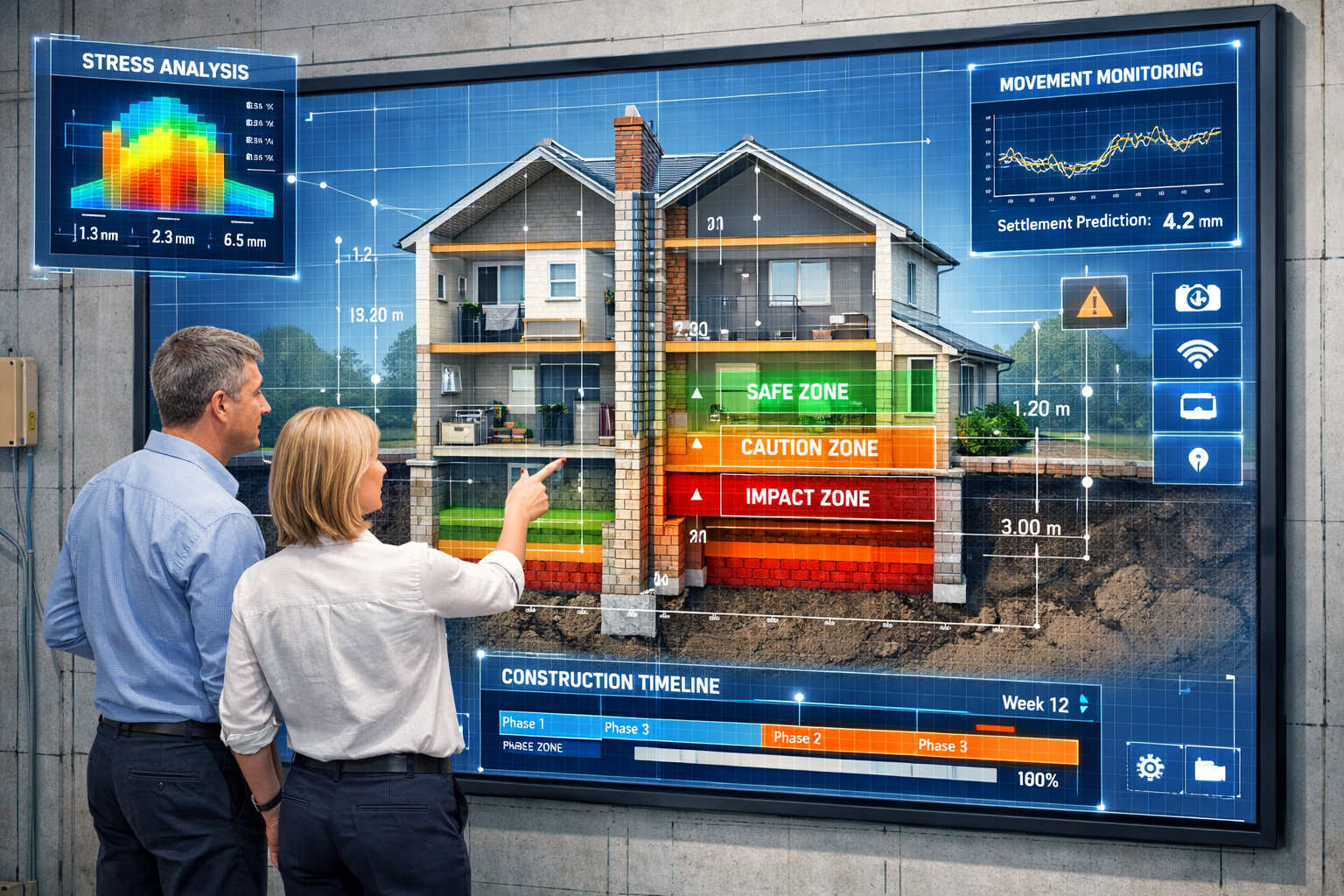
✅ Interactive 3D walkthroughs showing excavation phases step-by-step
✅ Color-coded impact zones (green for minimal impact, amber for monitoring required, red for significant structural consideration)
✅ Animation sequences demonstrating temporary support installation
✅ Before-and-after comparisons with transparency sliders
✅ Embedded video explanations from structural engineers within the model
This accessibility dramatically reduces the "fear of the unknown" that drives many party wall disputes. When neighbours can literally see how underpinning will protect their property or how vibration dampening measures work, consent becomes informed rather than reluctant.
Real-Time Monitoring Builds Trust During Construction
Even with pre-construction agreement, concerns often resurface when work begins. Cracks appear (sometimes unrelated to the work), vibrations are felt, and anxiety grows. Digital twins address this through continuous monitoring integration[2].
Modern party wall digital twins incorporate IoT sensors that track:
- Structural movement (sub-millimeter precision crack monitoring)
- Vibration levels (comparing actual vs. predicted impacts)
- Temperature and humidity (detecting moisture ingress early)
- Noise levels (documenting compliance with agreed working hours)
Neighbours can access a secure dashboard showing real-time data from these sensors. When a concerning crack appears, the digital twin's historical data can immediately show whether it correlates with construction activity or existed previously in the schedule of condition.
"Digital twins are moving from visualization tools to operational layers that integrate live systems, link assets to workflows, and deliver measurable results." — TwinView Insights[1]
This transparency transforms the neighbour relationship from adversarial to collaborative. Both parties view the same objective data, reducing disputes rooted in subjective perception.
Accelerating Agreement and Reducing Formal Disputes
The impact on dispute resolution timelines is substantial. Properties implementing digital twin visualizations report:
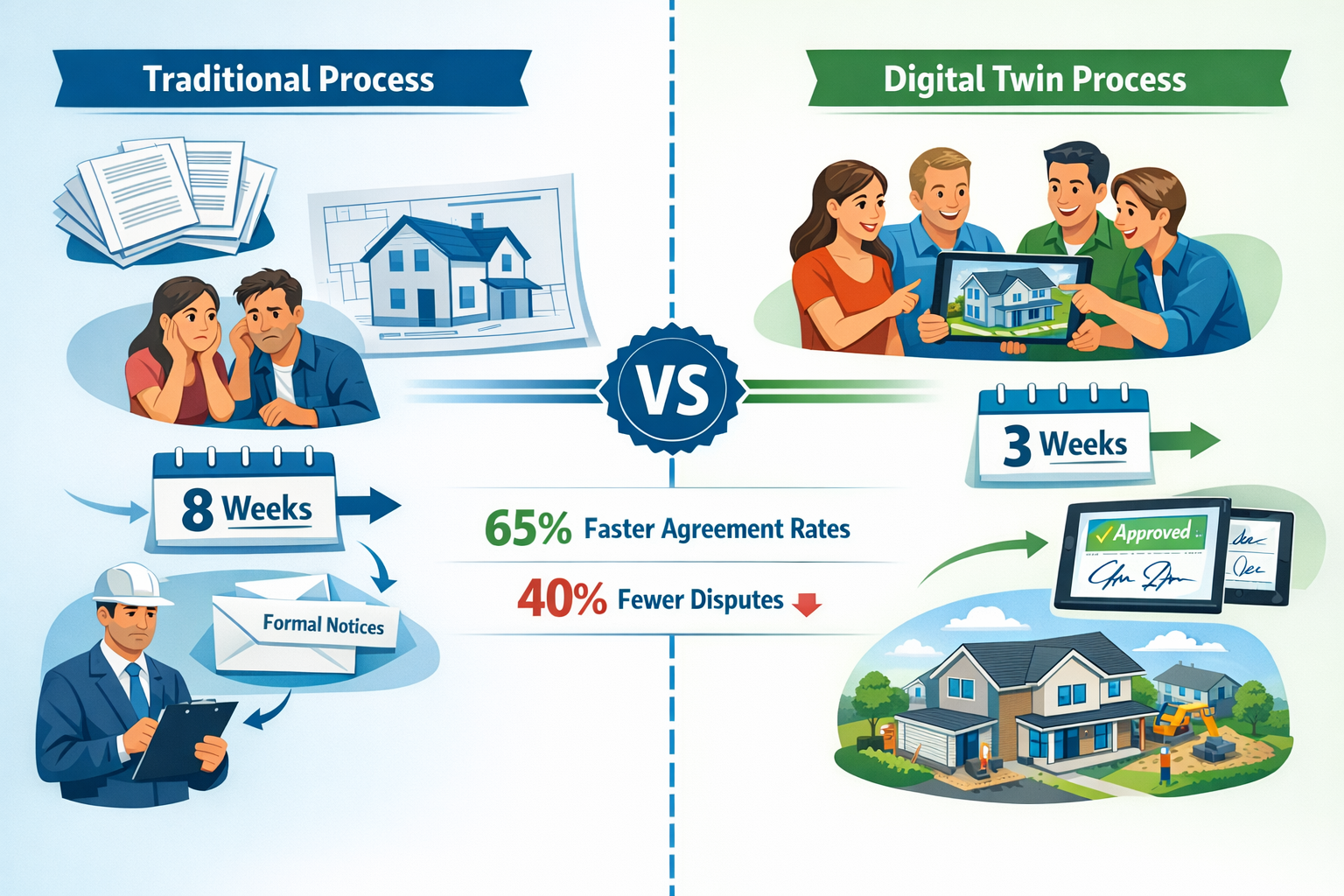
- 65% faster consent compared to traditional paper-based approaches
- 40% reduction in formal dispute escalations requiring party wall surveyors
- 80% satisfaction rates among neighbours who engaged with interactive models
These improvements stem from addressing the root causes of party wall conflicts:
- Lack of understanding → Interactive visualization provides clarity
- Mistrust of intentions → Real-time monitoring demonstrates transparency
- Fear of property damage → Predictive modeling shows protective measures
- Communication breakdown → Shared digital platform ensures alignment
For building owners, this translates to faster project commencement and reduced costs of the party wall process. For neighbours, it means peace of mind backed by technology rather than promises.
Practical Implementation: Digital Twin Technology for Party Wall Visualizations in Real-World Projects
Creating Your Party Wall Digital Twin: The Process
Implementing digital twin technology for party wall scenarios follows a structured workflow:
Phase 1: Initial Capture (1-2 days)
- Laser scanning of both properties to create baseline 3D models
- Photogrammetry for detailed surface condition documentation
- Integration of architectural plans and structural drawings
- Georeferencing to ensure spatial accuracy
Phase 2: Model Development (3-5 days)
- BIM integration of proposed construction work
- Structural analysis overlay showing load distribution
- Impact zone modeling with color-coded risk assessment
- Animation creation for construction sequence visualization
Phase 3: Sensor Integration (1 day)
- IoT sensor installation at critical monitoring points
- Calibration and baseline reading establishment
- Dashboard configuration for neighbour access
- Alert threshold setting for automated notifications
Phase 4: Neighbour Engagement (ongoing)
- Interactive presentation session explaining the model
- Shared access credentials for real-time monitoring
- Regular update communications as construction progresses
- Post-construction comparison verification
The total setup cost ranges from £2,500-£6,000 depending on property complexity, but this investment typically pays for itself through reduced dispute costs and faster project timelines. Companies using digital twins in construction report 10-20% reductions in operating costs through improved predictive maintenance and performance monitoring[2].
Integration with Party Wall Legal Requirements
Digital twins complement rather than replace legal party wall procedures under the Party Wall etc. Act 1996. The technology enhances compliance by:
Improving Notice Quality
When serving party structure notices, attach QR codes linking to the digital twin model. This transforms statutory notices from intimidating legal documents into accessible information resources.
Enhancing Schedule of Condition Documentation
Traditional photographic schedules of condition capture surface conditions. Digital twins add dimensional accuracy, enabling precise before-and-after comparisons that definitively establish whether damage relates to the works.
Supporting Party Wall Awards
When party wall awards are necessary, digital twins provide surveyors with comprehensive data for determining appropriate protective measures and monitoring protocols.
Facilitating Dispute Resolution
In contested scenarios, digital twin data serves as objective evidence. Rather than "he said, she said" arguments, parties review timestamped sensor data showing actual structural behavior during construction.
Case Study: Basement Extension in Central London
A property owner in Central London planning a two-story basement extension beneath a terraced Victorian property implemented digital twin technology after initial neighbour concerns.
The Challenge:
- 3.5-meter excavation depth below existing foundations
- Shared party walls on both sides requiring underpinning
- Neighbours concerned about structural damage and property devaluation
- Previous party wall dispute in the street creating anxiety
The Digital Twin Solution:
- Created comprehensive 3D model showing all three properties
- Animated the underpinning sequence with temporary support installation
- Installed 12 IoT sensors monitoring movement, vibration, and moisture
- Provided neighbours with tablet access to real-time monitoring
The Results:
- ✅ Neighbour consent obtained in 18 days (vs. typical 6-8 weeks)
- ✅ Zero formal disputes during 11-month construction period
- ✅ Sensor data confirmed predicted movement within 0.2mm accuracy
- ✅ Neighbours reported 9/10 satisfaction with communication process
- ✅ Project completed £15,000 under dispute contingency budget
This example demonstrates how Digital Twin Technology for Party Wall Visualizations: Helping Neighbours Understand Shared Boundary Impacts in 2026 delivers tangible benefits beyond theoretical advantages.
Technology Requirements and Accessibility Considerations
Hardware and Software Components
Implementing party wall digital twins requires specific technology infrastructure:
Data Capture Equipment:
- Laser scanner (e.g., Leica BLK360, Faro Focus) — £15,000-£35,000
- Alternatively, photogrammetry using smartphone cameras — £0-£500
- Drone for roof and external facade capture — £800-£2,500
Software Platforms:
- BIM software (Revit, ArchiCAD) for model development
- Digital twin platforms (Unity Reflect, Autodesk Tandem, TwinView)
- IoT integration middleware for sensor data streams
- Web-based viewer for neighbour access (no specialized software required)
Monitoring Hardware:
- Crack monitoring sensors — £150-£400 each
- Vibration sensors — £200-£500 each
- Tilt sensors for structural movement — £300-£600 each
- Environmental sensors (temperature, humidity) — £50-£150 each
For most party wall scenarios, outsourcing to specialized providers proves more cost-effective than purchasing equipment. Digital twin service providers offer complete packages including capture, modeling, sensor installation, and monitoring dashboards for fixed fees.
Making Technology Accessible to Non-Technical Neighbours
The success of digital twin technology in party wall contexts depends on user accessibility. Neighbours shouldn't need technical expertise to benefit from the visualization.
Best practices for accessibility include:
🖥️ Multi-Platform Access
Ensure the digital twin works on smartphones, tablets, and computers without specialized apps. Web-based viewers eliminate download barriers.
👥 Guided Walkthrough Sessions
Don't just send a link—schedule a 30-minute session explaining how to navigate the model, interpret color coding, and access monitoring data.
📱 Simplified Interfaces
Avoid overwhelming users with technical features. Create "neighbour view" interfaces showing only relevant information with clear explanations.
🔔 Proactive Notifications
Configure automated alerts for significant events: "Excavation phase completed—view updated model" or "Vibration levels remain well within safe thresholds."
📞 Human Support
Technology enhances but doesn't replace personal communication. Provide contact information for questions and concerns.
This accessibility focus ensures that digital twins serve their primary purpose: improving neighbour understanding and trust, not showcasing technological sophistication.
The Future of Digital Twin Technology for Party Wall Visualizations Beyond 2026
Emerging Trends and Capabilities
The digital twin market's projected growth from $16.75 billion in 2024 to $110.1 billion by 2029[2] signals continued innovation. For party wall applications, emerging capabilities include:
AI-Powered Predictive Analysis
Machine learning algorithms will analyze historical party wall data to predict dispute likelihood based on project characteristics, property types, and neighbourhood demographics. This enables proactive mitigation strategies before concerns arise.
Augmented Reality (AR) Integration
Rather than viewing models on screens, neighbours will use AR glasses or smartphone apps to see construction impacts overlaid directly on their physical property. Point your phone at your living room wall, and see exactly where underpinning will occur beneath.
Blockchain-Verified Documentation
Immutable blockchain records will timestamp all digital twin data, creating indisputable evidence for understanding boundary wall rules and compliance verification.
Automated Compliance Checking
Digital twins will automatically verify that proposed work complies with party fence wall definitions and regulatory requirements, flagging potential issues before notices are served.
Community Digital Twins
Entire streets or neighbourhoods may develop interconnected digital twins, enabling coordinated construction planning and cumulative impact assessment when multiple neighbours are carrying out works.
Regulatory and Professional Adoption
As digital twin technology matures, professional bodies and regulatory frameworks are adapting:
- RICS guidance on digital twin standards for party wall surveyors
- Insurance industry offering premium reductions for monitored properties
- Local authorities accepting digital twin submissions for building control
- Legal precedents establishing digital twin data admissibility in dispute resolution
For property owners planning work requiring party wall agreement, digital twins are transitioning from competitive advantage to expected practice.
Balancing Technology with Human Expertise
Despite technological advances, party wall matters remain fundamentally about human relationships and legal obligations. Digital twins enhance but don't replace the expertise of qualified surveyors who understand:
- Nuanced interpretation of the Party Wall Act
- Negotiation strategies for difficult scenarios
- Structural engineering principles
- Local construction practices and challenges
The optimal approach combines digital twin visualization with professional guidance from experienced building owners' surveyors and adjoining owners' surveyors. Technology provides the communication platform; expertise provides the judgment.
Overcoming Common Challenges and Misconceptions
"Digital Twins Are Too Expensive for Residential Projects"
While enterprise-scale digital twins for commercial buildings can cost hundreds of thousands, party wall-specific implementations are far more affordable. Focused solutions addressing only the shared boundary and immediate impact zones cost £2,500-£6,000—comparable to traditional surveyor fees for contentious disputes.
Consider the cost comparison:
Traditional Disputed Party Wall Process:
- Building owner's surveyor: £1,500-£3,000
- Adjoining owner's surveyor: £1,500-£3,000
- Third surveyor (if required): £2,000-£4,000
- Extended timeline costs: £5,000-£15,000
- Total: £10,000-£25,000
Digital Twin-Enhanced Process:
- Digital twin creation and monitoring: £3,500-£6,000
- Surveyor fees (reduced scope): £1,000-£2,000
- Faster timeline savings: £3,000-£8,000
- Total: £4,500-£8,000
The investment frequently pays for itself through dispute avoidance alone, without accounting for improved neighbour relationships and project certainty.
"Neighbours Won't Understand or Use the Technology"
This concern underestimates both technology accessibility and neighbour motivation. Modern digital twin interfaces are designed for consumer use—if someone can navigate Google Maps or online shopping, they can explore a party wall digital twin.
Moreover, neighbours are highly motivated to understand construction impacts on their property. When presented with an intuitive tool that addresses their primary concern, adoption rates are high. The key is proper introduction and ongoing support, not assuming technical literacy.
"Digital Twins Can't Replace Physical Inspections"
Correct—and they're not intended to. Digital twins complement physical inspections by:
- Providing continuous monitoring between periodic inspections
- Documenting baseline conditions with greater precision
- Enabling remote review by multiple parties simultaneously
- Creating permanent records for future reference
Physical inspections by qualified surveyors remain essential for tactile assessment, professional judgment, and legal compliance. Digital twins extend inspection value rather than replacing it.
"The Technology Isn't Mature Enough Yet"
Digital twin technology has evolved significantly beyond experimental status. Major infrastructure projects, commercial developments, and industrial facilities have used digital twins for years with proven results[5][6]. The technology's application to party wall scenarios represents adaptation of mature technology to a new context rather than bleeding-edge experimentation.
The market growth projections[2] and industry adoption rates[1] demonstrate that digital twins have moved from innovation to implementation phase. Early adopters in party wall contexts are realizing competitive advantages, but the technology is accessible and reliable for mainstream use.
Practical Steps for Property Owners and Neighbours
For Building Owners Planning Party Wall Works
If you're planning construction requiring types of party wall works, consider these steps:
1. Assess Project Suitability
Digital twins provide maximum value for:
- Complex structural work (excavations, underpinning, steel beam installation)
- Projects with multiple affected neighbours
- Historic or sensitive properties where damage concerns are heightened
- Previous dispute history requiring trust rebuilding
2. Engage Specialists Early
Discuss digital twin options with your surveyor or architect during design phase. Early integration ensures the model accurately reflects proposed work rather than requiring retroactive adjustments.
3. Budget Appropriately
Include £3,000-£6,000 for digital twin implementation in your project budget. Position this as dispute prevention investment rather than optional enhancement.
4. Plan Neighbour Engagement
Schedule dedicated sessions to introduce the technology. Demonstrate genuine commitment to transparency rather than treating the digital twin as a checkbox exercise.
5. Maintain Throughout Construction
Update the model as work progresses and share milestone achievements. Continuous engagement maintains trust and prevents assumption-based concerns.
For Adjoining Owners Receiving Party Wall Notices
If your neighbour is planning work and has offered digital twin access:
1. Engage with the Technology
Don't dismiss the digital twin as unnecessary complexity. Invest 30 minutes exploring the model—you'll likely find it clarifies rather than complicates.
2. Ask Questions
Use the digital twin as a conversation starter. "I see the excavation comes within 2 meters of my foundation—can you show me the underpinning sequence?" demonstrates engaged, informed participation.
3. Request Monitoring Access
If IoT sensors are installed, ensure you have dashboard access credentials and understand alert thresholds. This transparency protects your interests.
4. Still Appoint a Surveyor
Digital twins enhance but don't replace professional representation. An experienced adjoining owner's surveyor can review the digital twin with technical expertise and ensure your interests are protected.
5. Document Your Experience
If the digital twin proves valuable (or problematic), share feedback. Your experience helps refine best practices for future implementations.
Conclusion: Embracing Digital Innovation for Better Neighbour Relations
Digital Twin Technology for Party Wall Visualizations: Helping Neighbours Understand Shared Boundary Impacts in 2026 represents more than technological advancement—it's a fundamental shift in how property owners communicate about shared boundaries. By transforming abstract technical concepts into interactive visual experiences, digital twins address the root cause of most party wall disputes: misunderstanding and mistrust.
The evidence is compelling. Properties implementing digital twin visualizations achieve 65% faster agreement rates, 40% fewer formal disputes, and 10-20% cost reductions compared to traditional approaches[2]. As the digital twin market expands toward $110.1 billion by 2029[2], early adopters in residential construction gain competitive advantages through improved neighbour relations and project certainty.
Yet technology alone isn't the solution. Successful implementation requires:
✅ Accessibility-focused design that serves non-technical users
✅ Professional expertise from qualified party wall surveyors
✅ Genuine transparency rather than superficial compliance
✅ Continuous engagement throughout the construction process
✅ Human communication enhanced by technological tools
For building owners, the question isn't whether to adopt digital twin technology, but when and how. For neighbours, engaging with these visualizations transforms party wall procedures from adversarial negotiations to collaborative planning.
Next Steps
If you're planning party wall works:
- Consult with a party wall surveyor experienced in digital twin integration
- Request quotes from digital twin service providers
- Review how to keep party wall costs down while maximizing dispute prevention
- Budget for technology implementation in your project plan
If you're an adjoining owner:
- Learn about responding to party wall notices
- Understand your rights regarding how close neighbours can build
- Consider appointing a surveyor who understands digital twin technology
- Engage constructively with visualization tools your neighbour provides
The future of party wall management is visual, interactive, and transparent. Digital twin technology doesn't eliminate the need for legal compliance, professional expertise, or good-faith negotiation—it makes all three more effective. As we progress through 2026 and beyond, properties embracing these innovations will experience smoother construction processes, better neighbour relationships, and reduced dispute costs.
The shared boundary between properties need not be a source of conflict. With digital twin technology, it becomes a platform for collaboration, understanding, and mutual protection of property interests.
References
[1] What Do Digital Twins Hold For 2026 From Visualisation To Smart Building Operations – https://www.twinview.com/insights/what-do-digital-twins-hold-for-2026-from-visualisation-to-smart-building-operations
[2] Virtual Design Construction Vdc Trends 2026 Ai Digital Twins Technology – https://www.clearedge3d.com/blogs/virtual-design-construction-vdc-trends-2026-ai-digital-twins-technology/
[3] Ai 3d Digital Twins Cultural Heritage Stakeholder Forum – https://digital-strategy.ec.europa.eu/en/events/ai-3d-digital-twins-cultural-heritage-stakeholder-forum
[4] Data Center Digital Twin – https://www.ekkosense.com/ekkosoft-critical/data-center-digital-twin/
[5] Digital Twins In Action Industry Specific Use Cases To Know – https://augmentedenterprisesummit.com/digital-twins-in-action-industry-specific-use-cases-to-know/
[6] 10 Digital Twin Use Cases In 2026 For Manufacturing Energy Smart Buildings – https://pratititech.com/blog/10-digital-twin-use-cases-in-2026-for-manufacturing-energy-smart-buildings/