

The healthcare construction sector is experiencing unprecedented growth in 2026, with non-hospital facilities such as clinics and laboratories showing a remarkable 24% net reading in construction demand. As medical practices, diagnostic centers, and specialized treatment facilities expand into densely-packed urban environments, they increasingly encounter a complex challenge that requires both medical expertise and legal precision: Healthcare Facility Party Wall Agreements: Navigating Complex Shared Boundaries in Clinic and Lab Construction. These shared boundary situations demand specialized knowledge that goes far beyond traditional construction projects, blending infection control protocols, regulatory compliance, and neighbor relations into a single, intricate framework.
When a new urgent care clinic shares a wall with an existing dental practice, or when a diagnostic laboratory expands into space adjacent to a physical therapy center, the stakes extend beyond typical property disputes. These scenarios involve sensitive medical equipment, patient privacy concerns, infection control requirements, and stringent regulatory oversight that can make or break a healthcare facility's operational success. Understanding how to navigate Healthcare Facility Party Wall Agreements: Navigating Complex Shared Boundaries in Clinic and Lab Construction has become an essential competency for healthcare developers, property owners, and medical practice administrators.
Key Takeaways
- 🏥 Healthcare facilities face unique party wall challenges that combine traditional property law with medical regulations, infection control standards, and patient safety requirements
- 📋 Compliance documentation is critical in 2026, with healthcare systems prioritizing fair market value certifications and formal agreements that satisfy Stark Law and Anti-Kickback Statute requirements
- 🔧 Specialized construction methods like modular temporary hard wall systems have become the standard for healthcare renovations, ensuring infection control during shared boundary work
- ⚖️ Professional surveyor expertise is essential for healthcare party wall agreements, as standard approaches may not address medical facility-specific concerns
- 💰 Proactive planning reduces costs and prevents operational disruptions that could compromise patient care or regulatory compliance
Understanding Party Wall Agreements in Healthcare Settings
What Makes Healthcare Party Walls Different? 🏗️
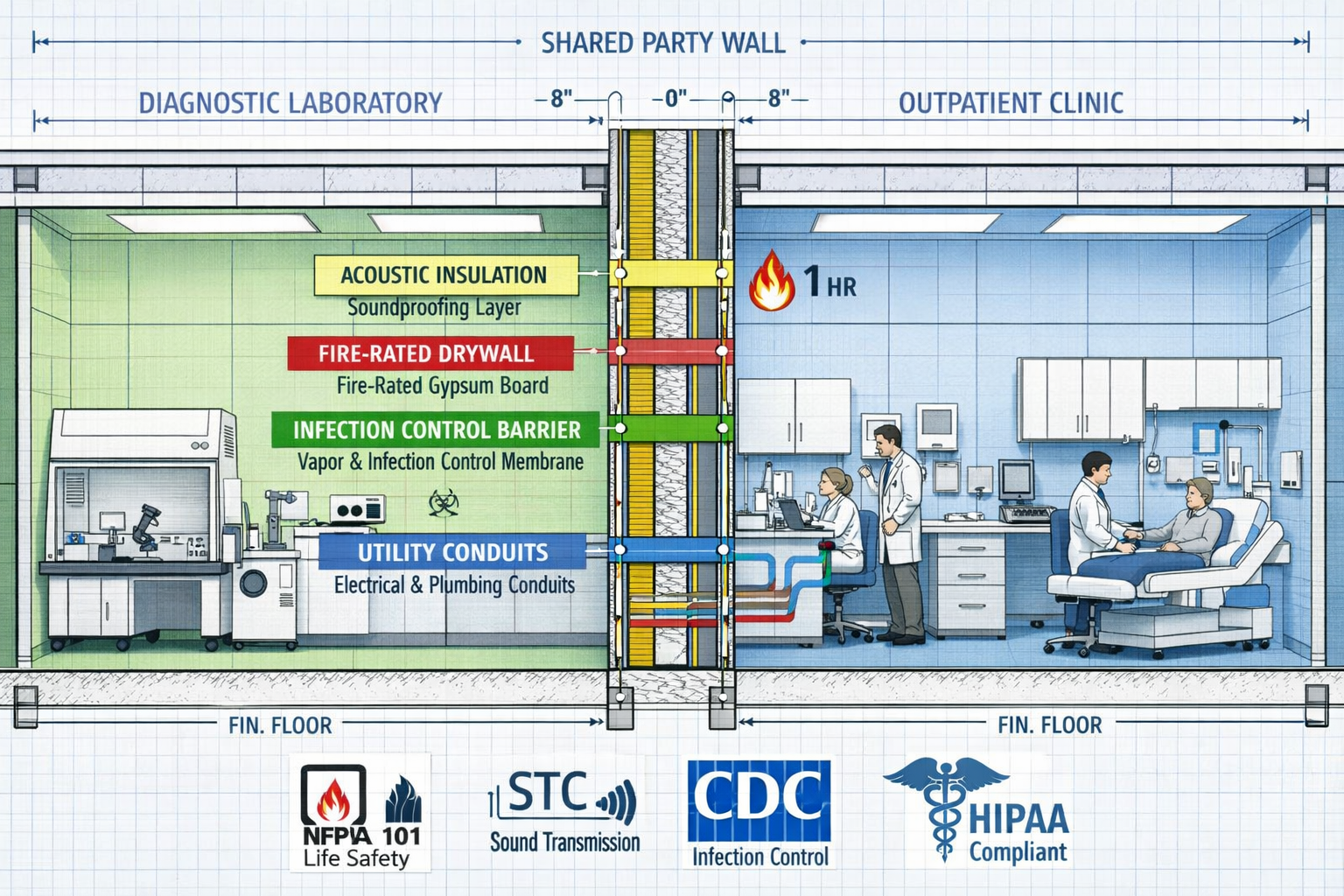
Party wall agreements govern the rights and responsibilities of property owners who share a common wall, boundary, or structure. In healthcare settings, these agreements take on additional complexity that standard commercial arrangements simply don't address. Unlike a shared wall between two retail stores or office spaces, healthcare facility party walls must account for:
- Infection control barriers that prevent cross-contamination between clinical spaces
- Vibration sensitivity for diagnostic equipment like MRI machines and laboratory instruments
- Sound transmission requirements that protect patient privacy and HIPAA compliance
- Emergency access considerations for fire safety and evacuation protocols
- Utility infrastructure including medical gas lines, specialized HVAC systems, and backup power
- Regulatory inspection access for health department and accreditation surveyors
The types of party wall works that healthcare facilities undertake often involve modifications that would be routine in other commercial settings but require extraordinary precautions in medical environments. For instance, drilling into a shared wall to install mounting brackets might seem straightforward, but in a healthcare facility, it could potentially compromise infection control barriers, disturb asbestos-containing materials in older buildings, or create dust that violates clean room standards in adjacent laboratory spaces.
The Legal Framework for Healthcare Facility Boundaries
Healthcare facility party wall agreements operate within a complex legal landscape that extends beyond traditional property law. In 2026, healthcare real estate compliance has become increasingly rigorous, with hospital systems and independent practices alike prioritizing formal documentation and fair market value certifications for all real estate arrangements.[1] This heightened focus stems from regulatory scrutiny around the Stark Law and Anti-Kickback Statute, which govern financial relationships in healthcare.
When navigating Healthcare Facility Party Wall Agreements: Navigating Complex Shared Boundaries in Clinic and Lab Construction, property owners must consider:
Regulatory Compliance Layers:
- Federal healthcare fraud and abuse laws
- State medical facility licensing requirements
- Local building codes and health department regulations
- Accreditation standards (Joint Commission, CAP, CLIA)
- Environmental health and safety regulations
The Party Wall etc. Act 1996 provides the foundational legal framework in the UK, but healthcare facilities must layer additional protections and provisions onto this baseline. A comprehensive party wall agreement template for healthcare use should incorporate medical facility-specific clauses that standard commercial agreements lack.
Key Stakeholders in Healthcare Party Wall Agreements
Successfully navigating Healthcare Facility Party Wall Agreements: Navigating Complex Shared Boundaries in Clinic and Lab Construction requires coordination among diverse stakeholders, each bringing specialized expertise:
| Stakeholder | Primary Concerns | Critical Contributions |
|---|---|---|
| Healthcare Facility Owner | Patient safety, operational continuity, regulatory compliance | Clinical requirements, equipment specifications, operational protocols |
| Adjacent Property Owner | Property value, minimal disruption, legal protection | Access agreements, damage prevention, compensation terms |
| Party Wall Surveyor | Fair assessment, technical accuracy, dispute resolution | Structural evaluation, condition documentation, award preparation |
| Healthcare Architect | Infection control, patient flow, regulatory compliance | Design specifications, containment strategies, code compliance |
| Medical Equipment Specialist | Equipment protection, calibration maintenance, operational continuity | Vibration tolerance, power requirements, environmental controls |
| Infection Control Officer | Patient safety, contamination prevention, regulatory compliance | ICRA protocols, barrier requirements, monitoring procedures |
| Legal Counsel | Regulatory compliance, liability protection, contract enforceability | Stark Law compliance, indemnification clauses, dispute mechanisms |
This multi-disciplinary approach distinguishes healthcare party wall agreements from standard commercial arrangements. While a party wall surveyor provides essential technical expertise, healthcare projects benefit from surveyors who understand medical facility requirements and can coordinate effectively with clinical stakeholders.
Critical Components of Healthcare Facility Party Wall Agreements
Infection Control Risk Assessment (ICRA) Integration
One of the most distinctive aspects of Healthcare Facility Party Wall Agreements: Navigating Complex Shared Boundaries in Clinic and Lab Construction is the mandatory integration of Infection Control Risk Assessment (ICRA) protocols. Any construction or renovation work near patient care areas requires a formal ICRA that evaluates the risk of spreading infectious agents through airborne particles, water system disruption, or compromised barriers.
In 2026, modular temporary hard wall systems have become the standard for healthcare renovations, replacing traditional plastic containment methods.[3] These precision-fit, airtight systems maintain stable pressure during negative-air operation, which is critical when party wall work occurs adjacent to occupied clinical spaces. The party wall agreement should explicitly address:
ICRA Requirements in Party Wall Agreements:
- 🔒 Containment specifications – Type and placement of temporary barriers during construction
- 💨 Air pressure management – Negative pressure requirements and monitoring protocols
- 🧹 Dust control measures – HEPA filtration, cleaning protocols, and particle monitoring
- 🚧 Access restrictions – Designated pathways that avoid patient care areas
- 📊 Monitoring and documentation – Air quality testing, pressure differential logs, compliance records
The agreement should specify which party bears responsibility for ICRA compliance costs and implementation. Typically, the building owner initiating the work assumes these obligations, but when both facilities share responsibility for the party wall modification, cost-sharing arrangements must be clearly documented.
Modern temporary wall systems allow healthcare facilities to reconfigure quickly without slowing projects,[3] which is particularly valuable when party wall work requires phased construction to maintain clinical operations. The agreement should outline the construction sequencing and any operational accommodations required to protect patient safety.
Structural and Engineering Specifications
Healthcare facilities often house heavy, vibration-sensitive equipment that makes structural considerations paramount in party wall agreements. Diagnostic imaging equipment, laboratory centrifuges, and surgical robots can weigh thousands of pounds and require extremely stable foundations with minimal vibration transmission.
When drafting Healthcare Facility Party Wall Agreements: Navigating Complex Shared Boundaries in Clinic and Lab Construction, engineering specifications should address:
Structural Performance Criteria:
- Load-bearing capacity – Current and projected equipment weights, including future expansion
- Vibration isolation – Transmission limits for sensitive equipment (often measured in micrometers)
- Sound transmission class (STC) – Acoustic performance requirements for patient privacy (typically STC 50-60 for medical facilities)
- Fire resistance rating – Required fire separation between occupancies (often 2-hour rated for healthcare)
- Seismic performance – Enhanced requirements for equipment anchorage and structural integrity
A qualified structural engineer should evaluate the existing party wall condition and proposed modifications. The schedule of condition becomes especially important in healthcare settings, as it documents the pre-construction state of both the structural elements and any sensitive medical equipment that could be affected by vibration or movement during construction.
For laboratory facilities, precision requirements are even more stringent. Analytical balances used in clinical chemistry can detect vibrations from footsteps in adjacent rooms, and electron microscopes require isolation from even minor building movements. Party wall agreements for lab facilities should include vibration monitoring protocols and remediation triggers if construction activities exceed acceptable thresholds.
Utility Infrastructure and Service Continuity
Healthcare facilities depend on uninterrupted utility services to maintain patient safety and regulatory compliance. Party walls in medical buildings often contain or support critical infrastructure including:
- Medical gas lines (oxygen, nitrous oxide, medical air, vacuum)
- Emergency power circuits and backup generator connections
- Specialized HVAC systems with precise temperature and humidity control
- Data and communication networks for electronic health records
- Water supply lines for sterile processing and laboratory operations
- Waste disposal systems including regulated medical waste
The party wall agreement must comprehensively address service continuity during any construction or modification work. This includes:
Utility Protection Provisions:
- 📍 Detailed utility mapping – Precise location of all services within or adjacent to the party wall
- ⚠️ Service disruption protocols – Advance notice requirements, timing restrictions, backup provisions
- 🔧 Temporary service arrangements – Alternative supply during modifications or repairs
- 🛡️ Protection measures – Physical barriers, monitoring systems, emergency shutdown procedures
- ✅ Testing and commissioning – Verification protocols before returning modified systems to service
Healthcare facilities cannot simply shut down for construction like other commercial properties. A diagnostic laboratory processing time-sensitive specimens or a dialysis center treating patients on fixed schedules requires meticulous planning to ensure party wall work doesn't compromise clinical operations. The agreement should specify acceptable work hours, which may be limited to nights, weekends, or specific low-census periods.
Regulatory Compliance and Documentation Requirements
In 2026, healthcare systems are placing unprecedented emphasis on formal documentation and compliance for all real estate arrangements.[1] This regulatory rigor extends to party wall agreements, which must satisfy multiple oversight bodies:
Regulatory Documentation Requirements:
- Fair Market Value (FMV) certification – Independent valuation of any financial arrangements or property exchanges
- Stark Law compliance – Documentation that arrangements don't constitute prohibited referral relationships
- Anti-Kickback Statute compliance – Evidence that agreements reflect legitimate business purposes
- State licensing authority approval – Notification or approval for modifications affecting licensed space
- Accreditation body notification – Advance notice to Joint Commission, CAP, or other accreditors
- Local health department permits – Construction permits specific to healthcare occupancies
Understanding party wall act notices and how to respond becomes more complex when healthcare regulations overlay traditional party wall procedures. The standard notice periods may need extension to allow time for regulatory review and approval processes.
For healthcare facilities involved in joint ventures or physician-hospital arrangements, party wall agreements may require legal review to ensure they don't create compliance risks. Even seemingly straightforward shared maintenance agreements could potentially be scrutinized as disguised compensation arrangements if not properly structured and documented.
Specialized Challenges in Clinic and Laboratory Construction
Outpatient Clinic Expansion and Shared Boundaries
The healthcare landscape in 2026 shows strong demand for outpatient facilities, with health systems increasingly converting retail spaces and other non-traditional locations into state-of-the-art healthcare facilities.[6] This trend creates unique party wall scenarios as medical practices move into shopping centers, office buildings, and mixed-use developments where they share walls with non-medical tenants.
When navigating Healthcare Facility Party Wall Agreements: Navigating Complex Shared Boundaries in Clinic and Lab Construction for outpatient clinics, several specialized concerns arise:
Clinic-Specific Party Wall Considerations:
🏥 Patient Privacy and HIPAA Compliance
- Sound transmission must prevent conversation overhearing between spaces
- Waiting areas require acoustic separation from examination rooms
- Telehealth consultation rooms need enhanced sound isolation
- Reception areas must protect patient check-in conversations
🚑 Emergency Access and Egress
- Clear evacuation routes that don't depend on adjacent property cooperation
- Emergency vehicle access for patient transport
- Separate entrances for ambulatory and wheelchair-dependent patients
- After-hours access that doesn't disturb neighboring tenants
💉 Infection Control Boundaries
- Separate HVAC systems to prevent cross-contamination with non-medical spaces
- Controlled access points to prevent unauthorized entry from shared areas
- Waste handling that isolates regulated medical waste from general building refuse
- Hand hygiene stations positioned to prevent contamination spread
⚕️ Medical Equipment Installation
- Wall-mounted examination equipment requiring structural reinforcement
- Diagnostic imaging equipment with radiation shielding requirements
- Dental equipment with specialized plumbing and compressed air needs
- Procedure room equipment requiring dedicated electrical circuits
The guide on boundary wall rules and differences between party fence walls and boundary walls provides foundational understanding, but clinic settings require additional layers of consideration around patient care requirements.
Laboratory Facilities and Precision Requirements
Diagnostic laboratories and research facilities present some of the most demanding party wall scenarios in healthcare construction. These facilities combine stringent regulatory requirements with extreme sensitivity to environmental conditions, making party wall agreements particularly critical.
Clinical laboratories must maintain CLIA (Clinical Laboratory Improvement Amendments) certification, which requires demonstrating environmental controls that ensure accurate test results. Party wall work that compromises temperature stability, introduces vibration, or creates dust contamination can invalidate test runs and require expensive recalibration.
Laboratory-Specific Party Wall Challenges:
🔬 Environmental Control Requirements
- Temperature stability within ±1°C for many analytical instruments
- Humidity control to prevent reagent degradation and static electricity
- Vibration isolation for mass spectrometers and electron microscopes
- Electromagnetic interference shielding for sensitive electronics
🧪 Contamination Prevention
- HEPA filtration and positive pressure in clean rooms
- Negative pressure in microbiology and molecular testing areas
- Separate ventilation systems that don't share air with adjacent spaces
- Dust control during construction that meets ISO clean room standards
⚗️ Chemical Safety and Storage
- Fire-rated separation for chemical storage areas
- Ventilation systems that prevent fume migration to adjacent spaces
- Spill containment that doesn't allow liquids to penetrate party walls
- Hazardous waste handling that isolates materials from shared areas
📊 Quality Control Documentation
- Environmental monitoring data showing stable conditions during party wall work
- Equipment calibration records demonstrating no impact from construction
- Incident reports for any environmental excursions
- Validation protocols for resuming testing after construction completion
Laboratory party wall agreements should include environmental monitoring provisions that establish baseline conditions before work begins and require continuous monitoring during construction. If conditions exceed acceptable parameters, work must stop immediately until remediation measures are implemented.
Converting Retail and Non-Medical Spaces
A growing trend in 2026 involves converting vacant retail spaces into healthcare facilities,[6] which creates unique party wall scenarios. These conversions often involve shared walls with active retail tenants, restaurants, or entertainment venues—uses that are fundamentally incompatible with healthcare operations without careful planning.
Retail-to-Healthcare Conversion Challenges:
When a former clothing store becomes a medical clinic, or a defunct restaurant transforms into a physical therapy center, party wall agreements must address the dramatic change in use requirements:
- Noise incompatibility – Restaurants, gyms, and entertainment venues generate noise levels incompatible with healthcare
- Odor migration – Food service and retail operations can create odors that penetrate shared walls
- Operating hours conflicts – Late-night venues may disturb early-morning medical operations
- Parking and access competition – Healthcare patients need accessible parking that retail customers may occupy
- Building system capacity – Medical use requires HVAC, electrical, and plumbing capacity beyond retail standards
The party wall agreement should establish performance standards that the non-medical tenant must maintain, such as maximum noise levels measured at the shared wall, restrictions on high-odor activities, and coordination of loading dock usage for medical supply deliveries.
For properties where healthcare facilities are moving into multi-tenant buildings, understanding how close a neighbor can build to your fence or boundary becomes relevant when future adjacent tenant improvements might impact the medical facility's operations.
The Party Wall Agreement Process for Healthcare Facilities

Initial Assessment and Professional Team Assembly
Successfully navigating Healthcare Facility Party Wall Agreements: Navigating Complex Shared Boundaries in Clinic and Lab Construction begins with comprehensive initial assessment and assembling the right professional team. This process differs significantly from standard commercial party wall procedures.
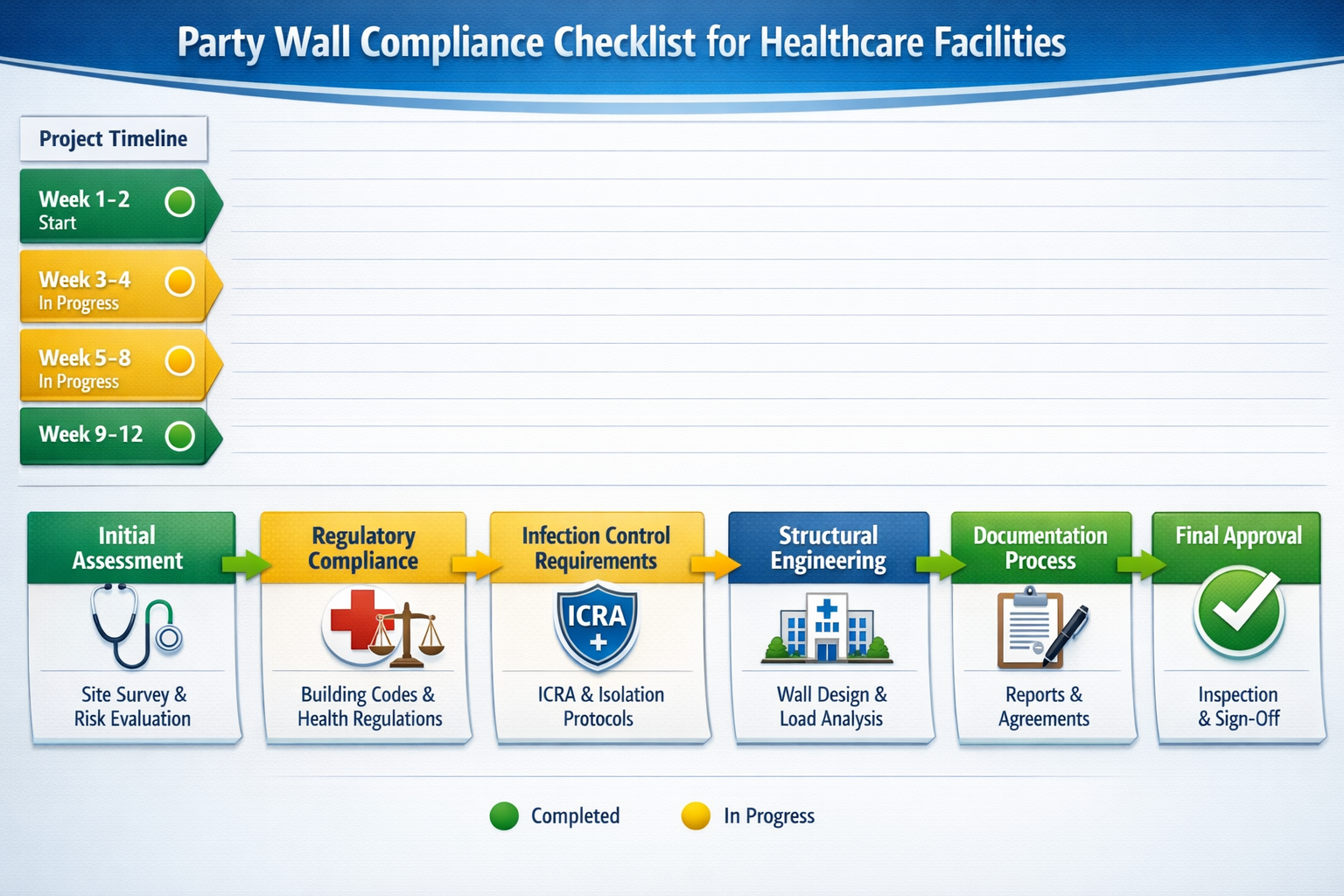
Phase 1: Preliminary Evaluation (Weeks 1-2)
The healthcare facility owner should begin by conducting a preliminary assessment that identifies:
- ✅ Exact location and extent of shared boundaries
- ✅ Current use of adjacent spaces and potential compatibility issues
- ✅ Existing party wall condition and any previous modifications
- ✅ Regulatory requirements specific to the planned healthcare use
- ✅ Equipment and infrastructure needs that may affect party wall design
This assessment should involve a site visit with key stakeholders including the healthcare facility administrator, project architect, and ideally a party wall surveyor with healthcare experience. The team should review existing building documentation, previous party wall agreements if any exist, and regulatory requirements for the intended medical use.
Phase 2: Professional Team Selection (Weeks 2-4)
Healthcare party wall projects require specialized expertise. The professional team should include:
- Party Wall Surveyor – Preferably with healthcare facility experience who understands medical equipment requirements and infection control protocols
- Healthcare Architect – Licensed professional experienced in medical facility design and regulatory compliance
- Structural Engineer – Qualified to evaluate medical equipment loads and vibration requirements
- MEP Engineer – Specialist in medical facility mechanical, electrical, and plumbing systems
- Infection Control Consultant – Professional who can develop ICRA protocols and containment specifications
- Healthcare Real Estate Attorney – Legal counsel familiar with Stark Law, Anti-Kickback Statute, and healthcare compliance
While it's possible to proceed with having a party wall agreement without a surveyor in simple residential scenarios, healthcare facilities should virtually always engage qualified professionals due to the complexity and regulatory implications.
Notice Procedures and Neighbor Coordination
Healthcare facility party wall projects must follow proper notice procedures while also addressing the unique concerns of medical neighbors. Standard party wall notice periods may need extension to accommodate healthcare-specific review processes.
Notice Timeline for Healthcare Projects:
-
Pre-Notice Consultation (Week 4-6) – Before formal notices, conduct informal discussions with adjacent property owners to explain the project scope, healthcare requirements, and anticipated impacts. This early engagement often prevents disputes and facilitates cooperation.
-
Formal Notice Service (Week 6) – Serve proper party wall notices according to statutory requirements, but include additional healthcare-specific information such as infection control measures, equipment protection protocols, and operational continuity plans.
-
Response Period (Weeks 6-8) – Allow the standard response period, but be prepared for adjacent healthcare facilities to request extended time for internal review with their infection control, facilities, and legal teams.
-
Surveyor Appointment (Weeks 8-10) – If the adjoining owner consents, work can proceed under an agreed-upon framework. If they dissent or don't respond, surveyors must be appointed to prepare a party wall award.
When the adjacent property is also a healthcare facility, coordination becomes even more critical. Both facilities must protect patient safety and maintain operations, which may require:
- Coordinated construction schedules that avoid simultaneous disruptive activities
- Shared infection control protocols that protect both facilities
- Joint emergency response plans in case construction creates unexpected hazards
- Communication protocols for real-time coordination during construction
Understanding what a party structure notice is and how to serve it provides the procedural foundation, but healthcare projects benefit from enhanced communication beyond minimum legal requirements.
Drafting Healthcare-Specific Agreement Provisions
While a free sample party wall agreement template provides a useful starting point, healthcare facility agreements require substantial customization. The agreement should comprehensively address medical facility-specific concerns through detailed provisions.
Essential Healthcare Party Wall Agreement Clauses:
📋 Scope of Work Description
- Detailed construction plans including all party wall modifications
- Equipment installation specifications with weights and vibration characteristics
- Infrastructure modifications including utility relocations or additions
- Timeline with phasing to minimize operational disruption
🛡️ Infection Control Provisions
- ICRA protocol requirements and approval process
- Temporary barrier specifications and installation standards
- Air quality monitoring and acceptable parameters
- Dust control measures and cleaning protocols
- Work stoppage triggers if contamination occurs
🔊 Noise and Vibration Limits
- Maximum noise levels during construction (typically 65-70 dBA in healthcare areas)
- Vibration limits for sensitive equipment protection (often 50-100 μm/s)
- Restricted work hours to protect patient care activities
- Monitoring protocols and remediation requirements
⚡ Utility Service Protection
- Detailed utility mapping and protection measures
- Service disruption notice requirements (typically 72 hours minimum)
- Backup provision requirements during planned outages
- Emergency response protocols for unplanned disruptions
- Testing and commissioning procedures before service restoration
💰 Cost Allocation and Payment
- Clear allocation of construction costs, surveyor fees, and professional consultants
- Responsibility for infection control measures and monitoring
- Payment terms and security deposits
- Cost overrun provisions and change order procedures
⚖️ Indemnification and Insurance
- Liability allocation for construction-related damages
- Insurance requirements including professional liability and pollution coverage
- Patient safety incident protocols and reporting requirements
- Regulatory compliance responsibility and penalty allocation
🔍 Access and Inspection Rights
- Construction access provisions that maintain security and infection control
- Inspection rights for condition monitoring and compliance verification
- Regulatory inspector access coordination
- Emergency access provisions
The agreement should explicitly address regulatory compliance responsibility, making clear which party bears the obligation to obtain necessary permits, maintain required certifications, and respond to any regulatory violations that arise from the party wall work.
The Party Wall Award in Healthcare Settings
When adjoining owners cannot reach agreement, or when statutory procedures require it, a formal party wall award becomes necessary. Healthcare facility awards require specialized provisions beyond standard commercial awards.
A comprehensive party wall contract template and guide on party wall awards explains the general framework, but healthcare awards should include:
Healthcare-Specific Award Provisions:
- Detailed condition schedule documenting not just structural elements but also medical equipment, environmental controls, and operational systems that could be affected
- Performance specifications for the completed work, including vibration limits, acoustic performance, and environmental stability
- Monitoring requirements during construction with specific parameters and reporting frequency
- Work restrictions including prohibited hours, noise limits, and infection control requirements
- Remediation protocols if work causes damage or operational disruption
- Dispute resolution procedures with expedited timelines given healthcare operational urgency
The appointed surveyors should have healthcare facility experience or consult with medical facility experts when preparing the award. Standard surveyor expertise in structural assessment must be supplemented with understanding of medical equipment requirements, infection control protocols, and healthcare regulatory compliance.
For complex healthcare projects, consider appointing a building owner's surveyor and an adjoining owner's surveyor who can work collaboratively to address the unique technical challenges while protecting their respective clients' interests.
Cost Considerations and Financial Planning
Understanding Healthcare Party Wall Agreement Costs
The financial implications of Healthcare Facility Party Wall Agreements: Navigating Complex Shared Boundaries in Clinic and Lab Construction extend well beyond standard commercial party wall costs. Healthcare facilities must budget for additional expenses related to regulatory compliance, infection control, and operational continuity.
Typical Cost Components:
| Cost Category | Standard Commercial | Healthcare Facility | Cost Increase Factor |
|---|---|---|---|
| Surveyor Fees | £1,500-£3,000 | £3,000-£7,500 | 2-2.5x |
| Legal Review | £1,000-£2,500 | £3,500-£8,000 | 3-3.5x |
| Structural Engineering | £2,000-£4,000 | £4,000-£10,000 | 2-2.5x |
| Condition Documentation | £500-£1,500 | £2,000-£5,000 | 3-4x |
| Infection Control Measures | Not applicable | £5,000-£25,000 | N/A |
| Environmental Monitoring | Not applicable | £2,000-£8,000 | N/A |
| Temporary Barriers/Containment | £1,000-£3,000 | £8,000-£30,000 | 8-10x |
| Regulatory Compliance Documentation | £500-£1,000 | £3,000-£10,000 | 6-10x |
These figures represent typical ranges for moderate-complexity projects in 2026. Large-scale healthcare facility expansions or complex laboratory renovations can significantly exceed these estimates.
The higher costs reflect the specialized expertise required and the additional measures necessary to protect patient safety and maintain regulatory compliance. However, these upfront investments typically prevent far more expensive problems such as:
- Regulatory violations that could result in facility closure or license suspension
- Operational disruptions that force patient care interruptions
- Equipment damage requiring expensive recalibration or replacement
- Contamination events necessitating extensive remediation
- Legal disputes arising from inadequate planning or documentation
Understanding how to keep party wall costs down remains relevant for healthcare facilities, but cost reduction strategies must never compromise patient safety or regulatory compliance.
Budgeting for Compliance and Contingencies
Healthcare facility owners should develop comprehensive budgets that account for the full scope of party wall agreement costs, including contingencies for unexpected complications.
Recommended Budget Allocation:
💵 Professional Services (25-35% of total party wall budget)
- Party wall surveyors
- Healthcare architects and engineers
- Infection control consultants
- Legal counsel
- Regulatory compliance specialists
🔨 Construction and Protection Measures (40-50%)
- Actual party wall construction or modification work
- Temporary containment and barrier systems
- Infection control measures
- Equipment protection and relocation
- Utility service continuity provisions
📊 Monitoring and Documentation (10-15%)
- Environmental monitoring during construction
- Vibration and noise monitoring
- Photographic and video documentation
- Compliance reporting and record-keeping
🚨 Contingency Reserve (15-20%)
- Unexpected conditions discovered during work
- Extended construction timelines
- Additional infection control measures
- Dispute resolution costs
- Regulatory compliance issues
Healthcare facilities should maintain a contingency reserve of 15-20% of the total party wall budget, compared to the 10% typical for commercial projects. The additional contingency reflects the higher risk of complications in medical environments and the critical importance of maintaining operations.
The costs of party wall processes in healthcare settings justify careful upfront planning and professional guidance. Attempting to minimize costs by skipping essential steps or using inadequately qualified professionals often results in far greater expenses when problems arise.
Fair Market Value and Compliance Considerations
In 2026, healthcare organizations face heightened scrutiny around fair market value (FMV) certifications for all real estate arrangements.[1] This regulatory focus extends to party wall agreements, particularly when they involve financial arrangements between healthcare entities or between healthcare providers and potential referral sources.
FMV Compliance Requirements:
When Healthcare Facility Party Wall Agreements: Navigating Complex Shared Boundaries in Clinic and Lab Construction involve any of the following scenarios, FMV certification may be required:
- ✅ Cost-sharing arrangements between a hospital and physician-owned practice
- ✅ Property exchanges or modifications involving potential referral relationships
- ✅ Shared facility arrangements between entities with financial relationships
- ✅ Party wall work that creates value for one party at another's expense
Healthcare organizations should engage independent valuation professionals to certify that any financial terms in party wall agreements reflect fair market value and don't constitute disguised compensation or inducements for referrals. This documentation protects against Stark Law and Anti-Kickback Statute violations that could result in severe penalties.
The agreement should explicitly state that all financial arrangements reflect commercially reasonable terms that would be acceptable to parties in an arm's-length transaction without consideration of referral relationships. Legal counsel familiar with healthcare fraud and abuse laws should review agreements before execution.
Risk Mitigation and Dispute Prevention
Proactive Strategies for Avoiding Party Wall Disputes
Healthcare facilities have compelling reasons to prevent party wall disputes rather than resolve them after they arise. Patient care cannot wait for legal proceedings, and regulatory agencies don't excuse compliance failures due to neighbor disagreements.
Dispute Prevention Best Practices:
🤝 Early and Transparent Communication
- Begin neighbor discussions well before formal notice requirements
- Explain healthcare-specific requirements and their importance for patient safety
- Listen to neighbor concerns and address them proactively in planning
- Maintain regular communication throughout the project
📋 Comprehensive Documentation
- Document all communications, agreements, and decisions in writing
- Maintain detailed photographic and video records of pre-construction conditions
- Create clear project timelines with milestones and completion dates
- Establish written protocols for addressing concerns or complaints
👷 Professional Project Management
- Engage experienced construction managers familiar with healthcare projects
- Implement rigorous quality control and inspection procedures
- Maintain strict adherence to infection control and safety protocols
- Respond immediately to any issues or neighbor complaints
🔍 Ongoing Monitoring and Reporting
- Conduct regular inspections of party wall condition during construction
- Monitor environmental parameters (noise, vibration, air quality) continuously
- Provide regular progress reports to adjoining owners
- Document compliance with all agreement terms and regulatory requirements
When neighbors are carrying out works that affect your healthcare facility, similar proactive engagement protects your interests and ensures your operational needs are considered.
Addressing Common Healthcare Party Wall Conflicts
Despite best efforts, disputes can arise in Healthcare Facility Party Wall Agreements: Navigating Complex Shared Boundaries in Clinic and Lab Construction. Understanding common conflict scenarios helps facilities prepare effective responses.
Common Dispute Scenarios and Resolutions:
⚠️ Construction Noise Exceeding Acceptable Levels
- Issue: Party wall work creates noise that disrupts patient care or violates local ordinances
- Prevention: Establish clear noise limits in the agreement with monitoring requirements
- Resolution: Implement additional sound dampening, restrict work to specific hours, or use quieter construction methods
🌡️ Environmental Condition Disruption
- Issue: Construction affects temperature, humidity, or air quality in adjacent medical spaces
- Prevention: Require continuous environmental monitoring with automatic work stoppage triggers
- Resolution: Enhanced containment measures, temporary environmental control systems, or construction sequencing changes
💥 Vibration Affecting Medical Equipment
- Issue: Party wall work causes vibration that damages equipment or invalidates test results
- Prevention: Establish vibration limits based on equipment manufacturer specifications with real-time monitoring
- Resolution: Vibration isolation measures, equipment relocation during critical work phases, or construction method modifications
🚧 Access and Security Concerns
- Issue: Construction workers require access through secure healthcare areas
- Prevention: Designate specific access routes and times with escort requirements
- Resolution: Alternative access arrangements, enhanced security measures, or modified construction logistics
💰 Cost Overruns and Payment Disputes
- Issue: Unexpected conditions increase costs beyond original estimates
- Prevention: Include detailed change order procedures and contingency allocations in agreement
- Resolution: Independent cost assessment, mediation of disputed charges, or third-party arbitration
The agreement should include expedited dispute resolution procedures that recognize the time-sensitive nature of healthcare operations. Standard litigation timelines are often incompatible with medical facility needs, making mediation or arbitration provisions essential.
Insurance and Liability Protection
Healthcare party wall projects require specialized insurance coverage that addresses both construction risks and medical facility-specific exposures.
Essential Insurance Coverage:
🏥 Healthcare Facility Owner Should Maintain:
- Commercial general liability with healthcare operations endorsement
- Property insurance covering medical equipment and specialized systems
- Business interruption insurance covering operational disruptions
- Professional liability insurance for medical staff and operations
- Cyber liability insurance protecting patient data during construction
🔨 Building Owner/Contractor Should Maintain:
- Commercial general liability with healthcare facility operations endorsement
- Builder's risk insurance covering construction and materials
- Professional liability insurance for design professionals
- Pollution liability insurance for contamination risks
- Workers' compensation insurance
The party wall agreement should specify minimum insurance limits and require each party to name the other as an additional insured. For healthcare projects, general liability limits of £5-10 million are typically appropriate, compared to £2-5 million for standard commercial projects.
Certificate of insurance should be provided before work begins, and the agreement should require advance notice if coverage lapses or changes. Healthcare facilities should verify that contractor insurance includes healthcare facility operations endorsements, as standard commercial policies may exclude medical facility work.
Future-Proofing Healthcare Party Wall Agreements
Planning for Facility Evolution and Technology Changes
Healthcare facilities evolve rapidly as medical technology advances and care delivery models change. Party wall agreements should anticipate future modifications rather than requiring complete renegotiation for every change.
Future-Proofing Strategies:
🔮 Flexible Use Provisions
- Allow for reasonable modifications to accommodate new medical equipment
- Establish pre-approved modification categories that don't require new agreements
- Include provisions for emerging technologies and treatment modalities
- Address potential changes in regulatory requirements
📈 Expansion and Modification Rights
- Grant specific rights for future vertical or horizontal expansion
- Establish procedures for requesting additional party wall modifications
- Include pre-negotiated cost allocation formulas for future work
- Address potential changes in building ownership or use
🔄 Technology Infrastructure Accommodation
- Anticipate increasing data and power requirements for medical technology
- Allow for reasonable utility infrastructure upgrades
- Address emerging technologies like telemedicine and remote monitoring
- Include provisions for renewable energy and sustainability improvements
The agreement should distinguish between minor modifications that can proceed with simple notification and major modifications that require formal approval and potentially new agreements. Clear criteria prevent disputes about whether proposed changes fall within existing agreement scope.
Sustainability and Environmental Considerations
Healthcare facilities in 2026 increasingly prioritize environmental sustainability while maintaining rigorous infection control and patient safety standards. Party wall agreements should address sustainability considerations that may affect shared boundaries.
Sustainable Healthcare Facility Provisions:
♻️ Energy Efficiency Improvements
- Party wall insulation upgrades to reduce energy consumption
- Installation of renewable energy systems that may affect shared structures
- High-efficiency HVAC systems with modified ventilation requirements
- LED lighting and electrical system upgrades
💧 Water Conservation Measures
- Low-flow plumbing fixtures and water recycling systems
- Rainwater harvesting systems that may require structural modifications
- Greywater systems with specialized plumbing infrastructure
🌱 Green Building Certifications
- LEED for Healthcare or similar certification requirements
- Material selection criteria for shared wall components
- Indoor air quality standards exceeding minimum requirements
- Waste reduction and recycling during construction
Sustainability improvements must never compromise infection control or patient safety, but well-designed green building features can enhance healthcare facility performance while reducing environmental impact. The party wall agreement should establish how sustainability initiatives affecting shared boundaries will be evaluated and approved.
Regulatory Trend Anticipation
Healthcare regulation continues evolving, and party wall agreements should include provisions that accommodate regulatory changes without requiring complete renegotiation.
Regulatory Flexibility Provisions:
The agreement should acknowledge that healthcare facilities must comply with evolving regulations and include mechanisms for:
- 📜 Implementing new infection control requirements as standards evolve
- 🔍 Accommodating new accreditation standards from Joint Commission or other bodies
- ⚖️ Responding to updated building codes and life safety requirements
- 🏛️ Complying with new privacy and security regulations affecting facility design
A well-drafted agreement includes language such as: "The parties acknowledge that healthcare facilities must comply with evolving regulatory requirements. Reasonable modifications to party wall arrangements necessary for regulatory compliance shall be permitted with advance notice and good-faith cost negotiation."
This flexibility prevents situations where regulatory compliance becomes impossible due to restrictive party wall agreement terms, while still protecting both parties' legitimate interests.
Conclusion: Building Strong Foundations for Healthcare Facility Success
Successfully navigating Healthcare Facility Party Wall Agreements: Navigating Complex Shared Boundaries in Clinic and Lab Construction requires a sophisticated approach that integrates traditional property law with healthcare-specific requirements. As the healthcare construction sector continues its robust growth in 2026, with non-hospital facilities showing 24% net demand, the importance of properly structured party wall agreements will only increase.
The unique challenges of healthcare party walls—from infection control requirements to regulatory compliance obligations—demand specialized expertise and proactive planning. Healthcare facility owners who invest in comprehensive agreements, qualified professional teams, and thorough documentation protect not only their property interests but also their fundamental mission of providing safe, high-quality patient care.
Key Success Factors 🎯
Professional Expertise: Engage party wall surveyors, architects, engineers, and legal counsel with specific healthcare facility experience who understand the intersection of property law and medical regulations.
Comprehensive Planning: Address infection control, environmental stability, utility continuity, and regulatory compliance explicitly in party wall agreements rather than assuming standard provisions suffice.
Proactive Communication: Begin neighbor discussions early, maintain transparency throughout the project, and address concerns before they escalate into disputes.
Adequate Budgeting: Allocate sufficient resources for healthcare-specific requirements including infection control measures, environmental monitoring, and compliance documentation.
Future Flexibility: Include provisions that accommodate facility evolution, technology changes, and regulatory updates without requiring complete agreement renegotiation.
Actionable Next Steps 📋
For healthcare facility owners and administrators preparing for party wall projects:
- Conduct a preliminary assessment of your shared boundaries and identify potential party wall scenarios before they become urgent
- Assemble a qualified professional team with healthcare facility experience, including a specialized party wall surveyor
- Review existing agreements if your facility already has party wall arrangements to ensure they address current healthcare requirements
- Develop comprehensive budgets that account for healthcare-specific costs and maintain adequate contingency reserves
- Establish neighbor relationships proactively, even before specific projects arise, to facilitate future cooperation
- Document current conditions thoroughly, including both structural elements and medical equipment that could be affected by future party wall work
- Consult legal counsel familiar with healthcare compliance to ensure agreements satisfy Stark Law and Anti-Kickback Statute requirements
The complexity of Healthcare Facility Party Wall Agreements: Navigating Complex Shared Boundaries in Clinic and Lab Construction should not deter healthcare organizations from pursuing necessary facility improvements. With proper planning, qualified professional guidance, and comprehensive agreements, healthcare facilities can successfully navigate shared boundary challenges while maintaining operational excellence and regulatory compliance.
As healthcare delivery continues evolving toward distributed, community-based care models, the ability to effectively manage party wall relationships will become an increasingly valuable competency for healthcare facility administrators and developers. Those who master these specialized agreements will be well-positioned to expand their facilities, adopt new technologies, and serve their communities effectively while protecting both patient safety and property interests.
References
[1] Healthcare Real Estate Strategy In 2026 Navigating Hospital Growth Outpatient Demand And Compliance Risk – https://lpc.com/insights-research/healthcare-real-estate-strategy-in-2026-navigating-hospital-growth-outpatient-demand-and-compliance-risk/
[3] Temporary Wall Systems The Gold Standard For 2026 Healthcare Renovations – https://www.hepacart.com/blog/temporary-wall-systems-the-gold-standard-for-2026-healthcare-renovations
[6] 4957 Converting Retail Spaces Into Health Care Facilities – https://www.hfmmagazine.com/articles/4957-converting-retail-spaces-into-health-care-facilities