

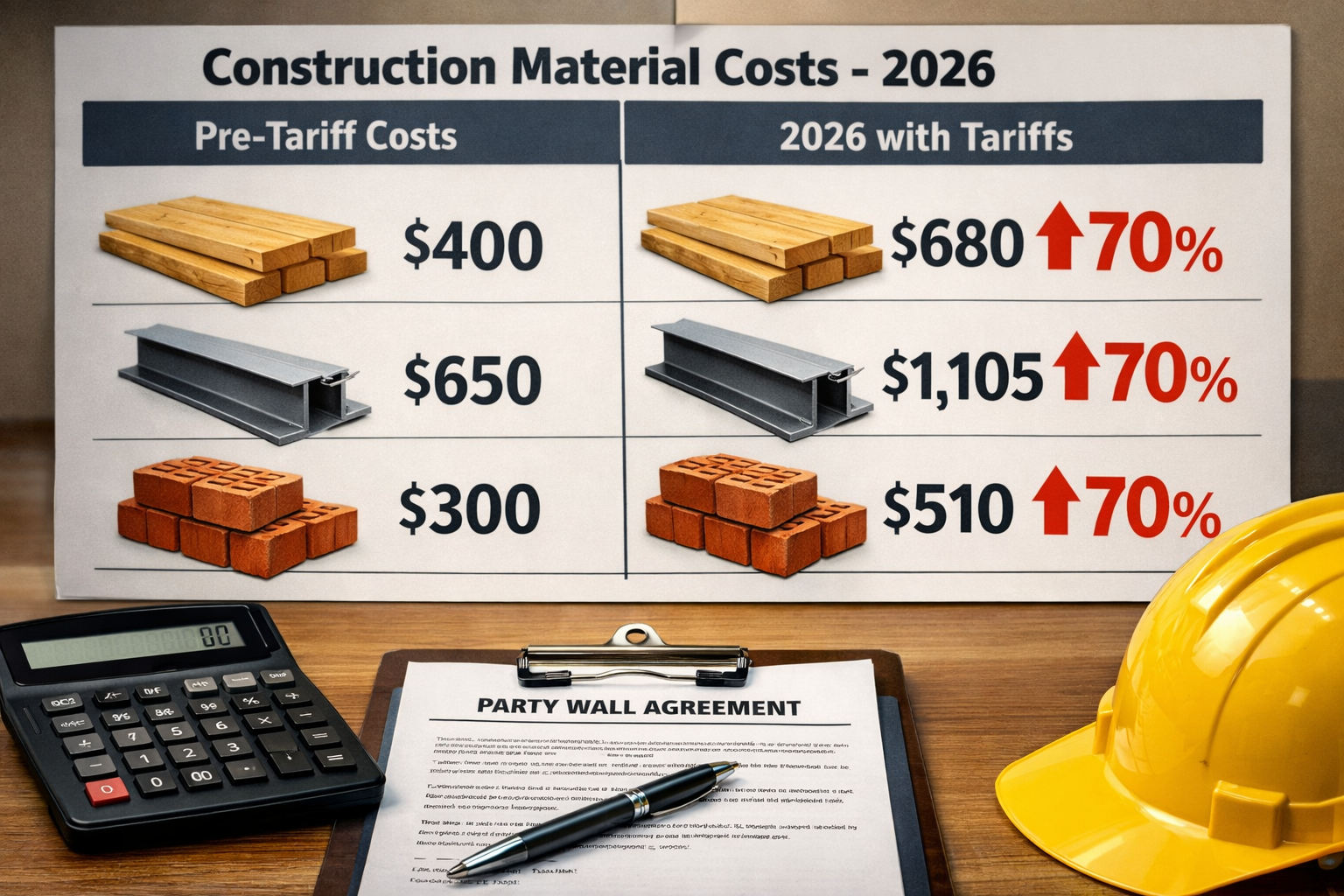
The construction landscape in 2026 presents unprecedented challenges for property owners planning building works. With tariff impacts reaching 70% on essential construction materials and labor shortages affecting 57% of construction projects, navigating tariffs and labor shortages in party wall agreements for 2026 builds has become a critical concern for anyone undertaking work that affects shared boundaries. These economic pressures are fundamentally reshaping how party wall agreements are structured, negotiated, and executed across the United Kingdom.
For property owners planning extensions, loft conversions, or structural alterations that involve party walls, understanding how these external economic factors translate into practical considerations is essential. The traditional party wall process, governed by the Party Wall etc. Act 1996, now requires additional strategic planning to account for fluctuating costs and extended timelines.
Key Takeaways
- 🏗️ Material costs have surged by up to 70% due to 2026 tariffs, significantly impacting party wall work budgets and requiring revised cost estimates
- 👷 Labor shortages affecting 57% of projects are extending party wall work timelines by 3-6 months on average
- 📋 Cost-pass-through clauses in party wall agreements protect building owners from unexpected tariff-related price increases
- ⚡ Expedited surveyor processes can reduce agreement timelines by 30-40%, helping offset labor shortage delays
- 💰 Party wall surveyor fees have increased 3-4% from 2025, with costs now ranging from £750-£1,800 per neighbour
Understanding the 2026 Economic Climate for Party Wall Works
The Tariff Impact on Construction Materials
The tariff landscape in 2026 has dramatically altered the cost structure of construction projects. Import duties on steel, timber, and specialized building materials have increased substantially, with some categories experiencing tariff increases of up to 70%. This unprecedented shift affects every aspect of party wall works, from basic structural repairs to complex foundation underpinning.
Key materials affected by tariffs include:
- Steel beams and reinforcements – 65-70% price increase
- Timber and engineered wood products – 45-55% price increase
- Specialized masonry materials – 40-50% price increase
- Concrete and cement products – 30-40% price increase
- Insulation and damp-proofing materials – 35-45% price increase
These tariff-driven cost increases don't just affect the building owner's budget—they also impact how party wall agreements are structured and what provisions must be included to protect all parties involved.
Labor Shortage Crisis in Construction
The construction industry faces a severe workforce deficit in 2026, with 57% of projects reporting significant labor shortages. This crisis stems from multiple factors: Brexit-related workforce reductions, an aging skilled tradesperson demographic, and insufficient training programs to replace retiring workers.
Impact on party wall projects:
| Challenge | Impact on Timeline | Cost Implication |
|---|---|---|
| Skilled bricklayer shortage | +2-4 weeks | +15-25% labor costs |
| Structural engineer availability | +3-6 weeks | +20-30% professional fees |
| Specialist underpinning teams | +4-8 weeks | +25-40% specialist costs |
| General construction labor | +1-3 weeks | +10-20% overall labor |
These delays cascade through the entire party wall process, affecting when party wall notices can be served, when works can commence, and ultimately when projects can be completed.
Navigating Tariffs and Labor Shortages in Party Wall Agreements for 2026 Builds: Strategic Planning

Early Engagement with Party Wall Surveyors
The compressed timelines and economic uncertainties of 2026 make early surveyor engagement more critical than ever. Property owners should contact party wall surveyors at least 4-6 months before planned works, rather than the traditional 2-3 month window.
Benefits of early engagement:
✅ More accurate cost projections accounting for current tariff rates
✅ Better contractor availability through advance scheduling
✅ Time to negotiate favorable terms in party wall awards
✅ Opportunity to explore cost-saving alternatives before committing to designs
✅ Reduced risk of disputes through thorough preliminary discussions
When engaging surveyors, ensure they have experience with the specific types of party wall works your project requires. Different work types—from simple wall repairs to complex basement excavations—face varying degrees of tariff and labor impact.
Implementing Cost-Pass-Through Clauses
One of the most effective strategies for navigating tariffs and labor shortages in party wall agreements for 2026 builds involves incorporating cost-pass-through clauses into party wall awards. These provisions protect building owners from bearing the full burden of unexpected tariff increases or labor cost spikes that occur between agreement signing and work commencement.
Essential elements of effective cost-pass-through clauses:
- Baseline date establishment – Lock in material costs as of the agreement date
- Tariff adjustment mechanism – Define how tariff increases will be calculated and applied
- Labor cost indexing – Reference industry-standard wage indices for adjustments
- Notification requirements – Specify how and when cost increases must be communicated
- Cap provisions – Set maximum percentage increases to protect against extreme volatility
- Documentation standards – Require proof of actual cost increases from suppliers
These clauses should be clearly articulated in the party wall award document, with specific reference to how costs will be verified and disputed if necessary. Working with experienced surveyors ensures these provisions are legally sound and practically enforceable.
Timeline Flexibility and Contingency Planning
Given that party wall agreements typically last one year from the date signed, the labor shortage crisis requires building owners to build substantial contingency time into their project schedules. A realistic 2026 timeline should include:
Recommended timeline buffers:
- Design phase – Add 2-4 weeks for surveyor availability
- Notice period – Standard 2 months (unchanged by Act requirements)
- Award negotiation – Add 3-6 weeks for complex economic provisions
- Contractor procurement – Add 4-8 weeks for labor availability assessment
- Construction phase – Add 20-30% contingency time for labor delays
- Completion and inspection – Add 2-3 weeks for surveyor scheduling
This extended timeline approach helps ensure that works can be completed within the one-year party wall agreement validity period, avoiding the need for agreement renewal and additional costs.
Cost Management Strategies for 2026 Party Wall Projects

Understanding Updated Surveyor Fee Structures
Party wall surveyor fees have increased 3-4% from 2025, with current rates ranging from £750 to £1,800 per neighbour depending on project complexity and location. Understanding these costs of the party wall process is essential for accurate budgeting.
2026 surveyor fee ranges by project type:
- Simple party wall notice (no structural work) – £750-£950 per neighbour
- Standard extension or loft conversion – £1,000-£1,400 per neighbour
- Complex basement excavation or underpinning – £1,400-£1,800 per neighbour
- Multiple party walls or commercial properties – £2,000+ per neighbour
Building owners should also budget for potential additional costs related to 2026's economic challenges, including extended schedule of condition surveys and multiple site inspections if labor shortages cause project delays.
Negotiating Favorable Terms in Awards
The economic pressures of 2026 create opportunities for creative negotiation in party wall awards. Both building owners and adjoining owners have legitimate interests in ensuring projects proceed efficiently while protecting property values.
Key negotiation points for 2026 agreements:
💡 Phased payment structures – Tie surveyor and contractor payments to completed milestones rather than upfront lump sums
💡 Material substitution provisions – Allow for equivalent alternative materials if tariffs make specified materials prohibitively expensive
💡 Labor flexibility clauses – Permit use of pre-approved alternative contractors if primary contractors become unavailable
💡 Extended working hours – Negotiate weekend or extended weekday hours to compensate for labor shortages (within local planning restrictions)
💡 Shared cost savings – If cost-pass-through clauses result in savings (rare but possible), define how benefits are shared
These provisions should be documented in the party wall contract template or award document, with clear language that all parties understand and accept.
Strategies for Keeping Costs Down
Despite the challenging economic environment, several strategies can help keep party wall costs down in 2026:
Practical cost-reduction approaches:
-
Agreed surveyor appointment – Both parties select a single surveyor rather than appointing separate surveyors, reducing fees by 40-50%
-
Simplified design approaches – Minimize structural complexity where possible to reduce both material costs and specialized labor requirements
-
Material procurement timing – Purchase long-lead-time materials before serving party wall notices to lock in current prices
-
Contractor pre-qualification – Secure contractor commitments early with detailed labor availability assessments
-
Bundled projects – If multiple neighbours are undertaking similar works, explore coordinated approaches to share surveyor costs
-
Digital documentation – Use electronic party wall agreement templates and digital communication to reduce administrative costs
-
Proactive neighbour relations – Early, transparent communication can prevent disputes that escalate costs
Expedited Surveyor Processes for 2026
Streamlining the Notice and Response Period
While the Party Wall etc. Act 1996 mandates specific notice periods that cannot be legally shortened, the response and award preparation phases can be significantly expedited through strategic approaches.
Acceleration strategies:
⚡ Pre-notice consultation – Discuss plans with neighbours before formal notice service to address concerns early
⚡ Complete documentation – Provide comprehensive plans, specifications, and party wall notices at first contact to avoid information requests that delay progress
⚡ Surveyor pre-appointment – Engage your surveyor before serving notices so they're ready to act immediately upon neighbour response
⚡ Digital communication protocols – Establish email and digital document sharing to eliminate postal delays
⚡ Scheduled site visits – Coordinate all required inspections in single visits rather than multiple trips
These approaches can reduce the post-notice timeline by 30-40%, helping offset some of the delays caused by labor shortages.
Leveraging Technology in Party Wall Processes
Modern technology offers opportunities to streamline party wall processes in ways that weren't available even a few years ago:
Digital tools for efficiency:
- 3D modeling and virtual inspections – Reduce need for multiple physical site visits
- Electronic signature platforms – Accelerate award execution and agreement signing
- Project management software – Coordinate multiple parties and track progress in real-time
- Digital cost tracking – Monitor tariff impacts and labor costs against budget baselines
- Cloud-based document sharing – Ensure all parties have immediate access to current plans and agreements
Surveyors who embrace these technologies can deliver faster service while maintaining the thoroughness required by the Act. When selecting a surveyor, inquire about their digital capabilities and willingness to use technology to accelerate processes.
Regional Considerations Across London
Location-Specific Challenges
The impact of tariffs and labor shortages varies across different London regions, with some areas experiencing more acute challenges than others.
Regional variation factors:
North London – Higher concentration of Victorian terraced properties requiring specialized masonry skills; moderate labor availability
South London – Extensive residential development activity creating high demand for contractors; above-average labor shortages
East London – Rapid regeneration areas with mixed property types; competitive contractor market but high demand
West London – Premium property market with higher budgets but also higher labor costs; good surveyor availability
Central London – Complex access issues and premium costs; best surveyor availability but highest fees
Understanding these regional dynamics helps property owners set realistic expectations for both timelines and costs when planning party wall works.
Legal Considerations and Compliance in 2026
Building Safety Act 2022 Amendments
From July 1, 2026, amendments from the Building Safety Act 2022 will implement further building control reforms that intersect with party wall processes. While these changes primarily focus on building safety rather than party wall procedures specifically, they create additional compliance requirements that affect project timelines.
Key compliance considerations:
- Enhanced documentation requirements for structural works
- Additional inspection protocols for party wall works affecting structural integrity
- Revised competency requirements for contractors undertaking party wall works
- Updated insurance and liability provisions
Property owners should ensure their surveyors and contractors are fully briefed on these new requirements and factor any additional compliance time into project schedules.
Dispute Resolution in Challenging Economic Times
Economic pressures can increase the likelihood of party wall disputes, particularly around cost allocation and work quality standards. Understanding boundary wall rules and the distinction between different wall types becomes especially important when costs are elevated.
Dispute prevention strategies:
✓ Crystal-clear award language – Eliminate ambiguity in cost allocation and work specifications
✓ Regular communication – Provide neighbours with progress updates and advance notice of any cost or timeline changes
✓ Photographic documentation – Maintain comprehensive visual records of all work stages
✓ Prompt issue resolution – Address concerns immediately rather than allowing them to escalate
✓ Professional mediation – Engage neutral third parties early if disagreements emerge
When disputes do arise, the appointed surveyor(s) have statutory authority to resolve them through the award process, but prevention through proactive communication remains far more cost-effective than formal dispute resolution.
Practical Steps for Building Owners
Pre-Construction Checklist for 2026
Before commencing any party wall works in 2026, building owners should complete this comprehensive checklist:
Planning phase:
- Engage party wall surveyor 4-6 months before planned start date
- Obtain detailed cost estimates accounting for current tariff rates
- Assess contractor availability and labor market conditions
- Review types of party wall works required for your project
- Understand boundary rules and property line locations
- Budget for 20-30% contingency above initial estimates
Notice phase:
- Prepare comprehensive plans and specifications
- Serve party wall notices with complete documentation
- Establish communication protocols with neighbours
- Confirm surveyor availability for rapid response
- Prepare cost-pass-through clause language
Agreement phase:
- Negotiate timeline flexibility provisions
- Include material substitution allowances
- Define labor cost adjustment mechanisms
- Establish payment milestone structure
- Confirm all parties understand economic provisions
Construction phase:
- Monitor material costs against baseline
- Track labor availability and adjust schedules accordingly
- Maintain regular neighbour communication
- Document all cost variations with supporting evidence
- Schedule completion within agreement validity period
Working with Neighbours Effectively
The economic challenges of 2026 make neighbour relations more important than ever. Transparent communication about how tariffs and labor shortages affect your project helps build understanding and cooperation.
Effective neighbour communication strategies:
🤝 Early informal discussion – Share your plans before formal notices to gauge concerns and build rapport
🤝 Cost transparency – Explain how tariffs affect material costs and why cost-pass-through provisions protect both parties
🤝 Timeline realism – Set realistic expectations about potential delays due to labor shortages rather than promising aggressive schedules
🤝 Regular updates – Provide monthly progress reports even when there's little visible activity
🤝 Damage prevention commitment – Emphasize your commitment to protecting their property and explain insurance provisions
🤝 Accessibility – Make yourself or your project manager available to address questions or concerns promptly
Remember that adjoining owners have legitimate interests in ensuring works are completed properly and don't damage their property. Treating these concerns with respect and transparency prevents disputes that can derail projects and escalate costs.
Future Outlook: Beyond 2026
Anticipated Market Trends
While 2026 presents significant challenges, understanding likely future trends helps property owners make strategic decisions about timing and approach.
Projected developments:
📈 Tariff stabilization – Economic analysts predict some tariff relief in late 2026 or early 2027 as trade negotiations progress
📈 Labor market improvements – New training initiatives may begin alleviating shortages by mid-2027, though full recovery will take years
📈 Technology adoption – Increased use of prefabrication and modular construction techniques may reduce on-site labor requirements
📈 Regulatory evolution – Further refinements to building safety regulations may streamline some approval processes
📈 Cost normalization – Construction costs may stabilize at new higher baseline rather than continuing rapid increases
Property owners with flexibility in timing should consider these trends when deciding whether to proceed with works in 2026 or delay until market conditions improve.
Conclusion
Navigating tariffs and labor shortages in party wall agreements for 2026 builds requires strategic planning, realistic budgeting, and proactive communication. The 70% tariff impacts on construction materials and 57% labor shortage rates create unprecedented challenges, but property owners who understand these dynamics and implement appropriate protective measures can successfully complete their projects.
Essential success factors:
✅ Early surveyor engagement – Start the process 4-6 months before planned works
✅ Cost-pass-through provisions – Protect against tariff-related price volatility
✅ Timeline flexibility – Build 20-30% contingency time into schedules
✅ Transparent communication – Keep neighbours informed about economic impacts
✅ Professional guidance – Work with experienced surveyors who understand 2026 challenges
The Party Wall etc. Act 1996 provides a robust framework for managing shared boundary works, but its successful application in 2026's challenging economic environment requires adaptation and strategic thinking. By implementing the strategies outlined in this guide—from cost-pass-through clauses to expedited surveyor processes—building owners can protect their interests while maintaining positive neighbour relations.
Next Steps
If you're planning party wall works in 2026, take these immediate actions:
- Contact a qualified party wall surveyor to assess your specific situation and provide current cost estimates
- Review your project timeline and add appropriate contingency periods for labor availability
- Engage with your neighbours early to discuss plans and build cooperative relationships
- Obtain detailed material cost quotes to understand tariff impacts on your specific project
- Consult with contractors about their labor availability and capacity for your planned timeline
For professional assistance with your party wall needs, consider contacting experienced surveyors who understand the unique challenges of the 2026 construction environment. Whether you're a building owner planning works or an adjoining owner responding to a neighbour's notice, expert guidance ensures your rights are protected and your project proceeds smoothly despite economic headwinds.
The challenges of 2026 are significant, but with proper planning and professional support, successful party wall projects remain entirely achievable. Start your planning process early, build in appropriate protections, and maintain open communication with all parties to navigate these economic challenges successfully.