

Nearly 40% of neighbour disputes in the UK escalate beyond initial disagreement — not because the legal facts are unclear, but because emotions take over before a resolution can be reached. In the world of party wall surveying, technical knowledge alone is no longer enough. Party Wall Surveyor Emotional Intelligence: Managing Difficult Neighbors and De-Escalating 2026 Disputes has become one of the most important — and most underappreciated — skill sets in the profession. As surveyors increasingly find themselves functioning as mediators, counsellors, and conflict navigators, the ability to read a room, manage tension, and communicate with empathy is just as critical as knowing the Party Wall etc. Act 1996 inside out. [1]
This article explores why emotional intelligence matters so deeply in party wall surveying, how surveyors can apply practical soft skills to prevent disputes from escalating to formal awards, and what both building owners and adjoining owners can expect from a truly skilled surveyor in 2026.
Key Takeaways 📌
- Emotional intelligence is now a core professional skill for party wall surveyors, not an optional extra.
- Homes carry deep emotional meaning for owners, making party wall disputes uniquely charged situations that require empathetic handling.
- Active listening, clear communication, and early intervention are the most effective tools for de-escalating neighbour conflicts.
- Most disputes can be resolved without reaching a formal party wall award — if surveyors apply the right interpersonal strategies early.
- Professional development in soft skills is growing across the surveying industry, with bodies like the FPWS offering dedicated training. [3]

Why Emotional Intelligence Matters in Party Wall Surveying
The Human Side of Property Disputes
A party wall dispute is rarely just about a wall. For most homeowners, their property is their largest financial asset and their most personal space. When a neighbour announces plans to build an extension, excavate near a shared boundary, or alter a party structure, the reaction is often visceral — fear of damage, loss of privacy, noise disruption, and a sense that their "safe space" is under threat. [1]
Industry professionals have described this dynamic clearly: party wall surveyors are often required to act as "agony aunts" as much as technical experts. [1] The person on the other side of the table is not simply a legal party — they are someone who may have lived in their home for decades and feels deeply vulnerable.
"A home is not just bricks and mortar. It represents someone's livelihood, their security, and their identity. Surveyors who forget that will always struggle to resolve disputes." [1]
This is why Party Wall Surveyor Emotional Intelligence: Managing Difficult Neighbors and De-Escalating 2026 Disputes has moved from a "nice to have" to a professional necessity.
The Industry Is Responding
The surveying profession has begun to formally acknowledge this shift. Recent industry discussions have placed significant emphasis on combining technical ability with emotional intelligence as a dual competency that defines the best practitioners in the field. [2] Professional development programmes, podcasts, and training events now regularly feature modules on communication, conflict resolution, and empathy — skills that were once considered outside the surveyor's remit. [3]
The Faculty of Party Wall Surveyors (FPWS) continues to expand its event programming to include professional development sessions that address these interpersonal dimensions of the role. [3]
Core Emotional Intelligence Skills for Party Wall Surveyors
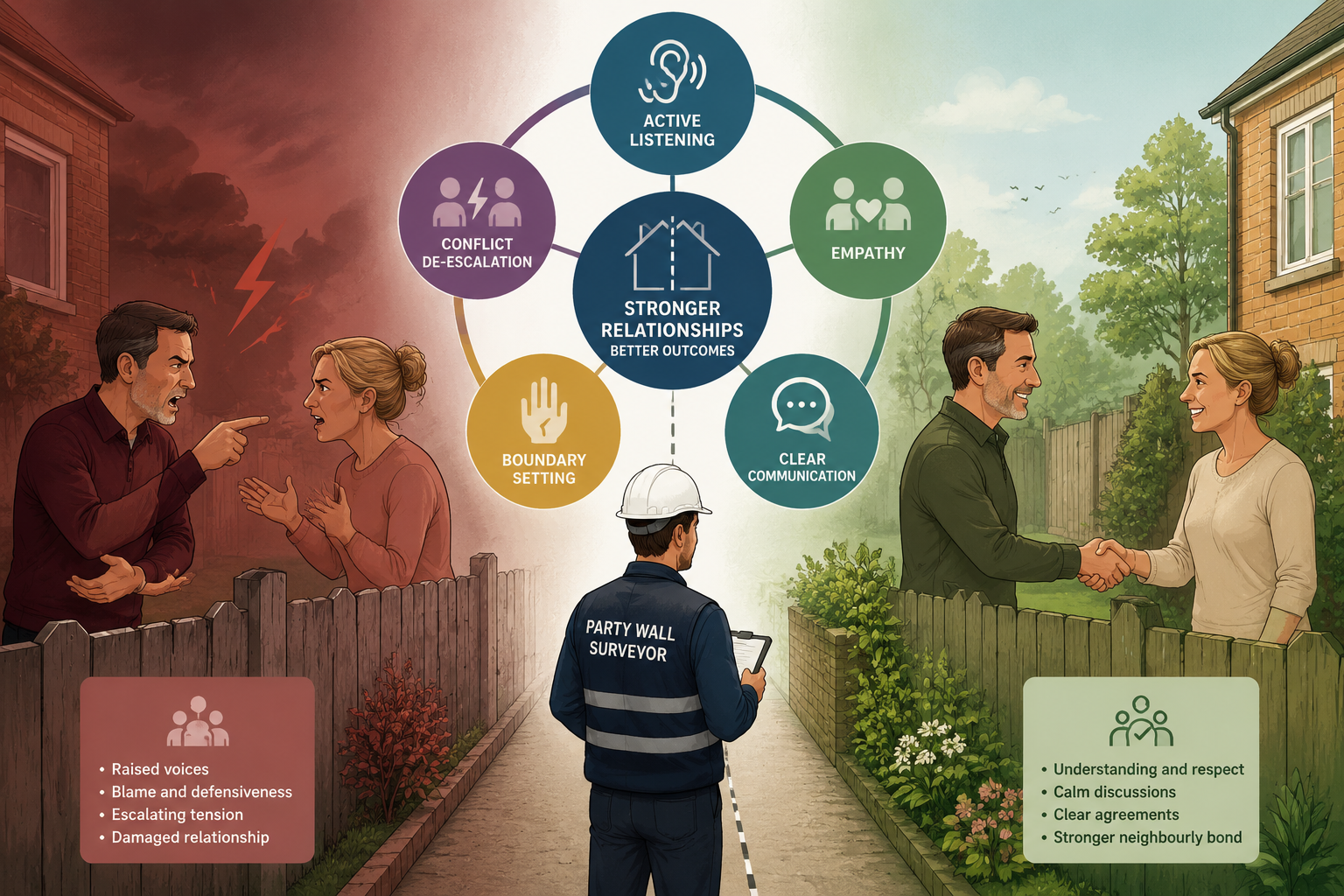
1. 🎧 Active Listening
Active listening means more than staying quiet while someone speaks. It involves:
- Maintaining eye contact and open body language
- Paraphrasing what the other party has said to confirm understanding
- Acknowledging emotions without necessarily agreeing with the position
- Avoiding interruptions, even when the information is factually incorrect
When an adjoining owner feels genuinely heard, their defensive posture often softens. This opens the door to productive dialogue. Surveyors who rush to explain the legal position before the client feels understood frequently find themselves facing a wall of resistance — sometimes literally.
2. 🤝 Empathy Without Bias
Empathy in this context does not mean taking sides. It means recognising and validating the emotional experience of both parties without allowing that recognition to compromise professional neutrality.
An agreed surveyor, in particular, must hold space for both the building owner and the adjoining owner simultaneously. This is a delicate balance. The key is to separate the feeling from the position:
| What the party says | What they may actually feel |
|---|---|
| "This notice is completely unreasonable." | "I feel blindsided and unheard." |
| "They're trying to destroy my property." | "I'm scared of losing something irreplaceable." |
| "I refuse to engage with this process." | "I don't understand what's happening and I feel powerless." |
Understanding the underlying emotion allows a skilled surveyor to address the real barrier to resolution.
3. 🗣️ Clear, Jargon-Free Communication
Legal and technical language can feel alienating and even threatening to homeowners unfamiliar with the Party Wall etc. Act 1996. Surveyors who communicate in plain English — explaining what a party wall notice means, what the process involves, and what the likely outcomes are — dramatically reduce anxiety and resistance.
Practical tips for clearer communication:
- Replace "party structure notice" with "a formal letter telling your neighbour about the planned work"
- Explain the party wall award as "a document that sets out the rules for how and when the work is done"
- Describe the schedule of condition as "a record of how your property looks before work starts, to protect you if anything is damaged"
This kind of translation is not dumbing down — it is professional excellence.
4. 🧘 Emotional Regulation Under Pressure
Surveyors sometimes face parties who are angry, tearful, or openly hostile. The ability to remain calm, measured, and non-reactive in these situations is a hallmark of high emotional intelligence.
Strategies for staying regulated:
- Pause before responding — a two-second pause prevents reactive replies
- Use neutral language — avoid words like "unreasonable" or "difficult" when describing a party's behaviour
- Acknowledge the emotion directly — "I can see this is very stressful for you" defuses tension faster than ignoring it
- Redirect to process — returning to the legal framework provides a neutral anchor when emotions run high
5. 🔍 Reading Non-Verbal Cues
Much of what people communicate in a dispute is not said out loud. A skilled surveyor pays attention to:
- Crossed arms or turned body — signals defensiveness or discomfort
- Avoiding eye contact — may indicate shame, fear, or distrust
- Rapid speech or raised voice — signals escalating anxiety
- Sudden silence — can indicate withdrawal or a decision to disengage
Noticing these cues early allows the surveyor to adjust their approach before the situation deteriorates.
Practical De-Escalation Strategies for 2026 Disputes
Start Early: Prevention Is Better Than Cure
The single most effective de-escalation strategy is early, proactive communication. Many disputes escalate because one party feels the other acted without warning or consultation. Surveyors who encourage building owners to speak informally with neighbours before serving formal party wall notices often find that the formal process runs far more smoothly.
If you are a building owner planning works, understanding your obligations early — including how to keep party wall costs down — can prevent unnecessary friction from the outset.
Frame the Process as Protective, Not Adversarial
One of the most common misconceptions among adjoining owners is that the party wall process is designed to allow their neighbour to do whatever they want. In reality, the process exists to protect both parties. Surveyors who reframe the process this way — consistently and clearly — often find that resistance drops significantly.
For adjoining owners who feel uncertain about their position, resources like the adjoining owners' surveyor guide can provide reassurance and clarity about what protections are in place.
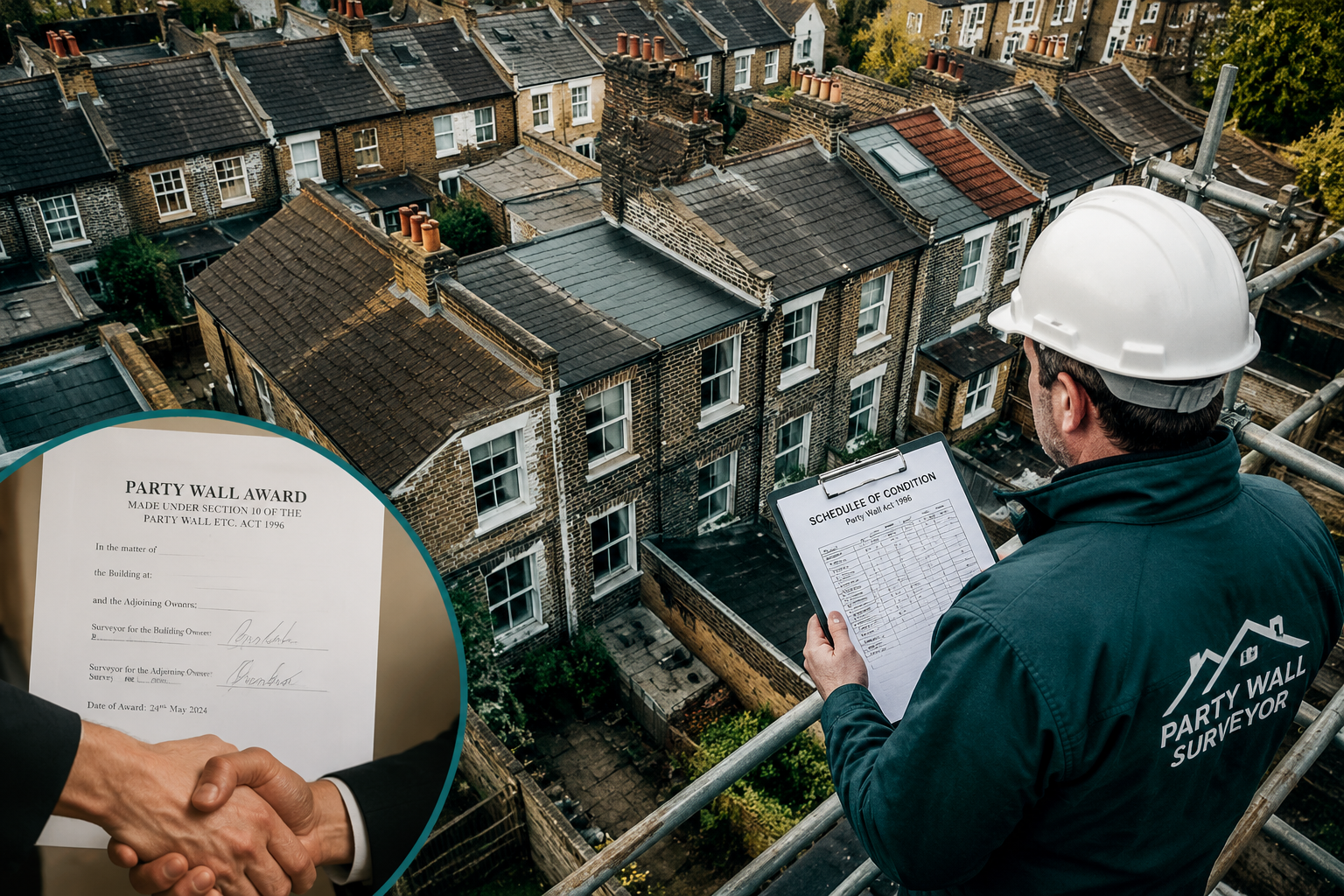
Use the Schedule of Condition as a Trust-Building Tool
The schedule of condition is not just a legal document — it is a confidence-building mechanism. When an adjoining owner sees that the surveyor has carefully recorded every crack, every mark, and every existing defect in their property before work begins, their anxiety about potential damage decreases substantially.
Presenting this document with care and explaining its purpose in plain terms is one of the most emotionally intelligent things a surveyor can do.
Know When to Recommend an Agreed Surveyor
In many cases, appointing a single agreed surveyor rather than two separate surveyors can reduce the adversarial dynamic significantly. When both parties share one neutral professional, the process feels less like a legal battle and more like a collaborative problem-solving exercise.
This approach is not always appropriate — particularly where there is deep distrust between parties — but an emotionally intelligent surveyor will recognise the situations where it can work well.
Document Everything, But Communicate Warmly
Thorough documentation is non-negotiable. But how that documentation is communicated matters enormously. A formal letter that reads like a legal threat will provoke a very different response than one that is clear, respectful, and explains the next steps in plain language.
For those navigating the process independently, reviewing a sample party wall agreement template can help demystify what the documentation actually involves.
Recognise When to Escalate — and When Not To
Not every dispute can or should be resolved informally. There are situations where a formal party wall award is the appropriate and necessary outcome. An emotionally intelligent surveyor knows the difference between:
- A dispute that can be resolved through better communication
- A dispute that requires formal legal protection for one or both parties
Attempting to keep everything informal when a formal award is genuinely needed does not serve the client — it delays resolution and increases stress.
The Professional Development Imperative
The surveying industry in 2026 is increasingly recognising that soft skills are not soft. They are demanding, learnable, and essential. [2]
Professional bodies like the FPWS are responding by integrating emotional intelligence and communication training into their continuing professional development programmes. [3] Surveyors who invest in this training — through workshops, mentoring, podcasts, and peer discussion — consistently report better client outcomes, fewer disputes reaching formal awards, and higher levels of professional satisfaction.
Key areas for professional development:
- ✅ Conflict resolution and mediation techniques
- ✅ Trauma-informed communication (understanding why some clients react with extreme distress)
- ✅ Cultural competency (particularly relevant in diverse urban areas like London)
- ✅ Active listening and motivational interviewing skills
- ✅ Written communication clarity and tone
For surveyors working across London — whether in Central London, South London, North London, or East London — the cultural and social diversity of the client base makes these skills even more important.
What Building Owners and Adjoining Owners Should Expect
If you are involved in a party wall dispute in 2026, you have every right to expect your surveyor to demonstrate:
- Patience and clarity in explaining the process
- Genuine neutrality — not favouring one party over another
- Proactive communication — keeping both parties informed at every stage
- Sensitivity to the emotional weight of the situation
- Professionalism under pressure, even when parties are hostile or distressed
If your current surveyor is not meeting these standards, it may be worth exploring your options. Whether you are a building owner or an adjoining owner, the right surveyor can make an enormous difference to the experience — not just the outcome.
Conclusion: Emotional Intelligence Is the Future of Party Wall Surveying
Party Wall Surveyor Emotional Intelligence: Managing Difficult Neighbors and De-Escalating 2026 Disputes is not a trend — it is a professional evolution that reflects the reality of what surveyors actually do every day. The technical framework of the Party Wall etc. Act 1996 provides the legal scaffolding, but it is the human skills — empathy, communication, patience, and conflict awareness — that determine whether a dispute is resolved smoothly or spirals into costly, stressful litigation.
Actionable Next Steps 🚀
- If you are a surveyor: Invest in formal training in conflict resolution and communication. Seek mentoring from experienced practitioners who model high emotional intelligence. [2]
- If you are a building owner: Choose a surveyor who demonstrates clear, empathetic communication — not just technical credentials. Serve notices early and encourage informal dialogue with your neighbour before formal processes begin.
- If you are an adjoining owner: Understand that the party wall process is designed to protect you. Ask your surveyor to explain every step in plain language, and do not hesitate to ask questions.
- For all parties: Remember that the goal is a resolved dispute — not a won argument. A surveyor with strong emotional intelligence will keep that goal in sight, even when the conversation gets difficult.
The best party wall surveyors in 2026 are not just legal technicians. They are skilled human beings who understand that behind every dispute is a person trying to protect something they care deeply about. That understanding — more than any legal knowledge — is what makes the difference.
References
[1] Inside Party Wall Surveying with Sarah Tanner – https://www.youtube.com/watch?v=2aECnSWEHB0
[2] Ep 123 Combining Technical Ability With Emotional Intelligence – The Surveyor Hub Podcast – https://www.lovesurveying.com/podcasts/the-surveyor-hub-podcast/episodes/2148977660
[3] FPWS Events List – https://fpws.org.uk/eeeventslist/