
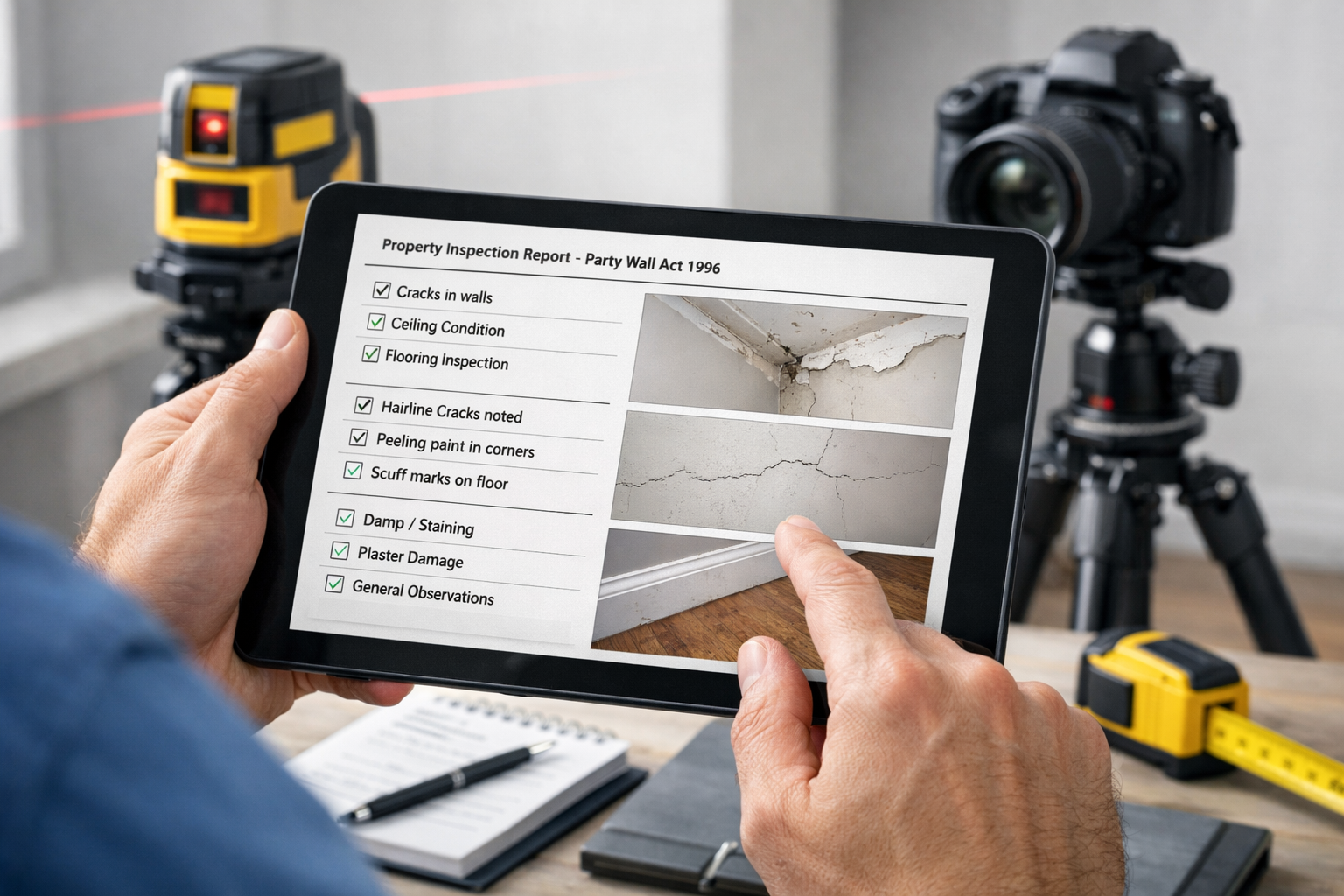
Nearly one in three party wall disputes in the UK escalates into a formal disagreement over whether damage was caused by construction works — or was already there before the first drill bit turned. That single question, so simple in theory, can cost thousands of pounds to resolve without the right evidence in place.
This is precisely where the Schedule of Condition in Party Wall Surveys: Protecting Your Property with Comprehensive Pre-Work Documentation becomes one of the most powerful tools available to both building owners and their neighbours. It is a factual, timestamped baseline — a forensic snapshot of a property’s condition before any notifiable works begin — and it can mean the difference between a swift, fair resolution and a drawn-out, expensive dispute. [1]
Whether you are planning a loft conversion, a basement dig, or a rear extension, understanding how this document works, who commissions it, and what it contains is essential reading for 2026.

Key Takeaways 📋
- A Schedule of Condition is a factual, photographic record of a neighbouring property’s state before party wall works begin.
- It is not legally required under the Party Wall etc. Act 1996, but it is strongly recommended to protect both parties from false or disputed damage claims. [1]
- The Building Owner (the person carrying out works) is typically responsible for commissioning the report. [1]
- When combined with a formal Party Wall Award, a Schedule of Condition provides significantly stronger legal protection. [5]
- Adjoining owners can formally request a Schedule of Condition when responding to a Party Wall Notice. [6]
What Is a Schedule of Condition and Why Does It Matter?
A Schedule of Condition is a professionally prepared document that records the existing state of a property — typically the adjoining owner’s home — immediately before construction or notifiable works commence. [3]
Think of it as a property’s “before” photograph, but far more detailed. The report captures:
- 📸 Photographic evidence — high-resolution images of every room, wall, ceiling, floor, and external area likely to be affected
- 📝 Written descriptions — factual, objective notes describing existing cracks, stains, settlement marks, or defects
- 🎥 Video walkthroughs — increasingly common in modern surveys to provide a continuous, timestamped record
- 📄 Thumbnail indexes — organised image grids making it easy to cross-reference specific areas
Completed reports typically run to approximately 20 pages and cover all areas that could reasonably be influenced by the proposed works. [6]
💬 “A Schedule of Condition does not speculate or offer opinions — it records only what is immediately visible and factually apparent at the time of inspection.” [1]
This distinction is critical. The document is non-intrusive and non-destructive. Surveyors do not lift floorboards, remove plaster, or investigate hidden voids. They record only what is observable, which means latent or concealed defects are not included. [1]
The Legal Framework: Is a Schedule of Condition Required?
The Party Wall etc. Act 1996 and Its Silence on the Subject
The Party Wall etc. Act 1996 governs works affecting shared walls, boundaries, and excavations near neighbouring properties. It sets out clear obligations around serving Party Wall Notices and, where consent is withheld, appointing surveyors to produce a Party Wall Award.
However — and this surprises many property owners — the Act does not make a Schedule of Condition a legal requirement. [1]
So why bother? Because the risks of not having one are substantial:
| Without a Schedule of Condition | With a Schedule of Condition |
|---|---|
| No baseline to compare against | Clear “before” record established |
| Disputes rely on memory or opinion | Disputes resolved with objective evidence |
| Building owner may face unfair claims | Pre-existing damage is documented |
| Adjoining owner has limited recourse | New damage is clearly identifiable |
| Resolution may require litigation | Resolution is faster and cheaper |
How Adjoining Owners Can Request One
When an adjoining owner receives a Party Wall Notice, they have the right to formally request that a Schedule of Condition be carried out as part of the party wall process. [6] This request is made during the response stage — typically within 14 days of receiving the notice.
If you have recently received a notice and are unsure how to respond, the Party Wall Act Notices guide provides a clear breakdown of your options and rights.

Schedule of Condition in Party Wall Surveys: How Surveyors Create Baseline Documentation
This is where the real value of the process lies. Understanding how a professional surveyor builds a comprehensive baseline record explains why this document is so effective at preventing false damage claims.
Step 1: Pre-Inspection Preparation
Before visiting the property, a qualified surveyor reviews the proposed works — the scope, depth, and proximity to the adjoining structure. This allows them to identify which areas are most at risk and prioritise documentation accordingly.
For a loft conversion, for example, the surveyor will focus heavily on the party wall itself, the roof junction, and ceilings on upper floors. For a basement excavation, ground-floor walls and foundations take priority. Understanding the types of party wall works helps surveyors tailor their inspection scope.
Step 2: The Physical Inspection
The surveyor conducts a room-by-room walkthrough of all accessible areas. Every surface is examined and documented:
- Walls — existing cracks, hairline fractures, damp patches, staining
- Ceilings — plasterwork condition, coving cracks, water marks
- Floors — settlement cracks in screeds, tile damage, gaps at skirting boards
- Windows and doors — frame condition, gaps, sticking or misalignment
- External areas — brickwork, pointing, render, drainage channels
Each defect is photographed with a scale reference and described in factual, neutral language. Phrases like “crack appears to be approximately 2mm wide at widest point, running diagonally from window corner” are typical — precise, measurable, and free of interpretation. [1]
Step 3: Compilation and Issue
The completed report is compiled into a structured document, cross-referenced with a floor plan or room index. Both the building owner and the adjoining owner receive copies, and the report is formally attached to or referenced within the Party Wall Award — the binding legal document that governs how works must be carried out. [5]
💬 “When a Schedule of Condition is embedded within a Party Wall Award, it transforms from a useful record into a legally referenced document — giving it far greater weight in any subsequent dispute.” [5]
Step 4: Post-Works Comparison
Once construction is complete, a post-works inspection can be carried out using the Schedule of Condition as a direct reference. Surveyors compare each documented area against its pre-works state. Any new damage is immediately identifiable because it was not present in the original record. [4]
This process is what makes the document so powerful in dispute resolution. Party wall surveyors use it to determine, with confidence, whether alleged damage is genuinely construction-related or was pre-existing. [4]
Who Pays for a Schedule of Condition?
The Building Owner — the party undertaking the notifiable works — is responsible for commissioning and funding the Schedule of Condition. [1] This is consistent with the broader principle under the Party Wall etc. Act 1996 that the building owner bears the costs associated with the party wall process.
Costs vary depending on the size and complexity of the property, but the investment is almost always far smaller than the cost of a disputed damage claim. For guidance on managing overall party wall costs, the party wall costs and process guide offers a useful breakdown.
There are also practical ways to keep party wall costs down without compromising on the quality of documentation.
Schedule of Condition in Party Wall Surveys: Protecting Both Parties Equally
One of the most common misconceptions is that a Schedule of Condition only protects the adjoining owner — the neighbour whose property is at risk of damage. In reality, it protects both parties equally. [2]
Protection for the Adjoining Owner 🏠
For the adjoining owner, the document provides:
- Evidence of pre-existing conditions — so they can identify and claim for genuinely new damage
- Leverage during dispute resolution — a documented baseline that cannot be disputed after the fact
- Peace of mind — knowing that their property’s condition has been professionally recorded
If you are an adjoining owner concerned about upcoming works, the adjoining owners guide explains your rights and the protections available to you.
Protection for the Building Owner 🔨
For the building owner, the Schedule of Condition is equally valuable:
- Defence against false claims — pre-existing cracks, damp, or settlement cannot be falsely attributed to the works
- Reduced liability exposure — only genuinely new damage can be claimed
- Smoother project completion — disputes are resolved quickly with reference to objective evidence
Building owners can learn more about their obligations and protections through the building owners guide.
Common Misconceptions About Schedules of Condition
❌ “A Schedule of Condition is the same as a structural survey”
Not at all. A structural survey investigates the integrity of a building’s structure, often involving intrusive testing. A Schedule of Condition is purely observational — it records visible conditions without investigation, interpretation, or recommendations. [1]
❌ “It only covers the party wall itself”
A well-prepared Schedule of Condition covers all areas likely to be affected by the proposed works — not just the shared wall. This typically includes multiple rooms, external elevations, and any outbuildings or garden structures within the zone of influence. [6]
❌ “Photographs on a phone are good enough”
While smartphone cameras have improved significantly, a professionally prepared report carries far greater evidential weight. It is dated, signed, and structured in a way that makes it admissible and credible in formal dispute resolution. [3]
❌ “It provides legal protection on its own”
A Schedule of Condition alone does not offer standalone legal protection. Its power is maximised when it forms part of — or is referenced by — a formal Party Wall Award. [5] Without that legal framework, the document is persuasive but not binding.
When Is a Schedule of Condition Most Important?
Not every party wall project carries the same risk profile. The following scenarios represent situations where a Schedule of Condition is particularly critical:
- Basement excavations — significant ground movement risk affecting foundations and ground-floor structures
- Loft conversions with party wall raising — direct structural work on the shared wall
- Rear extensions close to boundaries — excavations within 3–6 metres of neighbouring foundations
- Properties with older or fragile construction — Victorian and Edwardian terraces are especially vulnerable
- High-value properties — where the cost of any damage claim is likely to be substantial
In all these cases, the Schedule of Condition is not merely a best practice — it is essential risk management. [2]
Conclusion: Take Action Before Works Begin
The Schedule of Condition in Party Wall Surveys: Protecting Your Property with Comprehensive Pre-Work Documentation is one of the most cost-effective risk management tools available in the UK construction process. For a relatively modest investment, it creates an objective, professionally prepared baseline that protects both the building owner and the adjoining owner from the financial and emotional cost of disputed damage claims.
✅ Actionable Next Steps
-
If you are a building owner — commission a Schedule of Condition before works begin, even if your neighbour has consented. Contact a qualified party wall surveyor as early as possible in your project timeline.
-
If you are an adjoining owner — when you receive a Party Wall Notice, formally request a Schedule of Condition as part of your response. Do not assume it will be carried out automatically.
-
Ensure it is referenced in the Party Wall Award — a Schedule of Condition reaches its full protective potential when embedded within the formal award document.
-
Use a qualified professional — a surveyor experienced in party wall matters will produce a report that is structured, credible, and fit for purpose in any dispute scenario.
-
Act early — a Schedule of Condition carried out after works have started has limited value. The baseline must be established before the first tool is used.
The time to protect your property is before the scaffolding goes up — not after the cracks appear.
References
[1] Schedule Of Condition – ansteyhorne.co.uk
[2] Schedule Of Condition – thepartywallguru.com
[3] Schedule Of Condition – westvilleassociates.com
[4] Schedule Of Condition – partywall.expert
[5] Watch – youtube.com
[6] Party Wall Schedule Of Condition – grahamkinnear.com
[7] Party Wall Dispute – onlinearchitecturalservices.com
[8] Schedules Of Condition – peterbarry.co.uk
Speak to a RICS chartered party wall surveyor
Free initial consultation. Notices, awards and schedules of condition across London and nationwide.