


'
As urban centers across England and Wales experience unprecedented density increases in 2026, homeowners are looking downward for expansion opportunities. Basement extensions have become the go-to solution for adding valuable living space without expanding a property's footprint—but this underground growth comes with critical legal obligations. Securing Party Wall Agreements for Basement Extensions in 2026's Urban Density Surge has become essential for protecting both your investment and your relationship with neighbors as excavation work intensifies beneath shared structures.
The surge in basement projects reflects a simple reality: with horizontal space at a premium and planning restrictions tightening, digging down offers one of the few remaining expansion options. However, basement excavations almost universally trigger party wall notice requirements, creating a complex legal landscape that homeowners must navigate before breaking ground. Understanding the intricacies of the Party Wall Act 1996 and the agreement process can mean the difference between a smooth project and costly legal disputes.
Key Takeaways
- Basement excavations trigger party wall requirements in nearly all cases when digging within 3 meters of a neighbor's structure below their foundation level, or within 6 meters at certain depths 🏗️
- Budget £1,500–£3,600 per affected neighbor for complete party wall costs including both surveyors' fees, with individual surveyor fees ranging from £750–£1,800 in 2026 💰
- Allow 2–4 months minimum for the complete party wall process, starting immediately after receiving planning approval to avoid project delays ⏱️
- Schedule of condition surveys are mandatory for basement conversions, documenting existing property conditions before excavation begins to protect all parties 📋
- Party wall awards are legally binding and cannot be rescinded except through County Court applications, making proper negotiation critical from the start ⚖️
Understanding Party Wall Requirements for Basement Excavations
What Triggers Party Wall Notices for Basement Work
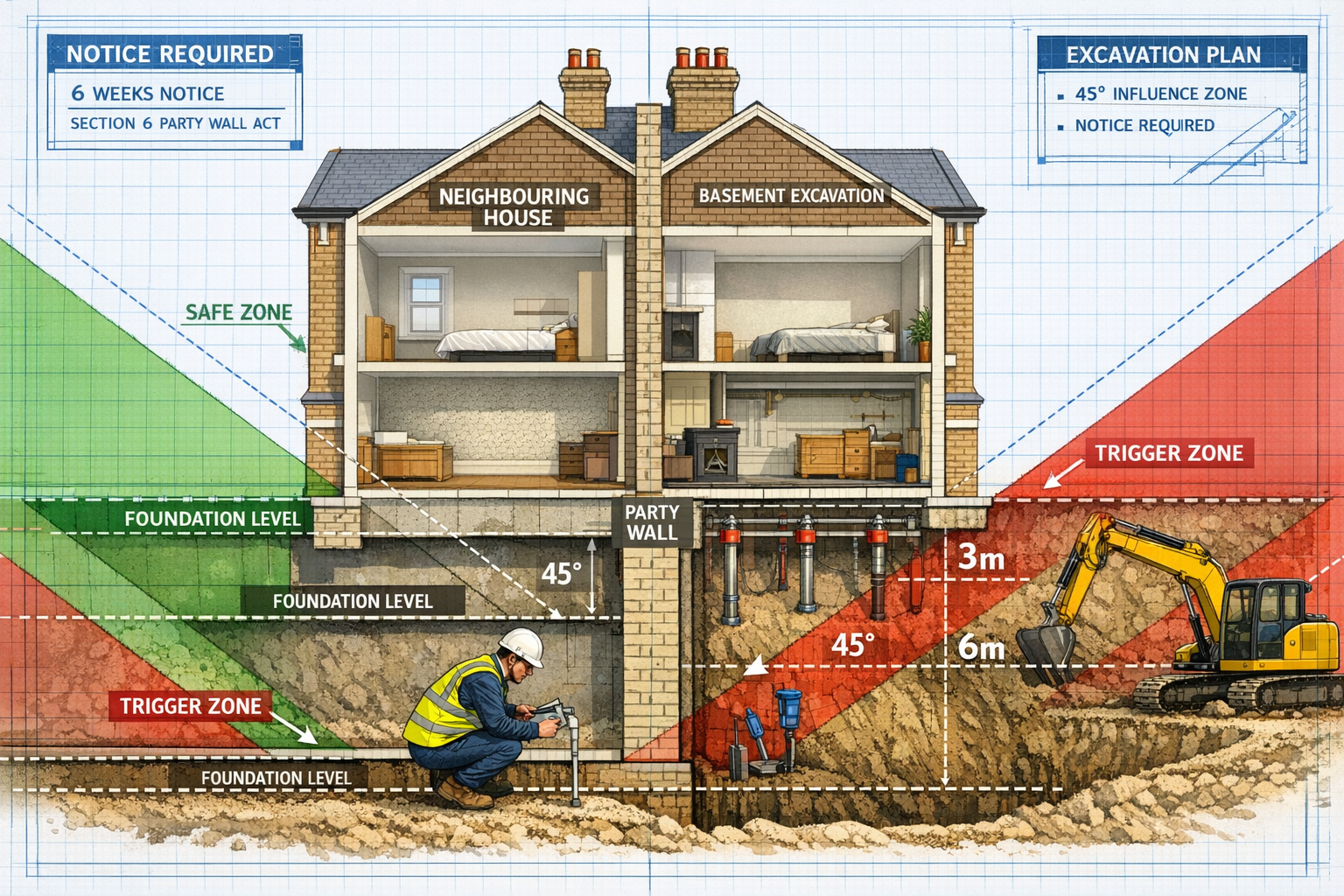
Basement extensions represent one of the most complex scenarios under the Party Wall etc. Act 1996. The excavation requirements are specific and unforgiving: if you're digging within 3 meters of a neighboring structure and going below their foundation level, you must serve notice. The requirements extend further if excavation occurs within 6 meters and falls within a 45-degree angle from the bottom of your neighbor's foundation.[1]
In London's densely packed terraced housing, these conditions apply to virtually every basement project. The typical Victorian or Edwardian terrace features shared party walls with foundations that rarely extend deep enough to avoid triggering notice requirements. This means that approximately 95% of London extension projects require party wall agreements,[1] with basement conversions sitting at the top of this list.
The types of party wall works relevant to basement extensions include:
- Excavation notices (Section 6 of the Act) for digging near neighbor foundations
- Party structure notices (Section 2) when underpinning or strengthening existing party walls
- Line of junction notices (Section 1) when building new walls at boundaries
Why 2026's Urban Density Makes Party Wall Agreements Critical
The urban densification trend accelerating through 2026 creates unique pressures on party wall processes. As properties become more valuable and space more scarce, neighbors have heightened awareness of their rights and increased motivation to protect their investments. The stakes have never been higher for both building owners and adjoining owners.
Modern basement extensions often involve substantial structural interventions that previous generations of homeowners never contemplated. Full-thickness party wall underpinning, permanent steel props, buttress walls, and new foundation installations all represent significant works that can affect neighboring properties.[3] These technical complexities demand robust agreements that clearly define responsibilities, protections, and remediation procedures.
The legal framework remains unchanged from 1996, but its application has evolved. Courts have consistently upheld the mandatory nature of party wall agreements, and failing to obtain proper agreements before commencing work violates the Party Wall Act.[4] In 2026's litigious environment, this violation can result in injunctions halting construction, forced remediation, and substantial legal costs.
The Complete Process for Securing Party Wall Agreements for Basement Extensions in 2026's Urban Density Surge
Step 1: Initial Assessment and Planning (Weeks 1-2)
Before serving any notices, conduct a thorough assessment of your project's party wall implications. Engage a qualified party wall surveyor early—ideally during the design phase—to identify all affected neighbors and determine which notices apply. This early consultation can save months of delays later.
Your surveyor will review architectural and structural drawings to identify:
- All excavation depths and distances from neighboring foundations
- Party wall underpinning requirements and structural interventions
- Number of affected neighbors (basement projects often affect multiple properties)
- Potential complications such as shared drains, utilities, or access issues
Understanding how to keep party wall costs down starts with this planning phase. Clear, professional drawings and a well-defined scope reduce ambiguity and potential disputes.
Step 2: Serving Party Wall Notices (Weeks 3-4)
Once you've identified all affected neighbors, formal party wall notices must be served. For basement excavations, you'll typically serve Section 6 excavation notices at minimum, and often Section 2 party structure notices if underpinning or strengthening party walls.
The notice must include:
✅ Detailed description of proposed works
✅ Drawings showing excavation depths and distances
✅ Structural methodology for underpinning or support
✅ Proposed start date (minimum notice periods apply)
✅ Your contact details and surveyor information
Critical timing: You must serve notice at least one month before starting work for excavation notices, and two months for party structure notices.[1] In practice, allow significantly more time because the notice period is just the beginning of the process.
Neighbors have 14 days to respond with either consent or dissent. Understanding what party wall act notices are and how to respond helps you anticipate neighbor reactions and prepare accordingly.
Step 3: Appointing Surveyors and Negotiating Terms (Weeks 5-12)
If your neighbor consents in writing, you can proceed without a formal party wall award—though this rarely happens with basement projects due to their complexity. More commonly, neighbors either dissent or fail to respond within 14 days, triggering the surveyor appointment process.
You have three surveyor arrangement options:
- Agreed Surveyor: One surveyor acts for both parties (fastest and most cost-effective)
- Two Surveyors: Each party appoints their own surveyor (most common for complex works)
- Three Surveyors: Two party-appointed surveyors plus a third surveyor (rare, for highly contentious cases)
For basement extensions in 2026, the two-surveyor approach dominates. Your neighbor will appoint their own surveyor to protect their interests, and both surveyors work together to produce the party wall award.
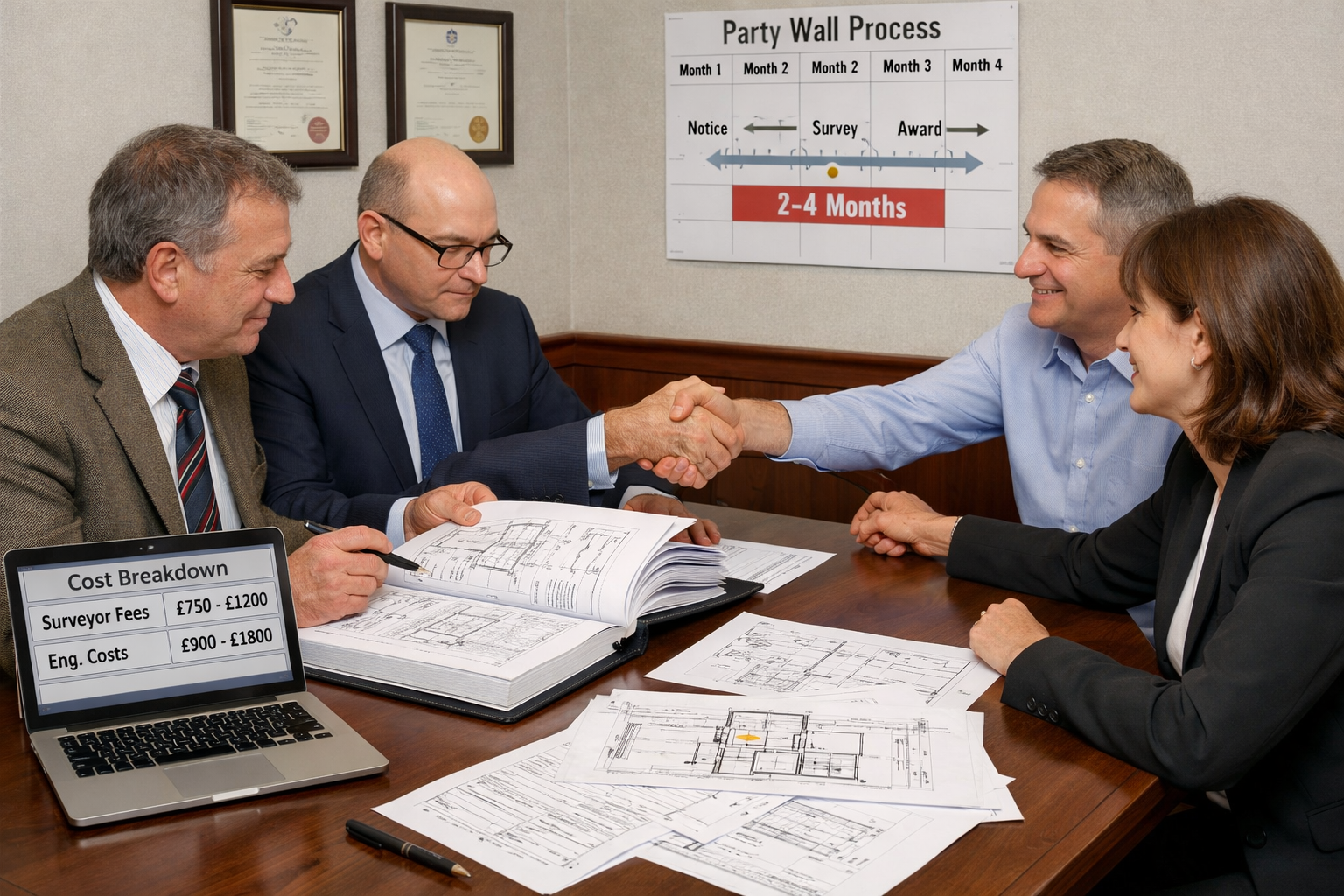
Cost reality check: Individual surveyor fees range from £750–£1,800 per neighbor in 2026, with total budgets reaching £1,500–£3,600 per affected neighbor when both surveyors' costs are included.[1] As the building owner, you typically bear both surveyors' reasonable fees—a fact that surprises many homeowners.
Step 4: Schedule of Condition Survey (Weeks 8-10)
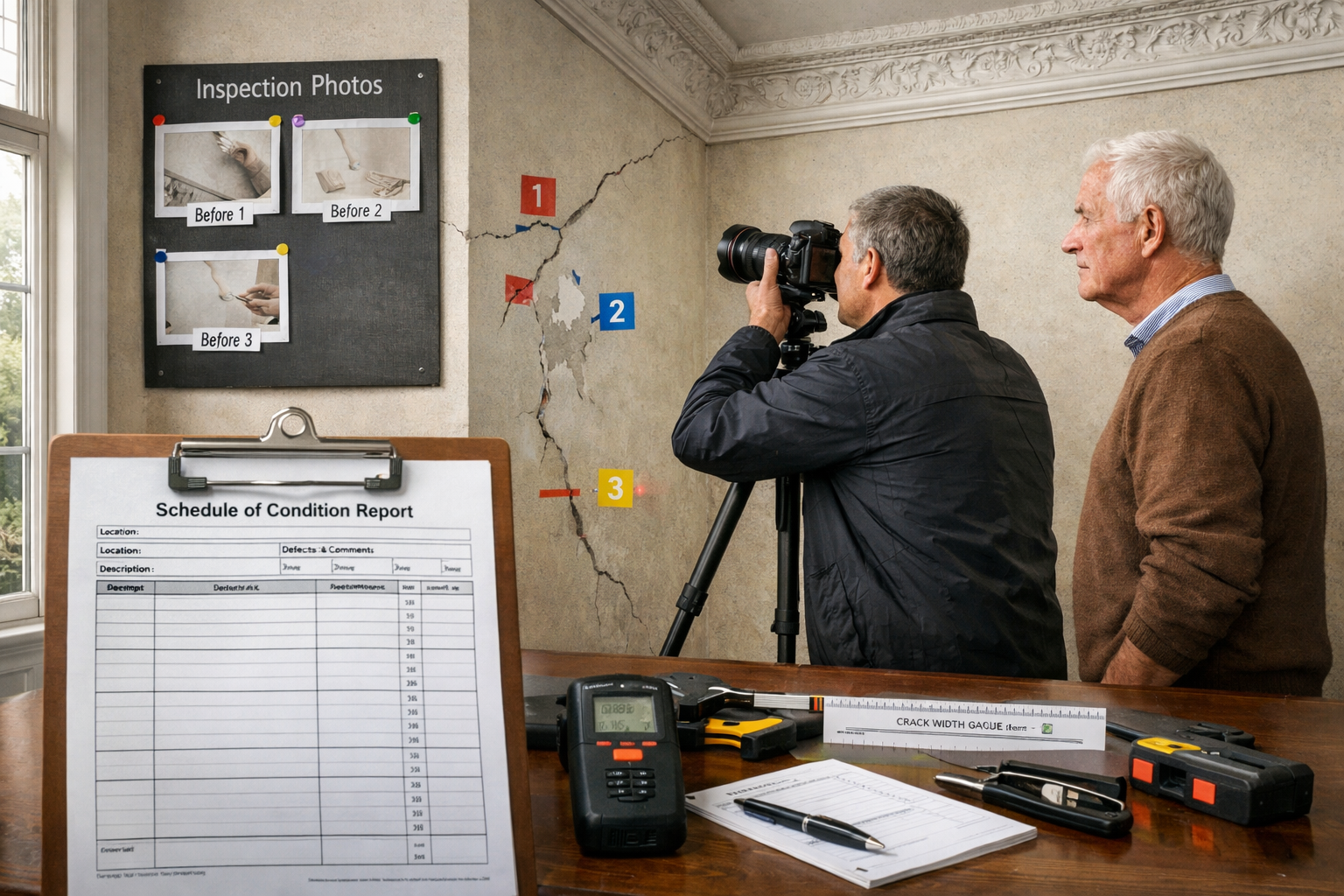
A schedule of condition is mandatory for basement conversions.[2] This comprehensive inspection documents the existing state of your neighbor's property before excavation begins, creating an objective baseline for assessing any damage claims.
The schedule of condition involves:
- 📸 Photographic documentation of all walls, floors, and ceilings adjacent to works
- 📏 Crack mapping with width measurements and locations
- 🔍 Structural assessment of existing defects or weaknesses
- 📝 Detailed written descriptions of finishes, decorations, and conditions
- 🏠 External inspection of foundations, walls, and drainage
This survey protects both parties. For you as the building owner, it prevents spurious claims for pre-existing damage. For your neighbor, it establishes clear evidence if your works cause deterioration. Professional surveyors typically conduct this inspection jointly or share findings to ensure agreement on baseline conditions.
The schedule becomes an appendix to the party wall award, making it a legally binding reference document. Party wall awards are legally binding once agreed by both surveyors and cannot be rescinded except by County Court application,[2] emphasizing the importance of accuracy in this documentation.
Step 5: Drafting and Agreeing the Party Wall Award (Weeks 10-16)
The party wall award represents the formal agreement governing your basement extension works. This detailed document specifies:
Technical specifications:
- Permitted excavation methods and sequences
- Underpinning procedures and materials
- Support requirements for party structures
- Drainage and waterproofing obligations
Protective measures:
- Working hours restrictions
- Noise and vibration limits
- Dust and debris control requirements
- Access arrangements for monitoring
Rights and responsibilities:
- Building owner's right to execute specified works
- Adjoining owner's right to inspect and monitor
- Surveyor inspection schedules
- Dispute resolution procedures
Financial provisions:
- Fee payment schedules
- Security for expenses (sometimes required)
- Damage compensation mechanisms
The party wall contract template guide on party wall awards provides insight into standard award structures, though basement projects typically require extensive customization.
Negotiating favorable terms while maintaining neighbor relationships requires diplomatic skill. Professional surveyors serve as intermediaries, translating technical requirements into acceptable terms and mediating disputes before they escalate.
Cost Management and Financial Considerations
Breaking Down Party Wall Costs for Basement Projects
Understanding the complete financial picture helps you budget accurately for Securing Party Wall Agreements for Basement Extensions in 2026's Urban Density Surge. The costs of party wall process extend beyond surveyor fees alone.
| Cost Component | Typical Range (2026) | Notes |
|---|---|---|
| Building Owner's Surveyor | £750–£1,800 per neighbor | Your appointed surveyor's fees |
| Adjoining Owner's Surveyor | £750–£1,800 per neighbor | Neighbor's surveyor (you pay) |
| Schedule of Condition | Included or £200–£500 | Often bundled with surveyor fees |
| Award Preparation | Included | Part of surveyor service |
| Monitoring Visits | £150–£300 per visit | During construction phase |
| Dispute Resolution | £500–£2,000+ | If disagreements arise |
| Total Per Neighbor | £1,500–£3,600+ | Multiply by number of neighbors |
For a typical terraced house basement extension affecting two neighbors, budget £3,000–£7,200 for party wall costs alone. Corner properties or detached houses may affect more neighbors, multiplying these expenses.
Strategies for Controlling Party Wall Expenses
While you cannot avoid party wall requirements, strategic approaches can minimize costs:
1. Early engagement reduces complications 🎯
Starting the party wall process immediately after planning approval prevents rushed decisions and costly mistakes. The 2–4 month minimum timeline[1] should be built into your project schedule from day one.
2. Consider an agreed surveyor arrangement 🤝
If you have a good relationship with neighbors and relatively straightforward works, proposing a single agreed surveyor can halve costs. Both parties must genuinely agree to this arrangement—it cannot be forced.
3. Provide complete, professional documentation 📐
Clear architectural and structural drawings reduce surveyor time spent requesting clarifications. Ambiguous plans lead to extended negotiations and higher fees.
4. Choose experienced basement specialists 🏗️
Surveyors with specific basement extension experience work more efficiently and anticipate issues before they become problems. Their higher hourly rates often result in lower total costs through efficiency.
5. Maintain open communication with neighbors 💬
Many party wall disputes stem from poor communication rather than technical disagreements. Regular updates and addressing concerns proactively prevents escalation.
Exploring options for having a party wall agreement without a surveyor might seem tempting, but basement projects' complexity makes professional surveyor involvement essential for protecting all parties.
Regional Considerations Across London's Urban Centers
Party Wall Practices in Different London Areas
While the Party Wall Act applies uniformly across England and Wales, local practices and property characteristics create regional variations in how Securing Party Wall Agreements for Basement Extensions in 2026's Urban Density Surge plays out practically.
Central London experiences the highest density of basement projects and the most sophisticated party wall practices. Properties in Westminster, Kensington, and Chelsea often feature complex ownership structures (freeholds, leaseholds, head leases) requiring additional consents beyond standard party wall agreements. Working with a party wall surveyor in Central London familiar with these complications proves invaluable.
North London areas like Islington, Hampstead, and Highgate feature Victorian and Edwardian terraces with varying foundation depths. The clay soil common in these areas creates additional subsidence risks during excavation, making thorough schedule of condition surveys particularly important. A party wall surveyor in North London understands these geological considerations.
West London neighborhoods including Hammersmith, Chiswick, and Ealing see extensive basement development in both terraced and semi-detached properties. The mix of property types creates diverse party wall scenarios, from simple single-neighbor situations to complex multi-party agreements. Party wall surveyors in West London navigate this variety regularly.
East London areas like Hackney, Shoreditch, and Stratford experience rapid gentrification driving basement conversion demand. Properties here often have more varied construction quality and foundation types, requiring careful assessment. Engaging a party wall surveyor in East London with local knowledge helps anticipate issues.
South London boroughs including Wandsworth, Lambeth, and Southwark feature extensive Victorian terracing similar to North London but with different soil conditions. The combination of London clay and proximity to the Thames creates unique drainage and waterproofing challenges for basement excavations. A party wall surveyor in South London brings essential local expertise.
Boundary Considerations and Property Lines
Basement excavations often raise questions about boundary wall rules and the difference between party fence walls and boundary walls. Understanding these distinctions matters because excavation near boundary walls triggers different notice requirements than work on party walls.
Key boundary considerations include:
- Excavation setbacks: Even if not touching a party wall, digging within trigger distances requires notice
- New foundation walls: Building new basement walls along boundaries may require line of junction notices
- Access requirements: Excavation often requires temporary access to neighbor's property for shoring or monitoring
- Drainage and waterproofing: New basement tanking systems must not direct water onto neighbor's property
Questions about how close your neighbor can build to your fence apply in reverse when you're the one excavating. Respecting boundary setbacks while maximizing basement space requires careful design.
Technical and Structural Considerations
Common Structural Interventions for Basement Extensions
Basement extensions demand significant structural work that directly impacts party wall agreements. Understanding these interventions helps you anticipate agreement requirements and costs.
Full-thickness party wall underpinning represents the most common intervention.[3] This process involves:
- Excavating beneath existing party wall foundations in controlled sections
- Installing temporary support to prevent settlement
- Pouring new deeper concrete foundations beneath existing footings
- Allowing concrete to cure before proceeding to next section
- Repeating in sequence until entire party wall is underpinned
The underpinning depth typically extends 1–1.5 meters below your new basement floor level, ensuring adequate foundation support. This work directly affects your neighbor's structure, making detailed party wall awards essential.
Permanent steel props provide additional lateral support when party walls must resist increased soil pressure from excavation.[3] These steel beams span from the party wall to your new basement's opposite wall, preventing inward movement. The party wall award must specify:
- Prop sizes, spacing, and fixing methods
- Connection details to party wall (drilling, chemical anchors, etc.)
- Load calculations and structural justification
- Inspection requirements during installation
Buttress walls built perpendicular to party walls offer alternative support methods.[3] These new walls provide lateral bracing while creating useful internal spaces. Party wall implications include:
- Foundation requirements near party wall
- Connection methods to existing party structure
- Load transfer to party wall considerations
- Future removal or modification rights
Understanding Party Structure Notices for Basement Work
When basement work involves strengthening, underpinning, or otherwise affecting party walls, you must serve a party structure notice. This notice type carries a two-month response period (longer than excavation notices) and triggers more detailed agreement requirements.
The party structure notice must describe:
- Specific party wall works proposed (underpinning, strengthening, etc.)
- Structural methodology and sequencing
- Temporary support measures during construction
- Permanent alterations to party structure
- Expected duration of works
Combining excavation notices and party structure notices in a single comprehensive notice package streamlines the process, though your surveyor must ensure all legal requirements are met for each notice type.
Common Pitfalls and How to Avoid Them
Mistake #1: Starting Work Before Agreement
The most costly error homeowners make is commencing excavation before obtaining a party wall award. The Act explicitly prohibits starting work before reaching agreement,[4] yet contractors eager to begin often pressure homeowners to proceed.
Starting early can result in:
- ⚠️ Injunctions halting all construction work
- ⚠️ Forced removal of completed work
- ⚠️ Neighbor's legal costs added to your expenses
- ⚠️ Damaged neighbor relationships beyond repair
- ⚠️ Insurance complications if damage occurs
Solution: Build the full 2–4 month party wall timeline into your project schedule from the outset. Treat the award date as your earliest possible start date, not an administrative formality to rush through.
Mistake #2: Underestimating Costs and Timeline
Many homeowners budget inadequately for party wall costs, viewing them as minor administrative expenses rather than substantial project components. With total costs reaching £3,600+ per neighbor,[1] this oversight creates budget crises mid-project.
Solution: Include party wall costs as a distinct line item in your budget, separate from construction costs. Add a 20% contingency for potential complications or additional monitoring visits. Review the complete costs of the party wall process before finalizing budgets.
Mistake #3: Neglecting the Schedule of Condition
Some homeowners view the schedule of condition as unnecessary bureaucracy, especially if they believe their work won't cause damage. This perspective ignores the protective function this survey serves for both parties.
Without a proper schedule of condition:
- Pre-existing cracks may be attributed to your works
- Neighbor claims become difficult to dispute
- Insurance coverage may be compromised
- Surveyors lack baseline data for damage assessment
Solution: Insist on comprehensive schedule of condition surveys even if your neighbor seems unconcerned. The professional documentation protects everyone and costs relatively little compared to potential dispute expenses.
Mistake #4: Poor Communication with Neighbors
Technical compliance with the Party Wall Act doesn't guarantee smooth neighbor relations. Many disputes arise from poor communication, unexpected disruption, or perceived disrespect rather than actual structural concerns.
Solution: Supplement formal notices with personal conversations. Explain your project, anticipated timeline, and measures you're taking to minimize disruption. Provide direct contact information for addressing concerns quickly. Regular updates during construction maintain goodwill.
Mistake #5: Choosing Surveyors Based on Price Alone
The cheapest surveyor rarely delivers the best value, especially for complex basement projects. Inexperienced surveyors may:
- Miss critical structural issues during assessment
- Produce inadequate party wall awards
- Fail to anticipate complications
- Require excessive time for basic tasks
- Lack credibility with adjoining owner's surveyor
Solution: Select surveyors based on basement-specific experience, professional qualifications (RICS membership), and reputation. Request references from previous basement projects and verify their understanding of underpinning and excavation issues.
Party Wall Agreements vs. Planning Permission
Understanding the Separation of Frameworks
A critical misconception persists that planning permission and party wall agreements are connected processes. They are completely separate legal frameworks.[1] Even permitted development extensions that don't require planning applications must comply with the Party Wall Act if triggering notice requirements.
This separation creates important implications:
Planning permission addresses:
- Land use and development appropriateness
- Design, appearance, and neighborhood character
- Environmental impacts and sustainability
- Local authority policies and restrictions
Party wall agreements address:
- Protection of adjoining owners' property rights
- Structural safety of shared structures
- Fair compensation for inconvenience or damage
- Technical construction methodologies
You can have planning permission without party wall agreement (and cannot legally build), or party wall agreement without planning permission (and still cannot legally build). Both frameworks must be satisfied independently.
Timing Coordination Between Processes
Strategic timing coordination optimizes your project schedule:
- Submit planning application (or confirm permitted development status)
- While planning is pending, begin preliminary party wall discussions
- Upon planning approval, immediately serve formal party wall notices
- During party wall process, finalize contractor selection and detailed design
- Upon receiving party wall award, commence construction
This sequencing prevents wasted party wall costs if planning is refused while avoiding construction delays waiting for party wall agreements after planning approval.
Dispute Resolution and Enforcement
When Neighbors Refuse to Engage
Occasionally, neighbors refuse to respond to party wall notices or engage with the process. The Act provides mechanisms for these situations:
If your neighbor fails to respond within 14 days, they are deemed to have dissented. You can then appoint a surveyor on their behalf (after serving notice of this intention). This surveyor has the same powers and duties as if the neighbor had appointed them directly, ensuring the process continues despite non-engagement.
If neighbors actively refuse to allow necessary access for schedule of condition surveys or monitoring, surveyors can note this refusal in the award. This refusal may limit the neighbor's ability to claim damages later, as baseline conditions couldn't be established through their own obstruction.
Appealing Party Wall Awards
Either party can appeal a party wall award to the County Court within 14 days of service.[4] Appeals are relatively rare but occur when:
- Surveyor fees are deemed unreasonable
- Technical specifications are impractical or unsafe
- Compensation provisions are inadequate
- Procedural errors occurred during the process
The County Court can:
- Uphold the award as issued
- Modify specific provisions
- Rescind the award and require re-negotiation
- Order cost payments between parties
Prevention is better than appeal: Thorough negotiation and clear communication during the award drafting phase prevents most disputes that would otherwise reach court.
Enforcement of Party Wall Awards
Once issued, party wall awards are legally binding on both parties and their successors in title.[2] If you sell your property mid-project, the award binds the new owner. Similarly, if your neighbor sells, the new neighbor inherits the award's terms.
Breaching award terms can result in:
- Injunctions halting work until compliance
- Damages for losses caused by breaches
- Surveyor fees for additional inspections
- Legal costs of enforcement actions
Compliance is mandatory: Treat the party wall award as a legal contract with the same seriousness as your construction contract or mortgage agreement.
Best Practices for Successful Party Wall Agreements
Building Positive Neighbor Relationships
The party wall process works best when supported by genuine neighborly cooperation. Consider these relationship-building strategies:
🤝 Early informal discussion: Before serving formal notices, have a casual conversation explaining your plans and asking about any concerns.
📋 Provide comprehensive information: Share architectural drawings, project timelines, and contractor details proactively rather than waiting for requests.
⏰ Respect working hours: Even if the award permits longer hours, voluntarily restricting noisy work to sociable times builds goodwill.
🧹 Maintain cleanliness: Keep shared areas clean, control dust and debris, and ensure contractors respect neighbor's property.
📞 Responsive communication: Provide direct contact information and respond quickly to concerns or complaints.
🎁 Small gestures matter: Consider small courtesy gifts (flowers, chocolates) when work begins, acknowledging the inconvenience your project causes.
Documentation and Record-Keeping
Maintain comprehensive records throughout the party wall process:
- All correspondence with neighbors, surveyors, and contractors
- Photographic evidence of conditions before, during, and after works
- Surveyor reports and inspection notes
- Award documents and all appendices
- Contractor compliance records showing adherence to award terms
- Incident logs documenting any issues or damage claims
This documentation proves invaluable if disputes arise months or years later. Digital backups ensure records survive even if physical documents are lost.
Selecting the Right Professional Team
Your professional team makes or breaks the party wall process. Essential team members include:
Party Wall Surveyor: Choose based on basement-specific experience, professional qualifications (RICS chartered), local knowledge, and communication skills. Interview multiple candidates and request references.
Structural Engineer: Ensure they understand party wall implications and can produce clear drawings that satisfy surveyor requirements. Basement specialists bring valuable experience with underpinning and excavation challenges.
Contractor: Select contractors with proven basement extension experience who understand party wall compliance. Request evidence of previous projects with party wall awards and references from those neighbors.
Solicitor (if needed): For complex ownership structures or contentious situations, a property solicitor familiar with the Party Wall Act provides valuable guidance.
Looking Ahead: Party Wall Trends in 2026 and Beyond
Evolving Urban Density Pressures
The urban densification driving basement demand in 2026 shows no signs of slowing. As horizontal expansion becomes increasingly restricted and property values continue rising, downward expansion will intensify. This trend creates several implications:
Increased scrutiny: Neighbors and surveyors are becoming more sophisticated about party wall rights and more assertive in protecting interests.
Higher standards: Schedule of condition surveys and monitoring requirements are becoming more detailed and comprehensive.
Technology integration: Digital monitoring systems, laser scanning for condition surveys, and real-time structural monitoring are becoming standard rather than exceptional.
Sustainability considerations: Party wall awards increasingly address environmental impacts, including sustainable drainage systems, thermal performance of party walls, and embodied carbon in materials.
Professional Standards and Regulation
The party wall surveying profession continues evolving with enhanced standards and accountability. RICS (Royal Institution of Chartered Surveyors) guidance becomes more detailed, and professional indemnity insurance requirements increase. These changes benefit homeowners through improved service quality but may contribute to rising costs.
Legislative Considerations
While the Party Wall Act 1996 remains the governing legislation, case law continues developing through court decisions. Recent trends include:
- Stricter interpretation of notice requirements
- Enhanced protection for adjoining owners
- Greater scrutiny of surveyor fee reasonableness
- Clearer guidance on damage compensation calculations
Staying informed about these developments—or working with professionals who do—ensures your party wall agreements reflect current best practices and legal standards.
Conclusion
Securing Party Wall Agreements for Basement Extensions in 2026's Urban Density Surge represents a critical success factor for underground expansion projects. The combination of technical complexity, legal requirements, and neighbor relations demands careful planning, professional expertise, and adequate time and budget allocation.
The key principles for success include:
✅ Start early: Begin the party wall process immediately after planning approval, allowing the full 2–4 month timeline
✅ Budget realistically: Allocate £1,500–£3,600 per affected neighbor for complete party wall costs
✅ Choose experienced professionals: Select surveyors and contractors with proven basement extension expertise
✅ Document thoroughly: Insist on comprehensive schedule of condition surveys and maintain detailed records
✅ Communicate proactively: Build positive neighbor relationships through transparency and responsiveness
✅ Comply fully: Treat party wall awards as legally binding contracts requiring strict adherence
Next Steps for Your Basement Extension Project
If you're planning a basement extension in 2026:
- Engage a party wall surveyor for initial consultation during design phase
- Review your project drawings to identify all affected neighbors and notice requirements
- Build party wall timeline and costs into your overall project schedule and budget
- Prepare comprehensive documentation including detailed drawings and structural calculations
- Initiate neighbor conversations before serving formal notices
- Serve notices promptly after receiving planning approval
- Cooperate fully with schedule of condition surveys and surveyor requests
- Maintain compliance throughout construction with award terms
The urban density surge transforming cities across England and Wales makes basement extensions increasingly attractive—and party wall agreements increasingly important. By understanding the process, respecting legal requirements, and working with experienced professionals, you can navigate this complex landscape successfully, protecting your investment while maintaining positive neighbor relationships.
The foundation of successful basement development isn't just the concrete and steel beneath your property—it's the solid party wall agreements that protect all parties involved. Invest the time, money, and effort to get these agreements right, and your basement extension will proceed smoothly from excavation through completion.
References
[1] Party Wall Agreement London 2026 – https://www.mayfairstudio.co.uk/blog/party-wall-agreement-london-2026
[2] Party Wall Agreements For Basement Conversions – https://www.olbc.co.uk/party-wall-agreements-for-basement-conversions/
[3] Party Wall Extensions And Conversions – https://www.squarepointsurveyors.co.uk/party-wall-extensions-and-conversions/
[4] Party Wall Agreement – https://hoa.org.uk/advice/guides-for-homeowners/i-am-improving/party-wall-agreement/