

Semi Detached Party Wall: Complete Guide for Homeowners in 2025
Imagine starting your dream home extension only to discover that the shared wall with your neighbour requires legal agreements, professional surveys, and strict compliance with building regulations. For millions of homeowners living in semi-detached properties across the UK, understanding the semi detached party wall is not just helpful—it’s essential. This shared structural element connects your home to your neighbour’s property, and any work affecting it triggers specific legal obligations under the Party Wall etc. Act 1996.
Whether you’re planning a loft conversion, basement excavation, or simple structural repairs, navigating the complexities of party wall legislation can feel overwhelming. This comprehensive guide demystifies everything you need to know about semi detached party walls, from legal requirements to practical advice that protects both your project timeline and your relationship with neighbours.
Key Takeaways
- Semi detached party walls are shared structural walls that separate two adjoining properties and are governed by the Party Wall etc. Act 1996
- Property owners must serve formal notices to neighbours before undertaking any work that affects the party wall, typically 2 months before construction begins
- Appointing a qualified party wall surveyor helps ensure compliance, protects both parties’ interests, and prevents costly disputes
- Understanding your rights and obligations prevents project delays, legal complications, and damaged neighbour relations
- The party wall process includes notice periods, agreements or awards, condition surveys, and ongoing monitoring during construction
What Is a Semi Detached Party Wall?
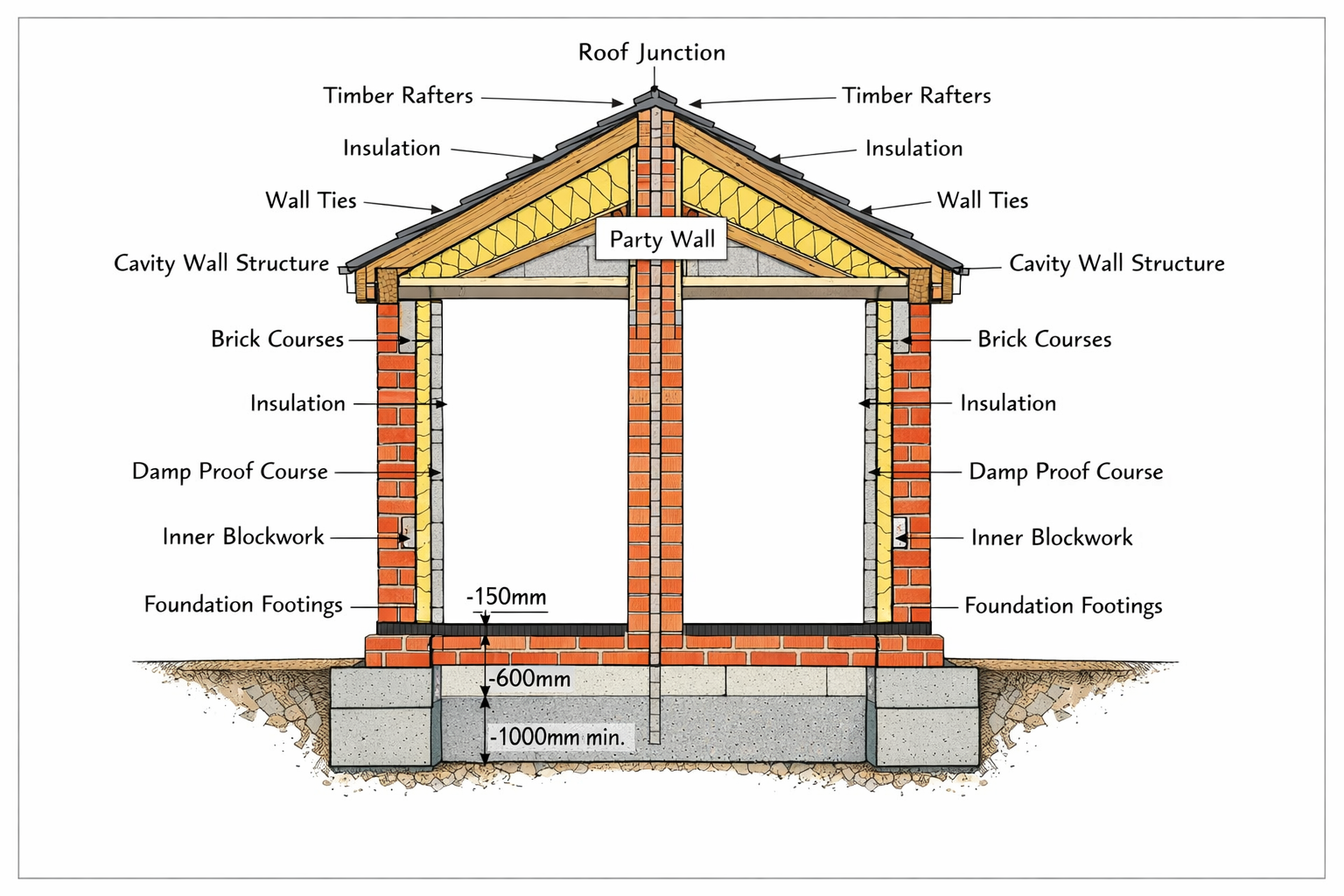
A semi detached party wall refers to the shared structural wall that separates two semi-detached houses. Unlike detached properties that stand alone, semi-detached homes are built in pairs, sharing a common dividing wall that extends from the foundation through to the roof structure.
Legal Definition Under the Party Wall Act
The Party Wall etc. Act 1996 provides the legal framework governing party walls in England and Wales. According to the legislation, a party wall is defined as:
- A wall that stands on the lands of two or more owners and forms part of a building
- A wall that stands on the lands of two owners but does not form part of a building (party fence wall)
- A wall that is within a building and separates parts of the building belonging to different owners
For semi-detached properties, the dividing wall typically falls under the first category. The wall belongs to both property owners equally, with each owning the portion on their side of the centre line. This shared ownership creates mutual rights and responsibilities that both parties must respect.
Physical Characteristics
Semi detached party walls possess several distinctive features:
Structural Elements:
- 🏗️ Load-bearing construction supporting roof structures and upper floors
- 🧱 Typically 9 inches (225mm) or thicker solid masonry construction
- 🔧 Shared foundations extending below ground level
- 🏠 Continuous from ground to roof, including chimney stacks
Construction Materials:
- Brick or block work with mortar joints
- May include cavity construction in newer builds
- Plaster or render finishes on interior surfaces
- Potential for sound insulation materials
The wall serves multiple critical functions: providing structural support, creating a fire barrier between properties, offering sound insulation, and defining property boundaries. Understanding these characteristics helps homeowners appreciate why modifications require careful consideration and professional oversight.
Types of Work Requiring Party Wall Agreements
Not all home improvements affecting a semi detached party wall require formal procedures, but many common projects do trigger legal obligations. Knowing which works require notices helps homeowners plan properly and avoid violations.
Notifiable Works Under the Act
The Party Wall etc. Act 1996 specifies several categories of work that require serving party wall notices to neighbours:
Category 1: Works Directly to the Party Wall
- Cutting into the wall to insert damp proof courses
- Raising the party wall height
- Demolishing and rebuilding the party wall
- Cutting into the wall to insert beams or joists
- Installing wall plates or timber supports
- Underpinning the party wall foundations
Category 2: New Building at the Boundary
- Constructing a new wall at or astride the boundary line
- Building up to the boundary line within specified distances
- Excavating within 3 metres of neighbouring structures (if going deeper than their foundations)
- Excavating within 6 metres of neighbouring structures (if excavation falls within 45-degree angle from foundation base)
Category 3: Alterations Affecting Load or Support
- Removing chimney breasts that share the party wall
- Creating openings or doorways through the party wall
- Installing steel beams that bear on the party wall
- Significant alterations to the wall’s structural integrity
Common Semi-Detached Projects
Homeowners frequently undertake these projects that affect the semi detached party wall:
| Project Type | Party Wall Impact | Notice Required |
|---|---|---|
| Loft Conversion | Cutting into wall for joists, raising wall height | Yes – 2 months |
| Basement Excavation | Underpinning, excavation near foundations | Yes – 1-6 months |
| Kitchen Extension | New foundations, wall alterations | Yes – 2 months |
| Chimney Breast Removal | Structural alteration to shared element | Yes – 2 months |
| Damp Proofing | Cutting into wall for DPC installation | Yes – 2 months |
| New Doorway | Creating opening through party wall | Yes – 2 months |
| Repointing External Face | Minor maintenance only | No |
Understanding the types of party wall works ensures compliance from the project’s earliest planning stages. Even well-intentioned homeowners can face legal action and project delays if they proceed without proper notices.
The Party Wall Notice Process for Semi Detached Properties
Navigating the formal notice process represents a crucial step for any homeowner planning work on a semi detached party wall. The procedure follows a structured timeline designed to protect both building owners and adjoining owners.
Step 1: Determine Notice Requirements
Before beginning any construction work, building owners must identify whether their planned work falls under the Party Wall Act. This assessment should occur during the early planning stages, ideally before submitting planning applications or hiring contractors.
Consider consulting with a qualified professional who can review architectural plans and confirm notice requirements. This preliminary step prevents costly mistakes and project delays later.
Step 2: Prepare and Serve Formal Notices
Once you’ve confirmed that notices are required, you must prepare formal documentation containing specific information:
Essential Notice Contents:
- ✅ Building owner’s name and address
- ✅ Description of the proposed works with technical details
- ✅ Date when works will commence
- ✅ Drawings or plans showing the work location and extent
- ✅ Statement of rights under the Party Wall Act
The notice must be served to all adjoining owners whose properties share the party wall or are affected by excavation work. Service methods include:
- Hand delivery with acknowledgment
- Recorded or registered mail
- Leaving at the property if occupants refuse acceptance
Critical Timing Requirements:
- 2 months’ notice for work directly to the party wall
- 1 month’s notice for excavation work near boundaries
- Notices must be served before work commences, not before planning permission
Step 3: Neighbour Response Options
After receiving a party wall notice, the adjoining owner has 14 days to respond in one of three ways:
Option 1: Consent ✅
The neighbour agrees to the proposed works in writing. This represents the simplest outcome, allowing work to proceed without appointing surveyors. However, even with consent, it’s advisable to prepare a schedule of condition documenting the property’s current state.
Option 2: Dissent ❌
The neighbour objects to the works or doesn’t respond within 14 days (silence equals dissent). This triggers the dispute resolution process requiring surveyor appointments.
Option 3: Conditional Consent 📋
The neighbour agrees but requests specific conditions, such as working hours, access arrangements, or additional protections. These conditions can be incorporated into a party wall agreement.
Step 4: Appointing Surveyors
When a dispute arises (through dissent or non-response), the Party Wall Act requires appointing surveyors to resolve matters impartially. Three appointment options exist:
Agreed Surveyor Approach:
Both parties jointly appoint a single surveyor who acts impartially for both sides. This approach typically reduces costs but requires mutual trust and agreement. The surveyor must remain neutral and cannot favour either party.
Two Surveyor Approach:
Each party appoints their own surveyor—the building owner selects a building owner’s surveyor, while the adjoining owner chooses an adjoining owner’s surveyor. The two surveyors then work together, and if they cannot agree on certain matters, they appoint a third surveyor to make final determinations.
Third Surveyor:
This impartial professional only becomes involved when the two appointed surveyors cannot reach agreement on specific issues. The third surveyor’s decisions are binding on both parties.
Important Note: The building owner typically bears the reasonable costs of the party wall process, including surveyor fees for both parties. Understanding how to keep party wall costs down helps manage project budgets effectively.
Understanding Party Wall Awards and Agreements
Once surveyors are appointed, they work to produce a formal document that governs how the work will proceed. This document—called a party wall award—provides legal protection for both parties and establishes clear parameters for construction activities.
What Is a Party Wall Award?
A party wall award is a legally binding document prepared by the appointed surveyor(s) that sets out:
- Detailed work description: Specific activities permitted under the Act
- Timing and access: When work may occur and access arrangements
- Protective measures: Requirements to prevent damage to the adjoining property
- Condition schedule: Photographic and written record of the neighbour’s property before work begins
- Dispute resolution: Procedures if problems arise during construction
- Cost allocation: Who pays for what aspects of the work and process
The award must be served to both parties and becomes enforceable once issued. Either party can appeal to the County Court within 14 days if they believe the award is unreasonable, though such appeals are relatively uncommon.
Key Components of Awards
Understanding what the award contains helps both building and adjoining owners know their rights and obligations:
Schedule of Condition
This critical component involves a detailed survey documenting the adjoining property’s current state through photographs and written descriptions. The schedule provides baseline evidence if damage claims arise later, protecting both parties from unfounded allegations or unrecognized damage.
Working Methods Statement
The award specifies exactly how work should be carried out, including:
- Construction techniques and sequences
- Structural support requirements
- Noise and vibration limitations
- Working hours restrictions
- Dust and debris control measures
Special Conditions
Tailored provisions address unique circumstances, such as:
- Protection for vulnerable structures or finishes
- Monitoring requirements during construction
- Notification protocols for specific work stages
- Emergency contact procedures
Rights of Access
The award clarifies when and how building owners or contractors may access the adjoining property for inspection, maintenance, or construction purposes. Reasonable notice periods and access limitations protect the adjoining owner’s privacy and convenience.
Agreements Without Surveyors
When neighbours consent to proposed works, they may choose to formalize their agreement without appointing surveyors. This approach works well when:
- The relationship between neighbours is strong and trusting
- The proposed works are relatively straightforward
- Both parties understand their rights and obligations
- Cost savings are a priority for both sides
However, even when proceeding without surveyors, creating a written agreement offers important protections. A party wall agreement template can help structure this documentation. The agreement should still include:
- Clear work descriptions
- Schedule of condition
- Access arrangements
- Damage resolution procedures
- Insurance confirmation
For guidance on this approach, homeowners can review information about having a party wall agreement without a surveyor, though professional advice remains valuable even in consensual situations.
Rights and Responsibilities of Building Owners
Property owners planning work on a semi detached party wall assume significant legal obligations alongside their rights to improve their property. Understanding this balance ensures compliance and maintains positive neighbour relations.
Building Owner Rights
The Party Wall Act grants building owners several important rights:
Right to Undertake Necessary Works 🔨
Building owners can proceed with works covered by the Act, even if neighbours object. The legislation recognizes that property owners must be able to maintain, repair, and improve their homes. Neighbour dissent cannot prevent work entirely—it only triggers the surveyor appointment process.
Right to Enter Neighbouring Property 🚪
When necessary for executing party wall works, building owners have a statutory right to enter the adjoining property, provided they:
- Give at least 14 days’ written notice
- Access at reasonable times (typically working hours)
- Cause minimal disruption and inconvenience
- Restore any damage caused by access
Right to Appoint Surveyors 👷
Building owners can select qualified professionals to represent their interests and ensure work proceeds according to the Act’s requirements. This appointment provides expert guidance throughout the process.
Building Owner Obligations
With these rights come corresponding responsibilities that must be taken seriously:
Duty to Serve Proper Notices 📬
Building owners must provide timely, accurate notices containing all required information. Defective notices can invalidate the entire process, potentially leading to injunctions stopping work and requiring the process to restart.
Financial Responsibility 💰
The building owner bears the cost of:
- Their own surveyor’s fees
- The adjoining owner’s reasonable surveyor fees
- Preparing the party wall award
- Any damage caused to the neighbouring property
- Making good any damage resulting from the works
Understanding the costs of the party wall process helps with budget planning. While these expenses add to project costs, they’re significantly less than the potential costs of legal disputes or damage claims.
Duty to Minimize Disruption ⏰
Building owners must conduct work reasonably, respecting the adjoining owner’s right to quiet enjoyment of their property. This includes:
- Adhering to agreed working hours
- Controlling noise, dust, and vibration
- Maintaining site safety and security
- Communicating about work schedules and progress
Obligation to Repair Damage 🔧
If works cause damage to the neighbouring property, the building owner must make good the damage at their expense. The pre-work schedule of condition provides the baseline for assessing what damage occurred.
Duty to Comply with the Award ⚖️
Once issued, the party wall award becomes legally binding. Building owners must follow its terms precisely, including working methods, access arrangements, and protective measures.
Rights and Responsibilities of Adjoining Owners
Neighbours whose properties adjoin a semi detached party wall where work is planned also have specific rights and obligations under the Party Wall Act.
Adjoining Owner Rights
The legislation provides several important protections for adjoining owners:
Right to Receive Proper Notice 📨
Adjoining owners must receive formal notice with adequate time to consider the proposed works and seek professional advice before responding. Inadequate notice periods or deficient information invalidate the process.
Right to Appoint a Surveyor 👨💼
Even if they don’t object to the works themselves, adjoining owners can appoint a surveyor at the building owner’s expense to ensure their interests are protected throughout the process. This professional reviews plans, monitors construction, and verifies that damage claims are properly addressed.
Right to a Schedule of Condition 📸
Adjoining owners can insist on a comprehensive photographic and written survey documenting their property’s condition before work commences. This evidence proves invaluable if damage disputes arise later.
Right to Compensation 💵
If the works cause damage, loss, or inconvenience, adjoining owners have the right to appropriate compensation. The party wall award typically addresses how such claims will be assessed and resolved.
Right to Appeal ⚖️
Adjoining owners can appeal a party wall award to the County Court within 14 days if they believe it’s unreasonable or doesn’t adequately protect their interests.
Adjoining Owner Obligations
Adjoining owners also have responsibilities under the Act:
Duty to Respond Promptly ⏱️
While adjoining owners have 14 days to respond to notices, prompt communication helps the process proceed smoothly. Delayed responses can cause project timeline uncertainty.
Obligation to Allow Reasonable Access 🔓
When the award grants access rights, adjoining owners must permit entry at agreed times. Unreasonably refusing access can lead to court enforcement.
Responsibility to Act Reasonably 🤝
While adjoining owners can dissent and appoint surveyors, they cannot use the process to prevent legitimate works or extract unreasonable concessions. The Act balances both parties’ interests fairly.
Duty to Cooperate with Surveyors 📋
Adjoining owners should facilitate surveyor access for inspections and provide information needed to prepare accurate schedules of condition and awards.
For more detailed information about navigating this process as a neighbour, visit the resources for adjoining owners.
Common Issues and Disputes with Semi Detached Party Walls
Despite the Party Wall Act’s clear framework, disputes and complications frequently arise during projects affecting semi detached party walls. Understanding common problems helps both parties anticipate and avoid issues.
Typical Dispute Scenarios
Disagreement Over Work Scope 🔍
Neighbours may dispute whether proposed works actually require party wall notices or whether the described works match what’s being executed on site. Clear, detailed notices and transparent communication prevent many such disagreements.
Damage Claims 💥
The most common dispute involves allegations that construction work damaged the adjoining property. Issues include:
- Cracks in walls or ceilings
- Subsidence or settlement
- Damage to finishes or decorations
- Structural movement or distortion
Pre-work schedules of condition provide crucial evidence for resolving these claims fairly. Without photographic documentation, determining whether damage existed before work began becomes nearly impossible.
Access Disputes 🚫
Conflicts about when, how often, and under what conditions building owners or contractors can access neighbouring properties create significant friction. Clear award provisions and respectful communication help manage access needs.
Cost Disagreements 💷
Disputes over who pays for what aspects of the process—particularly surveyor fees, monitoring costs, and remedial works—frequently arise. The general principle that building owners pay reasonable costs applies, but defining “reasonable” sometimes requires surveyor or court intervention.
Boundary Uncertainties 📏
Sometimes the exact location of the property boundary remains unclear, creating confusion about whether a wall is truly a party wall or belongs entirely to one owner. Land registry documents and professional surveys may be needed to resolve such questions. Understanding boundary wall rules and the difference between party fence walls and boundary walls clarifies these distinctions.
Prevention Strategies
Early Professional Involvement 👨🔧
Engaging qualified party wall surveyors early in the planning process prevents many problems. Professional guidance ensures notices are properly prepared, rights are understood, and potential issues are identified before they become serious.
Clear Communication 💬
Regular, transparent communication between neighbours builds trust and prevents misunderstandings. Building owners should:
- Explain the project’s purpose and benefits
- Share plans and timelines proactively
- Provide contact information for the project manager
- Update neighbours about progress and any changes
- Address concerns promptly and respectfully
Comprehensive Documentation 📄
Thorough records protect both parties:
- Detailed photographic schedules of condition
- Written correspondence and agreements
- Contractor qualifications and insurance certificates
- Progress photographs during construction
- Completion documentation
Respectful Work Practices 🙏
Contractors should minimize disruption by:
- Adhering strictly to agreed working hours
- Controlling noise, dust, and debris
- Maintaining site cleanliness and safety
- Parking considerately
- Treating neighbours and their property with respect
Insurance Coverage 🛡️
Building owners should verify that contractors carry adequate public liability insurance and that their own home insurance covers party wall works. This financial protection proves invaluable if damage occurs.
Selecting a Qualified Party Wall Surveyor
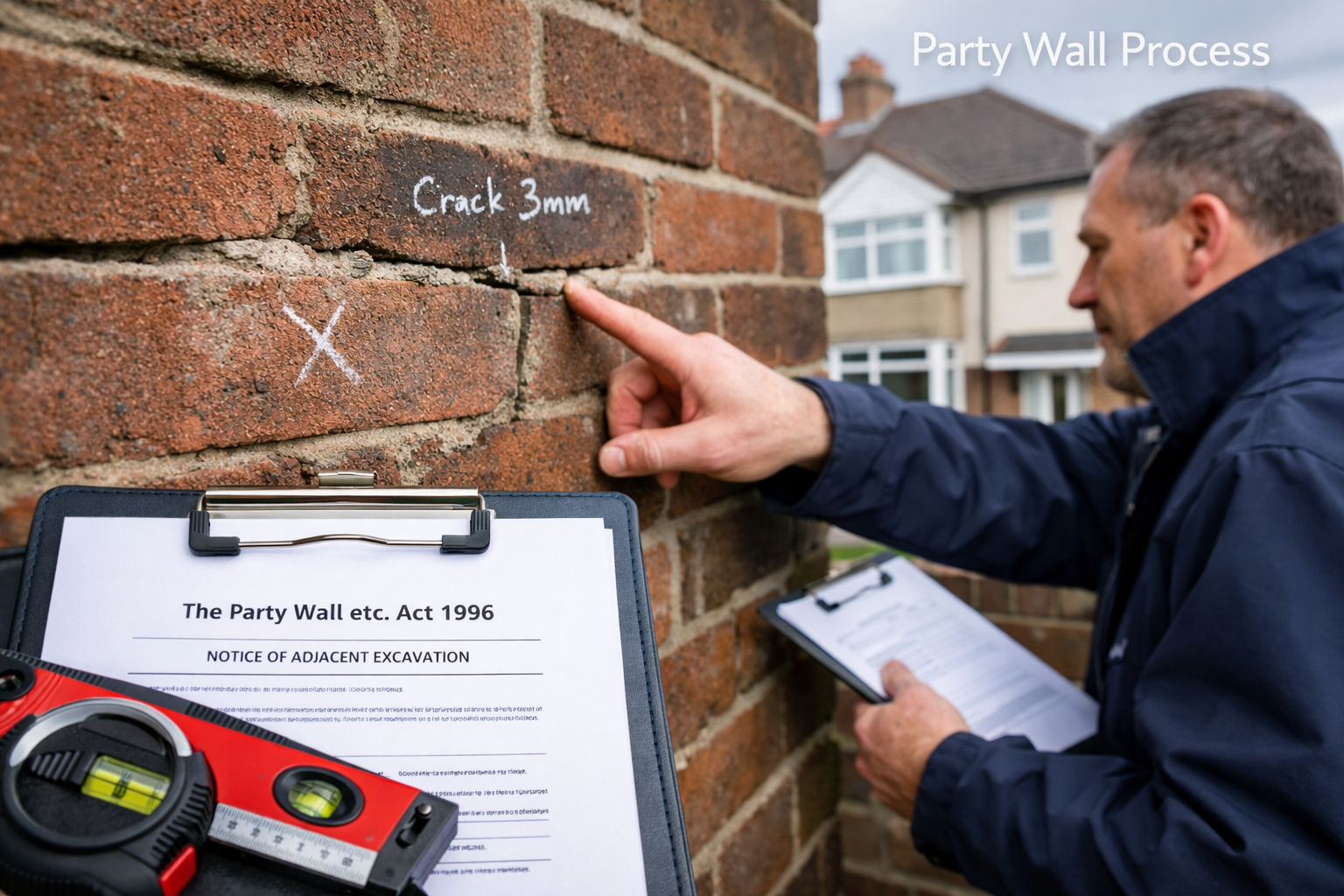
Choosing the right professional to manage the party wall process significantly impacts the experience for both building and adjoining owners. Qualified surveyors bring expertise, impartiality, and problem-solving skills that smooth the path from notice to completion.
Essential Qualifications and Experience
When selecting a party wall surveyor, look for:
Professional Credentials 🎓
- Membership in the Royal Institution of Chartered Surveyors (RICS)
- Specialist party wall qualifications or accreditations
- Faculty of Party Wall Surveyors (FPWS) membership
- Continuing professional development in party wall matters
Relevant Experience 📊
- Proven track record with semi-detached properties
- Experience with your specific type of work (extensions, loft conversions, etc.)
- Knowledge of local building practices and conditions
- Familiarity with dispute resolution procedures
Professional Indemnity Insurance 🛡️
Adequate insurance coverage protects all parties if professional errors occur. Verify that prospective surveyors carry current, sufficient coverage.
Questions to Ask Prospective Surveyors
Before appointing a surveyor, ask:
- How many party wall matters have you handled? Experience matters, particularly with cases similar to yours.
- What is your fee structure? Understand whether fees are fixed, hourly, or based on the project value. Request written fee estimates.
- What is your typical timeline? Know how long the process will take from appointment to award issuance.
- How do you communicate with clients? Clarify how often you’ll receive updates and through what channels.
- Can you provide references? Speaking with previous clients offers valuable insights into the surveyor’s professionalism and effectiveness.
- Are you familiar with local building practices? Local knowledge helps surveyors assess proposed works realistically.
The Value of Professional Guidance
While the party wall process adds costs to construction projects, professional surveyor involvement provides significant value:
Risk Mitigation ⚠️
Surveyors identify potential problems before they escalate, protecting both parties from costly disputes and project delays.
Impartial Expertise ⚖️
Qualified surveyors apply the law fairly and consistently, ensuring neither party gains unfair advantage.
Technical Knowledge 🔧
Understanding construction methods, structural implications, and building regulations allows surveyors to assess proposed works accurately and recommend appropriate protective measures.
Dispute Resolution 🤝
When disagreements arise, experienced surveyors employ negotiation and problem-solving skills to find practical solutions that satisfy both parties.
Documentation and Evidence 📋
Professional schedules of condition and awards provide clear, defensible records that prevent misunderstandings and support fair damage assessments.
For expert assistance with your party wall matters, consider consulting with experienced party wall surveyors in London who understand the unique challenges of semi-detached properties.
Regional Considerations and Local Variations
While the Party Wall etc. Act 1996 applies uniformly across England and Wales, practical implementation varies by location due to different building styles, local practices, and regional property markets.
London and Urban Areas
Dense urban environments like London present unique party wall challenges:
Higher Property Values 💰
Expensive properties mean greater financial stakes in damage claims and dispute resolution. Meticulous documentation becomes even more critical.
Complex Building Histories 🏛️
Older properties often have complicated structural histories with previous alterations, making it harder to assess the impact of new works. Victorian and Edwardian semi-detached homes particularly require careful evaluation.
Professional Expectations 👔
Urban property owners typically expect formal, professional party wall procedures even for relatively minor works. Informal arrangements are less common than in rural areas.
Specialist Surveyors 🏙️
Major cities have concentrations of experienced party wall professionals. Whether you need a party wall surveyor in North London, South London, East London, West London, or Central London, qualified professionals are readily available.
Suburban and Rural Settings
Less densely populated areas often experience different party wall dynamics:
Informal Relationships 🤝
Neighbours in smaller communities may have longer-standing relationships and prefer less formal arrangements, though written agreements remain advisable.
Different Building Styles 🏡
Suburban semi-detached properties often feature different construction methods and materials than urban counterparts, affecting how works should be approached.
Limited Surveyor Availability 🗺️
Rural areas may have fewer specialist party wall surveyors, potentially requiring professionals to travel from larger towns or cities.
Scotland and Northern Ireland
The Party Wall etc. Act 1996 does not apply in Scotland or Northern Ireland, where different legal frameworks govern shared walls:
Scotland 🏴
Scottish common law and the Title Conditions (Scotland) Act 2003 address party wall matters differently. Property deeds and local agreements play larger roles, and the formal notice procedures don’t apply.
Northern Ireland 🇮🇪
Northern Ireland follows common law principles for party walls, with property rights determined by deeds and established practices rather than statutory procedures.
Homeowners in these regions should seek local legal advice about their specific obligations when planning works affecting shared walls.
Practical Tips for Homeowners Planning Party Wall Works
Successfully navigating the semi detached party wall process requires careful planning, clear communication, and attention to detail. These practical strategies help ensure smooth project execution.
Before Starting Your Project
1. Research Requirements Early 📚
Don’t wait until you’re ready to start construction to learn about party wall obligations. Investigate requirements during the initial planning stages, ideally before finalizing architectural plans or hiring contractors.
2. Budget for Party Wall Costs 💵
Include surveyor fees, award preparation, schedule of condition costs, and potential remedial works in your project budget. Unexpected party wall expenses derail many renovation budgets.
3. Choose Contractors Wisely 🔨
Select builders experienced with party wall works who understand the importance of following award provisions and working considerately near neighbouring properties.
4. Talk to Your Neighbour First 💬
Before serving formal notices, have an informal conversation explaining your plans. This courtesy often prevents objections and builds goodwill that smooths the entire process.
5. Prepare Comprehensive Plans 📐
Detailed architectural drawings help neighbours understand exactly what you’re proposing and demonstrate your professionalism and transparency.
During the Notice Period
6. Serve Notices Correctly 📬
Use proper service methods and keep proof of delivery. Defective service can invalidate the entire process and delay your project significantly.
7. Respond to Questions Promptly ⏰
If neighbours have questions or concerns, address them quickly and thoroughly. Responsive communication prevents small worries from becoming major objections.
8. Be Flexible Where Possible 🤸
If neighbours request reasonable modifications to working hours, access arrangements, or protective measures, accommodate them when feasible. Flexibility builds cooperation.
9. Appoint Surveyors Quickly 👨💼
If your neighbour dissents or doesn’t respond, appoint your surveyor immediately to keep the process moving forward.
During Construction
10. Follow the Award Precisely 📋
Treat the party wall award as a binding contract. Deviating from its terms can expose you to legal action and damage claims.
11. Maintain Open Communication 📞
Keep neighbours informed about work schedules, potential disruptions, and project progress. Forewarned neighbours are more understanding and patient.
12. Monitor for Damage 👀
Regularly inspect both your property and the visible exterior of your neighbour’s property for signs of damage. Early detection allows prompt remediation before problems worsen.
13. Document Everything 📸
Take photographs throughout the construction process, particularly of critical stages like excavation, structural alterations, and completion. This documentation proves invaluable if disputes arise.
14. Respect Agreed Boundaries 🚧
Never exceed agreed working hours, access rights, or work scopes without prior agreement. Violations damage trust and can trigger legal action.
After Completion
15. Conduct Final Inspections 🔍
Have your surveyor inspect both properties to verify that no damage occurred or that any damage has been properly repaired.
16. Maintain Records 🗄️
Keep all party wall documentation permanently with your property records. Future owners will need this information, and it provides protection against later claims.
17. Thank Your Neighbour 🙏
A simple thank-you note or small gesture acknowledging your neighbour’s patience and cooperation maintains good relations for the future.
Frequently Asked Questions About Semi Detached Party Walls
Do I always need a party wall agreement for work on a semi-detached house?
Not all work requires formal party wall procedures. You need an agreement if you’re:
- Cutting into, raising, or demolishing the party wall
- Building a new wall at the boundary
- Excavating near your neighbour’s foundations
- Undertaking work that affects the wall’s structural integrity
Minor repairs, redecorating, or work that doesn’t affect the party wall structure typically don’t require notices.
How much does the party wall process cost?
Costs vary significantly based on project complexity, property location, and whether disputes arise. Typical expenses include:
- Agreed surveyor: £700-£1,500 for straightforward cases
- Two surveyors: £1,500-£3,000+ for more complex matters
- Schedule of condition: £300-£800 per property
- Monitoring visits: £150-£300 per visit
Building owners pay these costs, including reasonable fees for the adjoining owner’s surveyor. For detailed information, review the costs of the party wall process.
What happens if I don’t follow the Party Wall Act?
Proceeding without proper notices or awards exposes you to serious consequences:
- Injunctions: Neighbours can obtain court orders stopping your work immediately
- Damages: You’ll be liable for any damage caused, without the protection of an award
- Legal costs: You may have to pay your neighbour’s legal expenses
- Project delays: Rectifying procedural failures adds weeks or months to timelines
- Relationship damage: Ignoring legal obligations destroys neighbour goodwill
Can my neighbour stop my building project?
No. The Party Wall Act gives you the right to proceed with necessary works even if your neighbour objects. However, dissent triggers the surveyor appointment process, which adds time and cost to your project. Your neighbour cannot prevent legitimate works, but they can ensure proper protections are in place.
How long does the party wall process take?
Timeline varies based on several factors:
- With neighbour consent: 2 months from notice to commencement (minimum notice period)
- With surveyor involvement: 3-4 months typically, from notice through award preparation
- Complex cases or disputes: 4-6 months or longer
Plan accordingly and don’t schedule contractors until you’ve received consent or an award.
What if I discover my neighbour started work without serving notice?
If your neighbour is undertaking notifiable works without following proper procedures, you have several options:
- Communicate directly: Inform them of their obligations under the Act
- Seek professional advice: Consult a party wall surveyor about your rights
- Formal notification: Write formally requesting they comply with the Act
- Legal action: As a last resort, seek an injunction to stop the works
Acting quickly protects your property and rights. Don’t wait until damage occurs.
For additional questions and detailed answers, visit the general FAQs section.
The Future of Party Wall Legislation
As property development continues and building techniques evolve, party wall legislation faces new challenges and potential reforms.
Current Legislative Discussions
Various industry groups and professional bodies have proposed amendments to the Party Wall etc. Act 1996 to address:
Digital Communication 📱
Modernizing notice service methods to include email and electronic signatures, reflecting how people communicate in 2025.
Dispute Resolution ⚖️
Introducing alternative dispute resolution mechanisms to reduce costs and delays when disagreements arise.
Clarity and Guidance 📖
Providing more detailed statutory guidance to reduce interpretation disputes and improve consistency.
Enforcement Mechanisms 🔨
Strengthening enforcement provisions to deter non-compliance and protect adjoining owners more effectively.
Emerging Trends
Increased Awareness 📈
Property owners are becoming more knowledgeable about party wall requirements, partly due to online resources and professional education efforts.
Professional Standards 🎓
Surveyor professional bodies continue raising standards through enhanced training, certification programs, and ethical guidelines.
Technology Integration 💻
Digital tools for schedule preparation, award management, and project monitoring are improving efficiency and documentation quality.
Sustainability Considerations 🌱
As energy efficiency retrofits become more common, party wall procedures are adapting to address insulation installations, solar panel mounting, and other green building modifications.
Conclusion: Navigating Semi Detached Party Walls Successfully
Understanding the complexities of semi detached party wall regulations represents an essential responsibility for homeowners planning construction work. While the Party Wall etc. Act 1996 creates formal procedures that may seem bureaucratic, these requirements serve crucial purposes: protecting property rights, preventing disputes, and ensuring construction work proceeds safely and considerately.
The key to successful party wall navigation lies in early planning, professional guidance, clear communication, and mutual respect between neighbours. Building owners who approach the process transparently and courteously typically find that neighbours respond positively, even when formal surveyor appointments become necessary.
Your Next Steps
If you’re planning work that affects a semi detached party wall, take these actions now:
- Assess your project against Party Wall Act requirements to determine if notices are needed
- Consult a qualified surveyor early in the planning process for expert guidance
- Prepare comprehensive plans that clearly show the proposed works
- Communicate with your neighbour before serving formal notices
- Budget appropriately for party wall costs as part of your overall project
- Allow sufficient time for the notice period and award preparation before scheduling contractors
- Document everything from initial conversations through project completion
For professional assistance navigating the party wall process, contact experienced surveyors who can guide you through every step, from initial assessment through final completion.
Whether you’re carrying out works yourself or responding to a neighbour’s construction project, understanding your rights and obligations under the Party Wall Act protects your interests and maintains positive relationships with those who share your property boundaries.
The party wall process may add time and cost to your project, but it provides invaluable protection, clear procedures, and professional oversight that prevent far more expensive problems down the line. Approach it as an investment in your project’s success and your long-term relationship with your neighbours.
For more information, explore additional resources in the party wall blog section covering topics from party wall notices to boundary rules and everything in between.