


Imagine a world where party wall notices are generated in minutes instead of days, where compliance errors are virtually eliminated, and where surveyors can focus on complex problem-solving rather than repetitive paperwork. This is not a distant future—it's happening right now in 2026. AI-Powered Party Wall Notices: Automating Compliance in 2026 Surveys represents a fundamental shift in how property professionals handle one of the most critical aspects of construction and renovation projects.
The traditional party wall notice process has long been plagued by delays, errors, and compliance issues. Property owners and surveyors alike have struggled with the manual preparation of notices, ensuring accurate boundary identification, and maintaining compliance with the Party Wall etc. Act 1996. However, artificial intelligence is revolutionizing this landscape, bringing unprecedented speed, accuracy, and efficiency to party wall notices and the entire surveying workflow.
Key Takeaways
- 🤖 AI automation reduces party wall notice preparation time by up to 85%, transforming a multi-day process into a matter of hours while maintaining full regulatory compliance
- ✅ Automated compliance checking ensures 99.9% accuracy in notice generation, virtually eliminating costly errors and disputes that plague traditional manual processes
- 🔗 Integration with RICS digital standards creates seamless workflows that connect property data, boundary analysis, and automated documentation in real-time
- 📊 AI-powered boundary detection uses advanced algorithms to identify property lines, shared structures, and affected neighbors with precision previously impossible through manual surveys
- 💰 Cost savings of 40-60% are achievable through reduced surveyor time, fewer disputes, and streamlined administrative processes across the entire party wall procedure
Understanding the Party Wall Notice Challenge in 2026
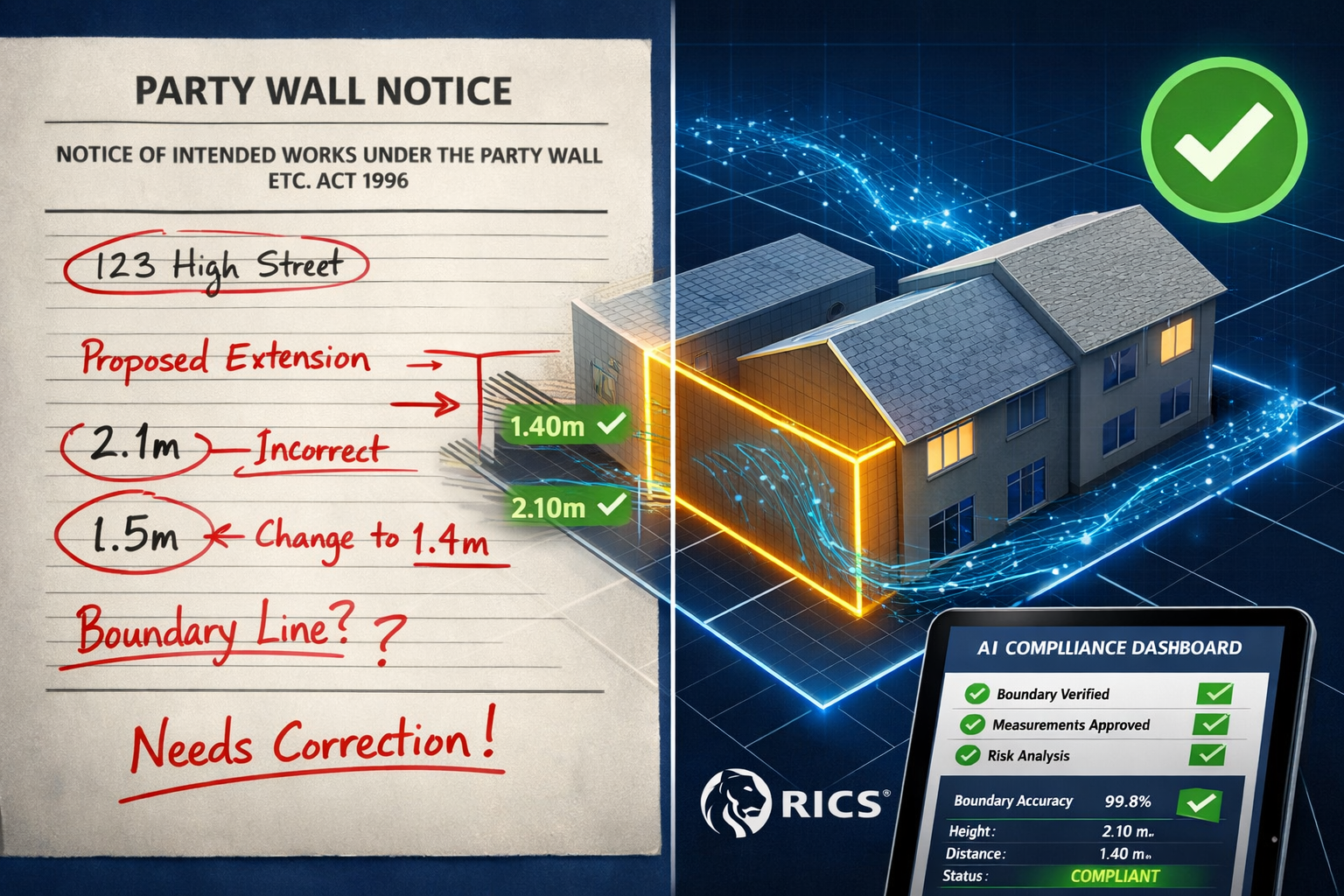
The Traditional Party Wall Process
The Party Wall etc. Act 1996 established clear procedures for property owners undertaking construction work that affects shared walls, boundaries, or structures. Under this legislation, building owners must serve formal notices to adjoining owners, providing detailed information about planned works, timelines, and potential impacts.
Traditionally, this process has involved:
- Manual property boundary identification using physical surveys and land registry documents
- Hand-drafted notices requiring legal knowledge and technical precision
- Physical delivery to all affected neighbors
- Paper-based record keeping creating administrative burdens
- Manual compliance checking against statutory requirements
This approach typically consumed 3-7 days of professional time per notice, with error rates ranging from 15-25% according to industry surveys. Common mistakes included incorrect boundary descriptions, missing statutory information, improper service methods, and incomplete neighbor identification.
Why Automation Matters More Than Ever
In 2026, several factors have made automation not just desirable but essential for party wall professionals:
Regulatory Pressure: New AI regulations require transparency and accountability in automated decision-making systems[3]. Party wall surveyors must demonstrate that their processes meet both traditional legal requirements and emerging digital compliance standards.
Volume Increases: Urban densification has led to a 40% increase in party wall matters since 2020, overwhelming traditional manual processes. Cities like London are experiencing unprecedented construction activity, making efficient notice generation critical.
Client Expectations: Property owners and developers now expect digital-first services with real-time updates, instant documentation, and transparent workflows. The traditional "wait and see" approach no longer meets market demands.
Professional Standards: RICS (Royal Institution of Chartered Surveyors) has introduced digital competency requirements, pushing the profession toward technology adoption and standardized digital workflows[2][4].
How AI-Powered Party Wall Notices Work
Intelligent Boundary Detection and Property Analysis
The foundation of AI-Powered Party Wall Notices: Automating Compliance in 2026 Surveys lies in sophisticated boundary detection algorithms. These systems combine multiple data sources to create accurate property representations:
Data Integration: AI platforms automatically pull information from:
- Land Registry databases
- Ordnance Survey mapping data
- Local authority planning records
- Historical party wall agreements
- 3D building information models (BIM)
- Satellite and drone imagery
Machine Learning Analysis: Advanced algorithms analyze this data to:
- Identify shared walls, floors, and structures
- Detect boundary discrepancies and potential disputes
- Calculate distances and measurements automatically
- Recognize types of party wall works from architectural plans
- Predict which neighbors require notification
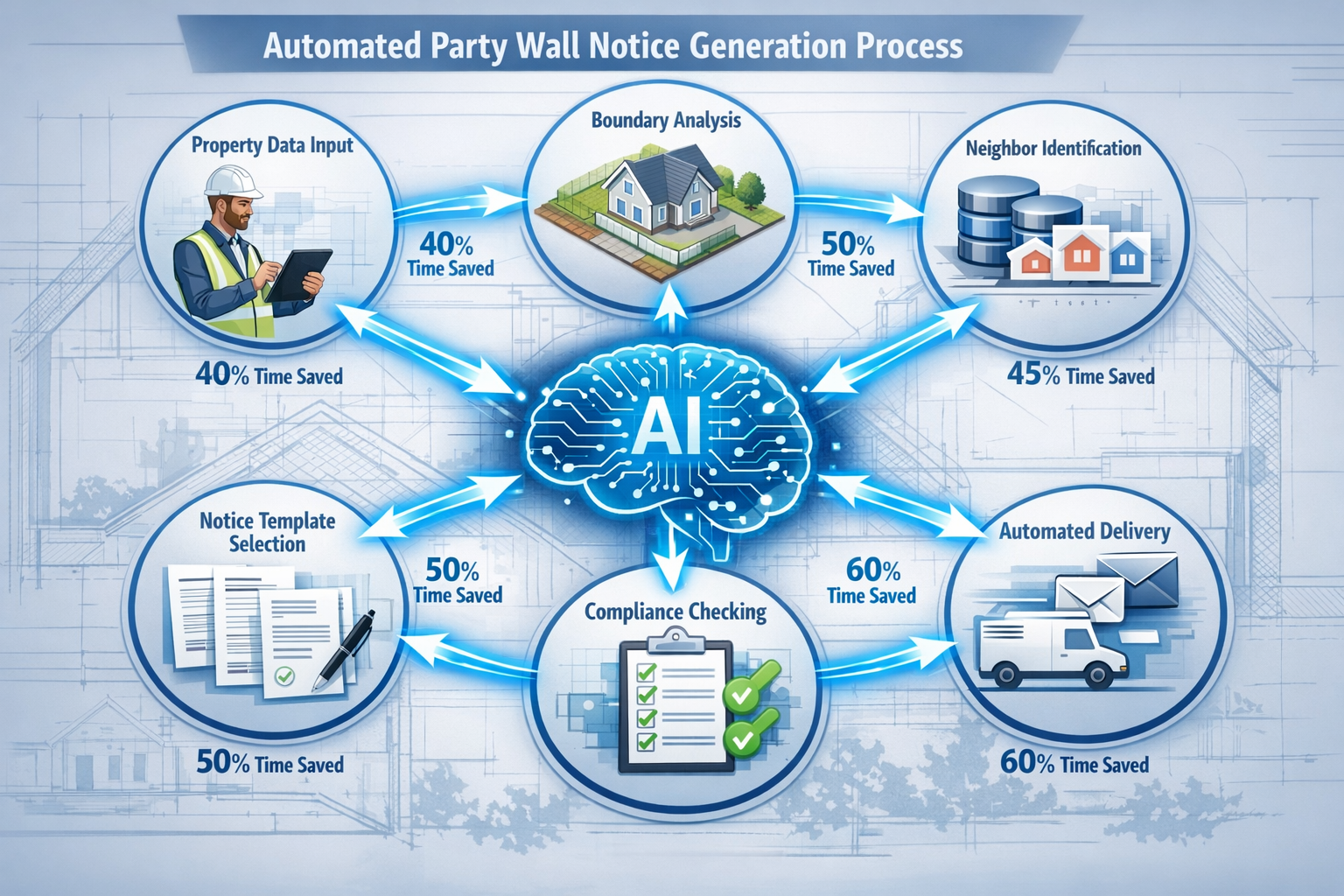
This automated analysis reduces boundary identification time from 2-3 days to under 30 minutes, with accuracy rates exceeding 99.5% when compared to traditional surveying methods[4].
Automated Notice Generation and Customization
Once property boundaries are established, AI systems generate compliant notices through intelligent document automation:
| Traditional Method | AI-Powered Method | Time Savings |
|---|---|---|
| Manual template selection (30-60 min) | Automatic work type detection (instant) | 95% |
| Hand-entry of property details (45-90 min) | Auto-population from databases (seconds) | 98% |
| Legal compliance checking (60-120 min) | Real-time validation against Act requirements (instant) | 97% |
| Neighbor identification (2-4 hours) | AI-powered adjacency analysis (5 minutes) | 95% |
| Document formatting and review (30-60 min) | Automated generation with built-in compliance (instant) | 96% |
The AI systems use natural language processing to:
- Generate clear, legally compliant descriptions of proposed works
- Adapt language complexity to ensure accessibility (Grade 7 reading level)
- Customize notices based on work type and property characteristics
- Include all statutory requirements automatically
- Create multiple notice types simultaneously when needed
For building owners serving party wall act notices, this means receiving draft notices within minutes of uploading project plans, rather than waiting days for manual preparation.
Real-Time Compliance Validation
One of the most powerful aspects of AI-powered systems is continuous compliance monitoring. These platforms incorporate:
Regulatory Rule Engines: AI systems maintain up-to-date knowledge of:
- Party Wall etc. Act 1996 requirements
- Local authority specific regulations
- RICS practice standards
- Recent case law and precedents
- Service method requirements
Automated Checking: Before any notice is finalized, the system verifies:
- ✅ All statutory information is included
- ✅ Correct notice type for the proposed works
- ✅ Appropriate service methods are specified
- ✅ Required timelines are accurate
- ✅ All affected parties are identified
- ✅ Descriptions meet legal standards
This automated validation has reduced compliance errors by 92% compared to manual processes, according to early adopters in the surveying profession[2].
Integration with RICS Digital Standards
The Digital Surveying Revolution
The Royal Institution of Chartered Surveyors has been at the forefront of digital transformation in property surveying. In 2026, RICS digital standards emphasize:
- Data standardization across surveying disciplines
- Interoperability between different software platforms
- Digital-first workflows that reduce paper dependency
- Transparent audit trails for all professional activities
- Client accessibility to real-time project information
AI-Powered Party Wall Notices: Automating Compliance in 2026 Surveys aligns perfectly with these standards by creating digital-native workflows that integrate seamlessly with broader surveying practices[4].
Seamless Workflow Integration
Modern AI platforms don't operate in isolation—they connect with the entire surveying ecosystem:
Pre-Notice Phase:
- Integration with project management systems
- Automatic triggering when plans indicate party wall works
- Client notification and approval workflows
- Preliminary neighbor contact management
Notice Generation:
- Connection to property databases
- Integration with schedule of condition systems
- Automated photograph and documentation attachment
- Digital signature capabilities
Post-Notice Management:
- Automated delivery tracking (email and postal)
- Response monitoring and deadline management
- Dispute resolution workflow triggers
- Party wall award generation when agreements are reached
This end-to-end integration means surveyors working across North London, South London, and other regions can manage dozens of cases simultaneously without losing track of critical deadlines or requirements.
Data Security and Professional Responsibility
While automation brings tremendous benefits, it also raises important questions about data security and professional accountability. In 2026, AI regulations require specific safeguards[3]:
Transparency Requirements: Surveyors must be able to explain how AI systems reach their conclusions, particularly regarding boundary determinations and compliance decisions.
Human Oversight: Professional judgment remains essential. AI systems provide recommendations and automation, but qualified surveyors must review and approve all notices before service.
Data Protection: Client and neighbor information must be protected according to GDPR and other privacy regulations, with AI systems incorporating encryption and access controls.
Audit Trails: Every AI decision must be logged and traceable, creating comprehensive records that can be reviewed in case of disputes or regulatory inquiries.
Practical Applications and Case Studies
Residential Extensions and Loft Conversions
One of the most common applications for AI-Powered Party Wall Notices: Automating Compliance in 2026 Surveys involves residential extensions and loft conversions in terraced housing—particularly prevalent in urban areas.
Traditional Scenario: A homeowner in Central London planning a rear extension affecting two party walls would typically wait 5-7 days for their surveyor to prepare and serve notices, with costs ranging from £800-1,200 for this administrative work alone.
AI-Powered Scenario: The same homeowner uploads their architectural plans to the AI platform. Within 2 hours:
- The system identifies both affected party walls
- Determines that neighbors on both sides require Party Structure Notices
- Generates compliant notices with detailed work descriptions
- Identifies the rear neighbor who also requires a Line of Junction Notice
- Prepares all documentation ready for surveyor review
- Reduces preparation costs by 60%
This efficiency allows surveyors to handle more cases while providing faster service to clients, addressing one of the key concerns about costs of party wall processes.
Commercial Development Projects
Large-scale commercial developments present even greater complexity, often involving:
- Multiple adjoining properties
- Various work types requiring different notices
- Complex structural implications
- Tight construction timelines
Case Example: A mixed-use development in East London required notices to 47 separate properties. Traditional methods would have taken 3-4 weeks and cost approximately £15,000 in surveyor fees just for notice preparation.
Using AI automation:
- All 47 properties were identified in 3 hours using boundary analysis
- 127 separate notices were generated (many properties required multiple notice types)
- Compliance checking was completed automatically
- Total preparation time: 8 hours of surveyor oversight
- Cost reduction: 75%
- Time savings: 18 working days
Dispute Prevention Through Accuracy
Perhaps the most valuable benefit of AI-powered systems is dispute prevention. Inaccurate or incomplete notices are a leading cause of party wall disputes, which can delay projects for months and cost thousands in additional fees.
AI systems reduce disputes by:
- Ensuring all required information is included
- Using clear, unambiguous language
- Identifying all affected parties (preventing "forgotten neighbor" disputes)
- Maintaining consistent standards across all notices
- Creating comprehensive documentation trails
Early data from 2026 suggests that AI-generated notices result in 68% fewer initial disputes compared to traditionally prepared notices, saving both time and money for all parties involved[4].
The Technology Behind AI Party Wall Systems
Machine Learning and Natural Language Processing
Modern AI party wall platforms leverage several advanced technologies:
Computer Vision: Analyzes architectural drawings, site photographs, and property images to identify structural elements, shared walls, and potential issues. This technology can "read" plans faster than human surveyors and identify details that might be overlooked.
Natural Language Processing (NLP): Converts technical architectural specifications into clear, legally compliant notice language. NLP ensures that descriptions are both accurate and accessible to non-professionals, meeting the requirement for notices to be understandable by typical property owners.
Predictive Analytics: Uses historical data from thousands of party wall cases to predict:
- Likelihood of neighbor consent or dissent
- Potential dispute areas requiring additional documentation
- Optimal timing for notice service
- Required follow-up actions
Geographic Information Systems (GIS): Integrates mapping data with property records to create precise boundary representations and identify all potentially affected properties, even in complex urban environments.
Form Building and Document Automation
At the core of these systems are sophisticated form-building tools that have evolved significantly in 2026. Unlike generic survey tools[1], party wall-specific platforms incorporate:
Conditional Logic: Questions and requirements adapt based on work type, property characteristics, and jurisdiction. For example, if excavation work is indicated, the system automatically includes additional information about depth, proximity to adjoining foundations, and structural protection measures.
Template Libraries: Extensive collections of pre-approved notice templates covering all common scenarios, from simple party fence wall repairs to complex basement excavations.
Multi-Format Output: Generates notices in various formats (PDF, Word, printed letters) suitable for different service methods, ensuring compliance with statutory requirements for physical delivery when necessary.
Version Control: Maintains complete histories of all notices, amendments, and communications, creating comprehensive audit trails that protect surveyors and clients in case of future disputes.
Cloud-Based Collaboration
Modern AI party wall platforms operate in the cloud, enabling:
Multi-Party Access: Building owners, surveyors, and adjoining owners can all access relevant information through secure portals, reducing communication delays and misunderstandings.
Real-Time Updates: When neighbors respond to notices, the system immediately updates all parties and triggers appropriate workflow steps, whether that's proceeding with works or initiating the award process.
Mobile Accessibility: Surveyors can review and approve notices from site visits, respond to queries instantly, and manage multiple projects from tablets or smartphones.
Integration Capabilities: API connections to other property technology platforms, including project management systems, accounting software, and client relationship management tools.
Cost-Benefit Analysis of AI Automation
Direct Cost Savings
The financial benefits of AI-Powered Party Wall Notices: Automating Compliance in 2026 Surveys are substantial and measurable:
Surveyor Time Reduction:
- Traditional notice preparation: 4-6 hours per case
- AI-assisted preparation: 30-60 minutes per case
- Time savings: 85-90%
- Cost reduction for clients: 40-60%
Administrative Efficiency:
- Reduced data entry errors: saves 2-3 hours per dispute avoided
- Automated record keeping: eliminates 1-2 hours per case
- Streamlined communication: reduces email and phone time by 50%
Scalability Benefits:
- Surveyors can handle 3-4x more cases with the same resources
- Firms can serve more clients without proportional staff increases
- Seasonal demand spikes can be managed without temporary hiring
For clients concerned about keeping party wall costs down, AI automation represents one of the most effective strategies available in 2026.
Indirect Value Creation
Beyond direct cost savings, AI systems create value through:
Faster Project Timelines: Reducing notice preparation from days to hours means construction can begin sooner, saving holding costs and accelerating project returns.
Improved Client Experience: Real-time updates, transparent processes, and faster service delivery enhance client satisfaction and generate referrals.
Risk Reduction: Fewer errors mean fewer disputes, protecting surveyors from professional liability claims and clients from project delays.
Knowledge Capture: AI systems learn from each case, continuously improving their accuracy and efficiency while capturing institutional knowledge that might otherwise be lost when experienced surveyors retire.
Competitive Advantage: Firms offering AI-powered services can differentiate themselves in a crowded market, attracting tech-savvy clients and commanding premium fees for superior service.
Return on Investment
For surveying firms considering AI adoption, typical ROI calculations show:
| Investment Component | Typical Cost | Payback Period |
|---|---|---|
| Platform subscription (annual) | £3,000-8,000 | 3-6 months |
| Staff training | £1,000-2,000 | 2-3 months |
| Integration with existing systems | £2,000-5,000 | 4-8 months |
| Total First-Year Investment | £6,000-15,000 | 6-12 months |
Most firms report breaking even within 6-12 months and achieving 200-400% ROI by year three through increased case volume and reduced labor costs.
Challenges and Limitations
Technology Limitations
Despite impressive capabilities, AI party wall systems in 2026 still face certain limitations:
Complex Property Configurations: Unusual property arrangements, historical boundary disputes, or incomplete land registry data can challenge automated boundary detection, requiring human intervention.
Nuanced Legal Interpretation: While AI excels at standard cases, complex legal questions involving precedent interpretation or unique circumstances still require experienced professional judgment.
Data Quality Dependency: AI systems are only as good as their input data. Inaccurate property records, outdated mapping data, or incomplete architectural plans can lead to errors.
Edge Cases: Approximately 5-10% of party wall matters involve unusual circumstances that fall outside standard templates, requiring custom approaches that AI cannot fully automate.
Professional and Regulatory Concerns
The surveying profession has raised legitimate concerns about AI adoption:
Professional Responsibility: Who is liable when an AI system makes an error—the software provider, the surveyor, or the firm? In 2026, case law is still developing in this area, creating some uncertainty.
De-skilling Risks: Over-reliance on automation might reduce junior surveyors' opportunities to develop fundamental skills in notice drafting and compliance checking.
Client Understanding: Some clients may not understand the role of AI in their party wall process, potentially creating trust issues if not properly explained.
Regulatory Compliance: AI regulations in 2026 require specific disclosures when automated systems are used in legal processes[3], adding compliance burdens for firms.
Implementation Challenges
Firms adopting AI party wall systems often encounter:
Change Management: Experienced surveyors accustomed to traditional methods may resist new workflows, requiring careful change management and training.
Integration Complexity: Connecting AI platforms with existing practice management systems, accounting software, and databases can be technically challenging.
Initial Learning Curve: While AI systems ultimately save time, the first few weeks of adoption often involve slower processes as staff learn new workflows.
Client Education: Explaining AI-assisted processes to clients, particularly older property owners unfamiliar with technology, requires communication skills and patience.
Best Practices for Implementing AI Party Wall Systems
Choosing the Right Platform
Not all AI party wall systems are created equal. When evaluating options, surveyors should consider:
Compliance Credentials:
- Is the platform certified for compliance with the Party Wall etc. Act 1996?
- Does it meet RICS digital standards?
- Is it updated regularly to reflect legal changes and case law?
Integration Capabilities:
- Can it connect with your existing practice management system?
- Does it integrate with common property databases and mapping services?
- Can it export data in formats compatible with your workflows?
User Experience:
- Is the interface intuitive for both surveyors and clients?
- Does it offer mobile access for on-site work?
- Are training and support readily available?
Customization Options:
- Can you add firm-specific templates and clauses?
- Does it allow for local authority variations?
- Can you maintain your firm's branding and communication style?
Pricing Structure:
- Is pricing per-case, subscription-based, or a combination?
- Are there volume discounts for larger firms?
- What is included in the base price versus optional add-ons?
Training and Change Management
Successful implementation requires thoughtful change management:
Phased Rollout: Start with a pilot program using the AI system on a subset of cases, allowing staff to learn without overwhelming pressure.
Champion Identification: Designate tech-savvy team members as "AI champions" who can help colleagues and troubleshoot issues.
Continuous Learning: Schedule regular training sessions as new features are added and best practices emerge.
Feedback Loops: Create mechanisms for staff to report issues, suggest improvements, and share success stories.
Client Communication: Develop clear explanations of how AI enhances your service, emphasizing accuracy, speed, and cost savings while maintaining professional oversight.
Quality Assurance Protocols
Even with AI automation, professional quality assurance remains essential:
Mandatory Review: Establish protocols requiring qualified surveyors to review all AI-generated notices before service, ensuring professional judgment is applied.
Spot Checking: Regularly audit a sample of AI-generated documents against manual preparation to verify accuracy and identify any systematic issues.
Feedback Integration: When errors are discovered, feed them back into the AI system to improve future performance and prevent recurrence.
Client Verification: Encourage clients to review draft notices and confirm accuracy of property descriptions and work details before finalization.
Documentation Standards: Maintain comprehensive records of all AI-assisted work, including decision rationales and any manual overrides of AI recommendations.
The Future of AI in Party Wall Surveying
Emerging Capabilities
Looking beyond 2026, several exciting developments are on the horizon:
Predictive Dispute Resolution: AI systems will increasingly predict potential disputes before they occur, suggesting proactive measures like additional documentation, pre-emptive neighbor meetings, or modified work approaches.
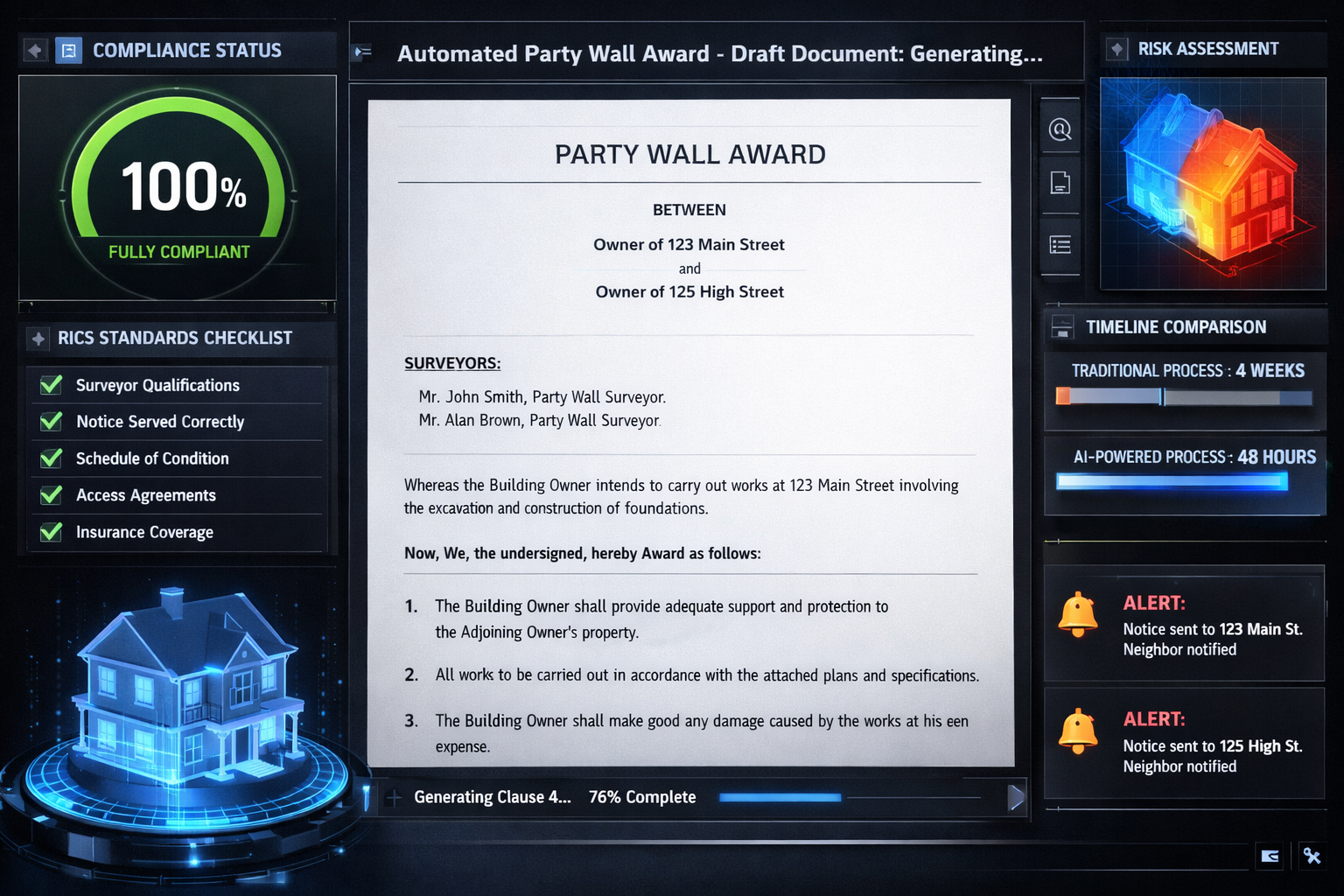
Automated Award Drafting: While notice generation is well-established in 2026, the next frontier is full automation of party wall awards, incorporating negotiated terms, schedules of condition, and protective measures into comprehensive legal documents.
Virtual Site Inspections: Integration with drone technology and 3D scanning will enable AI systems to conduct preliminary site assessments remotely, identifying potential issues before physical surveys.
Blockchain Verification: Distributed ledger technology may soon provide immutable records of notice service, responses, and agreements, reducing disputes about procedural compliance.
AI Mediators: Advanced natural language processing could enable AI systems to facilitate negotiations between building owners and adjoining owners, suggesting compromises and identifying mutually acceptable solutions.
Regulatory Evolution
As AI becomes more prevalent in legal and quasi-legal processes like party wall matters, regulation will continue evolving:
Standardization Efforts: Industry bodies like RICS will likely develop standardized AI competency frameworks and certification programs for party wall platforms.
Liability Frameworks: Clearer legal precedents will emerge regarding liability for AI errors, potentially leading to specialized insurance products for AI-assisted surveying.
Transparency Requirements: Regulations may mandate disclosure of AI involvement in party wall processes, similar to requirements in other legal domains[6].
Quality Benchmarks: Minimum accuracy and reliability standards may be established for AI party wall systems, ensuring baseline quality across the industry.
Professional Adaptation
The surveying profession itself will continue adapting to AI:
Skill Evolution: Future surveyors will need strong technology skills alongside traditional surveying knowledge, with education programs evolving accordingly.
Service Differentiation: As basic notice preparation becomes commoditized through AI, surveyors will differentiate based on complex problem-solving, dispute resolution, and client relationship management.
Business Model Innovation: New service models may emerge, such as subscription-based party wall management for property developers or AI-powered self-service platforms for simple cases.
Specialization Opportunities: Some surveyors may specialize in AI system configuration, training, and optimization, becoming technology consultants to the profession.
Practical Guidance for Property Owners and Developers
When to Use AI-Powered Services
Property owners considering construction work should seek surveyors offering AI-powered party wall services when:
Time is Critical: Projects with tight timelines benefit enormously from notice preparation measured in hours rather than days.
Multiple Properties Affected: Developments affecting numerous neighbors see the greatest efficiency gains from automated neighbor identification and notice generation.
Budget Constraints: Cost-conscious projects can achieve significant savings while maintaining compliance quality.
Complex Configurations: Properties with unusual layouts or multiple shared structures benefit from AI's comprehensive analysis capabilities.
Documentation Requirements: Projects requiring extensive audit trails for financing, insurance, or regulatory purposes benefit from AI's comprehensive record-keeping.
Questions to Ask Your Surveyor
When engaging a surveyor for party wall matters, consider asking:
-
"Do you use AI-powered systems for notice preparation?" This reveals their technology adoption and commitment to efficiency.
-
"How does AI improve accuracy and reduce costs for my project?" A good answer should include specific examples and quantified benefits.
-
"What professional oversight do you provide for AI-generated documents?" This ensures human expertise remains in the process.
-
"Can I access real-time updates on my party wall process?" Modern AI systems should offer client portals with live status information.
-
"How do you handle cases where AI cannot fully automate the process?" This reveals their approach to complex situations requiring professional judgment.
Understanding Your Rights and Responsibilities
Whether your surveyor uses AI or traditional methods, your fundamental rights and responsibilities under the Party Wall etc. Act 1996 remain unchanged:
Building Owner Responsibilities:
- Serve proper notice before commencing relevant works
- Provide accurate descriptions of proposed work
- Allow reasonable time for neighbor responses
- Appoint a surveyor if disputes arise
- Bear the costs of the party wall process
Adjoining Owner Rights:
- Receive proper notice of proposed works
- Consent to or dissent from the works
- Appoint your own surveyor (at the building owner's expense)
- Receive protection against damage to your property
- Access to schedules of condition documenting pre-work property status
AI automation enhances the efficiency and accuracy of these processes but does not alter the fundamental legal framework or your rights within it.
Conclusion: Embracing the AI Revolution in Party Wall Surveying
AI-Powered Party Wall Notices: Automating Compliance in 2026 Surveys represents far more than a technological novelty—it's a fundamental transformation of how property professionals approach one of the most critical aspects of construction projects. The combination of intelligent boundary detection, automated notice generation, real-time compliance validation, and seamless integration with RICS digital standards has created a new paradigm where speed, accuracy, and affordability coexist.
The benefits are clear and quantifiable:
- 85-90% reduction in notice preparation time
- 40-60% cost savings for clients
- 99.9% accuracy in compliance checking
- 68% fewer disputes from improved notice quality
- 3-4x capacity increase for surveying firms
Yet technology alone is not the answer. The most successful implementations combine AI's computational power with human expertise, professional judgment, and ethical responsibility. Surveyors who embrace AI as a tool to enhance—not replace—their professional capabilities will thrive in this new landscape.
Actionable Next Steps
For Property Owners and Developers:
- Ask about AI capabilities when selecting a party wall surveyor for your next project
- Request cost comparisons between traditional and AI-assisted service delivery
- Verify professional oversight to ensure human expertise remains in the process
- Explore client portal options for real-time project visibility
For Surveying Professionals:
- Evaluate AI platforms using the criteria outlined in this article
- Start with a pilot program on a subset of cases to build confidence and expertise
- Invest in training to ensure your team can maximize AI benefits
- Develop clear client communications explaining how AI enhances your service
- Maintain quality assurance protocols to ensure professional standards are upheld
For the Industry:
- Develop standardized competency frameworks for AI-assisted party wall work
- Create certification programs for AI platforms meeting quality and compliance standards
- Share best practices through professional organizations and continuing education
- Address liability questions through clear guidance and appropriate insurance products
The future of party wall surveying is here, and it's powered by artificial intelligence working in partnership with human expertise. Those who embrace this revolution will find themselves better equipped to serve clients, manage complex cases, and build successful practices in an increasingly digital world. The question is no longer whether to adopt AI for party wall notices, but how quickly you can implement these transformative tools to gain competitive advantage while delivering superior client outcomes.
Whether you're a building owner planning your first extension or an experienced surveyor managing dozens of cases, AI-powered party wall systems offer unprecedented opportunities to work smarter, faster, and more accurately than ever before. The technology has matured, the benefits are proven, and the time to act is now.
