


Only about one in five party wall disputes in London ever reaches the three-surveyor tribunal stage — yet most building owners and neighbours assume conflict is the default. The agreed surveyor model quietly resolves the vast majority of cases faster, more cheaply, and with less friction than any alternative. Understanding the Agreed Surveyor Model in Practice: Producing Unbiased Awards, Hourly Fees (£150-200), and When to Switch to Three Surveyors is not just useful for property professionals — it is essential knowledge for any homeowner planning works near a shared boundary in 2026.
Key Takeaways
- The agreed surveyor model appoints one neutral professional to act for both the building owner and the adjoining owner, reducing cost and delay.
- Hourly fees for agreed surveyors typically range from £150 to £200, with the building owner bearing the default cost [1].
- An agreed surveyor must produce a party wall award that is genuinely impartial, not simply favourable to the party who instructed them.
- When an agreed surveyor arrangement stalls or a conflict of interest emerges, the three-surveyor model provides a structured resolution pathway.
- Knowing the precise trigger points for switching models can save thousands of pounds and months of delay.
How the Agreed Surveyor Model Works in Practice
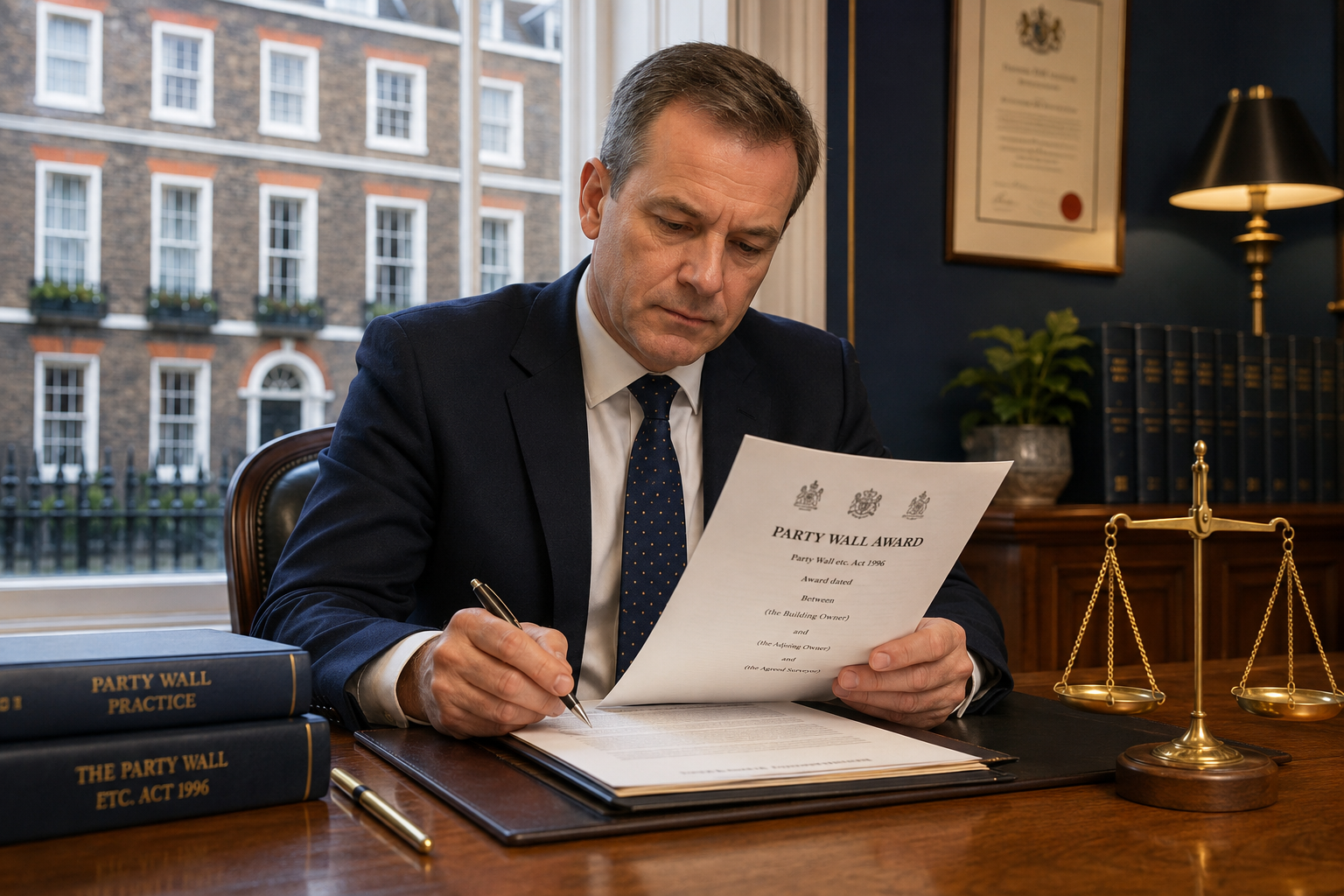
The Party Wall etc. Act 1996 creates a statutory framework for resolving disputes about works to shared walls, excavations near boundaries, and new boundary structures. When a building owner serves a party wall notice and the adjoining owner dissents — or fails to respond within the required period — a dispute is deemed to have arisen. At that point, both parties must appoint surveyors [7].
The agreed surveyor model is the most streamlined option available. Both parties jointly appoint a single surveyor who acts in a quasi-judicial capacity. This person is not an advocate for either side. Their legal duty under the Act is to produce a fair, evidence-based award that protects the legitimate interests of both the building owner and the adjoining owner.
How the appointment works in practice:
- The building owner proposes a surveyor by name.
- The adjoining owner formally concurs in writing.
- The agreed surveyor then proceeds to inspect, assess, and draft the award.
- Neither party can unilaterally dismiss the agreed surveyor once appointed.
This last point matters enormously. The agreed surveyor's security of tenure means they can act without fear of being replaced for producing an inconvenient finding. That structural independence is what makes the model capable of delivering genuinely unbiased awards.
For those planning works in the capital, connecting with a qualified party wall surveyor in Central London early in the process can help both parties understand whether the agreed model is appropriate before a dispute is formally triggered.
What Goes Into an Unbiased Party Wall Award
A party wall award is a legally binding document. It sets out the rights and obligations of both parties before, during, and after the notifiable works. A well-drafted award produced under the agreed surveyor model typically includes:
| Award Component | Purpose |
|---|---|
| Description of permitted works | Defines exactly what the building owner may do |
| Method and hours of working | Protects the adjoining owner from unreasonable disruption |
| Schedule of condition | Records the pre-works state of the adjoining property |
| Security for expenses | Protects the adjoining owner if damage occurs |
| Dispute resolution mechanism | Sets out how future disagreements are handled |
| Costs determination | Confirms who pays surveyor fees |
The schedule of condition is particularly important. Without a photographic and written record of the adjoining property's condition before works begin, any damage claim becomes a matter of word against word.
An agreed surveyor who omits key protections, or who drafts an award that systematically favours the building owner's programme over the adjoining owner's safety, is not producing an unbiased award. Either party may appeal such an award to the county court within 14 days of service.
Hourly Fees of £150-200 and Who Pays Them
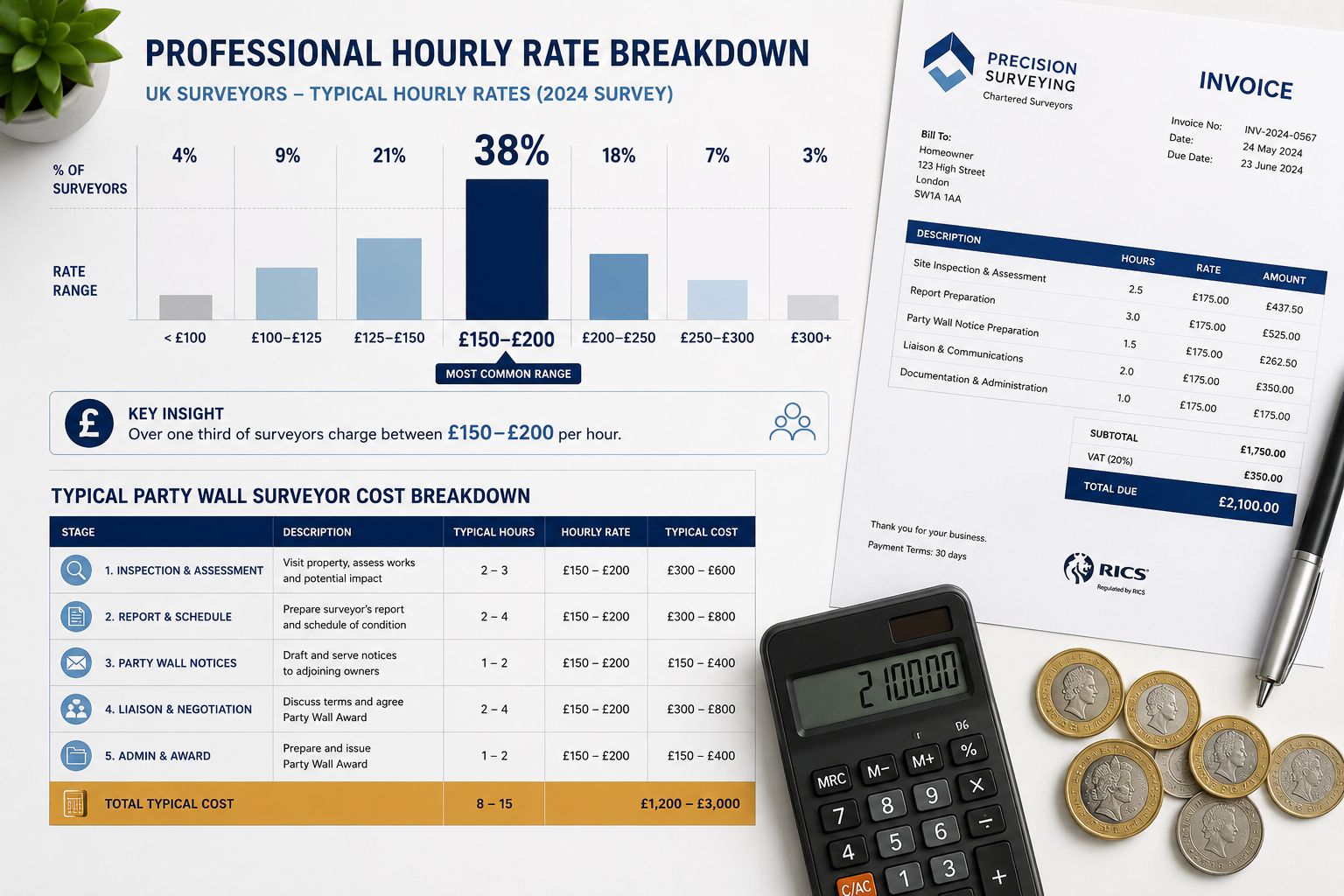
Cost is one of the most common sources of confusion in the party wall process. The agreed surveyor model is generally the most economical route, but understanding the fee structure prevents unpleasant surprises.
The Standard Fee Range in 2026
Agreed surveyors in London typically charge hourly rates of £150 to £200 for their professional time. Some senior or specialist surveyors charge above this range, particularly for complex structural projects. The total cost of an agreed surveyor appointment depends on the complexity of the works, the number of site visits required, and the time needed to draft and serve the award.
A straightforward loft conversion or rear extension award might require:
- One or two site visits (approximately 2-3 hours each)
- Drafting and reviewing the award (3-5 hours)
- Correspondence with both parties (1-2 hours)
- Total: roughly 8-12 hours of professional time
At £150-200 per hour, this produces a total fee in the region of £1,200 to £2,400 for a standard case. More complex projects — basement excavations, multi-party walls, or works affecting structural elements — can take considerably longer and cost more.
Who Bears the Cost
The default position under the Party Wall etc. Act 1996 is clear: the building owner pays all reasonable surveyor costs [1]. This applies whether the parties use an agreed surveyor, two separate surveyors, or the three-surveyor model. The rationale is straightforward — the building owner is the party initiating the works that create the need for the process.
There are limited exceptions. If the adjoining owner's behaviour unreasonably inflates costs — for example, by making excessive demands or refusing to engage — the agreed surveyor has discretion to apportion some costs to the adjoining owner. This is relatively rare in practice.
"The building owner's obligation to meet reasonable surveyor costs is not a penalty — it is the price of the statutory right to carry out notifiable works near a shared boundary."
For a detailed breakdown of what to expect financially, the costs of the party wall process page provides a useful reference. Building owners can also review tips on how to keep party wall costs down without compromising the integrity of the process.
Agreed Surveyor Fees Versus Two-Surveyor Costs
The financial case for the agreed model is compelling when compared to the two-surveyor route:
| Model | Typical Fee Range (London) | Who Pays |
|---|---|---|
| Agreed surveyor | £1,200 – £2,400 | Building owner |
| Two surveyors (building owner's) | £800 – £1,500 | Building owner |
| Two surveyors (adjoining owner's) | £800 – £1,500 | Building owner |
| Third surveyor (if required) | £500 – £1,500+ | Building owner |
In a two-surveyor scenario, the building owner typically pays both their own surveyor and the adjoining owner's surveyor. Add a third surveyor and costs can escalate significantly. The agreed model's single fee structure is therefore often the most cost-efficient outcome for the building owner, provided both parties trust the appointed professional.
When to Switch to Three Surveyors

The agreed surveyor model is not always the right choice, and it is not always sustainable once chosen. Recognising the specific triggers for switching to the three-surveyor model is a practical skill that can prevent a manageable situation from becoming an expensive legal dispute.
Trigger 1: Genuine Conflict of Interest
An agreed surveyor must be acceptable to both parties. If it later emerges that the appointed surveyor has a pre-existing professional relationship with the building owner — for example, they have worked on previous projects together — the adjoining owner has grounds to challenge the appointment. A conflict of interest, once identified, typically requires the appointment of separate surveyors for each party, with a third surveyor nominated as arbiter.
Trigger 2: Breakdown of Mutual Trust
Even without a formal conflict of interest, the agreed model depends on both parties having reasonable confidence in the surveyor's neutrality. If the adjoining owner believes, rightly or wrongly, that the agreed surveyor is not acting impartially, the process can stall. Stalled negotiations under the agreed model are a clear signal that the three-surveyor route is needed [7].
The three-surveyor model works as follows:
- The building owner appoints their own surveyor (the building owner's surveyor).
- The adjoining owner appoints their own surveyor (the adjoining owner's surveyor).
- Both appointed surveyors jointly select a third surveyor before any dispute arises.
- If the two appointed surveyors cannot agree, either party may call on the third surveyor to make a binding determination.
The third surveyor is not a mediator. They are a decision-maker whose award is as legally binding as one produced by an agreed surveyor.
Trigger 3: Complexity Beyond a Single Surveyor's Capacity
Some projects are structurally or legally complex enough that a single surveyor — however competent — may struggle to give adequate attention to all relevant interests. Deep basement excavations, projects affecting multiple adjoining owners, or works involving listed buildings or conservation areas may benefit from the independent scrutiny that two appointed surveyors provide before any contentious points go to a third.
Trigger 4: The Adjoining Owner Refuses to Concur
If the adjoining owner will not agree to a named surveyor, the agreed model is simply unavailable. The building owner must then appoint their own surveyor, and the adjoining owner either appoints theirs or the building owner's surveyor may act for both — a different statutory mechanism that should not be confused with the agreed surveyor appointment.
For adjoining owners navigating this situation, the adjoining owners' guidance page sets out the available options clearly.
A Practical Decision Framework
Use this checklist before committing to either model:
- Do both parties trust the proposed agreed surveyor without reservation? If no, use two surveyors.
- Is the project straightforward in scope and structure? If no, consider two surveyors.
- Has the agreed surveyor process already stalled for more than 4-6 weeks without progress? Switch to three surveyors.
- Has a conflict of interest been identified? Switch immediately.
- Is the adjoining owner legally represented and taking an adversarial position? Two surveyors are likely more appropriate.
The Third Surveyor's Role in Stalled Agreements
One underappreciated aspect of the three-surveyor model is that the third surveyor does not need to be called in to resolve every disagreement. Their existence on the panel often creates an incentive for the two appointed surveyors to reach agreement themselves. The prospect of a third-party determination — with its associated costs and unpredictability — concentrates minds.
When the third surveyor is called upon, their determination is final on the specific point referred to them. They cannot rewrite the entire award; they resolve the specific issue in dispute. This targeted function makes the three-surveyor model a precise tool rather than a blunt instrument [7].
For those in specific parts of the capital, qualified professionals are available across all areas, including party wall surveyors in North London, South London, East London, and West London.
Common Misconceptions About the Agreed Surveyor Model
Misconception 1: The agreed surveyor works for the building owner.
The agreed surveyor works for both parties simultaneously. Their duty is to the Act, not to either individual.
Misconception 2: Choosing an agreed surveyor means giving up rights.
The adjoining owner retains all statutory rights, including the right to appeal the award to court.
Misconception 3: The agreed model is always faster.
It is usually faster, but only when both parties engage constructively. A reluctant adjoining owner can slow the process regardless of the model used.
Misconception 4: The building owner can choose the agreed surveyor unilaterally.
The adjoining owner must formally concur. Without that concurrence, there is no agreed surveyor appointment.
For a broader understanding of how party wall awards are structured and what they contain, the guide on party wall awards provides detailed context.
Conclusion
The Agreed Surveyor Model in Practice: Producing Unbiased Awards, Hourly Fees (£150-200), and When to Switch to Three Surveyors is not an abstract legal concept — it is a practical framework that shapes the outcome of thousands of construction projects in London every year. Choosing the right model from the outset, and recognising the precise moment when a switch is warranted, can be the difference between a project that completes on time and one that stalls in costly dispute.
Actionable next steps for building owners and adjoining owners in 2026:
- Before serving a party wall notice, assess whether both parties are likely to accept a single agreed surveyor — if trust is already strained, plan for the two-surveyor route from the start.
- When appointing an agreed surveyor, verify their credentials, check for any prior professional relationship with either party, and confirm their hourly rate in writing before engagement.
- Budget for the full fee range of £150-200 per hour and factor in a realistic number of hours based on project complexity.
- If the agreed surveyor process stalls, do not wait months before acting — switch to the three-surveyor model promptly to preserve the project timeline.
- Ensure a schedule of condition is always included in the award, regardless of which model is used.
The party wall process exists to protect both parties. Used correctly, the agreed surveyor model is one of the most efficient dispute resolution mechanisms in English property law.
References
[1] Who Pays For Party Wall Surveyor – https://blackacresurveyors.com/2026/03/12/who-pays-for-party-wall-surveyor/
[7] Why Are There Three Party Wall Surveyors Involved – https://howorth.uk/2026/01/29/why-are-there-three-party-wall-surveyors-involved/