

Nearly one in three party wall disputes in the UK stems from preventable administrative errors — not genuine disagreements between neighbours [2]. That single statistic reveals something important: the party wall award, a legally binding document most homeowners never read closely, is doing far more protective work than most people realise. Understanding The Party Wall Award Explained: What's Included, How It Protects You, and Why It Matters for Your 2026 Project is not just a legal formality — it is the difference between a smooth build and a costly, neighbour-damaging dispute.
This article demystifies the party wall award as a binding roadmap. It specifies scope, protections, timings, and repair obligations — turning abstract legal language into practical project protection for anyone planning building work in 2026.
Key Takeaways
- A party wall award is a legally binding document issued under the Party Wall etc. Act 1996 that governs how notifiable building work must be carried out near shared boundaries.
- The award sets out the exact scope of works, working hours, access rights, and repair obligations — protecting both the building owner and the adjoining owner.
- Without a valid award in place, a building owner has no legal right to carry out notifiable works, and disputes can halt a project entirely.
- The RICS 8th Edition Party Wall Guidance, published in May 2026, introduces stricter rules on surveyor independence, fees, and notice service that directly affect how awards are drafted and enforced [1].
- Getting the award right from the start — with a qualified, independent surveyor — is the most cost-effective protection available for any 2026 project.
What Is a Party Wall Award and Why Does It Exist
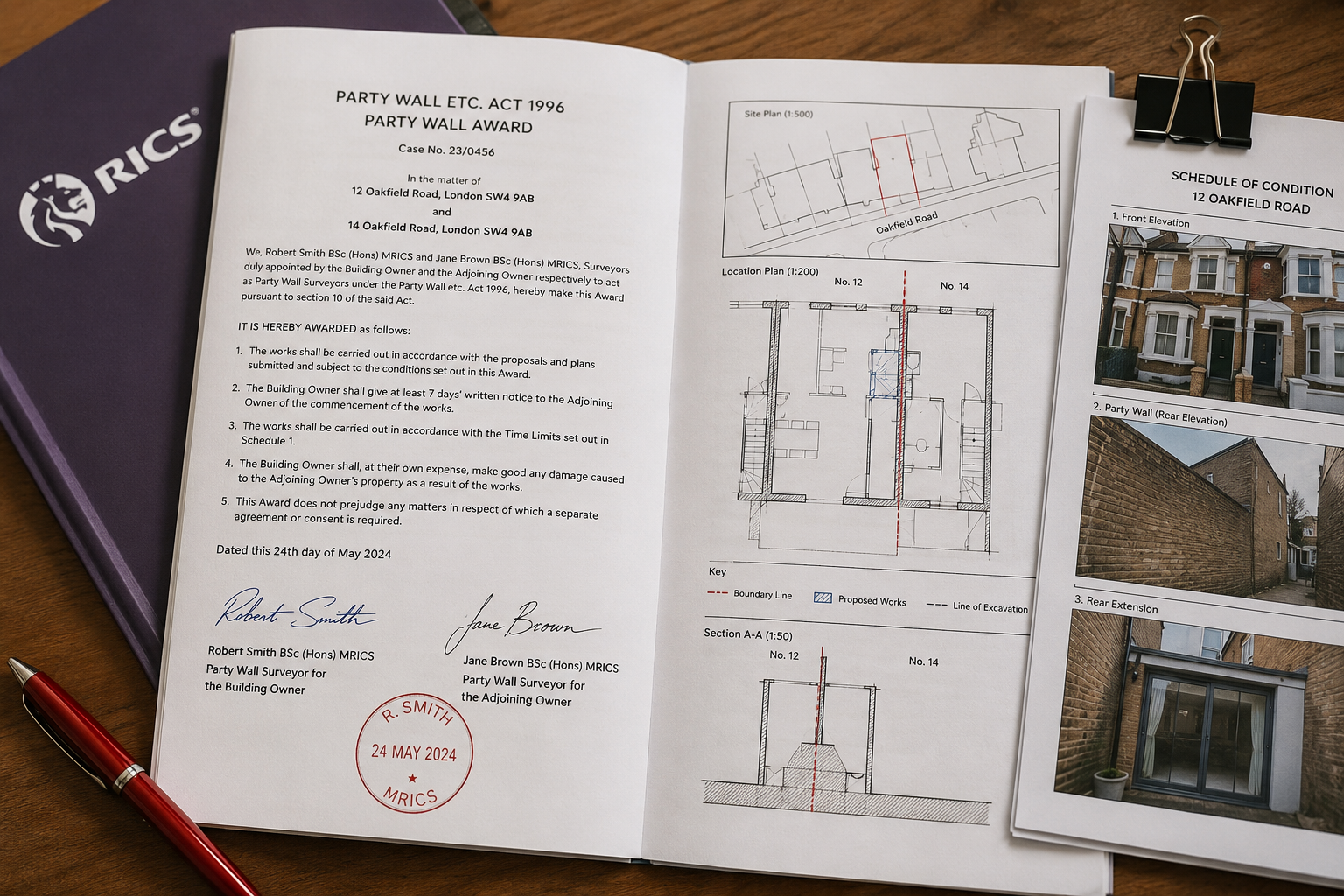
A party wall award — formally called an "award" under Section 10 of the Party Wall etc. Act 1996 — is a written determination made by one or more appointed surveyors. It resolves the dispute that arises (or is deemed to arise) when a building owner serves notice of intended works and the adjoining owner either dissents or fails to respond within the statutory 14-day window.
The award is not a planning permission. It does not replace building regulations approval. Its sole purpose is to regulate the relationship between the building owner and the adjoining owner during the works. Think of it as a project contract imposed by statute, one that neither party can simply ignore or override.
The legal foundation is the Party Wall etc. Act 1996, which applies across England and Wales. The Act covers three broad categories of work:
- Works to an existing party wall or party structure (Section 2)
- New buildings on or at the boundary line (Section 1)
- Excavations within 3 or 6 metres of a neighbouring structure (Section 6)
If any of these apply to a 2026 project, the award process is not optional. For a full breakdown of which works trigger the Act, the types of party wall works guide provides a practical reference.
What Is Included in a Party Wall Award
The award is a structured legal document. Its contents are not standardised by statute, but professional practice — now reinforced by the RICS 8th Edition guidance released in May 2026 — has established a clear set of components that every robust award should contain [1].
The Scope of Works
The award must describe the proposed works in precise detail. Vague descriptions create loopholes. A well-drafted award will reference:
- Structural drawings and specifications
- The exact sections of wall, floor, or structure to be affected
- The method of work (e.g., underpinning sequence, beam bearing details)
This description is the anchor of the entire document. If the building owner later carries out work that falls outside the described scope, the award no longer protects them.
The Schedule of Condition
Before work begins, a schedule of condition is prepared. This is a photographic and written record of the adjoining owner's property — cracks, damp patches, existing defects — captured before a single tool is lifted.
The schedule of condition is arguably the most protective element of the award for both parties. It establishes a baseline. If the adjoining owner later claims that a crack was caused by the works, the schedule either confirms or contradicts that claim with objective evidence.
Without a schedule of condition, any pre-existing defect becomes a potential liability for the building owner.
Working Hours and Access Rights
The award specifies:
| Element | Typical Provision |
|---|---|
| Working hours | Monday to Friday, 8am–6pm; Saturday 8am–1pm |
| Access to adjoining property | Advance notice required (usually 14 days) |
| Dust and noise controls | Specific mitigation measures listed |
| Security of the site | Obligations to secure openings overnight |
Access rights granted under the award are statutory. Under Section 8 of the Act, a building owner (and their workers) may enter the adjoining owner's land to carry out the works — but only within the terms the award sets out.
Repair and Reinstatement Obligations
The award places clear duties on the building owner to make good any damage caused. This includes:
- Reinstating finishes to at least their pre-works standard
- Repairing structural damage caused by the works
- Timescales for completing reinstatement
This section protects the adjoining owner. It also protects the building owner by defining the limit of their obligation — they are not responsible for pre-existing damage already documented in the schedule of condition.
Security for Expenses
In some cases, particularly where significant excavation or structural work is planned, the award may require the building owner to deposit a security sum. This acts as a financial guarantee that reinstatement obligations will be met, even if the building owner becomes insolvent or abandons the project.
The Award Itself — Determination of Dispute
The final section formally records the surveyors' determination. It confirms that the works may proceed, subject to the conditions set out. It is signed by the appointed surveyor or surveyors and is legally binding on both parties from the date of service.
For a downloadable template and more detail on structure, the party wall contract template guide on party wall awards offers a useful starting point.
How the Party Wall Award Protects You: What's Included Matters for Every 2026 Project
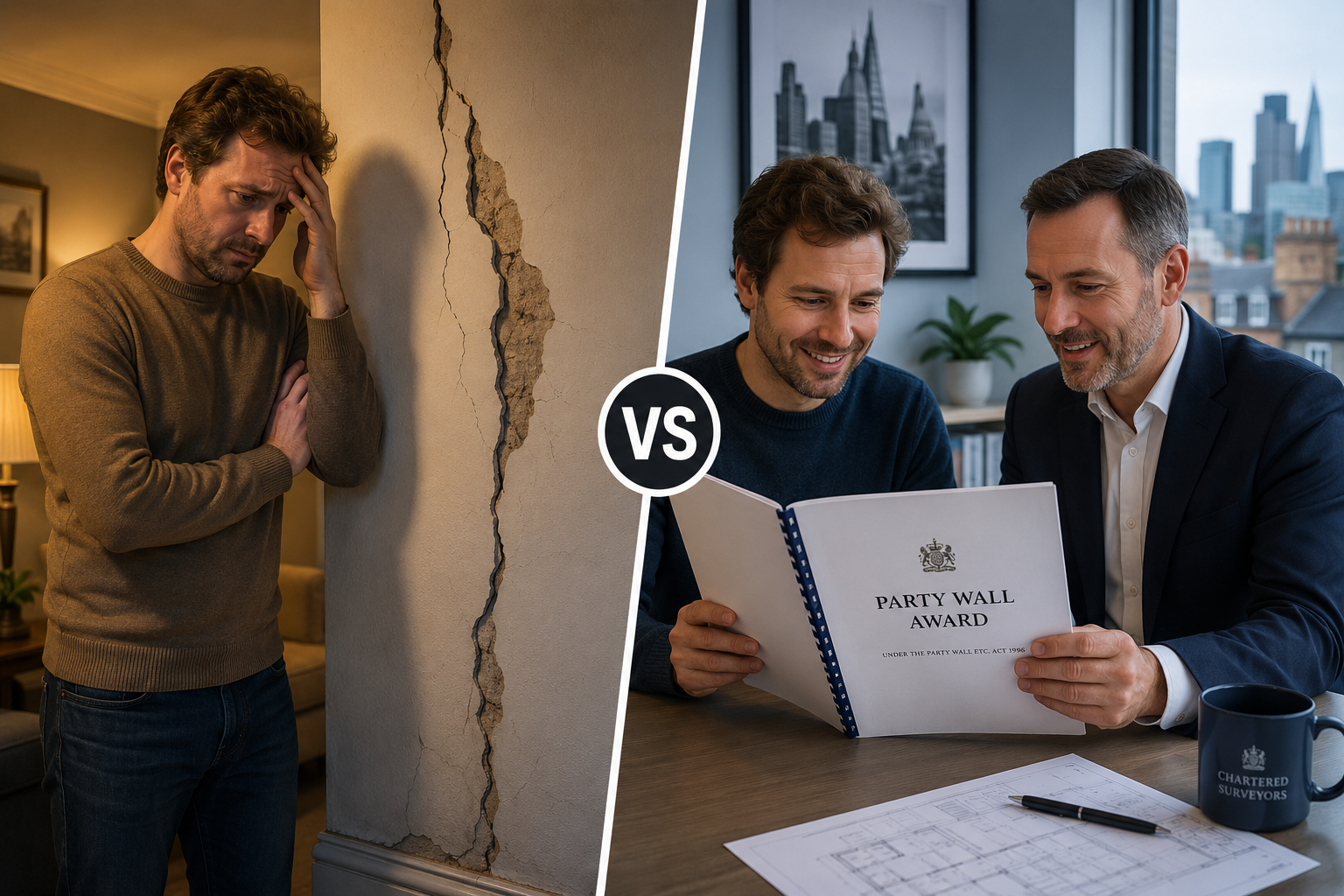
The protective value of The Party Wall Award Explained: What's Included, How It Protects You, and Why It Matters for Your 2026 Project becomes clearest when something goes wrong. Here is how the award shields each party.
Protection for the Building Owner
A building owner who has a valid award in place gains:
- Legal authority to proceed — without an award, carrying out notifiable works is unlawful and the adjoining owner can seek an injunction
- A defined liability ceiling — the award limits repair obligations to damage caused by the works, not pre-existing conditions
- A dispute resolution mechanism — if the adjoining owner raises objections mid-works, the award provides the framework for resolving them without going to court
- Protection against spurious claims — the schedule of condition provides objective evidence against inflated or fabricated damage claims
Protection for the Adjoining Owner
The adjoining owner benefits from:
- Independent oversight — the surveyor acts as a statutory officer, not as an agent of the building owner [3]
- Documented baseline — the schedule of condition records the state of their property before works begin
- Enforceable conditions — working hours, access terms, and reinstatement obligations are legally binding
- Right of appeal — under Section 10(17) of the Act, either party may appeal the award to the County Court within 14 days of service
If a neighbour has served notice and the adjoining owner is unsure how to respond, the party wall notices guide explains the options clearly.
The Role of Surveyor Independence in 2026
One of the most significant updates in the RICS 8th Edition guidance, released in May 2026, is the explicit reinforcement of surveyor independence. The guidance states that a party wall surveyor's appointment is personal and statutory — meaning the surveyor cannot simply follow client instructions if those instructions conflict with their duty as an impartial officer under the Act [3].
This matters enormously for 2026 projects. An adjoining owner who appoints their own surveyor can be confident that surveyor is not beholden to the building owner. Equally, a building owner whose surveyor is acting independently — rather than as a hired advocate — produces an award that is far less likely to be challenged or overturned.
"A party wall surveyor's appointment is personal and statutory, ensuring independence from client instructions." — RICS 8th Edition Party Wall Guidance, 2026 [3]
The 2026 Regulatory Landscape: What Has Changed
The party wall award process in 2026 operates within a noticeably updated regulatory environment. Two major developments affect how awards are drafted, served, and enforced.
RICS 8th Edition Party Wall Guidance
Published in May 2026 following an eight-week public consultation, the RICS 8th Edition introduces several changes that directly affect the award process [1]:
- Stricter rules on fees — greater transparency is now required in how surveyor fees are calculated and communicated to parties
- Clarified jurisdictional boundaries — surveyors must now operate within clearly defined limits of authority, reducing the risk of awards being challenged on jurisdictional grounds
- Environmental and cultural considerations — the guidance highlights the importance of factoring in sustainable construction practices and heritage considerations when drafting awards
- Continuous professional development — surveyors are expected to demonstrate ongoing compliance with the updated standards
These changes mean that awards drafted in 2026 should be more robust, more transparent, and less vulnerable to challenge than those produced under earlier guidance.
Mandatory AI Standards in Party Wall Surveys
From 9 March 2026, RICS implemented mandatory standards for the responsible use of artificial intelligence in party wall surveys [2]. These standards are designed to reduce the 35% of conflicts that arise from preventable administrative errors and invalid notices — errors that previously cost UK property owners an estimated £120 million annually [2].
AI tools are now being used to:
- Predict potential dispute flashpoints before they arise
- Check notice validity and flag procedural errors
- Assist in drafting award conditions more consistently
Importantly, the standards do not replace the surveyor's professional judgement. They are tools that support — not substitute — the human expertise required to produce a legally sound award.
Common Mistakes That Undermine a Party Wall Award
Even with a valid award in place, certain errors can erode its protective value. The most common mistakes include:
- Carrying out works outside the described scope — the award only covers what it describes; additional works may require a supplementary award
- Failing to serve the award correctly — the document must be formally served on both parties; informal sharing does not satisfy the statutory requirement
- Ignoring the schedule of condition process — skipping this step leaves both parties exposed
- Appointing a surveyor who is not genuinely independent — the 2026 RICS guidance makes clear that this undermines the entire award [1]
- Missing the appeal window — the 14-day appeal period under Section 10(17) is strict; missing it means the award stands even if it contains errors
For those concerned about managing costs without cutting corners, the guide on how to keep party wall costs down offers practical, legitimate strategies.
Why the Party Wall Award Matters for Your 2026 Project: Practical Steps to Take Now
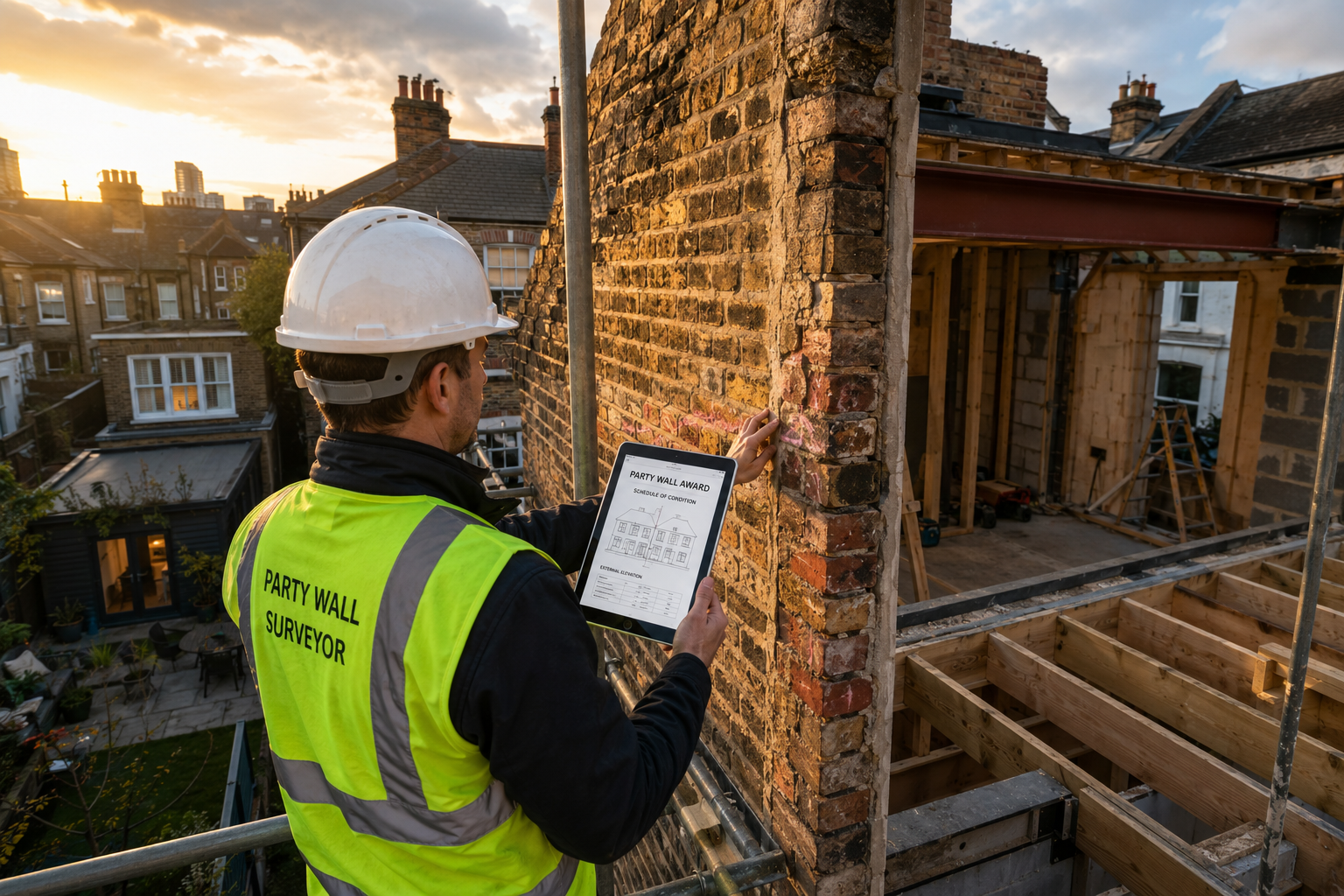
Understanding The Party Wall Award Explained: What's Included, How It Protects You, and Why It Matters for Your 2026 Project is only useful if that understanding translates into action. Here is a practical sequence for any building owner or adjoining owner facing party wall matters in 2026.
For Building Owners
Step 1: Identify whether the Act applies. Review the proposed works against the three categories covered by the Act. If in doubt, seek early advice.
Step 2: Serve the correct notice. The type of notice depends on the works. A party structure notice is required for most structural works to a shared wall. Notice periods vary: two months for Section 2 works, one month for Section 6 excavations.
Step 3: Respond to dissent promptly. If the adjoining owner dissents or fails to respond within 14 days, a dispute is deemed to have arisen. Appoint a surveyor without delay.
Step 4: Ensure the award is comprehensive. A thin award is a weak award. Insist on a full schedule of condition, precise scope description, and clear reinstatement terms.
Step 5: Keep the award accessible on site. The award should be available for inspection throughout the works.
For Adjoining Owners
Step 1: Do not ignore the notice. Failing to respond within 14 days triggers a deemed dispute — and the process proceeds with or without active participation.
Step 2: Appoint your own surveyor. The building owner pays reasonable fees for the adjoining owner's surveyor. There is no financial reason to rely solely on the agreed surveyor. For more on this, see the adjoining owners surveyor page.
Step 3: Engage with the schedule of condition. Request access to review the schedule before it is finalised. This document is the primary protection for the adjoining property.
Step 4: Review the draft award carefully. Check that working hours, access terms, and reinstatement obligations are adequate before the award is served.
Step 5: Note the appeal deadline. If the award contains errors or omissions, the 14-day appeal window under Section 10(17) is the only formal route to challenge it.
Conclusion
The party wall award is not bureaucratic paperwork. It is a binding legal instrument that defines the rules of engagement for works that could affect a neighbour's home, safety, and peace of mind. For any 2026 project involving shared walls, boundaries, or nearby excavations, the award is the single most important document in the process.
The RICS 8th Edition guidance published in 2026 has strengthened the framework significantly — reinforcing surveyor independence, tightening fee transparency, and introducing AI-assisted tools to reduce the administrative errors that have historically derailed projects and cost property owners millions [1][2]. These changes make a well-drafted award more achievable and more defensible than ever before.
Actionable next steps for 2026:
- Confirm whether the Act applies to the planned works before serving any notice
- Serve the correct notice with the correct notice period — errors at this stage invalidate the entire process
- Appoint a qualified, genuinely independent party wall surveyor
- Insist on a thorough schedule of condition as part of the award
- Keep the award on site and review it before any variation to the works
For those ready to move forward, the party wall awards service page provides a clear starting point, and the costs of the party wall process page helps set realistic budget expectations from the outset.
References
[1] Rics 8th Edition Party Wall Guidance 2026 Implementation Challenges And Surveyor Compliance Strategies – https://wimbledonsurveyors.com/rics-8th-edition-party-wall-guidance-2026-implementation-challenges-and-surveyor-compliance-strategies/?utm_source=openai
[2] Responsible Ai Use In Party Wall Surveys Rics 2026 Standards For Dispute Prediction And Award Drafting – https://wimbledonsurveyors.com/responsible-ai-use-in-party-wall-surveys-rics-2026-standards-for-dispute-prediction-and-award-drafting/?utm_source=openai
[3] Party Wall Awards Explained Surveyor Roles Notice Periods And Dispute Resolution Under 2026 Rics Guidance – https://wimbledonsurveyors.com/party-wall-awards-explained-surveyor-roles-notice-periods-and-dispute-resolution-under-2026-rics-guidance/?utm_source=openai