


Nearly one in three party wall disputes in England and Wales escalates beyond the initial notice stage — not because the works are unusually complex, but because one or both parties question whether their surveyor is truly acting without bias. That single concern sits at the heart of Impartiality in Practice: How Party Wall Surveyors Manage Conflicts Under RICS 8th Edition Standards, a topic that has taken on fresh urgency now that RICS has released a consultation draft for the 8th Edition of its Party Wall Legislation & Procedure guidance, with the consultation period closing in June 2026 [1]. The new draft sharpens the obligations placed on surveyors to identify, disclose, and manage conflicts of interest — and it raises the bar for what "acting impartially" actually means in day-to-day practice.
Key Takeaways
- RICS 8th Edition guidance reinforces that party wall surveyors owe a duty to the process itself, not to the individual party who appointed them.
- Surveyors must proactively identify and disclose actual or perceived conflicts of interest before accepting an appointment.
- The quasi-judicial nature of the role does not grant judicial immunity; surveyors remain personally accountable for their decisions.
- Complaints-handling procedures are now a mandatory feature of all RICS-regulated firms involved in party wall work.
- Selecting a chartered surveyor (MRICS or FRICS) provides the strongest procedural safeguard for both building owners and adjoining owners.

The Statutory Foundation: What the Party Wall Act Demands
The Party Wall etc. Act 1996 creates a framework that is unusual in property law. It places surveyors in a quasi-judicial role: they are appointed by the parties, yet they are required to act in the interests of the shared structure and the process, not in the interests of the party who pays their fee. This is not a soft professional aspiration — it is a statutory requirement built into the architecture of the Act itself.
When a building owner serves a party wall notice and the adjoining owner dissents, each party appoints their own surveyor. Those two surveyors then work together to produce a party wall award — a legally binding document that governs how the works will proceed. Alternatively, both parties may agree to appoint a single "agreed surveyor" who acts for both simultaneously, a scenario that places the impartiality obligation under even greater scrutiny.
The RICS 7th Edition guidance, published in January 2022, already made clear that surveyors must comply with both their statutory duties under the Act and the RICS Rules of Conduct [7]. The 8th Edition draft goes further, explicitly framing these two sets of obligations as complementary rather than separate, and requiring surveyors to demonstrate how they are meeting both in any given appointment [2].
Why the Quasi-Judicial Label Matters — and Where It Ends
Describing a party wall surveyor's role as "quasi-judicial" is more than professional flattery. It signals that the surveyor's decisions carry legal weight and that the process is designed to be fair to both sides. However, the 8th Edition draft includes a significant clarification: surveyors performing this function do not enjoy judicial immunity [4]. A judge cannot be sued for a negligent judgment; a party wall surveyor can be.
This distinction matters enormously for conflict management. A surveyor who dismisses a genuine conflict of interest on the grounds that their role is "court-like" misunderstands the legal position. Personal accountability remains intact, and that accountability is precisely what motivates the detailed conflict-checking obligations set out in the new guidance.
Identifying and Managing Conflicts: The RICS 8th Edition Framework
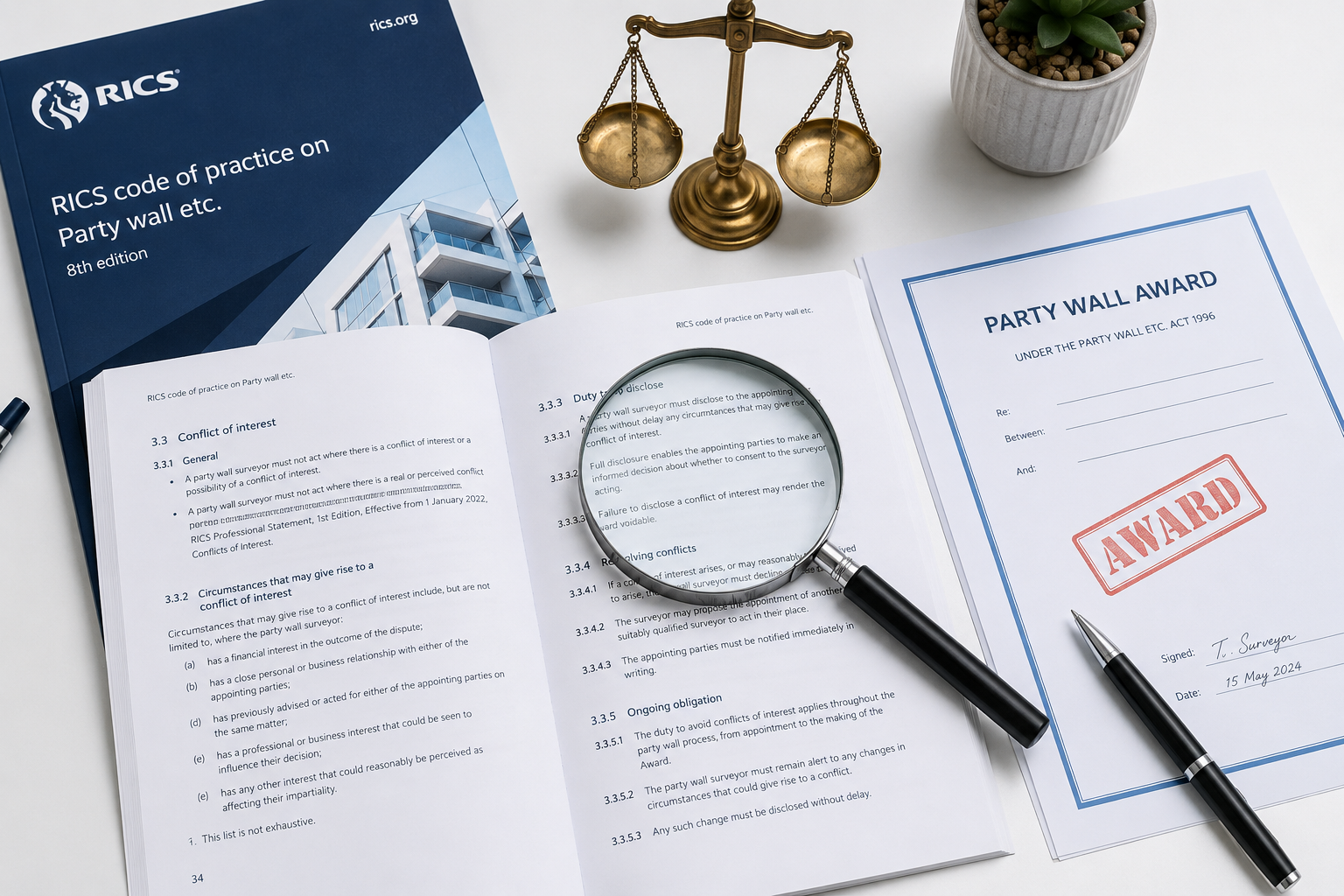
The 8th Edition consultation draft aligns party wall practice with the broader RICS professional standards on conflicts of interest for members acting as dispute resolvers [3]. Under this framework, a conflict of interest is not limited to direct financial relationships. It encompasses any circumstance — past or present — that could reasonably lead an informed observer to question the surveyor's impartiality.
Categories of conflict that surveyors must assess include:
| Category | Example Scenario |
|---|---|
| Financial interest | Surveyor holds a stake in the building contractor carrying out the works |
| Prior relationship | Surveyor previously acted as the building owner's conveyancer |
| Personal connection | Surveyor is a close friend or family member of one party |
| Repeat instruction bias | Surveyor regularly receives instructions from the same developer |
| Advocacy conflict | Surveyor has previously given partisan advice to one party on the same project |
The guidance is clear that surveyors must assess these categories proactively — before accepting an appointment — rather than waiting for a complaint to surface [3]. Where a potential conflict is identified, the surveyor must disclose it to both parties in writing. The parties may then consent to the appointment continuing, but that consent must be informed and documented.
The Agreed Surveyor Scenario: Heightened Obligations
When both parties appoint a single agreed surveyor, the impartiality obligation intensifies. The agreed surveyor must inform both parties of their rights under the Act, explain the implications of the agreed surveyor arrangement, and ensure that neither party feels pressured into the appointment [5]. RICS guidance specifically warns against scenarios where a building owner's surveyor is simply reframed as an "agreed surveyor" without genuine consent from the adjoining owner.
For adjoining owners who feel uncertain about this arrangement, understanding the role of an adjoining owner's surveyor is an important first step before agreeing to any shared appointment.
Informing Parties While Retaining Decision Control
One of the more nuanced obligations in the 8th Edition draft concerns the surveyor's duty to keep both parties informed without surrendering their independent judgment. This is a delicate balance. Surveyors must:
- Explain the party wall process in plain language to both parties
- Disclose the basis on which the award will be made
- Share relevant factual information with both sides
- Decline to act on partisan instructions that would compromise the award's fairness
What surveyors must not do is allow either party to dictate the terms of the award. The moment a surveyor begins treating one party's instructions as binding on the outcome, the quasi-judicial function collapses and the award becomes vulnerable to legal challenge. The RICS Built Environment Journal has noted that surveyors who act in the interests of both parties — rather than individual owners — produce awards that are far less likely to be appealed to the county court [5].
Practical Conflict Management: Scenarios and Case Law Lessons

Abstract principles become meaningful only when tested against real situations. The following scenarios illustrate how the 8th Edition standards apply in practice, drawing on patterns visible in recent case law and professional guidance.
Scenario 1: The Developer's Regular Surveyor
A large residential developer in North London routinely instructs the same surveyor across multiple projects. The surveyor has received dozens of instructions from this developer over three years. When the developer begins a new scheme affecting several adjoining properties, the surveyor is appointed as the building owner's surveyor on all of them.
Under 8th Edition standards, this pattern of repeat instruction creates a perceived conflict of interest that must be disclosed to each adjoining owner. The volume of prior instructions could reasonably lead an observer to conclude that the surveyor has a financial incentive to favour the developer's interests. If the surveyor fails to disclose this relationship, any award produced could be challenged on grounds of apparent bias.
For building owners carrying out works in areas such as North London or South London, selecting a surveyor with no prior relationship to the contractor or developer is the cleanest way to avoid this issue from the outset.
Scenario 2: The Schedule of Condition Dispute
An adjoining owner in East London claims that cracks appearing in their property after excavation works were pre-existing. The building owner's surveyor prepared the schedule of condition before works began, but the adjoining owner argues it was incomplete. The two appointed surveyors disagree on whether the damage is attributable to the works.
This scenario tests the surveyor's obligation to act on evidence rather than client preference. The 8th Edition guidance reinforces that surveyors must assess damage claims objectively, drawing on the schedule of condition as an evidential baseline rather than a document to be interpreted in favour of the appointing party [8]. Where the two surveyors cannot agree, the matter passes to a third surveyor — a mechanism built into the Act precisely to resolve deadlock without litigation.
Scenario 3: The Late Conflict Discovery
A surveyor accepts an appointment as an agreed surveyor, begins drafting the award, and then discovers that they advised the building owner informally at a networking event six months earlier. The advice was minor — a general comment about notice timelines — but it was partisan in nature.
Under RICS Rules of Conduct, this discovery triggers an immediate obligation to disclose the prior contact to the adjoining owner and to assess whether the appointment should continue [2]. The 8th Edition draft makes clear that late discovery does not excuse non-disclosure; the surveyor must act on the information as soon as it comes to light.
Complaints Handling: The Mandatory Safety Net
The 8th Edition guidance mandates that all RICS-regulated firms operating in the party wall space must maintain a formal complaints-handling procedure [2]. This requirement serves two functions. First, it provides a structured route for parties who believe their surveyor has acted improperly. Second, it creates an internal accountability mechanism that encourages firms to identify and address conduct issues before they escalate.
For property owners who feel that a surveyor has not acted impartially, the complaints route runs through the firm's internal procedure first, then to the RICS Regulation team if the internal process does not resolve the matter.
Competence, Ethics, and the 2026 Renovation Market
The 8th Edition draft does not treat impartiality as a standalone obligation. It situates impartiality within a broader framework of competence and ethical behaviour [6]. A surveyor who lacks up-to-date knowledge of case law may produce an award that inadvertently favours one party — not through bad faith, but through ignorance. The guidance therefore requires surveyors to maintain continuous professional development (CPD) that covers current case law, changes in building regulations, and evolving best practice in conflict management.
In 2026, this requirement is particularly relevant. The renovation market in London and across England is operating at high volume, with basement excavations, loft conversions, and rear extensions generating a steady flow of party wall notices. The types of party wall works that trigger the Act are diverse, and the technical demands on surveyors have grown accordingly. A surveyor who is not current with the latest structural engineering guidance, for example, may misjudge whether proposed works pose a genuine risk to an adjoining structure — a judgment error that has direct implications for the fairness of the award.
RICS recommends that only chartered surveyors holding MRICS or FRICS status be appointed under the Act, precisely because membership requires ongoing CPD and adherence to the Rules of Conduct [9]. For property owners navigating the process, this recommendation translates into a practical due diligence step: verify the surveyor's RICS membership status before appointment.
The Public Interest Dimension
Beyond the interests of the two parties in any given dispute, the 8th Edition guidance reminds surveyors of their broader duty to act in the public interest [7]. Party wall awards affect not just the immediate neighbours but the long-term structural integrity of shared buildings, many of which are Victorian or Edwardian terraces with complex load-bearing arrangements. An award that prioritises speed or convenience over structural safety fails the public interest test, regardless of whether both parties consented to it.
This public interest framing is one of the clearest signals in the 8th Edition draft that RICS views party wall practice as a matter of professional responsibility, not merely a commercial service. Surveyors who internalise this framing are better equipped to resist pressure from either party to cut corners or overlook genuine risks.
Conclusion
Impartiality in Practice: How Party Wall Surveyors Manage Conflicts Under RICS 8th Edition Standards is not a theoretical exercise. It is a set of concrete, enforceable obligations that shape every stage of the party wall process — from the initial conflict check before accepting an appointment, through the production of the award, to the handling of complaints after the works are complete.
The RICS 8th Edition consultation draft raises the standard in several important ways: it aligns party wall practice with the broader RICS conflict-of-interest framework, clarifies that quasi-judicial status does not confer immunity, mandates complaints-handling procedures, and embeds impartiality within a wider commitment to competence and public interest.
Actionable next steps for property owners and surveyors in 2026:
- Building owners: Before instructing a surveyor, check their RICS membership status and ask directly whether they have any prior relationship with your contractor or developer. Review the costs and process so you understand what the appointment covers.
- Adjoining owners: Do not feel obligated to accept the building owner's surveyor as an agreed surveyor without independent advice. Understand your right to appoint your own surveyor for adjoining owners.
- Surveyors: Conduct a written conflict-of-interest check before every appointment, disclose any prior relationships immediately, and ensure your firm's complaints-handling procedure is documented and accessible to clients.
- Both parties: If a dispute arises about the impartiality of an appointed surveyor, engage the firm's complaints procedure first, then escalate to RICS Regulation if the response is unsatisfactory.
The party wall process works best when all parties trust that the surveyor is genuinely independent. The 8th Edition standards provide the clearest framework yet for making that trust well-founded.
References
[1] Consultationhome – https://consultations.rics.org/party_walls_8th_edition_guidance/consultationHome?utm_source=openai
[2] Viewcompounddoc – https://consultations.rics.org/party_walls_8th_edition_guidance/viewCompoundDoc?docid=16799988&partId=16800404&sessionid=&voteid=&utm_source=openai
[3] Conflicts Of Interest For Members Acting As Dispute Resolvers 2nd Edition – https://www.rics.org/profession-standards/rics-standards-and-guidance/sector-standards/dispute-resolution-standards/conflicts-of-interest-for-members-acting-as-dispute-resolvers-2nd-edition?utm_source=openai
[4] Viewcompounddoc – https://consultations.rics.org/party_walls_8th_edition_guidance/viewCompoundDoc?docid=16799988&partId=16802324&sessionid=&voteid=&utm_source=openai
[5] Party Wall Surveyors Impartiality – https://ww3.rics.org/uk/en/journals/built-environment-journal/party-wall-surveyors-impartiality.html?utm_source=openai
[6] Party Wall Surveyor Impartiality And Rics Standards Managing Conflicts In 2026s Busy Renovation Market – https://wimbledonsurveyors.com/party-wall-surveyor-impartiality-and-rics-standards-managing-conflicts-in-2026s-busy-renovation-market/?utm_source=openai
[7] Jan 22 Party Wall Legislation And Procedure 7th Edition – https://www.rics.org/content/dam/ricsglobal/documents/standards/jan_22_party_wall_legislation_and_procedure_7th_edition.pdf?utm_source=openai
[8] Fair Principles For Party Walls – https://ww3.rics.org/uk/en/journals/property-journal/fair-principles-for-party-walls.html?utm_source=openai
[9] Party Walls – https://www.rics.org/consumer-guides/party-walls?utm_source=openai