

Nearly 60% of construction disputes in the UK trace back not to legal ambiguity but to data that never reached the right person at the right time. In the world of party wall agreements, that failure is especially costly. Surveyors, building owners, adjoining owners, and contractors each operate within their own systems, generating condition reports, notices, awards, and BIM models that rarely speak to one another. The concept of interoperable data flows in party wall agreements: breaking silos for seamless 2026 workflows addresses this problem directly — not as a future ambition, but as a practical, achievable standard for every project handled today.

Key Takeaways
- Fragmented data systems between surveyors, contractors, and owners are the leading cause of party wall process delays and disputes in 2026.
- Common Data Environments (CDEs) compliant with ISO 19650 and frameworks like the Property Data Transfer Framework (PDTF) provide the technical backbone for interoperability.
- BIM integration and 3D laser scanning, when linked directly to party wall award documentation, deliver millimeter-level accuracy and reduce costly rework.
- RICS mandatory AI standards, implemented in March 2026, set clear governance rules for automated condition monitoring within interoperable workflows.
- Standardizing data exchange in party wall agreements is not just a compliance exercise — it is the key to unlocking measurable ROI from technology investments across the construction lifecycle.
Why Data Silos Are Crippling Party Wall Workflows in 2026
The party wall process under the Party Wall etc. Act 1996 involves multiple parties exchanging time-sensitive legal documents, condition surveys, and technical drawings. Traditionally, each stakeholder manages their own records: the building owner's surveyor holds one set of files, the adjoining owner's surveyor holds another, and the contractor operates from a separate set of drawings entirely.
This fragmentation creates predictable problems:
- Duplicate data entry across platforms, increasing the risk of transcription errors
- Version control failures, where outdated drawings inform live construction decisions
- Delayed notice responses, because documents are shared via email rather than integrated platforms
- Compliance gaps, where schedule of condition reports are not linked to the party wall award they are meant to support
The result is a process that is slower, more expensive, and more legally exposed than it needs to be. Understanding the costs of the party wall process makes clear that much of the expense is administrative overhead — overhead that interoperability can eliminate.
The Scale of the Problem
| Pain Point | Consequence | Estimated Impact |
|---|---|---|
| Disconnected survey data | Disputes over pre-existing damage | Weeks of delay per dispute |
| Manual document transfer | Version mismatches between parties | 15-20% rework on affected projects |
| No shared BIM access | Contractors working from outdated plans | Cost overruns on excavation works |
| Siloed condition reports | Unenforceable party wall awards | Legal costs averaging thousands per case |
The business case for change is clear. The question is how to build the technical and procedural architecture to make interoperability real.
The Technical Backbone: Standards That Make Interoperable Data Flows Work
Achieving interoperable data flows in party wall agreements: breaking silos for seamless 2026 workflows requires more than goodwill between parties. It requires shared standards, compatible data formats, and governance frameworks that all participants agree to follow.
Common Data Environments and ISO 19650
The most significant structural change available to party wall practitioners is the adoption of a Common Data Environment (CDE) compliant with ISO 19650. A CDE consolidates project data — BIM models, survey reports, notices, awards, and correspondence — into a single, structured environment where all authorized parties can access the same version of the truth [10].
CDEs support open data formats, meaning information is not locked inside proprietary software. A surveyor using one platform can share a schedule of condition report with a contractor using a different system, without manual reformatting or data loss. This is the operational definition of interoperability: different software, different organizations, one seamless information flow.
Procore's connected CDE model demonstrates this in practice. By consolidating project data, BIM models, workflows, and asset information into one environment, it creates the foundation for AI-assisted analysis and automated compliance checking across the construction lifecycle [3]. For party wall work specifically, this means condition monitoring data captured on-site can feed directly into the award documentation without manual re-entry.
The Property Data Transfer Framework (PDTF)
In the UK property sector, the Property Data Transfer Framework (PDTF) provides a set of shared rules that enable interoperability in property data exchange. It functions similarly to a highway code: it does not replace the vehicles or the roads, but it ensures that every participant follows the same rules so that traffic flows without collision [6].
For party wall agreements, PDTF-aligned data exchange means that a party wall notice served digitally carries structured metadata that downstream systems — including those used by adjoining owners and their surveyors — can read, process, and respond to automatically. This eliminates the manual interpretation step that currently adds days to every exchange.
BIM and 3D Laser Scanning Integration
Building Information Modeling (BIM) and 3D laser scanning have become essential tools in party wall awards, particularly for deep excavation projects. These technologies provide millimeter-level accuracy in capturing existing conditions, reducing the disputes that arise when parties disagree about pre-existing damage [1].
When BIM models are linked directly to party wall award documentation within a shared CDE, the benefits compound:
- Surveyors can reference precise geometric data when drafting awards
- Contractors can verify that their excavation plans comply with the agreed methodology
- Adjoining owners can see exactly what conditions were recorded before works began
This linkage is the core of what interoperable data flows in party wall agreements: breaking silos for seamless 2026 workflows means in practice. It is not about digitizing paper; it is about creating a live, connected record that all parties trust.
Governance, AI, and the Human Element
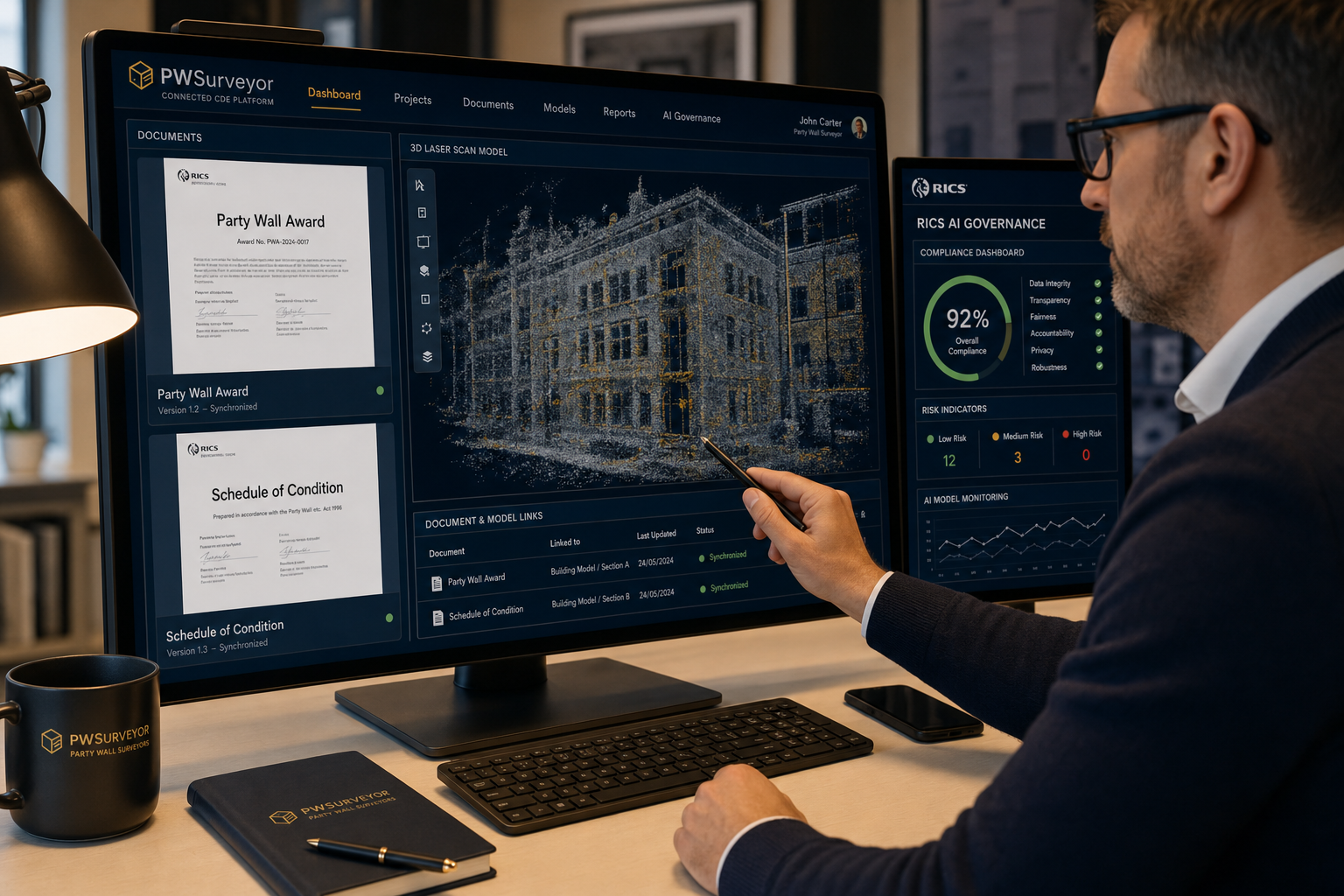
Technology alone does not break silos. Governance frameworks determine who can access what data, how disputes over data accuracy are resolved, and what happens when automated systems produce outputs that require human review. In 2026, this governance layer has become formalized in ways that directly affect party wall practice.
RICS Mandatory AI Standards: March 2026
On 9 March 2026, the Royal Institution of Chartered Surveyors (RICS) implemented mandatory standards for responsible AI use in party wall awards. These standards address risk governance, data security, and the preservation of professional independence when automated condition monitoring tools are used [2].
The standards matter for interoperability because they set the rules for how AI-generated outputs — such as automated crack detection in schedule of condition photography, or algorithmic comparison of pre- and post-works survey data — can be incorporated into legally binding documents. Without these rules, the liability position of surveyors using AI tools in interconnected workflows was unclear.
Key requirements under the RICS 2026 AI standards include:
- Audit trails for all AI-assisted decisions within party wall awards
- Data security protocols governing how condition monitoring data is stored and shared
- Human sign-off requirements before AI outputs are incorporated into formal awards
- Transparency obligations to inform adjoining owners when AI tools have been used
These requirements align with the broader direction of the EU Data Act, which mandates harmonized interoperability standards for data spaces and cloud services, ensuring that data exchange across platforms meets consistent security and quality thresholds [8].
Collaborative Contract Management
The legal documents at the heart of party wall practice — notices, awards, schedules of condition — are contracts in all but name. Modern contract management platforms now offer centralized repositories, workflow automation, and analytics that connect legal teams and stakeholders, streamlining the entire contract lifecycle and eliminating departmental silos [4].
For party wall surveyors, this means that a party wall award drafted in one system can trigger automated notifications to all relevant parties, track acknowledgment and response deadlines, and flag compliance issues before they become disputes. The party wall contract template and award guide provides a useful starting point for understanding what these documents must contain — but interoperable platforms ensure that content is also structured data, not just formatted text.
Data Sharing Agreements as Infrastructure
Interoperability does not happen by accident. Transportation agencies in the United States have demonstrated that formal operating agreements defining roles and responsibilities in data sharing are essential infrastructure for collaborative workflows. These agreements establish shared data libraries, define access rights, and set standards for data quality — all of which improve project delivery timelines [7].
The same principle applies to party wall practice. When a building owner, their surveyor, the adjoining owner, their surveyor, and the contractor all agree in advance how data will be shared, in what format, and through which platform, the downstream process runs faster and with fewer disputes. This agreement layer is as important as the technical standards themselves.
Implementing Interoperable Workflows: A Practical Roadmap
Interoperable data flows in party wall agreements: breaking silos for seamless 2026 workflows is achievable for firms of all sizes. The path from fragmented legacy systems to connected workflows follows a clear sequence.
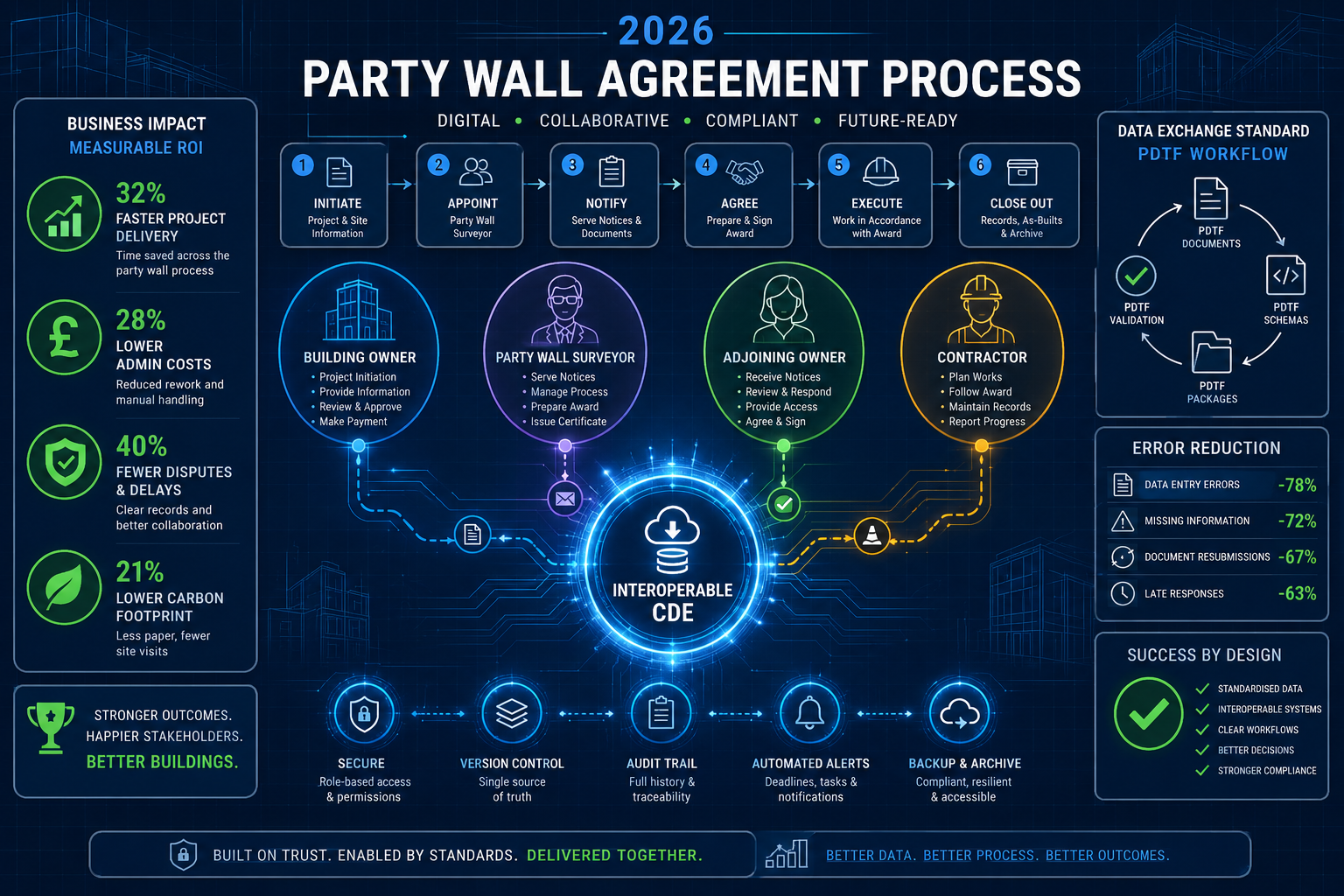
Step 1: Audit Current Data Flows
Before selecting platforms or drafting data sharing agreements, map every point at which data is created, transferred, or transformed in a typical party wall project. Common audit findings include:
- Notices served by email as PDF attachments, with no structured data
- Schedule of condition reports stored in surveyor-specific cloud drives, inaccessible to other parties
- BIM models held by the contractor, never shared with the party wall surveyor
- Party wall awards drafted in word processors, with no link to the underlying survey data
This audit reveals where the silos are and what it would take to bridge them.
Step 2: Adopt Open Data Formats
Proprietary file formats are a primary cause of interoperability failure. Adopting open standards — such as IFC for BIM data and structured PDF/A for legal documents — ensures that files created in one system can be read and processed by any other compliant system [10].
For party wall practitioners, this means specifying open formats in engagement letters and data sharing agreements from the outset of every project.
Step 3: Select a CDE and Define Access Tiers
A CDE is only as useful as its governance structure. Define clearly:
- Who can upload new documents or data
- Who can view each category of information
- Who must approve before documents move from draft to issued status
- How long data is retained after project completion
The schedule of condition is a particularly important document to manage within this structure, as it forms the evidentiary basis for any post-works dispute.
Step 4: Integrate Survey Data with BIM
Where projects involve excavation, underpinning, or structural works, 3D laser scanning data should be linked directly to the BIM model used by the contractor. This linkage, managed within the CDE, ensures that the conditions recorded by the party wall surveyor are visible to everyone making construction decisions [1].
For building owners and their surveyors, this integration is also a risk management tool. If a dispute arises after works, the linked data provides an unambiguous record of pre-works conditions.
Step 5: Automate Notice and Response Workflows
Party wall notices have strict legal timelines. Automated workflow tools can track service dates, calculate response deadlines, and send reminders to all parties — reducing the risk of procedural errors that invalidate the notice process.
Platforms modeled on the Peppol network's four-corner interoperability model — where structured documents flow between parties without bilateral agreements or custom mappings — offer a template for how this can work at scale [9]. Procore Connect demonstrates a similar approach in construction, synchronizing data across owners, general contractors, and specialty contractors to eliminate redundant data entry [5].
Step 6: Train Teams and Update Engagement Letters
Technology adoption fails without human buy-in. Training surveyors, legal teams, and contractors on the new workflows is essential. Equally important is updating standard engagement letters to specify data sharing obligations, platform requirements, and open format standards.
The ROI Case: Why Interoperability Pays
The investment in interoperable systems is not purely a compliance exercise. It delivers measurable returns across the party wall process:
- Reduced dispute costs: Linked survey and BIM data provides clear evidence in post-works disputes, reducing legal costs
- Faster project delivery: Automated notice workflows and shared CDEs eliminate days of administrative delay per project
- Lower error rates: Single-source data eliminates the version mismatches that cause rework
- Competitive differentiation: Surveyors and firms that offer connected, transparent workflows attract clients who value efficiency
For building owners considering types of party wall works that involve complex structural or excavation activities, working with surveyors who operate within interoperable systems is a direct cost and risk reduction strategy.
Conclusion
The fragmentation of data across party wall workflows is not an inevitable feature of a complex legal process. It is a solvable problem, and the tools to solve it — CDEs, open data standards, BIM integration, PDTF-aligned exchange frameworks, and RICS-governed AI tools — are available and proven in 2026.
Actionable next steps for practitioners and building owners:
- Audit your current data flows on the next party wall project and identify every manual transfer or format conversion.
- Specify open data formats in engagement letters and data sharing agreements from day one.
- Select a CDE that supports ISO 19650 compliance and define clear access tiers for all parties.
- Link 3D laser scan data to BIM models on any project involving excavation or structural works.
- Automate notice and response tracking to eliminate procedural errors and deadline failures.
- Review RICS 2026 AI standards and ensure any automated tools used in condition monitoring comply with the new governance requirements.
For anyone navigating the party wall process — whether as a building owner, adjoining owner, or surveyor — the shift to interoperable workflows is the single most impactful change available. It reduces cost, reduces risk, and transforms a legally complex process into one that runs with the efficiency that clients in 2026 rightly expect.
References
[1] Bim And 3d Laser Scanning For Party Wall Awards Enhancing Precision In 2026 Deep Excavation Projects – https://kingstonsurveyors.com/bim-and-3d-laser-scanning-for-party-wall-awards-enhancing-precision-in-2026-deep-excavation-projects/?utm_source=openai
[2] Responsible Ai Use In Party Wall Awards Rics March 2026 Standards For Automated Condition Monitoring – https://wimbledonsurveyors.com/responsible-ai-use-in-party-wall-awards-rics-march-2026-standards-for-automated-condition-monitoring/?utm_source=openai
[3] Procore Cde Lays Foundation For Agentic Ai – https://aecmag.com/collaboration/procore-cde-lays-foundation-for-agentic-ai/?utm_source=openai
[4] Collaborative Contract Management – https://www.dilitrust.com/collaborative-contract-management/?utm_source=openai
[5] One Network Every Partner Powering Synchronized Execution With Procore – https://www.procore.com/blog/one-network-every-partner-powering-synchronized-execution-with-procore?utm_source=openai
[6] How It Works – https://propdata.org.uk/how-it-works/?utm_source=openai
[7] Gdc Agreements – https://www.gis.fhwa.dot.gov/gdc_agreements.aspx?utm_source=openai
[8] Interoperability Standards – https://www.sorena.io/artifacts/eu/data-act/faq/interoperability-standards?utm_source=openai
[9] Peppol Network – https://peppolvalidator.com/peppol-network?utm_source=openai
[10] Common Data Environment – https://12d.co/guides/common-data-environment/?utm_source=openai