


Disputes over party wall surveyor fees have risen sharply across London in 2026, with some adjoining owners receiving invoices they never anticipated and building owners contesting costs they assumed were fixed. Against this backdrop, the RICS 8th Edition of Party Wall Legislation & Procedure, published in April 2026, has introduced the most substantive overhaul of fee practice guidance in over a decade. Understanding Party Wall Surveyor Fees Post-RICS Consultation: Updated Scales, Transparency Rules, and Recovery Tactics is no longer optional for property owners, developers, or the surveyors who serve them — it is essential for avoiding costly disputes and protecting legal rights under the Party Wall etc. Act 1996.
Key Takeaways
- The RICS 8th Edition (April 2026) sets clear standards for what constitutes reasonable party wall surveyor fees and how costs must be disclosed upfront.
- Typical fees for a single adjoining owner scenario now range between £1,000 and £1,500 per surveyor, reflecting 2026 market conditions.
- The building owner generally bears all surveyor fees, including those of the adjoining owner's surveyor and any third surveyor appointed.
- Cost apportionment between owners is permitted where works benefit both parties, but must be agreed before an award is made.
- When appointed surveyors reach deadlock, the third surveyor mechanism provides a structured, cost-recoverable resolution pathway.
What the RICS 8th Edition Says About Fee Scales and Reasonable Costs
The RICS 8th Edition guidance defines "reasonable costs" as those fees properly incurred in obtaining and making a party wall award. This includes the fees of appointed surveyors and any other advisers whose input is genuinely necessary to resolve the matter [1]. The guidance is explicit: surveyors making the award carry the responsibility for determining whether costs have been properly incurred under the Act's provisions.
Typical Fee Ranges in 2026
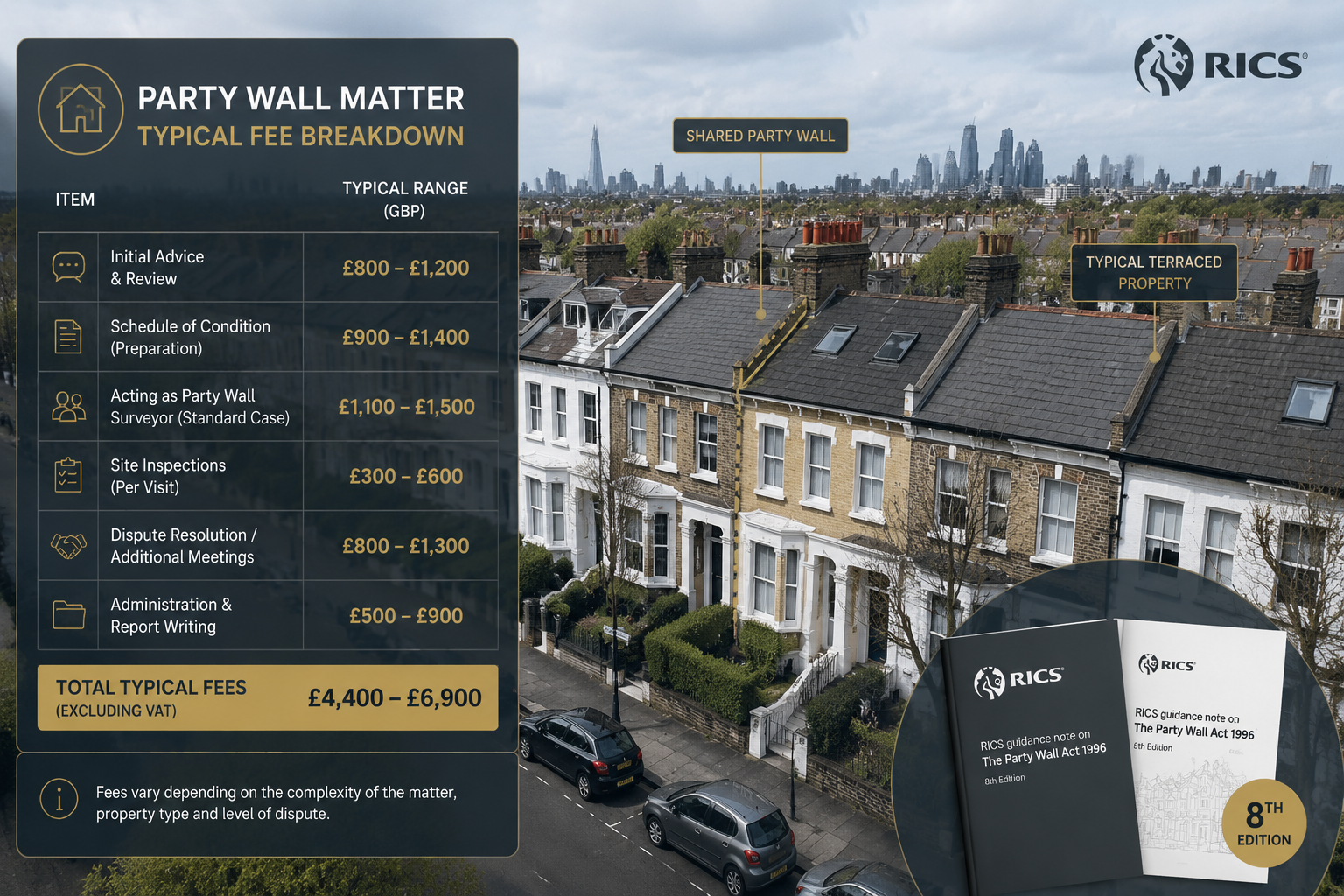
For domestic projects involving a single adjoining owner, professional fees in 2026 typically fall between £1,000 and £1,500 per surveyor [5]. More complex projects — those involving excavation near foundations, loft conversions affecting a shared wall, or multiple adjoining owners — can push total costs considerably higher. The table below provides a practical reference:
| Project Type | Typical Fee Per Surveyor | Notes |
|---|---|---|
| Simple loft conversion (1 adjoining owner) | £1,000 – £1,500 | Standard domestic scope |
| Rear extension with excavation | £1,200 – £2,000 | Additional schedule of condition work |
| Multiple adjoining owners | £800 – £1,500 per owner | Each owner may appoint separately |
| Third surveyor referral | £500 – £1,500 (additional) | Depends on complexity of dispute |
| Commercial development | £2,000+ | Bespoke assessment required |
These figures reflect the market reality that fee levels have increased in line with professional indemnity insurance costs, rising dispute volumes, and the expanded documentation requirements introduced by the 8th Edition.
For a detailed breakdown of the costs of the party wall process, including what each stage typically involves, it is worth reviewing current guidance specific to your project type.
What "Reasonable" Actually Means
The word "reasonable" carries significant legal weight. Surveyors cannot simply charge whatever the market will bear. The 8th Edition requires that fees be proportionate to the complexity of the work, the time genuinely spent, and the expertise required. A surveyor charging £2,500 for a straightforward single-skin extension where no dispute arose would face scrutiny if the matter were referred to a third surveyor for cost assessment.
Key factors that determine reasonableness:
- Complexity of the works and the party wall structure involved
- Number of site visits and inspections required
- Volume and complexity of correspondence
- Whether a schedule of condition was necessary
- Time spent preparing and serving the party wall award
Transparency Rules: What Surveyors Must Disclose in 2026

RICS has reinforced transparency requirements under its Rules of Conduct, and the 8th Edition aligns squarely with these obligations. Surveyors are required to provide clients with clear, upfront information about fee structures and anticipated total costs before work begins [2]. Any subsequent changes to fees must be communicated and agreed upon before additional work is undertaken.
This is a significant shift from previous practice, where some surveyors operated on loosely defined hourly rates with no cap, leaving building owners exposed to open-ended liability.
What a Transparent Fee Proposal Must Include
A compliant fee proposal under 2026 RICS standards should contain:
- A fixed fee or clearly defined hourly rate with an estimated total
- Scope of services — precisely what is and is not included
- Disbursements — travel, printing, and any third-party costs
- Conditions for additional charges — what triggers a revised fee
- Liability cap or proportionate liability clause where applicable [4]
"Transparency in professional fees is not merely good practice — under the current RICS Rules of Conduct, it is a professional obligation that can result in disciplinary action if ignored."
Building owners should request a written fee proposal before appointing any surveyor. If a surveyor is reluctant to provide one, that reluctance itself is a warning sign.
The Role of Liability Caps
RICS recommends that surveyors include proportionate liability clauses and liability caps in their engagement letters [4]. These clauses allocate risk appropriately and protect surveyors from disproportionate financial exposure in complex multi-party scenarios. However, the guidance is clear that such caps must be fair and reasonable — a liability cap set so low as to be meaningless would not withstand scrutiny.
For building owners, understanding these clauses matters because they affect what recourse is available if a surveyor's error causes financial loss. Always read the engagement letter carefully before signing.
Cost Apportionment, Recovery Tactics, and Third Surveyor Activation
Understanding who pays — and how to recover costs when things go wrong — is at the heart of Party Wall Surveyor Fees Post-RICS Consultation: Updated Scales, Transparency Rules, and Recovery Tactics.
Who Pays Party Wall Surveyor Fees?
The general rule under the Party Wall etc. Act 1996 is straightforward: the building owner pays all party wall surveyor fees [6]. This includes:
- Their own appointed surveyor's fees
- The adjoining owner's appointed surveyor's fees
- Any third surveyor's fees, if activated
This principle reflects the logic that the building owner initiates the works and therefore bears the associated professional costs. The adjoining owner does not typically pay anything, provided they appoint a surveyor in a reasonable and proportionate manner.
However, there are exceptions:
-
Works that benefit both owners — The 8th Edition confirms that costs may be apportioned between owners where the works confer a measurable benefit on both parties [1]. For example, if underpinning strengthens a shared foundation that both owners rely upon, a proportionate cost split may be appropriate.
-
Unreasonable conduct by the adjoining owner — Where an adjoining owner's surveyor runs up unnecessary costs through obstructive or dilatory behaviour, surveyors making the award have discretion to reflect this in their cost determination.
-
Agreed cost-sharing arrangements — Both parties can voluntarily agree to share costs, particularly in scenarios where both are carrying out works simultaneously.
Cost Apportionment in Practice
The 8th Edition advises that surveyors agree on cost responsibilities before making an award [1]. Where this cannot be agreed, the matter should be referred to the third surveyor. This prevents the award itself from being challenged on cost grounds after the fact.
For building owners managing a loft conversion or rear extension, getting clarity on apportionment early in the process avoids disputes that can delay construction programmes.
Third Surveyor Activation: The Cost Recovery Mechanism

When appointed surveyors cannot agree — whether on the terms of the award, the scope of works, or the fees themselves — the third surveyor mechanism provides the resolution pathway [3]. The 8th Edition has clarified and strengthened the protocols for third surveyor activation, making it a more predictable and cost-efficient process than it was under previous guidance.
How third surveyor activation works:
- Either appointed surveyor serves a written notice on the third surveyor requesting a determination
- The third surveyor reviews submissions from both appointed surveyors
- A determination is issued, which is binding on both parties
- The third surveyor's fees are typically awarded against the losing party or shared proportionately
The key tactical point for building owners: do not allow deadlock to persist. Delay costs money. If the adjoining owner's surveyor is being obstructive or unreasonable, activating the third surveyor promptly is almost always more cost-effective than prolonged correspondence.
Practical recovery tactics for building owners:
- Document all correspondence with the adjoining owner's surveyor carefully
- Keep a record of time-wasting behaviour that inflates costs unnecessarily
- Request itemised fee invoices from all surveyors before paying
- If fees appear disproportionate, raise the matter formally before the third surveyor rather than simply paying under protest
- Ensure the party wall award explicitly records the cost determination to avoid ambiguity later
Practical Steps for Building Owners and Adjoining Owners in 2026
For Building Owners
The single most effective cost control measure is early, proactive engagement. Serving party wall notices correctly and on time reduces the risk of disputes that inflate professional fees. A notice served too late or incorrectly can trigger a dissent that would otherwise have been avoided.
Checklist for managing fees effectively:
- Obtain written fee proposals from at least two surveyors before appointing
- Confirm the scope of services in writing before work begins
- Understand whether a schedule of condition is included or charged separately
- Ask explicitly whether the fee covers the adjoining owner's surveyor's costs
- Clarify the process for third surveyor referral and associated costs
For those considering whether professional involvement is strictly necessary, it is worth reading about having a party wall agreement without a surveyor — though for most structural works, professional appointment remains the safer route.
For Adjoining Owners
Adjoining owners have the right to appoint their own surveyor at the building owner's expense [6]. However, this right comes with a corresponding duty not to abuse it. Appointing a surveyor who then runs up disproportionate fees through unnecessary site visits or excessive correspondence exposes the adjoining owner to the risk that those costs will not be fully recoverable.
The 8th Edition's emphasis on quasi-judicial impartiality means that surveyors — even those appointed by the adjoining owner — must act in accordance with the Act rather than as advocates for their appointing party [7]. An adjoining owner's surveyor who behaves as a combative advocate rather than an impartial professional risks having their fees reduced on assessment.
For adjoining owners in specific London areas, local expertise matters. Whether the works are in East London, South London, or North London, appointing a surveyor familiar with local building stock and common construction methods can reduce the time — and therefore the cost — of reaching an agreed award.
Tips for Transparent Quoting Amid Rising Disputes
With party wall disputes rising across London in 2026, surveyors who quote transparently and comprehensively are better positioned to retain clients and avoid fee challenges. Practical tips for surveyors include:
- Use a standardised engagement letter template that clearly separates fixed fees from time-based elements
- Provide a realistic estimate of total costs at the outset, including the likely range for third surveyor involvement
- Send interim fee updates if the scope of work changes materially
- Never issue a final invoice that significantly exceeds the original estimate without prior written agreement
- Maintain detailed time records to support any fee assessment if challenged
Conclusion
The RICS 8th Edition has brought meaningful clarity to an area that has long been a source of friction between property owners and their professional advisers. Party Wall Surveyor Fees Post-RICS Consultation: Updated Scales, Transparency Rules, and Recovery Tactics is not an abstract regulatory matter — it directly affects the cost and timeline of every construction project that touches a shared wall.
Actionable next steps for 2026:
-
Building owners — Serve notices correctly and on time, obtain written fee proposals before appointing any surveyor, and do not hesitate to use the third surveyor mechanism if costs are being inflated unreasonably.
-
Adjoining owners — Exercise the right to appoint a surveyor, but ensure that surveyor understands their quasi-judicial obligations and does not behave as a pure advocate.
-
Surveyors — Adopt transparent fee disclosure as standard practice, include proportionate liability clauses in all engagement letters, and agree on cost apportionment before making an award.
-
All parties — Familiarise yourselves with the 8th Edition guidance, understand the third surveyor activation process, and treat transparent communication as the foundation of a cost-efficient resolution.
The framework now exists for party wall matters to be resolved fairly, efficiently, and at proportionate cost. The parties who benefit most will be those who engage with it proactively rather than reactively.
References
[1] Viewcompounddoc – https://consultations.rics.org/party_walls_8th_edition_guidance/viewCompoundDoc?docid=16799988&partId=16802804&sessionid=&voteid=&utm_source=openai
[2] Transparency In Professional Fees – https://www.apcrevision.com/articles/transparency-in-professional-fees?utm_source=openai
[3] Third Surveyor Activation In Party Wall Deadlocks Rics 8th Edition Protocols And Cost Recovery Tactics For 2026 – https://manchestersurveyors.com/third-surveyor-activation-in-party-wall-deadlocks-rics-8th-edition-protocols-and-cost-recovery-tactics-for-2026/?utm_source=openai
[4] Limiting Liability For Surveyors – https://www.rics.org/news-insights/limiting-liability-for-surveyors?utm_source=openai
[5] Party Wall Agreement Cost – https://www.aylingassociates.com/knowledge/party-wall-agreement-cost?utm_source=openai
[6] Who Pays For A Party Wall Surveyor – https://partywalldiy.com/guides/who-pays-for-a-party-wall-surveyor?utm_source=openai
[7] Fair Principles For Party Walls – https://ww3.rics.org/uk/en/journals/property-journal/fair-principles-for-party-walls.html?utm_source=openai