

Approximately 40% of party wall disputes in 2026 trace back to errors made at the very first stage of the process: serving the notice [1]. That single statistic should alarm any building owner planning works near a shared boundary. A defective notice does not merely cause inconvenience — it can trigger injunctions, void entire awards, and push project timelines back by months. Understanding Party Wall Notice Service Errors: Common Mistakes, Judicial Review Risks, and Surveyor Remediation Strategies is therefore essential for every professional involved in the process, from surveyors to solicitors to developers.
Key Takeaways
- Around 40% of party wall disputes in 2026 originate from errors at the notice stage, making accurate drafting and service the single most important risk-management step.
- Common mistakes include vague work descriptions, wrong notice types, improper service methods, and failure to identify all adjoining owners.
- Silence from an adjoining owner after 14 days constitutes deemed dissent under the Party Wall etc. Act 1996 — not consent.
- Invalid notices can expose building owners to injunctions and judicial review, with courts capable of setting aside awards on jurisdictional grounds.
- Engaging a qualified party wall surveyor 8 to 12 weeks before works begin is the most reliable strategy to prevent costly legal challenges.
What the Party Wall etc. Act 1996 Actually Requires
The Party Wall etc. Act 1996 creates a statutory framework that governs works affecting shared walls, boundary structures, and excavations near neighbouring properties. It is not optional. Building owners who proceed without complying with the Act risk injunctions that halt works mid-project — at enormous cost.
The Act requires building owners to serve formal notice on all adjoining owners before certain works begin. The three main notice types are:
| Notice Type | Trigger | Minimum Notice Period |
|---|---|---|
| Party Structure Notice | Works to an existing party wall or structure | 2 months |
| Line of Junction Notice | Building a new wall on or at the boundary | 1 month |
| Three Metre / Six Metre Notice | Excavation near neighbouring foundations | 1 month |
Each notice type has distinct statutory requirements. Selecting the wrong one — for example, serving a Line of Junction Notice for works on an existing party wall — invalidates the entire process and forces the building owner to restart the notice period from scratch [6]. This alone can delay a project by two months or more.
For a detailed breakdown of how to serve each notice correctly, the guide on party wall notices and how to serve them is a practical starting point.
Party Wall Notice Service Errors: Common Mistakes That Invalidate Notices
Vague or Incomplete Work Descriptions
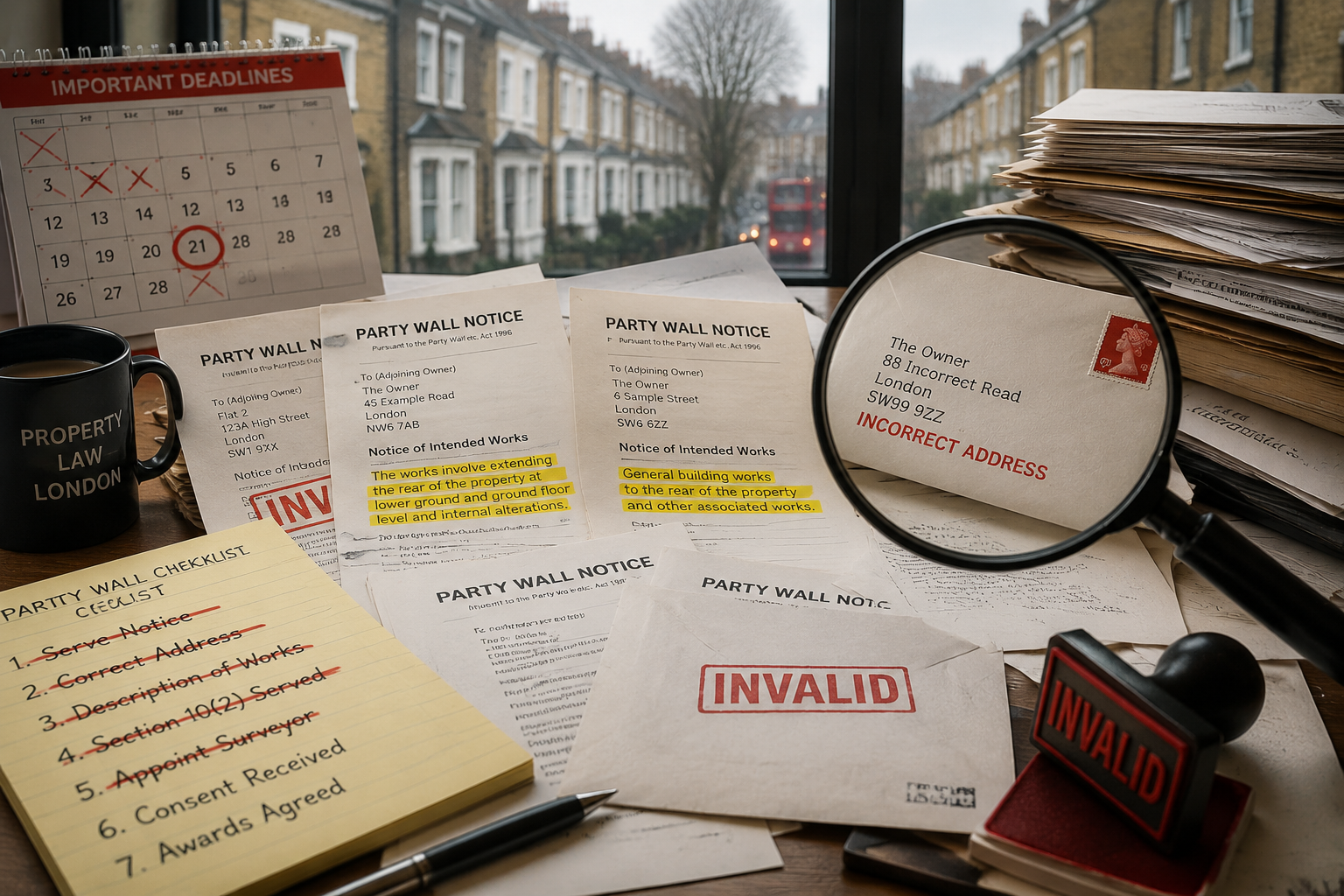
One of the most frequent drafting failures is describing proposed works in broad, non-specific terms. Phrases such as "general building works" or "internal alterations" provide no meaningful information about the nature, extent, or method of the works. Courts and surveyors have consistently found that notices lacking sufficient particularity fail to give adjoining owners the information they need to make an informed response [2].
A valid notice must describe:
- The exact nature of the proposed works
- The location of those works relative to the party wall or structure
- The proposed start date
- Whether the building owner intends to exercise any special rights under the Act
Generic templates downloaded from the internet and used without customisation are a leading cause of this problem. A template that is not tailored to the specific project almost always omits project-critical details [7].
Serving Notice on the Wrong Person
The Act requires notice to be served on the adjoining owner — the person with a freehold or leasehold interest of more than one year. Serving notice on a tenant, an occupier, or a managing agent without also notifying the freeholder renders the notice invalid [2].
In leasehold properties, this error is particularly common. Building owners often address notices to the flat occupier and overlook the management company or head leaseholder. Where a property has multiple owners — such as a jointly owned freehold — all owners must be served individually.
Around 30% of notice failures in 2026 are attributed to improper service methods, including addressing notices to the wrong party or using delivery methods not recognised under the Act [3].
Email-Only Service
The Party Wall etc. Act 1996 does not recognise email as a standalone valid method of service unless the adjoining owner has explicitly agreed to receive notices electronically. A documented case study illustrates the risk clearly: a building owner served all notices via email only, and the adjoining owner — unfamiliar with email — never received them. The result was an injunction halting works that had already begun [5].
Recognised methods of service under the Act include:
- Delivery by hand to the adjoining owner's last known address
- Recorded post to the adjoining owner's last known address
- Affixing the notice to a conspicuous part of the premises (where the owner cannot be found)
Misunderstanding the 14-Day Response Window
A widespread misconception among building owners — and even some less experienced surveyors — is that silence from an adjoining owner after 14 days means consent has been granted. The opposite is true. Under the Act, failure to respond within 14 days is treated as deemed dissent, triggering the dispute resolution mechanism and requiring the appointment of surveyors [1].
Building owners who misread silence as approval and proceed with works are in breach of the Act from the moment the first tool touches the wall.
Inadequate Notice Timing
Serving a Party Structure Notice two weeks before planned works begin, when the Act requires two months' notice, is an error that cannot be corrected without restarting the entire process. Inadequate timing accounts for a significant proportion of project delays, particularly on fast-moving development sites where programme pressures push owners to cut corners [2].
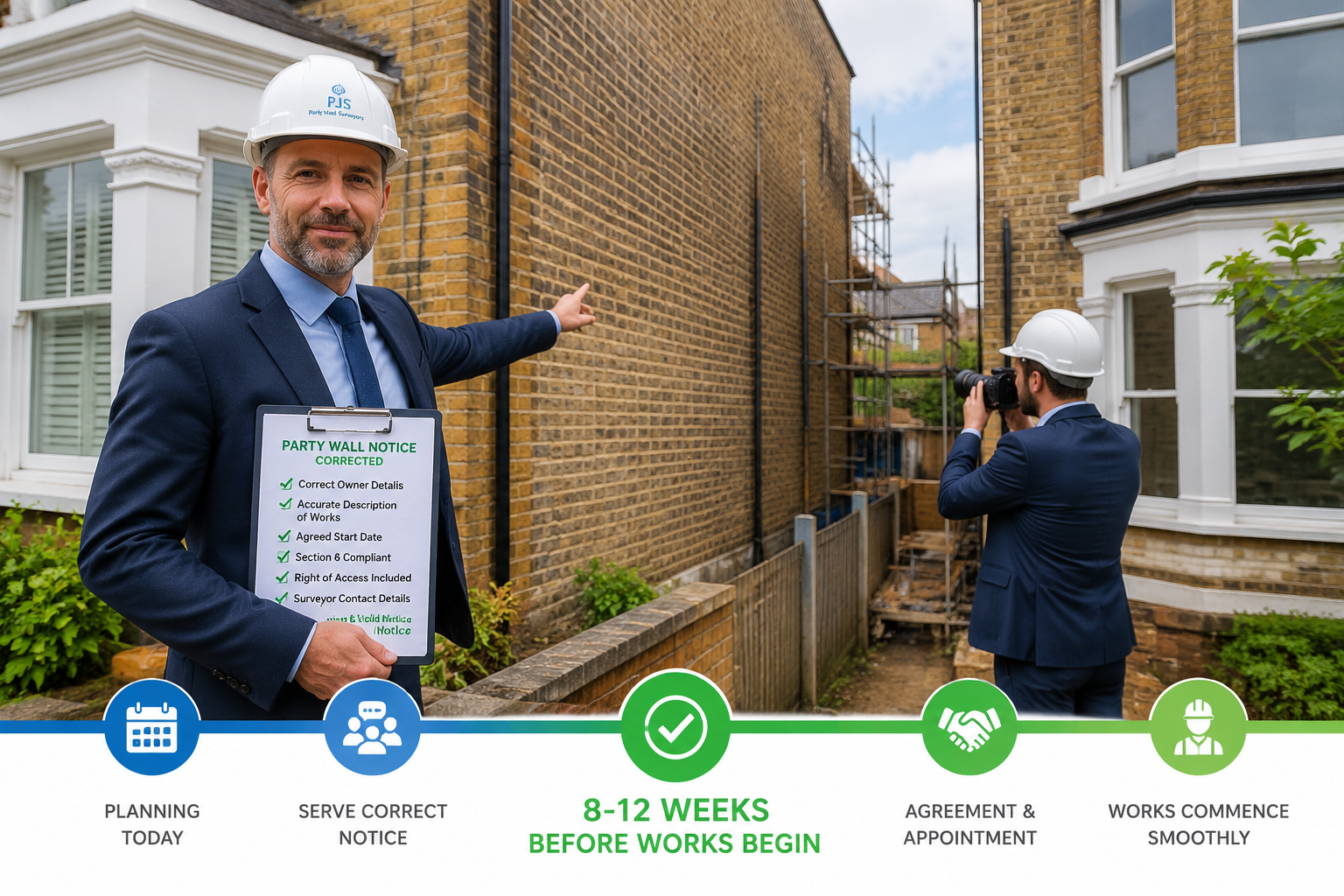
The practical rule: allow 8 to 12 weeks before the intended start date to serve notices, receive responses, and — where dissent is received — allow time for surveyors to be appointed and an award to be made [1].
For building owners who want to understand the full timeline and cost implications, the resource on party wall costs and the process provides useful context.
Judicial Review Risks: When Notice Errors Become Legal Challenges

How Invalid Notices Undermine Surveyor Jurisdiction
The authority of party wall surveyors to act — and to make a binding award — derives entirely from the validity of the underlying notice. If the notice is defective, surveyors have no jurisdiction. Any award they make on the basis of an invalid notice is itself void and unenforceable [3].
This is not a theoretical risk. Courts have set aside party wall awards where:
- The notice was served on the wrong person
- The notice described works that fell outside the scope of the Act
- The notice period had not expired before surveyors were appointed
- The notice failed to identify the correct notice type
"A party wall award made without valid jurisdiction is not merely voidable — it is void from the outset. No amount of procedural compliance downstream can cure a defective notice upstream."
Injunctions: The Most Immediate Consequence
Where works proceed without a valid notice, or where a notice is challenged as defective after works have begun, adjoining owners can apply to the court for an injunction to halt the works. Courts have shown a willingness to grant such injunctions, particularly where the building owner has ignored the statutory process entirely or has proceeded in the face of a known dispute [3].
The cost consequences are severe:
- Works halted mid-project may require temporary structural support
- Contractors standing idle accumulate daily costs
- Legal fees for injunction proceedings can reach tens of thousands of pounds
- Reputational damage affects future project financing and relationships
Judicial Review and Award Challenges
Beyond injunctions, a party wall award can be challenged by appeal to the county court within 14 days of service. Grounds for challenge include procedural irregularity, jurisdictional defects, and failure to follow the Act's requirements. Where an award is set aside, the entire process must restart — with all the associated costs and delays [3].
For adjoining owners who suspect a notice served on them is defective, understanding their rights is equally important. The guide on party wall act notices and how to respond outlines the options available.
Party Wall Notice Service Errors: Surveyor Remediation Strategies
Early Engagement: The Most Effective Prevention
The single most reliable remediation strategy is also the simplest: engage a qualified party wall surveyor before the notice is drafted, not after a problem has emerged. Surveyors appointed early can:
- Identify the correct notice type for the proposed works
- Draft notices with sufficient particularity to withstand challenge
- Confirm the identity of all adjoining owners through Land Registry searches
- Advise on the correct service method for each property
- Set a realistic programme that accounts for statutory notice periods [1]
Early engagement is particularly important for complex projects involving multiple adjoining owners, leasehold properties, or works that fall close to the boundary between different notice types. A building owner's surveyor can manage the entire notice process and reduce the risk of challenge significantly.
Correcting Defective Notices Before Works Begin
Where a notice has already been served and a defect is identified before works begin, the remediation options depend on the nature of the defect:
Minor defects — such as a typographical error in the property description — may be correctable by agreement between the parties without restarting the notice period.
Fundamental defects — such as wrong notice type, wrong recipient, or insufficient notice period — generally require a fresh notice to be served. The building owner must restart the statutory clock.
Service defects — such as email-only service — may be remedied by re-serving the notice using a recognised method, provided the original notice period has not yet expired.
In all cases, the surveyor should document the corrective steps taken and maintain a clear paper trail. This documentation becomes critical evidence if the matter is later challenged.
The Role of the Schedule of Condition
A comprehensive schedule of condition is not part of the notice itself, but it is an essential component of the broader risk management strategy. Detailed photographic evidence and written descriptions of the adjoining property's pre-existing condition protect both parties from post-work disputes about damage causation.
Schedules of condition should be prepared before any works begin and should cover:
- All areas of the adjoining property that could be affected by the proposed works
- Existing cracks, settlement, damp, and structural defects
- External elements including walls, roofs, and boundary structures
- Internal finishes in rooms adjacent to the party wall
Without a thorough schedule, any damage claim after works complete becomes a dispute about what existed before — a dispute that is expensive and difficult to resolve [4].
Appointing Surveyors Promptly After Dissent
When an adjoining owner dissents — or is deemed to have dissented — the building owner must appoint a surveyor within the timeframe set by the Act. Delays in appointment extend the period before an award can be made, pushing back the project start date further.
The adjoining owner's surveyor plays an equally important role in this process. Both surveyors — or a single agreed surveyor — must act impartially and in accordance with the Act. Choosing surveyors with relevant experience in the specific type of works proposed reduces the risk of disputes over the award itself.
Practical Checklist for Surveyors
Before serving any party wall notice, a competent surveyor should verify the following:
- Correct notice type identified for the proposed works
- All adjoining owners identified via Land Registry title register searches
- Notice addressed to all owners, not just occupiers
- Works described with sufficient particularity (drawings attached where appropriate)
- Proposed start date allows for the full statutory notice period
- Service method is legally recognised (hand delivery or recorded post)
- Proof of service retained (signed receipt or recorded delivery confirmation)
- Programme allows 8 to 12 weeks from service to planned works commencement
For projects in specific London areas, local surveyors with knowledge of the relevant property types and ownership structures can provide targeted support. Professionals covering North London, South London, and Central London are familiar with the leasehold complexities and dense terrace housing that make notice errors particularly common in the capital.
Conclusion
Party Wall Notice Service Errors: Common Mistakes, Judicial Review Risks, and Surveyor Remediation Strategies is not an abstract compliance topic — it is a practical framework for protecting projects, relationships, and finances. The consequences of a defective notice range from minor delays to injunctions, voided awards, and costly litigation.
Actionable next steps for building owners and surveyors in 2026:
- Appoint a qualified party wall surveyor at least 8 to 12 weeks before planned works begin — not after a problem arises.
- Conduct Land Registry searches to identify all adjoining owners before drafting any notice.
- Select the correct notice type for the specific works proposed and describe those works in precise, project-specific terms.
- Serve notices using a legally recognised method and retain proof of service.
- Never assume that silence equals consent — treat any non-response after 14 days as deemed dissent and act accordingly.
- Commission a detailed schedule of condition before works begin to protect against post-work damage disputes.
- If a defect is identified in a served notice, take immediate corrective action rather than hoping the error goes unnoticed.
The Party Wall etc. Act 1996 is a well-structured piece of legislation. Its requirements are clear and, when followed correctly, protect all parties. The errors that trigger injunctions and judicial review are almost always avoidable with proper professional input at the outset.
References
[1] Invalid Party Wall Notices Surveyor Strategies To Avoid Injunctions And Delays In 2026 – https://wimbledonsurveyors.com/invalid-party-wall-notices-surveyor-strategies-to-avoid-injunctions-and-delays-in-2026/?utm_source=openai
[2] Party Wall Notices In Practice The Most Common Drafting Errors That Trigger Delay Or Invalidity – https://kingstonsurveyors.com/party-wall-notices-in-practice-the-most-common-drafting-errors-that-trigger-delay-or-invalidity/?utm_source=openai
[3] The Most Common Reasons Party Wall Awards Get Delayed Challenged Or Ignored – https://manchestersurveyors.com/the-most-common-reasons-party-wall-awards-get-delayed-challenged-or-ignored/?utm_source=openai
[4] Evergreen Guide To Party Wall Act Notices 2026 Rics Templates And Common Pitfalls For Surveyors – https://princesurveyors.co.uk/blog/evergreen-guide-to-party-wall-act-notices-2026-rics-templates-and-common-pitfalls-for-surveyors/?utm_source=openai
[5] Common Mistakes In Party Wall Notices How Surveyors Fix Dissent And Delays – https://partywallsurveyorlondon.uk/blogs/common-mistakes-in-party-wall-notices-how-surveyors-fix-dissent-and-delays/?utm_source=openai
[6] Party Wall Notice Drafting Errors That Invalidate Compliance Avoiding Legal Challenges Before Work Begins – https://partywallsurveyorlondon.uk/blogs/party-wall-notice-drafting-errors-that-invalidate-compliance-avoiding-legal-challenges-before-work-begins/?utm_source=openai
[7] Invalid Party Wall Notices Common Drafting Errors That Trigger Injunctions And Project Delays – https://www.canterburysurveyors.com/blog/invalid-party-wall-notices-common-drafting-errors-that-trigger-injunctions-and-project-delays/?utm_source=openai