
The construction industry stands at a technological crossroads in 2026, where artificial intelligence and automation are fundamentally reshaping how professionals handle complex compliance documentation. For party wall surveyors, building owners, and construction professionals across the UK, the integration of AI and Automation in Party Wall Notice Preparation: Streamlining Compliance Documentation in 2026 represents not just an efficiency upgrade, but a complete transformation of traditional workflows. As regulatory requirements become increasingly sophisticated and project timelines compress, the question is no longer whether to adopt these technologies, but how to implement them effectively while maintaining the professional judgment that complex property disputes demand.
Key Takeaways
- AI-powered automation can reduce party wall notice preparation time by 40-60% while improving accuracy and compliance with the Party Wall etc. Act 1996
- Regulatory frameworks in 2026, including the EU AI Act, require human oversight and transparency when using AI for legal documentation, ensuring professional accountability remains central
- Generative AI tools can automate routine aspects of notice drafting, compliance tracking, and preliminary award preparation while surveyors focus on complex dispute resolution
- Cost reduction and improved consistency are primary benefits, with AI systems minimizing errors in statutory timeframes, property descriptions, and adjoining owner identification
- Hybrid workflows combining AI efficiency with human expertise represent the optimal approach for party wall compliance in 2026
Understanding the Current Landscape of Party Wall Documentation
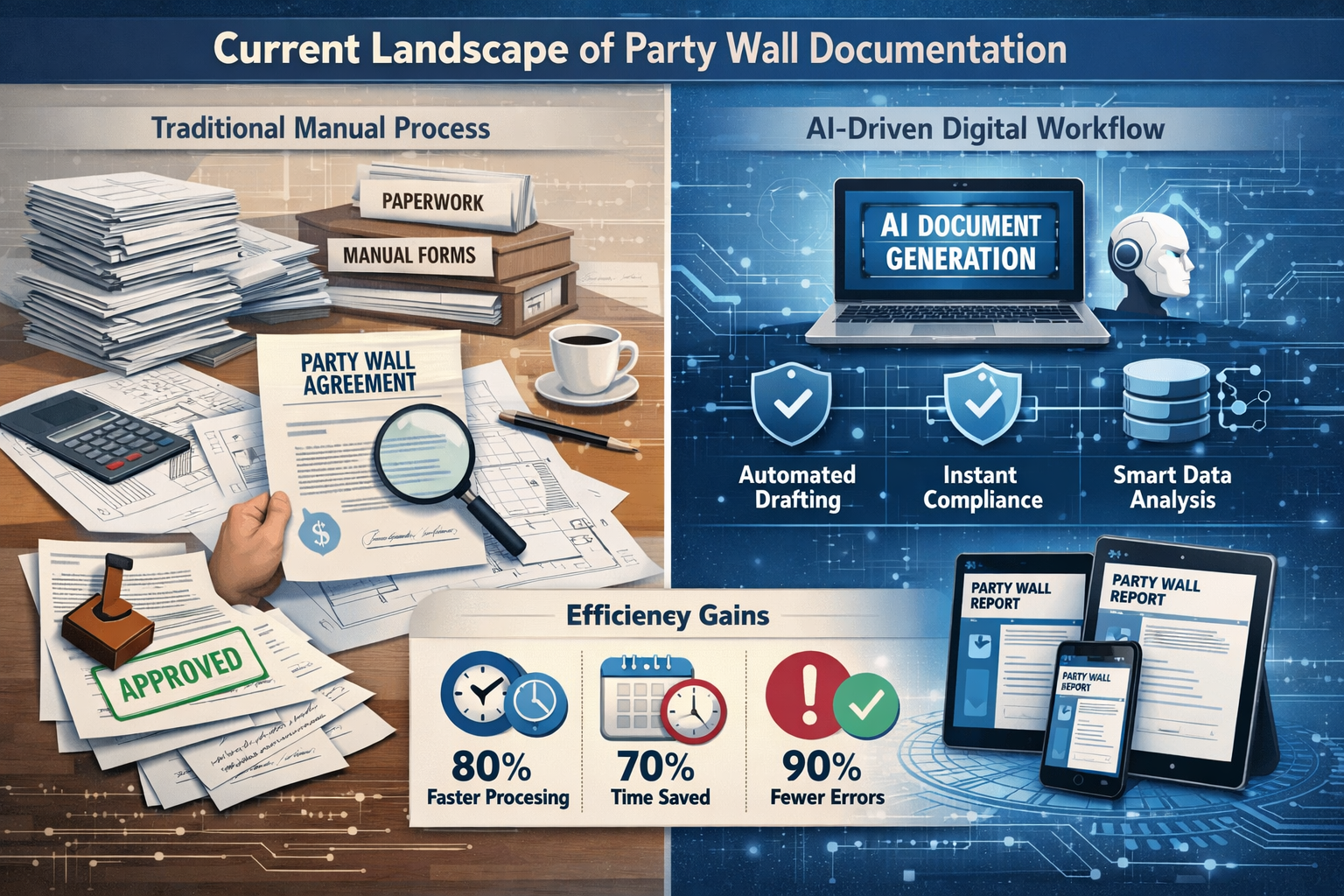
The Party Wall etc. Act 1996 establishes a comprehensive framework governing building works that affect shared structures between properties. Traditional preparation of party wall notices involves meticulous manual processes: identifying adjoining owners, drafting precise descriptions of proposed works, calculating statutory notice periods, and ensuring compliance with multiple regulatory requirements.
The Traditional Workflow Challenges
Party wall surveyors have long grappled with several persistent challenges:
- Time-intensive documentation: Preparing comprehensive notices for complex projects can require 8-15 hours of professional time
- Consistency issues: Manual drafting leads to variations in format, language, and completeness across different notices
- Regulatory complexity: Navigating the intersection of party wall law, building regulations, and planning requirements demands constant vigilance
- Administrative burden: Tracking multiple notice periods, responses, and deadlines across concurrent projects strains resources
- Error susceptibility: Manual data entry and document preparation create opportunities for costly mistakes in addresses, dates, or work descriptions
According to recent industry analysis, construction legal professionals are increasingly turning to technology solutions to address documentation bottlenecks[3]. The construction sector has recognized that automation can significantly reduce the administrative overhead that diverts professional attention from higher-value activities like dispute resolution and technical assessment.
Why AI and Automation Matter in 2026
The convergence of several technological and regulatory developments makes 2026 a pivotal year for AI and Automation in Party Wall Notice Preparation: Streamlining Compliance Documentation in 2026:
- Regulatory maturity: The EU AI Act and related frameworks now provide clear guidance on acceptable uses of AI in legal documentation[1]
- Technology accessibility: Generative AI tools have become more affordable and user-friendly for small to medium-sized surveying practices
- Industry adoption: Construction professionals across disciplines are integrating AI into workflows, creating ecosystem compatibility[6]
- Data availability: Years of digitized party wall documentation provide training data for specialized AI models
"The integration of AI into property surveying workflows represents a fundamental shift from reactive documentation to proactive compliance management, enabling professionals to identify potential issues before they escalate into costly disputes."
Understanding what party wall notices are and how to respond remains essential foundational knowledge, but the how of preparation is undergoing dramatic transformation.
How AI and Automation Transform Party Wall Notice Preparation
The practical application of AI and Automation in Party Wall Notice Preparation: Streamlining Compliance Documentation in 2026 manifests across multiple workflow stages, each offering distinct efficiency gains and quality improvements.
Automated Data Extraction and Property Analysis
Modern AI systems excel at extracting relevant information from diverse sources and structuring it for compliance documentation:
Land Registry Integration: AI tools can automatically retrieve property ownership details, boundary information, and historical records from Land Registry databases, eliminating manual research time. This capability proves particularly valuable when identifying all adjoining owners for complex developments affecting multiple properties.
Planning Application Analysis: Natural language processing algorithms can review planning permissions and building control applications to extract work descriptions, structural details, and timeline information that must be reflected in party wall notices.
Property Characteristic Assessment: Computer vision and geospatial AI can analyze property surveys, architectural drawings, and site photographs to identify party walls, party structures, and excavation zones that trigger notice requirements under different sections of the Act.
Real estate AI tools have demonstrated remarkable capability in property data processing and analysis[4], and these same technologies adapt effectively to party wall compliance workflows.
Intelligent Notice Drafting and Customization
Generative AI platforms can produce draft party wall notices by combining statutory templates with project-specific information:
| Notice Type | AI Automation Capability | Human Review Focus |
|---|---|---|
| Section 1 Notices (New building on line of junction) | Auto-generates property descriptions, work specifications, and statutory language | Verify accuracy of boundary location and structural approach |
| Section 3 Notices (Adjacent excavation) | Calculates affected properties based on excavation depth and proximity rules | Confirm engineering methodology and protective measures |
| Section 6 Notices (Works to existing party structures) | Populates standard work descriptions and notice periods | Assess technical complexity and potential dispute risk |
When preparing a party structure notice, AI systems can reference thousands of previous notices to ensure language clarity, completeness, and compliance with current best practices.
The contract automation capabilities demonstrated in SaaS and construction contexts[2] translate directly to party wall documentation, where standardized clauses combine with project-specific variables.
Compliance Checking and Quality Assurance
AI-powered validation systems provide multi-layered quality control:
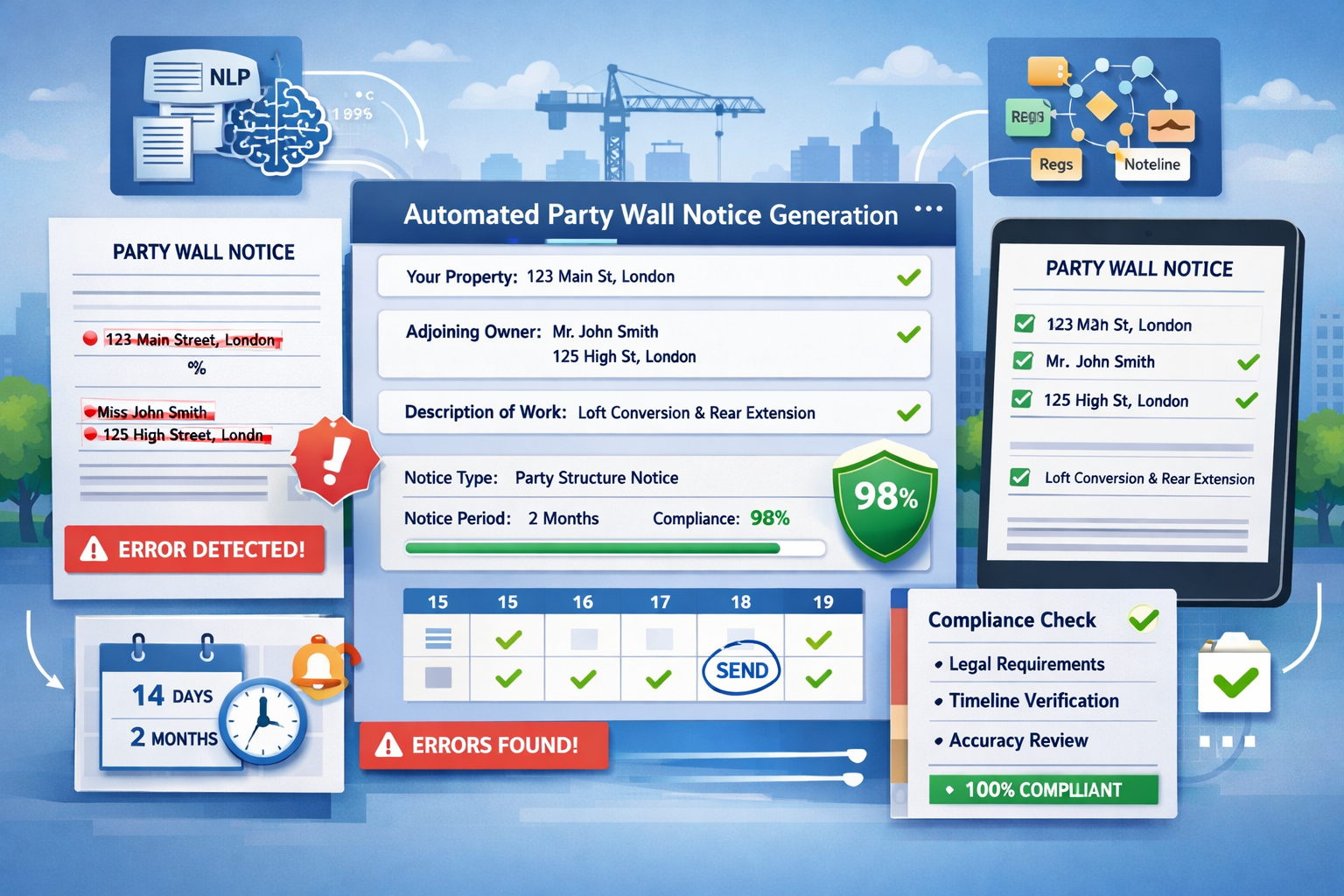
- Statutory requirement verification: Algorithms check that notices include all mandatory elements specified in the Party Wall etc. Act 1996
- Timeline calculation: Automated systems compute correct notice periods, accounting for weekends, holidays, and statutory minimums
- Cross-reference validation: AI tools verify consistency between notices, planning documents, and building control submissions
- Precedent comparison: Machine learning models compare draft notices against successful historical examples to identify potential ambiguities or omissions
These validation capabilities significantly reduce the error rate that can lead to invalid notices, requiring re-service and causing project delays.
Workflow Automation and Tracking
Beyond document preparation, AI systems streamline the entire party wall process:
Automated Scheduling: Systems can generate and manage notice service timelines, tracking when notices must be served to meet project commencement dates and automatically flagging approaching deadlines.
Response Management: AI chatbots and automated communication systems can handle routine inquiries from adjoining owners, providing information about the party wall process and next steps while escalating complex questions to human surveyors.
Award Preparation Assistance: For cases proceeding to party wall awards, AI can draft preliminary award documents incorporating standard protective clauses, condition schedules, and dispute resolution provisions.
Cost Tracking: Automated systems monitor professional fees, surveyor appointments, and related expenses, providing transparency for building owners concerned about keeping party wall costs down.
Property surveying workflows in 2026 increasingly rely on AI-driven precision for efficiency and accuracy[5], with party wall compliance representing a natural application of these technologies.
Regulatory Compliance and Ethical Considerations for AI in Party Wall Documentation
While AI and Automation in Party Wall Notice Preparation: Streamlining Compliance Documentation in 2026 offers substantial benefits, implementation must navigate evolving regulatory frameworks and professional responsibility standards.
The EU AI Act and Construction Documentation
The EU AI Act, fully applicable in 2026, establishes risk-based requirements for AI systems used in legal and regulatory contexts[1]. Party wall notice preparation falls into a moderate-risk category, requiring:
Transparency Requirements: Building owners and adjoining owners must be informed when AI systems contribute to notice preparation, award drafting, or dispute analysis. This doesn't mean disclosing proprietary algorithms, but rather acknowledging AI assistance in documentation.
Human Oversight Mandates: The Act requires "human-in-the-loop" oversight for AI systems affecting legal rights. For party wall work, this means qualified surveyors must review and approve AI-generated notices before service, rather than allowing fully automated issuance.
Accuracy and Reliability Standards: AI systems must demonstrate consistent performance and undergo regular validation testing. Surveyors using AI tools should maintain records of accuracy rates, error types, and corrective actions.
Data Protection Compliance: AI systems processing personal data (property ownership information, contact details, financial records) must comply with GDPR requirements, including data minimization, purpose limitation, and security safeguards.
Professional Standards and Liability
Professional bodies governing party wall surveyors have established guidelines for AI adoption:
✅ Acceptable AI Uses:
- Template population and standard clause generation
- Compliance checking and quality assurance
- Administrative task automation (scheduling, tracking, reminders)
- Research and precedent analysis
- Preliminary draft preparation for professional review
❌ Inappropriate AI Delegation:
- Final professional judgment on dispute resolution
- Unsupervised determination of structural adequacy
- Automated decision-making on award terms without human review
- Client relationship management without human interaction options
The fundamental principle remains that professional responsibility cannot be delegated to algorithms. When a surveyor signs a party wall notice or award, they assume personal liability for its accuracy and appropriateness, regardless of AI involvement in preparation.
Maintaining Professional Judgment in Automated Workflows
The optimal approach combines AI efficiency with human expertise:
Routine Tasks → High Automation: Standard notice preparation for straightforward works (simple loft conversions, standard extensions) can be heavily automated, with surveyors performing final review and approval.
Complex Situations → AI Assistance: Unusual structural scenarios, multiple affected properties, or anticipated disputes benefit from AI research and drafting support, but require substantial professional input and customization.
Dispute Resolution → Minimal Automation: Negotiation, technical assessment of damage claims, and resolution of conflicting expert opinions remain fundamentally human activities, though AI can provide relevant precedents and analytical support.
Understanding the types of party wall works helps determine appropriate automation levels for different scenarios.
Data Security and Confidentiality
Party wall documentation contains sensitive information requiring robust protection:
- Client confidentiality: AI systems must maintain strict separation between different clients' data, preventing cross-contamination or inadvertent disclosure
- Secure storage: Cloud-based AI platforms should employ encryption, access controls, and regular security audits
- Data retention policies: Automated systems should align with professional record-keeping requirements while respecting data minimization principles
- Vendor assessment: Surveyors should evaluate AI tool providers' security practices, data handling policies, and compliance certifications
The 2026 regulatory landscape demands that efficiency gains never compromise professional standards or client protections[1].
Practical Implementation: Adopting AI Tools in Party Wall Practice
For surveyors and construction professionals ready to embrace AI and Automation in Party Wall Notice Preparation: Streamlining Compliance Documentation in 2026, successful implementation follows a structured approach.
Assessing Practice Needs and Readiness
Before selecting AI tools, evaluate current workflows and pain points:
Volume Analysis: Practices handling high volumes of routine notices (50+ annually) realize greater ROI from automation than those primarily managing complex, bespoke situations.
Process Documentation: Map existing workflows to identify automation opportunities. Where do delays occur? Which tasks consume disproportionate time relative to their value?
Technology Infrastructure: Assess current systems for compatibility with AI tools. Cloud-based practice management systems typically integrate more easily than legacy on-premise solutions.
Staff Capabilities: Consider team members' technical comfort levels and training requirements. Successful AI adoption requires user buy-in and competence.
Selecting Appropriate AI Solutions
The 2026 market offers diverse AI tools for construction compliance:
Specialized Party Wall Platforms: Purpose-built solutions designed specifically for Party Wall etc. Act 1996 compliance, offering templates, automated calculations, and workflow management.
General Legal Tech Tools: Broader contract automation and legal documentation platforms that can be configured for party wall notices, often with greater customization flexibility.
AI-Enhanced Practice Management: Comprehensive surveying practice systems incorporating AI features alongside client relationship management, invoicing, and project tracking.
Custom AI Development: Larger practices may commission bespoke AI solutions tailored to their specific workflows and client base.
When evaluating options, consider:
- 🔍 Accuracy rates: Request validation data and case studies demonstrating reliability
- 💰 Pricing models: Assess per-notice fees, subscription costs, and total cost of ownership
- 🔗 Integration capabilities: Ensure compatibility with existing systems and data sources
- 📚 Training and support: Evaluate vendor resources for onboarding and ongoing assistance
- 📊 Reporting features: Look for analytics that demonstrate efficiency gains and quality metrics
Implementation Best Practices
Phased Rollout: Begin with a pilot program using AI for a subset of notices (e.g., standard Section 6 notices for common works). Monitor results, gather user feedback, and refine processes before full deployment.
Parallel Processing: Initially run AI-generated notices alongside traditional manual preparation to validate accuracy and identify edge cases where automation struggles.
Template Refinement: Invest time in configuring AI systems with practice-specific templates, standard clauses, and preferred language. Well-configured systems deliver better initial outputs requiring less revision.
Training Investment: Provide comprehensive training covering not just tool operation, but also understanding AI limitations, appropriate oversight, and quality assurance responsibilities.
Feedback Loops: Establish processes for users to report AI errors, suggest improvements, and share successful customizations. Continuous refinement maximizes value.
For practices operating across different regions, understanding location-specific considerations—whether serving as a party wall surveyor in South London, West London, or other areas—helps configure AI tools with appropriate local knowledge.
Measuring Success and ROI
Track key performance indicators to quantify AI impact:
| Metric | Pre-AI Baseline | Target Improvement | Measurement Method |
|---|---|---|---|
| Notice preparation time | Average hours per notice | 40-60% reduction | Time tracking comparison |
| Error rate | Invalid notices requiring re-service | 75%+ reduction | Quality audit results |
| Client satisfaction | Survey scores | Maintain or improve | Regular client feedback |
| Cost per notice | Total professional time cost | 30-50% reduction | Financial analysis |
| Turnaround time | Days from instruction to service | 50%+ reduction | Process timeline tracking |
Demonstrating clear value justifies continued investment and supports expansion to additional AI applications.
Integration with Human Expertise
The most successful implementations recognize that AI augments rather than replaces professional judgment:
Tiered Review Process: Establish clear protocols for when AI-generated notices require minimal review (simple, standard situations) versus extensive professional customization (complex, unusual circumstances).
Expertise Development: Free surveyors from routine documentation to focus on developing specialized knowledge in complex structural issues, dispute resolution techniques, and emerging construction methods.
Client Communication: Use time savings to enhance client service through more frequent updates, detailed explanations, and proactive issue identification.
Continuous Learning: Encourage team members to understand AI capabilities and limitations, fostering informed oversight rather than blind reliance.
When having a party wall agreement without a surveyor isn't appropriate, AI-equipped professionals can provide more efficient and cost-effective service than traditional manual approaches.
Future Trends: The Evolution of AI in Party Wall Compliance
Looking beyond 2026, several emerging trends will further transform AI and Automation in Party Wall Notice Preparation: Streamlining Compliance Documentation in 2026 and party wall practice more broadly.
Predictive Analytics and Dispute Prevention
Advanced AI systems are beginning to analyze historical party wall disputes to identify risk factors:
Dispute Probability Scoring: Machine learning models assess project characteristics (work type, property configuration, neighborhood demographics, surveyor selection) to predict likelihood of disagreement, enabling proactive mitigation strategies.
Optimal Approach Recommendations: AI systems suggest structural approaches, protective measures, and communication strategies that minimize dispute risk based on similar historical projects.
Early Warning Systems: Automated analysis of adjoining owner responses, tone, and concerns flags potential escalation, allowing early intervention before positions harden.
Integrated Construction Compliance Platforms
Party wall compliance increasingly integrates with broader construction legal and regulatory systems:
Unified Documentation: AI platforms that handle party wall notices, building control submissions, planning applications, and contractor agreements, ensuring consistency and reducing duplication.
Automated Cross-Referencing: Systems that verify alignment between party wall awards, construction contracts, and insurance policies, identifying gaps or conflicts.
Real-Time Compliance Monitoring: AI tools that track ongoing construction against approved party wall awards, flagging deviations requiring amended agreements.
Construction industry trends indicate growing integration of legal and technical workflows[3], with party wall compliance a natural component of comprehensive project management systems.
Enhanced Visualization and Communication
AI-powered visualization tools improve stakeholder understanding:
3D Work Visualization: Automated generation of visual representations showing proposed works in relation to party structures, helping adjoining owners understand scope and impact.
Impact Simulation: AI models predicting likely effects (noise, vibration, temporary access requirements) based on work type and property characteristics.
Interactive Timelines: Automated creation of visual project schedules showing notice periods, anticipated work phases, and key milestones.
These tools address a common pain point: adjoining owners' difficulty understanding technical descriptions in traditional notices, reducing anxiety and objections.
Blockchain and Smart Contracts
Emerging applications of blockchain technology to party wall documentation include:
Immutable Record-Keeping: Blockchain-based systems creating tamper-proof records of notice service, responses, and agreements, reducing disputes over procedural compliance.
Smart Contract Awards: Self-executing party wall awards that automatically trigger payments, access permissions, or dispute resolution procedures when specified conditions occur.
Distributed Verification: Blockchain networks enabling multiple parties (building owner, adjoining owners, surveyors) to verify document authenticity and completeness without centralized intermediaries.
While still experimental in 2026, these technologies may become mainstream in party wall practice within 5-10 years.
AI-Assisted Surveyor Selection
Platforms are emerging that use AI to match building owners with appropriate surveyors:
Expertise Matching: Algorithms that analyze project characteristics and match them with surveyors' experience profiles, specializations, and track records.
Performance Analytics: Systems that track surveyor outcomes (dispute resolution rates, award timelines, client satisfaction) to inform selection decisions.
Geographic Optimization: AI tools that identify surveyors with deep local knowledge relevant to specific areas, whether someone needs a party wall surveyor in East London, Central London, North London, or elsewhere.
Continuous Regulatory Adaptation
AI systems increasingly incorporate regulatory intelligence:
Automated Legal Updates: Systems that monitor changes to the Party Wall etc. Act 1996, related case law, and regulatory guidance, automatically updating templates and compliance checks.
Jurisdiction-Specific Customization: AI tools that adapt to regional variations in party wall practice, local authority requirements, and emerging precedents.
Regulatory Forecasting: Predictive models that anticipate likely regulatory developments based on consultation papers, parliamentary activity, and industry advocacy efforts.
As construction AI solutions continue to evolve[6], party wall compliance will benefit from broader industry innovation while developing specialized capabilities for this unique legal framework.
Case Studies: Real-World Applications of AI in Party Wall Practice
Examining practical implementations illustrates the tangible benefits of AI and Automation in Party Wall Notice Preparation: Streamlining Compliance Documentation in 2026.
Case Study 1: High-Volume Residential Development
Context: A London-based developer undertaking multiple simultaneous basement excavations across 15 properties required party wall notices for 47 adjoining owners.
Traditional Approach: Manual preparation would require approximately 120 professional hours (averaging 2.5 hours per notice for research, drafting, and review), costing £12,000-15,000 in surveyor fees.
AI Implementation: The developer's surveyor adopted an AI-powered notice preparation platform configured with project-specific details (excavation depths, construction methodology, timeline).
Results:
- ⏱️ Time reduction: 72% decrease in preparation time (34 hours total vs. 120 hours traditional)
- 💰 Cost savings: £8,500 reduction in professional fees
- ✅ Quality improvement: Zero notices required re-service due to errors (vs. typical 5-8% error rate)
- 📅 Timeline acceleration: All notices served 12 days earlier than traditional approach would allow
Key Success Factor: The surveyor invested upfront time creating comprehensive project templates and validation rules, enabling the AI system to generate highly accurate initial drafts requiring minimal customization.
Case Study 2: Complex Mixed-Use Development
Context: A commercial-residential conversion involving works to multiple party structures, requiring coordination between building owners and diverse adjoining owners with varying concerns.
AI Application: The appointed surveyor used AI tools for:
- Automated identification of all affected party structures from architectural drawings
- Generation of tailored notice drafts for different work types (structural alterations, new openings, facade works)
- Predictive analysis of likely concerns based on adjoining property types
- Automated tracking of response deadlines and surveyor appointment processes
Results:
- 🎯 Comprehensive coverage: AI analysis identified 3 affected party structures that manual review initially missed
- 🤝 Improved communication: Tailored notices addressing property-specific concerns reduced initial objections by 40%
- 📊 Enhanced coordination: Automated tracking prevented deadline lapses across complex multi-party process
- ⚖️ Dispute reduction: Only 2 of 12 adjoining owners proceeded to formal dispute (vs. typical 30-40% rate for similar projects)
Key Success Factor: The surveyor used AI for administrative efficiency while maintaining personal communication with adjoining owners, combining technological efficiency with human relationship management.
Case Study 3: Small Practice Efficiency Transformation
Context: A two-person surveying practice handling 60-80 party wall matters annually struggled with administrative burden limiting business growth.
AI Implementation: Gradual adoption of AI tools over 12 months:
- Months 1-3: AI-assisted notice drafting for standard Section 6 works
- Months 4-6: Expansion to Section 1 and Section 3 notices
- Months 7-9: Implementation of automated workflow tracking and client communication
- Months 10-12: Integration of AI-powered award drafting assistance
Results:
- 📈 Capacity increase: Practice handled 95 matters in year two (19% increase) without additional staff
- 💼 Service expansion: Time savings enabled launch of schedule of condition services
- 😊 Work-life balance: Principals reduced weekend work by 60% while maintaining service quality
- 💵 Revenue growth: 23% increase in practice revenue with only 12% increase in operating costs
Key Success Factor: Phased implementation allowed the practice to build confidence and competence gradually, refining processes before expanding AI application to more complex tasks.
Overcoming Common Challenges and Concerns
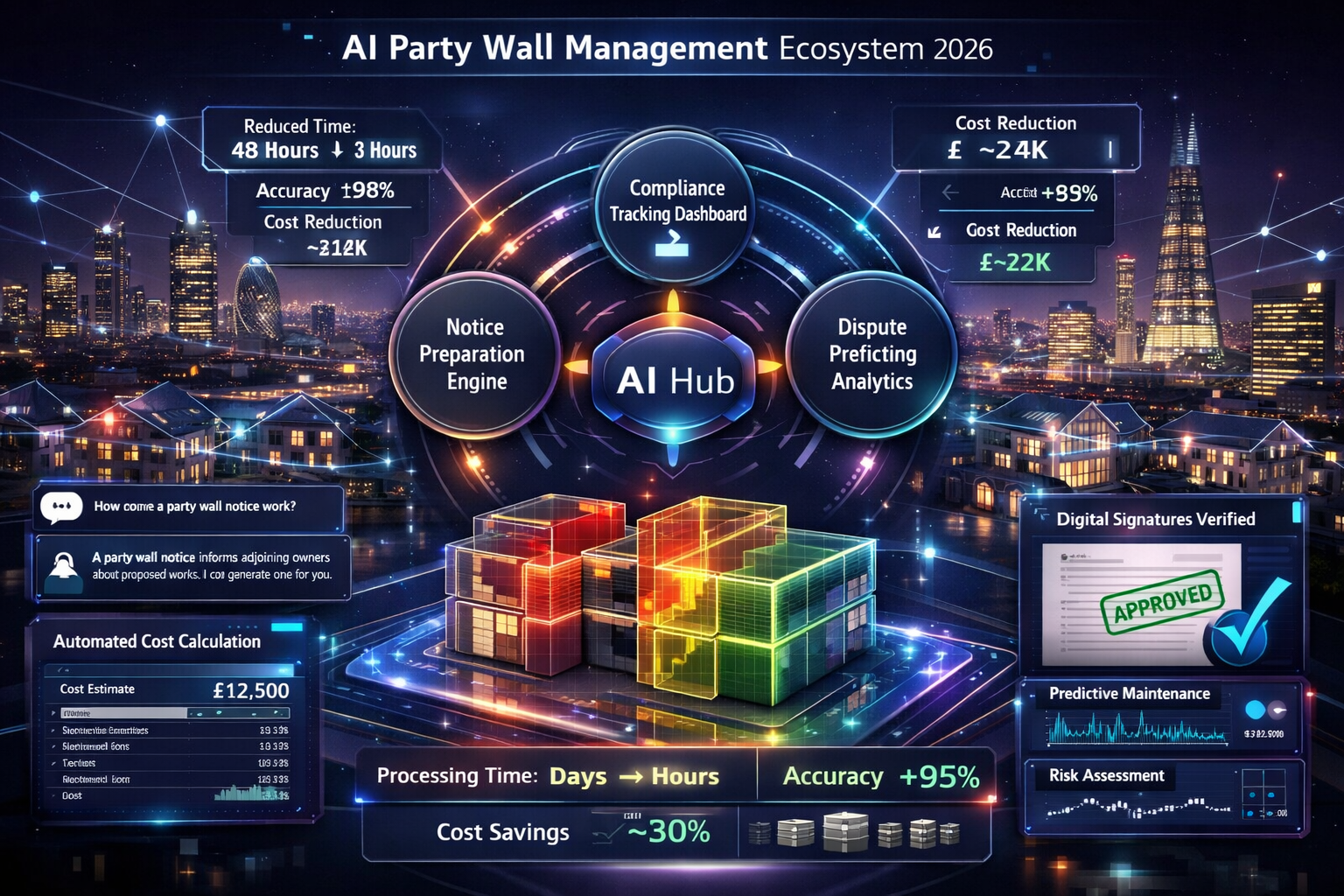
Despite clear benefits, adoption of AI and Automation in Party Wall Notice Preparation: Streamlining Compliance Documentation in 2026 faces several obstacles that practices must address.
Challenge 1: Professional Skepticism
Concern: "AI cannot replace the professional judgment required for complex party wall matters."
Response: This concern is valid and should be embraced rather than dismissed. AI tools are designed to augment professional expertise, not replace it. The goal is freeing surveyors from routine documentation to focus on areas where human judgment is irreplaceable: assessing structural adequacy, negotiating dispute resolution, and managing complex stakeholder relationships.
Solution: Frame AI adoption as professional enhancement rather than replacement. Emphasize that technology handles routine tasks while elevating surveyors to higher-value activities requiring genuine expertise.
Challenge 2: Initial Investment Concerns
Concern: "The cost of AI tools and training exceeds potential savings for small practices."
Response: ROI analysis often reveals faster payback than anticipated. Consider:
- Opportunity cost: Time spent on manual documentation represents foregone revenue from additional client work
- Error cost: Invalid notices requiring re-service create direct costs and client relationship damage
- Competitive positioning: Practices offering faster turnaround and lower costs gain market advantage
Solution: Start with limited-scope tools addressing specific pain points (e.g., automated compliance checking) before investing in comprehensive platforms. Many vendors offer tiered pricing suitable for practices of all sizes.
Challenge 3: Technology Learning Curve
Concern: "Staff lack technical expertise to effectively use AI tools."
Response: Modern AI platforms prioritize user-friendliness, requiring minimal technical knowledge. Most surveyors comfortable with standard practice management software can quickly master AI tools.
Solution:
- Select vendors offering comprehensive training and ongoing support
- Designate a "technology champion" within the practice to lead adoption
- Implement gradual rollout allowing skill development before full deployment
- Leverage vendor resources like video tutorials, user communities, and help desks
Challenge 4: Client Acceptance
Concern: "Clients may view AI-assisted service as inferior to traditional approaches."
Response: Client priorities typically center on accuracy, speed, and cost-effectiveness—areas where AI excels. Transparency about AI use, combined with emphasis on enhanced human oversight it enables, generally satisfies client concerns.
Solution:
- Communicate AI benefits clearly: faster turnaround, reduced costs, improved accuracy
- Emphasize continued professional oversight and responsibility
- Offer clients choice between AI-assisted and traditional approaches (most choose AI after understanding benefits)
- Use case studies and testimonials demonstrating successful outcomes
Challenge 5: Data Quality and System Training
Concern: "AI systems trained on generic data may not reflect practice-specific approaches and local variations."
Response: This represents a legitimate technical challenge requiring attention during implementation.
Solution:
- Invest time in system configuration using practice templates and preferred language
- Provide feedback on AI outputs to improve system performance over time
- Choose platforms allowing customization and learning from practice-specific data
- Maintain human review to catch outputs that don't align with practice standards
Understanding party wall awards and their specific requirements helps configure AI systems to produce appropriate documentation for different scenarios.
Challenge 6: Regulatory Uncertainty
Concern: "Evolving AI regulations create compliance risk."
Response: While regulatory frameworks continue developing, core principles are clear: transparency, human oversight, and professional accountability. Practices adhering to these principles remain compliant even as specific rules evolve.
Solution:
- Stay informed about regulatory developments through professional associations
- Choose AI vendors committed to regulatory compliance and regular updates
- Document AI use policies and oversight procedures
- Maintain professional indemnity insurance covering AI-assisted work
The 2026 regulatory landscape provides substantially more clarity than previous years[1], reducing uncertainty for conscientious adopters.
Conclusion: Embracing the Future of Party Wall Compliance
AI and Automation in Party Wall Notice Preparation: Streamlining Compliance Documentation in 2026 represents far more than a technological upgrade—it embodies a fundamental evolution in how construction professionals approach statutory compliance. The evidence is compelling: practices embracing these tools deliver faster service, reduce costs, improve accuracy, and free professionals to focus on genuinely complex challenges requiring human expertise.
The optimal path forward combines technological efficiency with professional judgment, recognizing that AI excels at routine tasks while human surveyors remain essential for nuanced assessment, relationship management, and dispute resolution. This hybrid approach delivers superior outcomes for all stakeholders: building owners benefit from reduced costs and faster timelines, adjoining owners receive clearer communication and more thorough protection, and surveyors enjoy enhanced productivity and professional satisfaction.
Key Implementation Principles
✅ Start strategically: Begin with high-volume, routine tasks offering clear ROI before expanding to complex applications
✅ Maintain oversight: Implement robust review processes ensuring professional accountability for all AI-generated outputs
✅ Invest in configuration: Dedicate time to customizing AI tools with practice-specific templates, language, and validation rules
✅ Prioritize training: Ensure all team members understand both AI capabilities and limitations, fostering informed use
✅ Measure performance: Track key metrics demonstrating value and identifying areas for refinement
✅ Stay compliant: Maintain awareness of evolving regulatory requirements and adjust practices accordingly
✅ Communicate transparently: Inform clients and stakeholders about AI use while emphasizing continued professional responsibility
Actionable Next Steps
For surveyors and construction professionals ready to embrace AI and automation:
- Assess current workflows: Document existing processes, identifying time-intensive routine tasks suitable for automation
- Research available tools: Evaluate AI platforms based on practice size, work types, and technical requirements
- Request demonstrations: Engage vendors for detailed product demonstrations using practice-specific scenarios
- Pilot test: Implement a limited trial with a subset of notices, measuring results against traditional approaches
- Gather feedback: Solicit input from staff and clients about AI-assisted service quality and efficiency
- Refine and expand: Based on pilot results, adjust implementation and gradually expand AI application
- Invest in training: Ensure team members develop competence and confidence with new tools
- Monitor regulations: Stay informed about evolving AI governance requirements affecting professional practice
The construction industry's broader digital transformation[3][6] creates an ecosystem increasingly compatible with AI-powered party wall compliance. Practices adopting these technologies position themselves advantageously for sustained success in an evolving professional landscape.
The Human Element Remains Central
Despite technological advancement, party wall practice remains fundamentally about relationships and trust. The most successful implementations use AI to enhance rather than replace human connection—freeing time for clearer communication, more thorough explanation, and more empathetic dispute resolution.
When neighbors are carrying out works that raise concerns, affected parties seek not just technically correct documentation but genuine understanding and protection of their interests. AI provides the efficiency that makes comprehensive, attentive service economically viable for a broader range of projects.
Looking Ahead
The trajectory is clear: AI and automation will become standard components of party wall practice, much as word processing and email transformed previous generations of professional work. The question facing practitioners is not whether to adopt these technologies, but how quickly and effectively to integrate them into existing workflows.
Those embracing this transformation thoughtfully—combining technological capability with professional judgment, regulatory compliance, and client service excellence—will thrive in the evolving landscape of construction compliance. The future of party wall practice is neither purely human nor fully automated, but rather a sophisticated collaboration between professional expertise and technological efficiency, each amplifying the other's strengths.
The tools are available, the regulatory framework is established, and the benefits are proven. The time to begin is now.
References
[1] 2026 Ai Laws Update Key Regulations And Practical Guidance – https://www.gunder.com/en/news-insights/insights/2026-ai-laws-update-key-regulations-and-practical-guidance
[2] Saas Vendor Playbook Build And Automate Contract Generation With Gen Ai – https://www.sirion.ai/library/contract-insights/saas-vendor-playbook-build-and-automate-contract-generation-with-gen-ai/
[3] constructiondive – https://www.constructiondive.com/news/5-construction-legal-trends-2026/810550/
[4] Best Ai Tools For Real Estate – https://www.v7labs.com/blog/best-ai-tools-for-real-estate
[5] Ai Driven Precision In Property Surveying How Artificial Intelligence Is Revolutionizing Workflows In 2026 – https://nottinghillsurveyors.com/blog/ai-driven-precision-in-property-surveying-how-artificial-intelligence-is-revolutionizing-workflows-in-2026
[6] 97984 Beyond The Blueprint Six Ai Solutions Revolutionizing Walls And Ceilings – https://www.wconline.com/articles/97984-beyond-the-blueprint-six-ai-solutions-revolutionizing-walls-and-ceilings