


The data center construction industry is experiencing unprecedented growth in 2026, with contractors reporting a remarkable 57% net positive reading for projects in the pipeline [6]. This explosive expansion brings with it a unique set of challenges that party wall surveyors must navigate with precision and expertise. Party Wall Agreements for Data Center Construction: Managing Surveying Complexity in 2026's Boom represents one of the most demanding specializations in the surveying profession today, requiring technical knowledge that extends far beyond traditional residential or commercial projects.
Unlike conventional construction projects, data centers present extraordinary structural demands, intensive cooling requirements, and critical operational specifications that directly impact neighboring properties. The stakes are exceptionally high—both financially and legally—making proper party wall procedures absolutely essential for project success.
Key Takeaways
- 📊 Data center construction is booming with a 57% net positive contractor outlook in 2026, creating unprecedented demand for specialized party wall surveying services
- ⚖️ Unique structural requirements including deep foundations, heavy equipment loads, and vibration-sensitive operations require advanced surveying methodologies beyond standard party wall assessments
- 🔧 Specialized technical knowledge is essential for managing cooling system installations, power infrastructure, and fiber optic connections that may impact party walls and neighboring properties
- 📋 Comprehensive documentation and proactive neighbor engagement are critical to avoiding costly disputes and project delays in high-stakes data center developments
- 💰 Financial implications are substantial, with proper party wall agreements protecting both building owners and adjoining owners from multi-million dollar liability exposures
Understanding the 2026 Data Center Construction Boom

The current surge in data center development stems from multiple converging factors that are reshaping the construction landscape. Artificial intelligence, cloud computing expansion, and increasing data storage demands are driving unprecedented investment in digital infrastructure [1].
Market Dynamics Driving Growth
The data center sector has become one of the most robust segments of the construction industry. According to recent industry analysis, construction activity continues to accelerate with no signs of slowing [2]. Several key factors fuel this expansion:
- AI and machine learning applications requiring massive computational resources
- 5G network deployment necessitating edge computing facilities
- Digital transformation initiatives across all industry sectors
- Cryptocurrency and blockchain operations demanding specialized facilities
- Cloud service provider expansion to meet growing enterprise needs
This growth trajectory creates significant opportunities but also introduces complex challenges for party wall surveyors who must adapt their traditional methodologies to accommodate these technically sophisticated structures.
Regulatory and Permitting Landscape
The regulatory environment surrounding data center construction has evolved considerably. Federal initiatives aimed at accelerating permitting processes reflect the strategic importance of digital infrastructure [4]. However, local jurisdictions increasingly scrutinize these projects due to concerns about:
- Energy consumption and grid capacity
- Water usage for cooling systems
- Noise pollution from mechanical equipment
- Traffic impacts during construction and operation
- Community benefit considerations
These regulatory complexities make proper party wall procedures even more critical, as any delays or disputes can have cascading effects on project timelines and financing arrangements.
What Makes Data Center Party Wall Agreements Unique
Data centers differ fundamentally from standard commercial or residential developments in ways that directly impact party wall surveying requirements. Understanding these distinctions is essential for surveyors working on Party Wall Agreements for Data Center Construction: Managing Surveying Complexity in 2026's Boom.
Structural Demands and Foundation Requirements
Data centers impose extraordinary structural loads that far exceed typical commercial buildings:
Foundation Depth and Proximity 🏗️
Data center foundations frequently extend 3-6 meters below ground level to support heavy equipment loads. This depth often exceeds the foundations of neighboring properties, triggering specific provisions under party wall legislation.
| Building Type | Typical Foundation Depth | Equipment Load (kg/m²) |
|---|---|---|
| Office Building | 1.5-2.5 meters | 250-400 |
| Retail Space | 1.0-2.0 meters | 200-350 |
| Data Center | 3.0-6.0 meters | 1,200-2,400 |
Vibration Sensitivity
Modern data centers house precision equipment that is extraordinarily sensitive to vibration. This creates a paradox: the construction process generates significant vibration that could damage neighboring structures, while the completed facility must be protected from external vibration sources. Party wall surveyors must establish baseline vibration measurements and implement continuous monitoring protocols.
Load-Bearing Considerations
The concentration of heavy server racks, battery backup systems, and cooling equipment creates point loads that can stress party walls in unexpected ways. Surveyors must conduct detailed structural assessments to ensure shared walls can withstand these forces without compromising the neighboring property's integrity.
Mechanical and Electrical Infrastructure
The mechanical and electrical systems in data centers present unique party wall challenges that require specialized expertise.
Cooling System Complexity ❄️
Data centers generate enormous heat that must be continuously dissipated. Cooling systems may include:
- Chilled water systems with large pipes penetrating near party walls
- Air handling units creating vibration and noise transmission
- Cooling towers positioned on rooftops or adjacent to boundaries
- Liquid cooling infrastructure for high-density computing areas
Each of these systems has potential impacts on neighboring properties that must be assessed and documented in party wall agreements.
Power Infrastructure
Data centers require redundant power systems including:
- Multiple utility connections and transformers
- Diesel generator installations for backup power
- Uninterruptible power supply (UPS) systems
- Battery storage facilities
Generator installations are particularly problematic from a party wall perspective, as they produce noise, vibration, and exhaust emissions that can affect adjoining owners. Proper party wall notices must address these operational impacts, not just construction activities.
Operational Considerations
Unlike most construction projects where party wall concerns end when building is complete, data centers create ongoing operational issues that should be addressed in initial agreements.
24/7 Operations
Data centers operate continuously with no downtime, creating persistent noise and vibration that neighboring properties must accommodate. Party wall agreements should establish acceptable operational parameters and monitoring requirements.
Security Requirements
The high-value equipment and sensitive data housed in these facilities necessitate extensive security measures, including perimeter fencing, surveillance systems, and access controls that may impact shared boundaries or easements.
Future Expansion Provisions
Data center operators frequently plan phased expansions. Forward-thinking party wall agreements should anticipate future construction activities and establish frameworks for additional notices and assessments.
Surveying Methodologies for Data Center Party Wall Projects
Managing Party Wall Agreements for Data Center Construction: Managing Surveying Complexity in 2026's Boom requires surveyors to employ advanced methodologies and technologies beyond traditional party wall assessments.
Pre-Construction Assessment Protocols
Comprehensive pre-construction documentation is absolutely critical for data center projects due to their complexity and potential for disputes.
Advanced Condition Surveys 📸
Standard photographic condition surveys are insufficient for data center projects. Surveyors should employ:
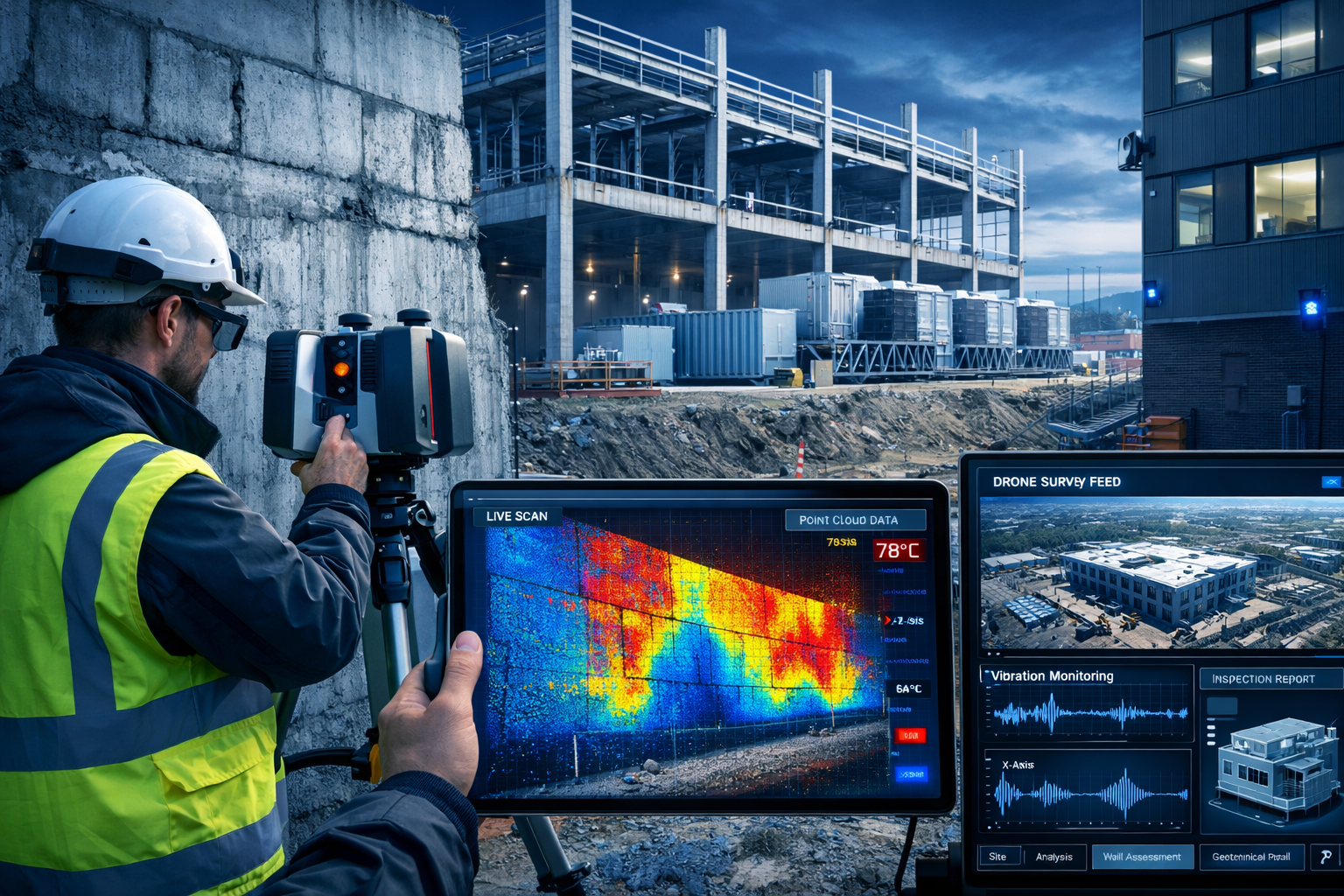
- 3D laser scanning to create precise point cloud models of existing structures
- Thermal imaging to identify existing moisture or insulation issues
- Structural movement monitoring using electronic crack gauges
- Vibration baseline measurements with seismographic equipment
- Acoustic assessments to establish pre-construction noise levels
This comprehensive approach creates an indisputable record of pre-existing conditions, protecting all parties from unfounded damage claims. For guidance on proper documentation, refer to resources on schedule of condition preparation.
Geotechnical Considerations
Data center foundations require extensive geotechnical investigation. Party wall surveyors should review:
- Soil bearing capacity reports
- Groundwater levels and drainage patterns
- Contamination assessments
- Underground utility locations
- Historical land use and previous structures
Understanding subsurface conditions helps surveyors anticipate potential settlement issues or excavation complications that could affect party walls.
Specialized Technical Assessments
Data center projects demand technical expertise that extends beyond traditional surveying skills.
Structural Engineering Collaboration 🔧
Party wall surveyors should work closely with structural engineers to evaluate:
- Load transfer mechanisms through party walls
- Differential settlement calculations based on varying foundation depths
- Lateral earth pressure from excavations near boundaries
- Dynamic loading from mechanical equipment
- Seismic considerations for critical infrastructure
This collaborative approach ensures that party wall awards include appropriate structural protection measures and monitoring requirements.
Vibration Impact Analysis
Given the sensitivity of data center equipment and the potential for construction vibration to damage neighboring properties, specialized vibration assessments are essential:
- Establish baseline conditions through pre-construction monitoring
- Model predicted vibration levels from construction activities
- Set threshold limits for acceptable vibration transmission
- Implement continuous monitoring during construction
- Develop mitigation protocols if thresholds are exceeded
Thermal and Moisture Assessment
Data centers generate significant heat that must not transfer through party walls to neighboring properties. Surveyors should assess:
- Existing thermal insulation of party walls
- Potential for condensation from temperature differentials
- Heat rejection system proximity to boundaries
- Impact on neighboring HVAC systems
Technology Integration in Surveying
The 2026 data center boom coincides with significant advances in surveying technology that enhance accuracy and efficiency.
Digital Documentation Platforms 💻
Modern party wall surveyors utilize cloud-based platforms that enable:
- Real-time collaboration between building owners, adjoining owners, and surveyors
- Automated notice generation and service tracking
- Digital signature collection for consents and awards
- Centralized document repositories accessible to all parties
- Audit trails for regulatory compliance
Remote Monitoring Systems
For high-risk data center projects, continuous remote monitoring provides early warning of potential issues:
- Automated crack monitoring with electronic gauges transmitting data hourly
- Vibration sensors triggering alerts when thresholds are exceeded
- Tilt meters detecting structural movement in real-time
- Environmental sensors tracking temperature, humidity, and noise levels
This technology allows surveyors to identify and address problems before they escalate into costly disputes or structural damage.
Navigating the Party Wall Agreement Process for Data Centers
The standard party wall process requires significant adaptation when applied to data center construction. Understanding these modifications is central to managing Party Wall Agreements for Data Center Construction: Managing Surveying Complexity in 2026's Boom.
Notice Requirements and Timing
Data center projects typically require multiple types of notices under party wall legislation.
Types of Notices Required 📋
- Party Structure Notices for work directly to party walls
- Line of Junction Notices for new walls at boundaries
- Excavation Notices for foundations within 3-6 meters of neighboring structures
Given the complexity of data center projects, surveyors should serve notices as early as possible—ideally 4-6 months before planned construction rather than the statutory minimum periods. This extended timeline allows for:
- Comprehensive technical assessments
- Detailed negotiation of special conditions
- Resolution of disputes before construction deadlines
- Coordination with other regulatory approvals
For detailed guidance on proper notice procedures, consult resources on serving party wall notices.
Appointing Surveyors with Data Center Expertise
The selection of appropriately qualified surveyors is crucial for data center projects.
Building Owner's Surveyor Selection
Data center developers should appoint surveyors with demonstrable experience in:
- Large-scale commercial construction
- Heavy industrial or infrastructure projects
- Mechanical and electrical systems assessment
- Vibration and acoustic analysis
- Multi-party coordination and dispute resolution
Adjoining Owner Considerations
Neighboring property owners should ensure their appointed surveyor understands:
- Data center operational impacts beyond construction phase
- Long-term monitoring and maintenance obligations
- Valuation implications of proximity to data center facilities
- Negotiation of appropriate compensation for permanent easements or restrictions
When parties cannot agree on surveyors, an agreed surveyor with specific data center experience should be appointed to ensure technical competence. Resources on having a party wall agreement without a surveyor explain when professional involvement is essential.
Drafting Comprehensive Party Wall Awards
Party wall awards for data center projects must address complexities far beyond standard residential or commercial developments.
Essential Award Provisions ⚖️
A comprehensive party wall award for data center construction should include:
Technical Specifications:
- Detailed descriptions of foundation systems and depths
- Structural protection measures for party walls
- Vibration limits during construction and operation
- Noise attenuation requirements
- Thermal insulation standards
- Waterproofing and drainage provisions
Monitoring Requirements:
- Pre-construction condition survey protocols
- Continuous monitoring during construction
- Post-construction verification assessments
- Long-term operational monitoring commitments
- Reporting frequencies and distribution
Access Provisions:
- Construction access for installation and monitoring
- Ongoing access for maintenance and inspection
- Emergency access protocols
- Notice requirements for routine access
Financial Protections:
- Security deposits or bonds for potential damage
- Insurance requirements and coverage limits
- Compensation for temporary inconvenience
- Provisions for permanent easements or rights
- Cost allocation for monitoring and inspections
Dispute Resolution:
- Escalation procedures for technical disagreements
- Expert determination processes
- Timelines for resolving issues
- Interim measures pending resolution
For templates and examples, review guidance on party wall awards and party wall contract templates.
Managing Costs and Budgets
Data center party wall procedures involve substantial costs that must be properly allocated and controlled.
Typical Cost Components 💰
| Cost Category | Typical Range (£) | Who Pays |
|---|---|---|
| Building Owner's Surveyor | £5,000-£25,000 | Building Owner |
| Adjoining Owner's Surveyor | £3,000-£15,000 | Building Owner |
| Agreed Surveyor (if appointed) | £8,000-£35,000 | Building Owner |
| Condition Surveys | £2,000-£10,000 per property | Building Owner |
| Specialist Assessments | £5,000-£20,000 | Building Owner |
| Monitoring Equipment | £3,000-£15,000 | Building Owner |
| Legal Fees (disputes) | £10,000-£100,000+ | Varies |
These costs are significantly higher than typical residential party wall matters due to the technical complexity and risk profile of data center projects.
Cost Control Strategies
Building owners can manage party wall costs through:
- Early engagement with neighbors to build consensus
- Clear project communication to minimize misunderstandings
- Comprehensive initial assessments to avoid repeated investigations
- Standardized procedures for multiple adjoining properties
- Proactive dispute avoidance through transparent processes
For additional cost management guidance, see tips on how to keep party wall costs down.
Common Disputes and Resolution Strategies
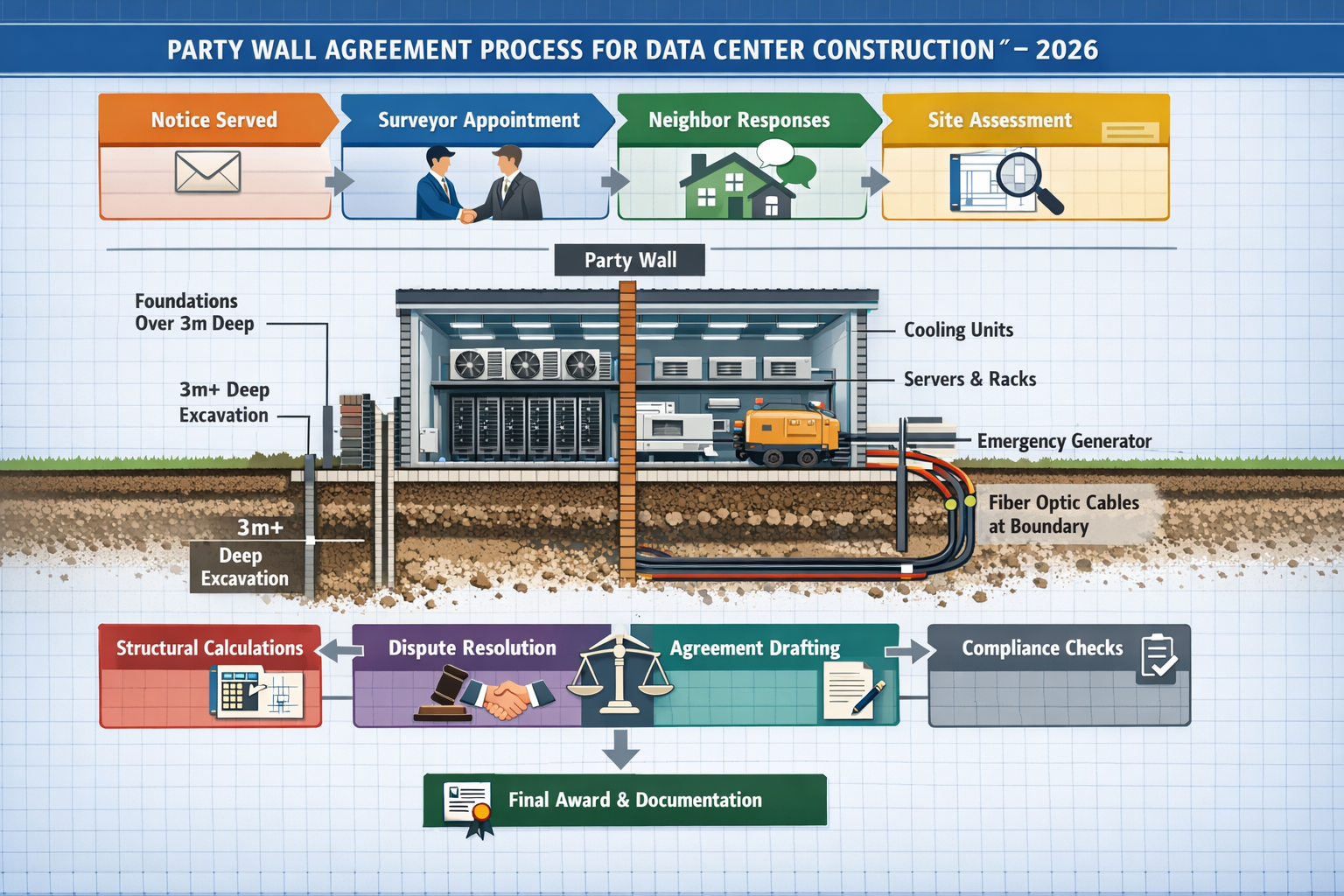
Despite careful planning, data center party wall projects frequently encounter disputes that require skilled resolution.
Typical Dispute Scenarios
Foundation Depth Disagreements 🏗️
Adjoining owners often object to deep excavations near their properties, fearing:
- Undermining of their foundations
- Loss of lateral soil support
- Groundwater drainage impacts
- Settlement and structural damage
Resolution Strategy: Provide detailed geotechnical reports, structural calculations, and temporary works designs demonstrating adequate protection measures. Offer enhanced monitoring and guaranteed remediation if issues arise.
Operational Impact Concerns
Neighboring property owners may resist data center development due to concerns about:
- Continuous noise from cooling equipment
- Visual impact of industrial-scale infrastructure
- Traffic from maintenance and operations
- Security measures affecting access or aesthetics
- Property value impacts
Resolution Strategy: Commission independent acoustic and visual impact assessments. Negotiate operational restrictions, screening measures, or financial compensation. Consider community benefit agreements for commercial neighbors.
Access and Construction Logistics
Data center construction requires substantial site access that may impact neighbors:
- Heavy vehicle movements during foundation work
- Crane oversailing of neighboring properties
- Temporary closure of shared access routes
- Storage of materials near boundaries
Resolution Strategy: Develop detailed construction logistics plans with specific timelines, access routes, and mitigation measures. Provide advance notice of major activities and maintain open communication channels.
Dispute Resolution Mechanisms
When disagreements arise, several resolution pathways are available:
Negotiated Settlement 🤝
The most cost-effective approach involves direct negotiation between surveyors to reach mutually acceptable solutions. This requires:
- Good faith engagement from all parties
- Technical expertise to evaluate proposals objectively
- Creative problem-solving to address legitimate concerns
- Willingness to compromise on non-essential issues
Third-Party Expert Determination
Complex technical disputes may benefit from independent expert review:
- Appoint specialist with relevant data center experience
- Define specific questions requiring determination
- Agree to binding nature of expert's decision
- Share costs according to award provisions
Formal Dispute Resolution
When other methods fail, formal proceedings may be necessary:
- Arbitration under party wall legislation
- Court proceedings for injunctions or damages
- Mediation to facilitate settlement discussions
The costs and delays associated with formal dispute resolution make early intervention and proactive communication essential.
Best Practices for Party Wall Surveyors in 2026
As Party Wall Agreements for Data Center Construction: Managing Surveying Complexity in 2026's Boom continues to evolve, surveyors must adopt best practices that reflect current industry standards and technological capabilities.
Professional Development and Specialization
Technical Training Requirements 📚
Surveyors working on data center projects should pursue specialized education in:
- Structural engineering principles for heavy industrial applications
- Mechanical and electrical systems understanding
- Vibration analysis and monitoring methodologies
- Acoustic assessment techniques
- Geotechnical engineering fundamentals
- Construction sequencing for complex projects
Professional organizations offer continuing education programs specifically addressing data center construction challenges.
Industry Networking
Building relationships with specialists enhances surveyor effectiveness:
- Structural engineers experienced in data center design
- Mechanical engineers specializing in cooling systems
- Vibration consultants with monitoring expertise
- Construction lawyers familiar with party wall legislation
- Data center developers and operators
These connections provide valuable technical resources and industry insights that improve service delivery.
Proactive Neighbor Engagement
Early Communication Strategies 📢
Successful data center party wall projects begin with proactive neighbor engagement:
- Pre-notice consultation to explain project scope and timeline
- Educational materials describing party wall process and protections
- Regular updates throughout design and approval phases
- Open house sessions to address concerns and answer questions
- Dedicated contact personnel for ongoing communication
This approach builds trust and reduces resistance when formal notices are served.
Addressing Community Concerns
Data center projects often generate broader community opposition beyond immediate neighbors. Surveyors should understand these concerns and help developers address them:
- Environmental sustainability and energy efficiency measures
- Economic benefits including construction jobs and tax revenue
- Community investment or benefit-sharing programs
- Infrastructure improvements benefiting the area
- Operational transparency and ongoing engagement
While these issues extend beyond traditional party wall scope, they create context that influences neighbor cooperation.
Documentation Excellence
Comprehensive Record-Keeping 📁
Meticulous documentation protects all parties and facilitates dispute resolution:
- Chronological logs of all communications and site visits
- Photographic records with timestamps and location data
- Technical reports with clear methodologies and findings
- Correspondence files organized by property and topic
- Monitoring data in accessible, analyzable formats
Cloud-based document management systems enable efficient organization and retrieval of project records.
Clear, Accessible Reporting
Technical reports should be written for diverse audiences:
- Executive summaries for property owners and decision-makers
- Technical sections with detailed analysis for specialists
- Visual aids including diagrams, photographs, and charts
- Plain language explanations of complex concepts
- Actionable recommendations with clear next steps
This approach ensures all stakeholders understand findings and can make informed decisions.
Technology Adoption
Embracing Innovation 💡
Forward-thinking surveyors leverage technology to enhance service delivery:
- Building Information Modeling (BIM) integration for 3D visualization
- Drone surveys for aerial documentation and monitoring
- Mobile apps for field data collection and reporting
- Automated monitoring systems with real-time alerts
- Virtual reality for stakeholder presentations and dispute resolution
These tools improve accuracy, efficiency, and client satisfaction while differentiating surveyors in a competitive market.
Regional Considerations and Jurisdiction Variations
Party wall legislation and practices vary significantly by jurisdiction, requiring surveyors to understand local requirements when managing data center projects.
England and Wales
The Party Wall etc. Act 1996 provides the primary legislative framework in England and Wales. Key considerations for data center projects include:
- Statutory notice periods that may be insufficient for complex projects
- Rights to appoint surveyors and dispute resolution mechanisms
- Compensation provisions for damage and inconvenience
- Access rights for construction and inspection
Surveyors operating in different regions should be familiar with local practices and precedents. Resources are available for party wall surveyors in Central London, North London, South London, East London, and West London.
Scotland and Northern Ireland
Different legal frameworks apply in Scotland and Northern Ireland:
Scotland: Common law principles govern party wall matters rather than specific legislation. Rights and obligations derive from property law and case precedents.
Northern Ireland: The Access to Neighbouring Land (Northern Ireland) Order 1992 provides limited statutory rights, with most matters governed by common law.
Surveyors must adapt their approaches to align with applicable legal frameworks in each jurisdiction.
International Data Center Hubs
As data center construction expands globally, surveyors may encounter projects in various international jurisdictions:
- European Union: Member states have diverse approaches to boundary rights and construction regulations
- United States: State and local laws vary significantly, with some jurisdictions having no party wall statutes
- Asia-Pacific: Rapid data center growth in Singapore, Hong Kong, and Australia creates demand for specialized surveying services
Understanding international variations is increasingly important as data center developers operate across multiple markets [7].
Future Trends and Emerging Challenges
The data center construction boom shows no signs of slowing, with several trends shaping the future of party wall surveying in this sector.
Edge Computing and Distributed Facilities
The shift toward edge computing is driving development of smaller, distributed data centers in urban locations [1]. This trend creates new party wall challenges:
- Conversion projects adapting existing buildings with established party walls
- Constrained urban sites with multiple adjoining properties
- Mixed-use developments combining data centers with residential or commercial uses
- Rapid deployment timelines compressing party wall processes
Surveyors must develop efficient procedures for managing multiple simultaneous party wall matters in edge computing deployments.
Sustainability and Environmental Considerations
Growing emphasis on environmental sustainability affects data center design and party wall implications:
- Renewable energy systems including rooftop solar installations
- Advanced cooling technologies such as liquid cooling and free air cooling
- Water conservation measures impacting drainage and party wall waterproofing
- Green building certifications requiring specific construction practices
Party wall awards should address environmental protection measures and sustainable construction methods [3].
Regulatory Evolution
The regulatory landscape continues to evolve in response to data center proliferation:
- Enhanced permitting scrutiny from local authorities concerned about community impacts [9]
- Energy efficiency requirements affecting mechanical system designs
- Noise and environmental standards becoming more stringent
- Community benefit obligations increasingly incorporated into approvals
Surveyors must stay current with regulatory developments and ensure party wall procedures align with broader compliance requirements.
Artificial Intelligence Applications
AI technology is transforming both data center operations and surveying methodologies:
In Data Centers:
- Increased power density requiring enhanced structural support
- Advanced cooling optimization creating variable thermal loads
- Predictive maintenance systems affecting operational protocols
In Surveying:
- AI-powered image analysis for condition assessment
- Predictive modeling of settlement and structural behavior
- Automated monitoring systems with intelligent alert algorithms
- Natural language processing for document review and analysis
Surveyors who embrace AI tools will gain competitive advantages in efficiency and accuracy [5].
Case Studies: Lessons from Recent Data Center Party Wall Projects
Examining real-world examples provides valuable insights for managing Party Wall Agreements for Data Center Construction: Managing Surveying Complexity in 2026's Boom.
Case Study 1: Urban Edge Data Center Conversion
Project Overview:
Conversion of former warehouse to edge computing facility in dense urban area with five adjoining properties including residential, retail, and office uses.
Party Wall Challenges:
- Existing party walls of varying construction and condition
- Deep excavation required for cooling system installation
- Noise concerns from residential neighbors
- Access constraints during construction
Solutions Implemented:
- Comprehensive pre-construction surveys using 3D laser scanning
- Phased construction approach minimizing simultaneous impacts
- Enhanced acoustic insulation exceeding standard requirements
- Community liaison officer maintaining neighbor communication
- Extended monitoring period post-completion
Outcomes:
Project completed on schedule with no formal disputes. One minor settlement issue identified through monitoring and remediated promptly. Positive neighbor relationships maintained throughout.
Key Lessons:
- Early engagement and transparent communication prevent disputes
- Investing in comprehensive initial assessments pays dividends
- Flexible construction sequencing accommodates neighbor concerns
- Professional community liaison is valuable for complex urban projects
Case Study 2: Hyperscale Data Center Campus Development
Project Overview:
Multi-phase development of hyperscale data center campus on former industrial site with adjacent commercial properties and public infrastructure.
Party Wall Challenges:
- Massive foundations extending 5 meters below neighboring property levels
- Vibration from piling operations threatening neighboring manufacturing facility
- Shared access road requiring reconstruction
- Phased development creating multiple notice periods
Solutions Implemented:
- Master party wall agreement covering all development phases
- Alternative foundation system (continuous flight auger piles) reducing vibration
- Real-time vibration monitoring with automated shutdown protocols
- Temporary access arrangements during construction
- Performance bonds securing neighbor protections
Outcomes:
Phase 1 completed successfully. Minor vibration exceedances during Phase 2 triggered temporary work stoppages and methodology adjustments. No structural damage to neighboring properties. Access disruptions managed through advance scheduling.
Key Lessons:
- Master agreements streamline multi-phase developments
- Construction methodology selection critically affects party wall impacts
- Real-time monitoring enables rapid response to issues
- Financial security provides confidence for all parties
Case Study 3: Dispute Resolution Through Expert Determination
Project Overview:
Proposed data center development adjacent to historic commercial building with concerns about foundation impacts and operational noise.
Party Wall Challenges:
- Adjoining owner disputed adequacy of proposed underpinning
- Disagreement over operational noise limits
- Valuation dispute regarding compensation for easements
- Timeline pressure from developer financing commitments
Resolution Process:
- Initial surveyor negotiations failed to resolve technical disputes
- Joint appointment of structural engineering expert for foundation review
- Acoustic consultant engaged to model operational noise
- Independent valuation surveyor appointed for easement compensation
- Mediation session facilitated final agreement
Outcomes:
Expert determinations led to enhanced underpinning design and additional acoustic treatment. Compensation package agreed including upfront payment and ongoing monitoring fund. Project proceeded with 8-week delay.
Key Lessons:
- Expert determination efficiently resolves technical disputes
- Independent specialists provide credible third-party validation
- Structured mediation facilitates overall settlement
- Delay costs emphasize importance of early dispute avoidance
Practical Guidance for Building Owners and Developers
Data center developers can optimize party wall processes through strategic planning and professional engagement.
Pre-Acquisition Due Diligence
Site Assessment Considerations 🔍
Before acquiring sites for data center development, conduct thorough party wall due diligence:
- Boundary survey identifying all party walls and neighboring properties
- Title review for easements, covenants, and access rights
- Neighboring property research understanding uses and ownership
- Preliminary party wall assessment estimating costs and timelines
- Risk evaluation identifying potential disputes or complications
This upfront investment prevents costly surprises during development.
Project Planning Integration
Incorporating Party Wall Timelines
Integrate party wall procedures into overall project schedules:
- Design phase: Engage party wall surveyor to review plans
- Pre-construction (6 months): Serve initial notices
- Pre-construction (4 months): Complete condition surveys
- Pre-construction (3 months): Finalize awards
- Construction phase: Implement monitoring protocols
- Post-construction: Conduct verification assessments
Building adequate time buffers prevents party wall delays from impacting critical path activities.
Professional Team Assembly
Selecting Qualified Advisors 👥
Assemble a professional team with relevant data center experience:
- Party wall surveyor with demonstrated data center expertise
- Structural engineer familiar with heavy industrial applications
- Construction lawyer understanding party wall legislation
- Project manager experienced in complex stakeholder coordination
- Community relations specialist for larger developments
The incremental cost of experienced professionals is minimal compared to the risks of inadequate representation.
Guidance for Adjoining Owners
Property owners neighboring proposed data center developments should understand their rights and options.
Understanding Your Rights
Statutory Protections ⚖️
Party wall legislation provides significant protections for adjoining owners:
- Right to be notified of proposed works affecting party walls or boundaries
- Right to appoint a surveyor at the building owner's expense
- Right to compensation for damage or diminution in property value
- Right of access for inspection and monitoring
- Right to dispute resolution through surveyor determination
Understanding these rights enables effective advocacy for your interests.
Responding to Party Wall Notices
Action Steps Upon Receiving Notice 📨
When you receive a party wall notice for a data center project:
- Don't ignore it – statutory deadlines apply
- Review carefully – understand the proposed works
- Appoint a surveyor – select someone with data center experience
- Document concerns – identify specific issues or risks
- Engage constructively – work toward mutually acceptable solutions
- Understand costs – building owner pays reasonable surveyor fees
For detailed guidance on responding to notices, see resources on how to respond to party wall notices.
Protecting Your Interests
Key Negotiation Points
Adjoining owners should ensure party wall awards address:
- Comprehensive condition surveys documenting pre-existing conditions
- Adequate monitoring during construction and operations
- Clear remediation obligations for any damage
- Operational limits on noise, vibration, and other impacts
- Financial security through bonds or insurance
- Access provisions for verification and inspection
- Long-term protections extending beyond construction phase
Professional representation ensures these protections are properly documented and enforceable.
Conclusion
Party Wall Agreements for Data Center Construction: Managing Surveying Complexity in 2026's Boom represents one of the most challenging and rewarding specializations in the surveying profession. The explosive growth of data center development—driven by AI, cloud computing, and digital transformation—creates unprecedented demand for surveyors who can navigate the unique technical, legal, and interpersonal complexities these projects present.
Success in this field requires a multifaceted approach combining:
✅ Technical expertise extending beyond traditional party wall knowledge to encompass structural engineering, mechanical systems, vibration analysis, and acoustic assessment
✅ Proactive communication that builds trust with neighbors and prevents disputes through transparency and engagement
✅ Advanced methodologies leveraging 3D scanning, continuous monitoring, and digital documentation platforms
✅ Comprehensive documentation protecting all parties through detailed condition surveys, clear awards, and meticulous record-keeping
✅ Strategic thinking that anticipates future issues and incorporates flexible provisions for evolving circumstances
The stakes in data center party wall matters are exceptionally high. Projects involve substantial capital investment, tight financing deadlines, and critical infrastructure supporting essential digital services. Neighboring properties face potential impacts from construction activities and ongoing operations. Proper party wall procedures protect everyone's interests while enabling vital infrastructure development.
Next Steps for Stakeholders
For Data Center Developers:
- Engage experienced party wall surveyors early in project planning
- Budget adequately for comprehensive surveying and monitoring
- Invest in proactive neighbor engagement and communication
- Build sufficient timeline buffers for party wall procedures
- Consider master agreements for multi-phase developments
For Property Owners:
- Respond promptly to party wall notices
- Appoint surveyors with data center project experience
- Document concerns and desired protections clearly
- Engage constructively while protecting your interests
- Understand long-term operational implications
For Surveyors:
- Pursue specialized training in data center technologies
- Build networks with technical specialists
- Adopt advanced surveying technologies and methodologies
- Develop efficient procedures for complex projects
- Stay current with regulatory and industry developments
For Policymakers:
- Consider statutory timeframe extensions for complex projects
- Develop guidance specific to data center party wall matters
- Balance infrastructure development needs with neighbor protections
- Support professional development and standards
The data center construction boom of 2026 and beyond will continue creating opportunities and challenges for the party wall surveying profession. Those who develop specialized expertise, embrace technological innovation, and maintain commitment to protecting all stakeholders' interests will thrive in this dynamic and essential field.
For additional resources and professional assistance with data center party wall matters, explore comprehensive guidance on party wall procedures and costs or contact experienced party wall surveyors who can provide tailored advice for your specific project.
The complexity of modern data center construction demands nothing less than excellence in party wall surveying. By following the best practices, methodologies, and strategies outlined in this guide, all stakeholders can navigate these challenges successfully, protecting property rights while enabling the digital infrastructure our society increasingly depends upon.
References
[1] Data Center Construction Predictions For 2026 – https://www.databank.com/resources/blogs/data-center-construction-predictions-for-2026/
[2] Data Center Construction Trends – https://cmicglobal.com/resources/article/data-center-construction-trends
[3] Data Centres – https://www.brownejacobson.com/insights/2026-horizon-scanning-in-construction/data-centres
[4] Accelerating Federal Permitting Of Data Center Infrastructure – https://www.whitehouse.gov/presidential-actions/2025/07/accelerating-federal-permitting-of-data-center-infrastructure/
[5] Navigating Contractual Considerations In The Ai Data Center Construction Boom – https://www.constructlaw.com/2025/10/20/navigating-contractual-considerations-in-the-ai-data-center-construction-boom/
[6] constructiondive – https://www.constructiondive.com/news/data-centers-construction-2026-trends/810016/
[7] Data Centers – https://www.hklaw.com/en/services/practices/real-estate-hospitality-and-leisure/data-centers
[8] Insights Realestate Cm From Data Centers To Offices – https://www.goodwinlaw.com/en/insights/publications/2026/02/insights-realestate-cm-from-data-centers-to-offices
[9] Data Center Rebellion Local Politics – https://dailyreporter.com/2026/01/07/data-center-rebellion-local-politics/