


Municipal water and sewer infrastructure projects are experiencing steady growth in 2026, with construction activity showing a modest but consistent 16% net reading as utilities expand and modernize aging systems. However, beneath this encouraging trend lies a complex legal landscape that many municipalities overlook: party wall compliance. When water mains, sewer laterals, and stormwater systems cross property boundaries—which they frequently do—robust party wall agreements and professional surveyor involvement become absolutely essential. 🏗️
The intersection of municipal infrastructure expansion and property rights creates unique challenges that require careful navigation. Unlike private construction projects, municipal works often affect multiple properties simultaneously, involve public right-of-way considerations, and must balance community needs against individual property rights. Understanding how Water and Sewer Infrastructure Expansion: Party Wall Compliance for Municipal Construction Projects in 2026 intersects with established legal frameworks is crucial for project success.
Key Takeaways
- Municipal water and sewer projects frequently cross property boundaries, triggering party wall legislation requirements and necessitating formal notices to adjoining owners before construction begins
- The Party Wall etc Act 1996 applies to municipal construction when works affect shared boundaries, foundations, or structures, requiring proper notice periods of at least two months for most excavation works
- 2026 regulatory updates introduce stricter watertightness testing standards (ASTM C1227), PFAS compliance requirements for drinking water, and enhanced stormwater pollution prevention measures that affect project timelines
- Professional party wall surveyors help municipalities navigate compliance, minimize disputes, and document pre-construction conditions to protect against future claims
- Proactive party wall agreements reduce project delays, legal costs, and community opposition while ensuring infrastructure expansion proceeds smoothly across property boundaries
Understanding Party Wall Legislation in Municipal Infrastructure Context
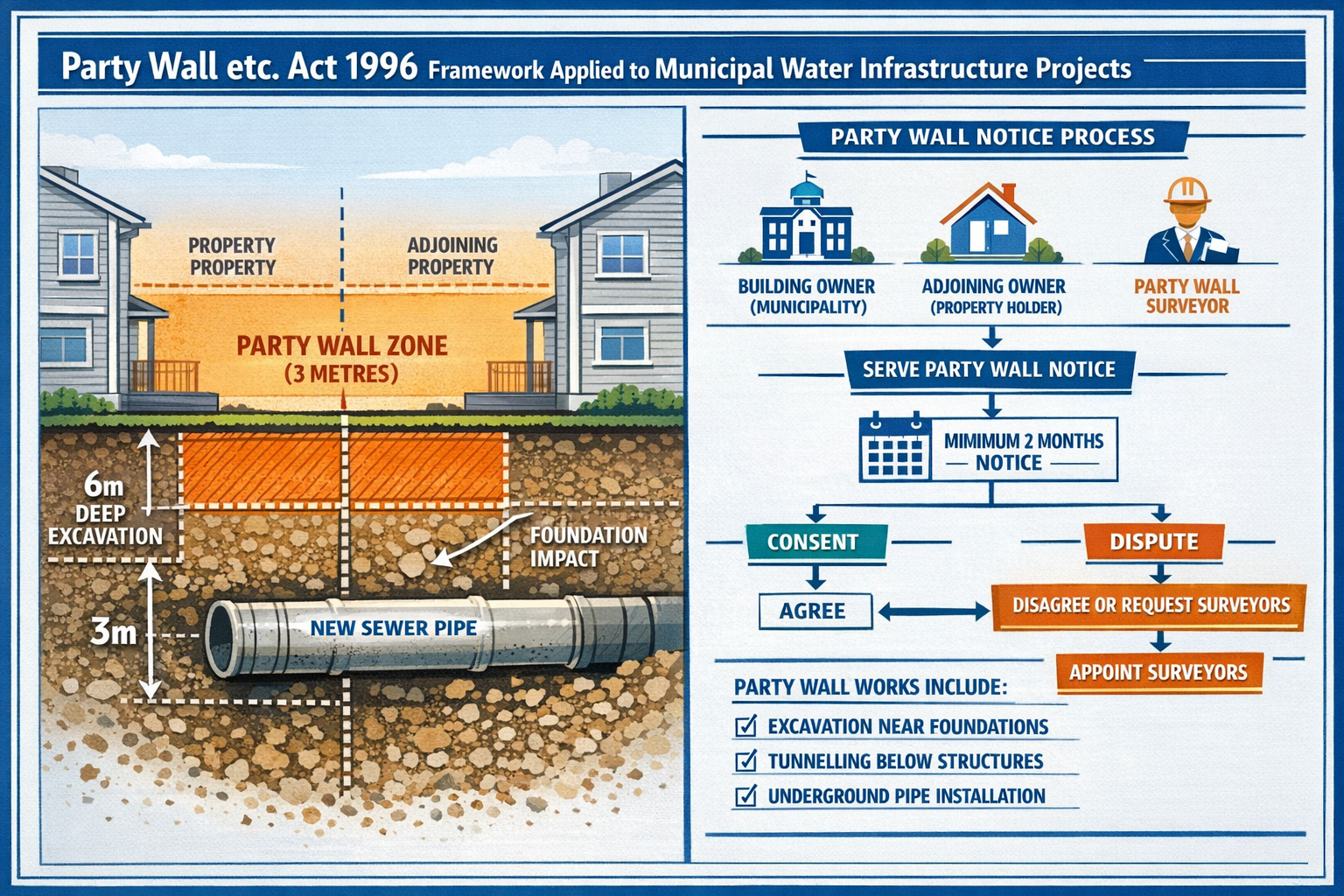
What is the Party Wall etc Act 1996?
The Party Wall etc Act 1996 establishes the legal framework governing construction work on or near property boundaries in England and Wales. While many associate this legislation primarily with residential extensions and loft conversions, it applies equally to municipal infrastructure projects when certain conditions are met.
The Act covers three main categories of work:
- Work directly to an existing party wall or party structure – This includes repairs, alterations, or modifications to walls shared between properties
- New building at or astride the boundary line – Construction of new structures on the property line
- Excavation within specified distances of neighboring buildings – The most relevant category for water and sewer infrastructure expansion
For municipal construction projects, the third category presents the most frequent compliance trigger. When excavating for water mains, sewer laterals, or drainage systems, municipalities must serve party wall notices if the excavation:
- Goes deeper than the foundations of an adjoining building and occurs within 3 meters of that building
- Goes deeper than a line drawn at 45 degrees from the bottom of the foundations of an adjoining building and occurs within 6 meters of that building
How Municipal Projects Differ from Private Construction
Municipal infrastructure expansion presents unique party wall considerations that distinguish it from typical private construction projects:
Multiple Property Impacts: A single water main replacement project might affect dozens of properties along its route, requiring coordinated notice serving and management of multiple party wall agreements simultaneously.
Public Interest vs. Private Rights: Municipalities must balance the public benefit of infrastructure improvements against individual property rights, creating a delicate negotiation that requires diplomatic handling and clear communication.
Statutory Powers: Local authorities possess certain statutory powers for infrastructure work, but these do not override party wall legislation requirements. Municipalities must still comply with proper notice procedures and agreement protocols.
Timeline Pressures: Infrastructure projects often face funding deadlines, seasonal construction windows, and public service continuity requirements that make party wall compliance delays particularly costly.
Understanding these distinctions helps municipalities develop appropriate compliance strategies. For guidance on types of party wall works that commonly apply to infrastructure projects, municipalities should consult with experienced party wall professionals early in the planning process.
Water and Sewer Infrastructure Expansion: Party Wall Compliance for Municipal Construction Projects in 2026 – Regulatory Framework
Current Party Wall Notice Requirements
Proper notice serving forms the foundation of party wall compliance. For Water and Sewer Infrastructure Expansion: Party Wall Compliance for Municipal Construction Projects in 2026, municipalities must understand the specific notice requirements and timelines.
Party Structure Notice: Required when work directly affects an existing party wall or structure. The building owner (municipality) must serve notice at least two months before intended work commencement.
Party Wall Notice: Necessary for new construction on the boundary line. Also requires two months advance notice.
Notice of Adjacent Excavation: The most relevant for infrastructure projects, this notice must be served when excavating within the 3-meter or 6-meter zones described earlier. The notice period is one month before work begins.
The party wall notices must include specific information:
- Name and address of the building owner (municipality)
- Nature and particulars of the proposed work
- Date when work will begin
- Clear drawings or plans showing the work location and extent
Common Municipal Mistakes ❌:
- Assuming statutory infrastructure powers override party wall requirements
- Serving generic notices that lack sufficient detail
- Failing to identify all affected adjoining owners
- Starting work before notice periods expire
- Not maintaining proper records of notice service
2026 Infrastructure Standards and Compliance Updates
The regulatory landscape for water and sewer infrastructure continues to evolve in 2026, adding layers of complexity to party wall compliance. Municipalities must navigate both party wall legislation and sector-specific standards.
Watertightness Testing Standards: New proposed regulations introduce mandatory watertightness testing per ASTM C1227 standards for all new sewer installations and replacements.[4] This requirement affects party wall compliance by:
- Extending construction timelines to accommodate testing protocols
- Requiring additional excavation access that may trigger party wall notices
- Necessitating post-installation monitoring that could affect adjoining properties
Aggregate Bedding Requirements: Updated standards mandate a minimum of 4 inches of aggregate for all tank types and underground infrastructure installations.[4] This uniform requirement ensures proper drainage and structural support but may increase excavation depths, potentially triggering party wall notice requirements where shallower excavation would not.
PFAS Compliance: The EPA expects to finalize revised drinking water standards for PFOA and PFOS in spring 2026, affecting municipal water treatment requirements.[5] While not directly related to party wall legislation, these standards impact project planning:
- Additional testing equipment installation may require boundary-adjacent construction
- Treatment facility expansions could trigger party wall requirements
- Monitoring well installations near property lines need proper notice procedures
Stormwater Pollution Prevention: The 2026 Multi-Sector General Permit (MSGP) adds inspection requirements for facility Stormwater Pollution Prevention Plans to enhance NPDES compliance.[6] Infrastructure projects must implement enhanced stormwater management, which may include:
- Sediment control measures extending onto or near adjoining properties
- Temporary drainage modifications affecting neighboring land
- Permanent stormwater infrastructure crossing property boundaries
Integration with Sanitary Standards
The 2026 Sanitary Standards Manual provides comprehensive design and construction standards for laterals and sanitary sewer facilities.[7] These standards establish technical requirements that municipalities must integrate with party wall compliance procedures:
Design Standards that affect party wall considerations include:
- Minimum pipe depths and slopes that determine excavation requirements
- Clearance requirements from existing structures and utilities
- Access point locations that may necessitate boundary-adjacent construction
Construction Standards requiring coordination with party wall procedures:
- Trench width specifications that define the excavation footprint
- Shoring and support requirements for deep excavations near structures
- Backfill and compaction standards affecting construction duration
Municipalities should review the complete guide on boundary wall rules and differences between party fence walls and boundary walls to understand how these technical standards interact with property boundary considerations.
Practical Implementation: Party Wall Compliance for Infrastructure Projects
Step-by-Step Compliance Process
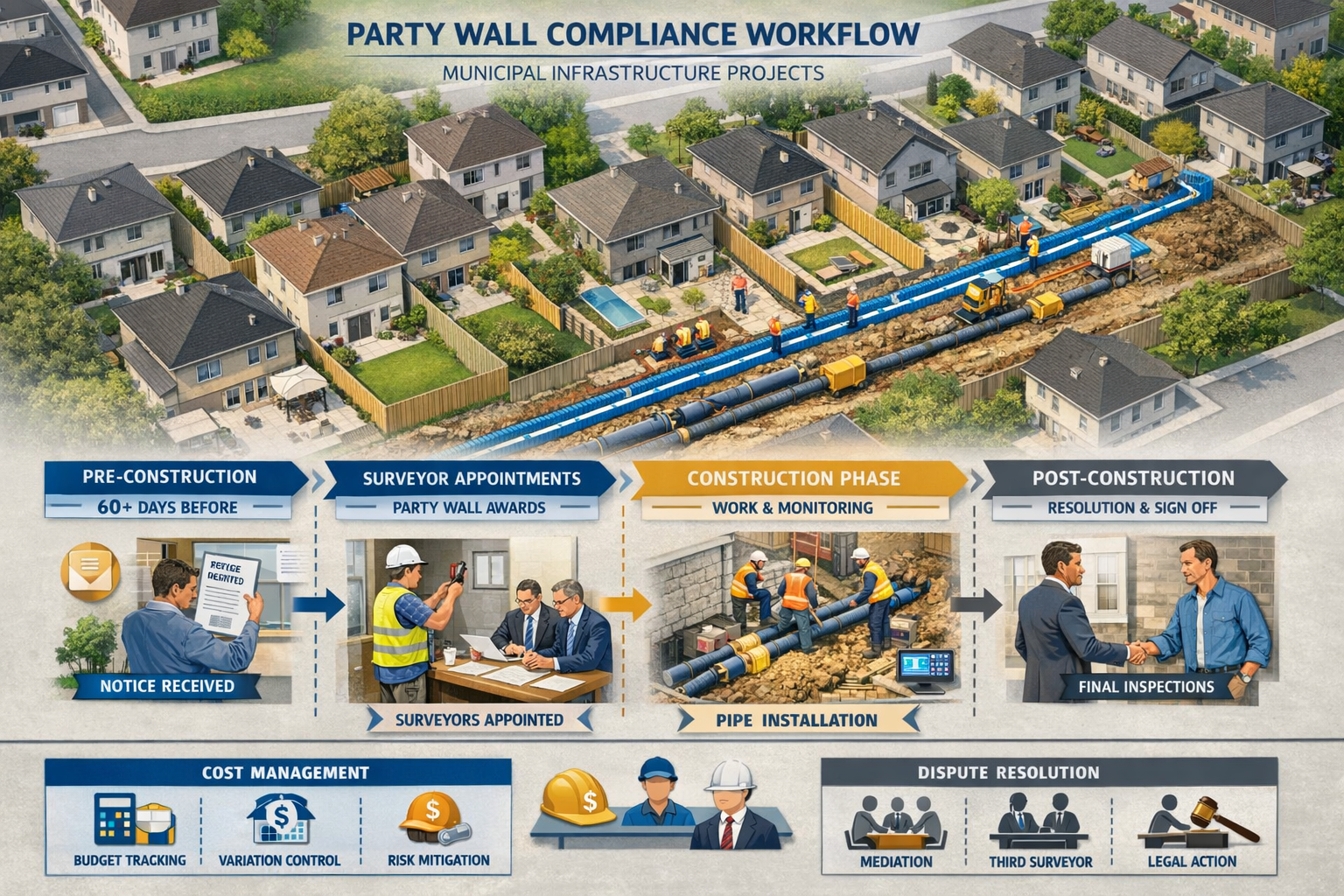
Successfully navigating Water and Sewer Infrastructure Expansion: Party Wall Compliance for Municipal Construction Projects in 2026 requires a systematic approach. Here's a comprehensive workflow:
Phase 1: Pre-Design Assessment (3-6 months before construction)
1. Property Boundary Mapping 🗺️
- Obtain accurate property boundary surveys for the entire project route
- Identify all properties within 6 meters of planned excavation
- Document existing structures, foundations, and improvements
- Review land registry records to confirm current ownership
2. Initial Party Wall Assessment
- Determine which properties will require party wall notices
- Categorize notice types needed (Adjacent Excavation, Party Structure, etc.)
- Estimate notice serving timeline requirements
- Budget for party wall surveyor fees and potential awards
3. Stakeholder Identification
- Create comprehensive list of all adjoining owners
- Identify properties with multiple owners or complex ownership structures
- Note any commercial properties requiring special consideration
- Document contact information and preferred communication methods
Phase 2: Notice Preparation and Service (2-3 months before construction)
4. Notice Drafting
- Prepare detailed party wall notices with complete project information
- Include accurate technical drawings showing excavation extent and depth
- Specify proposed construction methods and protective measures
- Clearly state intended commencement date
5. Notice Service
- Serve notices via recorded delivery or hand delivery with acknowledgment
- Maintain detailed records of service dates and methods
- Follow up with adjoining owners to confirm receipt
- Prepare for potential questions and concerns
6. Response Management
- Monitor for consent or dissent responses (14-day response period)
- Engage party wall surveyors when dissent is received or no response given
- Begin surveyor appointment process promptly to avoid delays
Phase 3: Party Wall Award Process (1-2 months)
7. Surveyor Appointments
When adjoining owners dissent or fail to respond, the party wall award process begins. Municipalities have several options:
| Scenario | Surveyor Arrangement | Timeline Impact |
|---|---|---|
| Adjoining owner consents | No surveyor needed | Minimal – proceed after notice period |
| Adjoining owner dissents | Each party appoints own surveyor, or agreed surveyor | 4-6 weeks for award preparation |
| No response after 14 days | Deemed dissent – surveyors required | 6-8 weeks including appointment process |
| Multiple properties | Consider agreed surveyor for all parties | Most efficient for large projects |
8. Schedule of Condition
A critical component of party wall compliance involves documenting pre-construction property conditions. Professional schedules of condition should include:
- Detailed photographic records of all adjoining properties
- Written descriptions of existing defects, cracks, or damage
- Structural condition assessments
- Baseline measurements for monitoring potential movement
This documentation protects both the municipality and property owners by establishing clear evidence of pre-existing conditions.
9. Party Wall Award Finalization
The party wall award document specifies:
- Permitted works and construction methods
- Working hours and access arrangements
- Protective measures and monitoring requirements
- Cost allocation and fee payment responsibilities
- Dispute resolution procedures
Understanding the costs of party wall processes helps municipalities budget appropriately and avoid financial surprises.
Phase 4: Construction and Monitoring
10. Pre-Construction Coordination
- Distribute party wall awards to all contractors and site supervisors
- Brief construction teams on party wall compliance requirements
- Establish monitoring protocols per award specifications
- Set up communication channels with adjoining owners
11. Ongoing Compliance
- Conduct regular monitoring as specified in awards
- Document compliance with protective measures
- Maintain open communication with adjoining owners
- Address concerns promptly to prevent disputes
12. Post-Construction Resolution
- Conduct final inspections with party wall surveyors
- Compare post-construction conditions to schedules of condition
- Address any damage claims through proper channels
- Obtain final sign-off from surveyors and adjoining owners
Managing Multiple Property Interfaces
Large-scale infrastructure projects often affect dozens of properties simultaneously. Efficient management strategies include:
Batch Processing: Group properties by project phase and serve notices in coordinated batches rather than individually. This approach:
- Streamlines administrative processes
- Allows for standardized communication materials
- Facilitates coordinated surveyor appointments
- Reduces overall timeline impact
Agreed Surveyor Strategy: For projects affecting many properties, appointing a single agreed surveyor (with consent from all parties) offers significant advantages:
- Reduced overall surveyor fees compared to multiple separate appointments
- Consistent approach to awards across all properties
- Simplified communication and coordination
- Faster award preparation process
However, municipalities should recognize that some adjoining owners may prefer their own representation, which is their legal right.
Community Engagement: Proactive communication beyond legal notice requirements helps minimize disputes:
- Hold public information sessions before serving formal notices
- Provide clear, accessible explanations of party wall processes
- Offer direct contact points for questions and concerns
- Share project timelines and expected impacts transparently
Digital Management Systems: Implement tracking systems to manage:
- Notice service dates and response deadlines
- Surveyor appointment status
- Award preparation progress
- Compliance monitoring schedules
- Documentation repositories
Cost Management and Dispute Prevention
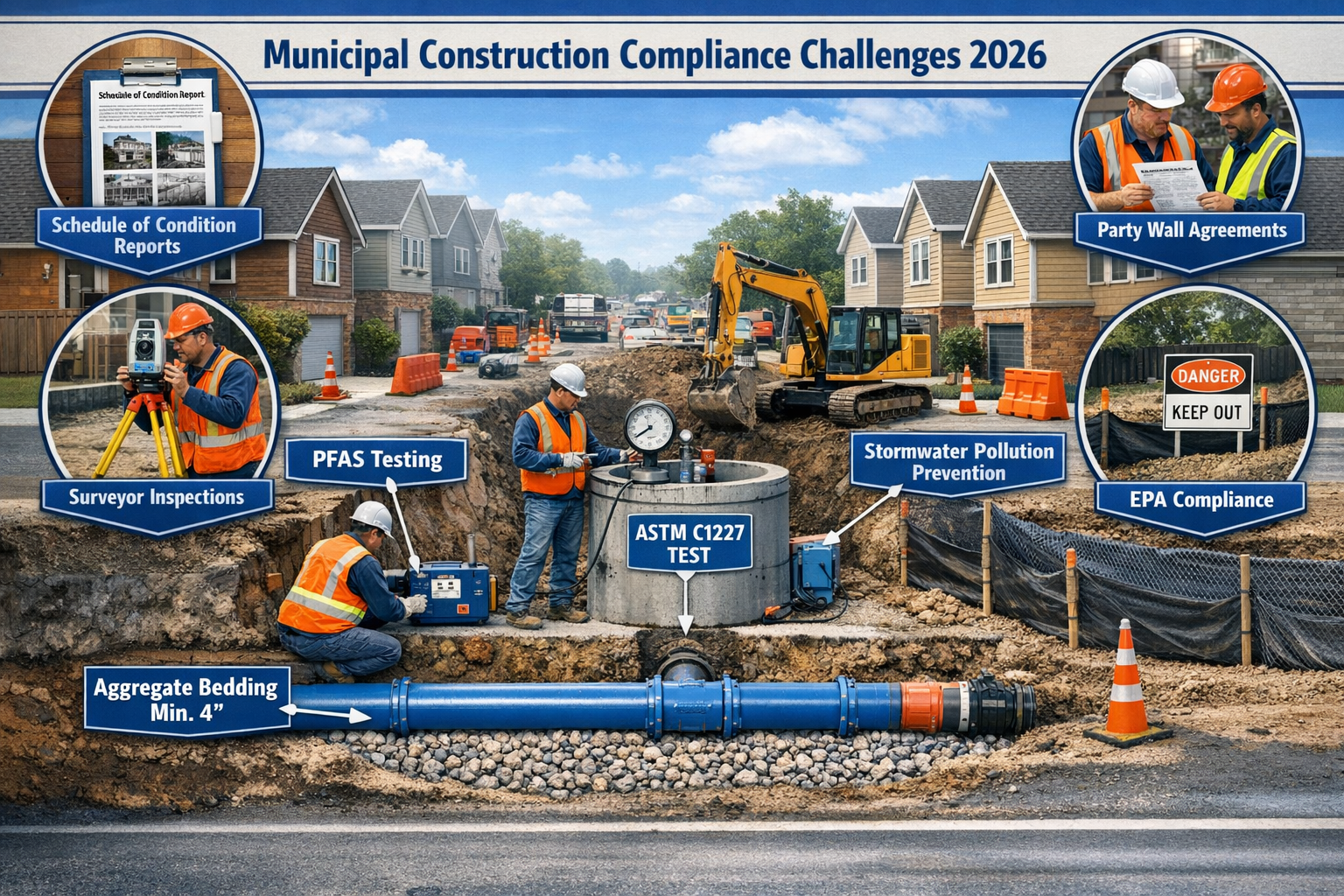
Understanding Party Wall Costs for Municipal Projects
The financial implications of party wall compliance can significantly impact infrastructure project budgets. Municipalities should anticipate several cost categories:
Surveyor Fees 💰
Under party wall legislation, the building owner (municipality) typically bears the reasonable costs of the party wall process, including:
- Building owner's surveyor fees: £800-£1,500 per property for straightforward cases
- Adjoining owner's surveyor fees: Similar range, paid by the municipality
- Agreed surveyor fees: £1,200-£2,000 per property when acting for both parties
For large infrastructure projects affecting multiple properties, these costs accumulate quickly. A water main replacement affecting 20 properties could incur £25,000-£50,000 in surveyor fees alone.
Schedule of Condition Costs
Professional condition surveys typically cost:
- Basic photographic schedule: £300-£600 per property
- Comprehensive structural assessment: £800-£1,500 per property
- Specialist surveys (for historic or complex structures): £1,500-£3,000+
Award Preparation and Administration
Additional costs include:
- Legal review of complex awards: £500-£2,000
- Administrative staff time for notice management
- Project management coordination
- Documentation and record-keeping systems
Potential Damage Remediation
While not strictly party wall costs, municipalities should budget for:
- Repair of construction-related damage to adjoining properties
- Temporary accommodation if properties become uninhabitable
- Compensation for loss of amenity during construction
For strategies on how to keep party wall costs down, municipalities should focus on efficient process management and early engagement with experienced professionals.
Dispute Prevention Strategies
Most party wall disputes arise from communication failures rather than genuine conflicts of interest. Municipalities can prevent costly disputes through:
1. Early and Transparent Communication 📢
Begin discussions with affected property owners well before formal notice service:
- Explain the public benefit of infrastructure improvements
- Describe expected construction impacts honestly
- Provide realistic timelines and schedules
- Offer direct contact points for ongoing communication
2. Professional Surveyor Selection
Choose party wall surveyors with specific experience in municipal infrastructure projects. Look for professionals who:
- Understand both party wall legislation and infrastructure construction
- Have established reputations for fair, balanced awards
- Communicate clearly with all parties
- Work efficiently to minimize delays
Regional specialists such as those offering party wall surveyor services in Central London, North London, South London, East London, and West London can provide valuable local knowledge and established relationships.
3. Comprehensive Awards
Well-drafted party wall awards prevent disputes by addressing potential issues before they arise:
- Specify permitted working hours with flexibility for essential works
- Define acceptable noise and vibration levels
- Establish clear protocols for emergency situations
- Include detailed protective measure requirements
- Set up regular communication schedules
4. Proactive Monitoring and Response
Don't wait for complaints to address issues:
- Implement monitoring programs that exceed award requirements
- Respond immediately to concerns from adjoining owners
- Document all communications and actions taken
- Empower site supervisors to make reasonable accommodations
5. Consider Alternative Dispute Resolution
When disputes do arise, avoid litigation through:
- Mediation services specializing in construction disputes
- Third surveyor appointments (as provided in the Act)
- Negotiated settlements that address underlying concerns
- Flexible construction scheduling to accommodate specific needs
Risk Allocation and Insurance Considerations
Municipalities should ensure adequate insurance coverage for party wall-related risks:
Public Liability Insurance: Verify coverage extends to:
- Damage to adjoining properties during construction
- Claims arising from party wall works
- Professional negligence of appointed surveyors
- Business interruption for affected commercial properties
Contractor Requirements: Ensure contractors carry appropriate insurance and understand party wall obligations:
- Include party wall compliance in contract specifications
- Require contractors to follow award conditions precisely
- Establish clear liability allocation for non-compliance
- Implement penalties for party wall violations
Case Studies: Municipal Infrastructure and Party Wall Compliance
Case Study 1: Urban Water Main Replacement
Project: Replacement of aging 12-inch water main through dense residential neighborhood
Party Wall Challenges:
- 34 properties within party wall notice zones
- Excavation depths of 2.5-3.5 meters
- Mix of Victorian terraced houses with shallow foundations
- Tight construction timeline due to funding requirements
Compliance Approach:
- Served notices to all 34 properties simultaneously, 10 weeks before planned construction
- Appointed single agreed surveyor for 28 properties (6 owners chose separate representation)
- Conducted comprehensive schedules of condition focusing on existing structural cracks in older properties
- Implemented enhanced vibration monitoring program exceeding award requirements
Outcomes:
- ✅ Zero formal disputes or third surveyor appointments
- ✅ Project completed on schedule despite party wall requirements
- ✅ Two minor damage claims resolved quickly through surveyor mediation
- ✅ Total party wall costs: £47,000 (within budget estimates)
Key Success Factors:
- Early community engagement before formal notices
- Experienced agreed surveyor with infrastructure background
- Proactive monitoring and immediate response to concerns
- Flexible construction scheduling to accommodate specific property needs
Case Study 2: Sewer Lateral Expansion in Mixed-Use District
Project: New sewer lateral installation serving commercial development area
Party Wall Challenges:
- 12 commercial properties and 8 residential properties affected
- Complex ownership structures including leasehold arrangements
- Excavation within 3 meters of occupied retail premises
- Need to maintain business access during construction
Compliance Approach:
- Identified all relevant parties including freeholders, leaseholders, and commercial tenants
- Served notices 12 weeks in advance to allow for complex ownership consultations
- Separate surveyors appointed for most commercial properties
- Detailed access and working hour negotiations for retail premises
- Phased construction approach to minimize business disruption
Outcomes:
- ⚠️ Three initial disputes regarding working hours and access
- ✅ All disputes resolved through surveyor negotiation without third surveyor
- ✅ Modified construction schedule accommodated peak business hours
- ✅ No damage claims or post-construction issues
- ⚠️ Total party wall costs: £68,000 (15% over initial estimate due to complex negotiations)
Lessons Learned:
- Commercial properties require more detailed access and timing negotiations
- Identify all legal interests early, including tenants with protected rights
- Budget additional time and costs for complex ownership structures
- Flexibility in construction scheduling prevents costly disputes
Case Study 3: Stormwater Infrastructure Upgrade
Project: Installation of new stormwater management system including detention basins and drainage pipes
Party Wall Challenges:
- Extensive excavation across multiple property boundaries
- Some excavation exceeding 4 meters depth near foundations
- Mix of residential and institutional properties (schools, churches)
- New 2026 stormwater pollution prevention requirements[6]
Compliance Approach:
- Integrated party wall compliance with MSGP inspection requirements
- Served notices 14 weeks in advance for deeper excavations
- Appointed specialist surveyors with geotechnical expertise for deep excavation areas
- Enhanced protective measures including temporary shoring and foundation monitoring
- Coordinated with institutional property managers for extended approval processes
Outcomes:
- ✅ All institutional properties required board/committee approvals, accommodated in timeline
- ✅ Enhanced monitoring detected minor foundation movement early, allowing immediate corrective action
- ✅ Stormwater pollution prevention measures integrated into party wall awards
- ✅ No formal disputes or damage claims
- ✅ Total party wall costs: £52,000 (on budget)
Key Success Factors:
- Extended notice periods accommodated complex approval processes
- Specialist surveyor expertise prevented foundation issues
- Integration of environmental compliance with party wall requirements
- Proactive monitoring and immediate corrective action
Water and Sewer Infrastructure Expansion: Party Wall Compliance for Municipal Construction Projects in 2026 – Best Practices
Developing a Municipal Party Wall Protocol
Forward-thinking municipalities are developing standardized protocols for party wall compliance in infrastructure projects. A comprehensive protocol should include:
1. Project Planning Integration 🎯
Incorporate party wall considerations into standard infrastructure project planning:
- Include party wall assessment in preliminary design phase
- Budget adequate funds for surveyor fees and potential awards
- Add party wall timeline requirements to project schedules
- Assign dedicated staff or consultants to manage compliance
2. Standard Operating Procedures
Develop templates and procedures for:
- Property boundary identification and owner research
- Notice drafting and service documentation
- Surveyor selection and appointment
- Award negotiation and finalization
- Construction monitoring and reporting
- Post-construction resolution
3. Training and Capacity Building
Ensure project teams understand party wall requirements:
- Train project managers on party wall legislation basics
- Educate engineers on how design decisions affect party wall compliance
- Brief contractors on award compliance requirements
- Develop internal expertise or establish consultant relationships
4. Stakeholder Communication Framework
Create standardized communication materials:
- Plain-language explanations of party wall processes for property owners
- FAQ documents addressing common concerns
- Project update templates for ongoing communication
- Complaint and concern response procedures
5. Technology and Documentation Systems
Implement systems to track and manage:
- Notice service dates and response deadlines across multiple properties
- Surveyor appointment status and award preparation progress
- Schedule of condition documentation and photographic records
- Monitoring data and compliance reports
- Financial tracking for surveyor fees and related costs
Leveraging Professional Expertise
While municipalities may develop internal capacity for basic party wall compliance, complex infrastructure projects benefit from professional expertise:
When to Engage Party Wall Surveyors Early:
- Projects affecting more than 10 properties
- Deep excavations near historic or structurally sensitive buildings
- Mixed-use areas with complex ownership structures
- Projects with tight timelines or funding deadlines
- Situations where community opposition is anticipated
Selecting the Right Professionals:
Look for party wall surveyors who offer:
- Specific experience with municipal infrastructure projects
- Understanding of current water and sewer construction standards
- Efficient processes for managing multiple simultaneous awards
- Strong communication skills for diverse stakeholder groups
- Professional indemnity insurance and relevant qualifications
Resources such as party wall agreement templates can help municipalities understand standard agreement structures, though professional drafting is recommended for complex projects.
Integration with Modern Construction Methods
Contemporary water and sewer construction increasingly employs methods that may reduce party wall impacts:
Trenchless Technologies:
- Horizontal directional drilling (HDD)
- Pipe bursting and pipe lining
- Microtunneling
These methods can sometimes avoid party wall notice requirements by minimizing excavation depths and distances from structures. However, municipalities should still assess:
- Entry and exit pit locations and depths
- Potential ground movement or settlement
- Vibration impacts from drilling equipment
- Access requirements for equipment positioning
Even when trenchless methods reduce party wall triggers, proactive communication with affected property owners remains advisable.
Modular and Prefabricated Systems:
Modern infrastructure increasingly uses prefabricated components that reduce on-site construction time. Benefits for party wall compliance include:
- Shorter construction periods reducing impact duration
- More predictable timelines for award scheduling
- Reduced risk of damage from extended construction activities
Future-Proofing Infrastructure Projects
As Water and Sewer Infrastructure Expansion: Party Wall Compliance for Municipal Construction Projects in 2026 continues to evolve, municipalities should anticipate:
Regulatory Trends:
- Increasing environmental standards (PFAS, stormwater, water quality)[5][6]
- Enhanced watertightness and construction standards[4][7]
- Greater emphasis on infrastructure resilience and climate adaptation
- Potential updates to party wall legislation addressing modern construction methods
Technological Developments:
- Digital notice service and tracking systems
- Remote monitoring technologies for party wall compliance
- Building Information Modeling (BIM) integration with party wall assessments
- Automated damage detection and documentation systems
Community Expectations:
- Greater demand for transparency in municipal projects
- Increased awareness of property rights and party wall protections
- Higher expectations for construction impact mitigation
- More sophisticated community engagement requirements
Municipalities that develop robust, adaptable party wall compliance frameworks position themselves for success regardless of how these trends develop.
Conclusion: Building Compliant, Community-Supported Infrastructure
Water and Sewer Infrastructure Expansion: Party Wall Compliance for Municipal Construction Projects in 2026 represents a critical intersection of public infrastructure needs and private property rights. As utilities continue their modest but steady expansion—reflected in the 16% net reading for water and sewer construction activity—municipalities must recognize that technical engineering excellence alone does not ensure project success.
The party wall compliance framework, established through the Party Wall etc Act 1996 and refined through decades of practice, provides a clear pathway for balancing these interests. When municipalities approach party wall requirements not as bureaucratic obstacles but as essential tools for community engagement and property protection, projects proceed more smoothly, disputes decrease, and public support strengthens.
Key Implementation Priorities
For municipalities embarking on infrastructure projects in 2026 and beyond:
1. Plan Early and Comprehensively ⏰
Integrate party wall compliance into project planning from the earliest stages. The two-month notice periods and potential surveyor appointment processes require advance planning that many municipalities underestimate.
2. Invest in Professional Expertise
Whether through internal capacity building or external consultant engagement, ensure access to party wall professionals who understand both the legislation and infrastructure construction realities. The investment in proper surveyor involvement pays dividends through reduced disputes and smoother project delivery.
3. Communicate Proactively and Transparently
Go beyond minimum legal notice requirements. Early, honest communication with affected property owners builds trust, identifies concerns before they become disputes, and demonstrates municipal commitment to responsible construction practices.
4. Document Thoroughly
Comprehensive schedules of condition, detailed notice service records, and careful monitoring documentation protect both the municipality and property owners. In the rare cases where disputes arise, proper documentation enables fair, evidence-based resolution.
5. Stay Current with Regulatory Developments
The 2026 updates to wastewater regulations, PFAS standards, and stormwater requirements[4][5][6] demonstrate the evolving regulatory landscape. Municipalities must monitor these changes and adapt party wall compliance approaches accordingly.
Actionable Next Steps
For municipalities planning water and sewer infrastructure projects:
Immediate Actions (Next 30 Days):
- ✅ Review current infrastructure project pipeline for party wall compliance needs
- ✅ Assess internal capacity and identify gaps in party wall expertise
- ✅ Research qualified party wall surveyors with municipal infrastructure experience
- ✅ Develop preliminary budget estimates including surveyor fees and related costs
- ✅ Review project timelines to ensure adequate notice periods
Short-Term Actions (Next 90 Days):
- ✅ Develop or update standard operating procedures for party wall compliance
- ✅ Create communication templates and stakeholder engagement materials
- ✅ Establish tracking systems for notice service and compliance monitoring
- ✅ Conduct training sessions for project managers and engineering staff
- ✅ Begin early engagement with communities for upcoming projects
Long-Term Strategic Actions (Next 6-12 Months):
- ✅ Formalize comprehensive municipal party wall protocol
- ✅ Build relationships with qualified surveyor network
- ✅ Implement technology solutions for compliance tracking and documentation
- ✅ Develop metrics to measure party wall compliance effectiveness
- ✅ Create continuous improvement processes based on project lessons learned
The Path Forward
The steady growth in water and sewer infrastructure construction reflects essential public investment in community health, environmental protection, and quality of life. These critical projects deserve to proceed with both technical excellence and legal compliance, respecting the property rights of affected owners while serving the broader public interest.
By embracing party wall compliance as an integral component of infrastructure project management—rather than an afterthought or obstacle—municipalities can build the modern water and sewer systems communities need while maintaining the trust and support of the property owners they serve.
The framework exists, the professional expertise is available, and the path to successful compliance is clear. Municipalities that commit to thorough, professional party wall compliance will find their infrastructure projects proceed more smoothly, cost-effectively, and with stronger community support than those that treat these requirements as mere formalities.
For additional guidance on specific aspects of party wall compliance, municipalities can explore resources on party wall contract templates and awards, understanding what party structure notices are and how to serve them, and whether party wall agreements can be managed without a surveyor in straightforward cases.
The infrastructure expansion that communities need and the property rights that owners deserve are not competing interests—they are complementary priorities that proper party wall compliance helps municipalities achieve simultaneously. 🏗️💧
References
[1] Checklist – https://www.greencommunitiesonline.org/checklist
[2] Con Chapter 6 – https://www.mmsd.com/application/files/3614/8235/0823/CON_Chapter_6.pdf
[3] Sbc%20agenda%20and%20requests%208 7 2024 – https://doa.wi.gov/DFDM_Documents/State-Building-Program/Agendas-Minutes/SBC%20Agenda%20and%20Requests%208-7-2024.pdf
[4] 2026 02 03 Chapter 73 Updates Adam Browning – https://www.psma.net/wp-content/uploads/2026/02/2026-02-03-Chapter-73-Updates-Adam-Browning.pdf
[5] What Watch 2026 Epa Highlights Major Pfas Actions 2025 And Plans Next Steps – https://natlawreview.com/article/what-watch-2026-epa-highlights-major-pfas-actions-2025-and-plans-next-steps
[6] Proposed 2026 Msgp Fact Sheet – https://www.epa.gov/system/files/documents/2024-12/proposed-2026-msgp-fact-sheet.pdf
[7] 2025%20sanitary%20standards%20manual – https://2545024.fs1.hubspotusercontent-na1.net/hubfs/2545024/site/permits%20and%20forms%20documents/2025%20Sanitary%20Standards%20Manual.pdf
