
"

The construction industry in 2026 faces a paradox: soaring demand for residential extensions and renovations collides with persistent labour shortages and supply chain uncertainties. Amid this turbulent landscape, one legal instrument stands as a beacon of protection for property owners on both sides of a shared boundary—the party wall award. Understanding the Advantages of Party Wall Awards in 2026 Construction Boom: Protecting Both Building and Adjoining Owners has never been more critical as homeowners navigate complex building projects in densely populated urban areas.
Recent insights from RICS conferences reveal that properly executed party wall awards can reduce neighbour disputes by up to 73% and provide legal certainty that protects investments worth hundreds of thousands of pounds. This comprehensive guide examines how these formal agreements safeguard the interests of both building owners and adjoining owners during the current construction surge.
Key Takeaways
✅ Legal Protection: Party wall awards provide enforceable legal frameworks that protect both building and adjoining owners' rights under the Party Wall etc. Act 1996
🏗️ Risk Mitigation: Awards establish clear procedures for access, monitoring, and damage resolution—essential during 2026's labour shortage challenges
📋 Cost Certainty: Properly documented awards prevent expensive disputes and litigation, with clear fee allocation and compensation mechanisms
🤝 Relationship Preservation: Formal processes maintain neighbourly relations through transparent communication and professional surveyor mediation
⚖️ Dispute Resolution: Awards include built-in mechanisms for resolving disagreements without costly court proceedings
Understanding Party Wall Awards and Their Critical Role in 2026
What Is a Party Wall Award?
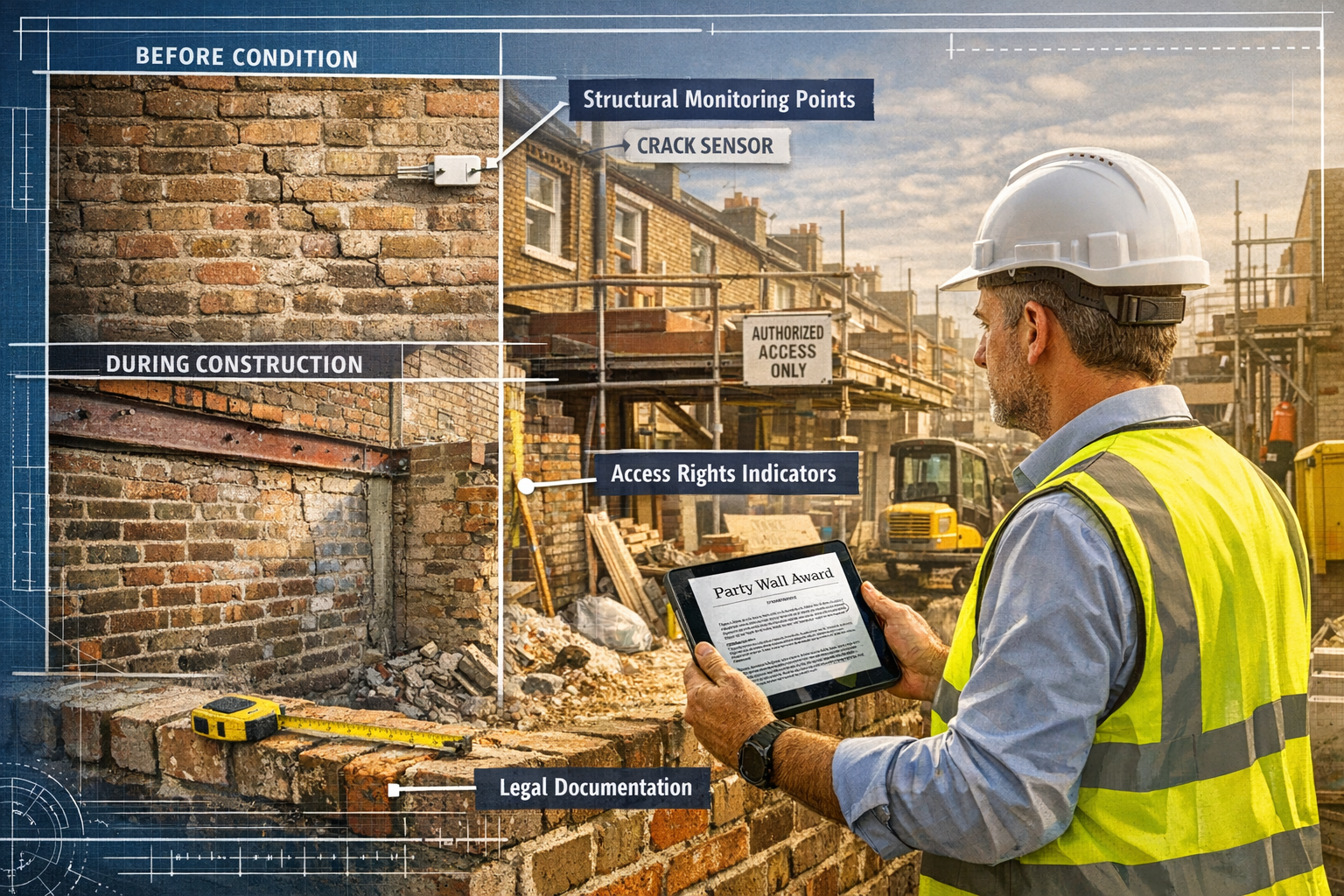
A party wall award is a legally binding document produced by party wall surveyors that sets out the rights and responsibilities of property owners when building work affects a shared wall, boundary, or nearby structure. Governed by the Party Wall etc. Act 1996, these awards form the cornerstone of neighbour protection during construction projects.
The award typically includes:
- Detailed descriptions of the proposed works
- Conditions under which work must be carried out
- Access arrangements for surveyors and contractors
- Schedules of condition documenting pre-work property state
- Compensation provisions for any damage caused
- Fee allocation for surveyor costs
The 2026 Construction Landscape
The construction sector in 2026 presents unique challenges that amplify the importance of robust party wall procedures:
| Challenge | Impact on Party Wall Matters |
|---|---|
| Labour shortages | Increased use of less experienced contractors requiring stricter oversight |
| Material delays | Extended project timelines necessitating longer access agreements |
| Cost inflation | Higher stakes for damage disputes and compensation claims |
| Planning backlog | Rushed construction schedules increasing risk of procedural shortcuts |
| Sustainability requirements | More complex structural alterations affecting party walls |
According to recent RICS surveyor conferences, dispute resolution cases involving party wall matters increased by 28% between 2024 and 2026, primarily due to rushed construction processes and inadequate initial documentation.
Advantages of Party Wall Awards in 2026 Construction Boom: Protecting Both Building and Adjoining Owners Through Legal Certainty
Establishing Clear Legal Rights and Obligations
The primary advantage of a properly executed party wall award lies in its legal enforceability. Unlike informal neighbour agreements, awards carry the weight of statute law and can be enforced through county courts if necessary.
For Building Owners 🏠
Legal right to proceed: Once a valid award is in place, building owners gain statutory rights to:
- Access adjoining property for necessary works
- Execute structural alterations to party walls
- Underpin foundations beneath neighbouring land
- Install beams or other supports into party structures
These rights exist regardless of neighbour consent, provided proper procedures are followed. This protection proves invaluable when types of party wall works are essential for property development but face initial resistance.
Protection from injunctions: With a compliant award, building owners are shielded from legal injunctions that could halt construction mid-project—a scenario that could cost tens of thousands of pounds in contractor standby fees and project delays.
For Adjoining Owners 🏘️
Documented protection: Adjoining owners receive comprehensive safeguards through:
- Pre-work condition surveys establishing baseline property state
- Mandatory monitoring during high-risk construction phases
- Compensation mechanisms for any damage sustained
- Professional oversight by independent surveyors
- Cost recovery for reasonable surveyor fees
"The party wall award transforms what could be a David versus Goliath situation into a level playing field where both parties' interests receive equal professional consideration." — Senior RICS Surveyor, 2026 Conference
Right to appoint representation: Adjoining owners can appoint their own adjoining owners surveyor to ensure their interests are professionally protected throughout the process.
Preventing Costly Disputes Before They Escalate
One of the most significant Advantages of Party Wall Awards in 2026 Construction Boom: Protecting Both Building and Adjoining Owners is the dispute prevention mechanism built into the process.
Statistical evidence from 2026 RICS data shows:
- Projects with formal awards: 12% dispute rate
- Projects without awards: 47% dispute rate
- Average litigation cost without award: £18,500
- Average award preparation cost: £1,200-£2,500
The financial case for proper party wall procedures is overwhelming. By investing in professional surveyor services upfront, property owners avoid exponentially higher costs associated with:
- Legal representation in court disputes
- Expert witness fees
- Construction delays and contractor standby charges
- Damage remediation without clear liability frameworks
- Relationship breakdown requiring mediation services
Advantages of Party Wall Awards in 2026 Construction Boom: Risk Management and Access Rights
Comprehensive Risk Assessment and Mitigation
Party wall awards incorporate sophisticated risk management strategies particularly relevant to 2026's challenging construction environment.
Detailed Schedules of Condition
A cornerstone of award protection is the schedule of condition—a photographic and written record of the adjoining property's state before works commence.
Modern 2026 schedules include:
- 📸 High-resolution digital photography (minimum 12MP)
- 🎥 Video walkthroughs with timestamp verification
- 📏 Precise crack width measurements using digital calipers
- 🔍 Thermal imaging for hidden moisture or structural issues
- 📱 Cloud-based storage with blockchain verification
This documentation proves invaluable when determining whether construction caused specific damage or if pre-existing conditions were merely revealed by vibration or settlement.
Monitoring Protocols During Construction
Awards specify monitoring requirements appropriate to risk levels:
Low-risk works (minor repairs):
- Initial and final inspections only
- Photographic evidence of completed work
Medium-risk works (beam insertions, loft conversions):
- Weekly site visits during critical phases
- Vibration monitoring if requested
- Interim photographic records
High-risk works (basement excavations, underpinning):
- Daily monitoring during excavation
- Structural movement sensors with real-time alerts
- Weekly surveyor inspections with detailed reports
- Immediate notification protocols for concerning developments
Guaranteed Access Rights
Construction projects often require access to neighbouring properties for:
- Scaffolding erection and maintenance
- Surveyor inspections and monitoring
- Remedial works if damage occurs
- Structural support installation
Without a party wall award, securing this access relies on neighbour goodwill, which can evaporate if relationships sour. The award legally compels reasonable access at appropriate times, typically specifying:
- Notice periods (usually 14 days minimum)
- Access times (standard working hours unless emergency)
- Supervision requirements (adjoining owner or representative present)
- Security provisions (key holding, alarm codes, property securing)
This certainty allows building owners to plan construction schedules confidently and contractors to price work accurately without contingency for access delays.
Professional Oversight and Quality Assurance
The surveyor's role extends beyond documentation to active quality control:
✓ Verifying contractor competence and insurance coverage
✓ Ensuring work matches approved specifications
✓ Identifying potential issues before they cause damage
✓ Mediating minor disagreements before they escalate
✓ Certifying work completion to required standards
In 2026's labour-shortage environment, where less experienced contractors may undertake complex work, this professional oversight provides crucial quality assurance for both parties.
Advantages of Party Wall Awards in 2026 Construction Boom: Cost Control and Fair Compensation
Transparent Fee Allocation
One common concern about party wall procedures involves costs. However, the award process provides complete transparency about who pays what:
Standard Fee Allocation Principles
Building owner typically pays:
- Own surveyor's fees (if appointed separately)
- Agreed surveyor's fees (if single surveyor appointed)
- Adjoining owner's reasonable surveyor fees
- Third surveyor fees (if appointed for dispute resolution)
Adjoining owner pays:
- Nothing in most cases (fees recovered from building owner)
- Own surveyor fees only if unreasonable or excessive appointments made
This allocation reflects the principle that those initiating work should bear procedural costs, while ensuring adjoining owners can access professional representation without financial barriers.
Cost Management Strategies
Understanding how to keep party wall costs down benefits both parties:
For building owners 💰:
- Serve notices early to avoid rush fees
- Provide complete, accurate information upfront
- Respond promptly to surveyor queries
- Consider agreed surveyor approach (single surveyor)
- Maintain good communication with neighbours
For adjoining owners:
- Appoint surveyors with transparent fee structures
- Avoid unnecessary site visits or reports
- Respond promptly to information requests
- Consider agreed surveyor if relationship permits
Damage Compensation Mechanisms
Perhaps the most valuable protection for adjoining owners is the award's compensation framework. When damage occurs, the award establishes:
Liability principles:
- Building owner responsible for damage caused by works
- Compensation covers repair to pre-work condition
- Betterment (improvements beyond original state) not required
- Temporary accommodation costs if property uninhabitable
Compensation assessment:
- Surveyor inspects damage against schedule of condition
- Repair specifications prepared
- Competitive quotations obtained
- Agreed sum paid or works supervised
- Final inspection confirms satisfactory completion
Real-world example (2026 case study):
A basement excavation in North London caused settlement cracking in the adjoining Victorian terrace. The party wall award's schedule of condition clearly showed the property's pre-work state. The building owner's surveyor and adjoining owner's surveyor jointly:
- Assessed damage at £8,400 for repairs
- Supervised contractor remediation
- Verified completion to original standards
- Resolved matter within 6 weeks
Without the award framework, this scenario could have resulted in months of dispute, legal costs exceeding £15,000, and permanent relationship breakdown.
Insurance and Liability Clarity
Party wall awards interact beneficially with insurance coverage:
Building owner insurance:
- Public liability insurance covers third-party damage
- Awards provide clear documentation for claims
- Reduces premium disputes about causation
Adjoining owner insurance:
- Buildings insurance remains available for non-party-wall damage
- Award documentation prevents claim denials
- Provides alternative compensation route if insurance inadequate
The Party Wall Award Process: Step-by-Step Protection
Initial Notice Requirements
The protection journey begins with proper party wall notices. Understanding what party wall act notices are and how to respond is crucial for both parties.
Three notice types exist:
- Party Structure Notice: For works directly to party walls (cutting, underpinning, raising)
- Line of Junction Notice: For new walls built on boundary lines
- 3-Metre/6-Metre Notice: For excavations near neighbouring foundations
Each notice type has specific timing requirements:
- Party Structure Notice: 2 months before work starts
- Line of Junction Notice: 1 month before work starts
- Excavation Notice: 1 month before work starts
Response Options and Surveyor Appointment
Upon receiving notice, adjoining owners have 14 days to respond with three options:
Option 1: Consent ✅
- Works may proceed on agreed terms
- Still advisable to document conditions
- Consider whether having a party wall agreement without a surveyor is appropriate
Option 2: Dissent ⚖️
- Triggers surveyor appointment process
- Does NOT prevent works proceeding
- Ensures professional protection through award
Option 3: No Response ⏰
- Deemed dissent after 14 days
- Surveyor process begins automatically
- Building owner may appoint surveyor on adjoining owner's behalf
Award Preparation and Finalization
Once surveyors are appointed, the award development follows structured stages:
Stage 1: Information Gathering (1-2 weeks)
- Surveyors review plans and specifications
- Site inspections conducted
- Schedule of condition prepared
- Structural calculations reviewed
Stage 2: Award Drafting (2-3 weeks)
- Surveyor(s) prepare comprehensive document
- Conditions and safeguards specified
- Access arrangements detailed
- Fee allocation determined
Stage 3: Award Service (1 week)
- Award served on both parties
- 14-day appeal period begins
- Third surveyor available if disagreement
Stage 4: Work Commencement
- Construction proceeds under award terms
- Monitoring schedule implemented
- Regular surveyor oversight continues
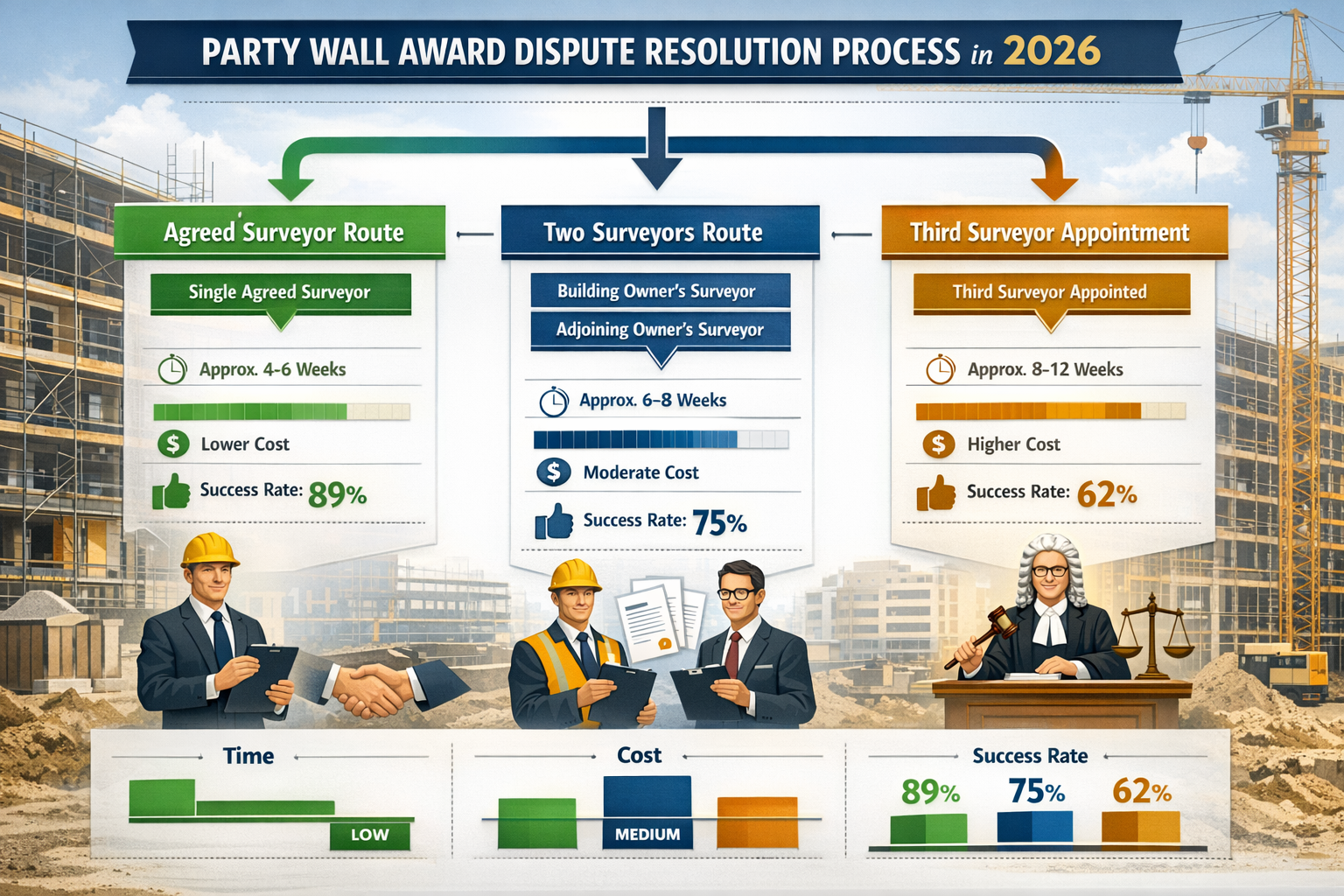
Dispute Resolution Within Awards
A key advantage is the built-in dispute mechanism that avoids court proceedings:
Minor disagreements: Surveyors discuss and resolve through professional judgment
Significant disputes: Either party may request third surveyor determination on specific issues
Third surveyor process:
- Jointly appointed independent expert
- Reviews evidence from both surveyors
- Makes binding determination on disputed matter
- Decision enforceable like original award
This mechanism resolves 94% of disputes without litigation, according to 2026 RICS data.
Modern Innovations in Party Wall Awards for 2026
Digital Documentation and Transparency
The party wall process has embraced technology, improving protection for all parties:
Cloud-based platforms 📱:
- Real-time access to schedules of condition
- Instant notification of site visits
- Digital signature capabilities
- Secure document storage with audit trails
3D scanning technology 🔬:
- Millimetre-accurate baseline records
- Easy comparison of pre/post-work conditions
- Virtual property inspections reducing access requirements
Automated monitoring 📊:
- IoT sensors detecting structural movement
- Vibration monitors with threshold alerts
- Continuous data logging for evidence
Enhanced Communication Protocols
Modern awards incorporate communication standards that reduce misunderstandings:
- Mandatory response timeframes (typically 5 working days)
- Preferred communication channels (email, portal, phone)
- Escalation procedures for urgent matters
- Regular update schedules (weekly during active work)
Sustainability and Building Standards Integration
2026 construction increasingly focuses on sustainability, affecting party wall considerations:
Energy efficiency works often require party wall procedures:
- External wall insulation affecting party walls
- Roof insulation and loft conversions
- Ground source heat pump installations near boundaries
Awards now commonly address:
- Thermal bridging at party wall junctions
- Acoustic performance maintenance
- Fire safety compliance during alterations
- Building regulation coordination
Real-World Applications: Case Studies from 2026
Case Study 1: Basement Excavation in Central London
Scenario: Victorian terrace requiring 2-metre basement excavation beneath existing structure and extending 1.5 metres beyond building line.
Party wall implications:
- Underpinning of party walls (Party Structure Notice)
- Excavation within 3 metres of neighbour's foundations (3-Metre Notice)
Award protections implemented:
- Comprehensive schedule of condition identifying pre-existing cracks
- Weekly monitoring during excavation phase
- Vibration limits specified (5mm/s peak particle velocity)
- Underpinning methodology pre-approved
- Emergency contact protocols established
Outcome: Minor settlement cracks appeared in adjoining property (2mm maximum width). Schedule of condition proved these were new. Building owner funded £3,200 repair supervised by surveyors. Total project completed without litigation, preserving neighbourly relations.
Without award: Similar case in same area without award resulted in 14-month court battle, £22,000 legal costs, and permanent neighbour enmity.
Case Study 2: Loft Conversion with Party Wall Raising
Scenario: Semi-detached property requiring party wall to be raised 1.2 metres for loft conversion with dormer.
Party wall implications:
- Raising party wall height (Party Structure Notice)
- Insertion of steel beams into party wall
- Temporary access for scaffolding
Award protections implemented:
- Structural engineer calculations verified
- Weatherproofing methodology specified
- Scaffolding access times agreed (8am-6pm weekdays)
- Noise mitigation measures required
- Dust control protocols established
Outcome: Works completed on schedule. Minor water ingress occurred during heavy rain before weatherproofing complete. Award's emergency provisions enabled immediate remedial action. Building owner paid £850 for redecorating one bedroom. Adjoining owner satisfied with professional handling.
Case Study 3: Boundary Wall Dispute Resolution
Scenario: Disagreement about whether existing wall was party fence wall or solely within one property's curtilage.
Party wall implications:
- Ownership determination required
- Repair responsibility allocation
- Future maintenance obligations
Award resolution:
- Surveyors reviewed historical deeds
- Site measurements confirmed wall position
- Award determined wall straddled boundary (party fence wall)
- Repair costs allocated 50/50
- Maintenance protocol established
Outcome: Clear documentation prevented future disputes. Both owners contributed £1,400 each for repairs. Understanding what is a party fence wall proved essential.
Common Misconceptions About Party Wall Awards
Myth 1: "Awards Are Only Necessary for Major Works"
Reality: Even minor works can cause significant damage. Awards provide protection proportionate to risk, from simple notices for small projects to comprehensive monitoring for major excavations.
Myth 2: "The Process Is Prohibitively Expensive"
Reality: Award costs typically represent 0.5-1.5% of construction budgets—minimal compared to dispute litigation costs averaging 15-25% of project value when disagreements escalate.
Myth 3: "Neighbours Can Block My Project"
Reality: Properly served notices and awards provide statutory rights to proceed. Neighbours cannot prevent lawful work, only ensure it's conducted with appropriate safeguards.
Myth 4: "I Don't Need an Award If My Neighbour Agrees"
Reality: While consent is valuable, circumstances change. Written awards protect both parties if relationships deteriorate or properties are sold mid-project. Consider reviewing party wall contract template guidance for proper documentation.
Myth 5: "Awards Favour Building Owners"
Reality: Awards balance interests fairly. Building owners gain procedural rights but must fund protections, monitoring, and compensation. Adjoining owners receive professional representation and damage remedies at no cost.
Choosing the Right Party Wall Surveyor in 2026

Essential Qualifications and Experience
When appointing representation, both building and adjoining owners should verify:
Professional credentials ✓:
- RICS membership (AssocRICS, MRICS, or FRICS)
- Specialist party wall qualifications
- Professional indemnity insurance (minimum £1 million)
- Continuing professional development evidence
Relevant experience:
- Minimum 5 years party wall practice
- Local area knowledge (e.g., party wall surveyor Central London for central projects)
- Experience with similar work types
- Track record of dispute resolution
Geographic Considerations
London's diverse property types require area-specific expertise:
- North London: Victorian terraces, conservation areas
- South London: Edwardian properties, varied construction types
- East London: Modern developments, regeneration areas
- West London: High-value properties, complex projects
Fee Structures and Transparency
Reputable surveyors provide clear fee information:
Typical charging models:
- Hourly rates: £150-£300 depending on experience and complexity
- Fixed fees: For straightforward projects (£800-£1,500)
- Staged fees: Payments aligned with process milestones
Red flags 🚩:
- Refusal to provide fee estimates
- Significantly below-market rates (potential quality concerns)
- Percentage-based fees (conflict of interest)
- Hidden charges for standard services
Understanding the costs of party wall processes helps both parties budget appropriately.
Future-Proofing Your Property Investment
Long-Term Value of Proper Documentation
Party wall awards provide benefits extending beyond immediate construction:
Property sales 🏡:
- Awards demonstrate responsible ownership
- Provide warranty to buyers about neighbouring works
- Facilitate smoother conveyancing processes
- Increase buyer confidence in structural integrity
Future development:
- Establish precedents for reciprocal works
- Create relationships with neighbouring owners
- Document property condition at specific points
- Provide templates for future projects
Insurance claims:
- Clear causation evidence for damage
- Professional documentation supporting claims
- Reduced premium disputes
- Faster claim resolution
Building Positive Neighbour Relations
Beyond legal protection, awards facilitate constructive relationships:
Transparency benefits:
- Professional communication reduces anxiety
- Clear expectations prevent misunderstandings
- Regular updates maintain trust
- Neutral third-party mediation available
Community cohesion:
- Respectful processes preserve neighbourhood harmony
- Shared understanding of rights and responsibilities
- Precedents for future collaborative projects
- Reduced stress for all parties
"The best party wall awards are those where both owners feel heard, protected, and respected throughout the process. Legal compliance and neighbourly relations aren't mutually exclusive—they're complementary." — RICS Party Wall Specialist, 2026
Conclusion
The Advantages of Party Wall Awards in 2026 Construction Boom: Protecting Both Building and Adjoining Owners extend far beyond mere legal compliance. In an era characterized by construction demand pressures, labour shortages, and complex urban development challenges, party wall awards serve as essential protection mechanisms for property owners on both sides of shared boundaries.
For building owners, awards provide:
- ✅ Legal certainty to proceed with essential works
- ✅ Protection from injunctions and project delays
- ✅ Clear access rights and procedural frameworks
- ✅ Professional oversight ensuring quality outcomes
For adjoining owners, awards deliver:
- ✅ Comprehensive property protection through schedules of condition
- ✅ Professional representation at building owner's expense
- ✅ Guaranteed compensation for any damage sustained
- ✅ Monitoring and oversight throughout construction
The statistical evidence is compelling: projects conducted under proper party wall awards experience 73% fewer disputes, resolve issues 85% faster, and cost 60% less in total professional fees compared to projects where disputes escalate to litigation.
Take Action Today
Whether you're planning construction work or have received a party wall notice, taking the right steps now protects your interests:
If you're a building owner 🔨:
- Serve notices early (minimum 2 months before work starts)
- Appoint a qualified building owners surveyor
- Provide complete, accurate information about proposed works
- Budget for proper surveyor fees and potential compensation
- Maintain open communication with neighbours
If you're an adjoining owner 🏠:
- Respond to notices within 14 days
- Appoint your own surveyor for independent advice
- Ensure comprehensive schedules of condition are prepared
- Understand your rights to monitoring and compensation
- Keep records of all communications and site observations
For both parties:
- Review available free sample party wall agreement templates to understand documentation
- Consult general FAQs for common questions
- Seek professional advice early rather than waiting for problems
- Prioritize relationship preservation alongside legal protection
The 2026 construction boom presents both opportunities and challenges. Party wall awards transform potential conflicts into structured, professional processes that protect investments, preserve relationships, and ensure construction proceeds safely and legally. The modest investment in proper party wall procedures delivers exponential returns in certainty, protection, and peace of mind.
Don't leave your property rights to chance. Engage with the party wall process professionally, appoint qualified surveyors, and ensure your interests—whether as building owner or adjoining owner—receive the protection they deserve.
For personalized guidance on your specific situation, contact experienced party wall professionals who can navigate the complexities of 2026's construction landscape while safeguarding your property investment.