


{"cover":"Professional landscape format (1536x1024) hero image featuring bold text overlay 'Drafting Party Wall Agreements for 2026 Loft and Basement Extensions: RICS-Compliant Templates' in extra large 72pt white sans-serif font with dark shadow and semi-transparent navy overlay box, centered in upper third. Background shows split-screen composition: left side displays modern London terraced house with scaffolding for loft extension, right side shows basement excavation work with exposed foundations. Foreground includes professional surveyor in hard hat reviewing architectural plans on tablet. Color scheme: deep navy blue, white, professional orange accents. High contrast, magazine cover quality, editorial style with subtle RICS branding elements and construction safety imagery.", "content":["Detailed landscape format (1536x1024) editorial image showing close-up of official Party Wall Notice document on professional desk with RICS logo visible, surrounded by architectural drawings of loft conversion cross-sections and basement extension plans. Includes measuring tape, professional surveyor's stamp, calendar showing 2026 dates with notice periods highlighted in yellow, and tablet displaying digital template. Clean professional lighting, shallow depth of field focusing on notice document header, modern office aesthetic with construction hard hat visible in background blur.", "Professional landscape format (1536x1024) infographic-style image displaying three-column comparison table of RICS-compliant party wall agreement templates. Left column shows loft extension requirements with roof diagram, center column displays basement excavation depth measurements with foundation cross-section illustration, right column features timeline flowchart from notice to award completion. Includes checkboxes, professional icons for surveyor appointments, neighbor consent stages, and cost allocation percentages. Color-coded sections in navy, orange, and white with clear typography and professional surveying instruments as decorative elements.", "Detailed landscape format (1536x1024) image showing common party wall agreement pitfalls as visual warning signs. Features split composition: top half displays correct procedures with green checkmarks including proper notice timing, qualified MRICS surveyor credentials, and complete schedule of condition documentation. Bottom half shows red X marks over common mistakes like inadequate foundation depth specifications, missing insurance details, and incomplete neighbor consultation records. Includes actual template excerpts, professional surveyor reviewing documents with concerned expression, and urban London terraced houses in background showing shared walls."]}

Urban living in 2026 means maximizing every square foot of property. As homeowners across England and Wales turn to loft conversions and basement extensions to create additional living space, the demand for properly drafted party wall agreements has never been higher. With terraced houses and semi-detached properties dominating urban landscapes, understanding how to navigate the Party Wall etc. Act 1996 has become essential for successful residential extensions.
Drafting Party Wall Agreements for 2026 Loft and Basement Extensions: RICS-Compliant Templates provides property owners, developers, and surveyors with the framework needed to comply with current legislation while avoiding costly disputes. The Royal Institution of Chartered Surveyors (RICS) reissued their professional standard in May 2023, establishing clear guidelines that all chartered surveyors must follow when handling party wall matters.[1]
Key Takeaways
✅ Notice timing is critical: Building owners must serve written notice 1-2 months before starting work, depending on the type of construction planned.[2]
✅ Qualified surveyors matter: RICS recommends only chartered surveyors with MRICS or FRICS designations handle party wall agreements, ensuring professional standards and insurance coverage.[2]
✅ Templates must cover specific elements: Compliant agreements require detailed work descriptions, schedules of condition, cost allocation provisions, and dispute resolution mechanisms.
✅ Basement extensions require special attention: Excavation within 3-6 meters of neighboring foundations triggers additional notice requirements under the Party Wall etc. Act 1996.[2]
✅ Documentation protects all parties: Properly drafted awards with photographic evidence prevent disputes and provide legal protection for both building and adjoining owners.
Understanding the Party Wall etc. Act 1996 Framework for Extensions

The Party Wall etc. Act 1996 applies exclusively to England and Wales, providing a statutory framework for preventing and resolving disputes between neighbors undertaking construction work.[2] This legislation becomes particularly relevant for loft and basement extensions, which frequently involve work to shared walls, foundations, and structures.
What Triggers Party Wall Requirements?
For loft extensions, party wall procedures apply when:
- Work affects a shared wall between semi-detached or terraced properties
- New structural beams are inserted into party walls
- Chimney breasts on party walls require removal or alteration
- The roofline extends beyond the existing party wall structure
For basement extensions, triggers include:
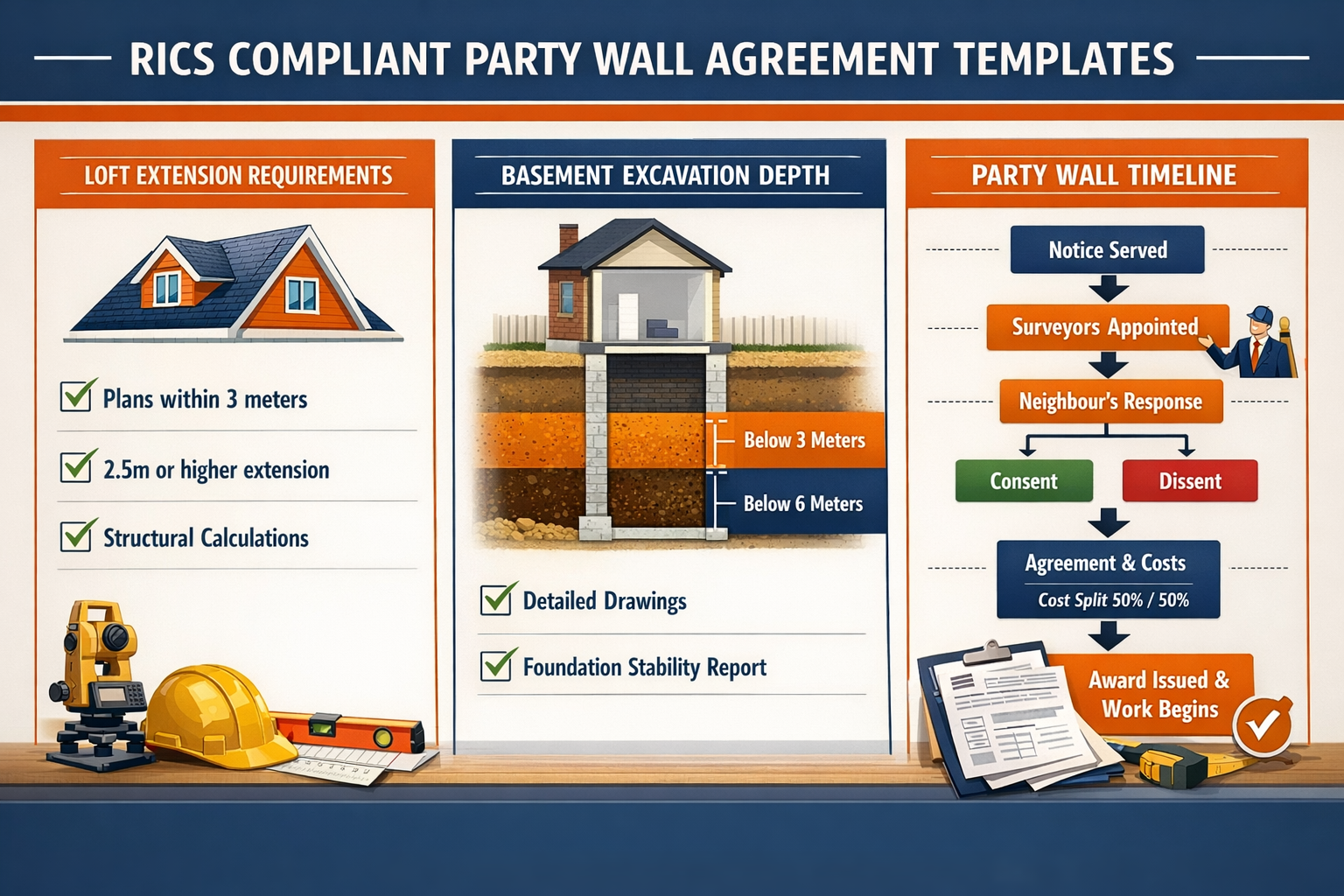
- Excavation within 3 meters of a neighboring building's foundation if going deeper than the existing foundation
- Excavation within 6 meters if the work extends below a 45-degree plane from the neighbor's foundation base[2]
- Underpinning work affecting shared foundations
- New party walls created during basement construction
Understanding these triggers helps property owners determine when formal party wall notices become legally required.
The Three Types of Party Wall Notices
The Act establishes three distinct notice types, each serving different construction scenarios:
| Notice Type | Purpose | Notice Period | Common Use Cases |
|---|---|---|---|
| Party Structure Notice | Work directly to party walls | 2 months | Loft conversions affecting shared walls, beam insertions |
| Line of Junction Notice | Building new walls on boundary lines | 1 month | Basement extensions creating new party walls |
| 3/6 Meter Notice | Excavation near neighboring foundations | 1 month | Deep basement excavations, underpinning work |
Each notice must contain specific information about the proposed work, including detailed plans, timing, and methodology. For comprehensive guidance on serving these notices, review our guide on party structure notices.
Essential Components of Drafting Party Wall Agreements for 2026 Loft and Basement Extensions: RICS-Compliant Templates
Creating compliant party wall agreements requires meticulous attention to detail and adherence to RICS professional standards. The 7th edition of the RICS guidance, effective since December 2019 and reissued as a formal standard in May 2023, establishes the benchmark for professional practice.[1]
Core Template Sections
1. Parties and Property Identification 📋
Every agreement must clearly identify:
- Full legal names and addresses of building owners
- Full legal names and addresses of adjoining owners
- Precise property descriptions with Land Registry references
- Appointed surveyor details (including MRICS/FRICS credentials)
2. Scope of Works Description
This section requires exceptional detail for loft and basement extensions:
For Loft Extensions:
- Structural alterations to party walls (beam positions, sizes, load calculations)
- Roof modifications affecting shared structures
- New openings or closures in party walls
- Chimney breast alterations
- Floor joist insertions or modifications
- Sound insulation specifications
For Basement Extensions:
- Excavation depth and proximity to neighboring foundations
- Underpinning methodology and specifications
- Temporary support systems during construction
- Waterproofing measures affecting adjoining property
- Drainage and water management provisions
- Access arrangements for construction vehicles
"The most common cause of party wall disputes in 2026 stems from inadequate work descriptions in initial agreements. Specificity prevents ambiguity." – RICS Building Surveying Conference, 2023
3. Schedule of Condition 📸
This critical component documents the pre-construction state of the adjoining owner's property. Best practices include:
- Professional photographic surveys (minimum 50-100 images for typical properties)
- Detailed written descriptions of existing defects
- Crack monitoring locations and measurements
- Structural observations by qualified surveyors
- Video walkthroughs for comprehensive documentation
The schedule of condition protects both parties by establishing baseline conditions before work commences.
4. Working Hours and Access Provisions
Templates must specify:
- Permitted construction hours (typically 8:00 AM – 6:00 PM weekdays)
- Weekend and holiday work restrictions
- Access rights for surveyor inspections
- Notice requirements for accessing adjoining property
- Emergency contact procedures
5. Cost Allocation and Payment Terms 💰
RICS-compliant agreements address:
- Which party bears surveyor fees (usually the building owner)
- Responsibility for making good any damage
- Payment timelines for agreed works
- Security deposit requirements (if applicable)
- Dispute resolution cost allocation
For insights on managing expenses, consult our guide on keeping party wall costs down.
Template Customization for 2026 Urban Density Challenges
The increasing density of urban development in 2026 creates unique challenges requiring template adaptations:
Terraced Property Considerations:
- Multiple adjoining owners (both sides)
- Coordinated notice serving to all affected parties
- Shared access arrangements through neighboring properties
- Cumulative impact assessments when multiple extensions occur simultaneously
Basement Extension Specifics:
- Groundwater management affecting multiple properties
- Party wall underpinning requiring neighbor cooperation
- Temporary propping systems extending into adjoining cellars
- Vibration monitoring provisions for sensitive structures
Loft Conversion Particulars:
- Shared chimney stack modifications
- Party wall height increases and weatherproofing
- New dormer windows affecting light and privacy
- Structural load redistribution through party walls
Step-by-Step Process for Drafting Party Wall Agreements for 2026 Loft and Basement Extensions: RICS-Compliant Templates
Implementing compliant agreements requires systematic execution across multiple phases. This section provides actionable guidance for property owners and professionals.
Phase 1: Pre-Notice Preparation (Weeks 1-2)
Step 1: Engage Qualified Professionals 🎓
RICS explicitly recommends appointing chartered surveyors with MRICS or FRICS designations who maintain:
- Current professional indemnity insurance
- Continuing professional development (CPD) records
- Relevant party wall experience
- Knowledge of local construction practices[2]
Verify surveyor credentials through the RICS member directory before appointment.
Step 2: Develop Detailed Construction Plans
Work with architects and structural engineers to create:
- Scaled drawings showing party wall interactions
- Foundation depth specifications for basement work
- Structural calculations for loft conversions
- Construction methodology statements
- Temporary works proposals
Step 3: Identify All Affected Parties
For terraced properties, this may include:
- Immediate neighbors on both sides
- Properties within 3-6 meters of excavation work
- Owners of shared access ways or structures
- Freeholders (if working on leasehold property)
Phase 2: Notice Service (Month 1)
Step 4: Prepare Compliant Notices
Using free party wall agreement templates as starting points, ensure notices include:
✔️ Building owner's name and address
✔️ Adjoining owner's name and address
✔️ Property addresses affected
✔️ Detailed work descriptions
✔️ Proposed commencement date
✔️ Architectural drawings and plans
✔️ Contact information for appointed surveyor
Step 5: Serve Notices Properly
Valid service requires:
- Hand delivery with signed acknowledgment, or
- Recorded delivery postal service, or
- Email (if previously agreed by parties)
Maintain proof of service for all notices. The Party Wall etc. Act 1996 establishes strict service requirements.
Step 6: Await Response (14 Days)
Adjoining owners have 14 days to respond with:
- Consent (allowing work to proceed without formal award)
- Dissent (triggering surveyor appointment process)
- No response (deemed dissent after 14 days)[2]
Phase 3: Award Preparation (Weeks 5-8)
When consent isn't obtained, surveyors must prepare a formal Party Wall Award before construction begins.
Step 7: Surveyor Appointments
Three appointment scenarios exist:
- Agreed Surveyor: Both parties jointly appoint one surveyor
- Two Surveyors: Each party appoints their own surveyor
- Third Surveyor: Appointed by the two surveyors to resolve disputes
The party wall award process determines which arrangement applies.
Step 8: Conduct Schedule of Condition Survey
The appointed surveyor(s) must:
- Arrange access to adjoining property (with reasonable notice)
- Photograph all rooms, particularly those nearest construction
- Document existing cracks, settlement, or defects
- Prepare detailed written descriptions
- Obtain adjoining owner's acknowledgment
Step 9: Draft the Party Wall Award
The award document must contain:
📄 Mandatory Elements:
- Detailed work specifications
- Schedule of condition findings
- Working hours and access provisions
- Cost allocation decisions
- Dispute resolution procedures
- Surveyor fee determinations
- Signatures of all appointed surveyors
Step 10: Serve the Award
Awards must be served on both building and adjoining owners, who have 14 days to appeal to the county court if dissatisfied with any provisions.[2]
Phase 4: Construction and Monitoring (Ongoing)
Step 11: Pre-Commencement Meeting
Before work starts, conduct a site meeting including:
- Building owner or their representative
- Principal contractor
- Appointed surveyor(s)
- Adjoining owner (if they wish to attend)
Discuss access arrangements, emergency contacts, and monitoring procedures.
Step 12: Regular Inspections
Surveyors should inspect:
- Before excavation begins (baseline verification)
- During critical phases (underpinning, beam insertion)
- Upon completion (final condition assessment)
- When requested by either party
Step 13: Damage Resolution
If construction causes damage:
- Document immediately with photographs
- Notify all parties within 24 hours
- Obtain repair quotations from qualified contractors
- Execute repairs promptly
- Update records for final settlement
Phase 5: Completion and Closeout (Final Month)
Step 14: Final Inspection
Compare current condition against the original schedule of condition to identify any construction-related damage.
Step 15: Settlement of Accounts
Resolve all outstanding matters:
- Surveyor fee payments
- Damage repair costs
- Any disputed items
- Final documentation
Step 16: Archive Documentation
Maintain complete records including:
- Original notices and responses
- Party wall award
- Schedule of condition (before and after)
- Inspection reports
- Correspondence
- Payment records
These documents provide legal protection and may be required for future property transactions.
Common Pitfalls and How to Avoid Them in 2026 Extensions
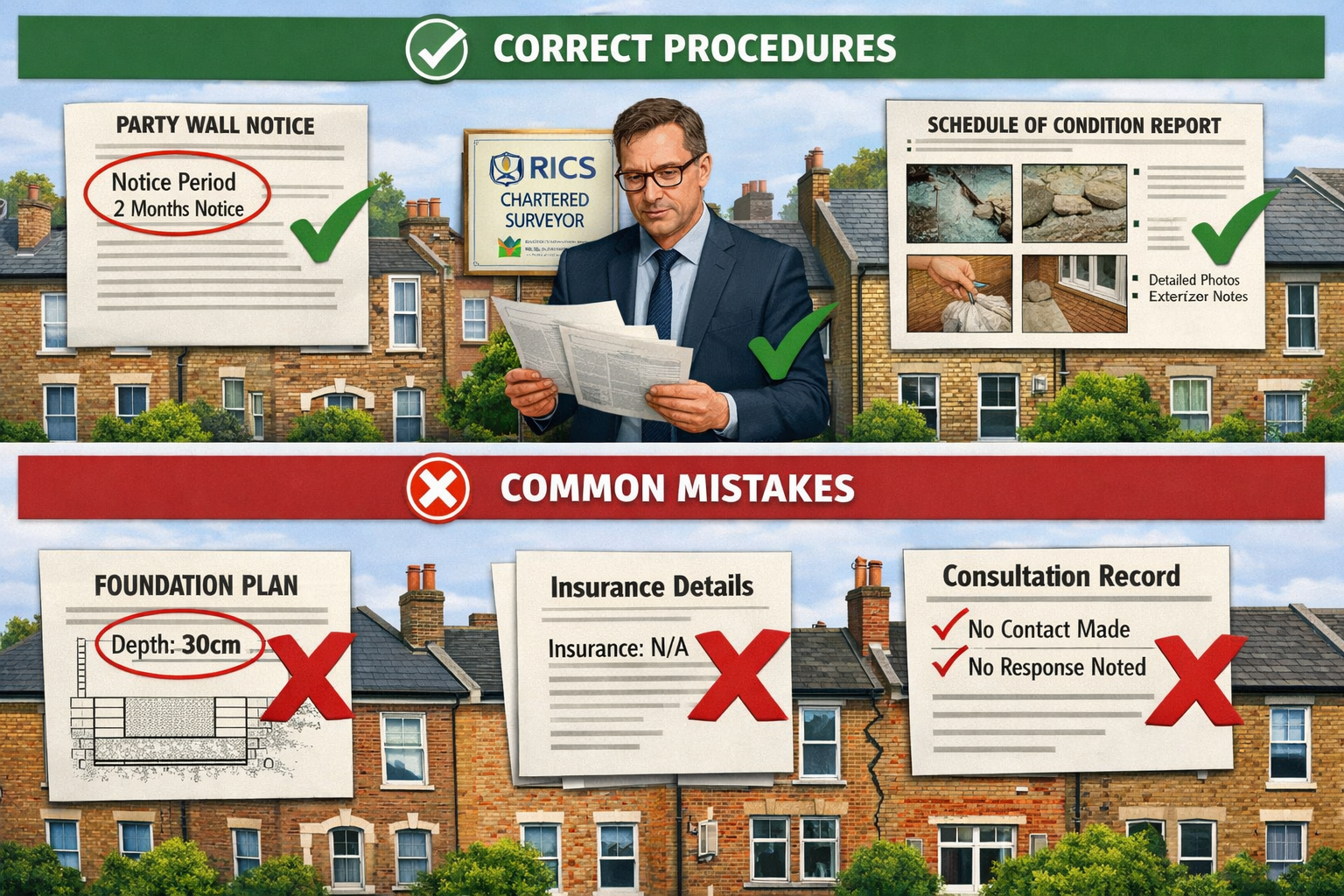
Learning from recent RICS Building Surveying Conference presentations and real-world case studies reveals recurring issues in party wall agreements for extensions.[3]
❌ Pitfall 1: Inadequate Notice Timing
The Problem: Serving notices too close to the planned construction start date leaves insufficient time for the full process, causing project delays.
The Solution: Begin the party wall process 4-6 months before planned construction, allowing for:
- 2 months notice period
- 14 days response time
- 4-6 weeks award preparation
- Buffer for unexpected complications
❌ Pitfall 2: Vague Work Descriptions
The Problem: Generic descriptions like "basement extension" fail to capture critical details, leading to disputes when actual work differs from expectations.
The Solution: Provide exhaustive specifications including:
- Exact excavation depths with datum points
- Specific beam sizes, materials, and load capacities
- Detailed underpinning methodology
- Temporary support system descriptions
- Waterproofing and drainage specifications
❌ Pitfall 3: Insufficient Schedule of Condition
The Problem: Rushed or incomplete pre-construction surveys make it impossible to determine whether damage resulted from construction or pre-existed.
The Solution: Invest in comprehensive documentation:
- Professional photographer or surveyor-captured images
- Minimum 50-100 photographs for typical properties
- Detailed written descriptions supplementing photos
- Crack width measurements with monitoring points
- Video walkthroughs for context
❌ Pitfall 4: Unqualified Surveyor Appointments
The Problem: Appointing surveyors without proper RICS credentials or party wall experience leads to non-compliant awards and potential legal challenges.
The Solution: Verify that appointed surveyors possess:
- Current MRICS or FRICS designation
- Active professional indemnity insurance (minimum £1 million coverage)
- Demonstrated party wall experience
- Local knowledge of construction practices
- CPD records showing continued education[2]
❌ Pitfall 5: Ignoring Adjoining Owner Concerns
The Problem: Dismissing neighbor concerns as unreasonable creates adversarial relationships and increases dispute likelihood.
The Solution: Engage proactively:
- Meet neighbors before serving formal notices
- Explain the project benefits and mitigation measures
- Address concerns genuinely and adjust plans where reasonable
- Maintain open communication throughout construction
- Provide regular progress updates
For guidance on handling situations where neighbors are undertaking work, see our resource on when your neighbor is carrying out works.
❌ Pitfall 6: Cost Allocation Ambiguity
The Problem: Unclear provisions about who pays for what creates payment disputes during and after construction.
The Solution: Specify explicitly:
- Building owner pays all surveyor fees (standard practice)
- Building owner responsible for making good damage
- Payment timelines (e.g., within 30 days of invoice)
- Security deposit arrangements if required
- Dispute resolution cost allocation
Review our costs of party wall process guide for typical expense ranges.
❌ Pitfall 7: Basement-Specific Oversights
The Problem: Basement extensions present unique challenges often overlooked in standard templates.
The Solution: Address basement-specific issues:
- Groundwater management: Provisions for dewatering affecting neighbors
- Underpinning access: Rights to work beneath adjoining property
- Vibration limits: Monitoring thresholds for sensitive equipment
- Temporary propping: Support systems extending into neighbor's space
- Party wall depth: Extending party walls downward during excavation
❌ Pitfall 8: Loft Conversion Complications
The Problem: Loft work affecting shared roof structures and chimney stacks creates complex party wall scenarios.
The Solution: Template provisions for:
- Chimney breast removal: Structural support for remaining portions
- Party wall height increases: Weatherproofing and maintenance access
- Roof valley modifications: Water runoff affecting both properties
- Fire separation: Ensuring compliance with Building Regulations
- Acoustic insulation: Sound transmission between converted spaces
RICS Compliance Checklist for 2026 Templates
Ensure your party wall agreement templates meet current RICS professional standards with this comprehensive checklist:
Documentation Requirements ✅
- All surveyor appointments confirmed in writing
- MRICS/FRICS credentials verified for all surveyors
- Professional indemnity insurance certificates obtained
- Conflict of interest declarations completed
- Scope of appointment clearly defined
Notice Compliance ✅
- Correct notice type selected (Party Structure/Line of Junction/3-6 Meter)
- Minimum notice periods observed (1-2 months as applicable)
- All affected adjoining owners identified and served
- Detailed plans and specifications attached
- Proof of service retained (signed acknowledgment/postal receipt)
Award Content ✅
- Parties correctly identified with full legal details
- Work description sufficiently detailed and specific
- Schedule of condition completed professionally
- Working hours and access provisions specified
- Cost allocation clearly stated
- Dispute resolution mechanism included
- Surveyor signatures obtained
- Award served on all parties with proof
Construction Phase ✅
- Pre-commencement meeting conducted
- Emergency contact procedures established
- Inspection schedule agreed and followed
- Damage reporting protocol in place
- Regular communication maintained with adjoining owners
- Photographic records maintained throughout
Completion Requirements ✅
- Final inspection comparing to original schedule of condition
- All damage identified and repair quotations obtained
- Making good works completed satisfactorily
- Final accounts settled
- All documentation archived for future reference
- Adjoining owner sign-off obtained
Regional Considerations Across England and Wales
While the Party Wall etc. Act 1996 applies uniformly across England and Wales, regional variations in construction practices and property types require template adaptations.
London and Major Urban Centers
High-density terraced housing and significant property values create specific challenges:
- Multiple adjoining owners: Terraced properties require coordinating with neighbors on both sides
- Conservation areas: Additional planning considerations affecting work scope
- High property values: Greater financial stakes increasing dispute likelihood
- Professional surveyor availability: Access to experienced party wall surveyors in Central London, North London, South London, East London, and West London
Suburban and Semi-Rural Areas
Different property configurations require adjusted approaches:
- Larger plot sizes: Fewer party wall triggers but potentially more complex boundary issues
- Varied construction types: Mix of attached and detached properties
- Local surveyor availability: May require surveyors traveling from urban centers
- Cost sensitivity: Lower property values affecting budget for professional fees
Understanding boundary wall rules helps distinguish party wall matters from simple boundary disputes.
Technology and Templates in 2026
Digital tools have transformed party wall agreement preparation and management in 2026:
Digital Notice Service
Electronic notice service via email has become standard practice when parties agree, offering:
- Instant delivery confirmation
- Reduced postal delays
- Digital record keeping
- Cost savings on recorded delivery fees
Cloud-Based Documentation
Modern party wall management uses cloud platforms for:
- Centralized document storage accessible to all parties
- Real-time schedule of condition updates with timestamped photos
- Collaborative award drafting between multiple surveyors
- Secure sharing with building owners and adjoining owners
3D Modeling and Visualization
Advanced templates now incorporate:
- 3D models showing work proximity to party walls
- Virtual walkthroughs helping neighbors understand proposed work
- Structural impact visualizations
- Excavation depth simulations for basement extensions
Automated Compliance Checking
Software tools verify:
- Correct notice periods calculated automatically
- Mandatory award elements included
- RICS standard compliance
- Regulatory requirement fulfillment
Alternatives to Formal Awards: When Agreement Without Surveyors Works
Not every party wall situation requires formal surveyor involvement. Understanding when simplified approaches suffice can save time and money.
Criteria for Informal Agreements
Consider having a party wall agreement without a surveyor when:
- Work is minor and low-risk
- Excellent relationship exists with neighbors
- Both parties understand the Party Wall Act
- Work scope is straightforward and well-defined
- Financial stakes are modest
Essential Elements of Informal Agreements
Even without surveyors, agreements should include:
- Written consent from adjoining owners acknowledging the notice
- Work description matching the served notice
- Photographic record of pre-construction condition
- Working hours agreement in writing
- Damage resolution commitment from building owner
- Contact information for all parties
When Professional Involvement Becomes Necessary
Engage qualified surveyors when:
- Adjoining owners express concerns or dissent
- Work involves structural alterations or deep excavations
- Property values are significant
- Previous disputes exist between parties
- Complex technical issues arise
- Either party requests professional involvement
The types of party wall works guide helps assess complexity levels.
Future-Proofing Party Wall Agreements for Evolving Construction Standards
As building techniques and regulations evolve, party wall agreements must adapt to remain effective.
Sustainability and Environmental Considerations
2026 construction increasingly incorporates:
- Green building materials: Agreements should specify eco-friendly materials used in party wall work
- Energy efficiency measures: Insulation improvements affecting shared structures
- Renewable energy installations: Solar panels or heat pumps with structural implications
- Water conservation systems: Rainwater harvesting affecting drainage
Building Safety Act Implications
Post-Grenfell building safety reforms influence party wall work:
- Enhanced fire safety requirements for party walls
- Documentation requirements for future building safety cases
- Material specifications meeting updated standards
- Competent person certifications for fire-stopping work
Climate Adaptation
Increasing extreme weather events require:
- Enhanced waterproofing specifications for basement extensions
- Flood resilience measures affecting party walls
- Structural resilience to temperature extremes
- Drainage capacity for intense rainfall events
Conclusion
Drafting Party Wall Agreements for 2026 Loft and Basement Extensions: RICS-Compliant Templates requires meticulous attention to legal requirements, professional standards, and practical construction realities. As urban density increases and homeowners maximize property potential through extensions, properly executed party wall procedures protect all stakeholders while enabling successful projects.
Key Success Factors
✅ Early engagement: Begin the party wall process 4-6 months before planned construction
✅ Qualified professionals: Appoint RICS-chartered surveyors with relevant experience
✅ Comprehensive documentation: Invest in detailed schedules of condition and work specifications
✅ Clear communication: Maintain transparent dialogue with neighbors throughout
✅ RICS compliance: Follow current professional standards and guidance
Actionable Next Steps
For Building Owners Planning Extensions:
- Consult professionals early: Engage architects and party wall surveyors during initial design phases
- Download template resources: Access sample party wall agreement templates to understand requirements
- Budget appropriately: Include party wall costs in project budgets (typically £700-£2,000 per neighbor)
- Communicate proactively: Discuss plans with neighbors before serving formal notices
- Maintain records: Archive all documentation for future reference and property transactions
For Adjoining Owners Receiving Notices:
- Understand your rights: Review the Party Wall etc. Act 1996 provisions
- Respond promptly: Provide written response within 14 days
- Consider professional advice: Appoint your own surveyor if concerns exist
- Document property condition: Take photographs before work commences
- Stay engaged: Maintain communication with appointed surveyors throughout
For Property Professionals:
- Verify credentials: Ensure MRICS/FRICS status and current insurance
- Update templates: Incorporate latest RICS guidance and case law developments
- Invest in CPD: Attend party wall training and conferences regularly
- Build local networks: Develop relationships with other qualified surveyors
- Embrace technology: Utilize digital tools for documentation and communication
The complexity of modern loft and basement extensions demands professional expertise and rigorous adherence to established procedures. By following RICS-compliant templates and best practices outlined in this guide, property owners and professionals can navigate party wall requirements successfully, protecting relationships and investments while achieving construction goals.
For personalized guidance on your specific project, consider consulting with qualified party wall surveyors who understand local construction practices and current regulatory requirements. The investment in proper party wall procedures invariably proves worthwhile, preventing disputes and ensuring smooth project execution from notice to completion.
References
[1] Party Wall Legislation And Procedure – https://www.rics.org/profession-standards/rics-standards-and-guidance/sector-standards/building-surveying-standards/party-wall-legislation-and-procedure
[2] Party Walls – https://www.rics.org/consumer-guides/party-walls
[3] Party Wall Surveys For Data Centre Expansions Navigating Agreements In The 2026 Investment Surge – https://nottinghillsurveyors.com/blog/party-wall-surveys-for-data-centre-expansions-navigating-agreements-in-the-2026-investment-surge
