

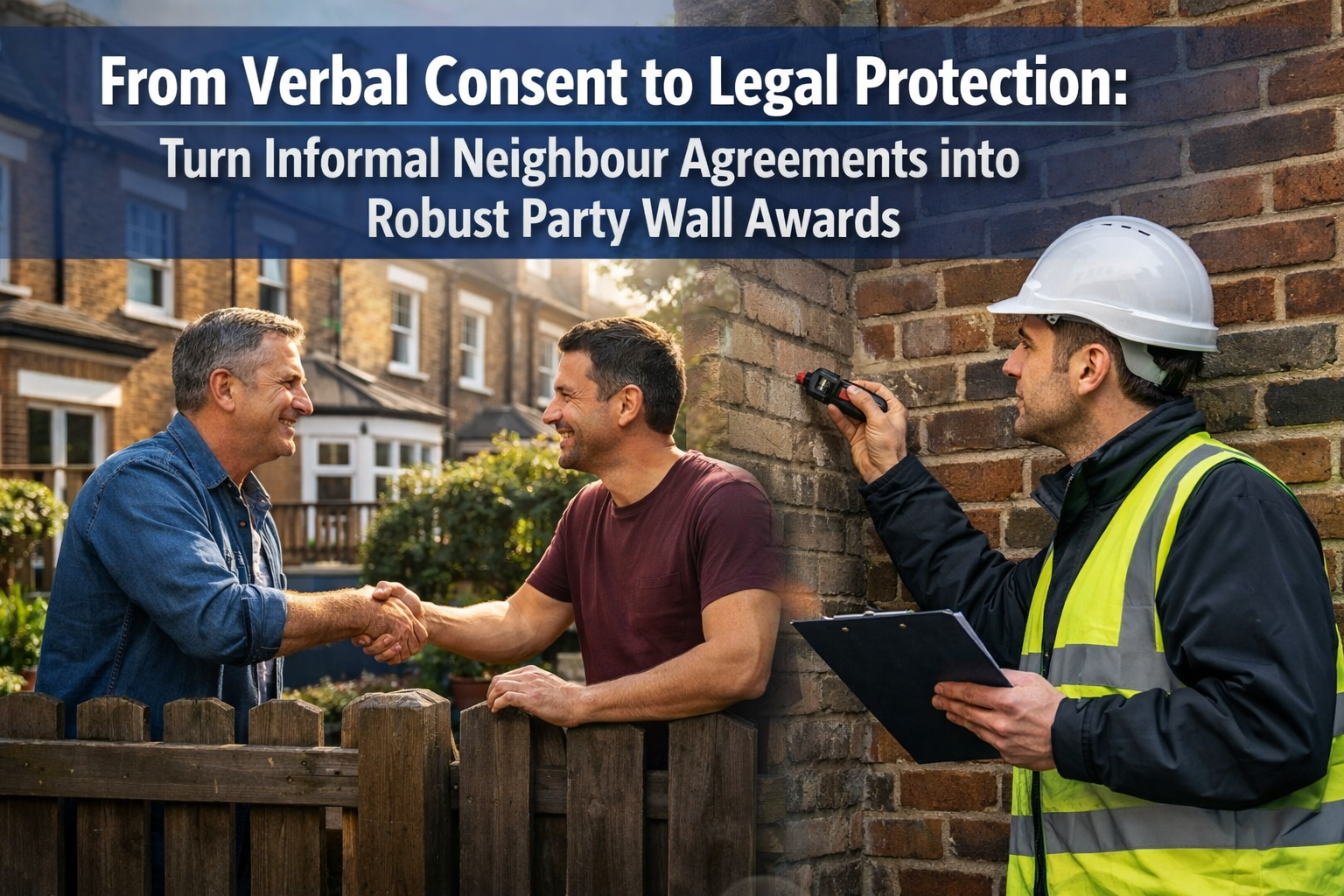
{"cover":"Professional landscape format (1536x1024) hero image with bold text overlay 'From Verbal Consent to Legal Protection: Turn Informal Neighbour Agreements into Robust Party Wall Awards' in extra large 72pt white sans-serif font with dark shadow and semi-transparent navy overlay box, positioned in upper third. Background shows split composition: left side depicts two neighbours shaking hands over garden fence in friendly conversation, right side shows professional surveyor in hard hat examining shared wall with clipboard and laser measure. Modern urban London terraced houses visible. Color scheme: navy blue, white, professional grey with warm accent lighting. High contrast, editorial magazine cover quality, photorealistic style with professional depth of field.","content":["Landscape format (1536x1024) detailed comparison infographic showing two paths side by side: left path labeled 'Informal Agreement' shows handwritten note on napkin, verbal handshake, question marks, cracked wall with dispute icons; right path labeled 'Party Wall Award' shows official document with surveyor seal, protective measures checklist, calendar timeline, shield icon representing legal protection. Clean professional layout with icons, arrows showing progression, red warning symbols on informal side, green checkmarks on formal side. Modern infographic style with navy, red, and green color coding. Text overlays: 'Risks vs Protection', clear visual hierarchy, professional typography.","Landscape format (1536x1024) detailed step-by-step visual flowchart showing the journey from verbal consent to party wall award. Five connected stages with numbered circles (1-5): Stage 1 shows neighbours talking with speech bubbles, Stage 2 shows formal Party Wall Notice document being served, Stage 3 shows surveyor appointment with professional in hard hat, Stage 4 shows Schedule of Condition photography and documentation, Stage 5 shows completed Party Wall Award document with official seal. Each stage connected by bold arrows, timeline indicators showing 3-4 months duration, cost annotations (£750-£1800), icons for each phase. Professional process diagram style with navy, grey, and gold accents. Clean, educational layout with clear labels.","Landscape format (1536x1024) professional scene showing party wall surveyor conducting detailed inspection of shared wall between two London terraced properties. Surveyor in business attire and hard hat uses laser measure and tablet device to document wall condition. Visible elements: exposed brick party wall with measurement annotations, photographic equipment on tripod capturing condition evidence, clipboard with official Party Wall Award template, protective barrier diagrams, access rights documentation. Background shows both properties' interiors partially visible. Warm professional lighting, documentary photography style, depth of field focusing on surveyor's detailed work. Color palette: warm brick tones, professional navy, safety yellow accents, official document whites. Photorealistic quality showing professionalism and thoroughness of formal process."]
}
A friendly chat over the garden fence. A handshake and a smile. A quick text message saying "sure, no problem." When planning building work that affects a shared wall, many neighbours in 2026 still rely on these informal agreements. They seem simple, cost-free, and preserve good relations. But when cracks appear, access is denied, or damage occurs, these casual arrangements offer zero legal protection to either party.
Understanding the journey from verbal consent to legal protection through a proper Party Wall Award can save thousands in disputes and preserve neighbourly relationships when construction challenges arise. This comprehensive guide explains exactly how to transform informal neighbour agreements into robust party wall awards that protect everyone involved.
Key Takeaways
- 📝 Informal agreements lack enforceability: Verbal consent and handwritten notes provide no legal protection when damage occurs or disputes arise during building works
- ⚖️ Party Wall Awards are legally binding: Formal awards create enforceable obligations, protective measures, and clear dispute resolution procedures under the Party Wall etc. Act 1996
- ⏱️ Timeline matters: Converting informal consent to formal protection typically takes 3-4 months and costs £1,500-£3,600 per neighbour in 2026[2]
- 🛡️ Protection works both ways: Awards protect building owners from unfounded claims and adjoining owners from uncompensated damage
- 🔄 Retrospective formalization is possible: Even after works begin, parties can create formal agreements to address emerging issues[3]
Why Informal Neighbour Agreements Fail When Building Work Begins
The Illusion of Simplicity
When neighbours have a good relationship, formal processes can feel unnecessary. A friendly conversation seems sufficient for minor works like a loft conversion or single-storey extension. However, construction projects rarely proceed exactly as planned.
Common scenarios where informal agreements collapse:
- 🏚️ Unexpected damage: Vibrations cause cracks that weren't anticipated
- 🚧 Access disputes: Neighbours change their mind about allowing scaffolding on their property
- 💰 Cost disagreements: Who pays for repairs when issues arise?
- 📅 Timeline conflicts: Works take longer than verbally agreed, causing frustration
- 👥 Change of ownership: New owners aren't bound by previous verbal agreements
What Informal Agreements Cannot Provide
Verbal consent and handwritten notes fundamentally lack several critical elements:
| Element | Informal Agreement | Party Wall Award |
|---|---|---|
| Legal enforceability | ❌ None | ✅ Fully binding |
| Damage protection | ❌ Ambiguous | ✅ Clear liability framework |
| Access rights | ❌ Revocable | ✅ Legally guaranteed |
| Condition records | ❌ Rarely documented | ✅ Professional schedule |
| Dispute resolution | ❌ Court only | ✅ Structured process |
| Cost allocation | ❌ Unclear | ✅ Defined in award |
The Party Wall etc. Act 1996 exists specifically because informal arrangements consistently fail to protect either party when complications arise. Understanding what types of works require formal procedures is the first step toward proper protection.
Real Costs of Relying on Verbal Consent
Property owners who skip formal procedures often face:
- Legal disputes: Court proceedings costing £10,000-£50,000+
- Work stoppages: Injunctions halting construction for months
- Relationship breakdown: Permanent damage to neighbour relations
- Insurance complications: Policies may not cover informally-agreed works
- Reduced property value: Undocumented works can affect future sales
"The £1,500-£3,600 cost of a proper Party Wall Award seems expensive until you face a £30,000 legal dispute over a crack that appeared during your extension. Formal protection is always cheaper than retrospective litigation." – Party Wall Surveyor, London 2026
Understanding Party Wall Awards: The Gold Standard of Legal Protection
What Is a Party Wall Award?
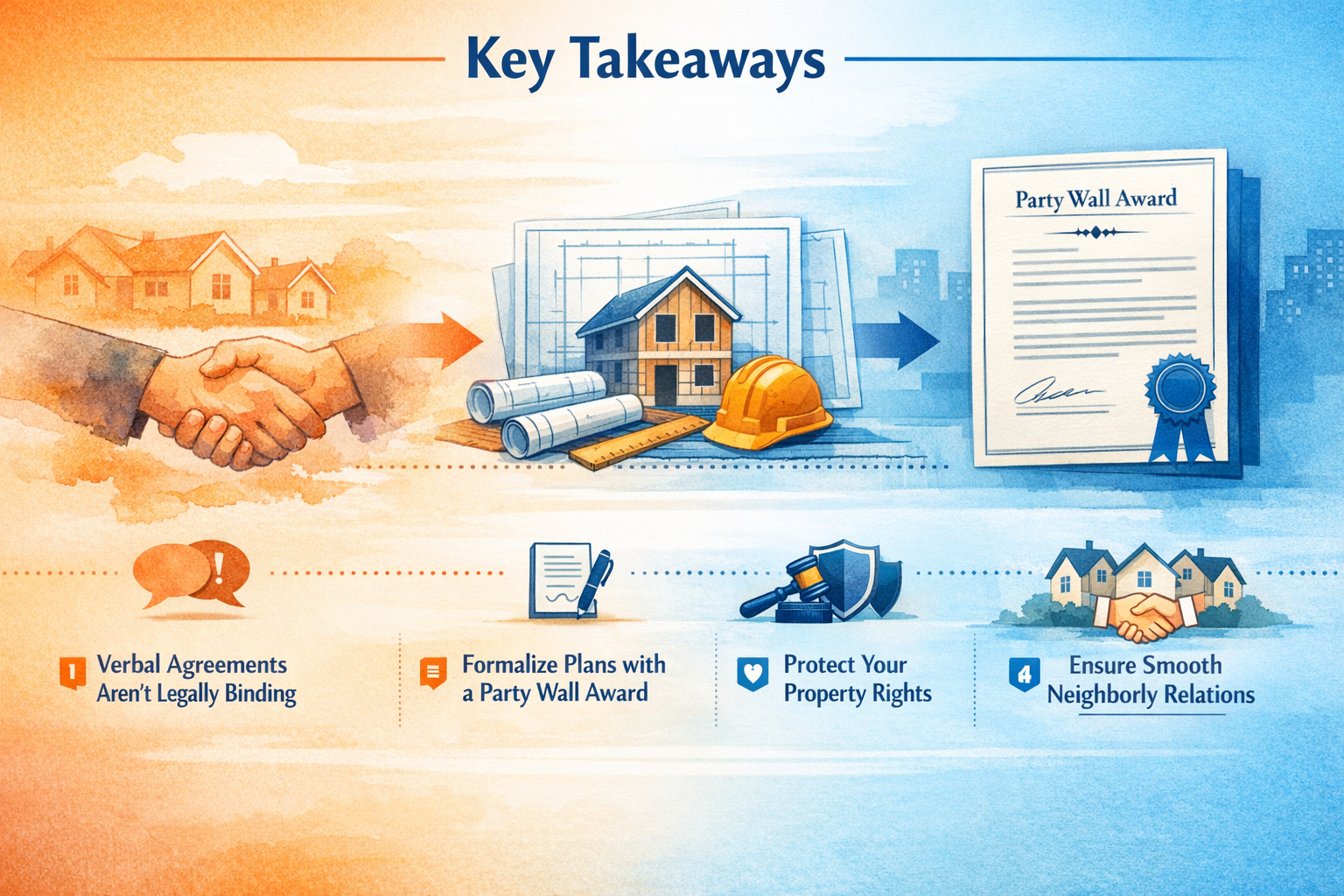
A Party Wall Award (sometimes called a Party Wall Agreement) is a legally binding document produced by qualified party wall surveyors that sets out precisely how building works affecting shared structures will proceed[1]. It creates enforceable rights and obligations for both the building owner (person doing works) and adjoining owner (neighbour).
Awards are required when:
- A neighbour dissents to a Party Wall Notice
- A neighbour doesn't respond within 14 days (deemed dissent)
- Both parties want formal protection even with consent
Essential Components of a Robust Party Wall Award
Every comprehensive award includes[1]:
1. Description of Authorized Works
- Detailed scope of permitted construction activities
- Technical specifications and methods
- Timeline and working hours
- Materials to be used
2. Schedule of Condition
- Professional photographic record of existing property condition
- Detailed written descriptions of walls, floors, ceilings
- Documentation of pre-existing cracks, defects, or damage
- Baseline for assessing any future damage claims
3. Protective Measures
- Required safeguards during construction
- Monitoring procedures (crack monitoring, vibration limits)
- Dust and noise mitigation requirements
- Structural support specifications
4. Access Provisions
- Specific rights to enter adjoining property
- Notice periods required
- Hours and days access permitted
- Compensation for access (if applicable)
5. Dispute Resolution Procedures
- Process for raising concerns during works
- Surveyor inspection protocols
- Third surveyor appointment mechanism
- Timeline for resolving disagreements
6. Cost Allocation
- Who pays surveyor fees (usually building owner)
- Responsibility for damage repairs
- Compensation arrangements
For detailed examples, reviewing a sample party wall agreement template can clarify what comprehensive protection looks like.
How Awards Create Legal Protection
Unlike informal agreements, Party Wall Awards are enforceable in county court without requiring full litigation. If either party breaches the award:
- ✅ The other party can seek immediate enforcement
- ✅ Breaches are clear violations of specific terms
- ✅ Remedies are defined in the award itself
- ✅ Legal costs are typically recoverable
This enforceability transforms neighbour relations from uncertain goodwill to contractual certainty.
From Verbal Consent to Legal Protection: The Step-by-Step Transformation Process
Step 1: Recognize When Formalization Is Necessary
Even if a neighbour has given verbal consent, formalization becomes essential when:
- Works involve structural alterations to party walls
- Excavations occur within 3-6 meters of neighbouring foundations
- New walls are being built on the boundary line
- Construction will cause vibration, noise, or access requirements
- The project has significant value or complexity
- Either party wants documented protection
Understanding whether you need a surveyor depends on your specific circumstances, but professional involvement dramatically increases protection quality.
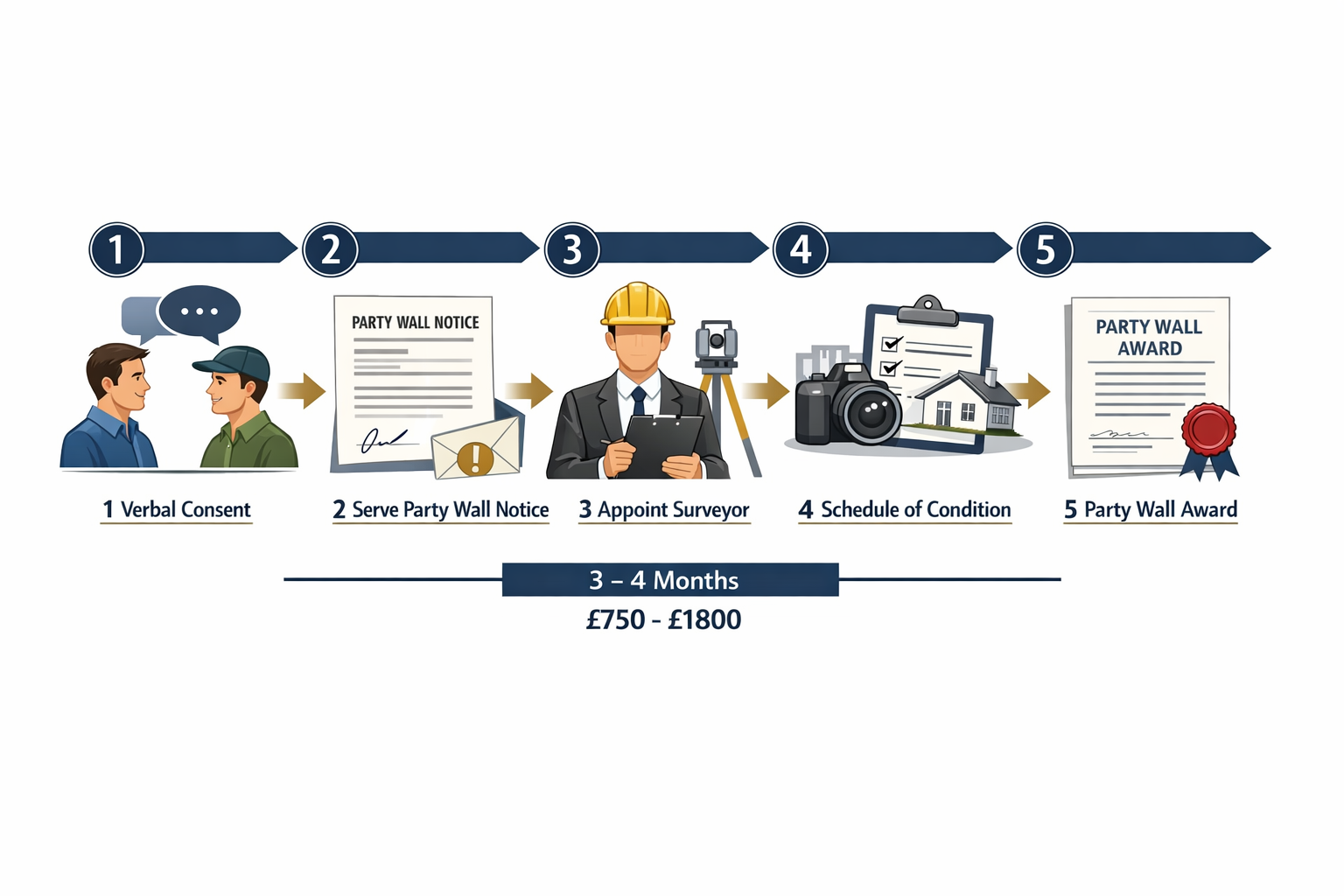
Step 2: Serve Formal Party Wall Notice
The transformation begins with proper notice, even if verbal consent exists:
Notice Requirements:
- Line of Junction Notice: For new walls on boundary lines (1 month advance notice)
- Party Structure Notice: For works to existing party walls (2 months advance notice)
- Notice of Adjacent Excavation: For excavations near foundations (1 month advance notice)
What to Include:
- Building owner's name and address
- Detailed description of proposed works
- Anticipated start date
- Technical drawings (where applicable)
- Request for written consent or dissent
Even with prior verbal agreement, formal notice creates the legal framework for protection. Learn more about how to serve party wall notices properly.
Step 3: Appoint Qualified Party Wall Surveyors
When a neighbour dissents (or you both want formal protection), surveyor appointment is mandatory:
Three Surveyor Options:
- Agreed Surveyor: One surveyor acts for both parties (most cost-effective)
- Two Surveyors: Each party appoints their own surveyor (most common)
- Third Surveyor: Appointed to resolve disputes between the two surveyors
2026 Surveyor Fees (London):[2]
- Building owner's surveyor: £750-£1,800 per neighbour
- Adjoining owner's surveyor: £750-£1,800 per neighbour
- Total typical cost: £1,500-£3,600 per affected neighbour
The building owner typically pays all reasonable surveyor fees, including the adjoining owner's surveyor. For strategies to manage expenses, see our guide on how to keep party wall costs down.
Step 4: Conduct Professional Property Inspections
Surveyors will:
For Building Owner's Property:
- Review construction plans and specifications
- Assess structural implications
- Identify necessary protective measures
- Determine access requirements
For Adjoining Owner's Property:
- Create comprehensive Schedule of Condition
- Photograph all potentially affected areas
- Document existing defects, cracks, or damage
- Establish baseline for future damage assessment
This documentation is critical evidence if disputes arise later about whether damage was caused by the works.
Step 5: Negotiate and Draft the Party Wall Award
Surveyors prepare the award through:
- Technical assessment of proposed works
- Risk evaluation of potential impacts
- Protective measure specification to minimize damage
- Negotiation of terms acceptable to both parties
- Drafting comprehensive award document
- Service of award on both parties
Timeline for Award Preparation:[2]
- Standard cases: 3-4 months from surveyor appointment to commencing work
- Complex cases: 5-9 months (access disputes, multiple neighbours, complex works)
Step 6: Execute the Award and Begin Protected Works
Once the award is served:
✅ Building owner gains:
- Legal right to proceed with specified works
- Protection from unfounded damage claims
- Clear access rights to neighbouring property
- Defined process for addressing legitimate concerns
✅ Adjoining owner gains:
- Documented baseline condition of their property
- Enforceable protective measures
- Clear compensation framework for any damage
- Professional monitoring of works
✅ Both parties gain:
- Dispute resolution mechanism avoiding court
- Clear cost allocation
- Preservation of evidence
- Legal certainty
Works can now proceed with full legal protection for everyone involved.
Step 7: Monitor Compliance and Address Issues
During construction:
- Surveyors conduct periodic inspections
- Protective measures are verified
- Any damage is documented immediately
- Disputes are resolved through award procedures
- Schedule of Condition is updated if needed
This ongoing oversight ensures the award's protections remain effective throughout the project.
Special Situations: Retrospective Formalization and Complex Cases
Can You Formalize Agreements After Works Begin?
Yes. Retrospective party wall agreements are possible when[3]:
- Works started with verbal consent but issues emerged
- Damage occurred and parties want clear resolution framework
- New owners discover previous works were informal
- Insurance requires formal documentation
Retrospective Process:
- Conduct current condition survey
- Document completed works
- Assess any damage or concerns
- Create award addressing past and future obligations
- Establish compensation framework
While not ideal, retrospective formalization provides better protection than remaining informal when problems arise.
Complex Multi-Party Situations
When works affect multiple neighbours:
- Separate awards may be needed for each adjoining owner
- Costs multiply (£1,500-£3,600 per neighbour)
- Timeline extends due to coordination requirements
- Different concerns require tailored protective measures
For projects in areas with multiple attached properties, such as central London terraces, early professional involvement is essential.
When Neighbours Refuse to Engage
If an adjoining owner won't participate:
- Deemed dissent occurs after 14 days of no response
- Building owner appoints surveyor for both parties
- Adjoining owner has 10 days to object to appointed surveyor
- If no objection, appointed surveyor proceeds
- Award is still legally binding on non-participating neighbour
The Party Wall etc. Act 1996 ensures works can proceed legally even without active neighbour cooperation.
Cost-Benefit Analysis: Informal Agreements vs. Formal Awards
Upfront Costs Comparison (2026)
| Approach | Immediate Cost | Risk Exposure |
|---|---|---|
| Informal verbal agreement | £0 | Unlimited |
| Handwritten note | £0 | Unlimited |
| DIY party wall notice | £0-£50 | High |
| Formal Party Wall Award | £1,500-£3,600 | Minimal |
True Cost Including Risk (Typical Extension Project)
Informal Agreement Scenario:
- Upfront cost: £0
- Crack appears during works
- Neighbour claims £15,000 damage
- Legal dispute costs £25,000
- Work stoppage delays: £10,000
- Total cost: £50,000+
Formal Award Scenario:
- Upfront cost: £2,500
- Same crack appears
- Schedule of Condition proves pre-existing
- No dispute, no delay
- Total cost: £2,500
The mathematics are clear: formal protection is dramatically cheaper when anything goes wrong.
Return on Investment
For every £1 spent on proper Party Wall Awards:
- 💰 £10-20 saved in avoided legal disputes
- ⏱️ Months of delays prevented
- 🏠 Property value protected
- 🤝 Neighbour relationships preserved
- 😌 Peace of mind gained
Practical Tips for a Smooth Transformation Process
For Building Owners
Before Starting:
- ✅ Identify all potentially affected neighbours early
- ✅ Serve proper notices even if verbal consent exists
- ✅ Budget for surveyor fees in project costs
- ✅ Allow 3-4 months for award process before construction start
- ✅ Choose experienced surveyors with local knowledge
During the Process:
- Communicate openly with neighbours about timeline
- Provide detailed plans to surveyors promptly
- Accept reasonable protective measures
- Don't pressure neighbours to use agreed surveyor if they prefer their own
- View the award as insurance, not an obstacle
For Adjoining Owners
Protecting Your Interests:
- ✅ Respond to notices within 14 days to preserve rights
- ✅ Consider appointing your own surveyor (building owner pays)
- ✅ Insist on comprehensive Schedule of Condition
- ✅ Request specific protective measures for concerns
- ✅ Don't feel pressured to consent informally
During Works:
- Monitor compliance with award terms
- Document any concerns immediately
- Contact your surveyor with issues, not the builder
- Keep copies of all correspondence
- Take your own photos if new damage appears
Choosing the Right Surveyor
Essential Qualities:
- 🎓 RICS qualified (Royal Institution of Chartered Surveyors)
- 📋 Specialist party wall experience (not just general surveying)
- 🏙️ Local knowledge of your area's building types
- 💬 Clear communication style
- ⭐ Positive client reviews
Whether you need a surveyor in North London, South London, East London, or West London, local expertise makes a significant difference in award quality.
Common Myths About Formalizing Neighbour Agreements
Myth 1: "Formal processes damage neighbour relationships"
Reality: Informal arrangements that fail cause far more relationship damage than professional processes. Awards create clarity and fairness that preserve relationships when challenges arise.
Myth 2: "Awards are only needed for major works"
Reality: Even minor works can cause unexpected damage. The Party Wall etc. Act 1996 applies to specific work types regardless of scale.
Myth 3: "Verbal consent is legally binding"
Reality: Verbal agreements are extremely difficult to enforce and provide no framework for damage assessment or dispute resolution.
Myth 4: "Awards take too long and delay projects"
Reality: The 3-4 month timeline runs before construction starts[2]. Projects without awards often face longer delays when disputes arise mid-construction.
Myth 5: "I can't afford surveyor fees"
Reality: You can't afford not to have proper protection. Surveyor fees are a tiny fraction of potential dispute costs. See party wall costs and process details for budget planning.
Legal Framework: Understanding Your Rights and Obligations
The Party Wall etc. Act 1996
This legislation governs party wall matters in England and Wales, providing:
- Statutory notice requirements for specific work types
- Surveyor appointment procedures when disputes arise
- Award creation framework for formal agreements
- Enforcement mechanisms for breaches
- Dispute resolution processes
Understanding what the Act covers helps both building and adjoining owners know their rights.
Key Legal Principles
Building Owner Obligations:
- Serve proper notice before commencing works
- Pay reasonable surveyor fees (both sides)
- Compensate for damage caused by works
- Provide access as specified in award
- Complete works in accordance with award terms
Adjoining Owner Rights:
- Receive proper notice of proposed works
- Appoint own surveyor at building owner's expense
- Have property condition professionally documented
- Receive compensation for legitimate damage
- Enforce award terms through legal process
Both Parties:
- Must act reasonably and in good faith
- Cannot unreasonably delay the process
- Must comply with surveyor requests for access
- Are bound by award terms once served
When to Seek Professional Legal Advice
While party wall surveyors handle most matters, legal advice becomes necessary when:
- 🚨 Criminal damage allegations arise
- 🚨 Trespass disputes occur
- 🚨 Award breaches require court enforcement
- 🚨 Complex ownership structures exist (leasehold, trusts, companies)
- 🚨 Multiple legal issues overlap (planning, building regulations, easements)
Solicitors specializing in property disputes can work alongside surveyors to provide comprehensive protection.
Conclusion: Protecting Your Investment and Your Relationships
The journey from verbal consent to legal protection through a robust Party Wall Award represents a fundamental shift from hope to certainty. While informal neighbour agreements feel friendly and cost-free, they provide zero protection when construction realities clash with expectations.
In 2026, the modest investment of £1,500-£3,600 and 3-4 months for proper formalization[2] delivers:
✅ Legal enforceability of rights and obligations
✅ Professional documentation of property conditions
✅ Clear protective measures minimizing damage risk
✅ Structured dispute resolution avoiding costly litigation
✅ Peace of mind for all parties
Whether you're a building owner planning works or an adjoining owner receiving notice, transforming informal arrangements into formal Party Wall Awards protects your property, your investment, and your neighbour relationships.
Your Next Steps
If you're planning building works:
- Identify all neighbours potentially affected by your project
- Serve proper Party Wall Notices 1-2 months before desired start date
- Appoint a qualified party wall surveyor if dissent occurs
- Budget £1,500-£3,600 per affected neighbour for the process
- Allow 3-4 months for award completion before construction begins
If you've received a Party Wall Notice:
- Review the proposed works carefully
- Respond within 14 days to preserve your rights
- Consider appointing your own surveyor (at building owner's expense)
- Request comprehensive Schedule of Condition
- Engage constructively with the process
If you currently have only verbal consent:
- Recognize the risks of remaining informal
- Discuss formalization with your neighbour
- Serve proper notice to begin the legal process
- Appoint surveyors to create a protective award
- Don't wait until problems arise to seek protection
The difference between informal hope and legal protection is a professional Party Wall Award. In construction, as in life, prevention is always cheaper than cure.
For expert guidance on your specific situation, contact experienced party wall surveyors who can transform your informal arrangements into robust legal protection that serves everyone's interests.
References
[1] Party Wall Agreement Award What It Covers And How To Get One Fast – https://iconsurveyors.co.uk/blog/party-wall-agreement-award-what-it-covers-and-how-to-get-one-fast/
[2] Party Wall Agreement London 2026 – https://www.mayfairstudio.co.uk/blog/party-wall-agreement-london-2026
[3] Party Wall Agreement – https://hoa.org.uk/advice/guides-for-homeowners/i-am-improving/party-wall-agreement/