


{"cover":"Professional landscape format (1536x1024) hero image featuring bold text overlay 'Party Wall Awards vs Licences: Choosing the Right Route for Boundary Works' in extra large 72pt white sans-serif font with dark shadow effect, positioned in upper third center. Background shows split-screen composition: left side displays formal legal documents with surveyor's seal and architectural plans on wooden desk, right side shows two neighbors shaking hands over garden fence with construction scaffolding visible. Color scheme: deep navy blue, white, gold accents. High contrast, magazine cover quality, editorial professional style with subtle gradient overlay for text readability.","content":["Detailed landscape format (1536x1024) editorial image showing close-up of three distinct legal documents laid out on architect's desk: Party Wall Award with official seal and multiple pages, simple one-page Licence to Alter agreement, and Access Agreement with property boundary diagram. Each document clearly labeled with colored tabs (blue, green, orange). Magnifying glass highlighting key clauses. Professional lighting, overhead perspective, clean business aesthetic with architectural drawings partially visible in background. Photorealistic style emphasizing document differences and formal legal nature.","Landscape format (1536x1024) conceptual illustration depicting decision-making flowchart for boundary works. Central image shows terraced houses with shared party wall, branching arrows leading to three pathways: left shows formal surveyor with hard hat inspecting wall (Party Wall Award route), center shows neighbors signing simple agreement at kitchen table (Licence route), right shows contractor accessing neighbor's garden with temporary fencing (Access Agreement). Each pathway labeled with key criteria text overlays. Clean infographic style, isometric perspective, professional color coding (blue, green, purple), modern architectural visualization.","Detailed landscape format (1536x1024) photograph showing professional party wall surveyor in high-visibility vest documenting pre-construction conditions. Surveyor holds tablet displaying Schedule of Condition checklist while photographing brick party wall with visible cracks marked with measurement arrows. Neighbor observing from doorway. Construction site setting with extension foundation excavation visible, safety barriers, and measuring equipment. Natural daylight, documentary photography style, emphasis on professional documentation process, insurance protection concept, realistic construction environment with depth of field focusing on surveyor's documentation activity."]}
Planning construction work near your property boundary can feel like navigating a legal minefield. 🏗️ One wrong step—choosing an informal handshake agreement when you need a formal Party Wall Award, or commissioning an expensive surveyor's report for minor alterations—can cost thousands of pounds and months of delays. In 2026, property owners face critical decisions about Party Wall Awards vs Licences and Access Agreements: Choosing the Right Route for Your Boundary Works, with each option carrying distinct legal protections, cost implications, and risk profiles.
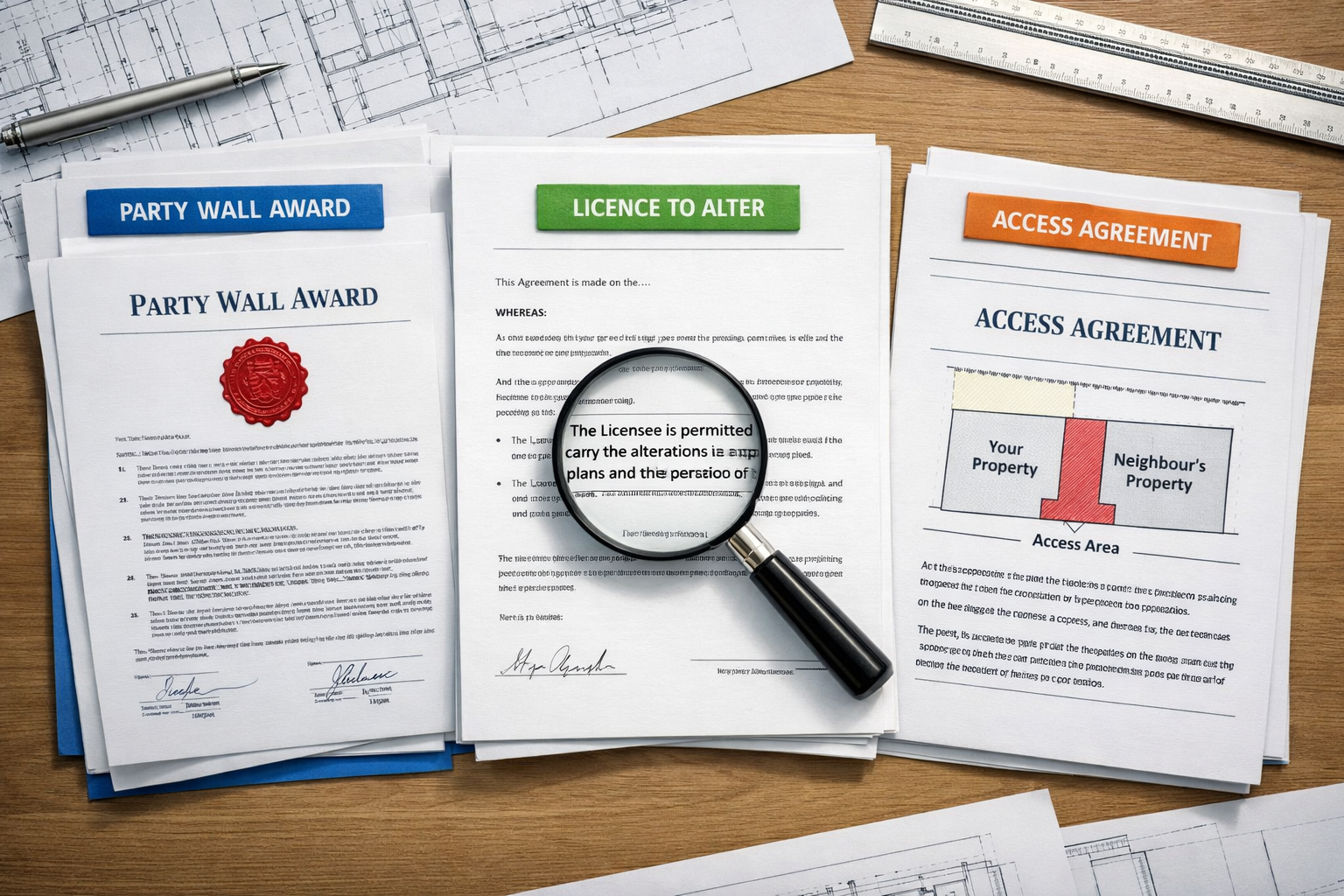
Understanding when to use a formal Party Wall Award, a simple Licence to Alter, or an Access Agreement can mean the difference between smooth construction progress and expensive disputes. This comprehensive guide examines the fundamental differences between these three approaches, helping property owners make informed decisions that protect their interests while maintaining good neighbor relations.
Key Takeaways
- Party Wall Awards are legally binding documents required under the Party Wall etc. Act 1996 for specific works affecting shared walls in England and Wales, prepared by qualified surveyors and costing from £1,000 upwards[2][3]
- Licences to Alter are simpler contractual agreements suitable for minor alterations that don't trigger statutory party wall procedures, offering faster approval but limited legal protection
- Access Agreements grant temporary rights to enter neighboring property for construction purposes, with recent 2026 legal reforms in some jurisdictions relaxing access requirements[1]
- The wrong choice can expose property owners to liability for damage, construction delays, and uninsured risks that could have been prevented through proper documentation
- Professional surveyor guidance is essential for complex boundary works, as they structure protective clauses covering access rights, damage protocols, and insurance requirements
Understanding the Three Routes for Boundary Works
What is a Party Wall Award?
A Party Wall Award represents the most formal and legally robust option for boundary construction works. It is a legally binding document prepared by qualified Party Wall Surveyors that resolves disputes and establishes clear terms when neighbors cannot agree on proposed construction affecting shared structures[2][3].
The Party Wall etc. Act 1996, which applies exclusively to England and Wales, mandates this process for specific types of party wall works including:
- Building on or astride the boundary line
- Excavating within three or six meters of a neighboring structure (depending on depth)
- Cutting into or removing parts of a party wall
- Inserting damp proof courses
- Raising party walls for loft conversions
Key characteristics of Party Wall Awards:
✅ Statutory protection under the Party Wall etc. Act 1996
✅ Mandatory Schedule of Condition with photographic evidence documenting pre-work property state[2][3]
✅ Professional surveyor preparation ensuring compliance and dispute resolution
✅ Defined timelines including 14-day response periods and two-month notice requirements[3][4]
✅ Cost allocation mechanisms typically placing surveyor fees on the building owner
The process requires serving formal Party Wall Notices on affected neighbors. If neighbors dissent or fail to respond within 14 days, surveyors must be appointed to prepare the Award[3][4]. This formality provides comprehensive protection but comes with costs typically ranging from £1,000 upwards, with surveyor hourly rates between £150-£200[2][3].
What is a Licence to Alter?
A Licence to Alter is a contractual agreement between property owners permitting specific alterations that affect shared structures or boundaries but fall outside statutory party wall requirements. This route suits minor works where the Party Wall Act doesn't apply or where neighbors prefer a simpler arrangement.
Common scenarios for Licences to Alter include:
- Internal modifications to leasehold properties requiring freeholder consent
- Minor external changes to shared structures below statutory thresholds
- Cosmetic alterations to boundary features
- Works where drilling internally for fixtures like kitchen units or shelving doesn't compromise structural integrity[2]
Advantages of Licences to Alter:
📋 Simplified documentation without statutory formalities
💰 Lower costs compared to full Party Wall Awards
⏱️ Faster approval without mandatory waiting periods
🤝 Flexible terms negotiated directly between parties
Limitations and risks:
⚠️ No statutory backing if disputes arise
⚠️ Limited protection against unforeseen damage claims
⚠️ Potential inadequacy if works prove more extensive than anticipated
⚠️ Enforcement challenges without surveyor oversight
Property owners considering this route should carefully assess whether their planned works truly fall outside Party Wall Act requirements. Misclassifying works that legally require a Party Wall Award can invalidate insurance coverage and create liability exposure.
What is an Access Agreement?
An Access Agreement grants temporary rights for a property owner (or their contractors) to enter neighboring land to complete construction work that cannot reasonably be accomplished from their own property. Unlike Party Wall Awards, these agreements focus specifically on access rights rather than structural alterations to shared walls.
Recent legal developments have significantly impacted access agreements. In January 2026, New York State amended RPAPL § 881, relaxing access standards. Property owners no longer need to prove access is "necessary"—they now only need to demonstrate work cannot be completed in a "commercially reasonable" way without accessing a neighbor's property[1]. This reform expanded the scope of permissible work and limited fee requirements, restricting attorney and surveyor fees to cases involving bad faith or willful misconduct[1].
Typical Access Agreement provisions include:
🔑 Defined access periods specifying dates and times
🛡️ Damage protection clauses establishing liability and repair obligations
📸 Pre-access condition surveys documenting existing property state
💼 Insurance requirements mandating adequate coverage
🚧 Restoration obligations requiring return to original condition
💷 Compensation terms for inconvenience or temporary loss of use
Access Agreements prove particularly valuable for:
- Scaffolding erection extending over neighboring property
- Maintenance or repair of boundary walls accessible only from adjacent land
- Foundation excavation requiring temporary access for machinery
- External rendering or painting of party walls
While less complex than Party Wall Awards, properly structured Access Agreements require careful drafting to protect both parties' interests. Professional surveyors often recommend combining Access Agreements with Party Wall Awards when works involve both structural alterations and access requirements.
Party Wall Awards vs Licences and Access Agreements: Key Differences Explained
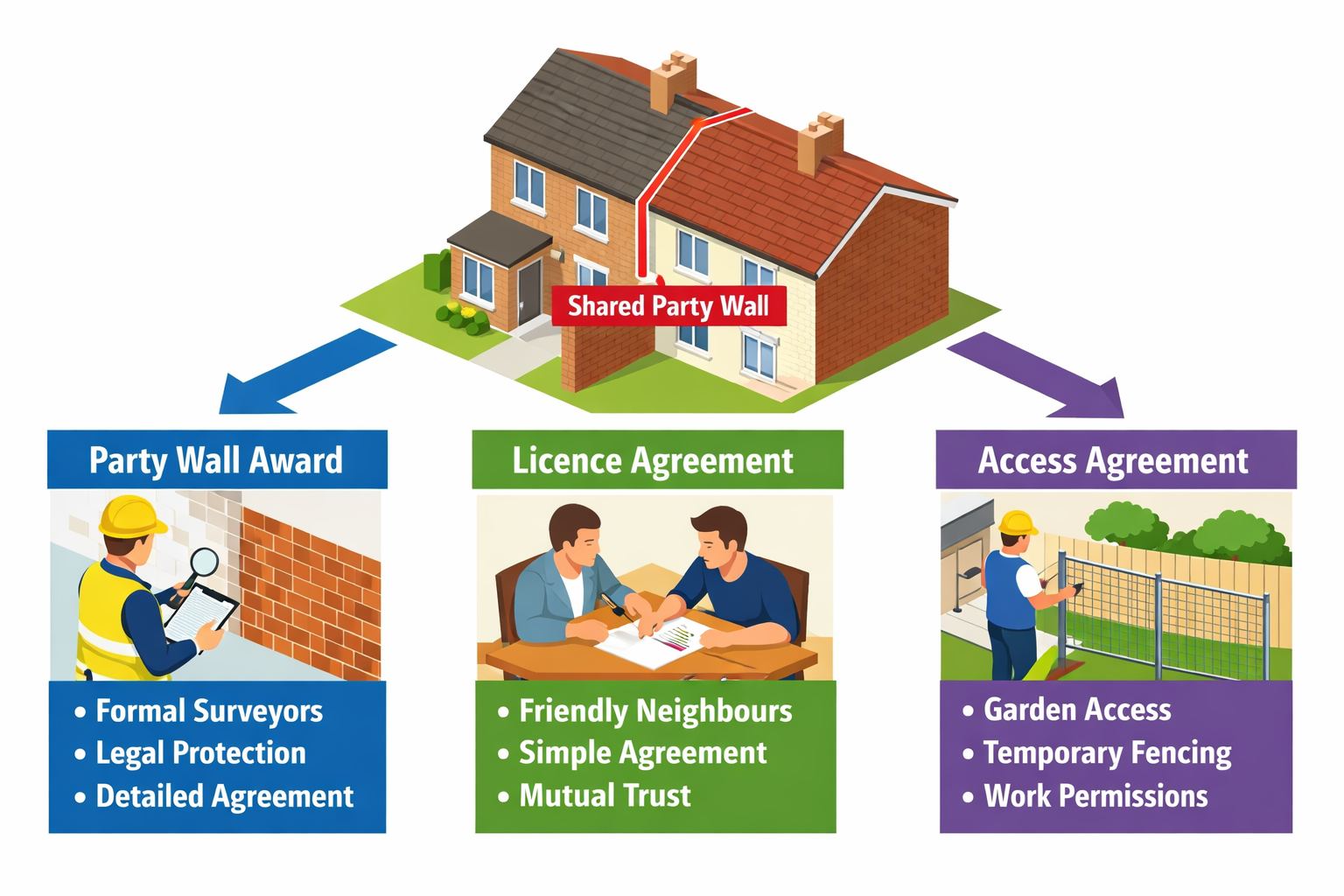
Legal Framework and Enforceability
The most fundamental distinction between these three routes lies in their legal foundation and enforceability mechanisms.
Party Wall Awards derive their authority from the Party Wall etc. Act 1996, a statutory framework that provides:
- Automatic legal standing regardless of neighbor cooperation
- Surveyor appointment rights if neighbors dissent or fail to respond
- Appeal mechanisms through county courts within 14 days of Award service[3]
- Statutory cost recovery for reasonable surveyor and legal fees
- Prescribed notice periods that cannot be waived without consent
This statutory backing means Party Wall Awards carry the force of law. Non-compliance can result in injunctions halting construction and potential damages claims.
Licences to Alter and Access Agreements, conversely, function as private contracts governed by general contract law principles. Their enforceability depends entirely on:
- Clear drafting of terms and conditions
- Voluntary agreement by all parties
- Standard contractual remedies (damages, specific performance)
- No statutory fallback if negotiations fail
This contractual nature offers flexibility but provides weaker protection if disputes arise. Without statutory backing, enforcement requires pursuing breach of contract claims through civil courts—a potentially expensive and time-consuming process.
Scope of Works Covered
Each route suits different types of boundary works based on their nature, scale, and statutory triggers.
| Work Type | Party Wall Award | Licence to Alter | Access Agreement |
|---|---|---|---|
| Loft conversion raising party wall | ✅ Required | ❌ Insufficient | May supplement |
| Excavation within 3m of neighbor's foundation | ✅ Required | ❌ Insufficient | May supplement |
| Inserting damp proof course in party wall | ✅ Required | ❌ Insufficient | May supplement |
| Internal drilling for shelving | ❌ Not required | ✅ Suitable | ❌ Not needed |
| Minor cosmetic changes to boundary fence | ❌ Not required | ✅ Suitable | ❌ Not needed |
| Scaffolding over neighbor's garden | ❌ Not required | ❌ Insufficient | ✅ Required |
| External wall maintenance from neighbor's land | ❌ Not required | ❌ Insufficient | ✅ Required |
Understanding boundary wall rules and the difference between party fence walls and boundary walls proves essential for correctly categorizing planned works.
Cost Implications and Fee Structures
Financial considerations often influence route selection, though cost should never compromise legal compliance.
Party Wall Award costs typically include:
- Building Owner's Surveyor fees: £1,000-£3,000+ depending on complexity[2][3]
- Adjoining Owner's Surveyor fees: £800-£2,500 (usually paid by Building Owner)
- Agreed Surveyor option: £1,000-£2,000 total when neighbors share one surveyor[2][3]
- Schedule of Condition preparation: Included in surveyor fees
- Award drafting and service: Included in surveyor fees
Those seeking to minimize expenses should review guidance on how to keep party wall costs down while maintaining proper compliance.
Licence to Alter costs generally involve:
- Legal drafting fees: £300-£800 for solicitor preparation
- Negotiation time: Minimal if neighbors cooperate
- No surveyor requirement: Unless parties voluntarily engage one
- Potential goodwill payments: Negotiated compensation for inconvenience
Access Agreement costs may include:
- Legal drafting: £400-£1,000 for comprehensive agreements
- Condition survey fees: £300-£600 for photographic documentation
- Compensation payments: Negotiated amounts for access rights
- Insurance premium increases: Additional coverage for third-party property
Under recent 2026 reforms in some jurisdictions, fee limitations now restrict when neighbors can demand payment of their professional fees, potentially reducing Access Agreement costs[1].
Timeline and Process Requirements
Construction schedules depend heavily on which route applies and its associated procedural requirements.
Party Wall Award timeline:
- Notice service: Minimum 2 months before work commences (for party structure notices)[3][4]
- Neighbor response period: 14 days to consent or dissent[3][4]
- Surveyor appointment: Immediate if dissent occurs
- Award preparation: 2-6 weeks depending on complexity
- Appeal window: 14 days after Award service[3]
- Total minimum duration: 3-4 months from initial notice to work commencement
This timeline cannot be shortened without neighbor consent, making early planning essential. Property owners should review what is a Party Structure Notice and how to serve it to ensure compliance.
Licence to Alter timeline:
- Negotiation: Variable (days to weeks)
- Drafting: 1-2 weeks
- Execution: Immediate upon signing
- Total duration: 2-4 weeks typically
Access Agreement timeline:
- Negotiation: 1-4 weeks
- Condition survey: 1-2 weeks
- Legal drafting: 1-2 weeks
- Execution: Upon signing
- Total duration: 3-6 weeks typically
Choosing the Right Route: Decision Framework for Property Owners
When Party Wall Awards Are Mandatory
The Party Wall etc. Act 1996 removes choice for certain works, making Party Wall Awards legally mandatory regardless of neighbor cooperation or preference.
Statutory triggers requiring Party Wall Awards:
🏗️ Building on the boundary line – Any new wall constructed directly on or astride the property boundary
🏗️ Excavation near foundations – Digging within 3 meters (if deeper than neighbor's foundations) or 6 meters (if excavation cuts 45-degree plane from foundation base)
🏗️ Cutting into party walls – Removing chimney breasts, creating openings, or cutting into shared structures
🏗️ Raising party walls – Increasing height for loft conversions or extensions
🏗️ Underpinning party structures – Foundation reinforcement affecting shared walls
🏗️ Inserting damp proof courses – Remedial works penetrating party walls
Attempting to substitute a Licence to Alter or informal agreement when the Party Wall Act applies creates significant risks:
⚠️ Insurance invalidation – Insurers may refuse damage claims for non-compliant works
⚠️ Injunction risk – Neighbors can obtain court orders halting construction
⚠️ Damage liability – Full responsibility for any harm without Award protections
⚠️ Retrospective Award costs – Higher expenses resolving disputes after works begin
Property owners uncertain about statutory requirements should consult resources on types of party wall works or engage qualified surveyors for preliminary assessments.
When Licences to Alter Provide Sufficient Protection
Licences to Alter offer appropriate solutions for works falling outside Party Wall Act scope while still requiring neighbor consent or documentation.
Suitable scenarios for Licences to Alter:
✅ Leasehold alterations requiring freeholder permission
✅ Minor boundary modifications not affecting structural integrity
✅ Cosmetic changes to shared features
✅ Internal works below statutory thresholds
✅ Voluntary agreements where neighbors prefer simplified documentation
Risk assessment considerations:
Before selecting a Licence to Alter route, property owners should evaluate:
- Work complexity – Will alterations remain minor as planned, or could scope expand?
- Damage potential – What realistic risk exists for affecting neighboring property?
- Insurance coverage – Does existing policy cover intended works without Party Wall Award?
- Neighbor relationship – Is trust sufficient to rely on contractual rather than statutory protection?
- Future implications – Could works affect property value or future sale?
For those considering this route, reviewing a sample party wall agreement template can provide insight into essential protective clauses even for simpler arrangements.
When Access Agreements Are Essential
Access Agreements become necessary when construction physically cannot be completed from the property owner's land alone, regardless of whether Party Wall Act works are involved.
Common access requirements:
🚧 Scaffolding overhang – Temporary structures extending beyond property boundaries
🚧 Boundary wall maintenance – Repairs or painting accessible only from neighboring land
🚧 Foundation excavation – Machinery access for digging near boundaries
🚧 Drainage installation – Connecting to systems crossing neighboring property
🚧 External cladding or rendering – Finishing works requiring access from adjacent land
Recent 2026 legal reforms in some jurisdictions have made Access Agreements more accessible by:
- Reducing the burden of proof from "necessary" to "commercially reasonable"[1]
- Expanding categories of qualifying work[1]
- Limiting neighbor's ability to demand payment of their professional fees except in bad faith cases[1]
Combining Access Agreements with Party Wall Awards:
Many boundary projects require both mechanisms working in tandem:
- Party Wall Award addresses structural alterations to shared walls
- Access Agreement provides rights to enter neighboring property for construction
Professional surveyors typically coordinate both documents to ensure comprehensive protection and avoid conflicting terms.
How Surveyors Structure Protective Clauses
Access Rights and Restrictions
Whether preparing Party Wall Awards or Access Agreements, experienced surveyors include detailed clauses governing entry rights and limitations.
Standard access provisions include:
📅 Permitted hours – Typically 8:00 AM to 6:00 PM weekdays, with weekend restrictions
📅 Notice requirements – 48-72 hours advance notice for each access instance
📅 Duration limits – Maximum access period (e.g., 6 months) with renewal provisions
📅 Personnel restrictions – Named contractors only, with identification requirements
📅 Access routes – Specified pathways minimizing disruption
📅 Exclusion zones – Areas of neighboring property remaining off-limits
For Party Wall Awards specifically, surveyors balance the Building Owner's statutory rights with the Adjoining Owner's reasonable enjoyment of their property. The Party Wall etc. Act 1996 provides the framework, but surveyors add practical details ensuring workability.
Damage Protection and Liability Mechanisms
Comprehensive damage clauses form the cornerstone of effective Party Wall Awards and Access Agreements, allocating responsibility and establishing resolution procedures.
Key damage protection elements:
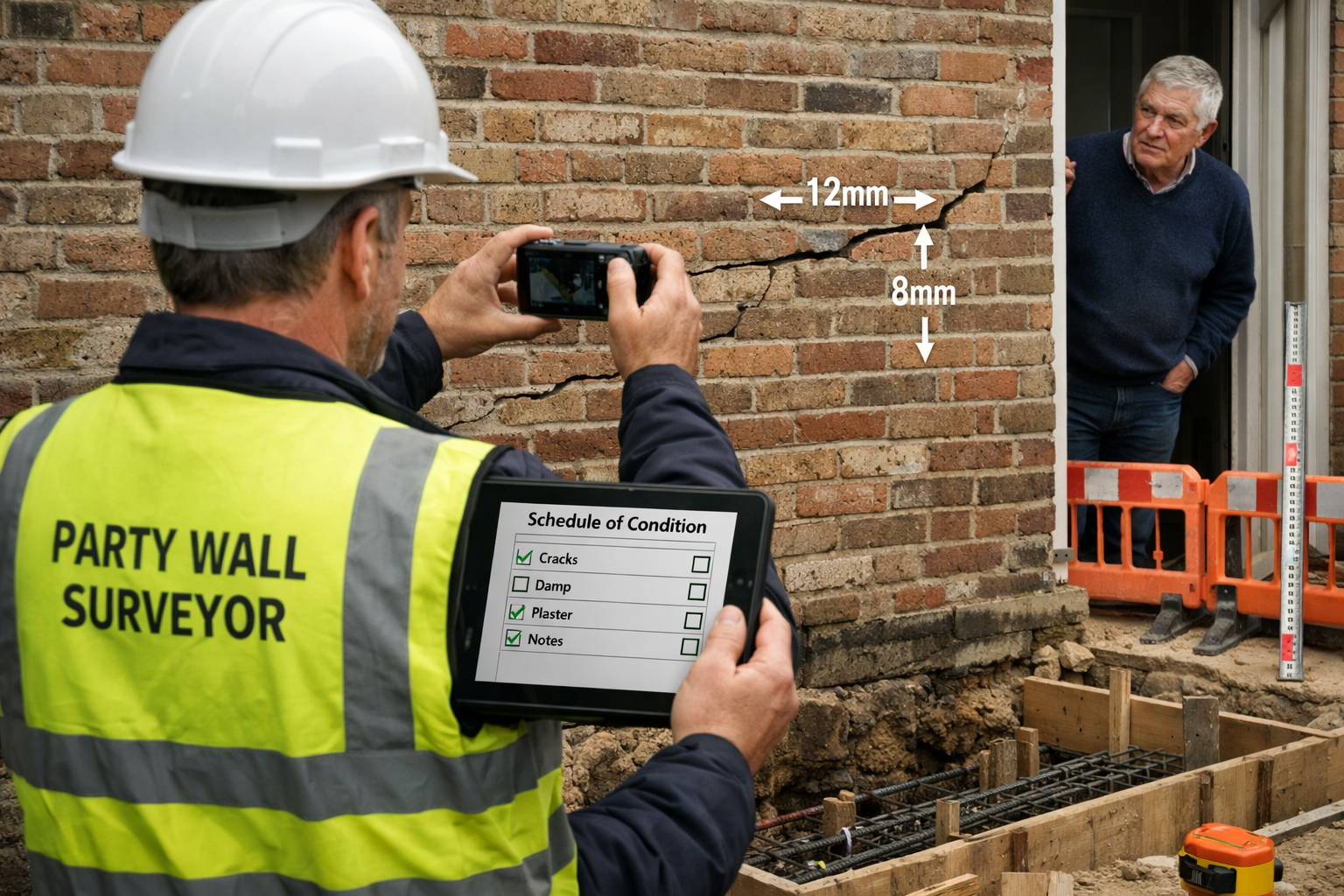
🛡️ Schedule of Condition – Mandatory photographic record documenting pre-work property state[2][3]
🛡️ Damage definition – Clear criteria distinguishing actionable harm from minor wear
🛡️ Notification protocols – Immediate reporting requirements upon damage discovery
🛡️ Repair obligations – Timeline and quality standards for remediation
🛡️ Dispute resolution – Surveyor determination procedures for contested claims
🛡️ Cost allocation – Building Owner liability for damage caused by works
The Schedule of Condition serves as critical evidence if disputes arise about whether damage existed before works commenced. Professional surveyors typically include:
- High-resolution photographs of all affected areas
- Written descriptions of existing defects
- Crack monitoring measurements
- Structural condition assessments
- Date-stamped documentation
This evidence protects both parties: Building Owners avoid liability for pre-existing damage, while Adjoining Owners secure proof of work-related harm.
Insurance Requirements and Indemnities
Robust insurance provisions transfer financial risk from individuals to professional insurers, protecting all parties from catastrophic loss.
Standard insurance clauses require:
💼 Public liability coverage – Minimum £5-10 million for construction works
💼 Policy evidence – Certificate of insurance provided before work commences
💼 Continuous coverage – Maintenance throughout construction period
💼 Named insured parties – Adjoining Owners listed as interested parties
💼 Notification requirements – Immediate reporting of claims or coverage changes
Indemnity provisions supplement insurance by establishing direct liability:
"The Building Owner shall indemnify and hold harmless the Adjoining Owner against all losses, damages, costs, and expenses arising from or in connection with the Works, whether or not covered by insurance policies."
This dual protection—insurance plus indemnity—ensures Adjoining Owners can recover damages even if insurance proves inadequate or claims are denied.
For complex projects, surveyors may require:
- Contractor's all-risk insurance covering materials and works in progress
- Professional indemnity insurance for design professionals
- Structural warranty coverage for long-term defect protection
Understanding costs of party wall processes helps property owners budget for comprehensive insurance requirements.
Common Pitfalls and How to Avoid Them
Choosing Informal Agreements for Statutory Works
The most costly mistake property owners make involves attempting informal arrangements when the Party Wall Act mandates formal procedures.
Real-world consequences:
❌ Construction halted mid-project – Neighbors obtaining injunctions after discovering non-compliance
❌ Insurance claims denied – Policies excluding coverage for works lacking proper Party Wall Awards
❌ Damage liability without limits – Personal exposure exceeding insurance coverage
❌ Retrospective Award costs – Higher surveyor fees resolving disputes after works begin
❌ Sale complications – Buyers' solicitors identifying non-compliant works during conveyancing
Prevention strategies:
✅ Engage qualified Party Wall Surveyors for preliminary assessments
✅ Review Party Wall Act notices and how to respond before proceeding
✅ Obtain written confirmation that planned works fall outside statutory requirements
✅ Document all professional advice received
✅ Verify insurance coverage explicitly covers intended approach
Some property owners attempt having a party wall agreement without a surveyor, which may work for truly minor alterations but creates risks for substantial works.
Inadequate Access Agreement Terms
Poorly drafted Access Agreements frequently fail to address foreseeable issues, creating disputes during construction when time pressures intensify tensions.
Common deficiencies:
⚠️ Vague access periods – "Reasonable times" without specific hours
⚠️ Undefined damage standards – No criteria for actionable harm
⚠️ Missing restoration obligations – Unclear requirements for returning property to original condition
⚠️ Inadequate insurance minimums – Coverage insufficient for realistic risk exposure
⚠️ No dispute resolution mechanism – Forcing court proceedings for minor disagreements
Best practice solutions:
✅ Specify exact permitted hours and maximum duration
✅ Commission pre-access condition surveys with photographic evidence
✅ Define "restoration" with objective standards and completion timelines
✅ Require insurance certificates naming all parties
✅ Include surveyor determination clauses for expedited dispute resolution
Professional surveyors bring experience from hundreds of projects, anticipating issues that property owners and general solicitors might overlook.
Neglecting Schedule of Condition Documentation
The Schedule of Condition represents the single most important piece of evidence in damage disputes, yet property owners frequently underestimate its importance.
Documentation failures:
📸 Insufficient photographs – Missing angles or inadequate lighting
📸 Delayed surveys – Conducted after works commence, compromising evidence
📸 Incomplete coverage – Omitting areas later claimed as damaged
📸 Poor quality images – Resolution insufficient for detailed analysis
📸 Missing written descriptions – Photographs without contextual notes
Professional standards:
✅ Comprehensive photographic coverage of all potentially affected areas
✅ High-resolution images with date/time stamps
✅ Written descriptions accompanying each photograph
✅ Crack width measurements using calibrated equipment
✅ Video walkthroughs supplementing still photographs
✅ Survey completion before any works commence
Surveyors preparing Party Wall Awards automatically include professional Schedule of Condition documentation, but property owners using Licences to Alter or Access Agreements must ensure equivalent protection through explicit contractual requirements.
Regional Considerations and Jurisdictional Differences
Geographic Scope of Party Wall Act 1996
Understanding jurisdictional limitations prevents applying inappropriate legal frameworks to boundary works.
Party Wall etc. Act 1996 applies only to:
🏴 England
🏴 Wales
Jurisdictions with different frameworks:
🏴 Scotland – Relies on common law and the Title Conditions (Scotland) Act 2003[2][3]
🇮🇪 Northern Ireland – Governed by common law principles without statutory party wall procedures[2][3]
Property owners in Scotland and Northern Ireland cannot utilize Party Wall Awards as defined under the 1996 Act. Instead, they must rely on:
- Contractual agreements between neighbors
- Common law rights and obligations
- Title deed provisions
- Court proceedings if disputes arise
This fundamental difference means Scottish and Northern Irish property owners depend more heavily on well-drafted Licences to Alter and Access Agreements, as no statutory fallback exists.
Local Authority Variations
Even within England and Wales, local planning authorities may impose additional requirements affecting boundary works.
Common local variations:
🏛️ Conservation areas – Enhanced protections requiring planning permission for works otherwise exempt
🏛️ Listed buildings – Separate consent regimes operating alongside Party Wall Act
🏛️ Tree preservation orders – Restrictions on root cutting during excavation
🏛️ Building control requirements – Structural calculations and inspections beyond Party Wall Awards
Property owners should verify local requirements with their planning authority before finalizing their approach to boundary works. Party Wall Awards address neighbor relations but don't replace planning permission or building regulations approval.
Those working in specific areas may benefit from consulting local specialists, such as party wall surveyors in South London, West London, East London, North London, or Central London who understand regional nuances.
Practical Steps for Property Owners
For Building Owners Planning Works
Property owners initiating boundary works should follow a systematic approach to ensure compliance and minimize disputes.
Step-by-step process:
- Preliminary assessment – Determine whether planned works trigger Party Wall Act requirements
- Professional consultation – Engage qualified Party Wall Surveyor for initial advice
- Neighbor communication – Discuss plans informally before formal notices
- Route selection – Choose Party Wall Award, Licence to Alter, or Access Agreement based on work type
- Documentation preparation – Commission professional drafting of required agreements
- Formal service – Deliver notices or agreements according to legal requirements
- Response management – Address neighbor concerns and questions promptly
- Schedule of Condition – Arrange pre-work documentation of neighboring property
- Insurance verification – Confirm adequate coverage in place
- Work commencement – Proceed only after all agreements finalized
Resources for building owners provide detailed guidance on navigating this process effectively.
For Adjoining Owners Receiving Notices
Neighbors receiving Party Wall Notices or requests for access face important decisions affecting their property rights and protection.
Response options:
✅ Consent – Agreeing to proposed works with or without conditions
✅ Dissent – Triggering surveyor appointment and Party Wall Award preparation
✅ Negotiate – Proposing modifications to works or additional protections
❌ Ignore – Deemed dissent after 14 days, with surveyor appointed on their behalf[3][4]
Protection strategies for Adjoining Owners:
🛡️ Appoint own surveyor – Ensures independent representation of interests
🛡️ Review Schedule of Condition – Verify accuracy and completeness before signing
🛡️ Confirm insurance coverage – Obtain certificate naming you as interested party
🛡️ Document all communications – Maintain written record of agreements and concerns
🛡️ Understand cost implications – Building Owner typically pays reasonable surveyor fees
Resources for adjoining owners explain rights and options in detail.
When to Seek Professional Surveyor Guidance
While simple works may proceed with basic agreements, certain situations demand professional surveyor involvement.
Red flags requiring professional guidance:
🚩 Structural alterations to party walls
🚩 Excavation within 3-6 meters of neighboring foundations
🚩 Disagreement with neighbors about proposed works
🚩 Complex projects involving multiple properties
🚩 High-value properties where damage risk is significant
🚩 Previous boundary disputes or strained neighbor relations
🚩 Uncertainty about whether Party Wall Act applies
Professional surveyors provide value through:
- Technical expertise – Understanding structural implications and risk assessment
- Legal knowledge – Ensuring compliance with Party Wall Act and related legislation
- Negotiation skills – Facilitating agreement between parties with competing interests
- Documentation standards – Preparing legally robust Awards and Schedules of Condition
- Dispute resolution – Providing determinations that avoid court proceedings
The modest investment in professional surveyor fees typically prevents far greater costs from disputes, delays, and damage claims.
Conclusion
Navigating Party Wall Awards vs Licences and Access Agreements: Choosing the Right Route for Your Boundary Works requires understanding the fundamental differences between statutory protections, contractual arrangements, and access rights. In 2026, property owners benefit from clearer legal frameworks—including recent reforms to access agreements in some jurisdictions—but face critical decisions that significantly impact project costs, timelines, and risk exposure.
Party Wall Awards provide comprehensive statutory protection for works affecting shared structures, with mandatory Schedules of Condition, professional surveyor oversight, and established dispute resolution mechanisms. While costs typically start from £1,000, this investment prevents far greater expenses from construction delays, damage claims, and legal disputes.
Licences to Alter offer streamlined solutions for minor works falling outside Party Wall Act scope, reducing costs and approval times when appropriate. However, their contractual nature provides weaker protection than statutory Awards, making careful risk assessment essential before choosing this route.
Access Agreements address the distinct issue of temporary entry rights, often working alongside Party Wall Awards for comprehensive project protection. Recent legal reforms have made access more accessible by relaxing proof requirements and limiting fee obligations.
The wrong choice exposes property owners to invalidated insurance, injunctions halting construction, unlimited damage liability, and relationship breakdowns with neighbors. Conversely, selecting the appropriate route—supported by professional surveyor guidance for complex works—ensures legal compliance, financial protection, and smooth project completion.
Next Steps
✅ Assess your planned works against Party Wall Act triggers using resources on types of party wall works
✅ Consult qualified Party Wall Surveyors for preliminary advice before committing to any approach
✅ Review sample documentation to understand protective clauses and requirements
✅ Communicate early with neighbors to build cooperation before formal processes begin
✅ Verify insurance coverage explicitly addresses your chosen route and planned works
✅ Document everything from initial discussions through work completion
Whether you're carrying out works or your neighbor is undertaking construction, understanding these three routes empowers informed decisions that protect your property, finances, and neighbor relations throughout the construction process.
References
[1] Access Granted New Law Enacts Major Changes To Rules Governing Rpapl %c2%a7 881 By Elizabeth Marchionni Esq And Adam Perlin Esq 1 15 2026 – https://www.kaufmandolowich.com/news-resources/access-granted-new-law-enacts-major-changes-to-rules-governing-rpapl-%C2%A7-881-by-elizabeth-marchionni-esq-and-adam-perlin-esq-1-15-2026/
[2] What Is A Party Wall Agreement And Party Wall Award – https://westvilleassociates.com/blog/what-is-a-party-wall-agreement-and-party-wall-award
[3] Party Wall Agreement – https://hoa.org.uk/advice/guides-for-homeowners/i-am-improving/party-wall-agreement/
[4] Knowledge Article Party Wall Agreement – https://www.aylingassociates.com/knowledge-article-party-wall-agreement.html