

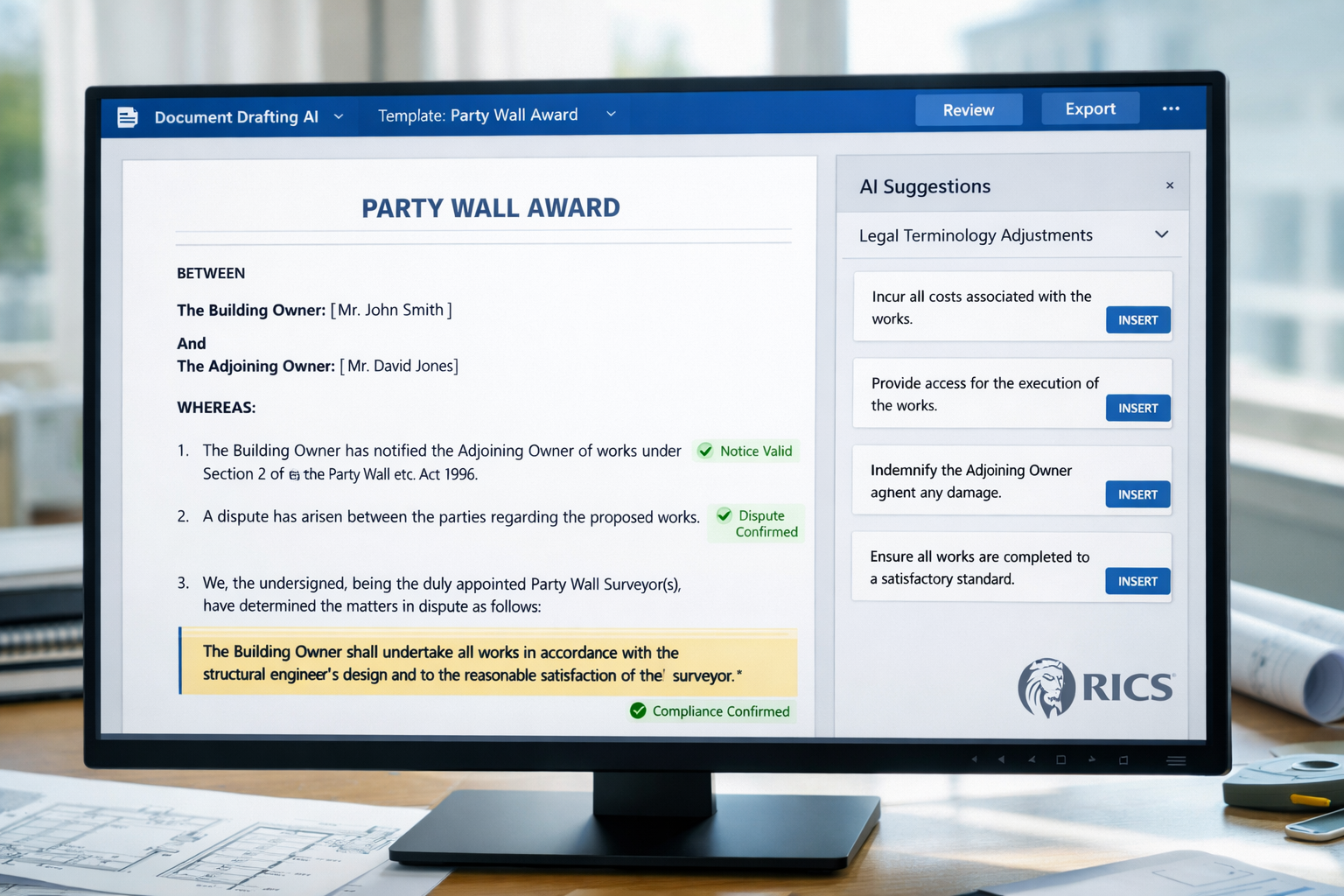
The landscape of party wall surveying is undergoing a seismic shift. As artificial intelligence transforms how chartered surveyors draft, review, and finalize party wall awards, professionals face both unprecedented opportunities and critical compliance challenges. In 2026, the integration of AI Tools for Drafting Party Wall Awards in 2026: RICS-Compliant Best Practices and Guardrails has become not just an option, but an essential consideration for modern surveying practice.
With the RICS Professional Standard "Responsible use of artificial intelligence in surveying practice" taking effect in March 2026, surveyors must now navigate a complex intersection of technological innovation, professional responsibility, and legal enforceability. This comprehensive guide explores how AI is transforming party wall surveying contracts, with templates, accuracy checks, and ethical considerations to ensure enforceable awards under the Party Wall Act.
Key Takeaways
- RICS standards mandate human oversight: AI must augment, not replace, professional surveyor judgment in party wall award preparation
- Compliance frameworks are now mandatory: The March 2026 RICS AI standard establishes clear guardrails for responsible AI use in surveying practice
- Template automation improves efficiency: AI tools can reduce drafting time by 40-60% while maintaining accuracy and consistency
- Risk management is paramount: Proper implementation requires robust verification protocols, liability considerations, and quality assurance mechanisms
- Professional development is essential: Surveyors must develop AI literacy as a core competency for future practice
Understanding AI's Role in Party Wall Award Drafting
The Evolution of Party Wall Documentation
Traditional party wall award drafting has long been a time-intensive process requiring meticulous attention to statutory requirements, property-specific details, and legal precision. Chartered surveyors typically spend 4-8 hours drafting comprehensive awards, reviewing schedules of condition, and ensuring compliance with the Party Wall etc. Act 1996.
AI tools are now transforming this workflow by:
- Automating template population with property-specific data
- Cross-referencing statutory requirements automatically
- Identifying inconsistencies and potential compliance gaps
- Generating standardized clauses based on work type
- Streamlining schedule of condition integration
What AI Can and Cannot Do
The RICS 2026 standard establishes a critical principle: AI should augment, not replace, surveyor judgment. This distinction is fundamental to understanding appropriate AI deployment in party wall work.
✅ AI Excels At:
- Pattern recognition across thousands of previous awards
- Identifying missing clauses or incomplete sections
- Standardizing terminology and formatting
- Cross-checking dates, addresses, and reference numbers
- Suggesting relevant case law and precedents
- Generating initial draft frameworks
❌ AI Cannot Replace:
- Professional assessment of party wall rights
- Negotiation and dispute resolution judgment
- Site-specific risk evaluation
- Interpretation of complex boundary issues
- Ethical decision-making in conflicts of interest
- Final professional sign-off and accountability
"Full automation of high-stakes professional opinion is unlikely to meet RICS standards without human oversight. The surveyor's professional judgment remains the cornerstone of compliant party wall practice." — RICS Professional Standard, 2026
AI Tools for Drafting Party Wall Awards in 2026: Implementation Best Practices
Selecting Appropriate AI Solutions
The market for AI-powered surveying tools has expanded rapidly, but not all solutions meet RICS compliance standards. When evaluating AI tools for party wall award drafting, surveyors should assess:
Core Functionality Requirements:
| Feature | Why It Matters | RICS Compliance Factor |
|---|---|---|
| Template Customization | Ensures awards reflect specific work types | High – maintains professional standards |
| Statutory Compliance Checking | Verifies Party Wall Act requirements | Critical – legal enforceability |
| Audit Trail Capability | Documents AI suggestions and human decisions | Essential – professional accountability |
| Data Privacy Controls | Protects client confidentiality | Mandatory – GDPR and client duty |
| Version Control | Tracks document evolution and amendments | Important – dispute resolution |
| Integration with Existing Systems | Connects with scheduling and invoicing tools | Moderate – operational efficiency |
Establishing Robust Verification Protocols
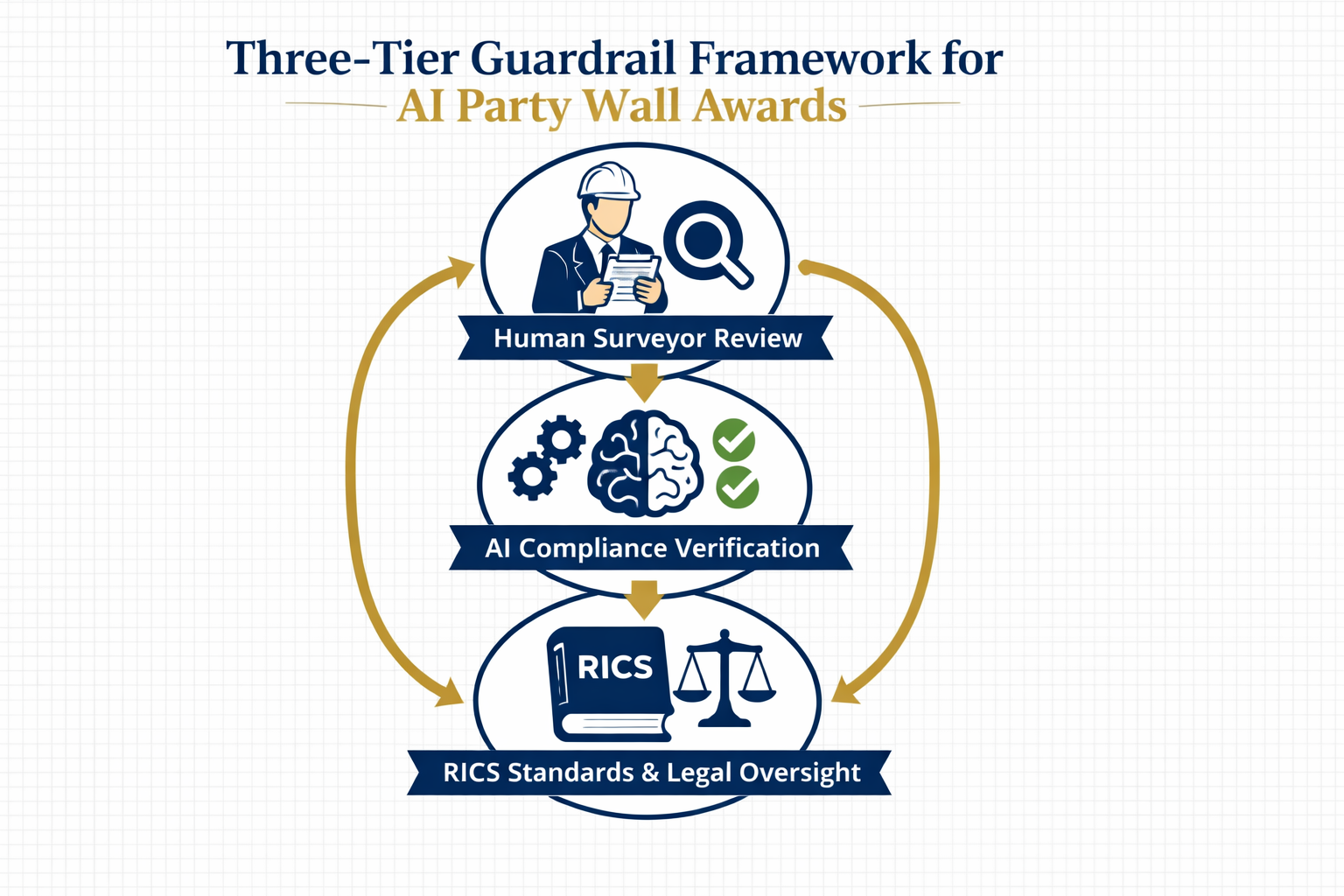
The cornerstone of AI Tools for Drafting Party Wall Awards in 2026: RICS-Compliant Best Practices and Guardrails lies in systematic verification. Every AI-generated element must undergo professional review before finalization.
Three-Stage Verification Framework:
-
Initial AI Output Review (15-20 minutes)
- Verify all property addresses and party details are correct
- Confirm work descriptions match party wall notices served
- Check statutory timeframes and dates
- Review automated clause selection for appropriateness
-
Technical Accuracy Assessment (20-30 minutes)
- Validate technical specifications against site surveys
- Cross-reference with schedule of condition documentation
- Ensure construction methodology descriptions are accurate
- Verify measurements and dimensional references
-
Professional Judgment Application (30-45 minutes)
- Assess reasonableness of conditions and restrictions
- Evaluate balance of rights between building and adjoining owners
- Consider site-specific risks and mitigation measures
- Apply professional experience to nuanced situations
Template Standardization and Customization
AI tools excel at maintaining consistency across awards while allowing necessary customization. Effective implementation requires developing a template hierarchy:
Level 1: Core Statutory Elements (Fully Standardized)
- Preamble and statutory authority references
- Standard definitions and interpretation clauses
- Basic rights and obligations under the Act
- Award service and dispute resolution provisions
Level 2: Work-Type Specific Clauses (AI-Suggested, Surveyor-Approved)
- Excavation depth and underpinning requirements
- Wall raising or thickening specifications
- Beam insertion or structural alteration conditions
- Working hours and access arrangements
Level 3: Property-Specific Provisions (Surveyor-Drafted)
- Unique site constraints or sensitivities
- Bespoke protection measures for heritage features
- Special access or logistics arrangements
- Non-standard insurance or security requirements
This approach allows AI to handle routine standardization while preserving professional judgment for complex or unusual circumstances—a balance essential for RICS-compliant party wall practice.
Critical Guardrails for RICS-Compliant AI Use
The March 2026 RICS AI Standard: Key Requirements
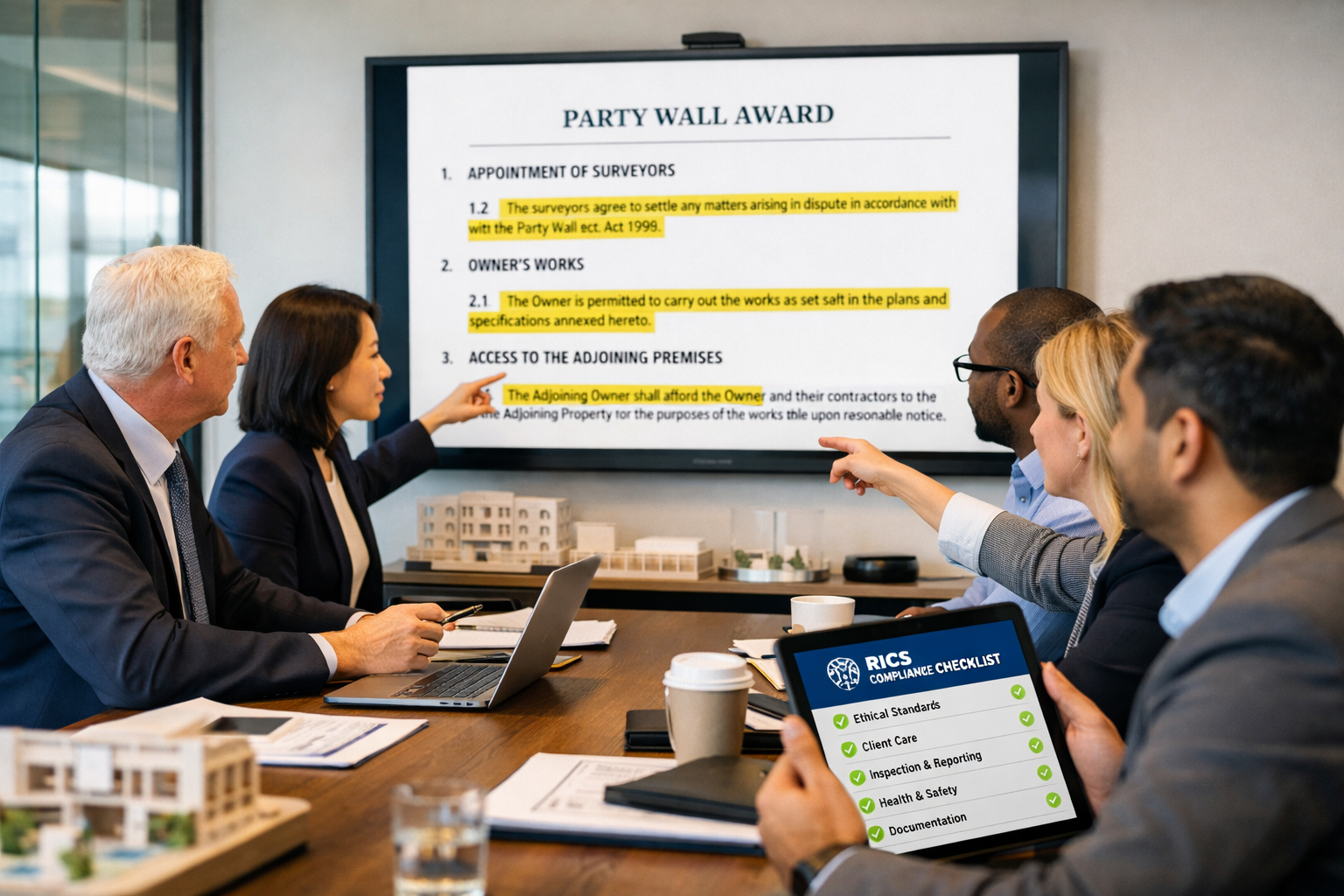
The RICS Professional Standard "Responsible use of artificial intelligence in surveying practice" establishes mandatory requirements that apply directly to party wall award drafting. Surveyors must understand and implement these guardrails to maintain professional standing.
Mandatory Compliance Elements:
🔒 Transparency and Disclosure
- Clients must be informed when AI tools are used in award preparation
- The extent and nature of AI assistance should be documented
- Limitations of AI capabilities must be clearly communicated
⚖️ Professional Accountability
- The surveyor remains fully responsible for award content and accuracy
- AI cannot be cited as justification for errors or omissions
- Professional indemnity insurance must cover AI-assisted work
🛡️ Data Protection and Security
- Client data input into AI systems must be protected
- GDPR compliance is mandatory for all data processing
- Third-party AI providers must meet security standards
🎯 Quality Assurance
- Systematic verification protocols must be documented
- Regular audits of AI output accuracy are required
- Continuous professional development in AI use is expected
Managing Liability and Risk
The integration of AI into party wall practice introduces new liability considerations. Surveyors must address these proactively to protect themselves and their clients.
Key Risk Management Strategies:
1. Professional Indemnity Insurance Review
Ensure your PI insurance explicitly covers AI-assisted professional work. Many traditional policies may not address AI-related claims without specific endorsements.
2. Client Engagement Letters
Update engagement terms to clearly explain:
- How AI tools will be used in award preparation
- The verification and oversight processes in place
- That professional judgment remains the surveyor's responsibility
- How data will be processed and protected
3. Documentation Standards
Maintain comprehensive records showing:
- Which AI tools were used and when
- What AI-generated content was modified or rejected
- The rationale for professional decisions that differed from AI suggestions
- Verification steps completed before award finalization
4. Continuing Professional Development
Invest in training that covers:
- AI tool capabilities and limitations
- Prompt engineering for optimal results
- Critical evaluation of AI outputs
- Emerging best practices in AI-assisted surveying
Ethical Considerations in AI-Assisted Awards
Beyond technical compliance, surveyors must navigate ethical dimensions of AI use in party wall practice.
Conflict of Interest Management:
AI tools trained on previous awards might inadvertently favor building owner or adjoining owner positions based on training data bias. Surveyors must remain vigilant to ensure impartiality, particularly when acting as agreed surveyors.
Access to Justice Concerns:
While AI can reduce party wall costs, surveyors must ensure efficiency gains don't compromise quality or thoroughness, particularly for vulnerable clients.
Professional Skill Development:
Over-reliance on AI tools may erode fundamental drafting skills in junior surveyors. Firms should balance AI efficiency with training opportunities that develop core competencies.
Practical Workflows for AI-Enhanced Award Drafting
Step-by-Step Implementation Process
Implementing AI Tools for Drafting Party Wall Awards in 2026: RICS-Compliant Best Practices and Guardrails requires a structured approach that balances efficiency with compliance.
Phase 1: Initial Setup and Data Input ⏱️ 10-15 minutes
-
Gather all relevant documentation:
- Party wall notices and responses
- Property addresses and Land Registry details
- Schedule of condition reports
- Building owner's construction specifications
- Correspondence and agreements to date
-
Input core data into AI system:
- Verify auto-populated fields for accuracy
- Upload supporting documents for AI analysis
- Select appropriate work type templates
- Set parameters for automated clause generation
Phase 2: AI-Assisted Draft Generation ⏱️ 5-10 minutes
-
Allow AI to generate initial draft:
- Review suggested award structure
- Assess clause selection and sequencing
- Identify any missing or inappropriate sections
- Note areas requiring professional customization
-
Run automated compliance checks:
- Statutory requirement verification
- Cross-reference with Party Wall Act provisions
- Consistency and completeness assessment
- Timeline and date validation
Phase 3: Professional Review and Refinement ⏱️ 45-90 minutes
-
Conduct detailed technical review:
- Verify work descriptions match actual proposals
- Assess reasonableness of conditions and restrictions
- Customize clauses for site-specific circumstances
- Add professional judgment to nuanced provisions
-
Apply surveyor expertise:
- Evaluate balance between party rights
- Consider practical enforceability of conditions
- Address any unique property characteristics
- Incorporate negotiated agreements or compromises
-
Final quality assurance:
- Complete manual read-through of entire award
- Check consistency between sections
- Verify all cross-references and appendices
- Confirm professional standards are met
Phase 4: Documentation and Finalization ⏱️ 15-20 minutes
-
Document AI involvement:
- Record which tools were used
- Note significant modifications to AI suggestions
- Save version history and audit trail
- Archive supporting documentation
-
Prepare for service:
- Generate final formatted documents
- Prepare covering correspondence
- Arrange for proper service on all parties
- Update case management systems
Time Savings and Efficiency Gains
When properly implemented, AI tools can significantly reduce award drafting time while maintaining or improving quality:
Traditional Manual Drafting:
- Initial draft: 3-4 hours
- Review and refinement: 2-3 hours
- Formatting and finalization: 1 hour
- Total: 6-8 hours
AI-Assisted Drafting with Proper Guardrails:
- Setup and data input: 15 minutes
- AI draft generation: 10 minutes
- Professional review and refinement: 90 minutes
- Documentation and finalization: 20 minutes
- Total: 2.5-3 hours
This represents a 60-65% time reduction while maintaining RICS compliance standards. However, these efficiency gains should never come at the expense of thoroughness or professional judgment.
Common Pitfalls and How to Avoid Them
Over-Reliance on Automation
The Risk: Surveyors may be tempted to accept AI-generated awards with minimal review, particularly for straightforward cases. This creates significant liability exposure and potential RICS disciplinary issues.
The Solution: Implement mandatory verification checklists that must be completed for every award, regardless of perceived simplicity. Document completion of each verification step in case files.
Inadequate Training and Competency Development
The Risk: Surveyors using AI tools without proper training may not recognize when AI outputs are inappropriate, incomplete, or non-compliant.
The Solution: Require formal training before any surveyor uses AI tools for client work. Establish mentoring relationships where experienced surveyors review junior colleagues' AI-assisted awards until competency is demonstrated.
Data Privacy Breaches
The Risk: Inputting sensitive client information into AI systems without proper security measures or data processing agreements violates GDPR and professional duties.
The Solution: Conduct thorough due diligence on AI tool providers, ensuring they meet UK data protection standards. Implement data minimization principles—only input information necessary for award drafting. Maintain data processing records as required by GDPR.
Inconsistent Application Across Cases
The Risk: Using AI tools selectively without clear criteria creates inconsistency in practice standards and potential discrimination issues.
The Solution: Develop clear policies on when and how AI tools will be used. Apply these consistently across all matters, with documented exceptions only for specific technical reasons.
Failure to Update Knowledge
The Risk: AI tools and best practices evolve rapidly. Surveyors using outdated approaches may fall behind compliance standards.
The Solution: Schedule quarterly reviews of AI tool capabilities, RICS guidance updates, and industry best practices. Participate in professional networks sharing AI implementation experiences.
Future Developments and Emerging Trends
The Evolution of AI in Party Wall Practice
As we progress through 2026 and beyond, several trends are shaping the future of AI Tools for Drafting Party Wall Awards in 2026: RICS-Compliant Best Practices and Guardrails:
🔮 Predictive Dispute Analysis
Next-generation AI tools are beginning to analyze award provisions and predict potential dispute risks based on historical data. This allows surveyors to proactively address contentious issues before they escalate.
📊 Integrated Case Management
AI platforms are increasingly integrating with broader case management systems, connecting party wall notices, schedules of condition, award drafting, and post-award monitoring in unified workflows.
🤝 Collaborative AI Platforms
Cloud-based AI tools are enabling better collaboration between building owners' surveyors and adjoining owners' surveyors, with shared drafting environments and real-time negotiation support.
📱 Mobile AI Applications
Site-based AI tools are emerging that allow surveyors to capture information during inspections and automatically populate award sections, reducing administrative burden and improving accuracy.
Preparing for Regulatory Changes
The regulatory landscape for AI in professional practice continues to evolve. Surveyors should anticipate:
- Enhanced disclosure requirements for AI use in professional services
- Standardized competency frameworks for AI-assisted surveying
- Mandatory AI auditing as part of RICS firm assessments
- Client consent protocols for AI-processed personal data
- Liability framework clarifications addressing AI-related professional negligence
Staying ahead of these developments requires active engagement with RICS consultations, professional body communications, and continuing education opportunities.
Conclusion: Embracing AI While Upholding Professional Standards
The integration of AI Tools for Drafting Party Wall Awards in 2026: RICS-Compliant Best Practices and Guardrails represents a significant evolution in surveying practice. When implemented responsibly, AI can enhance efficiency, improve consistency, and allow surveyors to focus on the professional judgment and client service that define quality practice.
However, the benefits of AI can only be realized within a robust framework of professional oversight, ethical consideration, and regulatory compliance. The March 2026 RICS standards make clear that technology must serve professional excellence—not replace it.
Actionable Next Steps for Surveyors
Immediate Actions (This Week):
- Review your professional indemnity insurance coverage for AI-assisted work
- Assess current AI tools against RICS 2026 compliance standards
- Update client engagement letters to address AI use and data processing
- Document your current verification protocols for AI-generated content
Short-Term Implementation (This Month):
5. Complete formal training on AI tools and RICS compliance requirements
6. Develop standardized verification checklists for AI-assisted awards
7. Conduct data protection impact assessments for AI systems in use
8. Establish quality assurance auditing procedures for AI outputs
Long-Term Development (This Quarter):
9. Build AI literacy into your continuing professional development plan
10. Participate in professional networks sharing AI implementation experiences
11. Review and refine your AI workflows based on initial implementation results
12. Stay informed about emerging RICS guidance and regulatory developments
The future of party wall surveying will be shaped by those who successfully balance technological innovation with unwavering professional standards. By implementing the best practices and guardrails outlined in this guide, surveyors can confidently embrace AI tools while maintaining the trust, competence, and integrity that define the profession.
Whether you're working in West London, South London, North London, or East London, the principles of responsible AI use remain constant. Technology changes rapidly, but the fundamental responsibility of the chartered surveyor—to provide competent, ethical, and accountable professional service—remains timeless.