


The housing market in 2026 has sparked an unprecedented surge in loft conversions across the UK, with homeowners racing to maximize living space without the expense and hassle of moving. Yet amid this construction boom, one critical compliance requirement catches countless property owners off guard: party wall notices. Whether you're planning a modest dormer or an ambitious mansard conversion, understanding how to navigate party wall notices for the 2026 loft conversion boom is essential to avoid costly delays, legal disputes, and project shutdowns. This comprehensive guide reveals the compliance essentials during this high-demand surge, ensuring your loft conversion proceeds smoothly from notice to completion.
Key Takeaways
✅ Party wall notices are mandatory for most loft conversions in terraced or semi-detached properties, regardless of planning permission status—the Party Wall Act operates independently from planning regimes
⏰ Serve notices at least 2 months before work begins for Section 2 Party Structure notices affecting shared walls; starting work without proper notices can result in immediate court injunctions
💰 Neighbour consent eliminates surveyor costs (typically £700–£2,000 per affected neighbour); written agreement means no Party Wall Surveyor appointment is necessary
🔥 Building Regulations approval is non-negotiable for every loft conversion, covering fire safety, thermal performance, acoustic insulation, and structural integrity
📋 Full Plan Applications are required for loft conversions due to extensive structural work, with local authorities responding within 5 weeks of submission
Understanding the 2026 Loft Conversion Surge and Party Wall Implications
The 2026 housing landscape has created perfect conditions for a loft conversion explosion. With property prices remaining elevated and mortgage rates stabilizing, homeowners are choosing to invest in their existing properties rather than face the substantial costs of moving. Loft conversions offer an attractive solution—adding valuable square footage, creating additional bedrooms, and potentially increasing property values by 15-20%.
However, this surge in loft conversion activity has also created a compliance bottleneck. Many homeowners discover too late that their project requires party wall notices, leading to frustrating delays and unexpected costs. The Party Wall etc. Act 1996 governs all work affecting shared structures between properties, and loft conversions frequently trigger these requirements.
When Loft Conversions Trigger Party Wall Act Requirements
Navigating party wall notices for the 2026 loft conversion boom requires understanding exactly when the Act applies to your project. Loft conversions trigger party wall obligations in these specific scenarios:
- 🏗️ Cutting into party walls to insert steel beams (RSJs) or padstones for structural support
- 📏 Raising or altering party walls, including building up parapets for mansard conversions
- 🧱 Removing chimney breasts attached to or passing through party walls
- ⛏️ Excavating within 3 metres of a neighbour's structure if going deeper than their foundations
- 🔨 Excavating within 6 metres if the excavation depth extends below a 45-degree plane from the neighbour's foundation base
According to industry data, approximately 70-80% of terraced house loft conversions require party wall notices due to the need for structural steel beams spanning across or into shared walls. [1] Even if your loft conversion qualifies as Permitted Development and requires no planning permission, party wall obligations exist separately and must be fulfilled.
Common Loft Conversion Scenarios Requiring Notices
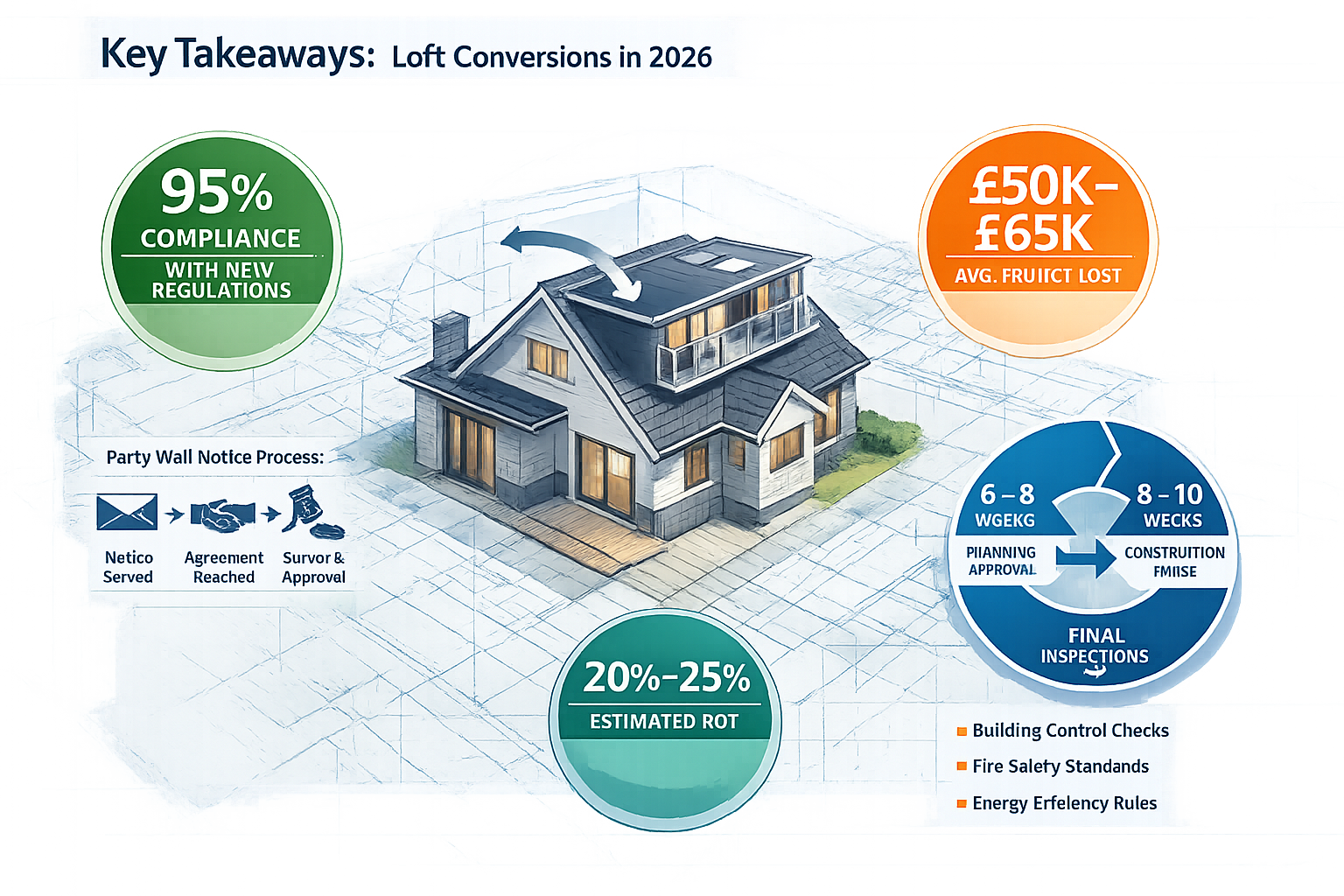
Three popular loft conversion types dominate the 2026 market, each with distinct party wall implications:
Rear Dormer Conversions 🏠
The most common loft conversion type, rear dormers typically require party wall notices when steel beams are inserted into or bear against party walls for structural support. Even if the dormer itself doesn't extend over the party wall, the internal structural work usually does.
Mansard Conversions 🏛️
These substantial conversions almost always require party wall notices because they involve raising the party wall to create vertical walls. The parapet must be built up on both sides of the boundary, directly affecting the shared structure.
Hip-to-Gable Conversions 📐
Common in semi-detached properties, these conversions extend the roof to the side boundary. They typically require padstones or steel beams bearing on or near party walls, triggering Section 2 Party Structure Notice requirements.
For detailed information on different types of work requiring notices, consult our guide on types of party wall works.
Step-by-Step Guide: Serving Party Wall Notices for Your Loft Conversion
Navigating party wall notices for the 2026 loft conversion boom demands careful attention to statutory timelines and procedural requirements. The process may seem daunting, but following these steps ensures compliance and minimizes delays.
Step 1: Identify Which Notices You Need (2-3 Months Before Work Starts)
The Party Wall Act includes three types of notices, each with different purposes and timelines:
| Notice Type | Purpose | Minimum Notice Period | Validity Period |
|---|---|---|---|
| Section 1 | Building new walls on boundary line | 1 month | 12 months |
| Section 2 | Work on existing party structures | 2 months | 12 months |
| Section 6 | Excavation near neighbour's foundations | 1 month | 12 months |
For loft conversions, Section 2 Party Structure Notices are most commonly required. [1] These cover work involving cutting into, raising, or altering existing party walls—precisely what happens when installing structural steel beams or building up parapets.
If your loft conversion also involves foundation work (such as underpinning to support additional loads), you may need Section 6 Adjacent Excavation Notices if digging within the specified distances of your neighbour's foundations.
Step 2: Prepare Comprehensive Notice Documents
A proper party wall notice must include specific information to be legally valid:
✏️ Essential Notice Contents:
- Your name and address as the building owner
- Address of the property where works will occur
- Clear description of the proposed works
- Date when work is intended to start (must be at least 2 months ahead for Section 2)
- Detailed drawings or plans showing the work
- Statement that the notice is served under the Party Wall etc. Act 1996
Many homeowners benefit from having their architect or structural engineer prepare these documents, as technical accuracy is crucial. For guidance on proper notice format, review our resource on Party Wall Act notices and how to respond.
Step 3: Serve Notices to All Affected Neighbours
Proper service of party wall notices requires delivering documents to every adjoining owner whose property shares the party wall or falls within excavation zones. Valid service methods include:
- Hand delivery with signed acknowledgment
- Registered or recorded delivery post
- Leaving the notice conspicuously at the property
- Standard post (though recorded methods provide better proof)
For terraced properties, this typically means serving notices to neighbours on both sides. For semi-detached properties, one neighbour receives notice. Always keep proof of service—dated photographs, postal receipts, or signed acknowledgments.
Step 4: Navigate the 14-Day Response Window
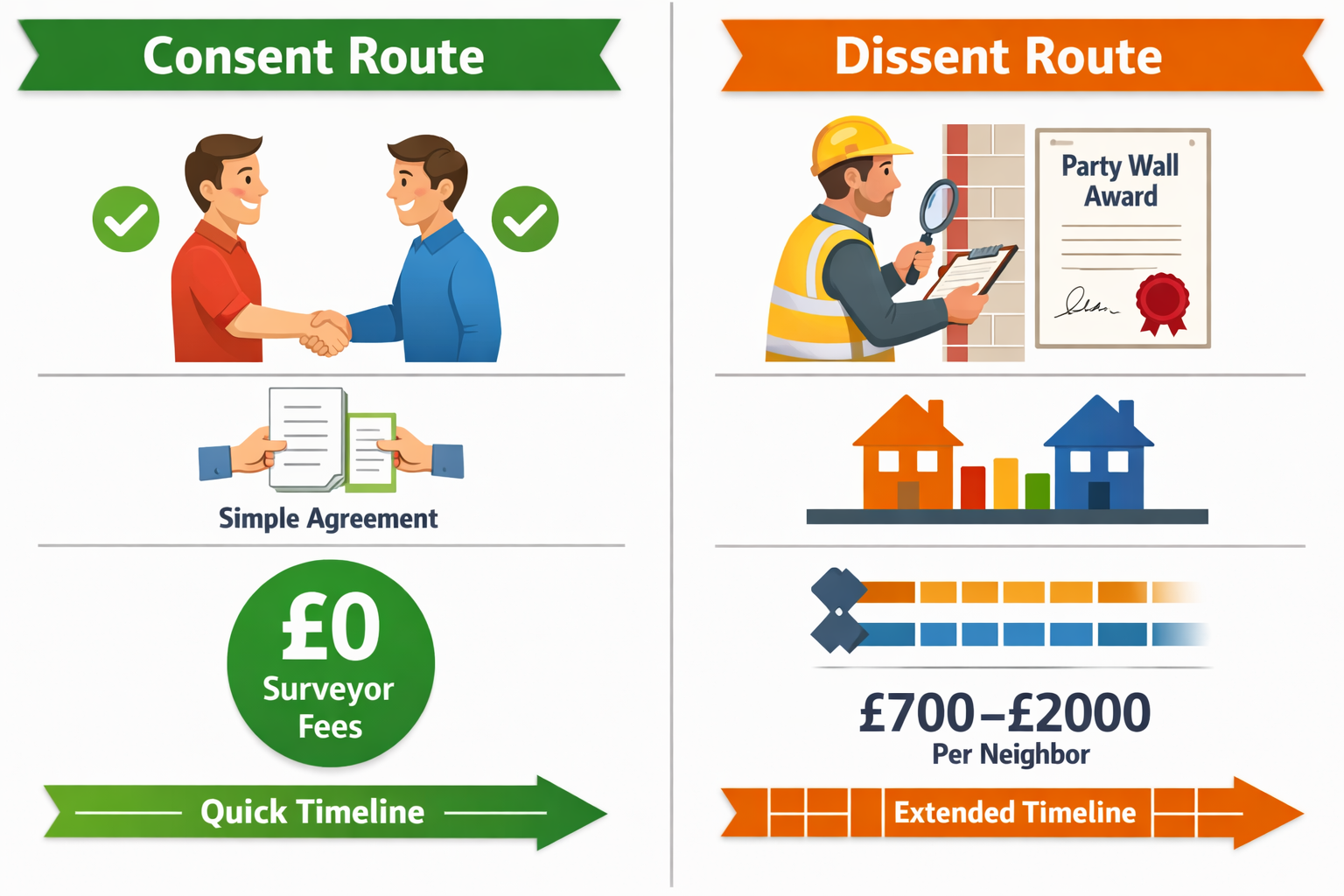
After receiving your party wall notice, adjoining owners have 14 days to respond in one of three ways:
Option 1: Consent in Writing ✅
If neighbours provide written consent to your proposed works, no Party Wall Surveyor appointment is necessary, and you can proceed once the notice period expires. This is the fastest and most cost-effective outcome. [2]
Option 2: Dissent or Request Modifications ⚠️
If neighbours dissent (object) or request changes to your proposed works, a "party wall dispute" arises. Despite the term "dispute," this is a standard procedural mechanism, not necessarily an adversarial situation. At this point, surveyors must be appointed.
Option 3: No Response 🔕
Silence is treated as dissent under the Act. If neighbours fail to respond within 14 days, they are deemed to have dissented, triggering the surveyor appointment process.
Step 5: Appoint Party Wall Surveyors (If Required)
When dissent occurs or neighbours don't respond, the Act provides three surveyor appointment options:
Agreed Surveyor (Most Common) 💼
Both parties jointly appoint a single impartial surveyor to prepare the Party Wall Award. This is typically the most cost-effective approach, with fees ranging £700–£2,000 per affected neighbour depending on complexity and location. [2]
Two Surveyors Plus Third Surveyor 👥
Each party appoints their own surveyor, and these two surveyors jointly appoint a third surveyor to resolve any disagreements. This approach is more expensive but may be appropriate for complex or contentious situations.
Building Owner Appoints for Non-Responsive Neighbour 📋
If your neighbour fails to appoint a surveyor within 10 days of being requested, you can appoint one on their behalf. This surveyor must act impartially despite being selected by you.
Professional party wall surveyors across London can assist with this process. Depending on your location, consider consulting specialists in Central London, West London, East London, North London, or South London.
Step 6: Obtain the Party Wall Award
The appointed surveyor(s) will prepare a Party Wall Award—a legally binding document that:
- Describes the proposed works in detail
- Sets out the rights and responsibilities of both parties
- Establishes a schedule of condition (photographic record of the neighbour's property before work begins)
- Specifies working hours and access arrangements
- Determines who pays surveyor fees (typically the building owner)
- Provides dispute resolution mechanisms
The Award must be served on both parties, and either party has 14 days to appeal to the County Court if they disagree with its terms. Once this appeal period expires without challenge, the Award becomes binding and work can commence.
For more information on the Award process, see our guide on party wall contract templates and Awards.
Step 7: Comply with Award Terms During Construction
Once work begins, strict compliance with the Party Wall Award is essential:
- Allow surveyor access for inspections as specified
- Adhere to working hours restrictions
- Maintain the schedule of condition accuracy
- Report any unexpected issues immediately
- Complete work within the timeframe stated in the Award
Critical Warning: Starting work without serving required party wall notices can result in an immediate court injunction to stop your entire project. [2] Neighbours have the right to seek legal remedies for non-compliance, potentially costing tens of thousands in legal fees, project delays, and remedial work.
Building Regulations and Fire Safety Compliance for 2026 Loft Conversions
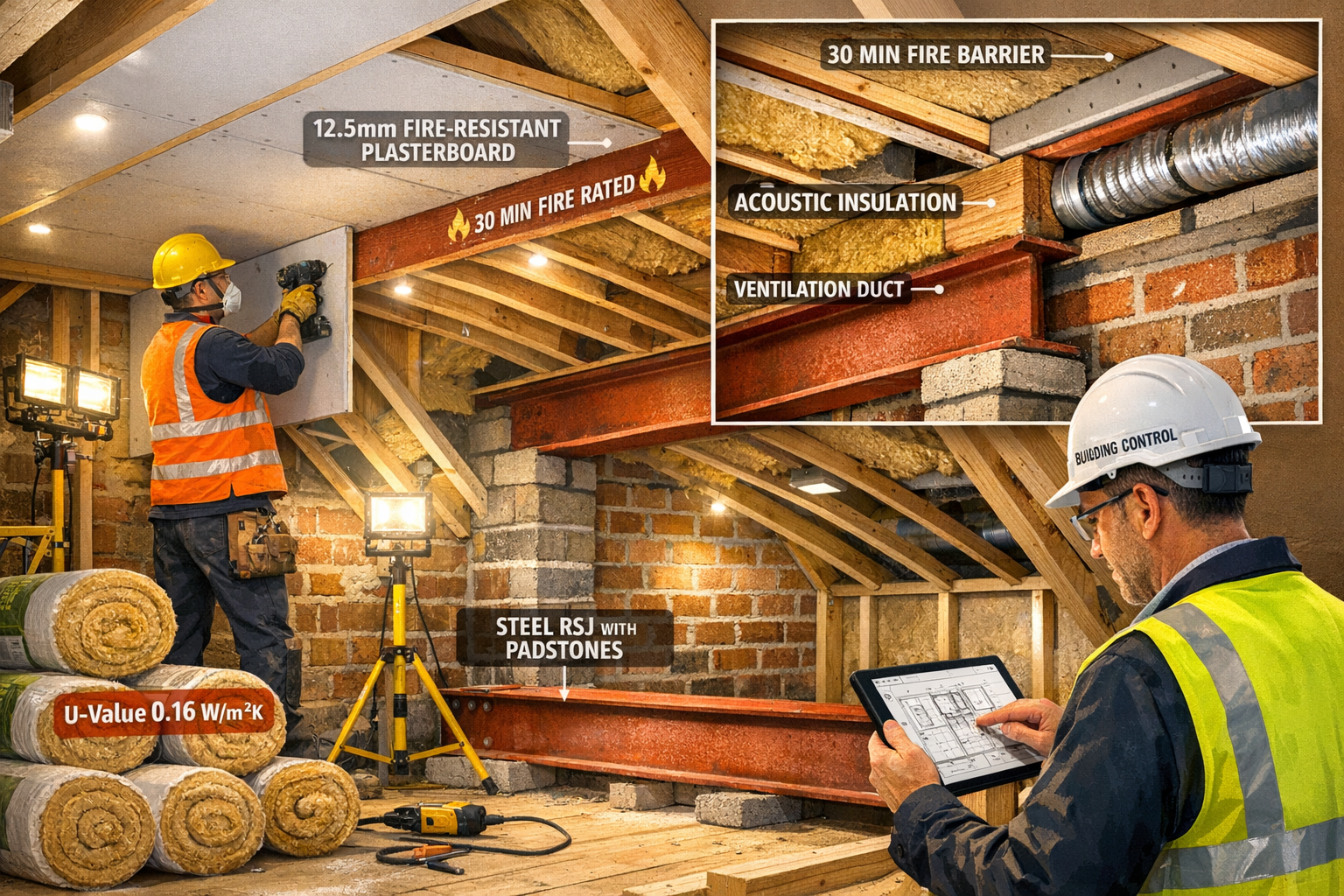
While navigating party wall notices for the 2026 loft conversion boom is crucial, it represents only one layer of compliance. Building Regulations approval is mandatory for every loft conversion without exception, regardless of whether planning permission is required. [2]
Non-Negotiable Building Regulations Requirements
The Building Regulations 2010 (as amended) impose stringent requirements on loft conversions to ensure safety, energy efficiency, and structural integrity:
Fire Safety (Part B) 🔥
- 30-minute fire resistance for all floors, beams, and walls separating the loft from the rest of the house
- Fire-resistant materials must be at least 12.5mm thick plasterboard or equivalent fire-proof coating [3]
- Protected escape route (typically fire-rated staircase with self-closing doors)
- Smoke alarms on every floor with interconnected systems
- Escape windows meeting minimum size requirements (450mm high × 450mm wide with 0.33m² openable area)
Thermal Performance (Part L) 🌡️
- Updated U-value requirements introduced in 2024-25 remain in force for 2026
- Roof insulation must achieve U-values of 0.15 W/m²K or better
- Windows must meet minimum energy efficiency standards
- Thermal bridging must be minimized at junctions
Structural Safety (Part A) 🏗️
- Structural calculations by qualified engineers for all load-bearing elements
- Steel beam specifications must account for additional loads
- Floor joists must support increased live loads (typically 1.5 kN/m² for bedrooms)
- Staircase design must meet pitch, headroom, and handrail requirements
Acoustic Insulation (Part E) 🔇
- Sound insulation between the loft conversion and floors below
- Minimum performance standards for airborne and impact sound
- Particularly important for conversions creating bedrooms above living spaces
Ventilation (Part F) 💨
- Adequate ventilation for habitable rooms
- Background ventilation and rapid ventilation (openable windows)
- Mechanical ventilation for bathrooms without external windows
Full Plan Application Process
Loft conversions require Full Plan Applications (not Building Notices) due to the extensive structural work involved. [3] This process includes:
- Submit detailed plans to your local authority Building Control or an Approved Inspector
- Wait for approval (typically 5 weeks for local authority response)
- Schedule inspections at key construction stages (foundations, structural work, insulation, fire protection, completion)
- Receive Completion Certificate confirming compliance with all Building Regulations
The Completion Certificate is essential for future property sales and mortgage applications. Properties with undocumented loft conversions face significant valuation challenges and legal complications.
Enforcement and Retrospective Applications
Building Control has a four-year enforcement window from the date of completion. [3] After four years without an Enforcement Notice, an unlawful loft conversion may be deemed "lawful" through the passage of time. However, this doesn't mean the conversion meets Building Regulations—it simply means enforcement action is time-barred.
Retrospective Building Regulations applications are possible but often more expensive and complicated than obtaining approval before work begins. Inspectors may require invasive investigations to verify hidden structural elements, and remedial work may be necessary to achieve compliance.
Cost Management and Dispute Prevention Strategies
Navigating party wall notices for the 2026 loft conversion boom involves not just compliance but also strategic cost management. With surveyor fees, potential disputes, and construction costs all adding up, smart planning can save thousands.
Minimizing Party Wall Costs
Strategy 1: Seek Neighbour Consent Early 🤝
The single most effective cost-saving measure is obtaining written consent from neighbours before the 14-day response period expires. Consider:
- Meeting neighbours in person to explain your plans
- Showing detailed drawings and addressing concerns proactively
- Offering reassurances about working hours, noise management, and project duration
- Providing contact information for your builder and architect
When neighbours consent in writing, you avoid surveyor fees entirely—a potential saving of £1,400–£4,000 for a typical terraced property with two adjoining owners. [2]
Strategy 2: Use an Agreed Surveyor 💰
If surveyor appointment is necessary, the Agreed Surveyor route (single surveyor appointed jointly) is significantly more cost-effective than appointing separate surveyors for each party. For practical tips on cost control, review our guide on how to keep party wall costs down.
Strategy 3: Prepare Comprehensive Documentation 📄
Well-prepared party wall notices with detailed drawings and clear descriptions reduce surveyor time and complexity, directly lowering fees. Engage your architect or structural engineer to prepare professional notice documents.
Strategy 4: Time Your Project Strategically ⏰
Party wall notices remain valid for 12 months from service. [1] If you're planning a loft conversion but not starting immediately, serving notices early allows time for the process to complete without delaying construction.
Preventing and Resolving Disputes
While the term "party wall dispute" sounds adversarial, most cases resolve amicably through the Award process. However, genuine disputes can arise, particularly regarding:
- Noise and disruption concerns
- Access requirements for inspections
- Potential damage to neighbouring properties
- Working hours and project duration
Best Practices for Dispute Prevention:
✅ Maintain open communication with neighbours throughout the project
✅ Provide regular updates on construction progress and any changes
✅ Respect agreed working hours and minimize disruption
✅ Address concerns promptly and professionally
✅ Document everything including communications, site conditions, and compliance with Award terms
✅ Engage professional surveyors who can mediate and provide impartial guidance
If disputes escalate beyond the Award process, either party can appeal to the County Court within 14 days of receiving the Award. Legal advice may be necessary for complex disputes, though most resolve through the surveyor-led process.
For detailed guidance on what to do as an adjoining owner receiving notice, see our resource for neighbours carrying out works.
Permitted Development Limits and Planning Considerations for 2026
Understanding the relationship between party wall requirements and planning permission is essential when navigating party wall notices for the 2026 loft conversion boom. These are separate regulatory regimes that operate independently—you may need party wall notices even if your loft conversion qualifies as Permitted Development.
Current Permitted Development Limits
As of 2026, loft conversions can proceed under Permitted Development rights (without planning permission) if they meet these criteria:
Volume Limits 📏
- 40m³ additional volume for terraced properties
- 50m³ additional volume for semi-detached and detached properties
- Measured as the total additional volume created by the conversion
Design Restrictions 🏠
- No extension beyond the plane of the existing roof slope on the principal elevation (typically the front)
- No extension above the highest part of the existing roof
- Materials must be similar in appearance to the existing house
- Side-facing windows must be obscure-glazed and non-opening (unless 1.7m above floor level)
- Roof terraces or balconies are not permitted
Height and Projection Limits 📐
- Rear extensions must not exceed the existing ridge height
- Dormers on rear slopes can typically extend up to the ridge but not over it
- Side extensions (hip-to-gable) must not exceed the existing ridge height [1]
Important: Even if your loft conversion qualifies as Permitted Development, you still need Building Regulations approval and must comply with party wall requirements if the work affects shared structures.
When Planning Permission Is Required
Loft conversions require full planning permission if they:
- Exceed Permitted Development volume limits
- Involve front-facing dormers or extensions
- Include roof terraces or balconies
- Are in Conservation Areas (where Permitted Development rights may be restricted)
- Are on Listed Buildings (which have special protections)
- Involve changes to the roofline that alter the character of the property
Planning applications typically take 8-12 weeks for determination, so factor this into your project timeline. Some local authorities offer pre-application advice services that can clarify whether planning permission is necessary for your specific proposal.
Timeline and Project Management for 2026 Loft Conversions
Effective project management requires understanding how party wall processes integrate with overall loft conversion timelines. Here's a realistic timeline for a typical loft conversion project in 2026:
Comprehensive Project Timeline
Months 1-2: Planning and Design 📋
- Engage architect to prepare detailed plans
- Obtain structural engineer calculations
- Determine party wall notice requirements
- Prepare Building Regulations application
- Submit planning application (if required)
Month 3: Statutory Notices 📮
- Serve party wall notices (minimum 2 months before work starts)
- Submit Full Plan Application for Building Regulations
- Await planning decision (if applicable)
Month 4: Approvals and Appointments ✅
- Neighbour response period expires (14 days)
- Appoint party wall surveyors (if required)
- Receive Building Regulations approval
- Obtain planning permission (if required)
Month 5: Pre-Construction 🔨
- Party Wall Award prepared and served
- Schedule of condition completed
- Final contractor selection and contract signing
- Order materials and schedule deliveries
Months 6-8: Construction 🏗️
- Structural work and steel beam installation
- Roof alterations and dormer construction
- Insulation, fire protection, and internal finishes
- Building Control inspections at key stages
- Staircase installation
Month 9: Completion 🎉
- Final Building Control inspection
- Receive Completion Certificate
- Final surveyor inspection (if Party Wall Award applies)
- Snagging and final touches
Total Timeline: 9-12 months from initial design to completion, depending on complexity, planning requirements, and party wall processes.
Managing the 2026 High-Demand Surge
The 2026 loft conversion boom has created capacity constraints across the construction industry. Property owners should anticipate:
Extended Lead Times ⏰
- Architect and engineer availability may be limited (book 2-3 months ahead)
- Party wall surveyors are experiencing high demand
- Quality contractors have full schedules (book 3-6 months ahead)
- Material delivery times may be longer than pre-2024 norms
Cost Pressures 💷
- Labour costs continue rising due to high demand
- Material costs remain elevated
- Party wall surveyor fees may increase in high-demand areas
- Building Control fees are set by local authorities and typically increase annually
Quality Considerations ⭐
- Avoid contractors offering suspiciously low quotes or immediate availability
- Verify contractor credentials, insurance, and previous loft conversion experience
- Check party wall surveyor qualifications (RICS membership is the gold standard)
- Don't rush the design phase—thorough planning prevents costly changes during construction
Conclusion
Navigating party wall notices for the 2026 loft conversion boom requires careful planning, procedural compliance, and strategic management of timelines and costs. As this comprehensive guide demonstrates, party wall requirements are not optional obstacles but essential legal protections that ensure fair treatment of all property owners affected by construction work.
Key Action Steps for Your Loft Conversion Project:
1️⃣ Identify party wall requirements early—determine whether your loft conversion will involve cutting into party walls, raising shared structures, or excavating near neighbours' foundations
2️⃣ Serve notices at least 2 months before work starts for Section 2 Party Structure notices, ensuring you have proof of proper service
3️⃣ Engage neighbours proactively to seek written consent, potentially saving £1,400–£4,000 in surveyor fees per project
4️⃣ Appoint qualified party wall surveyors if dissent occurs or neighbours don't respond—look for RICS-registered professionals with loft conversion experience
5️⃣ Never start work without proper notices—court injunctions can shut down your entire project immediately, costing far more than compliance
6️⃣ Obtain Building Regulations approval through Full Plan Application, ensuring your loft conversion meets all fire safety, thermal performance, structural, and acoustic requirements
7️⃣ Budget realistically for the complete process, including surveyor fees, Building Control costs, and potential contingencies
8️⃣ Plan for extended timelines due to the 2026 high-demand surge—quality professionals and contractors are worth the wait
The 2026 loft conversion boom presents an excellent opportunity to add valuable living space to your property, but success depends on thorough compliance with party wall and building regulations requirements. By following the step-by-step guidance in this article, you can navigate the complexities with confidence, avoid costly delays and disputes, and ensure your loft conversion proceeds smoothly from initial notice to final completion.
For professional assistance with your party wall requirements, consider consulting experienced party wall surveyors who understand the unique challenges of the 2026 construction surge and can guide you through every stage of the process.
References
[1] Party Wall Notice For Loft Conversions – https://www.houricanassociates.com/party-wall-news/party-wall-notice-for-loft-conversions/
[2] Loft Conversion Guide 2026 – https://www.getmaster.co.uk/blog/loft-conversion-guide-2026.html
[3] Rules Regulations – https://www.greenmatch.co.uk/loft-conversion/rules-regulations