

As London's construction landscape shifts toward net-zero targets, property owners and surveyors face a new challenge: how do traditional party wall procedures adapt to accommodate cutting-edge sustainability standards? In 2026, the integration of low-carbon Integrated Mechanical Packages (IMPs) and stringent energy codes into party wall awards represents a fundamental evolution in how we approach shared boundary construction. Sustainability in Party Wall Awards: Embedding Low-Carbon IMPs and Energy Codes for 2026 High-Performance Builds is no longer optional—it's becoming the industry standard for responsible development.
The convergence of environmental regulations and property law demands that party wall awards now address thermal performance, embodied carbon, and electrification requirements alongside traditional structural concerns. This transformation affects everyone involved in boundary construction projects, from building owners planning extensions to adjoining owners concerned about their property's performance.
Key Takeaways
- 🌱 Green clauses in party wall awards now specify low-carbon materials, thermal performance standards, and airtightness requirements for shared walls
- ⚡ Energy code compliance must be documented within party wall agreements, including blower-door test protocols and electrification infrastructure specifications
- 📊 Embodied carbon calculations for IMPs are becoming mandatory components of party wall documentation in high-performance builds
- 🏗️ Surveyors require new expertise in sustainable construction methods to properly evaluate and approve eco-compliant party wall works
- 🤝 Collaborative frameworks between building owners, adjoining owners, and sustainability consultants ensure compliance with both Party Wall Act requirements and environmental standards
Understanding the Intersection of Sustainability and Party Wall Procedures
What Are Low-Carbon IMPs in Party Wall Context?
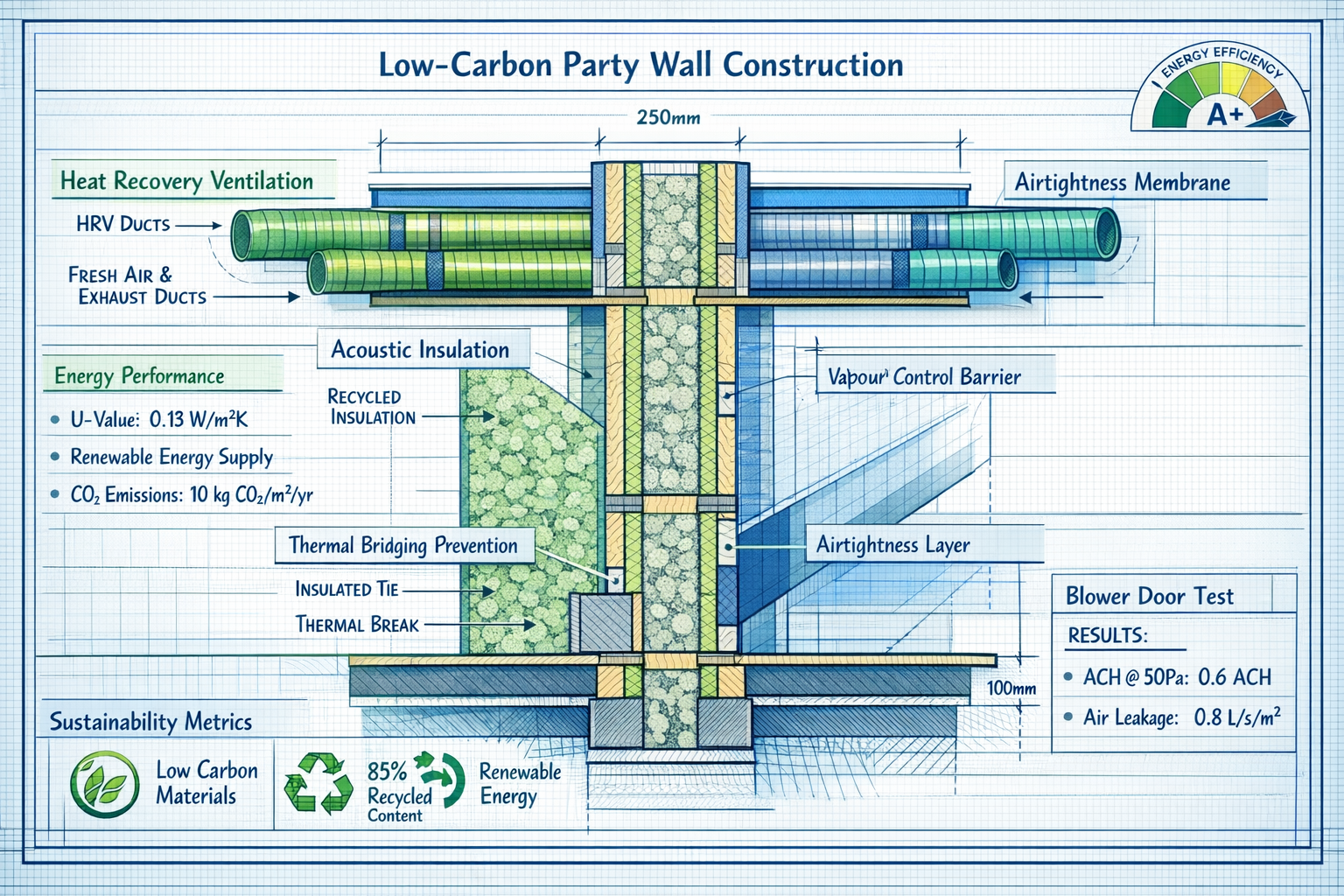
Integrated Mechanical Packages (IMPs) represent the coordinated systems within a building that manage heating, cooling, ventilation, and water services. In the context of party walls, low-carbon IMPs specifically refer to:
- Heat recovery ventilation (HRV) systems that penetrate or run alongside party walls
- Heat pump infrastructure requiring structural support or acoustic treatment at boundaries
- Thermal bridging prevention measures at party wall junctions
- Airtightness membranes that must maintain continuity across shared structures
- Acoustic insulation using sustainable, low-embodied-carbon materials
When these systems interact with party walls—whether through penetrations, attachments, or thermal considerations—they must be addressed in the party wall award documentation.
Energy Codes Affecting Party Wall Works in 2026
The UK's evolving building regulations place increasingly strict requirements on thermal performance and energy efficiency. For party wall works in 2026, key energy code considerations include:
Thermal Performance Standards:
- U-values for party walls must meet or exceed current Building Regulations Part L requirements
- Continuity of insulation at party wall junctions to prevent thermal bridging
- Temperature factor (f-value) calculations at critical junctions
Airtightness Requirements:
- Blower-door testing protocols that account for party wall construction
- Air permeability targets typically ≤3 m³/(h·m²) @ 50 Pa for high-performance builds
- Sealing strategies at party wall penetrations for services
Electrification Standards:
- Infrastructure for all-electric heating systems affecting party walls
- Capacity planning for heat pump equipment near boundaries
- Acoustic treatment requirements for mechanical equipment adjacent to party walls
Embedding Sustainability Clauses in Party Wall Awards
Essential Green Clauses for 2026 Awards
Modern party wall awards must incorporate specific sustainability provisions that protect both environmental performance and neighbouring property interests. These eco-compliance clauses should address:
Material Specifications:
- Embodied carbon limits for structural materials (typically measured in kgCO₂e/m²)
- Recycled content requirements for insulation and acoustic materials
- Sustainable timber sourcing certifications (FSC or PEFC)
- Prohibition of high-GWP (Global Warming Potential) materials
Performance Guarantees:
- Minimum thermal resistance values (R-values) for party wall assemblies
- Acoustic performance standards (Rw + C values) using sustainable materials
- Airtightness continuity commitments at party wall junctions
- Durability and maintenance provisions for green building systems
Testing and Verification:
- Pre-completion blower-door testing requirements
- Thermal imaging surveys to identify thermal bridging
- Acoustic testing protocols for completed works
- Documentation of embodied carbon calculations
Documentation Requirements for High-Performance Builds
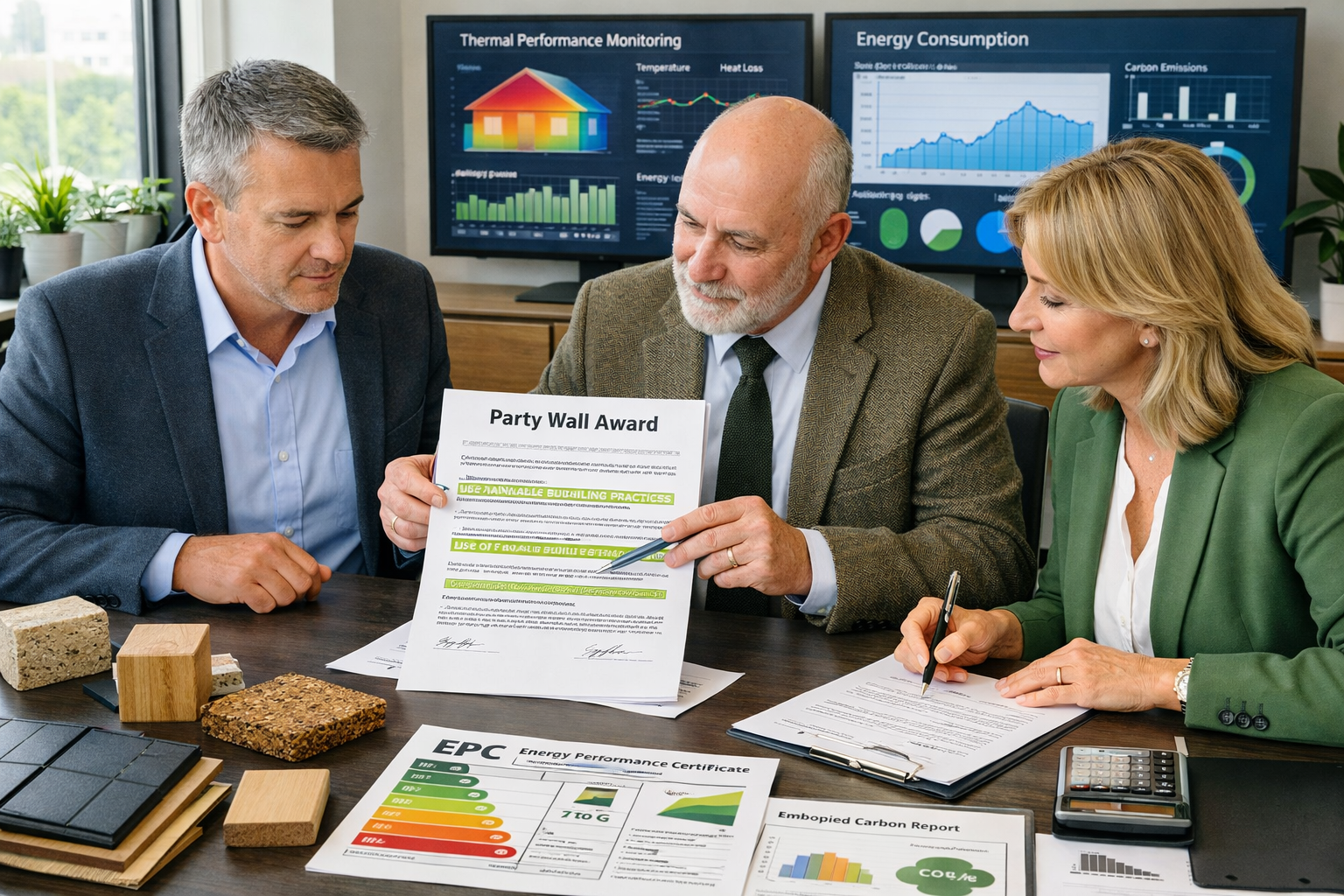
When pursuing Sustainability in Party Wall Awards: Embedding Low-Carbon IMPs and Energy Codes for 2026 High-Performance Builds, comprehensive documentation becomes critical. The award should include:
| Document Type | Purpose | Key Contents |
|---|---|---|
| Sustainability Schedule | Define environmental standards | Material embodied carbon data, energy performance targets, testing protocols |
| IMP Integration Plan | Detail mechanical system interfaces | Penetration locations, acoustic treatment, thermal continuity measures |
| Energy Compliance Certificate | Demonstrate regulatory adherence | Building Regulations Part L compliance, SAP/SBEM calculations, airtightness design |
| Material Declarations | Verify sustainable sourcing | EPDs (Environmental Product Declarations), certifications, supply chain documentation |
| Testing Protocol | Establish verification methods | Blower-door test procedures, thermal imaging schedule, acoustic testing requirements |
This documentation framework ensures that types of party wall works meet both legal requirements and environmental performance standards.
Practical Implementation: Surveyors' Role in Green Party Wall Awards
New Competencies for Party Wall Surveyors
The evolution toward sustainable construction demands that party wall surveyors develop expertise beyond traditional structural assessment. Essential competencies for 2026 include:
Technical Knowledge:
- Understanding of building physics (thermal dynamics, moisture management, airtightness principles)
- Familiarity with low-carbon construction materials and their properties
- Knowledge of heat pump systems, HRV units, and their installation requirements
- Awareness of embodied carbon calculation methodologies
Regulatory Expertise:
- Current Building Regulations Part L (Conservation of fuel and power)
- Future Homes Standard requirements and timelines
- Local authority sustainability policies and planning conditions
- Energy Performance Certificate (EPC) implications of party wall works
Collaborative Skills:
- Coordination with sustainability consultants and energy assessors
- Communication with mechanical engineers regarding IMP installations
- Liaison with building control officers on integrated compliance issues
- Mediation between parties with differing sustainability priorities
Assessing Sustainable Party Wall Works
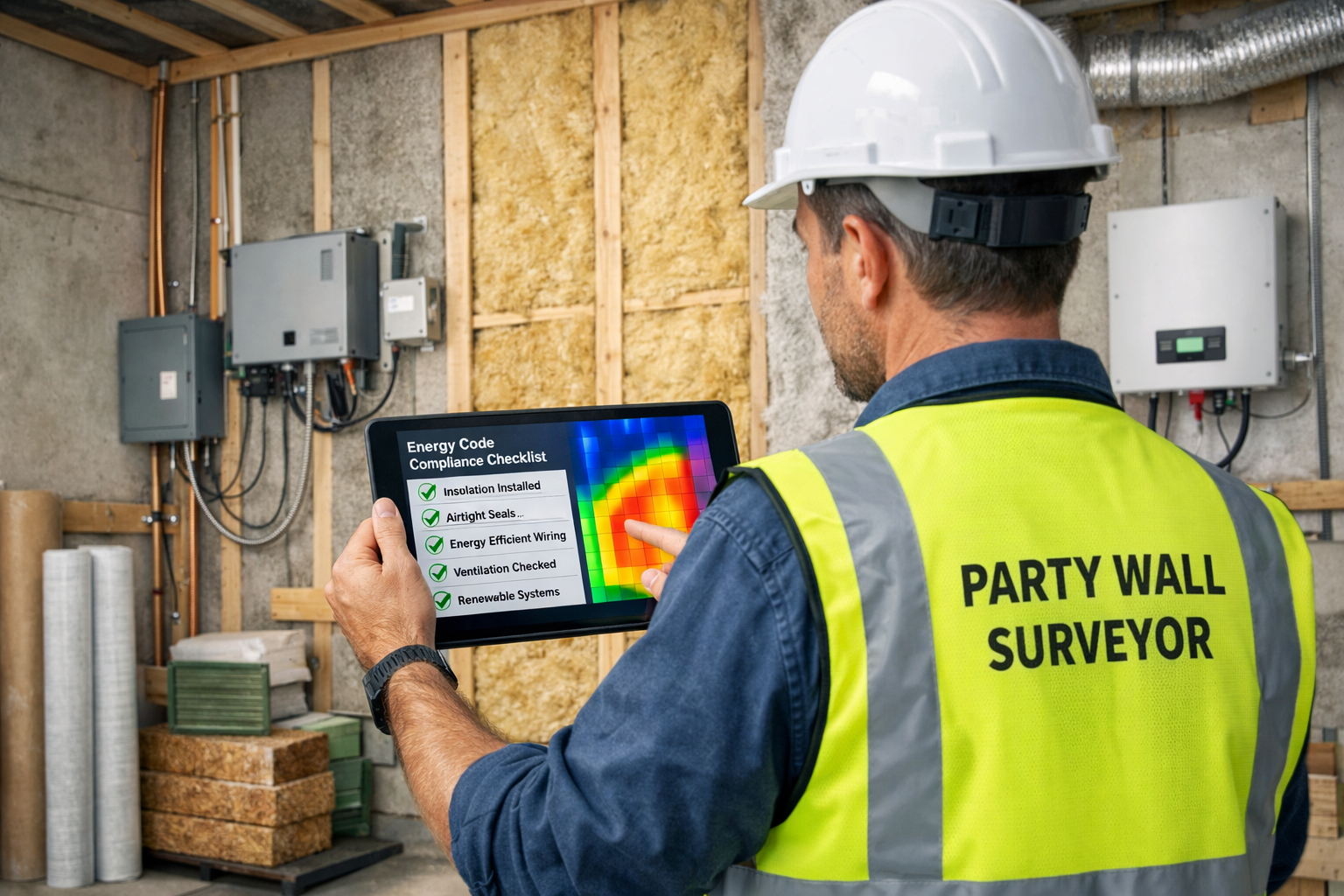
When evaluating proposed works under Sustainability in Party Wall Awards: Embedding Low-Carbon IMPs and Energy Codes for 2026 High-Performance Builds, surveyors should follow a structured assessment process:
Step 1: Review Sustainability Proposals
- Examine material specifications for embodied carbon data
- Verify thermal performance calculations for party wall assemblies
- Assess IMP integration plans for structural and acoustic impacts
- Check compliance with relevant energy codes and standards
Step 2: Evaluate Adjoining Owner Impacts
- Consider thermal performance implications for neighbouring property
- Assess acoustic impacts of mechanical equipment installations
- Review structural adequacy for additional loads from green systems
- Identify potential moisture or condensation risks from thermal upgrades
Step 3: Specify Protective Measures
- Require acoustic treatment for heat pumps or ventilation equipment
- Mandate thermal continuity measures to prevent cold bridging
- Stipulate airtightness testing protocols and remediation procedures
- Include provisions for ongoing maintenance of sustainable systems
Step 4: Document Environmental Commitments
- Record agreed embodied carbon limits in the award
- Include energy performance targets and verification methods
- Specify sustainable material requirements with acceptable alternatives
- Establish testing schedules and compliance verification procedures
This systematic approach ensures that party wall notices and subsequent awards adequately address sustainability considerations while protecting all parties' interests.
Blower-Door Testing and Airtightness Standards in Party Wall Context
Why Airtightness Matters for Party Walls
Airtightness refers to a building's resistance to uncontrolled air leakage through gaps and cracks in the building envelope. For party wall works, airtightness is critical because:
- Party wall junctions are common locations for air leakage paths
- Service penetrations through party walls can compromise airtightness
- Poor airtightness reduces energy efficiency and increases heating costs
- Air leakage can transport moisture, potentially causing condensation issues
- Building Regulations increasingly require stringent airtightness performance
High-performance builds in 2026 typically target air permeability of 3 m³/(h·m²) @ 50 Pa or better, compared to the Building Regulations maximum of 10 m³/(h·m²) @ 50 Pa.
Incorporating Blower-Door Protocols into Awards
Party wall awards should specify how airtightness will be achieved and verified when works affect shared boundaries:
Design Stage Requirements:
- Airtightness strategy drawings showing continuity of air barrier at party walls
- Detail drawings for service penetrations with sealing specifications
- Material specifications for airtightness membranes and tapes
- Junction details between party walls and external envelope
Construction Stage Provisions:
- Quality assurance procedures for airtightness installation
- Interim inspection points for critical airtightness elements
- Photographic documentation of sealed penetrations before covering
- Contractor training requirements for airtightness installation
Testing and Verification:
- Blower-door testing schedule (typically pre-completion)
- Pass/fail criteria aligned with project performance targets
- Remediation procedures if initial testing fails
- Retesting protocols and cost responsibility allocation
Post-Completion Obligations:
- Maintenance requirements for airtightness elements
- Restrictions on future penetrations without proper sealing
- Documentation handover including airtightness test results
- Warranty provisions for airtightness performance
These provisions ensure that sustainability objectives are achievable while maintaining clear accountability between building and adjoining owners.
Electrification and Heat Pump Considerations
Party Wall Implications of All-Electric Heating
The transition away from gas heating toward all-electric systems creates specific party wall considerations:
Structural Requirements:
- External heat pump units may require mounting on or near party walls
- Additional load-bearing capacity may be needed for equipment
- Vibration isolation measures to prevent transmission through party structures
- Weatherproofing considerations for external equipment installations
Acoustic Challenges:
- Heat pumps generate noise that can transmit through party walls
- Air source heat pump (ASHP) units typically produce 40-60 dBA at 1 meter
- Acoustic treatment may be required to achieve acceptable noise levels
- Location planning to minimize impact on adjoining properties
Service Infrastructure:
- Electrical supply upgrades may require routing through or near party walls
- Pipework for heating distribution may penetrate party structures
- Thermal insulation requirements for pipes in party wall voids
- Access provisions for future maintenance of systems
Award Clauses for Heat Pump Installations
When heat pump systems interact with party walls, awards should include:
Location and Installation Standards:
- Specific mounting locations with distances from party wall boundaries
- Structural support specifications and load calculations
- Vibration isolation requirements (anti-vibration mounts, pads)
- Clearance requirements for airflow and maintenance access
Acoustic Performance Requirements:
- Maximum noise levels at party wall (typically 30-35 dBA internally)
- Acoustic barrier specifications if required
- Operating time restrictions during sensitive hours (if necessary)
- Post-installation acoustic testing and remediation provisions
Maintenance and Access:
- Access rights for servicing equipment near party boundaries
- Notice requirements for maintenance activities
- Responsibility for ongoing acoustic performance
- Provisions for equipment replacement or upgrades
These detailed specifications ensure that electrification objectives align with the requirements of the Party Wall etc. Act 1996 and protect adjoining owners' reasonable enjoyment of their property.
Embodied Carbon Reduction in Party Wall Materials
Understanding Embodied Carbon
Embodied carbon refers to the total greenhouse gas emissions associated with the extraction, manufacture, transportation, installation, and disposal of building materials. For party wall works, embodied carbon considerations include:
- Material selection: Choosing lower-carbon alternatives (timber vs. concrete, recycled vs. virgin materials)
- Supply chain impacts: Transportation distances and manufacturing processes
- Longevity and durability: Materials requiring less frequent replacement reduce lifecycle carbon
- End-of-life considerations: Recyclability and disposal impacts
High-performance builds in 2026 increasingly incorporate embodied carbon budgets—maximum allowable kgCO₂e per square meter of construction.
Material Specifications for Low-Carbon Party Walls
Party wall awards can specify sustainable material requirements:
Structural Materials:
- Engineered timber for party wall framing (lower embodied carbon than steel or concrete)
- Recycled content requirements for masonry or concrete elements (minimum 30-50% recycled aggregate)
- Locally sourced materials to reduce transportation emissions (within 50-100 km radius)
- Certified sustainable timber (FSC or PEFC certification)
Insulation Materials:
- Natural fiber insulation (sheep's wool, wood fiber, hemp) with low embodied carbon
- Recycled content insulation (recycled plastic, newspaper cellulose)
- Avoidance of high-GWP materials (certain foam insulations with blowing agents)
- Thermal performance per unit embodied carbon optimization
Finishes and Treatments:
- Low-VOC (Volatile Organic Compound) paints and coatings
- Natural lime-based plasters rather than gypsum alternatives
- Recycled or reclaimed materials where appropriate
- Durable finishes requiring less frequent replacement
Calculating and Documenting Embodied Carbon
For Sustainability in Party Wall Awards: Embedding Low-Carbon IMPs and Energy Codes for 2026 High-Performance Builds, embodied carbon should be quantified and documented:
Calculation Methodology:
- Use Environmental Product Declarations (EPDs) for specific products
- Apply industry-standard databases (ICE Database, RICS embodied carbon guidance)
- Calculate total kgCO₂e for party wall elements
- Compare against project carbon budget or benchmarks
Documentation in Awards:
- Include embodied carbon calculations as appendix to award
- Specify maximum allowable embodied carbon for party wall works
- Require submission of EPDs for key materials
- Establish verification procedures for material substitutions
Compliance and Verification:
- Pre-commencement material approval process
- Site inspections to verify specified materials are used
- Documentation of material certifications and EPDs
- Post-completion embodied carbon reporting
This rigorous approach ensures that sustainability commitments are measurable, verifiable, and enforceable within the party wall framework.
Coordinating with Building Control and Planning Requirements
Integrated Compliance Approach
Sustainability in Party Wall Awards: Embedding Low-Carbon IMPs and Energy Codes for 2026 High-Performance Builds requires coordination across multiple regulatory frameworks:
Party Wall Act Compliance:
- Serving appropriate party wall notices
- Agreeing party wall awards with sustainability provisions
- Protecting adjoining owners' interests during sustainable works
Building Regulations Approval:
- Part L (Conservation of fuel and power) compliance
- Part E (Resistance to the passage of sound) for acoustic performance
- Part F (Ventilation) for mechanical ventilation systems
- Structural adequacy under Part A
Planning Permission Considerations:
- Local authority sustainability policies
- Conservation area restrictions on external equipment
- Permitted development limitations for heat pumps
- Design and appearance requirements for visible sustainable elements
Avoiding Conflicts Between Requirements
Potential conflicts can arise when sustainability objectives intersect with party wall procedures:
Common Conflict Scenarios:
-
Acoustic vs. Thermal Performance: Sustainable insulation materials may have different acoustic properties than traditional options
- Resolution: Specify hybrid assemblies meeting both thermal and acoustic standards
-
Equipment Location Constraints: Optimal heat pump locations may be near party boundaries
- Resolution: Early consultation with adjoining owners and acoustic mitigation measures
-
Testing Access Requirements: Blower-door testing may require temporary access to adjoining properties
- Resolution: Include testing access provisions in party wall awards with advance notice requirements
-
Cost Allocation Disputes: Sustainable upgrades may increase project costs
- Resolution: Clear documentation of which sustainability measures are building owner's choice vs. regulatory requirements
Best Practice Coordination:
- Engage party wall surveyors early in sustainable design process
- Share sustainability proposals with adjoining owners during notice period
- Coordinate party wall award conditions with Building Control requirements
- Document how sustainable measures benefit both properties where applicable
Understanding how to keep party wall costs down while achieving sustainability goals requires this integrated planning approach.
Case Studies: Sustainable Party Wall Projects in Practice
Rear Extension with Passive House Standards
Project Overview:
A Victorian terrace property in North London underwent a rear extension designed to Passive House standards, requiring extensive party wall works with both adjoining properties.
Sustainability Challenges:
- Achieving airtightness continuity at party wall junctions
- Installing heat recovery ventilation with minimal party wall penetrations
- Specifying low-embodied-carbon materials for party wall construction
- Coordinating thermal performance with acoustic requirements
Award Solutions:
- Detailed airtightness strategy drawings included in award documentation
- Material specifications requiring timber frame construction with recycled insulation
- Pre-agreed blower-door testing protocol with remediation procedures
- Acoustic performance guarantees for HRV equipment near party walls
Outcomes:
- Achieved airtightness of 0.6 air changes per hour @ 50 Pa (exceeding Passive House standard)
- Party wall acoustic performance maintained at Rw 52 dB using sustainable materials
- Embodied carbon 40% lower than conventional construction
- No disputes during or after construction due to comprehensive award provisions
Loft Conversion with All-Electric Heating
Project Overview:
A semi-detached property in East London converted its loft space with air source heat pump heating, requiring party wall works for structural alterations and equipment installation.
Sustainability Challenges:
- Locating ASHP unit to minimize noise impact on adjoining property
- Upgrading party wall thermal performance to prevent thermal bridging
- Installing electrical infrastructure through party wall void
- Achieving Building Regulations Part L compliance for loft conversion
Award Solutions:
- Specific ASHP location with minimum 2-meter offset from adjoining property boundary
- Acoustic barrier specification achieving 10 dB noise reduction
- Party wall insulation upgrade using natural fiber materials (mutual benefit clause)
- Electrical penetration details with fire-stopping and acoustic sealing
Outcomes:
- ASHP noise levels at adjoining property measured at 32 dBA (below target of 35 dBA)
- Party wall U-value improved to 0.18 W/m²K (benefiting both properties)
- EPC rating improved from D to B for the building owner's property
- Adjoining owner experienced reduced heat loss through upgraded party wall
These examples demonstrate how Sustainability in Party Wall Awards: Embedding Low-Carbon IMPs and Energy Codes for 2026 High-Performance Builds can be successfully implemented with proper planning, documentation, and collaborative approaches.
Future Trends: Where Party Wall Sustainability Is Heading
Emerging Technologies and Standards
The intersection of party wall procedures and sustainability will continue evolving:
Anticipated Developments:
🔮 Digital Documentation: Building Information Modeling (BIM) integration for party wall awards with embedded sustainability data
🔮 Performance Monitoring: Post-occupancy verification of energy performance and embodied carbon through smart building systems
🔮 Circular Economy Principles: Material passports for party wall components enabling future reuse and recycling
🔮 Enhanced Energy Codes: Stricter thermal performance requirements and embodied carbon limits in future Building Regulations
🔮 Retrofit Standards: Standardized approaches for upgrading existing party walls to high-performance standards
Preparing for Stricter Requirements
Property owners and professionals should anticipate increasingly stringent sustainability requirements:
For Building Owners:
- Budget for higher-quality sustainable materials and systems
- Engage sustainability consultants early in project planning
- Consider mutual benefit opportunities with adjoining owners
- Document sustainability credentials for property value enhancement
For Adjoining Owners:
- Understand potential benefits of neighbours' sustainable upgrades
- Request sustainability information during party wall notice period
- Consider coordinated improvements to maximize mutual benefits
- Protect interests while supporting reasonable environmental improvements
For Surveyors:
- Invest in continuing professional development on sustainable construction
- Develop networks with sustainability consultants and energy assessors
- Update standard award templates to include green clauses
- Stay informed about evolving energy codes and embodied carbon standards
For Policymakers:
- Develop guidance on integrating sustainability into party wall procedures
- Consider incentives for coordinated party wall sustainability upgrades
- Clarify responsibilities when sustainable measures benefit multiple properties
- Support professional training on sustainable party wall practices
The trajectory is clear: sustainability will become an integral, non-negotiable component of party wall procedures rather than an optional consideration.
Common Questions About Sustainable Party Wall Awards
Do sustainability requirements increase party wall costs?
Initial costs for sustainable materials and systems are typically 5-15% higher than conventional approaches. However, this must be balanced against:
- Long-term savings from improved energy efficiency
- Increased property values from enhanced EPC ratings
- Regulatory compliance avoiding future retrofit costs
- Potential mutual benefits when improvements enhance both properties
The costs of party wall procedures themselves may increase slightly due to additional documentation and specialist input, but this represents a small proportion of overall project costs.
Can adjoining owners object to sustainable building methods?
Adjoining owners cannot unreasonably withhold consent for works that comply with the Party Wall Act. However, they can:
- Request acoustic treatment for noisy sustainable equipment
- Require protection of their property's thermal performance
- Seek guarantees about airtightness and moisture management
- Negotiate compensation for temporary inconvenience
Surveyors must balance building owners' sustainability objectives with adjoining owners' legitimate concerns, documenting appropriate protective measures in the award.
Are there standard green clauses for party wall awards?
While no universally mandated standard exists, best practice green clauses typically address:
- Material embodied carbon limits or sustainable sourcing requirements
- Thermal performance standards for party wall assemblies
- Airtightness continuity measures and testing protocols
- Acoustic performance guarantees for mechanical equipment
- Installation quality assurance for sustainable systems
- Post-completion verification and documentation requirements
Professional bodies and industry organizations are developing model clauses that surveyors can adapt to specific projects.
How do I find a surveyor experienced in sustainable party wall works?
When seeking expertise in Sustainability in Party Wall Awards: Embedding Low-Carbon IMPs and Energy Codes for 2026 High-Performance Builds, look for:
- Surveyors with additional qualifications in sustainable construction or building physics
- Membership in professional bodies with sustainability focus (RICS, CIBSE)
- Experience with Passive House, BREEAM, or other environmental standards
- Collaborative approach willing to work with sustainability consultants
- Portfolio demonstrating previous sustainable party wall projects
Whether you need a party wall surveyor in North London, East London, or elsewhere, asking about sustainability experience is increasingly important.
Practical Checklist: Implementing Sustainable Party Wall Awards
For Building Owners Planning Sustainable Works
✅ Pre-Design Phase:
- Define sustainability objectives (embodied carbon targets, energy performance goals)
- Engage sustainability consultant and party wall surveyor early
- Assess party wall implications of proposed sustainable systems
- Budget for sustainable materials and additional documentation
✅ Design Phase:
- Develop detailed specifications for low-carbon materials
- Create airtightness strategy showing party wall details
- Plan IMP installations considering party wall interfaces
- Prepare embodied carbon calculations for party wall elements
✅ Notice Phase:
- Serve party wall notices with sustainability information attached
- Explain benefits and protective measures to adjoining owners
- Offer consultation on mutual benefit opportunities
- Provide detailed drawings showing sustainable features
✅ Award Phase:
- Ensure award includes comprehensive sustainability clauses
- Document testing protocols and performance standards
- Clarify responsibilities for compliance verification
- Include material substitution approval procedures
✅ Construction Phase:
- Implement quality assurance for sustainable installation
- Document critical details before covering (airtightness, thermal continuity)
- Conduct interim inspections with surveyor
- Maintain photographic records of sustainable measures
✅ Completion Phase:
- Conduct blower-door and acoustic testing as specified
- Provide embodied carbon documentation and EPDs
- Complete schedule of condition comparisons
- Handover sustainability performance documentation
For Adjoining Owners Responding to Sustainable Works
✅ Upon Receiving Notice:
- Review sustainability proposals for potential impacts
- Consider requesting acoustic treatment for mechanical equipment
- Identify opportunities for mutual benefit (shared insulation upgrades)
- Appoint surveyor with sustainability expertise if needed
✅ During Award Negotiation:
- Ensure protective measures address your concerns
- Request clear performance guarantees (acoustic, thermal)
- Clarify testing and verification procedures
- Understand your rights regarding future access for testing
✅ During Construction:
- Monitor compliance with agreed sustainability measures
- Attend site inspections for critical party wall interfaces
- Document any deviations from agreed specifications
- Maintain communication with appointed surveyor
✅ Post-Completion:
- Verify completion of agreed testing (blower-door, acoustic)
- Review test results against award standards
- Document any performance issues promptly
- Understand maintenance requirements affecting party wall
Conclusion: Building a Sustainable Future Through Collaborative Party Wall Practice
Sustainability in Party Wall Awards: Embedding Low-Carbon IMPs and Energy Codes for 2026 High-Performance Builds represents a fundamental evolution in how we approach shared boundary construction. The integration of environmental performance requirements into party wall procedures is not merely a regulatory compliance exercise—it's an opportunity to create better buildings that benefit all parties while contributing to broader climate objectives.
The key principles for success are:
🌍 Integration, not isolation: Sustainability considerations must be woven throughout party wall procedures from initial design through post-completion verification
🤝 Collaboration, not conflict: Building owners, adjoining owners, and surveyors working together can achieve superior environmental outcomes while protecting everyone's interests
📋 Documentation, not assumption: Comprehensive award clauses specifying sustainable materials, performance standards, and verification protocols prevent disputes and ensure accountability
🔬 Verification, not aspiration: Testing protocols for airtightness, thermal performance, and acoustic standards transform sustainability goals into measurable outcomes
📚 Education, not resistance: Continuous professional development for surveyors and informed engagement by property owners enable the industry to meet evolving environmental challenges
As we progress through 2026 and beyond, the practices outlined in this article will transition from innovative approaches to standard industry expectations. Property owners planning types of party wall works should proactively incorporate sustainability considerations from the earliest planning stages. Adjoining owners should understand both their rights to protection and the potential benefits of neighbours' environmental improvements. Surveyors must develop the technical competencies and collaborative approaches necessary to navigate this complex intersection of property law and environmental performance.
The built environment's contribution to climate change demands action at every scale—from national policy to individual construction projects. Party wall procedures, touching thousands of projects annually across London and beyond, represent a significant opportunity to embed sustainability into the fabric of our cities. By embracing Sustainability in Party Wall Awards: Embedding Low-Carbon IMPs and Energy Codes for 2026 High-Performance Builds, we transform routine legal procedures into mechanisms for positive environmental change.
Next Steps
If you're planning works requiring party wall procedures:
- Engage a qualified party wall surveyor experienced in sustainable construction
- Consult with sustainability specialists early in your design process
- Review the guidance on carrying out works with sustainability in mind
- Budget appropriately for sustainable materials and verification testing
- Communicate proactively with adjoining owners about environmental benefits
If you're an adjoining owner receiving notice:
- Understand the adjoining owner's role in sustainable works
- Appoint a surveyor knowledgeable about environmental performance standards
- Identify opportunities for mutual benefit from sustainable improvements
- Ensure the award includes appropriate protective measures for your property
The future of party wall practice is sustainable, collaborative, and performance-focused. By adopting these principles today, we build not just better buildings, but better neighbourhoods and a more sustainable urban environment for generations to come.