


Last updated: May 21, 2026
Quick Answer: The most common party wall notice mistakes basement extensions London 2026 homeowners make include serving the wrong type of notice, failing to identify all adjoining owners, and starting excavation before the statutory waiting period expires. Under the Party Wall etc. Act 1996, basement and deep rear extensions typically trigger both Section 2 (party structure) and Section 6 (excavation) notices, each with different rules. Getting these wrong can result in injunctions, neighbour damage claims, and costly project delays.
Key Takeaways
- Basement excavations near boundaries almost always require at least two types of party wall notice under the 1996 Act.
- The 3-metre and 6-metre excavation rules (Section 6) catch many homeowners off guard — they apply even when no shared wall is touched.
- If a neighbour does not respond within 14 days, a dispute is automatically deemed to arise and surveyors must be appointed.
- A Schedule of Condition is essential before works begin to protect both parties from inflated damage claims later.
- Approximate surveyor fees in London run £750–£1,800 per adjoining owner, with the process typically taking 2–4 months.
- The building owner (the one doing the works) usually pays the surveyor fees for both sides.
- Serving notice too early or too late, or on the wrong person, can invalidate the entire process.
- London's densification trend means party wall disputes are rising — qualified professional advice is more important than ever.
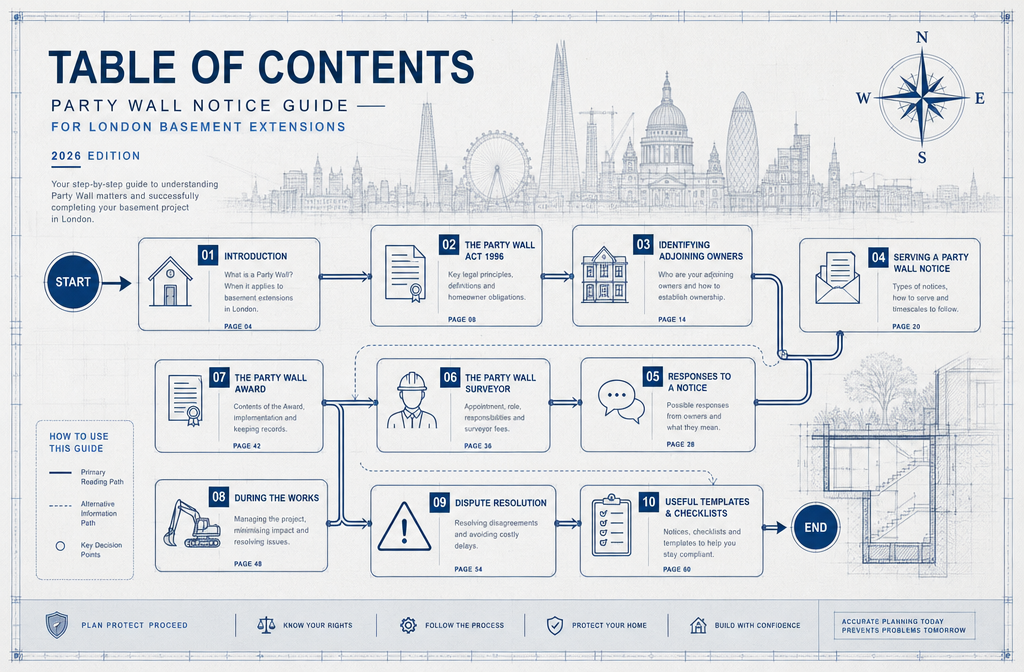
Table of Contents
- What Exactly Is a Party Wall Notice for Basement Work?
- Do You Need a Party Wall Agreement for a Basement Extension?
- Common Errors That Can Invalidate a Party Wall Notice
- What Makes a Party Wall Notice Legally Compliant in 2026?
- What Happens If You Don't Serve a Proper Party Wall Notice?
- How Long Is a Party Wall Notice Valid?
- Who Pays for the Party Wall Surveyor in London Basement Projects?
- How Much Does a Party Wall Agreement Cost in London?
- Can a Neighbour Block Your Basement Extension?
- Single-Storey vs. Basement Extensions: Notice Differences
- Risks of Skipping or Incorrectly Filing a Party Wall Notice
- FAQ
What Exactly Is a Party Wall Notice for Basement Work?
A party wall notice is a formal written document that a building owner must serve on adjoining owners before carrying out certain works near or on a shared boundary or structure. For basement and deep rear extensions in London, this notice is a legal requirement under the Party Wall etc. Act 1996 — not a courtesy.
For basement projects specifically, three notice types commonly apply:
- Section 1 Notice (Line of Junction Notice): Required when building a new wall at or astride the boundary line.
- Section 2 Notice (Party Structure Notice): Required when works affect a shared (party) wall or structure — for example, cutting into a shared wall to insert a beam or underpin it.
- Section 6 Notice (Adjacent Excavation Notice): Required when excavating within 3 metres of an adjoining building or structure to a depth lower than that building's foundations, or within 6 metres if the excavation point falls within a 45-degree line drawn down from the base of the neighbour's foundation.
The Section 6 notice is the one most frequently missed in basement projects. Many homeowners assume that because they are not touching the shared wall, no notice is needed. That assumption is wrong and expensive. For a detailed breakdown of how these notices work, see this guide to party wall notices and how to respond.
Do You Need a Party Wall Agreement for a Basement Extension?
Almost certainly yes, if your basement extension involves excavation within 3 or 6 metres of a neighbouring property, or if works affect a shared wall. In London's dense terrace and semi-detached housing stock, it is rare for a basement project to avoid the Act entirely.
The key triggers are:
- Underpinning or strengthening foundations of a party wall (Section 2)
- Excavating below the level of a neighbour's foundations within 3 metres (Section 6, first limb)
- Excavating within 6 metres where the excavation intersects a 45-degree plane from the bottom of the neighbour's foundation (Section 6, second limb)
Even a modest rear extension with a small basement element can trigger Section 6 if the ground conditions mean your excavation goes deeper than your neighbour's existing footings. A structural engineer's drawings will usually confirm whether this threshold is met. When in doubt, serve the notice — failing to do so carries far greater risk than the administrative effort of serving one unnecessarily.
For homeowners unsure of their obligations, the Party Wall etc. Act 1996 overview sets out the statutory framework clearly.
Common Errors That Can Invalidate a Party Wall Notice
The most frequent party wall notice mistakes in basement extensions London 2026 homeowners make fall into a predictable pattern. Awareness of these errors before serving notice can save months of delays.
1. Serving the wrong notice type
Serving only a Section 2 notice when Section 6 is also required (or vice versa) is among the most common errors. Each section of the Act addresses different works and has different notice periods.
2. Serving notice on the wrong person
Notice must be served on the legal owner of the adjoining property — not just the occupier. If the property is rented, the freeholder and any long leaseholder with a term exceeding one year must both be served. Missing a qualifying owner invalidates the notice.
3. Incorrect or incomplete notice content
A valid notice must include: the building owner's name and address, a description of the proposed works, the proposed start date, and (for Section 6) the depth of excavation and a plan. Omitting any of these can render the notice defective.
4. Wrong notice period
- Section 2 (Party Structure Notice): 2 months before works begin.
- Section 6 (Adjacent Excavation): 1 month before works begin.
- Section 1 (Line of Junction): 1 month before works begin.
Starting works before these periods expire is a breach of the Act.
5. Serving notice too early
Notices are valid for 12 months from the date of service. If your project is delayed beyond that window, you must re-serve.
6. Assuming no response means consent
If a neighbour does not respond within 14 days of receiving a party wall notice, a dispute is deemed to arise automatically. This is not consent — it triggers the mandatory appointment of surveyors. Many building owners incorrectly proceed with works at this point.
7. Failing to commission a Schedule of Condition
A Schedule of Condition documents the pre-works state of the neighbour's property. Without it, any crack or defect discovered after excavation becomes a he-said-she-said dispute, often resolved against the building owner.
What Makes a Party Wall Notice Legally Compliant in 2026?
A legally compliant party wall notice in 2026 must satisfy the requirements set out in the Party Wall etc. Act 1996 — the legislation has not changed, but enforcement awareness among London homeowners and their solicitors has increased significantly as basement conversions have multiplied.
A compliant notice must:
| Requirement | Section 2 Notice | Section 6 Notice |
|---|---|---|
| Building owner's full name and address | ✅ | ✅ |
| Description of proposed works | ✅ | ✅ |
| Proposed start date | ✅ | ✅ |
| Plans and sections showing excavation depth | Not always required | ✅ Required |
| Served on all qualifying adjoining owners | ✅ | ✅ |
| Served within correct notice period | 2 months prior | 1 month prior |
Notices should be served by hand, recorded delivery, or (if the adjoining owner cannot be found) fixed to a conspicuous part of the premises. Email is not a recognised method of service under the Act unless the adjoining owner has explicitly agreed to it in writing.
For a practical starting point, a sample party wall notice template can help homeowners understand what a compliant document looks like — though professional review is always advisable.
What Happens If You Don't Serve a Proper Party Wall Notice?
Skipping or incorrectly serving a party wall notice does not make the legal obligation disappear — it simply means you proceed without the protections the Act provides, while still being exposed to its penalties.
Potential consequences include:
- Injunction: An adjoining owner can apply to court to stop works immediately. Courts have granted injunctions to halt basement excavations mid-project, which can be catastrophic for programme and budget.
- Damages claim: If excavation causes settlement, cracking, or other damage to a neighbour's property without a prior Award in place, the building owner faces an unprotected damages claim. Without a Schedule of Condition, pre-existing defects cannot be distinguished from new damage.
- Retrospective process: Courts have sometimes required building owners to retrospectively go through the party wall process, including appointing surveyors and paying all associated costs, even after works are complete.
- Difficulty selling: Solicitors acting on property sales routinely check for party wall compliance. Missing documentation can delay or complicate a future sale.
London's densification trend — with more loft conversions, basement digs, and rear extensions than ever — means neighbours are increasingly aware of their rights. Assuming a neighbour won't notice or won't act is a risky strategy.
How Long Is a Party Wall Notice Valid?
A party wall notice is valid for 12 months from the date it is served. If works have not commenced within that period, a fresh notice must be served before excavation or structural works begin.
This is a practical consideration for London basement projects, which frequently face delays due to planning permission timelines, contractor availability, or structural design revisions. Homeowners who serve notice promptly but then experience a 13-month delay to start on site must repeat the entire process, including the waiting period and any surveyor appointments.
Practical tip: Serve notice as soon as your structural drawings are sufficiently advanced to describe the works accurately — but not so far in advance that the 12-month validity window expires before you break ground.
Who Pays for the Party Wall Surveyor in London Basement Projects?
In the vast majority of cases, the building owner (the person carrying out the works) pays the reasonable fees of both their own surveyor and the adjoining owner's surveyor. This is the default position under the Party Wall etc. Act 1996, and it applies even if the adjoining owner appoints an expensive surveyor.
There are limited exceptions: if an adjoining owner makes unreasonable requests or behaves obstructively, a surveyor making an Award can apportion costs differently. But this is uncommon in practice.
For adjoining owners, this means you can appoint your own surveyor at no cost to yourself — which is why many London neighbours do so as a matter of course. For building owners, it underlines why keeping the process efficient matters. See how to keep party wall costs down for practical strategies.
How Much Does a Party Wall Agreement Cost in London?
Approximate costs for a party wall agreement in London for a basement extension typically range from £750 to £1,800 per adjoining owner in surveyor fees, though this varies based on project complexity, the number of surveyors appointed, and whether an agreed or disputed process is followed.
Cost breakdown (approximate):
- Building owner's surveyor: £750–£1,500 (their own fees)
- Adjoining owner's surveyor: £750–£1,800 (paid by the building owner)
- Third surveyor (if appointed): Additional fees if the two surveyors cannot agree
- Schedule of Condition: Often included within the surveyor's fee, but sometimes charged separately
For a typical London terrace with two adjoining neighbours, total surveyor costs could reach £3,000–£5,000 or more, depending on complexity. The timeline from serving notice to receiving a Party Wall Award is typically 2–4 months, assuming neighbours respond and surveyors are appointed promptly.
A Party Wall Award is the formal document produced by the surveyors that governs how works are carried out, protects both parties, and records the Schedule of Condition. It is not optional once a dispute is deemed to have arisen. For a full cost breakdown, the party wall costs and process guide provides detailed context.
Can a Neighbour Block Your Basement Extension?
A neighbour cannot permanently block a basement extension simply by dissenting to a party wall notice. The Act is designed to allow works to proceed while protecting adjoining owners — not to give neighbours a veto.
What dissent (or deemed dissent after 14 days of silence) does is trigger the surveyor appointment process, leading to a Party Wall Award that sets the conditions under which works can proceed. The Award may impose restrictions on working hours, methods, or monitoring requirements, but it does not prevent the works from happening.
However, a neighbour can apply for an injunction if works begin without proper notice, or if the building owner breaches the terms of an Award. This is where the real risk lies. Courts have occasionally granted injunctions to halt ongoing basement excavations where the Act has been ignored.
The distinction matters: follow the Act correctly, and a difficult neighbour has limited ability to stop your project. Ignore the Act, and even a cooperative neighbour's solicitor can cause serious disruption.
Single-Storey vs. Basement Extensions: Notice Differences
For a standard single-storey rear extension that does not involve significant excavation, the party wall obligations are often limited to a Section 2 notice if the works affect a shared wall, or no notice at all if the extension is entirely within the building owner's own land and does not touch or excavate near the boundary.
Basement extensions are fundamentally different because of the excavation depth involved.
Key differences:
| Factor | Single-Storey Rear Extension | Basement Extension |
|---|---|---|
| Section 2 notice likely? | Sometimes (if party wall affected) | Often yes (underpinning) |
| Section 6 notice likely? | Rarely | Almost always |
| Schedule of Condition needed? | Advisable | Essential |
| Typical notice period | 2 months (S2) | 1 month (S6) + 2 months (S2) |
| Surveyor involvement | Sometimes avoidable | Rarely avoidable |
The excavation depth of a basement — typically 2.5 to 4 metres in London terraces — almost always brings the works within the 3-metre or 6-metre zones of Section 6. This is the single biggest reason why party wall notice mistakes basement extensions London 2026 are so prevalent: homeowners apply the same mental model they used for a loft conversion or single-storey extension and find it does not translate.
For a broader view of the types of party wall works that trigger the Act, that resource covers the full range of scenarios.
Risks of Skipping or Incorrectly Filing a Party Wall Notice
The risks of ignoring or mishandling party wall notices in basement projects are not theoretical. They are financial, legal, and practical.
Summary of key risks:
- Court injunction halting works mid-excavation, with daily costs accumulating on site
- Unprotected damage liability if settlement or cracking occurs without a prior Award
- Retrospective surveyor costs imposed by court, often higher than if the process had been followed correctly from the start
- Project delays of weeks or months while the dispute is resolved
- Damaged neighbour relationships that complicate ongoing access requirements during construction
- Conveyancing complications when selling the property in future
The cost of getting party wall notices right — including professional surveyor fees — is almost always lower than the cost of getting them wrong. For London homeowners planning basement work, consulting a qualified party wall surveyor before serving any notice is the single most effective risk-reduction step available.
Regional resources for London homeowners include specialists covering East London, South London, North London, and West London.
Conclusion: Actionable Next Steps for London Homeowners
Party wall notice mistakes in basement extensions remain one of the most avoidable sources of construction disputes in London. The Act is not complicated once you understand which sections apply to your specific works — but the consequences of misapplying it are disproportionately large.
Before breaking ground on any basement or deep rear extension:
- Confirm your excavation depth and proximity to boundaries with your structural engineer.
- Identify all qualifying adjoining owners — freeholders, long leaseholders, and any owner within the 3m or 6m zones.
- Determine which notices apply (Section 1, 2, and/or 6) based on your specific works.
- Engage a qualified party wall surveyor to draft and serve notices correctly — do not rely on template letters alone for complex basement projects.
- Allow for the statutory waiting periods (1 month for Section 6, 2 months for Section 2) in your project programme.
- Commission a Schedule of Condition before any excavation begins.
- Obtain the Party Wall Award before works commence, and keep a copy on site throughout the project.
The 2–4 month timeline and approximate £750–£1,800 per-neighbour cost are manageable when planned for. They become painful when they arrive as surprises mid-project.
FAQ
Q: Can I serve a party wall notice myself, without a surveyor?
A: Yes, legally you can serve notice yourself. However, for basement extensions — where multiple notice types often apply and errors are costly — professional preparation is strongly advisable. A surveyor will ensure the correct notice type, content, and service method are used.
Q: What happens if my neighbour ignores my party wall notice?
A: If a neighbour does not respond within 14 days, a dispute is automatically deemed to arise under the Act. This is not consent. Both parties must then appoint surveyors (or agree on a single agreed surveyor) to produce a Party Wall Award before works begin.
Q: Does planning permission replace the need for a party wall notice?
A: No. Planning permission and party wall notices are entirely separate legal processes. Obtaining planning consent does not satisfy party wall obligations, and vice versa.
Q: How far from my boundary does Section 6 apply?
A: Section 6 applies if you excavate within 3 metres of an adjoining building or structure to a depth below that building's foundations. It also applies within 6 metres if the excavation point falls within a 45-degree line drawn downward from the base of the neighbour's foundation. Both thresholds are measured from the neighbouring structure, not the boundary line.
Q: Can I start works if my neighbour consents in writing within 14 days?
A: Yes. Written consent (known as "agreement in writing") within the 14-day response period means you can proceed without a formal Award, provided works stay within what was described in the notice. A Schedule of Condition is still strongly advisable even with consent.
Q: What is a Party Wall Award and is it legally binding?
A: A Party Wall Award is a formal document produced by the appointed surveyors that sets out the rights and obligations of both parties regarding the notifiable works. It is legally binding and can be enforced in the county court. It typically includes the Schedule of Condition, permitted working hours, and any monitoring requirements.
Q: Do I need a party wall notice if my basement is entirely within my own property footprint?
A: Possibly still yes, if the excavation is within 3 or 6 metres of a neighbouring structure under Section 6. The footprint of your property is not the determining factor — the proximity and depth of excavation relative to neighbouring foundations is what matters.
References
- UK Government. Party Wall etc. Act 1996. legislation.gov.uk. https://www.legislation.gov.uk/ukpga/1996/40/contents
- Ministry of Housing, Communities and Local Government. Party Wall etc. Act 1996: explanatory booklet. 2016. https://www.gov.uk/government/publications/party-wall-etc-act-1996-explanatory-booklet