

A party wall surveyor is paid by one or both neighbours — yet the law demands they act for neither. That paradox sits at the heart of every dispute under the Party Wall etc. Act 1996, and misunderstanding it costs homeowners time, money, and neighbourly goodwill every year in London alone.
The question of joint appointments, conflicts of interest, and impartiality is not merely academic. Whether a surveyor is jointly appointed or separately appointed, their statutory duty under the Act is the same: to determine matters impartially, in the interests of both owners sharing the wall or structure. Recent case law, updated RICS guidance, and the Faculty of Party Wall Surveyors (FPWS) Code of Conduct all reinforce this principle — and all confirm the consequences when it breaks down [2][5].
This article explains, in plain terms, how surveyors manage these duties in practice, what the rules say about conflicts of interest, and how owners can protect themselves whether they are carrying out works or living next door.
Key Takeaways 🔑
- A party wall surveyor is a statutory appointee, not a client advocate — even when paid by just one party.
- Joint (agreed) appointments are lawful and cost-effective but remove the built-in "third surveyor" safety valve.
- Separate appointments trigger the right to a third surveyor, providing a vital impartial escalation route.
- Conflicts of interest must be disclosed and can void an award if they compromise natural justice.
- RICS and FPWS are tightening standards on independence, especially for high-volume urban projects.
What the Party Wall etc. Act 1996 Actually Says About Impartiality
The Surveyor as Statutory Decision-Maker
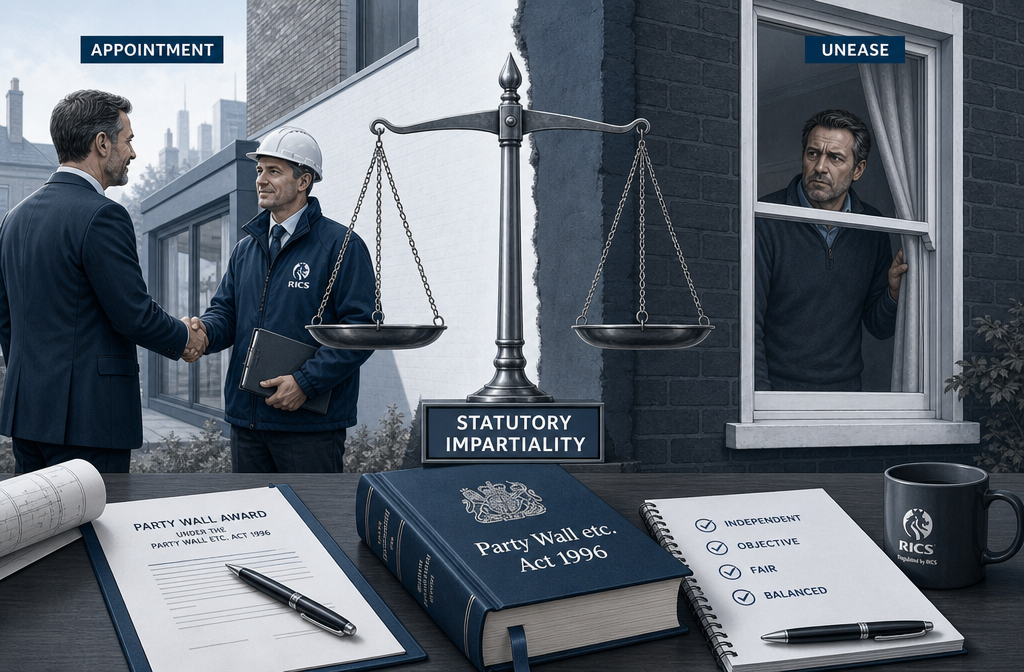
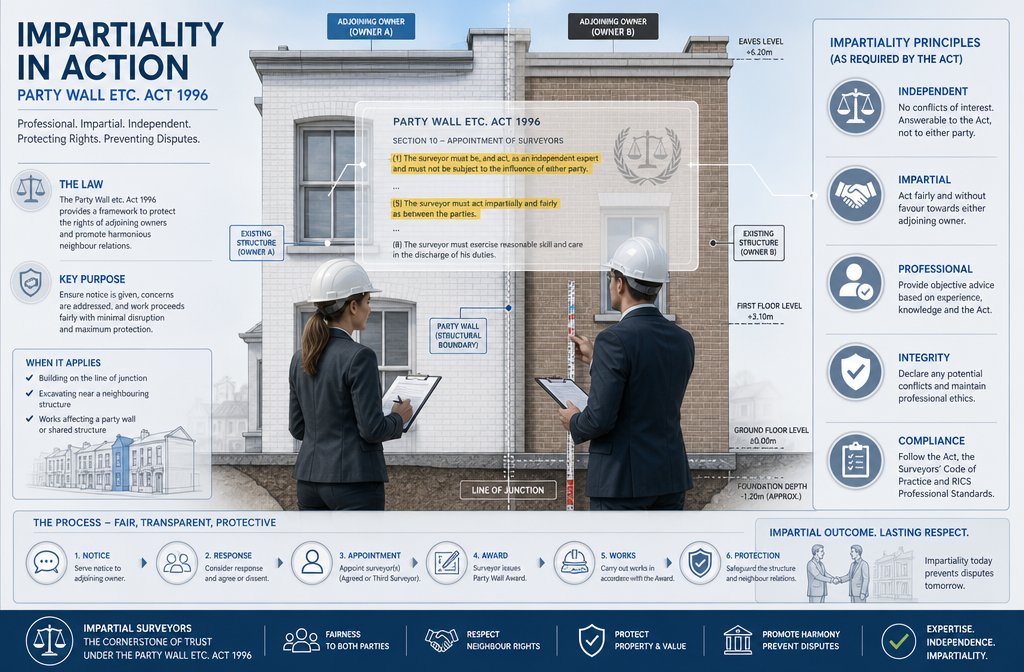
Most people assume a surveyor works for the person who hired them. Under the Party Wall etc. Act 1996, that assumption is wrong. The courts have consistently held that a party wall surveyor "is not an agent of or mouthpiece for the owner who appointed them" [2]. Instead, they are a statutory decision-maker whose duty runs to both owners — and ultimately to the proper administration of the Act.
This means:
- A surveyor appointed solely by the building owner must still consider the adjoining owner's interests when drawing up a party wall award.
- A surveyor appointed solely by the adjoining owner cannot simply obstruct reasonable works to please their appointing owner.
- Both surveyors must approach the dispute as neutral arbiters, not partisan advocates.
💬 "The party wall surveyor occupies a unique role — part quasi-arbitrator, part technical expert, part statutory officer. That uniqueness demands a higher standard of independence than ordinary professional appointments." [5]
Natural Justice and the Risk of Voidable Awards
If a surveyor breaches impartiality, the consequences are serious. Awards can be set aside by the county court under section 10(17) of the Act if they are shown to violate natural justice — for example, where a surveyor failed to hear both parties fairly, acted outside jurisdiction, or appeared biased [2][6].
This is not a theoretical risk. RICS-linked analysis on boundary and party wall work warns surveyors to avoid accepting appointments where they have close commercial or personal ties to either party, or where they might be seen as pre-committed to a particular outcome [6].
Joint Appointments, Conflicts of Interest, and Impartiality: The Agreed Surveyor Model
How Joint Appointments Work
Under section 10(1)(b) of the Act, both owners may agree to appoint a single "agreed surveyor" instead of each appointing their own. This is sometimes called a joint appointment or agreed surveyor appointment. It is entirely lawful and, in straightforward cases, genuinely efficient.
Advantages of the agreed surveyor route:
| Factor | Agreed Surveyor | Separate Surveyors |
|---|---|---|
| 💰 Cost | Lower (one fee) | Higher (two or three fees) |
| ⏱️ Speed | Faster (one decision-maker) | Slower (negotiation required) |
| 🔄 Escalation route | Limited (court only) | Third surveyor available |
| ⚖️ Perceived neutrality | Potentially questioned | Clearer structural separation |
| 🏗️ Best for | Simple, low-risk works | Complex or contentious works |
For a typical loft conversion or rear extension, the agreed surveyor route is often sensible. Both neighbours save money, the award is produced quickly, and the process moves on.
The Hidden Risk: No Third Surveyor Safety Valve
Here is the critical limitation that many owners do not realise until it is too late. When an agreed surveyor is appointed, there is no third surveyor. Under section 10 of the Act, the third surveyor mechanism only applies where each owner has appointed their own surveyor. If the agreed surveyor makes an error, appears biased, or is perceived as favouring one party, the only formal remedy is an appeal to the county court — which is slower, more expensive, and more adversarial than invoking the third surveyor [3][10].
Practitioners have documented real-world failures where agreed surveyors, consciously or not, aligned too closely with the building owner's programme or budget pressures, leaving the adjoining owner feeling unprotected [10]. The FPWS Code of Conduct requires surveyors to disclose any interest that might affect independence and to decline or cease an appointment where a significant conflict arises [8].
Practical safeguards for agreed surveyor appointments:
- ✅ Document the joint appointment clearly in writing from the outset
- ✅ Explain impartiality obligations to both owners at the first contact
- ✅ Maintain full transparency on fees and how decisions are reached
- ✅ Prepare a thorough schedule of condition before works begin
- ✅ Confirm in writing that either owner may challenge the award in court if dissatisfied
For higher-risk projects — deep basements, high-value developments, complex engineering — many practitioners now recommend separate surveyors as a matter of course, even where both owners might initially prefer the cheaper joint route [10].
Separate Appointments, Third Surveyors, and Conflict-of-Interest Checks
How the Two-Surveyor Model Protects Both Parties
When each owner appoints their own surveyor — the building owner's surveyor and the adjoining owner's surveyor — the Act requires them to select a third surveyor at the outset. This is not optional. Section 10(1)(b) mandates it, and the selection must be made before any substantive work begins.
The third surveyor is the Act's primary impartiality mechanism. They can be invoked by:
- Either owner directly
- Either appointed surveyor
- The situation where the two appointed surveyors cannot agree
Recent legal commentary re-emphasises that once a third surveyor is properly selected in writing, surveyors cannot change that selection except in very narrow circumstances [7]. This underscores the importance of choosing a genuinely independent, conflict-free third surveyor from the start.
Conflict-of-Interest Checks in Practice
Before accepting any appointment, a competent party wall surveyor should run through the following checks:
🔍 Pre-Appointment Conflict Check:
- Do they have any financial interest in the outcome of the works?
- Have they worked for either owner in the past 12–24 months?
- Do they have a personal relationship with either owner or their contractors?
- Are they already acting as third surveyor on a related project involving the same parties?
- Would a reasonable observer question their independence?
If the answer to any of these is "yes," the surveyor must disclose the conflict and, in most cases, decline the appointment [8]. The FPWS Code of Conduct makes this explicit: members must decline or cease appointments where a significant conflict arises, and must keep owners informed about any limitations in their expertise or independence [8].
💡 Key point: Impartiality is not just an ethical standard — it is a negligence and liability issue. Where there is a significant risk that a surveyor's interpretation of the Act may be wrong, they have a duty to warn their client. Failing to do so may be negligent [6].
The RICS Consultation: Tightening Standards for 2026
RICS has been consulting on updated party wall practice guidance throughout the 2024–2026 period, driven by rising case volumes and growing concerns about impartiality in high-volume urban projects [9]. The draft guidance focuses on:
- Clearer record-keeping of appointments and declarations of interest
- Expectations around third surveyor neutrality, particularly on large multi-unit or repeat-client work
- Transparency on fees and delegation, so owners know exactly who is making decisions and why
Although final guidance text is still emerging as of 2026, the direction of travel is clear: more robust, codified standards for independence [9]. Surveyors who rely on informal arrangements or who take on repeat work for the same developer clients without proper conflict checks face increasing professional and legal risk.
Joint Appointments, Conflicts of Interest, and Impartiality: Practical Guidance for Owners

If You Are the Building Owner
If you are planning works that affect a shared wall or structure, understanding how surveyor appointments work will save you time and money. Start by reviewing what party wall notices need to be served and when.
Key steps to protect yourself:
- Choose your surveyor carefully. Look for RICS or FPWS membership, relevant experience, and a clear explanation of their impartiality duties.
- Do not pressure your surveyor to rush the award or minimise the adjoining owner's concerns. A surveyor who yields to that pressure is not acting lawfully — and an award produced under such conditions may be challenged.
- Understand the costs. The costs of the party wall process are generally borne by the building owner. Trying to cut corners by appointing a cheap agreed surveyor on a complex project can lead to far greater costs if the award is challenged or set aside.
- Consider a joint appointment only for straightforward works. If your project involves significant structural risk or a neighbour who is already concerned, separate surveyors may be wiser.
If You Are the Adjoining Owner
If your neighbour is carrying out works and has served notice, you have important rights. See our guidance on what to do when your neighbour is carrying out works.
Key steps to protect yourself:
- You have the right to appoint your own surveyor — and in most cases, the building owner pays for it. Do not feel pressured to accept an agreed surveyor if you are uncomfortable.
- Ask about conflicts of interest before agreeing to a joint appointment. Has this surveyor worked for your neighbour before? Do they regularly act for the same developer?
- Insist on a schedule of condition before works begin. This documents the existing state of your property and is essential if you later need to claim for damage.
- Know the escalation routes. If you have separate surveyors and cannot agree, the third surveyor can be invoked. If you have an agreed surveyor and are unhappy, the county court is the formal route — but try to raise concerns early, in writing, with the surveyor first.
Red Flags to Watch For 🚩
The following situations should prompt owners to seek independent advice:
| Red Flag | Why It Matters |
|---|---|
| Surveyor refuses to explain their impartiality obligations | Suggests lack of awareness or willingness to be transparent |
| Agreed surveyor has an ongoing commercial relationship with the building owner | Classic conflict-of-interest scenario |
| Third surveyor selection is delayed or avoided | Removes the key escalation mechanism |
| Award is produced unusually quickly with minimal consultation | May indicate one party's concerns were not properly considered |
| Surveyor discourages the adjoining owner from seeking their own advice | Potentially improper conduct under FPWS Code [8] |
Why Impartiality Matters Beyond the Paperwork
The practical stakes of surveyor independence go beyond legal technicalities. When a surveyor genuinely acts impartially:
- Disputes resolve faster, because both owners trust the process
- Awards are more robust, because they withstand scrutiny from both sides
- Damage claims are handled fairly, because the schedule of condition was thorough and neutral
- Professional reputations are protected, because neither owner can later claim they were disadvantaged
When impartiality fails — even in perception — the opposite happens. Owners litigate. Awards are appealed. Relationships between neighbours deteriorate. And surveyors face professional complaints, cost orders, or negligence claims [4][6].
The FPWS Code of Conduct provides an additional layer of protection beyond the Act itself [8]. Members who breach conflict-of-interest or impartiality rules face disciplinary action. This professional accountability layer is one reason why choosing a FPWS or RICS member surveyor is strongly advisable.
Whether you are in Central London, South London, North London, or East London, the density of party wall work in urban areas means the risk of encountering a surveyor with undisclosed conflicts is real. Knowing your rights under the Act — and what questions to ask — is your best protection.
Conclusion: Practical Next Steps
The rules around joint appointments, conflicts of interest, and impartiality under the Party Wall Act are not bureaucratic formalities. They are the foundation of a system designed to let neighbours resolve building disputes fairly, without going to court.
Here is what to do right now:
- Before serving or responding to a party wall notice, read up on what party wall notices involve and how to respond.
- When choosing a surveyor, ask directly: "Have you worked for this owner or developer before? Do you have any interest in the outcome of these works?"
- If considering a joint appointment, weigh the cost savings against the complexity of the project and the level of trust between neighbours.
- If appointing separately, confirm the third surveyor selection in writing at the earliest opportunity.
- If you have concerns about a surveyor's conduct, raise them in writing immediately — do not wait until the award is issued.
- Seek RICS or FPWS members who are subject to professional codes of conduct that go beyond the statutory minimum.
The Act gives both owners powerful protections. But those protections only work when the surveyors involved take their independence seriously — and when owners know enough to hold them to it.
References
[1] Analysis Of Party Wall Surveyors Impartiality – https://iconsurveyors.co.uk/blog/analysis-of-party-wall-surveyors-impartiality/
[2] Party Wall Surveyors Impartiality – https://ww3.rics.org/uk/en/journals/built-environment-journal/party-wall-surveyors-impartiality.html
[3] Exploring The Pros And Cons Of Agreed Surveyors Versus Separate Surveyors In Party Wall Disputes – https://www.partywalllondonlimited.com/post/exploring-the-pros-and-cons-of-agreed-surveyors-versus-separate-surveyors-in-party-wall-disputes
[4] How Far Can Party Wall Surveyors Go To Protect Adjoining Owners – https://www.adamjoseph.co.uk/how-far-can-party-wall-surveyors-go-to-protect-adjoining-owners
[5] The Unique Role Of A Party Wall Surveyor – https://dwfgroup.com/en/news-and-insights/insights/2017/4/the-unique-role-of-a-party-wall-surveyor
[6] Boundary Disputes Unbiased Work – https://www.isurv.com/info/390/features_archive/11913/boundary_disputes_unbiased_work
[7] Third Party Mechanisms In Party Wall Deadlocks Rics Guidance For 2026 High Volume Projects – https://princesurveyors.co.uk/blog/third-party-mechanisms-in-party-wall-deadlocks-rics-guidance-for-2026-high-volume-projects/
[8] 2021 06 29 005 Guide To Code Of Conduct – https://fpws.org.uk/wp-content/uploads/2021/07/2021-06-29-005-Guide-to-Code-of-Conduct.pdf
[9] James Kavanagh RICS Launches Consultation On Updated Party Wall Activity – https://www.linkedin.com/posts/james-kavanagh-65448b17_rics-launches-consultation-on-updated-party-activity-7448044807869988865-vPZF
[10] The Failure Of The Agreed Surveyor Appointment – https://akt-surveyors.com/the-failure-of-the-agreed-surveyor-appointment/