


Construction projects in 2026 are witnessing a digital transformation that extends far beyond basic 3D modeling. As Building Information Modeling (BIM) technology advances, forward-thinking surveyors and construction professionals are discovering powerful new ways to manage one of the most sensitive aspects of property development: party wall agreements. The integration of Party Wall Notices and BIM Integration: Embedding Geospatial Data into Construction Information Models for 2026 Projects represents a significant leap forward, allowing teams to embed boundary data, neighbor agreements, and compliance requirements directly into digital construction models—reducing conflicts before the first shovel breaks ground. 🏗️
This convergence of legal compliance and digital modeling is revolutionizing how construction teams approach party wall notices and neighbor relations. Rather than treating party wall procedures as separate administrative tasks, modern projects can now integrate this critical information into the very fabric of their construction information models.
Key Takeaways
- BIM integration allows party wall data to be embedded directly into construction models, improving coordination and reducing boundary disputes
- Geospatial accuracy ensures precise property boundaries, excavation zones, and neighbor agreements are visualized in 3D space
- Automated compliance checking within BIM systems can flag potential party wall violations before construction begins
- Cloud-based collaboration enables real-time sharing of party wall information between surveyors, builders, and adjoining owners
- 2026 projects benefit from AI-powered clash detection that identifies conflicts between planned works and party wall constraints
Understanding Party Wall Notices in Modern Construction
What Are Party Wall Notices?
Party wall notices are formal legal notifications required under the Party Wall etc. Act 1996 when property owners plan construction work that affects shared walls, boundaries, or nearby structures. These notices serve three primary purposes:
- Inform adjoining owners about planned construction activities
- Establish legal protection for all parties involved
- Create a framework for resolving disputes before work begins
The Party Wall etc. Act 1996 covers three main types of work:
- New building on or at the boundary between properties
- Work directly to an existing party wall or party structure
- Excavation within 3 or 6 meters of a neighboring building's foundation
The Traditional Party Wall Process
Historically, party wall procedures have been paper-intensive, involving:
| Step | Traditional Method | Time Required |
|---|---|---|
| Notice service | Physical mail or hand delivery | 2-4 weeks |
| Surveyor appointment | Phone calls and meetings | 1-2 weeks |
| Site inspection | Manual measurements and photos | 1-2 days |
| Award preparation | Document drafting and revisions | 2-4 weeks |
| Ongoing monitoring | Periodic site visits | Throughout project |
This traditional approach often operates in isolation from the actual construction planning process, creating opportunities for miscommunication and conflicts. Understanding what types of party wall works trigger these requirements is essential for proper planning.
The BIM Revolution in Construction for 2026
What Is BIM and Why Does It Matter?
Building Information Modeling (BIM) is a digital representation of physical and functional characteristics of a building or infrastructure project. Unlike traditional 2D drawings, BIM creates intelligent 3D models that contain rich data about every component, from structural elements to mechanical systems.
In 2026, BIM has evolved significantly beyond its original scope. According to recent industry analysis, BIM is transforming smart construction projects through several key innovations[2]:
- Cloud-based collaboration platforms enabling real-time multi-party access
- AI-powered clash detection identifying conflicts automatically[1]
- Automated compliance checking against building regulations[5]
- Mobile integration for on-site access to model data
- IoT sensor integration for real-time construction monitoring
Current BIM Adoption Trends
The construction industry has reached a tipping point in BIM adoption. Large-scale projects now routinely require BIM Level 2 or higher, meaning:
✅ Collaborative working across all project disciplines
✅ Federated models combining architectural, structural, and MEP data
✅ Common data environments for information sharing
✅ 4D scheduling integration linking models to construction timelines
✅ 5D cost estimation embedding financial data into models
Party Wall Notices and BIM Integration: Embedding Geospatial Data into Construction Information Models for 2026 Projects
The Integration Opportunity
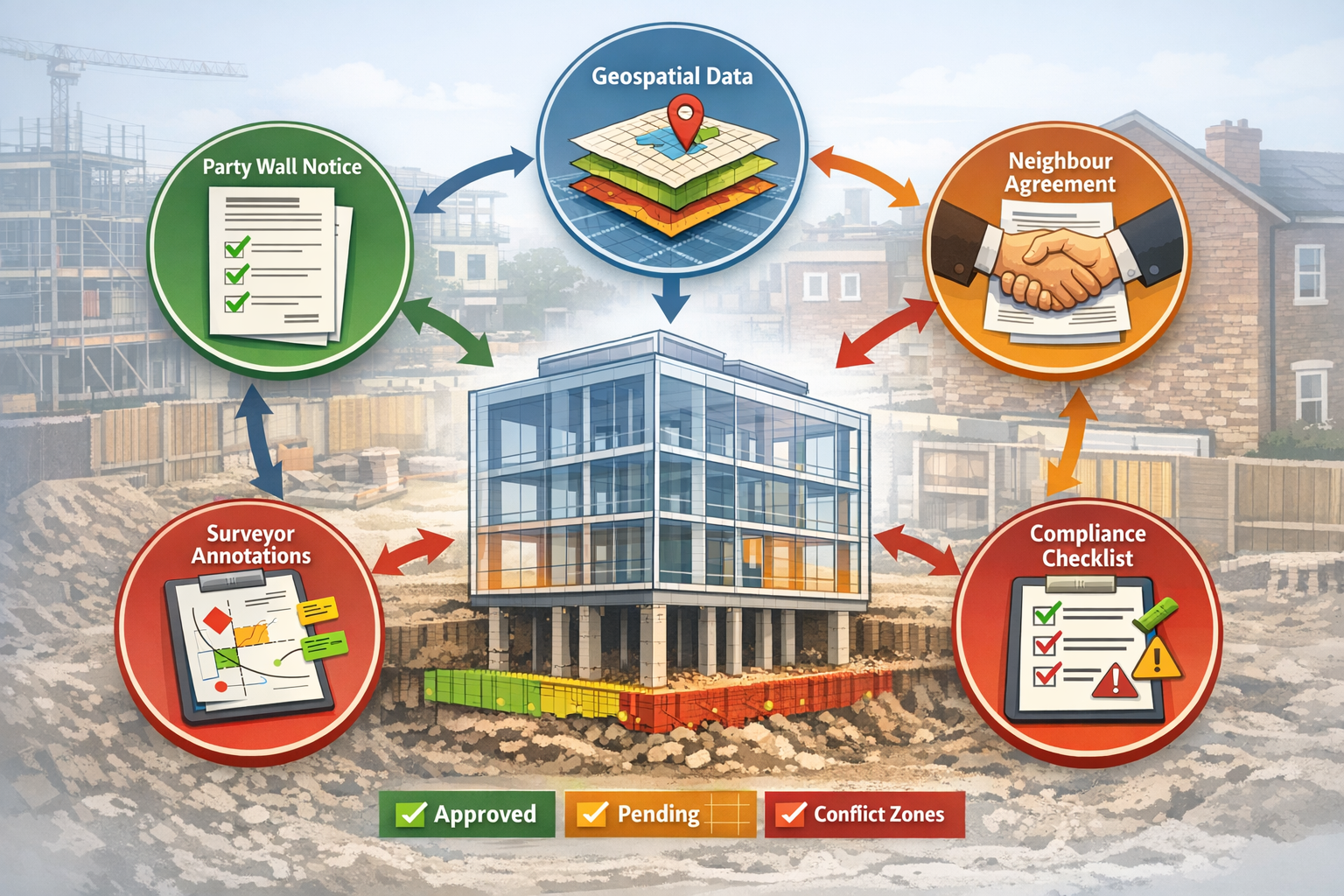
The convergence of party wall procedures and BIM technology creates unprecedented opportunities for construction coordination. By embedding geospatial data related to party wall notices directly into construction information models, project teams can:
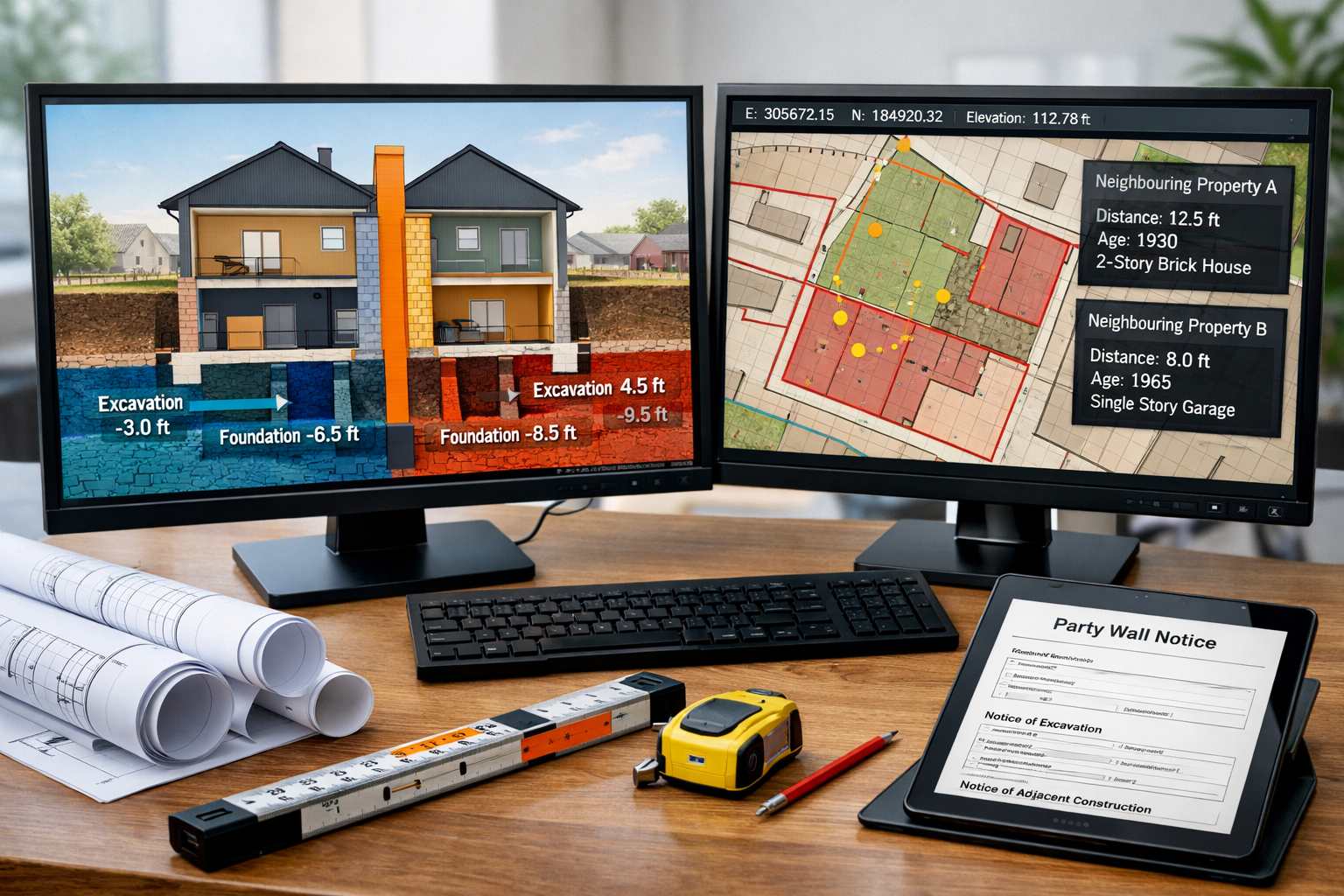
Visualize boundary constraints in 3D space – Rather than interpreting 2D property plans separately from construction drawings, integrated models show exact property lines, party wall locations, and excavation limits within the same 3D environment where construction is planned.
Automate conflict detection – BIM software can automatically flag when proposed foundations, excavations, or structural elements encroach on party wall zones or violate agreed-upon constraints from party wall awards.
Centralize compliance documentation – All party wall notices, neighbor consents, surveyor reports, and condition schedules can be linked directly to the relevant model elements, creating a single source of truth.
Enable real-time collaboration – Surveyors, architects, structural engineers, and contractors can all access the same geospatially accurate model, reducing miscommunication about boundary locations and permitted works.
Geospatial Data Components for Party Wall Integration
To effectively integrate party wall information into BIM models, several types of geospatial data must be accurately captured and embedded:
Property Boundary Coordinates
- Precise GPS coordinates defining legal property boundaries
- Historical boundary survey data
- Land registry information
- Easement and right-of-way data
Party Wall Locations
- Exact position of shared walls and structures
- Wall thickness and material composition
- Structural load-bearing characteristics
- Historical modification records
Excavation Zones
- 3-meter and 6-meter zones from adjoining foundations
- Depth of neighboring foundations
- Soil condition data
- Groundwater levels and drainage patterns
Neighbor Property Data
- Adjacent building footprints and heights
- Foundation types and depths
- Structural vulnerabilities
- Access routes and construction logistics constraints
Consent and Agreement Status
- Which neighbors have received notices
- Consent or dissent status for each adjoining owner
- Surveyor appointment details
- Conditions and restrictions from awards
Technical Implementation Approaches
Several technical pathways exist for embedding this geospatial party wall data into BIM models:
1. Direct Modeling Within BIM Software
Modern BIM platforms like Revit, ArchiCAD, and Vectorworks support custom parameters and geospatial referencing. Party wall data can be added through:
- Custom parameter sets attached to wall, foundation, and boundary elements
- Linked reference models showing neighboring properties and constraints
- Annotation layers highlighting party wall zones and restrictions
- Shared coordinates ensuring accurate geographic positioning
2. GIS-BIM Integration
Geographic Information System (GIS) platforms excel at managing spatial data. Integration approaches include:
- Data exchange formats like IFC (Industry Foundation Classes) and CityGML
- API connections between GIS databases and BIM platforms
- Geospatial overlays imported as reference layers
- Coordinate system alignment ensuring spatial accuracy
3. Cloud-Based Common Data Environments
Platform solutions that combine document management, model hosting, and collaboration tools:
- Centralized repositories for all party wall documentation
- Model viewers with embedded document links
- Permission-based access for different stakeholders
- Version control tracking changes to agreements and models
- Mobile access for on-site reference
Case Study: Data Centre Development
Recent analysis of party wall agreements in data centre developments highlights the growing importance of this integration. Data centre projects frequently trigger Party Wall Act obligations due to significant excavation depths and heavy foundation requirements[4].
In a typical 2026 data centre project, BIM integration enables:
- Foundation clash detection identifying conflicts with neighboring basements before excavation
- Vibration impact modeling showing which adjacent structures may be affected
- Access route planning coordinating construction logistics with neighbor concerns
- Phased construction visualization demonstrating how works will progress to minimize disruption
Practical Benefits of Party Wall Notices and BIM Integration for 2026 Construction Projects
Reducing Pre-Construction Conflicts
The most significant benefit of integrating party wall data into BIM models is early conflict identification. Traditional approaches often discover boundary issues only after construction begins, leading to costly delays and disputes.
With integrated models, project teams can:
🔍 Identify encroachments before finalizing designs
🔍 Optimize foundation layouts to minimize party wall impacts
🔍 Plan excavation sequences that respect neighbor constraints
🔍 Visualize construction access routes without boundary violations
Improving Stakeholder Communication
Party wall disputes often arise from misunderstandings about what work is planned and how it will affect neighboring properties. BIM models provide powerful communication tools:
Visual presentations – Showing adjoining owners exactly what is proposed in 3D, rather than expecting them to interpret technical drawings
Impact simulations – Demonstrating construction sequences, noise zones, and temporary access requirements
Before-and-after comparisons – Illustrating the finished project in relation to existing structures
Progress tracking – Providing neighbors with visual updates showing compliance with agreed conditions
This improved communication can significantly reduce party wall costs by minimizing disputes and accelerating agreement processes.
Streamlining Surveyor Workflows
Party wall surveyors benefit substantially from BIM integration:
Accurate measurements – Digital models provide precise dimensions and spatial relationships, reducing site measurement time
Condition documentation – Schedule of condition photographs and notes can be linked directly to model elements
Award preparation – Automatically generating descriptions of works from model data
Ongoing monitoring – Comparing as-built conditions against original models to verify compliance
Enhancing Compliance and Risk Management
Regulatory compliance becomes more manageable when party wall constraints are embedded in construction models:
- Automated checks flag potential violations during design development
- Audit trails document when and how party wall considerations were addressed
- Risk visualization highlights areas of highest dispute potential
- Insurance documentation provides clear evidence of due diligence
The future of BIM extends beyond mere compliance to become a comprehensive project management platform[5].
Implementation Challenges and Solutions
Data Accuracy and Survey Quality
Challenge: Party wall integration is only as good as the underlying geospatial data. Inaccurate boundary surveys or outdated property information can lead to false confidence in model accuracy.
Solution:
- Commission professional boundary surveys using modern GPS and total station equipment
- Verify property boundaries against Land Registry records
- Cross-reference historical survey data
- Document survey accuracy and confidence levels within the model
- Update models as new survey information becomes available
Software Interoperability
Challenge: Party wall surveyors, architects, structural engineers, and contractors often use different software platforms that may not seamlessly exchange data.
Solution:
- Adopt open standards like IFC for model exchange
- Establish clear data exchange protocols in project BIM execution plans
- Use platform-agnostic viewers for stakeholder review
- Implement common data environments accessible to all parties
- Provide training on data import/export procedures
Legal and Procedural Considerations
Challenge: The Party Wall etc. Act 1996 was written before BIM technology existed, and traditional legal procedures may not explicitly recognize digital models as formal documentation.
Solution:
- Use BIM models as supplementary tools alongside traditional notices and awards
- Ensure all legal documents reference and describe the digital models used
- Obtain explicit consent from adjoining owners for digital communication methods
- Maintain paper backups of critical documents
- Work with surveyors experienced in both traditional procedures and modern technology
Stakeholder Digital Literacy
Challenge: Not all adjoining owners, surveyors, or construction professionals are comfortable with BIM technology and 3D model visualization.
Solution:
- Provide simple, intuitive model viewers for non-technical stakeholders
- Create 2D extracts from 3D models for those preferring traditional formats
- Offer training sessions for project team members
- Use hybrid approaches combining digital and traditional communication
- Gradually introduce technology rather than requiring immediate full adoption
Best Practices for Party Wall Notices and BIM Integration: Embedding Geospatial Data into Construction Information Models for 2026 Projects
Establishing Clear Protocols
Successful integration requires clear procedures established before project commencement:
- Define data requirements – Specify what party wall information must be included in models
- Assign responsibilities – Clarify who captures, verifies, and maintains geospatial data
- Set accuracy standards – Establish acceptable tolerances for boundary and survey data
- Create naming conventions – Standardize how party wall elements are labeled in models
- Document workflows – Write step-by-step procedures for data integration and updates
Leveraging Professional Expertise
Optimal results require collaboration between specialists:
Party wall surveyors bring legal knowledge and neighbor relations expertise
Geospatial surveyors provide accurate boundary and topographic data
BIM coordinators manage model development and data integration
Architects and engineers design within identified constraints
Construction managers implement works according to agreed parameters
For London-based projects, engaging experienced professionals such as party wall surveyors in Central London or party wall surveyors in East London who understand both traditional procedures and modern technology can be invaluable.
Phased Implementation Approach
Organizations new to BIM integration should consider gradual adoption:
Phase 1: Basic Integration
- Add property boundaries and party wall locations to models
- Link party wall notices and awards as external documents
- Use models for internal coordination only
Phase 2: Enhanced Coordination
- Implement automated clash detection for boundary conflicts
- Share models with project team for collaborative review
- Create visual presentations for adjoining owners
Phase 3: Full Integration
- Embed all party wall data as intelligent model parameters
- Automate compliance reporting and monitoring
- Integrate with construction scheduling and cost management
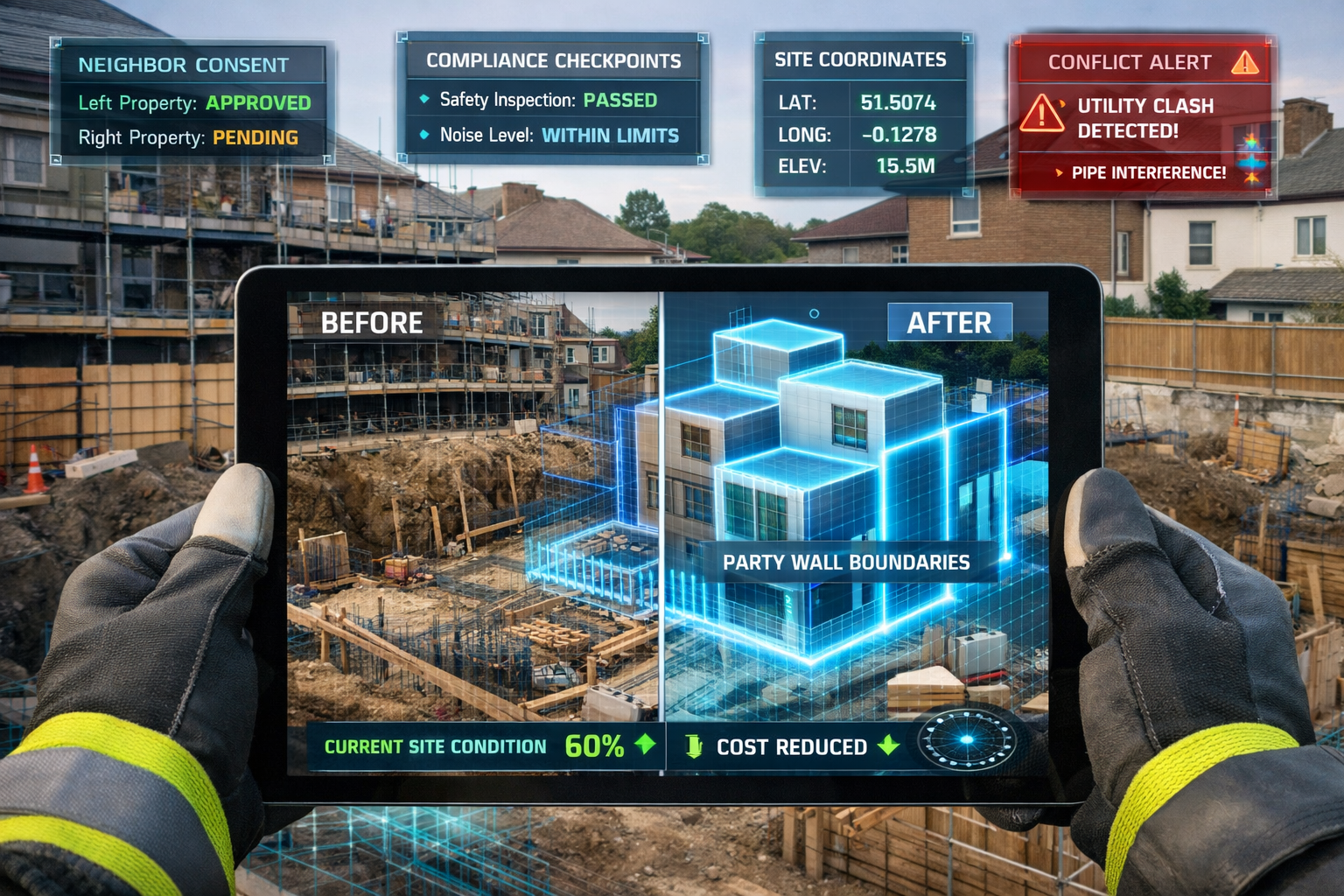
- Use augmented reality for on-site verification
Maintaining Model Currency
Party wall information changes throughout project lifecycles:
- Initial design – Preliminary boundary data and anticipated constraints
- Notice period – Updated with actual notices served and responses received
- Award stage – Incorporating conditions and restrictions from agreed awards
- Construction – Tracking compliance with agreed parameters
- Completion – Final as-built documentation and condition records
Establish clear procedures for updating models at each stage, ensuring all stakeholders work from current information.
Future Trends and Emerging Technologies
Artificial Intelligence and Machine Learning
AI integration promises to further enhance party wall management:
- Automated notice generation based on design intent
- Predictive dispute modeling identifying high-risk neighbor relationships
- Natural language processing extracting requirements from legal documents
- Computer vision analyzing condition photographs for change detection
Augmented and Virtual Reality
Immersive technologies are making BIM models more accessible:
- AR site visualization overlaying models on actual construction sites
- VR neighbor presentations allowing adjoining owners to experience proposed works
- Mixed reality collaboration enabling remote stakeholders to jointly review models
- Digital twin integration connecting physical and digital project representations
Blockchain for Documentation
Distributed ledger technology may revolutionize party wall record-keeping:
- Immutable records of notices served and consents received
- Smart contracts automating payment triggers and milestone verification
- Transparent audit trails documenting all communications and agreements
- Decentralized storage ensuring long-term document preservation
Regulatory Evolution
As technology adoption increases, regulatory frameworks may evolve:
- Updated guidance on digital notice service methods
- Standards for BIM-based party wall documentation
- Requirements for digital record retention
- Professional competency standards for integrated workflows
Conclusion: Embracing Integration for Better Construction Outcomes
The integration of Party Wall Notices and BIM Integration: Embedding Geospatial Data into Construction Information Models for 2026 Projects represents more than technological innovation—it's a fundamental shift in how construction professionals approach neighbor relations and boundary management. By embedding accurate geospatial data about property boundaries, party wall constraints, and neighbor agreements directly into digital construction models, project teams can identify conflicts earlier, communicate more effectively, and deliver projects with fewer disputes and delays.
The benefits are clear: reduced pre-construction conflicts, improved stakeholder communication, streamlined surveyor workflows, and enhanced compliance management. While implementation challenges exist around data accuracy, software interoperability, and stakeholder digital literacy, practical solutions and phased adoption approaches make integration accessible to projects of all sizes.
Actionable Next Steps
For construction professionals looking to implement BIM integration for party wall management:
- Assess current capabilities – Review existing BIM maturity and identify gaps in geospatial data management
- Establish partnerships – Connect with party wall surveyors experienced in digital workflows
- Pilot on appropriate projects – Start with smaller developments before scaling to complex schemes
- Invest in training – Ensure team members understand both party wall procedures and BIM technology
- Document and refine – Capture lessons learned and continuously improve integration protocols
- Stay informed – Monitor emerging technologies and evolving best practices
As we progress through 2026 and beyond, the construction industry will increasingly expect integrated approaches to party wall management. Organizations that embrace these technologies now will gain competitive advantages through reduced risk, improved efficiency, and stronger neighbor relationships. Understanding how party wall agreements work and integrating this knowledge into modern digital workflows positions forward-thinking professionals for success in an increasingly complex construction landscape.
The future of construction lies not in treating party wall procedures as separate administrative burdens, but in weaving them seamlessly into the digital fabric of project delivery. Through thoughtful integration of geospatial data, collaborative technology platforms, and professional expertise, the construction industry can build better relationships with neighbors while delivering projects more efficiently than ever before. 🚀
References
[1] Watch – https://www.youtube.com/watch?v=4LTuKhP07kU
[2] How Bim Is Transforming Smart Construction Projects In 2026 – https://acurabim.com/how-bim-is-transforming-smart-construction-projects-in-2026/
[4] Party Wall Agreements In Data Centre Developments 2026 Compliance Amid Ai Driven Uk Demand – https://nottinghillsurveyors.com/blog/party-wall-agreements-in-data-centre-developments-2026-compliance-amid-ai-driven-uk-demand
[5] The Future Of Bim Beyond Compliance – https://archademia.com/blog/the-future-of-bim-beyond-compliance/