


The surveying profession stands at a pivotal crossroads. Traditional methods that served party wall surveyors for decades are rapidly giving way to sophisticated digital ecosystems that demand entirely new competencies. In 2026, Technical Skills Evolution for Party Wall Surveyors in 2026: Building Proficiency in AI, Cloud Platforms, and Digital Twins is no longer optional—it's the baseline requirement for remaining competitive and delivering the modern client expectations that define today's construction landscape.
The transformation is profound. Party wall surveyors who once relied primarily on measuring tapes, notebooks, and decades of experience now find themselves navigating artificial intelligence algorithms, cloud-based collaboration platforms, and immersive 3D building models. This shift represents more than just adopting new tools; it requires fundamentally rethinking how surveyors capture data, analyze structures, communicate findings, and maintain accountability throughout a building's entire lifecycle.
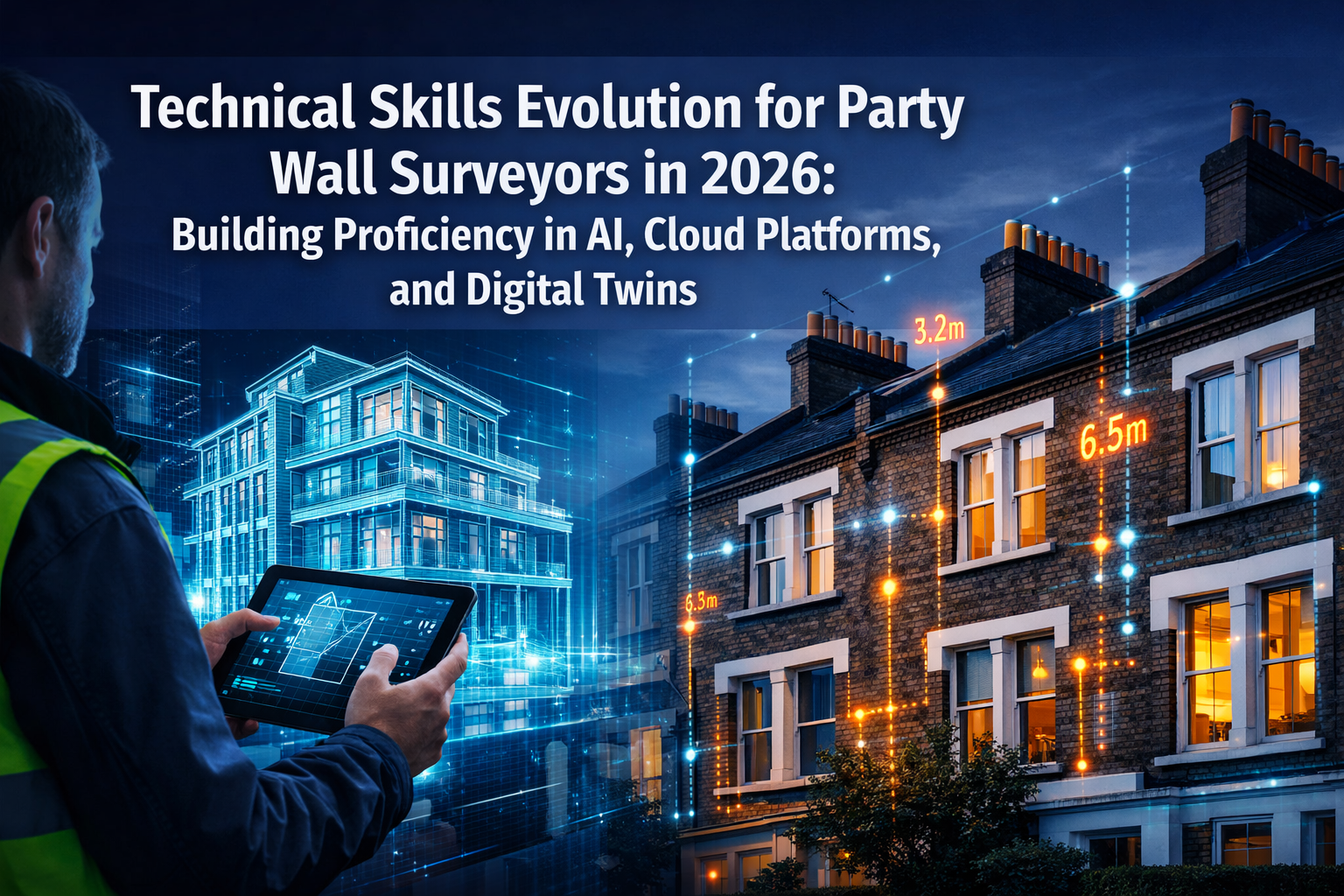
Key Takeaways
- 🤖 AI literacy has become essential for party wall surveyors, enabling automated defect detection, predictive analytics, and data-driven decision-making that enhances accuracy and efficiency
- ☁️ Cloud platform proficiency ensures seamless collaboration, real-time data access, and compliance with modern accountability standards required by the Building Safety Act 2022
- 🏗️ Digital twin technology transforms how surveyors assess party walls, enabling lifecycle tracking, resilience forecasting, and comprehensive building performance analysis
- 📊 Data interpretation skills now matter as much as technical accuracy, with the ability to translate complex findings into compelling narratives that connect with stakeholders
- 🎯 Continuous learning mindset is critical as technology evolves rapidly, requiring surveyors to invest in ongoing professional development and digital upskilling
Understanding the Digital Transformation Driving Technical Skills Evolution for Party Wall Surveyors in 2026
The construction and surveying industries have undergone seismic shifts in recent years. By 2026, digital literacy has transitioned from being a competitive differentiator to an absolute baseline professional competency [2]. Party wall surveyors can no longer view technology adoption as optional or supplementary to their core expertise.
The New Baseline: Digital Ecosystems Replace Analog Processes
Modern party wall surveying operates within interconnected digital ecosystems that span multiple platforms, stakeholders, and data formats. Surveyors must now demonstrate fluency with:
- Building Information Modeling (BIM) environments where party wall data integrates with broader construction documentation
- Cloud-based collaboration platforms that enable real-time communication between building owners, adjoining owners, and surveying teams
- Mobile reporting applications that capture site conditions with millimeter-level accuracy and instant data synchronization
- Digital documentation systems that maintain traceability and transparency throughout party wall awards and dispute resolution
The shift reflects broader industry trends. According to recent construction technology surveys, data connectivity and interoperability have emerged as top priorities, with many projects experiencing costly "data siloing" where incompatible technology stacks create errors, delays, and revenue loss [3].
Regulatory Drivers: Building Safety Act 2022 Accountability Requirements
The Building Safety Act 2022 has fundamentally altered the accountability landscape for surveyors. Professionals are now legally responsible for the accuracy, traceability, and transparency of data across a building's entire lifecycle [2]. This regulatory framework makes digital competency non-negotiable.
For party wall surveyors, this means:
✅ Maintaining clear digital records of all inspections, communications, and decisions
✅ Demonstrating competence through documented processes and quality assurance
✅ Ensuring data accessibility for future reference, audits, and lifecycle assessments
✅ Providing transparent documentation that withstands legal scrutiny
Party wall professionals working across London—whether in North London, South London, or Central London—must adapt their practices to meet these elevated standards.
Client Expectations: Speed, Precision, and Digital Delivery
Today's clients expect more than traditional survey reports delivered weeks after site visits. Modern stakeholders demand:
- Real-time updates on survey progress and findings
- Interactive digital deliverables that allow them to explore data themselves
- Integration with their existing project management systems
- Predictive insights rather than purely descriptive observations
These expectations align with broader workforce concerns. Industry surveys consistently identify workforce skills, hiring and retention, and technology adoption as top concerns for construction professionals in 2026 [3].
Artificial Intelligence: Building AI Literacy for Party Wall Surveying Applications
Artificial intelligence represents perhaps the most transformative technology entering the surveying profession. AI adoption has been identified as a top investment priority for construction industry leaders, focused on augmenting human capabilities, automating complex workflows, and applying predictive analytics to large datasets [3].
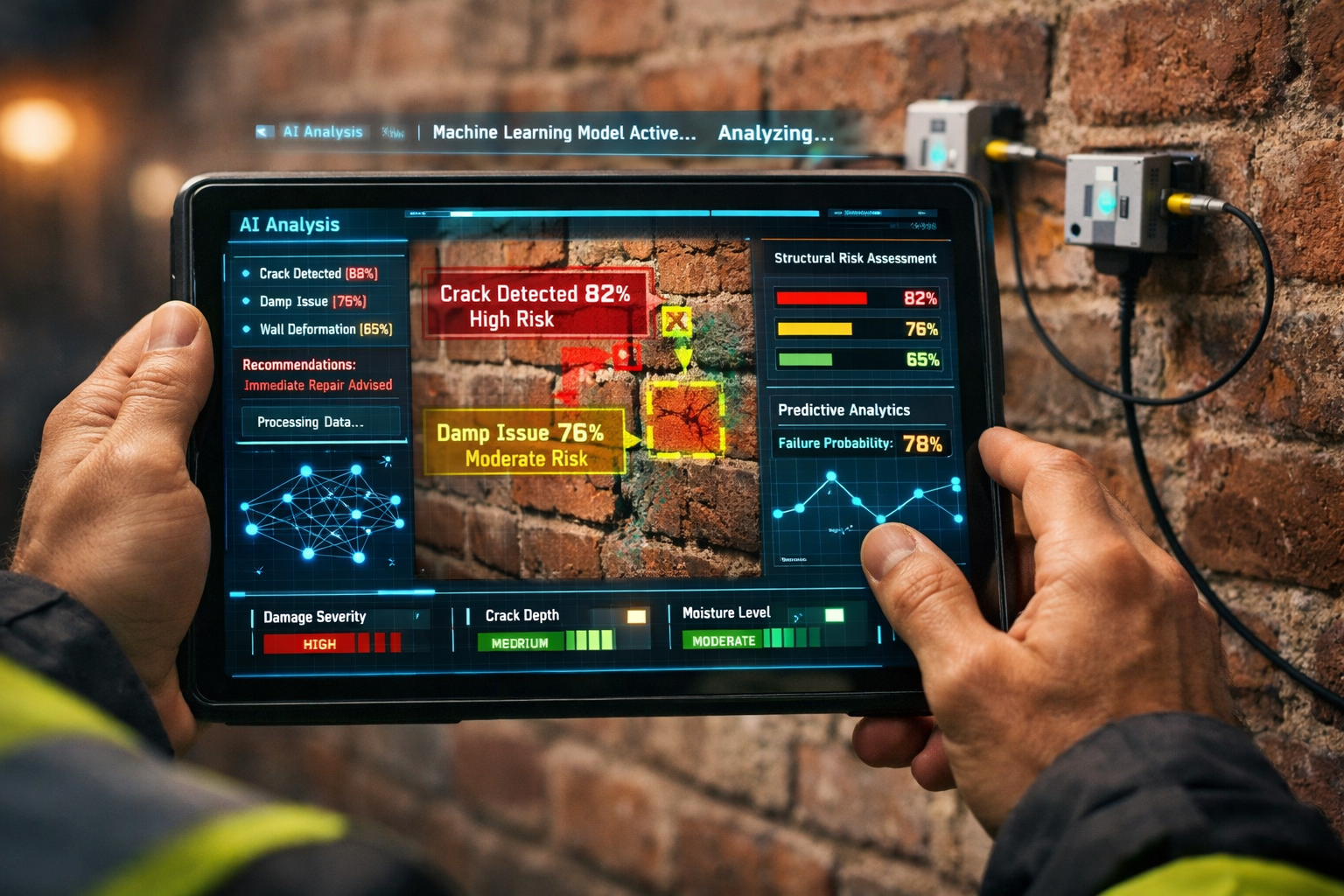
Core AI Competencies for Party Wall Surveyors
Party wall surveyors must develop practical AI literacy across several key areas:
1. Automated Defect Detection and Pattern Recognition
Modern AI algorithms can analyze thousands of images and sensor readings to identify:
- Structural anomalies in party walls that human observers might miss
- Crack propagation patterns that indicate underlying settlement issues
- Material degradation through comparative analysis of historical data
- Moisture intrusion using thermal imaging and pattern recognition
These systems don't replace human judgment—they enhance it by processing volumes of data impossible for individuals to analyze manually.
2. Predictive Analytics for Risk Assessment
AI-powered predictive models enable surveyors to move beyond describing current conditions to forecasting future performance. Applications include:
| AI Application | Party Wall Benefit | Business Impact |
|---|---|---|
| Settlement prediction | Forecast foundation movement | Proactive intervention planning |
| Maintenance scheduling | Identify optimal repair timing | Cost optimization |
| Dispute risk analysis | Assess likelihood of neighbor conflicts | Strategic communication planning |
| Lifecycle costing | Project long-term maintenance expenses | Informed investment decisions |
3. Natural Language Processing for Documentation
AI-powered writing assistants help surveyors:
- Generate comprehensive reports from structured field data
- Translate technical findings into accessible language for non-technical stakeholders
- Ensure consistency across multiple party wall notices and awards
- Extract insights from historical documentation and case precedents
Practical Steps for Building AI Proficiency
Party wall surveyors can develop AI literacy through structured approaches:
🎓 Educational Foundation
- Complete online courses in AI fundamentals and machine learning basics
- Attend industry workshops focused on construction AI applications
- Participate in webinars demonstrating AI tools for surveying
🔧 Hands-On Experience
- Experiment with AI-powered image analysis tools on sample projects
- Test predictive analytics platforms using historical party wall data
- Integrate AI writing assistants into report generation workflows
🤝 Collaborative Learning
- Join professional networks discussing AI implementation
- Share case studies with colleagues testing similar technologies
- Engage with software vendors offering AI-enabled surveying tools
The key is recognizing that AI augments rather than replaces human expertise. The surveyor's contextual understanding, ethical judgment, and client relationship skills remain irreplaceable—AI simply amplifies their effectiveness.
Cloud Platforms: Mastering Collaborative Digital Environments for Technical Skills Evolution
Cloud computing has fundamentally transformed how party wall surveyors store, access, and share information. Cloud platform proficiency is now essential for meeting modern collaboration requirements and regulatory accountability standards [2].
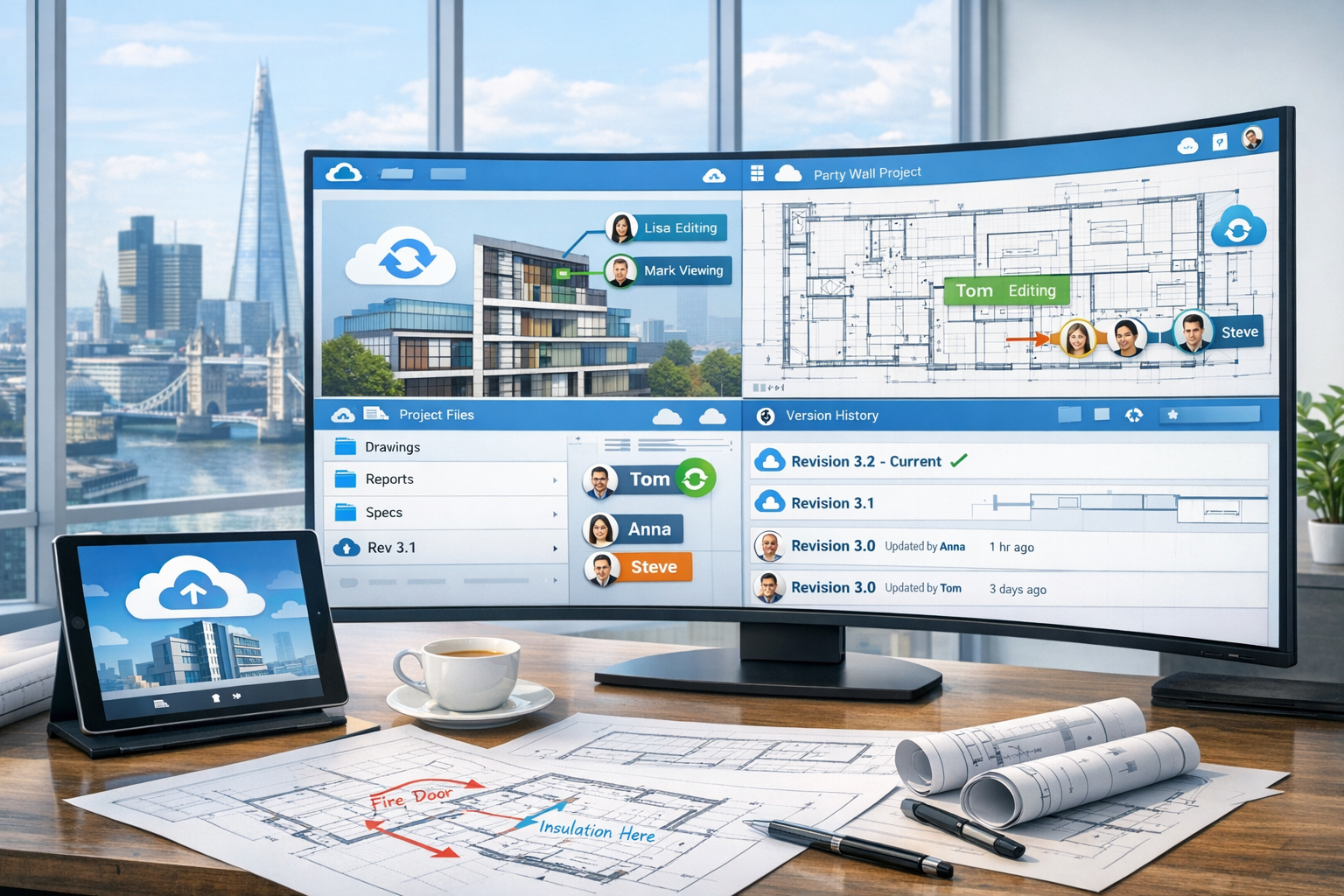
Essential Cloud Platform Capabilities
Modern party wall surveyors must master several cloud-based competencies:
Real-Time Collaboration and Data Synchronization
Cloud platforms enable seamless teamwork across distributed teams:
- Simultaneous document editing by multiple surveyors working on complex projects
- Instant updates when site conditions change or new information emerges
- Version control that maintains complete audit trails of all modifications
- Access management ensuring appropriate stakeholders see relevant information
This capability proves particularly valuable when coordinating between building owners' surveyors and adjoining owners' surveyors who must collaborate despite representing different interests.
Mobile Field Access and Data Capture
Cloud connectivity transforms on-site surveying:
- Tablet and smartphone apps that sync instantly with central databases
- Offline capability with automatic synchronization when connectivity returns
- Photo and video uploads directly from inspection sites
- GPS tagging that precisely locates observations and measurements
These tools eliminate the traditional delay between site visits and report generation, enabling near-instantaneous client updates.
Integration with BIM and Digital Documentation Systems
Cloud platforms serve as central hubs connecting multiple systems:
| Integration Point | Surveying Application | Technical Requirement |
|---|---|---|
| BIM models | Embed party wall data in 3D building context | IFC file format compatibility |
| Project management | Link survey milestones to construction schedules | API connectivity |
| Document management | Store awards, notices, and schedules centrally | Secure access controls |
| Client portals | Provide stakeholder visibility into progress | Customizable permissions |
Compliance and Security Management
Cloud platforms must meet stringent requirements:
- ✅ Data encryption both in transit and at rest
- ✅ Backup redundancy ensuring no data loss
- ✅ Compliance certifications (GDPR, ISO 27001, etc.)
- ✅ Audit logging tracking all access and modifications
Selecting and Implementing Cloud Solutions
Party wall surveyors should evaluate cloud platforms based on:
🔍 Functionality Assessment
- Does it support the specific workflows of party wall surveying?
- Can it integrate with existing tools and systems?
- Does it offer mobile-first design for field use?
💰 Cost-Benefit Analysis
- What are the subscription costs versus efficiency gains?
- How does it impact party wall costs and fee structures?
- What is the return on investment timeline?
🎯 User Experience
- Is the interface intuitive for team members with varying technical skills?
- What training resources and support are available?
- How steep is the learning curve?
🔒 Security and Compliance
- Does it meet Building Safety Act 2022 requirements?
- What certifications and audits verify security claims?
- How does it handle sensitive client information?
Leading surveyors increasingly adopt cloud-first strategies where digital platforms become the primary workspace rather than supplementary tools.
Digital Twins: Leveraging 3D Modeling and Lifecycle Simulation
Digital twin technology represents the cutting edge of surveying innovation. These virtual replicas of physical buildings enable unprecedented insights into party wall performance, condition tracking, and predictive maintenance [5].
Understanding Digital Twin Technology in Party Wall Context
A digital twin is more than a 3D model—it's a dynamic, data-rich representation that continuously updates based on real-world inputs:
| Traditional 3D Model | Digital Twin |
|---|---|
| Static snapshot at one point in time | Continuously updated with live data |
| Visual representation only | Integrated with sensors, analytics, and simulations |
| Limited interactivity | Fully interactive with scenario testing |
| Single-purpose documentation | Multi-purpose lifecycle management tool |
For party wall surveyors, digital twins enable:
- Baseline condition documentation with millimeter-accurate 3D capture
- Change tracking showing how structures evolve over time
- Stress analysis modeling how construction activities affect party walls
- Predictive maintenance forecasting when interventions become necessary
Creating Digital Twins: Technology and Workflows
Building digital twins requires mastering several technologies:
Reality Capture Technologies
📸 Photogrammetry
- Uses overlapping photographs to create 3D models
- Accessible entry point with smartphone or camera
- Suitable for external elevations and accessible surfaces
🔦 LiDAR Scanning
- Laser-based technology capturing millions of data points
- Provides millimeter-level accuracy
- Effective in complex spaces and difficult lighting
🚁 Drone Surveying
- Captures aerial perspectives and hard-to-reach areas
- Enables comprehensive site context documentation
- Increasingly affordable and user-friendly [3]
Software Platforms and Integration
Digital twin creation involves multiple software tools:
- Data capture applications (site-based collection)
- Processing software (converting raw data to 3D models)
- BIM platforms (integrating models with building information)
- Analysis tools (performing simulations and predictions)
- Visualization interfaces (presenting findings to stakeholders)
Surveyors must develop cross-platform fluency, understanding how data flows between systems and maintaining quality throughout the pipeline.
Practical Applications for Party Wall Surveyors
Digital twins transform traditional surveying activities:
📋 Schedule of Condition Documentation
Traditional schedules of condition rely on photographs and written descriptions. Digital twins provide:
- Immersive 3D walkthroughs showing pre-construction conditions
- Precise measurements extractable at any time
- Annotated hotspots highlighting specific concerns
- Comparative analysis showing before-and-after conditions
🔍 Dispute Resolution and Evidence
When disagreements arise about damage or liability:
- Objective baseline data removes subjective interpretation
- Temporal analysis shows exactly when changes occurred
- Visual evidence that non-technical stakeholders easily understand
- Expert witness support with compelling demonstrative evidence
🌱 Sustainability and Lifecycle Assessment
Digital twins enable lifecycle thinking—a core competency for modern surveyors [2]:
- Embodied carbon calculations for party wall materials
- Retrofit planning optimizing energy efficiency improvements
- Resilience assessment evaluating climate adaptation strategies
- Net zero pathway modeling supporting decarbonization goals
Building Digital Twin Competency
Surveyors can develop these skills progressively:
Beginner Level:
- Learn basic photogrammetry using smartphone apps
- Experiment with free 3D modeling software
- Complete online courses in reality capture fundamentals
Intermediate Level:
- Invest in entry-level LiDAR equipment or partner with specialists
- Master professional BIM software (Revit, ArchiCAD, etc.)
- Integrate digital twins into standard surveying workflows
Advanced Level:
- Implement sensor integration for live monitoring
- Develop predictive analytics capabilities
- Create client-facing digital twin portals for ongoing access
Data Interpretation and Storytelling: The Human Element in Technical Skills Evolution
While technology provides unprecedented data volumes, human expertise remains essential for contextualizing and communicating insights [2]. The ability to transform raw data into compelling narratives that drive decision-making has become a core professional competency.
From Technical Accuracy to Strategic Communication
Traditional surveying emphasized technical precision above all else. Modern practice requires balancing multiple communication objectives:
🎯 Technical Depth ↔️ Accessibility
- Maintaining rigorous accuracy while ensuring non-technical stakeholders understand implications
📊 Data Richness ↔️ Clarity
- Presenting comprehensive findings without overwhelming audiences with information
⚖️ Professional Objectivity ↔️ Persuasive Narrative
- Remaining impartial while effectively advocating for appropriate actions
Developing Data Storytelling Skills
Effective data communication involves several techniques:
Visual Hierarchy and Information Design
- Use charts, graphs, and infographics to make patterns obvious
- Employ color coding to highlight risk levels and priorities
- Create layered reports where readers choose their detail level
Narrative Structure
- Begin with executive summaries stating key conclusions
- Provide context explaining why findings matter
- Offer clear recommendations with actionable next steps
- Support conclusions with detailed evidence in appendices
Stakeholder-Specific Communication
- Tailor language and detail to audience technical sophistication
- Emphasize different aspects for building owners versus adjoining owners
- Anticipate questions and address concerns proactively
Practical Examples in Party Wall Surveying
Consider how data storytelling transforms standard deliverables:
Traditional Approach:
"Vertical crack measuring 2mm width observed in party wall at 1.2m height, extending 450mm vertically."
Data Storytelling Approach:
"A 2mm vertical crack has developed in the party wall, likely caused by differential settlement between the properties. While currently minor, our predictive analysis suggests this could widen to 5mm within 18 months without intervention, potentially causing water ingress and requiring costly repairs. We recommend monitoring with quarterly measurements and considering underpinning if movement continues."
The second approach provides:
- ✅ Context (cause identification)
- ✅ Implications (future consequences)
- ✅ Recommendations (actionable steps)
- ✅ Business impact (cost considerations)
Implementing Continuous Learning Strategies for Ongoing Technical Skills Evolution
The rapid pace of technological change means skills development can never be "complete". Party wall surveyors must embrace continuous learning as a permanent professional commitment.
Creating Personal Development Plans
Effective upskilling requires structured approaches:
📅 Quarterly Skills Assessment
- Identify emerging technologies relevant to party wall surveying
- Evaluate current proficiency levels honestly
- Prioritize skills with highest impact on practice
🎯 Goal Setting and Milestones
- Define specific, measurable learning objectives
- Set realistic timelines for skill acquisition
- Celebrate progress and adjust plans as needed
💡 Diverse Learning Methods
- Formal training (courses, certifications, workshops)
- Peer learning (professional networks, study groups)
- Experiential learning (pilot projects, controlled experimentation)
- Self-directed learning (online resources, tutorials, documentation)
Professional Development Resources
Surveyors can access numerous learning opportunities:
Industry Organizations
- RICS (Royal Institution of Chartered Surveyors) offers specialized training on party wall fundamentals and emerging technologies [1]
- Professional associations providing technology-focused continuing education
- Specialized conferences addressing surveying innovation
Technology Vendors
- Software companies offering product-specific training
- Certification programs demonstrating platform proficiency
- User communities sharing best practices and solutions
Academic Partnerships
- University short courses on construction technology
- Research collaborations exploring emerging methodologies
- Graduate programs with surveying technology specializations
Building a Technology-Forward Practice Culture
Individual skill development must extend to organizational capabilities:
🔧 Infrastructure Investment
- Allocate budget for technology acquisition and upgrades
- Provide team members with appropriate tools and platforms
- Maintain competitive technical capabilities
👥 Team Development
- Create internal training programs and knowledge sharing
- Mentor junior surveyors in digital competencies
- Recognize and reward technology adoption
🚀 Innovation Mindset
- Encourage experimentation with new approaches
- Accept that some pilots may not succeed
- Share lessons learned across the organization
Understanding types of party wall works and how technology enhances each category helps prioritize development efforts.
Overcoming Barriers to Technical Skills Evolution
Despite clear benefits, many surveyors face obstacles to digital transformation:
Common Challenges and Solutions
⏰ Time Constraints
Challenge: Busy practices struggle to find time for training
Solution: Integrate learning into billable work through pilot projects; use micro-learning approaches with short, focused sessions
💰 Cost Concerns
Challenge: Technology investments seem expensive
Solution: Calculate total cost of ownership including efficiency gains; start with affordable entry-level tools; consider subscription models spreading costs
🤷 Resistance to Change
Challenge: Established surveyors comfortable with traditional methods
Solution: Demonstrate tangible benefits through case studies; involve skeptics in technology selection; emphasize augmentation rather than replacement
🎓 Skill Gaps
Challenge: Existing team lacks digital literacy foundation
Solution: Provide foundational training before advanced tools; hire digitally-native junior surveyors; partner with technology specialists
Measuring Return on Investment
Justify technology investments by tracking:
- ⏱️ Time savings in data collection and report generation
- 🎯 Accuracy improvements reducing errors and disputes
- 😊 Client satisfaction scores and retention rates
- 💼 Competitive advantage in winning new projects
- 📈 Revenue growth from expanded service offerings
Future-Proofing Your Party Wall Surveying Practice
Looking beyond 2026, several trends will continue shaping the profession:
Emerging Technologies on the Horizon
🥽 Mixed Reality and Augmented Reality
- On-site visualization of hidden structures
- Interactive client presentations with immersive experiences
- Remote expert consultation with shared visual context
🤖 Advanced Robotics
- Automated inspection of dangerous or inaccessible areas
- Continuous monitoring with robotic sensors
- Autonomous data collection reducing human risk
🧠 Advanced AI and Machine Learning
- Self-learning systems improving with each project
- Cross-project pattern recognition identifying systemic issues
- Natural language interfaces simplifying complex analyses
Sustainability and Resilience Focus
Climate change and net-zero commitments will increasingly influence surveying:
- Embodied carbon assessment becoming standard practice
- Climate resilience evaluation for extreme weather adaptation
- Circular economy principles guiding material reuse recommendations
- Whole-life costing replacing initial cost focus
These capabilities align with growing demand for sustainability expertise across AEC professions [5].
Regulatory Evolution
Expect continued regulatory development:
- Enhanced digital record-keeping requirements
- Standardized data formats for interoperability
- Expanded accountability throughout building lifecycles
- Professional competency frameworks including digital skills
Conclusion
The Technical Skills Evolution for Party Wall Surveyors in 2026: Building Proficiency in AI, Cloud Platforms, and Digital Twins represents a fundamental transformation of the profession. Digital literacy has transitioned from optional to essential, with surveyors now expected to operate fluently within sophisticated technology ecosystems that span AI-powered analytics, cloud-based collaboration platforms, and immersive digital twin environments.
Success in this new landscape requires more than simply adopting new tools. Party wall surveyors must develop genuine proficiency across multiple domains: understanding how AI algorithms enhance decision-making, mastering cloud platforms that enable seamless collaboration, creating and leveraging digital twins for lifecycle management, and translating complex data into compelling narratives that drive stakeholder action.
The regulatory environment, particularly the Building Safety Act 2022, has made these capabilities non-negotiable. Surveyors must demonstrate accountability through transparent digital documentation, maintain traceability across building lifecycles, and provide evidence of competence in modern methodologies. Whether practicing in West London, East London, or elsewhere, professionals face consistent expectations for digital excellence.
Actionable Next Steps
Party wall surveyors should begin their technical skills evolution journey immediately:
- Assess current capabilities honestly, identifying specific skill gaps in AI, cloud platforms, and digital twins
- Create a structured learning plan with quarterly milestones and diverse learning methods
- Start small with pilot projects testing new technologies on appropriate cases before full-scale implementation
- Invest strategically in tools and training that deliver measurable return on investment
- Build a continuous learning culture recognizing that technology evolution requires permanent commitment
- Connect with professional networks sharing experiences and best practices in digital transformation
- Measure and communicate results demonstrating the value of technology investments to stakeholders
The surveyors who thrive in 2026 and beyond will be those who embrace technology not as a threat to traditional expertise but as a powerful amplifier of their professional capabilities. The future belongs to professionals who combine deep technical knowledge with digital fluency, delivering unprecedented value to clients while advancing the profession into its next era.
References
[1] Party Walls The Fundamentals – https://www.rics.org/training-events/online-training/on-demand/party-walls-the-fundamentals
[2] Future Of The Surveying Profession Skills 2026 – https://goreport.com/future-of-the-surveying-profession-skills-2026/
[3] Future Construction Technology Trends Contractor Survey – https://www.trimble.com/blog/trimble/en-US/article/future-construction-technology-trends-contractor-survey
[5] The Most In Demand Skills For Aec Professionals In 2026 – https://slccc.net/2025/10/22/the-most-in-demand-skills-for-aec-professionals-in-2026/